Feeds:
Posts
Comments

Posts Tagged ‘Joseph Bathanti’

 . 
[ two poems by Joseph Bathanti ]
 . 
The Cellar
 . 
When my sister talked to boys on the phone,
she stretched the cord down the cellar stairs
into the dark and whispered.
 . 
My parents didn’t like her down there, barefoot
on cold concrete, without a light,
talking to a boy. We had to pretend
 . 
nothing at all odd about it –
supper on the table, sacramental
supper, the sacred daily rite
 . 
of our commingled lives interrupted.
We couldn’t even mention Marie
in the cellar, exchanging on the phone
 . 
whatever it might have been, at that moment,
with a nameless boy.
Everything had to be as if it weren’t happening;
 . 
that was how one got through things.
My parents would have punished me
had they known what I was thinking.
 . 
I was not at all curious about them.
But I often wondered about Marie,
sixteen, 1966: Johnson’s first term
 . 
after the assassination,
the year I started remembering
with dreadful precision.
 . 
My father taught her to drive
our blue Belair. Riding shotgun,
I adored that Chevy, my sister behind the wheel,
 . 
windows down, her long hair blowing.
I punched radio buttons, station to station,
lashing music over us, like I was typing her story,
 . 
as she sang from memory, and I mumbled.
Without even realizing, she shaved the hairpin
on Mellon Terrace while I held my breath
 . 
and tried to get it all down with speed
and truth before 1967 showed up
and she left for college at Slippery Rock.
 . 
I loved her secret life,
living all the yearned for alone,
in the cellar: with the coal furnace,
 . 
copper pipes weaving in and out
of the ancient rafters that held up the house,
my father’s tools, our sleds,
 . 
shelves of empty jars, canned hams,
fruit cocktail—statues and crucifixes
my mother thought a little much for upstairs.
 . 
In her nightgown, Mother washed clothes
down there, where my father shaved,
our retreat when we craved solitude,
 . 
in it very center a drain
that flowed to the city sewer,
then the Allegheny, west on the Ohio,
 . 
all the way to California.
Marie ascended to us, from the cellar,
changed, all of us changed.
 . 
What had she and that boy talked of?
We made the Sign of the Cross,
said Grace, and ate supper.
 . 
Joseph Bathanti
from Steady Daylight, Louisiana State University Press, Baton Rouge, LA; © 2026 by Joseph Bathanti
 . 
❀    ❀    ❀
 . 
Right Guard
 . 
As he aged, my father dwindled,
not in stature—though he grew smaller
as elders must—but rather in estate.
He never required much,
 . 
insisted on giving things away.
What am I going to do with all this?
Suddenly I had his shirt,
wristwatch, hammer and plane—
 . 
his car keys and driver’s license
when the time came. I arrived,
the night of his death, and stole a moment alone in his room
 . 
at The Pines, a name too green
and pulsing, filled with trees—
near infuriating—for a tomb.
My mother had died a year earlier.
 . 
To save money to pass along to me
and my sister, my father requested
a move to an efficiency—a monk’s cell.
At heart, he was an ascetic.
 . 
I sat on the edge of his small bed,
where he’d perched that morning—
September 3,
his 59th wedding anniversary,
 . 
my mother gone a year—to quell his vertigo,
hands folded, his dawn office,
before launching his day.
He witnessed the first rind
 . 
of sabbath sun cross the sash.
Song sparrows chanted Asperges me.
Then, prepared, he rose.
I stood and paced behind his shade,
 . 
gauging where, in the modest span
between his bedclothes and coffeepot,
he decided to join my mother—
privately, no announcement, illness,
 . 
deathwatch. No priest.
The attention would have embarrassed him.
His only flourish was the white pressed
handkerchief on him at all times.
 . 
Perhaps he glimpsed his fetch
or, responsive to my mother’s whims,
her beckoning;
or his own mother, whom, at five,
 . 
he’d lost to childbirth.
Given neither to signs nor bodement,
never mysterious, but like us all
who parse life step by step,
 . 
my father kept a secret life
he alone entered—nothing terrible,
or even curious—a silent chamber
he had the wisdom, the courage,
 . 
to leave locked, the key hidden—
though he had little use for metaphor.
A millwright, a steelman,
he discovered the ladled heat,
 . 
and molten pour, the union shop,
a practice he abided and died for.
What was there left of his to take?
He’d already given me everything.
 . 
I wandered into the tiny bathroom.
Stationed on the shelf above the sink
stood a can of Right Guard,
the only deodorant my dad used—
 . 
Original, of course, Sport:
the logo stick figure, in full throttle,
bolting from the blocks.
I grabbed it and pressed the actuator.
 . 
The valve hissed and hung a familiar
incensed mist. Out of it,
like a genie summoned from its lamp,
appeared my father.
 . 
Joseph Bathanti
from Steady Daylight, Louisiana State University Press, Baton Rouge, LA; © 2026 by Joseph Bathanti
 . 

salamander eggs

 . 
❀    ❀    ❀
 . 
spirit and element, inseparably connected, receiveth a fullness of joy;
Doctrine and Covenants 90:5e (1833)
 . 
What was there left of his to take?
He’d already given me everything.
 . 
Elemental – reduced to its essential form, pure, vital, a foundation upon which everything else can be built. Joseph Bathanti’s poems in Steady Daylight. Here in a few words and lines is a life; here are many lives, family, community. Here is a life’s span, from unremembered ancestors through all the days on earth to gathering in the celestial. Here is school and church and baseball, steel mill and pearl-handled basting knife, scungilli and sfogliatelle, the lingering perfume of de Nobili cigars and incense of Right Guard. Every image is pure. Every moment is alive. Read these lines and live.
 . 
When Joseph Bathanti sits down with pen and paper the universe stretches, edges itself up around him, and words become its center. Some poetry is music but these poems are whispered secrets, thwacks on the back of the head, huge smothering hugs from floral aunts, hundred pound hods of mortar. Steady Daylight is a world that has completely drawn me into itself. As I read I become the boy, the man, the child of mother and father. The simplest daily routine and the most mundane object reveal their essence. They are good. The drain in the cellar connects the house to the entire world. Sitting down to supper changes everything. Each of us must eat. Each of us must face the last day of someone we love, and our own last day. Take a moment for Grace, for a few words that want to connect it all. Spirit and element, the days of our lives woven into a pattern so frustratingly complicated that we can’t tell its beginning from its end, but so simple that we discover it in one word – joy.
 . 
❀    ❀    ❀
 . 
Joseph Bathanti has written more than twenty books: poetry, novels, short stories. He served as North Carolina Poet Laureate from 2012-2014, has been inducted into the NC Literary Hall of Fame, and received the state’s highest civilian honor, the North Carolina Award in Literature. Every time he as arrived in Elkin to read at our public library, he begins his remarks, “It’s good to be back in the center of the universe.” I believe he carries that center with him everywhere he goes.
 . 
Steady Daylight is available from LSU Press HERE
Other poems by Joseph Bathanti at Verse and Image:
 . 
 . 
 . 
❀    ❀    ❀    ❀    ❀
 . 
Thank you for visiting Verse and Image:
. . . . . every Friday I present one or two poems I’ve read this week that particularly speak to me;
. . . . . some Saturdays I present one or two poems submitted by YOU, my readers.
 . 
If you would like to offer a poem for consideration, either by a favorite author or your own work, please view these GUIDELINES for Saturday Readers Share:
 . 
 . 
If you would like to receive an email each time a post appears, please SUBSCRIBE to Verse and Image using the button on the Home Page.
 . 
If you have a hard time finding the SUBSCRIBE button on this WordPress site, you can send me your email address and I will add you to the subscriber list. Send your request to
 . 
COMMENTS@GRIFFINPOETRY.COM
 . 
Thanks again for joining the conversation.
 . 
– Bill
 . 
 . 

Read Full Post »


[with poems by Joseph Bathanti]

In my post of May 20, I wrote this: Green is God’s best idea.

I wasn’t kidding. None of us would be here without green. Slugs, snow leopards, billionaires, and all the rest of us, we only have being by the beneficence of creatures that can turn sunlight into sugar.

I expected a rebuttal, however, to the best idea position. Wait, isn’t Homo sapiens God’s best idea? Humans, are we not the pinnacle? To have dominion over all (some would say dominance)? Do grey wolves and groundhogs even have souls? Not to mention old growth hemlocks?

Perhaps we humans, with our large and complex brains of which we are so proud, are the only creatures that have evolved an awareness of God’s presence. Perhaps, though, all other creatures live their every precognitive moment within that enfolding perfect presence. Perhaps we have yet to attain the harmony of oneness which must be every creature’s reason for being – perhaps grey wolves and ground hogs are born into it.

The LORD God took the man and put him in the Garden of Eden to work it and take care of it. Genesis 2:15 (New International Version)

Here’s a good idea: Perhaps each one us, almost nine billion now, might consider one way we can contribute to the loving care we take of this single known planet in the cosmos which harbors God-aware organisms.

The contemporary ecological crisis, in fact, lays bare precisely our incapacity to perceive the physical world as impregnated with divine presence. We have swapped the lofty vision of the physical world as God’s own abode, sanctified by the incarnation of the Son of God, with the one-dimensional mechanistic outlook of modernity. Father Joshtrom Isaac Kureethadam

The tree which moves some to tears of joy is in the eyes of others only a green thing that stands in the way. Some see nature all ridicule and deformity, and some scarce see nature at all. But to the eyes of the man of imagination, nature is imagination itself. William Blake

To me, to worship God means to recognize that mind and intelligence are woven into the fabric of our universe in a way that altogether surpasses our comprehension. Freeman Dyson

Look at the animals roaming the forest: God’s spirit dwells within them. Look at the birds flying across the sky: God’s spirit dwells within them. Look at the tiny insects crawling in the grass: God’s spirit dwells within them. Pelagius

Nature is trying very hard to make us succeed, but nature does not depend on us. We are not the only experiment. R. Buckminster Fuller

❦ ❦ ❦

April Snow

The grass whelps in biblical mien –
mowers spend themselves –

a writ of greenest green,
spangled in sunbursts,

as if Van Gogh decided on
the remnant petrified thistle,

the first violets at his feet,
and painted Billings’ meadow.

Robins pompously swagger.
Swifts (little crosses)

jet above them. Birdsong.
Frog-song. Early spring

by habit exaggerates itself,
the green a blinding recognition.

To the ridge mount pines and firs.
Ancient hardwoods swell

by the day with bringing forth.
Blackberry whip the swales,

its cane shrove-purple
from the long winter.

In Sugar Grove, daffodils worship
on the abandoned Ruritan diamond.

Bases bleach in the dirt.
Home plate is a pentagon.

It forgets nothing.
Life is more than fable,

but never stops stunning earth.
And so: hushed clouds, sheepish,

sheep-shaped, yet foretold,
slip over Snake Den Mountain.

Their shadows blanket the valley floor.
The snow they release is inevitable.

This is how we must think of it –
inevitable – how we must welcome it,

the white behest of silence,
the green beneath it jade, milky.

Joseph Bathanti

❦ ❦ ❦

April Snow and Floyd County, Kentucky are from Joseph Bathanti’s new book, Light at the Seam (LSU Press © 2022). The poems are about Appalachian coal country, its people, its deep spirit, its devastation by the mining practice of mountaintop removal. Many are inspired by photographer Carl Galie’s exhibition Lost on the Road to Oblivion: The Vanishing Beauty of Coal County and these lines are deeply visual and sensual. Joseph’s language is earthy and exalted; it synergizes with his intimate observations to make us reverent participants. Care for the earth as your beloved; enter as an acolyte into this tender presence; discover, deep within, light at the seam.

❦ ❦ ❦

Floyd County, Kentucky

No lintel to speak of,
but a chicken wire screen
door hinged on twelve-inch

block and lattice, jittering,
wind chimes knelling,
each time a charge grunts –

off-thunder rumbling the hollows.
The masonry had been sound;
shock split the seams: gashes

of mortar where it’s been repointed,
caulked sashes.
Number 2 pine gone ashy, fixing

to rot; the dooryard
held in a brazen of peonies,
rickety picket once-white

to corset them, pink-red
like the font in Luke
where Jesus says to John:

. . . the Son of Man hath not where to lay His Head.
Just inside hangs a woman’s shawl,
slick, see-through as onion skin;

maybe it’s parchment,
scrivened in bodement,
the letters gone to blood.

It can drive you to your knees:
how folks set out flowers
and look upon the earth.

Joseph Bathanti

❦ ❦ ❦

❦ ❦ ❦

Doughton Park Tree, 2022-05-17B

Read Full Post »


[poems by Jaki Shelton Green, Joseph Bathanti, Shelby Stephenson]

Perhaps you saw the photograph in last week’s news: Marine Sgt. Nicole Gee at Kabul Airport cradling an infant evacuee in her arms. A few days after the shot was taken, Sgt. Gee was killed by an ISIS-K suicide bomber while she worked at the airport gates. Twelve other American soldiers were killed; one hundred fifty Afghan civilians were killed. The world is full of hate which can only be answered with vengeance and punishment.

One the last day of her life, Sgt. Gee continued her mission to give Afghan women and children hope. She saved their lives. The world is full of hate which can only be answered with love.

.     .     .     .     .     .     .

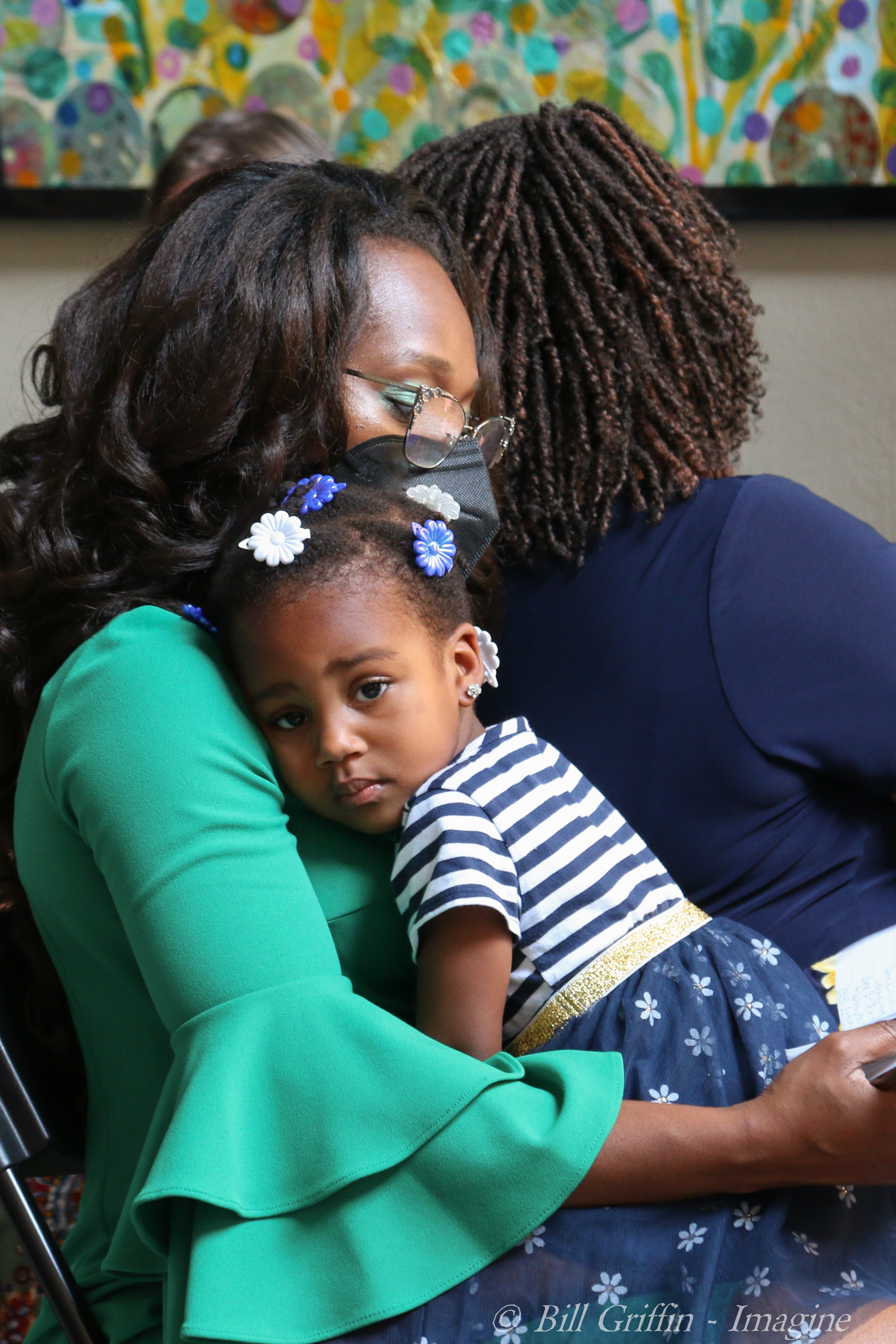
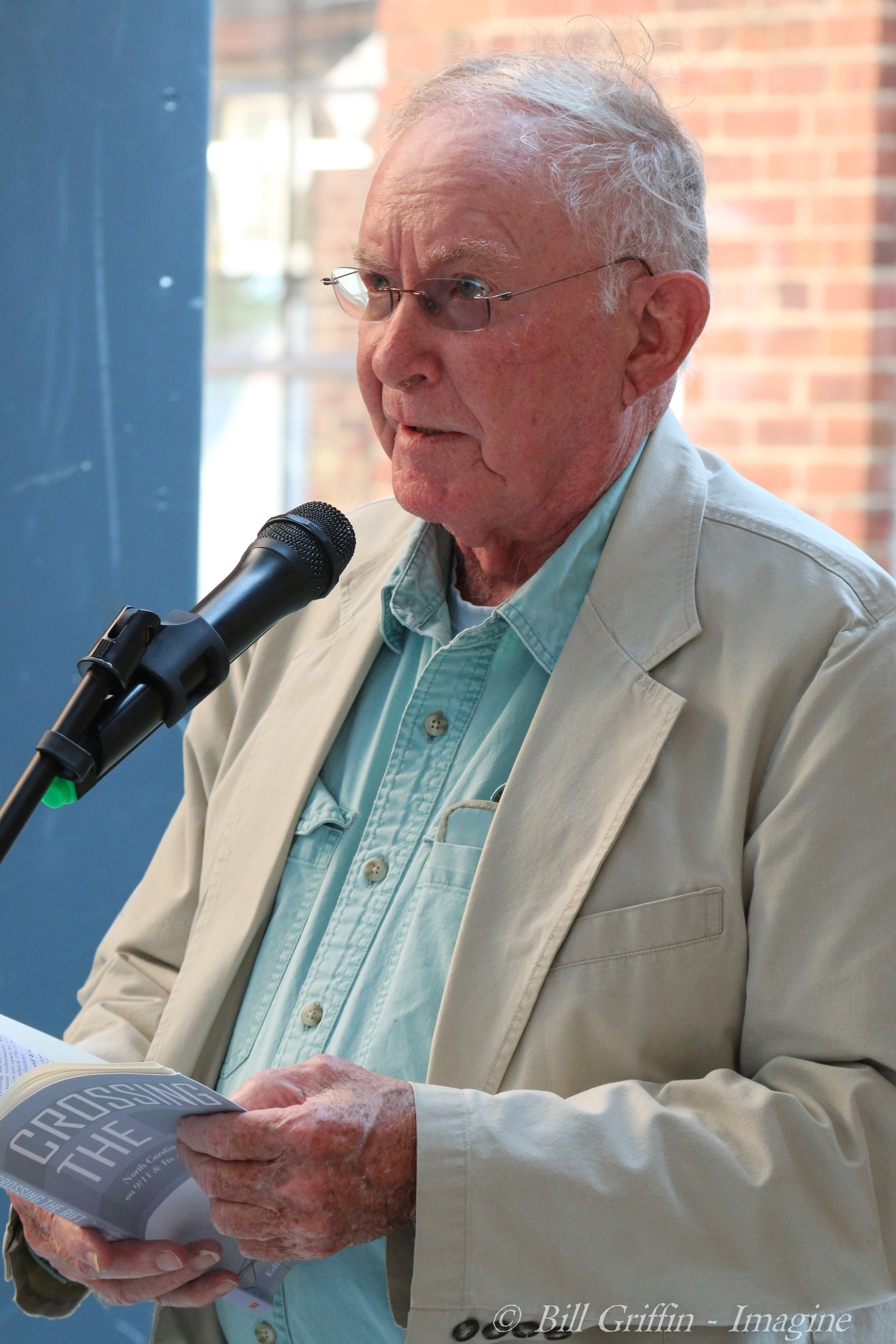
You are part of the human heart. With her beautiful voice and beautiful heart Chanda Branch opened the book launch for Crossing the Rift last Sunday (September 12) in Winston-Salem. Editors Joseph Bathanti and David Potorti shared the vision that led them to create this anthology of North Carolina poets writing on 9/11 and its aftermath. About a hundred of us gathered in the breezeway at Bookmarks on 4th St. to listen, to remember, to witness, to continue to heal.

Among the poems we heard that afternoon are these three by current NC Poet Laureate Jaki Shelton Green and former Laureates Joseph Bathanti and Shelby Stephenson. Twenty years: it’s hard to imagine it’s been that long; it’s hard to believe that it has been only twenty. The world changed on 9/11/2001. It’s hard, but if we seek them hard and also work hard to create them we may find some signs of change for the better. What is the answer for hate? Where will we be at the thirtieth anniversary?

.     .     .     .     .     .     .

lifting veils

++++ 11 september 2001

++++ ++++ I

it is a bloodstained horizon
whispering laa illaha il-allah
prelude to a balmy evening
that envelops our embrace
we stand reaching across
sands, waters, airs full of blood
in the flash of a distant storm
i see you standing on another shore
torn hijab
billowing towards an unnamed wind
we both wear veils
blood stained
tear stained
enshrouding separate truths

++++ ++++ II

misty morning
teardrops of dust
choke and stain lips
that do not move
will not utter
it is a morning of shores
sea shadows that caress memory
of another time
another veil
another woman needing
reaching
lifting

++++ ++++ III

into your eyes i swam
searching for veils
to lift
to wrap
to pierce
dance with
veils that elude such mornings
veils that stain such lips
veils tearing like music

++++ ++++ IV
it is the covering of spirit
not the body
my hijab your hijab
connecting interweaving crawling snaking binding
into a sky that will not bend

Jaki Shelton Green (ninth and current NC Poet Laureate, since 2018)

.     .     .     .     .     .     .


Katy

After the first plane,
Katy phoned her brother.
She was safe, in another building.

They were evacuating. DJ thought
she had said the other building—
the South Tower—crashed into

by United Flight 175 at 9:03,
moments after the line went dead.
That’s all Katy’s mother, my sister,

Marie, could tell me when I called.
All we had to cling to:
a single syllable, separating another

from other, negligible, mere nuance;
but, in this case, the difference
between escape and incineration—

a seam notched for her in the secret ether,
should she stumble into it,
to pass through unharmed.

To cast wider our search,
Marie and I tuned to different networks,
watching for Katy among the fleeing hordes.

They had talked the night before
about what she’d wear to her client meeting:
a brown suit, a black bag; her black hair

was shorter since last I’d seen her.
All day I peered into the TV—punching
the cordless: Katy’s office, home, cell,

office, home, cell, over and over—scanning
faces unraveling diabolically
like smoldering newsreels, smeared

with hallucinatory smoke and ash.
They came in ranks, wave upon wave,
leagued across the avenues:

the diaspora into John’s Apocalypse.
Those still on their feet staggered.
Others lay in the street snarled

in writhing weirs of fire-hose.
The firmament had been napalmed:
orange-plumed, spooling black. Volcanic stench.

Somewhere beyond the screen,
inside that television from which we all, that day,
received, like communion, the new covenant,

for all time, was my niece in her brown suit
and new haircut, her purse—outfitted
for her seventh day in Manhattan,

her fourth day at the World Financial Center,
six days past her twenty-second birthday.
I would spy her, coax her back to us

through the TV’s lurid circuitry
into my living room. Our perfect girl,
my princess—she had lost her shoes—

wandering the skewered heart of the future—
finally arrived, black-hooded, afire,
eerily mute—toward the Upper East side:

a bus, a shared cab with an old man
who befriended her, then barefoot blocks
and blocks to her apartment on 89th Street

where she dialed her parents and announced
with the sacrificial modesty of saints
that she had made it home.

Joseph Bathanti (seventh NC Poet Laureate, 2012-2014)

.     .     .     .     .     .     .

September Mourning

O limbo of life—
the wings dapple
mourning,
a twitter in the field,
color in the wind,
a spider on feet of purest gossamer.

Trust goes up in flames.

Girders

change

loved ones,

doors strange to touch,

all the lovely times

sinking

in the face of the steely plumes

breaking apart

brilliances
under the jet, so silver and
beautiful—
gone—

the going on
lifting

dreams

competing for truth

for dear life’s sake

holding the screams

held together by need.

Give me breath.

Cockleburs on an old man’s knees—
roses November leaves—

the memory of this place

catches us
off center

loses hold
and holds to nothing,

the world seeming
seamless
days of glory,

a tapestry
of women and men
dawdling
and scuffling their
shoes, eyeing their toes,

knowing there is nothing to say

that might lighten the load
turning around, coming back, onward,
never to finish telling the story

numb in the name
of the fluttering flag
o say can the tattered one
defend the fences fenced around
and in and through this century of all times
the way a baby’s wrapped in a shawl or shirt for the
tucking into the arms
clutching dear life so thin
the stubborn holding on
a giving in

Shelby Stephenson (eighth NC Poet Laureate, 2015-2017)

.     .     .     .     .     .     .

.     .     .     .     .     .     .


Crossing the Rift – North Carolina Poets on 9/11 & Its Aftermath
edited by Joseph Bathanti and David Potorti, © 2021
Press 53, Winston-Salem, North Carolina, USA

Available from Press 53 and from Bookmarks

Links to the NC Arts Council regarding current and past NC Poets Laureate

.     .     .     .     .     .     .


Read Full Post »

Older Posts »