Feeds:
Posts
Comments

Posts Tagged ‘family’

 . 
[with 4 poems from I-70 Review]
 . 
Bears Active in This Area
 . 
++++ warning sign in my mountain cabin
 . 
This time, others have seen you,
treading circles on the gravel drive,
shouldering through grapevine tangles.
The possibility of you was always here,
in the night-mouth of the cave that gapes
below my porch, in dark boulders
hulking along the trail.
 . 
Your presence countermands silence –
I chatter and sing as I walk the open road,
snatches of carols, toddler songs –
and shy from the path that meanders
to a sunlit filed strewn with windfalls
from long-neglected trees. I imagine
you keeping pace, just out of sight,
your huffs mocking my jabber,
your heavy steps a counterpoint
as I scurry past thickets, scan uneasily
the curving trail ahead, intruder
in a world that was never mine,
though you are the first to insist
that I acknowledge it.
 . 
Rebecca Baggett
from I-70 Review, Eighteenth Edition, 2024
 . 
❦ ❦ ❦
 . 
What would a toddler remember about moving away? The apartment in Niagara Falls is a dream of stairwells and windows and darkness outside; the new house in the new subdivision with no grass at all is a neighbor’s dog named Bishy. Or was Bishy the neighbor’s toddler I played with?
 . 
I am four when we move away again, from New York to Tennessee, and I remember plenty about Marion Road: Bob and I watching Little Rascals until Mom declares, “You’re going to turn into rascals!”; our little sun room Aunt Ellen fitted up as a bed-sit while she attended Memphis State, and we kids hiding giggling under her covers until she came home each afternoon; the neighbor boy who introduced us to the word butt and we thought we were the first humans ever to utter something so outrageous. Memories of the neighborhood, yes, but memories of moving there? Packing and unpacking? Worrying that Puppy would get lost in the shuffle or that somehow Mom wouldn’t be there when we arrived? None of that remains.
 . 
Our family makes one more inconsequential move just blocks away when I am six, but then when I’m twelve the Big Away arrives. Up until this what a tranquil 1950’s childhood: I walk to Colonial Elementary every morning with my friends and play with the same friends every evening until the streetlights come on. Serene. Now I’m midway through sixth grade, still coasting, when the bomb drops. Did I protest when Dad announced in January we were leaving Memphis to move to Delaware? Maybe, I don’t recall; that memory is muddy, but this one is sharp as crystal – I walk into class in my new school and my new classmates all turn to look. My clothes aren’t right, my accent is a joke (literally – within about sixty seconds I will have the nickname “Memphis,” which sticks), and I have a different teacher for every subject. And then in just six more months we will move to Michigan. Just over a year beyond that, two months into eighth grade, we move to Ohio.
 . 
So, my friend, is it any wonder that some sixty years later I have trouble remembering your name until the fourth or fifth time we meet? That as we converse in a group you notice me smiling and nodding and slowly drifting off into space? That I would rather write this blog into the wee hours than drop by your house for coffee? I want to be a good friend to you, and in fact I like you and this hug from me to you is real, but ah, it’s risky. There’s always that possibility, without warning and with no desire on my part, that someday soon I might be moving away.
 . 
 . 
It never occurred to me to wonder how Dad felt about all those moves. The moving was his fault, after all, necessary for his promotions and advancement with DuPont, for whom he worked all his life. I can scarcely imagine the million details he had to sift through to put his family into boxes and take them out again hundreds of miles away. I’m not surprised that as I clean out his house I find drawers full of lists on yellow pads, on the backs of junk mail, on bills and receipts. Half the time when he calls me, it’s to add something to the shopping list. And then there are still those boxes in the attic labeled Allied Van Lines.
 . 
But what about the rest of us? Did Dad wake sweating in the middle of the night worrying how moving away would affect his family? Just one time he blinked: after I was married and gone but Mary Ellen was still at home, a junior in high school, Dad turned down a promotion so she could graduate with her class. A sacrifice that stalled his career for a decade.
 . 
Tomorrow is Dad’s last moving day. Since Mom died in July, Dad has agreed to move closer to us. For a week I’ve ferried boxes and duffels, checked off my lists and then made new ones, and tomorrow after lunch I’ll drive Dad to a nursing center just two miles from our house. He says he’s willing to move as long as the food is good (it is). We’ve hung portraits of the grandkids, pastels by Mom. His Duke pillow is on the recliner and his new Duke banner hangs on the door of room 507 to welcome him. God knows I’ve been waking in the middle of the night sweating the million details. Let us hope that after 98 years of moving, Dad will discover in this new and final home a place to rest.
 . 
 . 
❦ ❦ ❦
 . 
Porta Nigra   *
 . 
++++ Trier, Germany
 . 
The breath of sun and rain
only darkens on my face.
The cat-claws of millennia,
the graffiti of tourists,
fade into my walls.
 . 
I, who guarded this city so long,
sit truncated now.
My frieze the sweaty flesh
of lovers on cool bare stones.
 . 
Catch me in another thousand years,
your eyes as hard and dark as mine.
See if these holes will match
the mysteries of death
and flesh on blackened stone.
 . 
Bradley Strahan
from I-70 Review, Eighteenth Edition, 2024
 . 
* a gate in the remaining piece of Trier’s old Roman wall
 . 
❦ ❦ ❦
 . 
The 2024 issue of I-70 Review arrived in last week’s post. Besides many wonderful voices new to me, I discovered within its pages several old friends who’ve agreed to let me reprint their poems.
 . 
I-70 Review, Writing and Art from the Middle and Beyond is based in Kansas, USA, but publishes poetry, short fiction, and art from around the world. They also sponsor the annual Bill Hickok Humor award for poetry.
 . 
Submission guidelines HERE
Purchase a copy HERE
 . 
 . 
❦ ❦ ❦
 . 
Messenger in Early November
 . 
++++++ – in memory of Jay Klokker
 . 
Driving past Agate Bay, I catch a glimpse
of this deer in a splotch of sun and shadow –
the brown-tail’s flanks on the edge of the road
in yellow leaves, thin branches. Las May
after your death, a bear cub loped beside my car
like a lost Labrador, seemed to disappear
under my front bumper. Slamming on the brakes,
I felt no thud, heard nothing. Amazing, the cub
as if uninjured, clambered up the ditch-bank.
Only later, after your memorial, did I reread
your last poems, that black bear nosing
at your sleeping bag in the camp site
in Arizona; recalled marmots whistling
in the pillow basalt near Mt. Baker; the grouse
thumping its tail near our driveway,
feasting on red hawthorn berries.
You noticed. I cannot believe you said no
to another go-round on the cancer wish machine,
you called it, completed your book First Stars.
On you last hike, you raced downhill
in your wheelchair, shouting. You must
be in these sun spots, mottled shadows.
Too excellent a camouflage, my friend –
thin, flickering branches, a few gold leaves,
before all the color goes away.
 . 
Richard Widerkehr
from I-70 Review, Eighteenth Edition, 2024
this poem will appear in Richard’s new book, Missing The Owl (Shanti Arts Press)
 . 
❦ ❦ ❦
 . 
The Other
 . 
Last night coyotes laughed
at the neighbor’s bulked-up lab restrained
behind his chain-link, his fearful bark,
their yips of liberty and mild derision;
 . 
are coyotes such demons, or just particular
about whom they allow to know them?
Or are they perhaps spirits of the other,
avatar of all we hominids in our marrow
 . 
know to fear? How to live beside that feeling?
Afraid of attack I stab; afraid of pain I cause it.
 . 
In the woods before daylight willingly lost,
soft tread, a twist in the trail then face to face –
perhaps she and I look into each other’s eyes
for two seconds, perhaps the rest
 . 
of my life; coyote impassive,
considerate, measures our distance,
our closeness, then softly pivots
and pads away, prudent, fearless,
 . 
willing to allow the two of us
to share the universe.
 . 
Bill Griffin
from I-70 Review, Eighteenth Edition, 2024
 . 
❦ ❦ ❦
 . 
 . 
❦ ❦ ❦
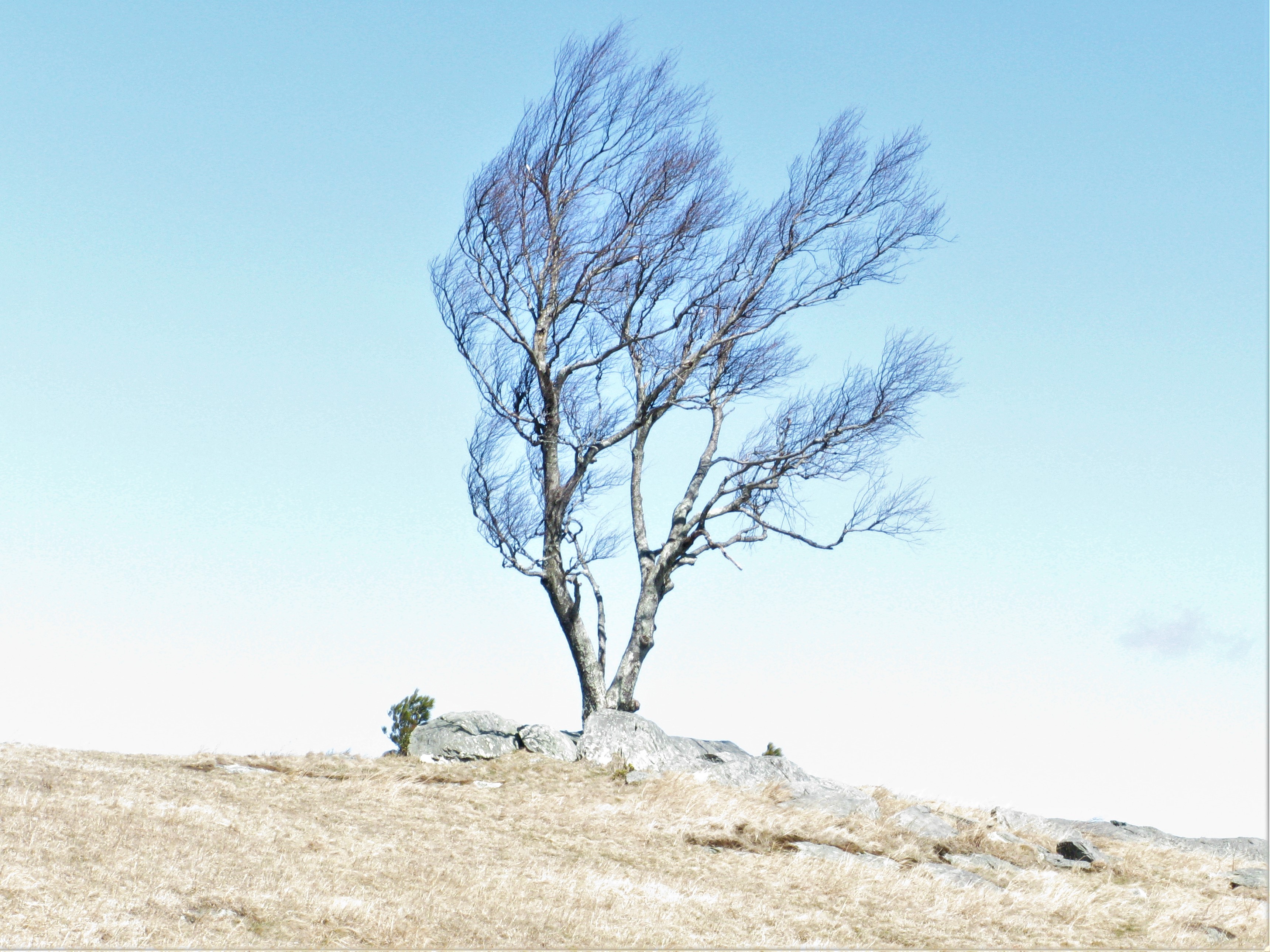
Doughton Park Tree 2020-09-08b

Read Full Post »

 . 
[with 3 poems by AE Hines]
 . 
A foot of new snow
 . 
and down the middle
+++++ of our icy street
a dawn congregation
+++++ of ravens, all blue-black
and wing, hunch
+++++ in their strange bureaucracy,
as if arrived to divide
+++++ the daily assignments. Even
at this age, I still see signs. Even
+++++ a gathering of black birds
on a snow-covered road,
+++++ a Rorschach test
that conjures a warning
+++++ in my anxious machinery:
 . 
an assembly of plague doctors –
+++++ with folded feather arms, dark
nodding heads. I wonder what
+++++ they are here to tell me.
None of us is promised green lights
+++++ and straightaways, but sometimes
the bloodwork comes back
+++++ quietly, the tumor
benign. Sometimes, just up the road
+++++ from where you lie in bed,
brakes give way and barrel
+++++ a terrified trucker across four
frozen lanes into your
+++++ could-have-been path.
 . 
AE Hines
from Adam in the Garden, Charlotte Lit Press, Charlotte NC; © 2024
 . 
❦ ❦ ❦
 . 
Imagine you really like to eat. No, I don’t mean you enjoy sitting down at the table, plate in front of you, bite by bite, chew & swallow, push away and say, “That was good!” What I’m talking about is when your eldest son calls and asks, “How’re you doin’?”, the first thing out of your mouth is, “For supper I had . . .”
 . 
It’s a blessing that Dad likes to eat. My experience from forty years of geriatric practice is that once you lose your appetite you’re going to have a tough time ever finding it again. The first thing Dad usually brings up when we talk is what he needs me to pick up at the store. He’s thinking two meals ahead, tonight’s supper, tomorrow’s breakfast. He can’t walk as far as the kitchen any more, he can’t rummage through the cupboards or the fridge, in fact there may not be many things left in life for him to enjoy, but he can think about something good to eat.
 . 
That’s why this morning I’m poking around in the freezer and shifting unidentifiables in the back of the refrigerator, holding a shopping list and a yellow pad. Besides chucking out the old and vaguely greenish, I’m making Dad a list. A “MENU” I’ll leave at his bedside. There’s a column for meals in the fridge, a column for freezer, and at the bottom is that most important header of all: TREATS. I found four kinds of cookies in the pantry. Four flavors of pudding we originally bought for Mom. Chocolate brownies with M&M’s his cousin June brought by. Some zucchini bread a neighbor dropped off (and it is good). Please don’t forget the Trader Joe’s Vanilla Ice Cream.
 . 
From here, then, it’s off to Harris Teeter. I’m sure I’ll see some more things Dad would like as I cruise the aisles. They say the olfactory sense is tightly cross-linked to the hippocampus – a familiar smell instantly evokes vivid memories of old associations. I suspect for Dad the gustatory sense is equally evocative. Maybe he needs a little country ham with red eye gravy. Maybe spoon bread or hushpuppies. Maybe I can find the recipe for Mom’s famous German chocolate cake.
 . 
In our final days, may we all treat ourselves to what brings us joy.
 . 
 . 
❦ ❦ ❦
 . 
Eden
 . 
I recall placing ripe plantain on the lowest
branch of eucalyptus, and the tree
filling with small wings: toucans
and motmots, a flock of miniature finches
dusted with pale blue chalk. There are so few
days I would – if I could – set on repeat
and live over and over:
+++++++++++++++++ Here, the man
I love, sight of him a reviving breath,
carrying plates of chorizo and fried eggs.
Then the two of us reclined in dappled grass,
drinking hot chocolate from a single,
chipped cup beneath prehistoric ferns
that tower and sway just as they must have
with the world still new.
+++++++++++++++++ I like to pretend
then too – didn’t I? – that we were the first
and last of our kind, a multitude
of wings beating the air under a sun
that never set, our queer, middle-aged bodies
never a day older.
 . 
AE Hines
from Adam in the Garden, Charlotte Lit Press, Charlotte NC; © 2024
 . 
❦ ❦ ❦
 . 
Some quiet evenings I go out / to sit with them, all the men / I’ve been . . .
 . 
When has there ever been an evening that quiet? A space filled with invitation and empty of demands? When has my mind ever been that pliant, willing to contemplate such things much less able? Is there a garden somewhere waiting for each of us, waiting for our return?
 . 
Adam in the Garden by AE Hines offers no simple answers but it certainly invites questions. These poems span many years and many situations; even more so they span the many conditions of one human person. Broken and reborn, dead and exalted – you nor I are not one immutable creature, none of us an unvarying beam transiting the years allotted to our individual existence. If we discover a quiet moment and stop to think, we may discover the many persons we have been and are being.
 . 
Where could there be such a quiet space? Turn the page. Again. The poet invites us to join him here. He makes himself vulnerable to our gaze. He makes no other demand on us than to enter the quiet with him, to be with him and with our selves. And truthfully, I confess that I need this! I need the quieting of all those voices, external but really mainly internal, the quieting which is required to read a poem. Not to escape myself but to sit down with myself. Thank you for the invitation and for the welcome. Thank you for the sharing. It is, I assure you, a treat.
 . 
 . 
Adam in the Garden by AE Hines is published by Charlotte Center for the Literary Arts, Inc., through Charlotte Lit Press.
 . 
 . 
❦ ❦ ❦
 . 
Green Satin
 . 
++++++++++++++for Ginny
 . 
Perhaps, it’s not the drugs
when you tell me you plan
to come back as a tree, wearing
 . 
green satin gowns and scarves
made of wind. No more ridiculous,
you say, than dying, or your wig
 . 
teetering from the nightstand.
Last night, a cypress lifted its dark
roots from the earth, and lay down
 . 
Like a great, leafy-maned beast
across your yard, making room
for more morning
 . 
to flood your window, dawn
a spotlight across a hospice bed
where you labor over breathing,
 . 
a potter over clay, spinning
and kneading the mud of yourself
into finer and finer pieces.
 . 
“It must be time,” you tell me,
with summer’s sun shining
and sparrows flinging
 . 
shadows on your walls.
When even the cypress lies down
and points the way home.
 . 
AE Hines
from Adam in the Garden, Charlotte Lit Press, Charlotte NC; © 2024
 . 
❦ ❦ ❦
 . 
 . 
❦ ❦ ❦

Read Full Post »

 . 
[with 3 poems by Mark Smith-Soto]
 . 
Sunroom Twilight
 . 
Another thunk against the window glass,
another broken wing or neck, as like as not,
another muted spill of feathers on the grass –
I love this space, but it’s been dearly bought.
 . 
Of course, the same might well be said
of the lamb we grilled last night, honoring
its sacrifice with salad and good bread.
The whole-grain loaf, the baby kale, everything
 . 
sundered from daylight for my sake,
floods the mind in unforgiving surge,
sweeps me into the sobering give / take
 . 
that underpins life / death. In the sun’s wake,
birdsong dapples the gold air with its dirge.
Or rather, hymn of wonder; my mistake.
 . 
Mark Smith-Soto
from Daybreak, Unicorn Press, Greensboro, NC; © 2024
 . 
❦ ❦ ❦
 . 
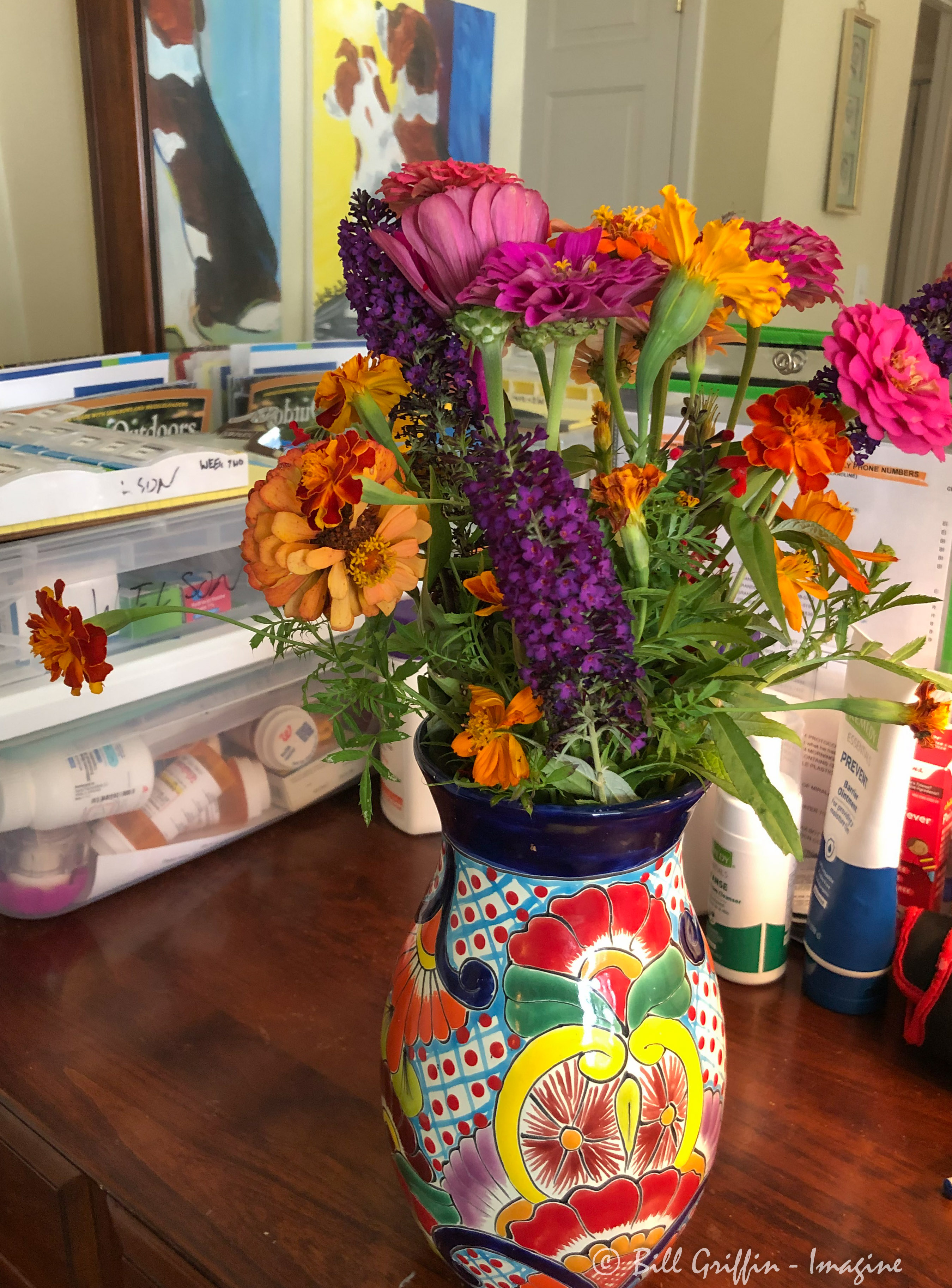
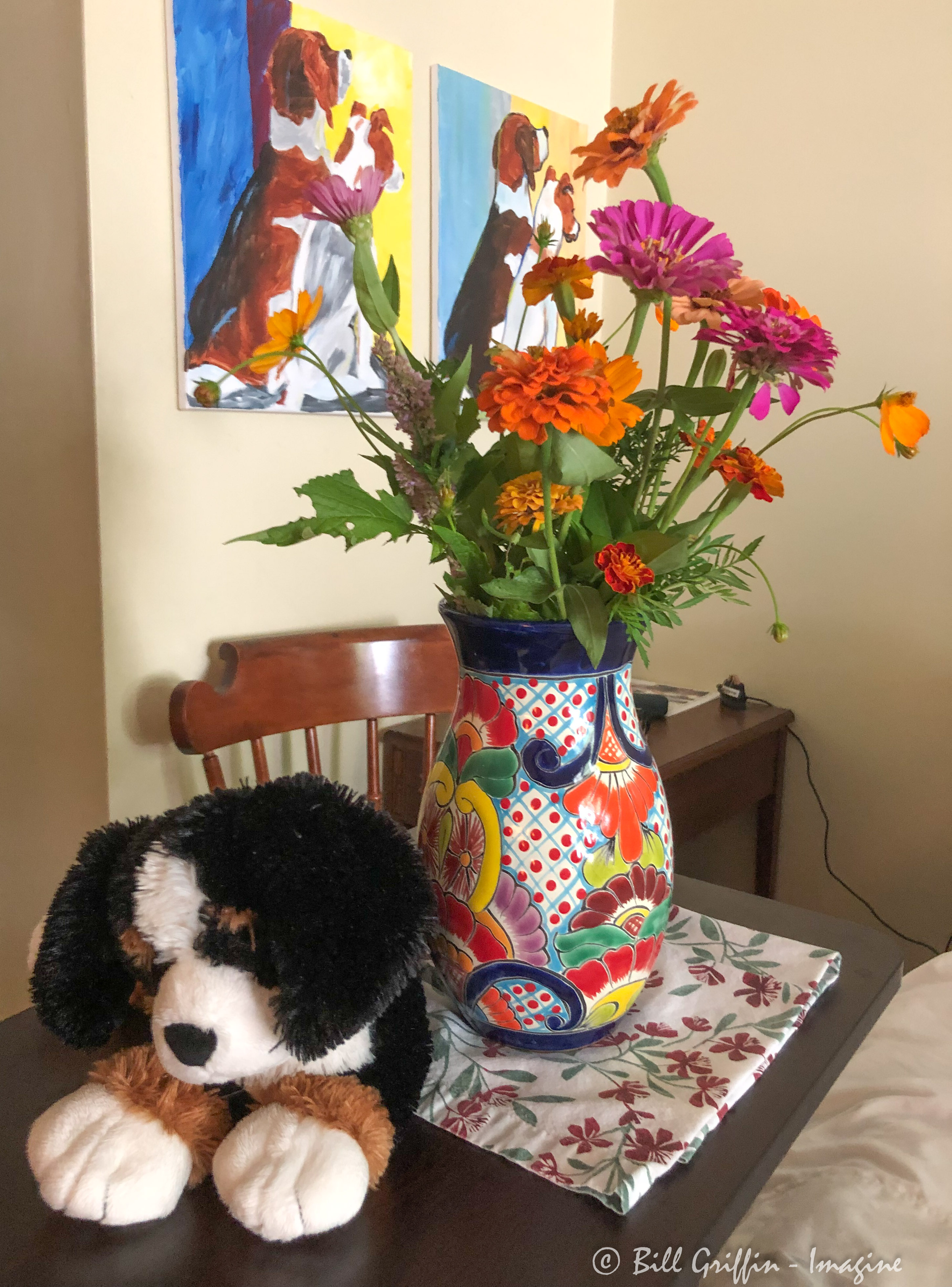
Passenger side floorboard there’s a Mason jar of flowers, black-eyed susan and zinnia, marigold and mint. I cut them from our garden this morning for Mom’s bedside table. On I-77 South just past Jonesville there’s a field of sunflowers blooming, another field near the coverleaf with 421, all looking southeast right now because it is still morning. I’m driving to Winston to visit Mom and Dad in Kate B. Reynold’s Hospice Home. Life surely does suck. Life surely is exalted.
 . 
This is a respite care admission, scheduled so we can upgrade their bathroom and bedroom. Make their home more liveable while dying. Their dates of death are not clearly visible to us over the horizon, certainly not etched in stone, but how distant can they be? Is this what people mean when they say live one day at a time? Mom can still laugh when we joke around, although each day a bit more of her releases into airy nothingness. Dad’s crash has been more sudden, broken neck, delirium, bedfast, but he still seems to add a few more good minutes to each ensuing day. All three of their children will be under the same roof today, now that’s red-letter. We’ll be helping them with lunch, sitting with Mom in the flower garden for a half hour, logrolling Dad in bed to rub ointment on his back. And while the two nap, we three will have a long conversation in another room about next week, and the weeks after.
 . 
Yesterday afternoon my son called after he returned from a few hours visit with his grandparents. Josh took Granddaddy grits and collards and says he spent most of their visit eating. Yeah! Josh has been afraid to see the changes in the two up close and had put been putting this day off for months. I told him I know he still hurts from Jonathan, his best friend all through school, right after graduation the cancer. But then at the end of talking, Josh says to me, “So how are you doing, Dad?”
 . 
Don’t get that question a lot and even less often do I say anything more than, “Fine.” I hear the sincerity when Josh asks. All the drive down today and all the drive back what I’m really thinking about is how to continue the conversation. I’ll stop at his house before I get home to drop off a cooler he left at Granddaddy’s house. I’ll begin by taking him outside and telling him how much I appreciate what he said. I’ll ask how he’s doing. And then I’ll ask another – rehearsed in my head for days, weeks, months: “And how are you doing on your path to quit drinking?” Life can surely do its best to convince you it sucks. But I have a feeling the two of us standing in the driveway for a half hour talking is going to show life it doesn’t have to.
 . 
 . 
❦ ❦ ❦
 . 
Segue
 . 
Now that you mention it: death,
the cherry outside the kitchen
in full bloom, the novel I left
open on my bed, the stitch in
 . 
my side riding a rib, the small
hole at the center of my retina
where nothing registers at all,
the rip in the screen letting in a
 . 
gnat adrift on the whiff of daphne
blooming along the broken driveway,
the sudden abandon of your laugh, me
forgetting what I was going to say,
 . 
closing my eyes, holding my breath,
and now that you mention it, death.
 . 
Mark Smith-Soto
from Daybreak, Unicorn Press, Greensboro, NC; © 2024
 . 
❦ ❦ ❦
 . 
The poet notices a little something, a little nothing, really: breakfast, a chess board, chalk dust; light across a woman’s profile, flowers that shouldn’t be there, a word that carries on its back two meanings. Common things, every day things. The poet notices and his smile as he points out what he has noticed is almost sly; the pointing is all about what he’s not quite saying. Then all at once you notice, too. And you smile.
 . 
In Mark Smith-Soto’s world you might discover wonder in commonplace, joy in commonalities, mystery in what we share and have always shared without noticing that we do. You might join him in memories that make you cry, realizations that lift from within you a deep sigh, possibilities that sober you right down before they exalt you. In Mark’s ultimate collection, Daybreak, every single one of the 56 sonnets has touched me, gently but insistently, until I admit I’m relieved: I am / a human being. I’m pretty sure of that. [Biology Lesson]. After reading these poems, I begin to notice the flowers in the cracks of my walkway with new eyes; they implore me that death [is] a lifetime of hours away [Aria da Capo].
 . 
During the years of this twenty-first century, my orbit and Mark’s intersected only a handful of times, for only a handful of hours. But what gravity and what luminosity! In life I knew Mark only a little; I am glad to know him much more in poetry.
 . 
 . 
Mark Smith-Soto (1948-2023) was born in Washington, DC, and lived in Costa Rica until the age of 10, when his bilingual family returned to Washington, his father’s native city. Mark’s awards include a fellowship in creative writing from the National Endowment for the Arts and the NC Writers Network’s Persephone Competition for his chapbook Green Mango Collage, among many others. Daybreak is his seventh poetry collection and is available from Unicorn Press in Greensboro, NC.
 . 
Thank you, Michael Gaspeny, for sending me Mark’s book as a gift. A treasure.
 . 
❦ ❦ ❦
 . 
There You Are
 . 
I do feel somehow exiled here, outside
the frame – just what is it about a woman
at an open window, seen from the side,
an opalescent half light on her hands
 . 
holding the curtains apart, head tilted,
questioning? Maybe her gaze has stranded
on the naked lady half-hidden by the shed,
a blossom she knows she never planted,
 . 
her wondering, These small, random gifts,
why do they touch one so? But of course,
I can’t begin to guess her mind, it’s
 . 
me trespassing here, I should go before
she sees me, leave her to her thoughts –
“Oh, there you are, amor. Come look at this.”
 . 
Mark Smith-Soto
from Daybreak, Unicorn Press, Greensboro, NC; © 2024
 . 
 . 
❦ ❦ ❦
 . 
Doughton Park Tree 2016-10-17a
 . 

Read Full Post »

« Newer Posts - Older Posts »