Feeds:
Posts
Comments

Posts Tagged ‘family’

 . 
[for my mother]
 . 
Liminal
crepuscular
 . 
You take my hand and lead
me from the porch, leavings
of sticky watermelon rind,
half-eaten hotdogs, out into
the yard where the older kids
whoop in the descent
of darkness almost too deep
to see through; at its edge
grownups in folding chairs,
the orange winks of their cigarettes
like lightning bugs.
 . 
Too dark. You feel me hanging back
but here around the corner
real fireflies guide us, cool green,
silent. You catch one
in your hands, Like this . . .
when I was a girl, laughing
in the twilight; you pinch off
its tiny ember and smear
the glowing on your eyelids
so that when you close your eyes
its faint gaze assures
that you still see me.
 . 
And the truly wondrous thing,
besides this moment together while
the luminescence fades
and I am able too to laugh,
is that once you were a girl.
 . 
❦❦❦
 . 
All stories are true. The story’s facts may get a bit smudged & skewed, a bit shuffled & stretched, a bit jiggled & juxtaposed & conflated, but the story’s truth is undiminished. Good stories know their truth. The best stories know your truth. You discover it in their pages. Perhaps it was always in you, smudged & skewed – now you are following its trail into the open.
 . 
A poem has its own particular way of telling its story. Planed down until you can see the grain. That burl is a metaphor for the winter storm when something cracked. The curly maple echoes laughter you can still hear tinkling faint from the past. Storms and laughing are metaphors for what you’re facing this morning when you roll out of bed. The poem rolls you out of bed. It won’t feed you lying down.
 . 
And in a poem the story lives on its own fine edge. It balances the limn between nothing and everything. Wait here, breathing slowly, at the transition between dusk and night. Or between darkness and dawn. The poem’s story may seem at ease but in the silence beside the swift river you can hear the rush, the flow, the movement. The poem taps the shoulder of awareness – look ahead, look back, live right now in all those moments that coalesce to make a life. Your story is unfolding, and don’t you know it’s true?
 . 
 . 
❦❦❦
 . 
Liminal
riparian
 . 
Let’s tube the Brandywine: you
are brilliant, my kids so fractious,
lucky to keep them for an hour
in the same room with Grandmommy
much less engaged.
All the lazy afternoon
watched over by staid sycamores
of summer, the splashing,
the dunking, and through smooth
passages you get them talking
about yesterday’s museum, Howard Pyle
and the Wyeths, art, its stories,
how if we can only imagine
something strongly enough
we may make it so.
 . 
Imagine: all things flow,
the benevolent stream, its clarity
every possibility of color
and everything it collects,
benediction of damp
on our bodies, water and salt,
half-adrift in the dailyness
of life and where
might this meandering take us?
 . 
At the takeout toweling off
you touch my shoulder, point:
a tree swallow’s looping masterwork
has knit together river, forest, sky,
metallic blue . . . brilliant.
 . 
❦❦❦
 . 
A story about Mom: when I was five we lived in a little house on Marion Road in Memphis. Mom had made a special cake for my birthday surprise, German chocolate with thick gooey coconut and pecan frosting. She hid it in the little closet pantry until after supper, but when she brought it out for five candles, she wept. It was covered with ants. Don’t you think my brother and I were able to pick off the little crawlies and eat it anyway? And every year at birthday time we piped up, “Mom, make us another Ant Cake!” It was years before she could laugh.
 . 
Another one: Mom and Dad moved away from the South before I was born, but her friends in Michigan or Ohio or Delaware could still detect the remnants of her North Carolina accent. I believe they always thought her a bit prim. When I was fifty I happened to visit Mom in Wilmington DE around Halloween. She said, “Let’s go trick-or-treating!” I figured we’d just walk down the block and say Hi to the neighbors, but she came out of the bedroom wearing a cape and hunchback, an old wig pulled all the way down over her face, and stark staring eyes painted on her cheeks. A wooly booger. None of the neighbors knew who the hell she was and they flinched visibly when she cackled.
 . 
Last story?: Mom was the czarina of crosswords, and she could finish the entire Jumble in the morning paper while I was still juggling the first word. The last few months of her life, at ninety-six, she would sit on the couch after breakfast and I would bring in the paper, sit down beside her, and hand her a pen. Sometimes, I admit, I had to offer her hints (assuming I myself could figure out the words). But at times she would put pen to paper, hesitate just a moment, and fill in the blocks with faint, spidery letters. Just right, Mom. Just right.
 . 
 . 
❦❦❦
 . 
Liminal
nonagenarian
 . 
Every Sunday after church I knock
at your kitchen door then forge on through
to the living room before you can struggle
from your favorite chair, milky tea
half-finished, The Times crossword
and a few spaces you’ve saved me,
78 down, wings, four letters, and today
I’ve brought my grand-daughter,
 . 
your great-. We’ve taken to calling her
Sister like your brother and all
the cousins called you,
and while she cuddles your old doll
almost ninety itself and explains
to it the universe of her three years
you settle your pad across your lap,
charcoal on your fingers, capture
the purity of her which is the closest
we will ever come to defining love,
the three of us a grand alignment
 . 
of planets in some untrammeled
system, and although the scratch scratch
on paper binds me to this moment
I see you luminescent, intangible,
the halo of fine white hair that limns
your face, your wings, alae,
strong enough to lift us all.
 . 
Bill Griffin
first appeared in Grey Sparrow Journal  –  Issue 32, Summer 2018
 . 
❦❦❦
 . 
 . 
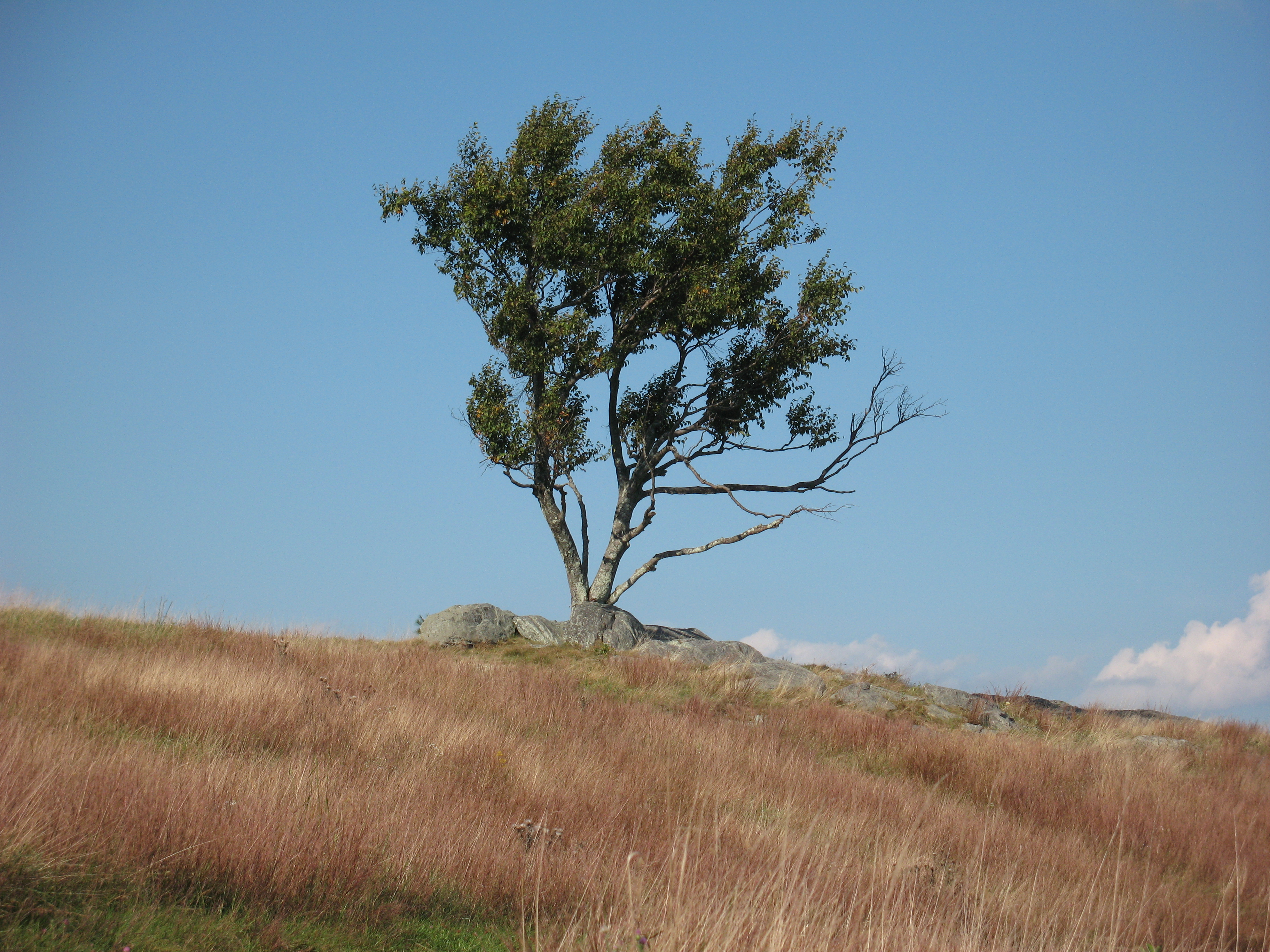
2020-06-11a Doughton Park Tree

Read Full Post »

 + 
[with 3 poems by Sarah Small]
 + 
Dad, Peeling Apples
 + 
++++++ The color of wheat
bread speckled
like the skin of a Golden Delicious,
freckles on top of freckles
and tiny nicks
from his knife, dots of blood
turned to brown scabs.
My father’s hands
 + 
have never changed. Every night
a different apple
skinned naked,
split and seeded without him
ever looking down, loving the fit
 + 
of apple
in the left hand, brown-handled
knife in the right.
He licks the tip of his finger
where the juice runs clear
and skewers a slice
 + 
for me, which I take
regardless
of whether I want
an apple or whether
the flesh has begun to brown
around the edges.
 + 
When he is done,
knife set down and fingers wiped
clean against the legs
of his beige corduroys, I will take
the leathered back
of his hand to my cheek
and hold it there, begging
 + 
his weathered roots to spread
their soil-caked fingers
long and strong
as deep as the generations will go.
 + 
Sarah Cummins Small
from Stitches, Finishing Line Press, Georgetown, Kentucky. © 2025
 + 
❦ ❦ ❦
 + 
Last week I was out on the Mountains-to-Sea Trail with Bob and Steve digging ditches. “Erosion mitigation features” – yeah, ditches. Along one stretch we kept turning up huge earthworms, dozens of them, fat and long as little snakes. As we rescued each one and chucked him/her off the trail, Bob turned to me, local naturalist, and asked, “Say Bill, can you tell which is male and which is female?” Smirk on, Bob. If I recall correctly from Mrs. Schilling’s high school biology, every worm is both. One end is boy and the other end is girl, hermaphrodites. When they want to make little wormlets, they line up parallel head to tail and exchange genetic material. Slimy but exciting!
 + 
Thank you Hermes, Aphrodite, and Mrs. Schilling, whose motto was, “There’s no place in the world for weak women!” Everybody, now, hands on! as we dissected our earthworm. And each 9-week term Mrs. Schilling also sent us out collecting: leaves, insects, fungi. In mid-winter Ohio it was bare bud identification time, each labeled per Linnaeus. I’ve never forgotten Acer rubrum and Quercus alba. My lab partner Dave tried to foist off the bare tip of his defunct Christmas tree as one of his collected buds. Just before he turned his project in, I replaced its label (Pinus pinus?) with Gluteus maxiumus. It was exactly five minutes before Mrs. Schilling’s menacing contralto penetrated to our back row table: “Mr. Mason, come forward!”
 + 
Mrs. Schilling was one of my three most memorable teachers (Mr. Geigel, English, and Herr Watt, German, the other two). I am still in love with Latin binomials and squishy things thanks to her. Mrs. Schilling would certainly never shrink from describing in the most squirm-inducing detail the reproductive habits of earthworms. And at age 15 who is not obsessed with sex in all its varieties, manifestations, and practices? I can’t in all honesty confess that the mystery has even now been fully dispelled, although I think I may have finally figured out the convoluted sex life of ferns. (Listen up, y’all, that’s pronounced Thallus.)
 + 
When I was 12, Dad never sat me down for THE TALK. He just handed me a slim pamphlet, mysteriously titled Where You Came From, then sent me off to read it somewhere my little brother couldn’t peep. “When you’re finished, let me know if you have any questions.” I returned it to him later with the 1965 equivalent of “All good,” but for at least the next two years I still confused female anatomy with British monarchy (Elizabeth Regina). And now I’m supposed to be the one to sit Dad down at 98 and explain to him the facts of why he can’t be asking his physical therapist out on a date? I think I’d rather just stick with the earthworms.
 + 
 + 
❦ ❦ ❦
 + 
War
 + 
++++++ Our mother is beautiful
Without makeup, with the round balls
Of her cheekbones like crabapples
Or plums, and her crooked front
Tooth. But with a little
Pencil to shade in the sharp arch
Of eyebrows and bright red lipstick, she becomes
A black-and-white
Photograph hung in a young man’s barracks
Where in the early evening before dark
And after a green supper, one soldier lies
Sideways on his cot facing her,
Tracing the soft outline of her cheek
With one knuckle, three fingers from his lips
To hers and back. We will never be
So carefully memorized.
 + 
Sarah Cummins Small
from Stitches, Finishing Line Press, Georgetown, Kentucky. © 2025
 + 
❦ ❦ ❦
 + 
We will never be / so carefully memorized – Sarah Small begins her collection Stitches with a portrait of her parents in the 1940’s, deeply imagined, drawn deep from her heart. Poem by poem she pieces a quilt of memory and legacy, reverence and longing. This is one poetry collection that left me wanting more when I had turned the final page. Its beautiful pattern gradually emerges, on each page so carefully felt and conveyed. The simplest things conceal the greatest mysteries. Within the simplest the greatest is revealed.
 + 
The poet’s eye and ear, her imagery and music, each delicate detail and meticulous observation, all the lives shared, every secret revealed: the colors and textures arrange themselves until we recognize not only the poet’s family but our own place among the tribe of humankind. These are indeed the stitches that gather us into a single human family.
 + 
 + 
Stitches is Sarah Cummins Small’s debut collection and is available HERE.
The book’s cover art and design are by Summer Small.
 + 
 + 
❦ ❦ ❦
 + 
Unstitched
 + 
I am held together
by tiny stitches
on small scraps of feed sack,
snatches of wool, snips of gingham.
A patchwork of pastels—
a slipshod collage of cotton.
I’ve been silk, satin, taffeta;
I’ve been flowers, polka-dots, and plaid.
 + 
Thin white thread
++++ ++++ zig-zags
++++ across
++++ ++++ the decades
++++ hemming me in, keeping me
from ripping.
 + 
I’ve been zipped.
++++ Buttoned.
++++ ++++ Unsnapped.
I’ve been bumblebunched, twisted,
and straightened. Held pins in my mouth,
pricked fingers, and calloused
my thimble-less thumbs.
 + 
I am done.
Unravel me now:
Rip out the seams
one by one, untwist strings
and untangle knots. Fold me gently.
What I haven’t finished—
take now.
Begin again.
 + 
Sarah Cummins Small
from Stitches, Finishing Line Press, Georgetown, Kentucky. © 2025
 + 
❦ ❦ ❦
 + 
Just a reminder that I m leading a naturalist hike the morning of Friday, September 12, 2025 on the Mountains-to-Sea Trail near Elkin and you are invited. During the month of September we celebrate the birthday of the MST! It’s an easy walk, 2 hours or so, lots of stops to check out flora and fauna. Sign up at:
 + 
 + 
And if you can’t come on the Friday, we will probably repeat the hike on Saturday, September 27. Sign up with Elkin Valley Trails Association at Meetup.com to receive notices.
 + 
 + 
❦ ❦ ❦
 + 
2014-06-30a Doughton Park Tree

Read Full Post »

IMG_4192_crop

Albert Mountain Sunrise

 . 
[with 3 poems by Kathy Ackerman]
 . 
Heritage Lost
 . 
Hills are keening,
yellowed voices of serious photos
call me home to “precious memories,
how they linger,
how they ever flood my soul.”
 . 
How in a displaced caravan
we went to lay her down
in shining soil,
flecks of coal on shovels
in the hills of familiar gravestones.
It had to be that church,
that pastor’s family name,
Rock of Ages, Beulah Land.
 . 
How odd to call it home and feel it so
without a waiting bed of down
to follow the wake,
all of us gone north for good,
except for this.
 . 
How we walked between
the railroad and the shallow ditch
collecting tadpoles in a pail
we’d flush in the motel’s aqua bathroom
because I would not understand.
Death, a newborn slippery thing.
 . 
How the stone had to be a heart
to bear the name of Mother,
how the heart had to be a stone
to be left behind
in its rightful place
in the hills near the church
near the home place bought by strangers.
 . 
We packed the memories once again
in bursting overnight bags,
left the motel beds unmade,
because we could
and settled into our procession.
CB radios, Thermoses, Styrofoam,
we headed back up north
to our factories, unions, high schools,
without looking backward.
 . 
Kathy Ackerman
from Coal River Road, Livingston Press, The university of West Alabama; © 2013
 . 
❦ ❦ ❦
 . 
Where is home? Is it a house number, 1074 Marcia Road, a side yard, fence, and oak tree I can still see as clearly as when I was 10? I could walk right through the carport sixty years later and show you exactly where we buried my hamster. Or is home a garage full of cardboard boxes and bric-a-brac from four other homes of parents and grandparents, houses you only spent a few dozens of nights in altogether? Is home the towns those houses occupied? The states?  Whose home is your home? Whose place is yours?
 . 
I was barely four when we moved from Niagara Falls to Memphis. Not until years later was I able to piece together the stories of my parents’ migration, how they drifted together across those red clay counties of piedmont North Carolina, then pinballed via Atlanta to New York before birthing me. All my solid early childhood memories abide in those eight years in Shelby County, Tennessee, that little four-square subdivision on the outskirts of Memphis.
 . 
Then we moved. And moved again. The sixth graders in Delaware mimicked my accent and immediately nicknamed me “Memphis.” It doesn’t take long for a 12-year old to figure out how important it is to fit in. For the next couple decades I can now see that I lived as if the place I was staying would never be the place I stayed.
 . 
Here in the rural South, when you meet someone new question number one is not, “What do you do?” but, “Where are you from?” One longs to fit in; one doesn’t want to whack the conversation with an axe by replying, “New York.” I invented my stock answer right quick: “Both of my parents are from North Carolina.” Subtext: “I want to be from North Carolina. I want you to let me be.”
 . 
I have now lived exactly 70% of my entire lifespan in North Carolina. NC driver’s license, NC property taxes, kids born in NC, grandkids too. Maybe being almost from here is an advantage. Every new state park we visit, every historical factoid, every endemic flower species I learn, every third generation progeny of a friend I greet while out walking – I tally them all securely in my calculus of belonging. Way back when Linda and I arrived in Durham a week after we’d married, a month before I started med school at Duke, we just assumed that in four years we’d be moving back to Ohio to be closer to her huge family. Now it’s been fifty-one years in The Old North State, forty-four of those in rural Elkin in rural Surry County. Lately we’ve started talking about downsizing, moving somewhere we can age in place through to the end of our allotted spans. Linda says, “You know where I’d really like to live?” Oh my God, is Ohio still calling her? Is the place we’ve been staying never to be the place we stay? She looks at me level, no joking here. “Winston-Salem.”
 . 
Well, I guess we are from North Carolina. It’s nice to be home.
 . 
 . 
❦ ❦ ❦
 . 
Cul-de-sac
 . 
From Coal River Road to White Mist Lane
is more than forty years,
several hundred miles
as the crow truly flies, one point to another,
and sometimes back,
no straighter than a crooked river
wrecked by mines.
 . 
Here the landscapers claw in stony earth
to sow some seed
while wings of straw fly it away.
My lawn’s a futile thing
where rocks and trees should be.
 . 
I stoop to gather stubborn stones,
pretend I do it for the grass,
but in their quartz and granite peaks
admittedly ground to bits by time
I find the mountain of my blood
and hear the ancient syllables spilled,
silenced now by cul-de-sac
and swaying Mylar storks,
a neighborhood of strangers
increasing overnight.
 . 
Kathy Ackerman
from Coal River Road, Livingston Press, The university of West Alabama; © 2013
 . 
❦ ❦ ❦
 . 
Linda spots the book on top of my pile, next in queue for reading, and its title speaks right up and makes its demands known. “We need to save this one for Jodi.” Who was born in Ohio but lives in coal country, and whose career has been to tell its stories as naturalist and interpreter in the New River Gorge near Beckley, WV. Indeed, I’ll share it with Jodi, this book I bought from a friend whose poetry I’ve admired for many years, whom I’ve come to know better through the North Carolina Poetry Society Board, and whose more recent book I featured here three years ago. Now I open the book, though, and out spill the connections and intersections. Kathy, just up the road there at Isothermal Community College, I never realized we’ve come from the same place!
 . 
Kathy Ackerman grew up in Ohio (like me, at least from 8th grade on) far from her birthplace and her family’s heritage. In later years she has mainly visited the old home state for funerals, but the landscapes, place names, family memories, and fortunes (or lack thereof) of West Virginia are the palette from which she paints these poems of Coal River Road. This collection is yearning for home, but home is something slippery and out of reach. A bright fleck in a stone might remind her of the mountain in her blood, but returning to stand on the that mountain she discovers a hint of strangeness and regret. Perhaps the yearning itself is home, the uprooted and cast adrift feeling that keeps a person looking for something solid, for something that means.
 . 
I identify with these poems. Kathy uses imagery and memory not just to disclose the past but to define the present. She can only be the person she is because she’s traveled the twisting roadways through old hollers and coves as well as the West Virginia Turnpike straight up to Ohio’s new sown lawns. And finally I-77 South. Although Kathy Ackerman didn’t settle in this state until a full ten years after I did, I can assure you that she is from North Carolina.
 . 
 . 
Coal River Road by Kathy Ackerman is available from Livingston Press. Her more recent book is Repeat After Me from Redhawk Publications (2022).
 . 
 . 
❦ ❦ ❦
 . 
Whitesville, WV
 . 
Because we never had the conversation
I am following a hearse that winds
down Coal River Road toward Whitesville.
 . 
How to say irrational to bury you here
in the only land we own outright,
owned for generations
though none of us can visit your grave
in less than a day.
 . 
These plots foreshadow the ending
no matter the story you wanted to tel.
you never wanted to return, like this or not.
 . 
You’d cringe to see this dingy place,
smelling of rot as if what remains
of the Big Coal River
seeps in each night while the corpses await
their faraway bereaved.
 . 
For once, I’m relieved to by unromantic.
That body is merely a souvenir
a keepsake – you wore it every day.
Symbol. Skin. Form.
 . 
I am relieved to know you’re not really here
though there’s nowhere else for us to go
to pay our respects. It is not respect
that brought you here, but silence,
the failure to make a better plan
because you never learned to say goodbye.
 . 
Kathy Ackerman
from Coal River Road, Livingston Press, The university of West Alabama; © 2013
 . 
❦ ❦ ❦
Doughton Park Tree 2020-09-08b

Read Full Post »

« Newer Posts - Older Posts »