Feeds:
Posts
Comments

Posts Tagged ‘family’

 . 
[with 3 poems by Jane Shlensky]
 . 
Balance
 . 
Each morning Granny hobbles to the spring
uphill two miles with buckets in her hands
through woods now thick with frost, limbs cleared of leaves.
And over rocks almost atop a hill
behind her house, she sees the water gush,
and, slow with age, she stoops to clear away
the leaves and sticks that clot the pulses’ rush,
and, cracked cup in her hand, she dips into
“sweet water” as she calls it, gathered wild
as honey in abandoned rees, and pours
the nectar into metal milking pails
to carry down the mountain, arms held far
from hips and sides, all tense – as pugilists
might hold their arms, quite low with hands in fists.
But her fists grip the metal handle’s cut
into her palms, as water weighs her down
and down the well-worn path toward her house.
I offer her a new artesian well,
but she just laughs at me and shakes her head.
I ask if I may carry home the spring
for her, but she denies she wants the help
and says it gives her reason for a walk
among the trees on any given day
and carrying two buckets makes her sure
of foot and balanced in a world that’s not.
 . 
Jane Shlensky
from Barefoot on Gravel, Finishing Line Press, Georgetown, KY; © 2016
 . 
❦ ❦ ❦
 . 
I hate my anger more than I hate vomiting. The dead sick inevitability as it rises, how it makes my hands go cold and clenches my jaw. Disorienting, paralyzing rational thought. I am not going to let that anger out.
 . 
People tell you it’s best if you do. You have to let go of your anger. Maybe they’re right, because while it’s rising I don’t even see it coming, I don’t know to call it anger, I have no warning or defense that might prevent the stupid things I will do or the hurtful things I will say. I am afraid of the anger so I run from it before it can get me. Running, stumbling, I usually fall. Anger blasts me off balance.
 . 
Linda and I are sitting in the car. We had thought to take a walk in the gardens but now I’ve picked a fight with her, I can’t even recall about what. Linda has never let me get away with anything – I say this with honest, grudging admiration – and she says something now that jars me: “So is this what it’s going to be, then?” She is seeing something I can’t see. I admit it. I’m so confused, I tell her. And so she pushes me to relive the last couple of hours, ticking over the balance sheet – frustration at last night’s botched meeting, undercurrent of worried anticipation for tomorrow, niggling mis-steps and course changes this morning that had me snapping at a friend, patience evaporating to hot steam. Little angers mounting, not let out.
 . 
At last she wants to give me some justification. “Anyone would feel that way.” Not this time. True or not, I’m not buying that line. I’ve used it a hundred times to tamp down the anger, cover it and hide it. I don’t actually gain much insight into all this until much later, but there is one best way to regain some balance. To let anger’s own entropy cool it down to nothing. Sitting in the car next to Linda, I open up and own it. I said and did things that hurt people; I am responsible. I am sorry. I’m not happy with myself or the situation, but at least the two of us are finding enough balance to begin our walk after all.
 . 
❦
 . 
It hurts to walk barefoot on gravel. When I first met Linda, she and her sisters went barefoot all summer long. It was nothing for them to walk a mile or two on those tar-and-gravel Ohio roads or through the woods over dry twigs and sweetgum balls. I tried to keep up, limping like an old codger and next day lame. But I kept walking on sore feet because I wanted to keep up. I wanted to be near them.
 . 
Jane Shlensky’s poems will not make you limp although they can be sharp and pointed. They will make you want to come along and keep up. Jane loves her characters, which she has drawn from generations of rural memories and red clay. She grew up in Yadkin County, NC, just across the muddy river from me, and she sees those farmers and grandmothers and wives more clearly than they ever saw themselves, perhaps. I don’t sense Jane imploring us to return to those old times and old ways. Instead, she shines her light on the truth of what brought her up and made her. What we carry in our pockets may change, but what we carry in our hearts does not. Read Barefoot on Gravel and find a moment of balance in a world that is so often not.
 . 
 . 
❦ ❦ ❦
 . 
Ain’t No Sunshine
 . 
“Oh, Lord,” she says, mixing the batter
for pancakes, the sausages sizzling,
the coffee perking in her mama’s pot
that’s so worn it’s barely metal.
She keeps it for the comforting perk,
fragrant life bubbling up, making promises.
 . 
But he’s in his wing chair, hunkered
over his guitar, his face blank as rain,
his strum, hum, strum him,
accompanying his slow moan.
His voice is like buttered rum, oiled
and warm as fever, just enough gravel
in his bass notes to scratch at her heart.
 . 
“Oh, Lord, that man,” she says to no one,
but her Lord hears everything in her heart.
She knows this as sure as she knows
the spit of oil before she tips the batter in,
as sure as she knows the hiss and blister,
bubble browning in the cakes.
 . 
He is having one of his blue days –
won’t fight the sadness, just leans on
that old guitar, curls in on himself
like a dog that hopes to lick the pain away.
He’s finding a sound to help him stand,
a trembling chord to lift a mighty weight.
 . 
He’s singing his own song and she knows it,
her heart clutching at his words, wishing
she could mother is sorrow away, feed
his hopes. She needs him, even if
they struggle every day. She turns to Jesus
kneeling on the wall and whispers,
“Dear Lord, that man there . . . we best
but some blueberries in these cakes.”
 . 
Jane Shlensky
from Barefoot on Gravel, Finishing Line Press, Georgetown, KY; © 2016
 . 
 . 
❦ ❦ ❦
 . 
One Better
 . 
While we puzzled over the perfect
birthday gift for our father,
he packed up his fishing gear and
a few clothes and bid us farewell.
 . 
Jane Shlensky
from Barefoot on Gravel, Finishing Line Press, Georgetown, KY; © 2016
 . 
❦ ❦ ❦
 . 
 . 
❦ ❦ ❦
 . 
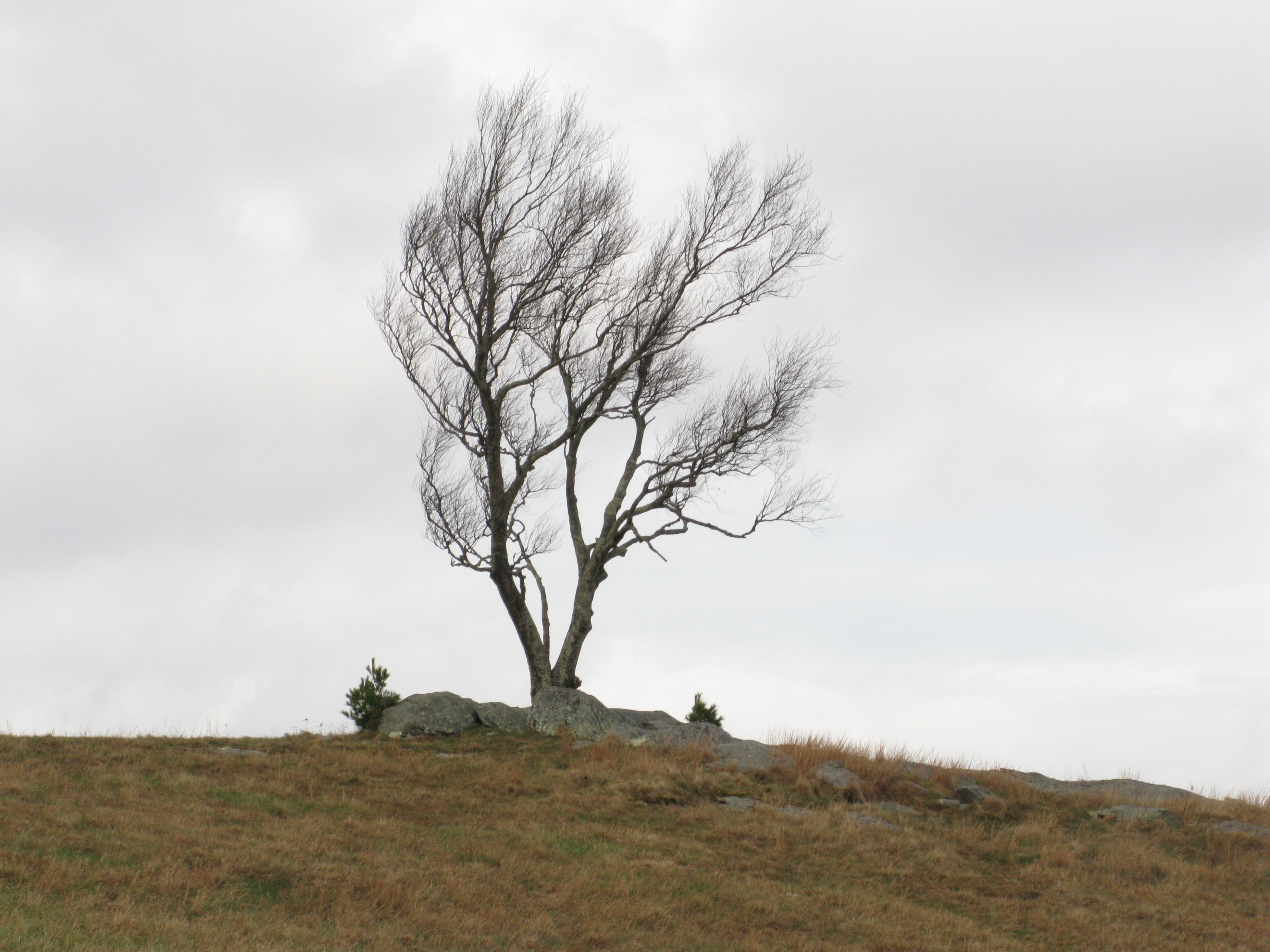
 . Doughton Park Tree 2020-11-22

Read Full Post »

 . 
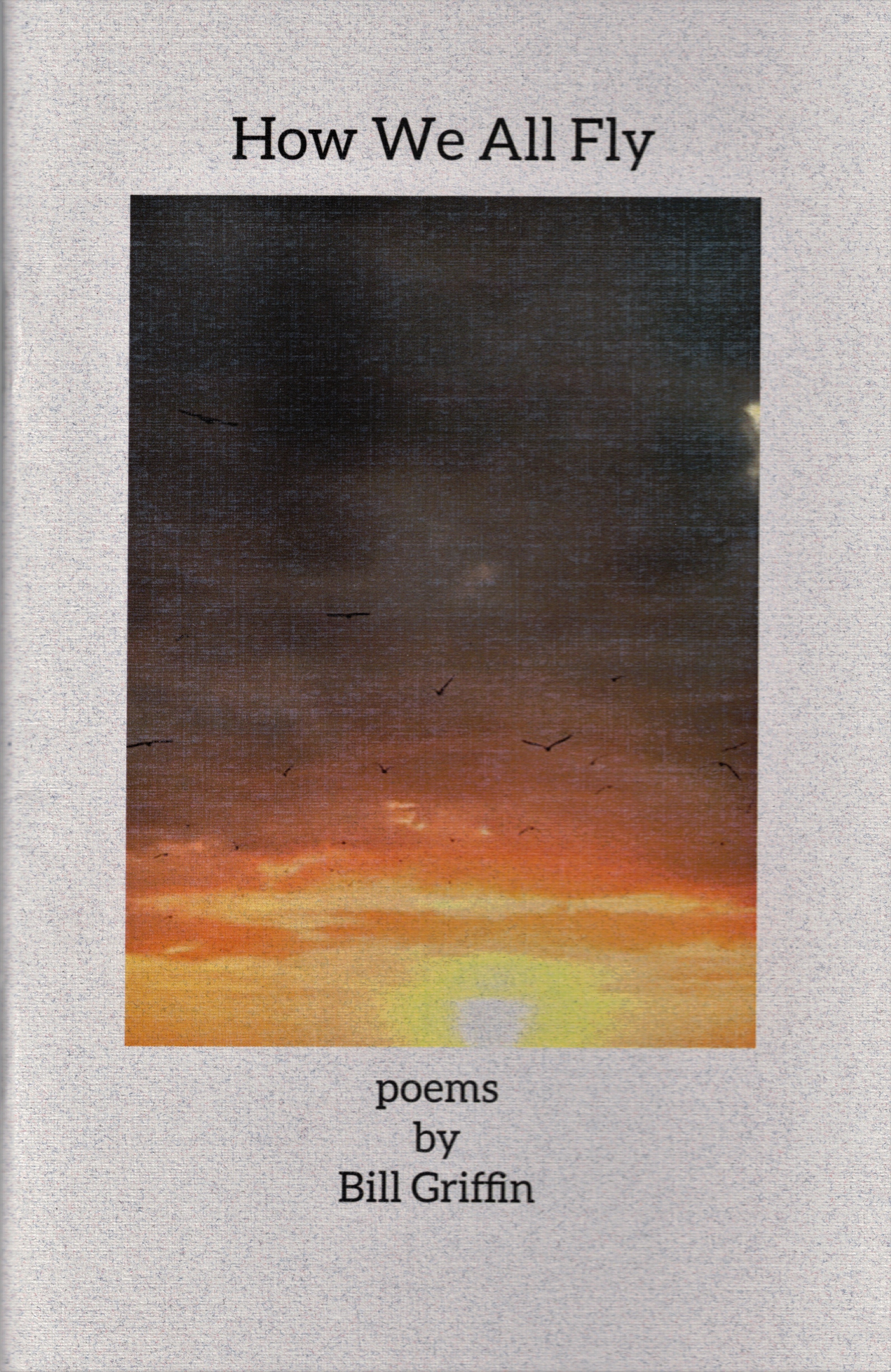
[2023 chapbook by Bill Griffin]
 . 
We Never Give Up Hoping
 . 
Morning frozen hard. Pour
++++ boiling water
into the birdbath;
++++ they will come
to drink when I have gone.
 . 
++++ God of holy ice, holy
++++ ++++ steam,
++++ give my children
++++ ++++ water
++++ that all my hoping
++++ ++++ can’t.
 . 
Sound of wings, splash
++++ diminishing;
find the world again
++++ iced over.
Fill the kettle. Holy water.
 . 
Bill Griffin
from How We All Fly, The Orchard Street Press. Gates Mills, OH, © 2023
originally published in Quiet Diamonds
 . 
❦ ❦ ❦
 . 
Join me in celebrating the release this month of my newest chapbook, How We All Fly, from The Orchard Street Press.
 . 
Poet Patricia Hooper describes the collection: “Through close observations of the physical world, these clear, direct poems yield insights into the corresponding life of the spirit.” And Rebecca Baggett says this: “Throughout these poems, but particularly toward the collection’s end, How We All Fly leads the reader up and onward, infusing even inevitable losses with tenderness, trust, and hope.”
 . 
Patricia Hooper is author of Wild Persistence, University of Tampa Press.
Rebecca Baggett’s most recent book is The Woman Who Lives Without Money, Regal House Publishing.
 . 
❦ ❦ ❦
 . 
 . 
❦ ❦ ❦
 . 
Thank you for your support, both of the writing you discover here and of the literary arts!
 . 
You may purchase a copy of How We All Fly directly from me by mailing a check for $15 (postage included) to this address:
++++++ 131 Bon Aire Rd.
++++++ Elkin, NC 28621
Please make your check payable to Bill Griffin.
 . 
If you would prefer to pay via PayPal, please contact me for transaction details at: comments@griffinpoetry.com
 . 
❦ ❦ ❦
 . 

Read Full Post »

 . 
[with 3 poems by Michael Hettich]
 . 
Abide with Me (excerpt)
 . 
That first year together, we lived in the shadow
of a fishing line factory, next to a super
highway, under a railroad bridge,
 . 
behind a field of junked cars – mountains
of tires, hub caps, and smashed glass – and we
 . 
prayed fervently for our love to return
this world to the poised grace we could imagine
when we touched each other just right, or when we saw sunlight
glint on the stream full of chemicals and junk
that ran by the factory walls.
 . 
We prayed with our yearning. That year we could float things
in midair on the hymns
we sang in perfect harmony.
 . 
We practiced one hymn – “Abide With Me” –
until we could lift cancered minnows from that stream,
until we could lift stray cats and junkyard dogs,
until we could lift each other as high
as our voices carried. We harmonized versions
 . 
of our families and secrets, until we could float
each other in unison, knowing if we fell silent
for even on moment, we’d fall . . .
 . 
Michael Hettich
from The Halo of Bees
 . 
❦ ❦ ❦
 . 
When did I lose my knack for magic? Oh, I can still work what from a distance appears to be magic. I can wiggle my nose and make a seven-year old girl laugh. I can pull from my tall black hat the Latin binomial for obscure little flowers that most people don’t even consider flowers. I can perform any number of spells that compel my wee ancient mother to say , “You’re such a good boy.”
 . 
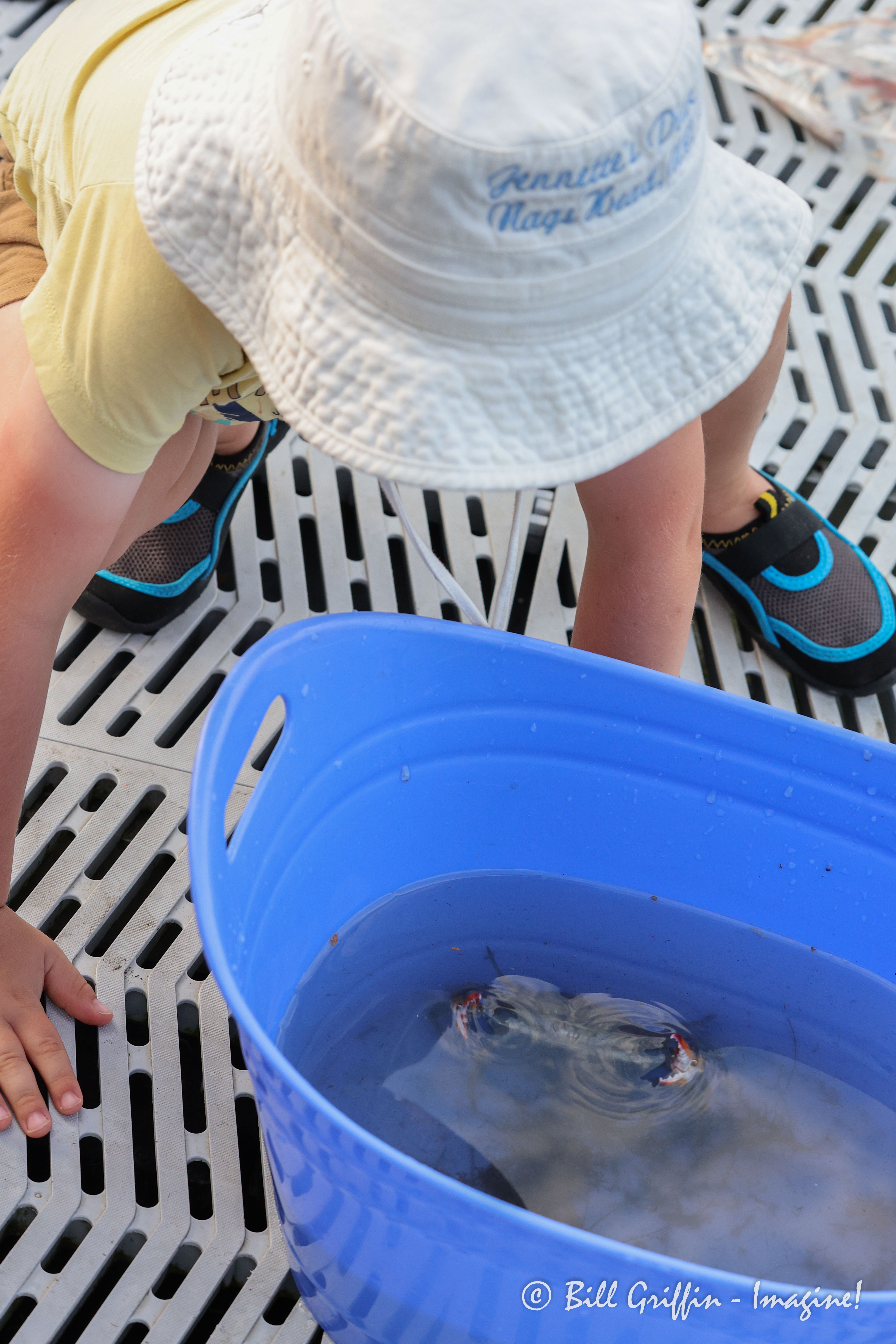
I don’t mean I can’t work magic; I mean I’m afraid I’ve lost the knack of magic working me. This morning the home health aide arrived to ride herd on Mom and Dad so I could spend the morning on the beach with grandson Bert and friends. The kid dads had planned some long postponed surf fishing; while Anthony dug for mole crabs, Josh whirled the casting net into the waves and hoped for minnows. On the third throw he brought up two tiny pompano the size of silver dollars and slipped them into a blue plastic bucket of sea water.
 . 
Bert, Wyatt, and Mari were more than rapt. The magic of flipping silvery fishes totally captured them and transported them into a new realm. Who would have thought four- and five-year olds could stare into a bucket for a solid hour? The magic of touching those velvet smooth wriggles, the magical bigness of becoming the ones responsible for bringing fresh water from the waves and moving the bucket with the shifting shade, the shocking magic of closeness, even intimacy, with something up until now just so many pictures in books – the magic worked those children. I witnessed their magic and regret to confess that I until I did I had only seen those little fish as bait.
 . 
That same evening I drove Mom and Dad over to Bogue Sound – Josh and Bert were going to catch a crab. The tide was right; the dead fish on a string was acceptably fragrant; the blue crab crept closer through the reeds. On his second try, Josh scooped up the dangerous decapod with a dip net and untangled his swimmerets and claws until he plopped into the blue bucket of sound water. A feisty one! Every time Bert moved his hand, the crab snapped claws up out of the water with undaunted ferocity. Bert was magic-smacked. “I never thought I would get this close to a real crab!” This from the boy with a hundred plastic sea creatures of every class, order, and family.
 . 
Perhaps I’ve lost the knack to be worked by magic because I read too much about and spend too little time staring into the blue depths of this unrelentingly odd and utterly magical universe. Perhaps the only hope for me is to catch a little magic as it streams off the children who are still so joyously connected to it. Or perhaps there are others also willing to share their magic. Those persons around me who are inching ever nearer to the magic as the long years of their living come ever nearer to their ending. Driving home from Bert and the Sound at dusk, Mom riding shotgun, I mention, “This is a good time of evening to see bunnies, Mom. Keep your eyes peeled.”
 . 
We turn the corner and Mom spots her at once, a fat cottontail smack in the middle of the neighbor’s lawn. And then we see her two smaller companions, the three of them considering us and chewing thoughtfully as we pass. Mom laughs and claps. “Oh Billy, how did you know we’d see bunnies? It’s just like magic!”
 . 
❦
 . 
One magic that poetry works is to occupy a different life. In Michael Hettich’s poems, he often seems to occupy several lives, each one exceedingly strange and each entirely commonplace. Through the thirty some years that the poems in this collection occupy, the writer walks around trying on other people’s lives. The surprise of his body may be rivers, trees, dry grass, a child sprouting wings. Bodies may be seedpods or they may burst into flame, they might be figures that dissolve into night or into water. These strange and wonderful transpositions and transformations are not fearful or repulsive – we as readers simply step into these bodies with Michael and become part of the magic.
 . 
This is the magic of wildness. Repeatedly, the poems remind us and display for us how wildness is at the heart of each of us. And this is the magic of music, not that the poem uses music to achieve its end but that the noise the world makes is music — poem discovers it and it reveals magic. So many of Michael’s characters sing. Or become song. Those not known for music as well as those whose music we have shut out of our busy non-wild lives. Michael sings, his wife sings, his father and family sing, and the songs weave magic that levitates and elevates and brings joy. When the ringing of my ears and of my machines has deafened me to the everything that makes up this universe of ours – the only known residence, after all, of magic – I know I can return to these poems and be restored.
 . 
The Halo of Bees, New & Selected Poems 1990-2022, Michael Hettich. Press 53, Winston-Salem NC, © 2023
Today’s post features “Selected” poems from the collection. Also see last week’s post, Catch Fire, which features “New” poems.
 . 
 . 
❦ ❦ ❦
 . 
The Frogs
 . 
He loved frogs, so he spent his afternoons
wading in the tall grass, or standing in the leafy water
where the stream turned. Charmed by their stories
of woods and muck, he practiced singing with them
at dusk at pond’s edge, while his mother and father
sat talking, with their cocktails, on the porch. As dark fell
his parent called him, most evenings, for dinner,
but sometimes they let him stay down there until the frogs
were hushed by the cicadas, whose conversations
startled him back to himself. He wandered
up to the house through the tall grass, through the dark,
still singing in his own language. Don’t think of him now,
drinking in a city bar, talking to strangers
who ignore him. Don’t think of him walking out into
the empty street, slightly drunk. He’ll be fine.
Think instead of that walk through the dark wet grass,
the sound of a child’s body moving through the grass;
think instead of those frogs falling silent, of that forest,
of mushrooms that push up overnight like elbows
in the moon-drenched mind of the woods.
 . 
Michael Hettich
from The Halo of Bees
 . 
 . 
❦ ❦ ❦
 . 
House of Light
 . 
Someone breaks open like a seedpod or a flower
to spill out across the street, and we all keep walking by
because it is too beautiful to notice, or too frightening,
as the river just moves on, the clothed and dreaming river,
the speaking river feeling just the way it needs to, nothing more.
There are feathers in the sky. Say birds, generic things,
or simply ignore them. But what about those other people
bursting into flame? will the singe you? Step away
from those other fires, as though you weren’t wild yourself
in all the parts that matter: in your blood and vivid thinking, seeing
colors for their secrets: how to move and be and feel
until you burst aflame. Some buildings built of stone are made
to echo now and then, forever – no one can escape –
but others made of wood are filled with window after window,
so many windows you could ever open all of them
in a single lifetime. No one lives that long. But you could open some.
 . 
Michael Hettich
from The Halo of Bees
 . 
 . 
❦ ❦ ❦
 . 
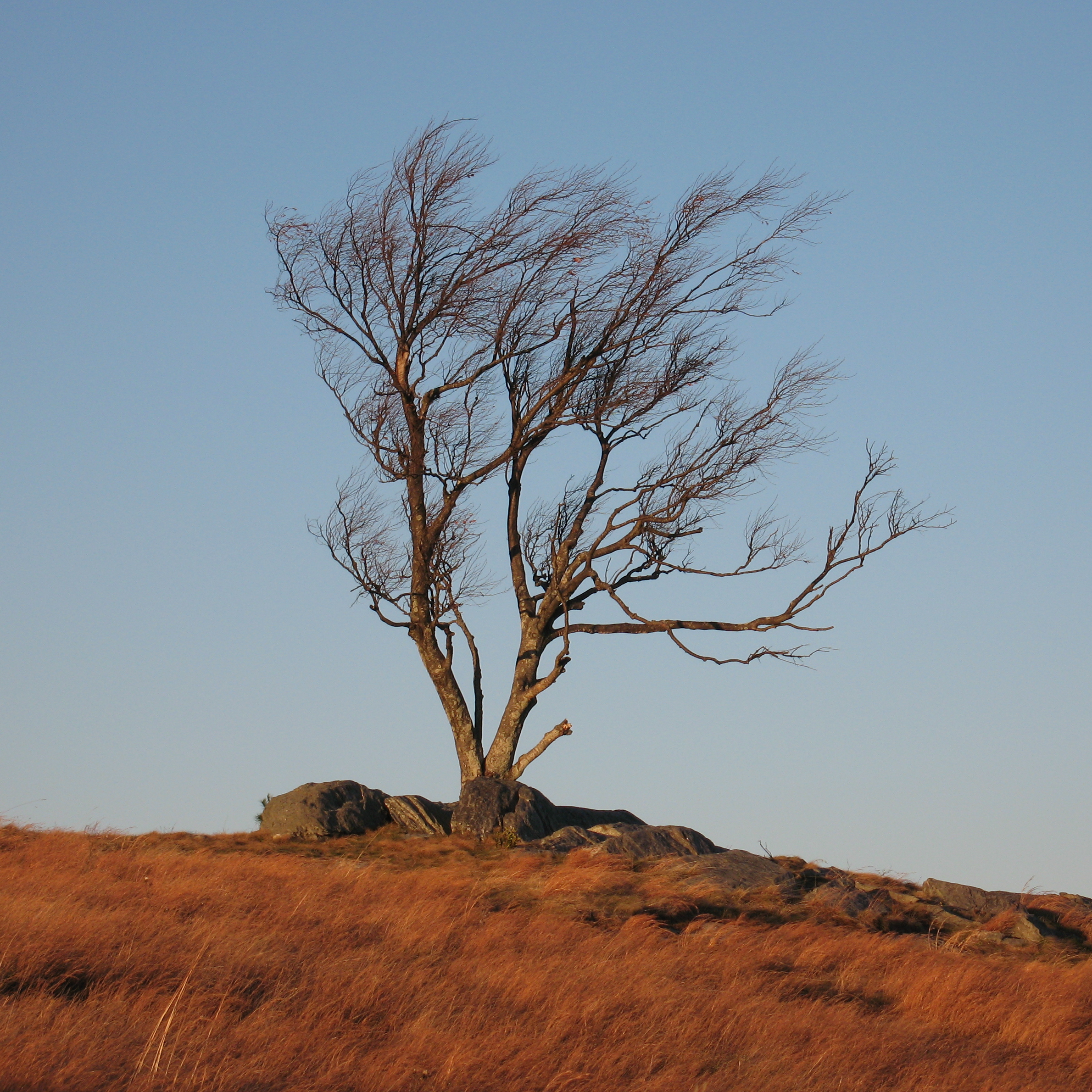
2020-06-11a Doughton Park Tree

Read Full Post »

« Newer Posts - Older Posts »