Feeds:
Posts
Comments

Posts Tagged ‘family’

 . 
[with 3 poems by Ana Pugatch]
 . 
My Mother’s Visit
 . 
The woman sensed that I now
looked down on her. That the earth
had turned slowly
 . 
into night. That her kin would only be
a distant moon. She watched
shards of light slice through the bamboo
 . 
thicket, the stars’ edges harden
and cool. In daytime she marveled
at the strength of a water buffalo, how
 . 
it shoulders could shift continents.
But I knew it would never be
enough.
 . 
We looked down
from the bamboo raft, and below
the glass surface saw
 . 
what flickered in turbid
darkness. Like my mother I thought
of the day when the river
 . 
would freeze over –
and how I’d give up everything
to feel its final stillness.
 . 
Ana Pugatch
from Engrams, Seven Years in Asia, winner of the 2022 Lena Shull Book Award of the North Carolina Poetry Society; Redhawk Publications, Hickory, NC; © 2023
 . 
❦ ❦ ❦
 . 
Above the river a west-facing ridge, protected, always cool and moist, and a narrow rustic trail that veers from the main — this is the path I take the day after Christmas. Winter brown, mossy stones and lichen, these are all I expect today, but here and there are premonitions. Ruddy toothed leaves, foamflower will bloom in March; bright green variegated heartleaf hides beneath pine needles today but soon will hide its own little brown jugs. So much muted beauty to share, but what is this! Hepatica is blooming!
 . 
Right here along this little path is the first place I ever discovered native hepatica in Elkin. (I still clearly remember where I was standing when I added my first bird to my life list decades ago, a chestnut-sided warbler — do normal people hold onto these sorts of memories?) But this is December — the earliest we ever see hepatica in bloom is late February, preceding even the rush of trout lilies. Nevertheless here is one plant with a flower and two swelling buds. Too, too early. Winter too warm. I can’t say I’m filled with happy thoughts for our planet.
 . 
A few days later I’m back with a camera. I can’t say I’m filled with happy thoughts of botany and phenology. Last night my brother and sister and I had a lengthy conference about our Mom’s decline. Tomorrow I’ll be sitting down with her and Dad to discuss a palliative care consultation and possibly moving to a higher level of care. I have to watch my footing carefully on parts of this trail – exposed stones, roots, erosion. Going downhill is when you’re most likely to fall. Mom’s descent has been steady for years, gradual, but the path ahead appears much steeper.
 . 
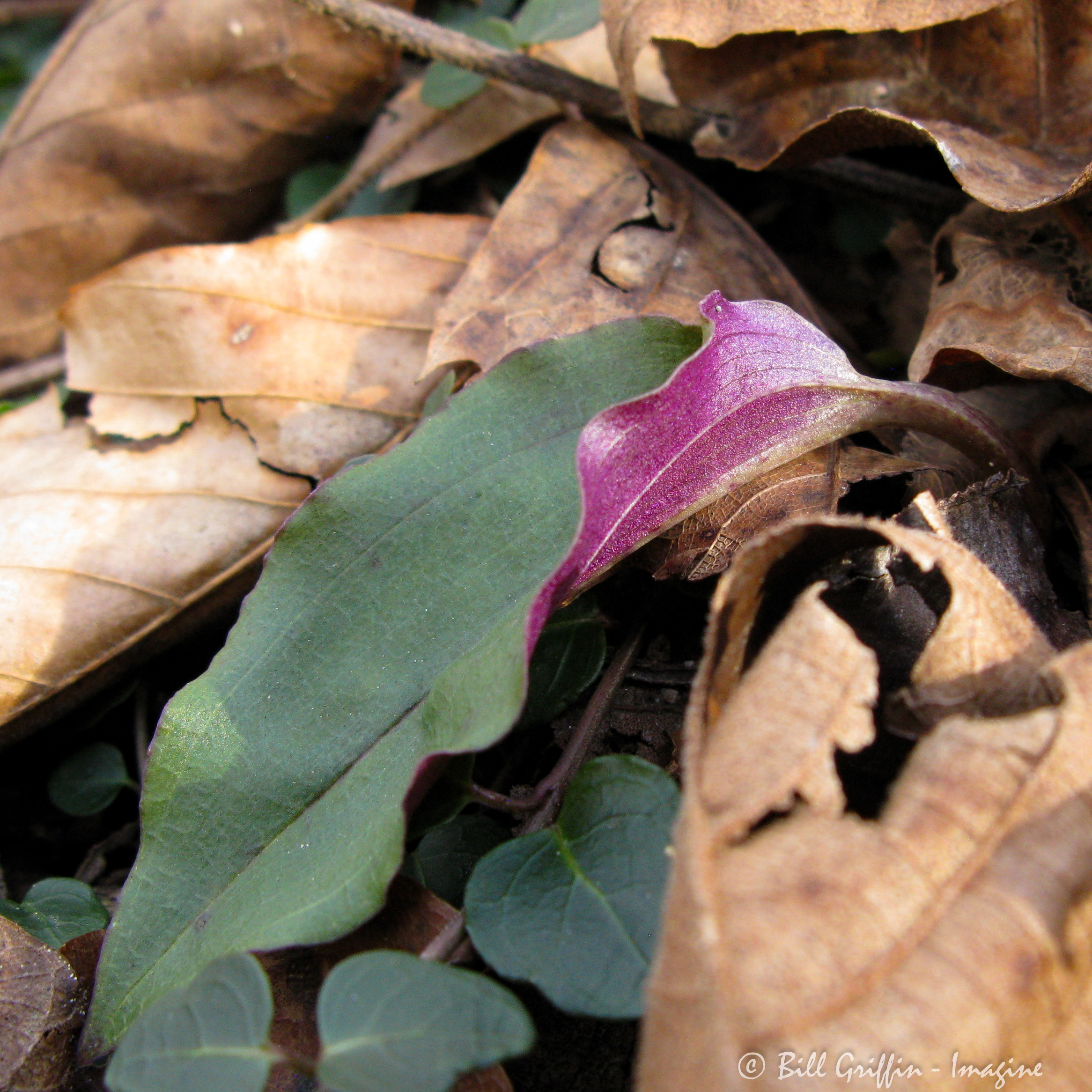
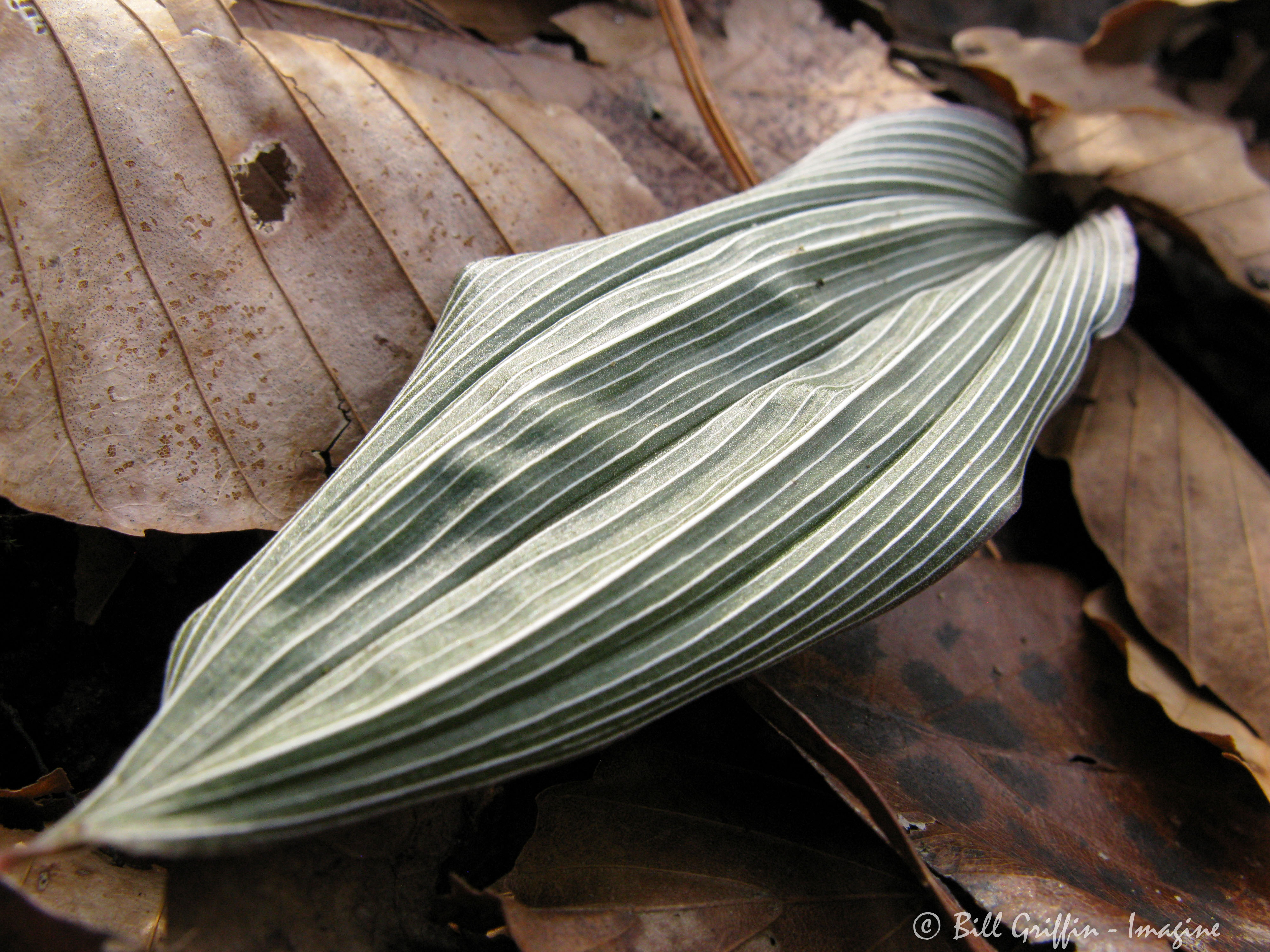
This is interesting – a single clump of pinstriped leaves, Adam-and-Eve Orchid. And Cranefly Orchid with its magenta underleaf is plentiful here. When the surrounding trees lose their leaves these orchids make sugar from winter sun. Their own leaves will fade and disappear before spikes of tiny flowers appear  mid-summer. Similar for the hepatica: last year’s flecked and nibbled liver-lobed leaves are making way for new green even now. Diminished light, cold and frost, life makes what it can of every season. I bend lower for a better look at each delicate yet resolute little family of leaves. Not a single flower to be found today.
 . 
 . 
❦ ❦ ❦
 . 
The Nightjar
+++ for S.
 . 
In the evenings you fold your wings
in a hammock on the porch.
 . 
your jaw clicks in imitation
of car locks. Your hair grows dark
to form a nest, twilight clouds:
 . 
a puff of throat. Mangrove roots
of a slow entanglement; filaments of stars
hang above us.
 . 
Don’t forget you say with the fan-eyes
of your tail as you fly away
 . 
each morning. You’re known
to frequent other lives, exhale their smoke,
catch tiny deaths on the temple’s
 . 
low wall. You’re known
for your camouflage, the concealment
of thoughts in daylight.
 . 
But I’ll still hold you, hoping
you’ll stay. Even if your ones are hollow,
 . 
fragile – I know one day you’ll roost
on steady ground.
 . 
Ana Pugatch
from Engrams, Seven Years in Asia, winner of the 2022 Lena Shull Book Award of the North Carolina Poetry Society; Redhawk Publications, Hickory, NC; © 2023
 . 
❦ ❦ ❦
 . 
Where does a memory live? Where does its root take hold, where is its safe repository? The sudden intake of breath at one sepia photo slipped from a pile of many others? A brief waft of scent upon opening a long-closed drawer? A word spoken in an unknown language ferrying meaning beyond its meaning? A phrase written in a notebook long misplaced? A dream?
 . 
Perhaps our memories are truly embedded in biochemical engrams deep in our hippocampus, hard-wired each in its own bud of synapse, but where is the map to its local address? Ana Pugatch knows to follow the narrow alleys and unmarked streets. Her poems are visions, aromas, sensations that may chill or warm. That may be fearful and unsettling or openly inviting. Her memories weave a world for me. Her world opens me to my own alleys, dim at times but becoming brighter; she opens me to streets I had forgotten. Or have yet to travel.
 . 
 . 
Is it because the world is so big and there are so many of us in it that we react by closing ourselves and retreating? Are we threatened by the rush and clamor of ideas, practices, cultures? Is that why we draw a line around our tribe and push all others away? We imagine that to survive we must deny, even destroy, everything outside our comfortable patch of expectations. To my mind, humankind’s survival depends on just the opposite. We can’t close the door but most open it. Perhaps we do feel frightened when confronted with anything that challenges our assumptions, whether a person, an artifact, an idea. Perhaps. And perhaps responding to novelty with imagination rather than rebuff is what allowed Homo sapiens to expand while Homo neanderthalensis dwindled and disappeared (except for the handful of Neanderthal genes we’ve acquired and still carry!).
 . 
Within poetry is concealed the map to our local memories. And in poetry we encounter shared memory and experience, doorways that may lead us out of our cloister and into the embrace of the different, the foreign, the alien, the frightening. As I read Ana Pugatch’s sensitive and sometimes ephemeral visions of her years in China and Thailand, and now of her presence in North Carolina, I am not an impartial observer watching a travelogue. I connect with those struggles. We are human, she and I and all the people she encounters. From the strangeness I feel a common thread winding around my heart. May that thread continue to pull me forward, and outward.
 . 
 . 
Engrams, Seven Years in Asia is available from Redhawk Publications.
The Lena Shull Book Award for a full length poetry manuscript is sponsored annually by the North Carolina Poetry Society. Submission period opens June 15, 2024.
 . 
 . 
❦ ❦ ❦
 . 
Unfurnished
 . 
I would write down the date if I knew
which day it was.
It’s Tuesday, I think,
and the baby cries upstairs.
 . 
I’ve never seen the family;
I only know them by
the red and gold characters posted
on their door.
 . 
Their laundry hangs
on the lines above mine;
Cantonese echoes through
my empty rooms.
 . 
We share the same view of Zhuhai.
We share that space of sky and trees
and we open our doors
when it rains.
 . 
Ana Pugatch
from Engrams, Seven Years in Asia, winner of the 2022 Lena Shull Book Award of the North Carolina Poetry Society; Redhawk Publications, Hickory, NC; © 2023
 . 
❦ ❦ ❦
 . 
 . 
❦ ❦ ❦
 . 
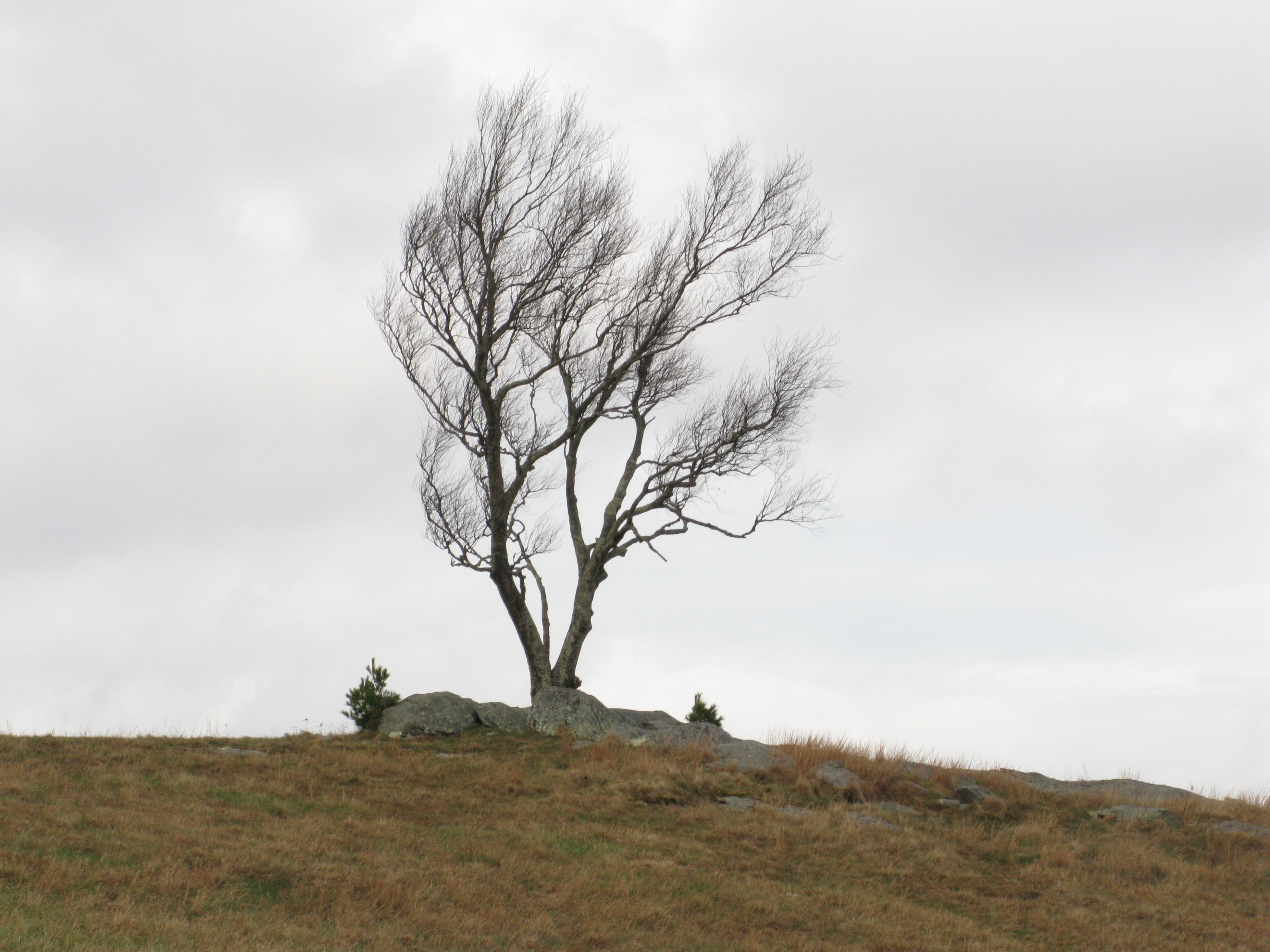
2018-02-09 Doughton Park Tree

Read Full Post »

 . 
[with 3 poems by Jane Shlensky]
 . 
Balance
 . 
Each morning Granny hobbles to the spring
uphill two miles with buckets in her hands
through woods now thick with frost, limbs cleared of leaves.
And over rocks almost atop a hill
behind her house, she sees the water gush,
and, slow with age, she stoops to clear away
the leaves and sticks that clot the pulses’ rush,
and, cracked cup in her hand, she dips into
“sweet water” as she calls it, gathered wild
as honey in abandoned rees, and pours
the nectar into metal milking pails
to carry down the mountain, arms held far
from hips and sides, all tense – as pugilists
might hold their arms, quite low with hands in fists.
But her fists grip the metal handle’s cut
into her palms, as water weighs her down
and down the well-worn path toward her house.
I offer her a new artesian well,
but she just laughs at me and shakes her head.
I ask if I may carry home the spring
for her, but she denies she wants the help
and says it gives her reason for a walk
among the trees on any given day
and carrying two buckets makes her sure
of foot and balanced in a world that’s not.
 . 
Jane Shlensky
from Barefoot on Gravel, Finishing Line Press, Georgetown, KY; © 2016
 . 
❦ ❦ ❦
 . 
I hate my anger more than I hate vomiting. The dead sick inevitability as it rises, how it makes my hands go cold and clenches my jaw. Disorienting, paralyzing rational thought. I am not going to let that anger out.
 . 
People tell you it’s best if you do. You have to let go of your anger. Maybe they’re right, because while it’s rising I don’t even see it coming, I don’t know to call it anger, I have no warning or defense that might prevent the stupid things I will do or the hurtful things I will say. I am afraid of the anger so I run from it before it can get me. Running, stumbling, I usually fall. Anger blasts me off balance.
 . 
Linda and I are sitting in the car. We had thought to take a walk in the gardens but now I’ve picked a fight with her, I can’t even recall about what. Linda has never let me get away with anything – I say this with honest, grudging admiration – and she says something now that jars me: “So is this what it’s going to be, then?” She is seeing something I can’t see. I admit it. I’m so confused, I tell her. And so she pushes me to relive the last couple of hours, ticking over the balance sheet – frustration at last night’s botched meeting, undercurrent of worried anticipation for tomorrow, niggling mis-steps and course changes this morning that had me snapping at a friend, patience evaporating to hot steam. Little angers mounting, not let out.
 . 
At last she wants to give me some justification. “Anyone would feel that way.” Not this time. True or not, I’m not buying that line. I’ve used it a hundred times to tamp down the anger, cover it and hide it. I don’t actually gain much insight into all this until much later, but there is one best way to regain some balance. To let anger’s own entropy cool it down to nothing. Sitting in the car next to Linda, I open up and own it. I said and did things that hurt people; I am responsible. I am sorry. I’m not happy with myself or the situation, but at least the two of us are finding enough balance to begin our walk after all.
 . 
 . 
It hurts to walk barefoot on gravel. When I first met Linda, she and her sisters went barefoot all summer long. It was nothing for them to walk a mile or two on those tar-and-gravel Ohio roads or through the woods over dry twigs and sweetgum balls. I tried to keep up, limping like an old codger and next day lame. But I kept walking on sore feet because I wanted to keep up. I wanted to be near them.
 . 
Jane Shlensky’s poems will not make you limp although they can be sharp and pointed. They will make you want to come along and keep up. Jane loves her characters, which she has drawn from generations of rural memories and red clay. She grew up in Yadkin County, NC, just across the muddy river from me, and she sees those farmers and grandmothers and wives more clearly than they ever saw themselves, perhaps. I don’t sense Jane imploring us to return to those old times and old ways. Instead, she shines her light on the truth of what brought her up and made her. What we carry in our pockets may change, but what we carry in our hearts does not. Read Barefoot on Gravel and find a moment of balance in a world that is so often not.
 . 
 . 
❦ ❦ ❦
 . 
Ain’t No Sunshine
 . 
“Oh, Lord,” she says, mixing the batter
for pancakes, the sausages sizzling,
the coffee perking in her mama’s pot
that’s so worn it’s barely metal.
She keeps it for the comforting perk,
fragrant life bubbling up, making promises.
 . 
But he’s in his wing chair, hunkered
over his guitar, his face blank as rain,
his strum, hum, strum him,
accompanying his slow moan.
His voice is like buttered rum, oiled
and warm as fever, just enough gravel
in his bass notes to scratch at her heart.
 . 
“Oh, Lord, that man,” she says to no one,
but her Lord hears everything in her heart.
She knows this as sure as she knows
the spit of oil before she tips the batter in,
as sure as she knows the hiss and blister,
bubble browning in the cakes.
 . 
He is having one of his blue days –
won’t fight the sadness, just leans on
that old guitar, curls in on himself
like a dog that hopes to lick the pain away.
He’s finding a sound to help him stand,
a trembling chord to lift a mighty weight.
 . 
He’s singing his own song and she knows it,
her heart clutching at his words, wishing
she could mother is sorrow away, feed
his hopes. She needs him, even if
they struggle every day. She turns to Jesus
kneeling on the wall and whispers,
“Dear Lord, that man there . . . we best
but some blueberries in these cakes.”
 . 
Jane Shlensky
from Barefoot on Gravel, Finishing Line Press, Georgetown, KY; © 2016
 . 
 . 
❦ ❦ ❦
 . 
One Better
 . 
While we puzzled over the perfect
birthday gift for our father,
he packed up his fishing gear and
a few clothes and bid us farewell.
 . 
Jane Shlensky
from Barefoot on Gravel, Finishing Line Press, Georgetown, KY; © 2016
 . 
❦ ❦ ❦
 . 
 . 
❦ ❦ ❦
 . 
 . Doughton Park Tree 2020-11-22

Read Full Post »

 . 
[2023 chapbook by Bill Griffin]
 . 
We Never Give Up Hoping
 . 
Morning frozen hard. Pour
++++ boiling water
into the birdbath;
++++ they will come
to drink when I have gone.
 . 
++++ God of holy ice, holy
++++ ++++ steam,
++++ give my children
++++ ++++ water
++++ that all my hoping
++++ ++++ can’t.
 . 
Sound of wings, splash
++++ diminishing;
find the world again
++++ iced over.
Fill the kettle. Holy water.
 . 
Bill Griffin
from How We All Fly, The Orchard Street Press. Gates Mills, OH, © 2023
originally published in Quiet Diamonds
 . 
❦ ❦ ❦
 . 
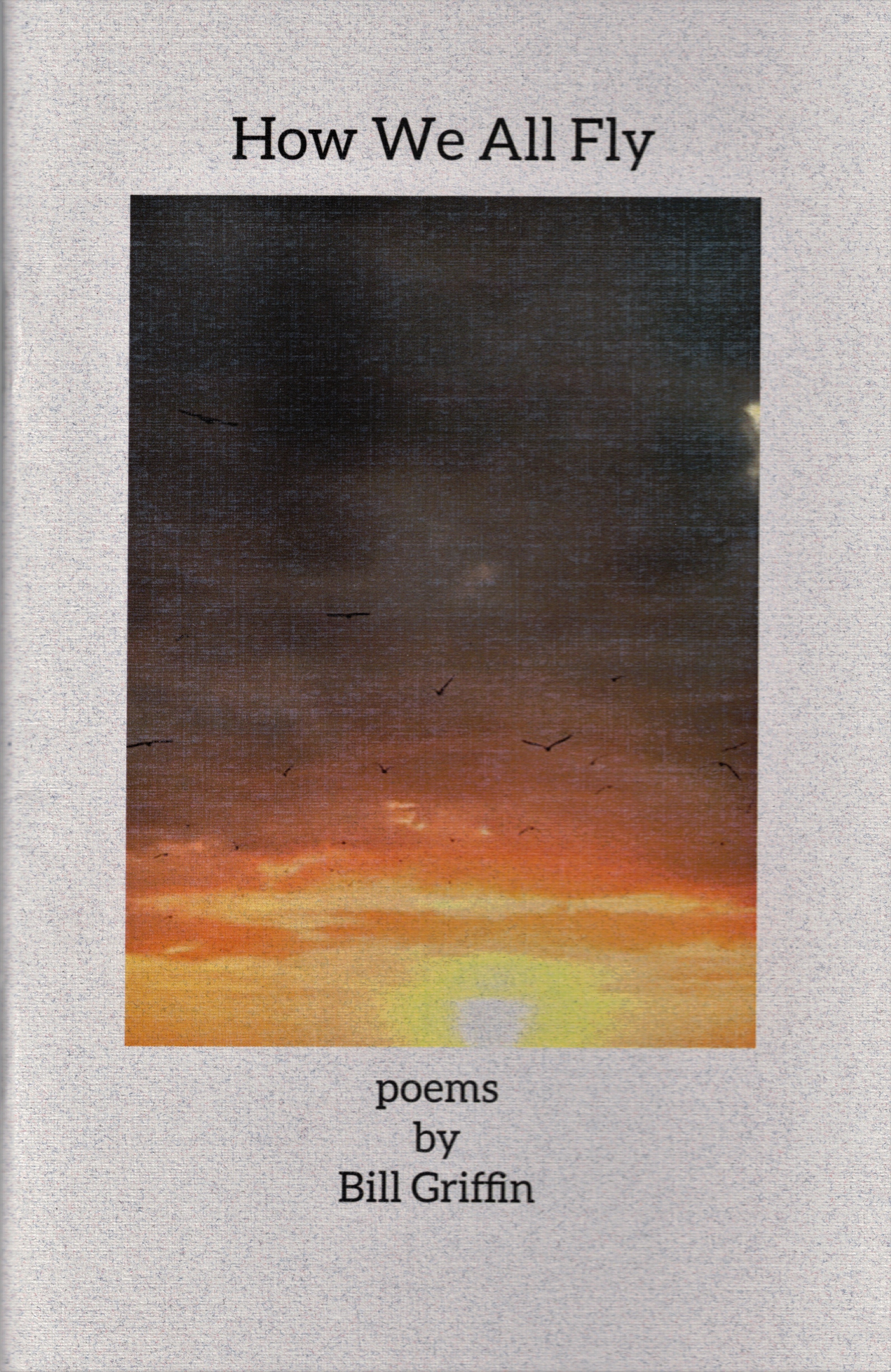
Join me in celebrating the release this month of my newest chapbook, How We All Fly, from The Orchard Street Press.
 . 
Poet Patricia Hooper describes the collection: “Through close observations of the physical world, these clear, direct poems yield insights into the corresponding life of the spirit.” And Rebecca Baggett says this: “Throughout these poems, but particularly toward the collection’s end, How We All Fly leads the reader up and onward, infusing even inevitable losses with tenderness, trust, and hope.”
 . 
Patricia Hooper is author of Wild Persistence, University of Tampa Press.
Rebecca Baggett’s most recent book is The Woman Who Lives Without Money, Regal House Publishing.
 . 
❦ ❦ ❦
 . 
 . 
❦ ❦ ❦
 . 
Thank you for your support, both of the writing you discover here and of the literary arts!
 . 
You may purchase a copy of How We All Fly directly from me by mailing a check for $15 (postage included) to this address:
++++++ 131 Bon Aire Rd.
++++++ Elkin, NC 28621
Please make your check payable to Bill Griffin.
 . 
If you would prefer to pay via PayPal, please contact me for transaction details at: comments@griffinpoetry.com
 . 
❦ ❦ ❦
 . 

Read Full Post »

« Newer Posts - Older Posts »