Feeds:
Posts
Comments

Posts Tagged ‘Ecopoetry’

 . 
[with 3 poems by Hilde Weisert, plus Wilfred Owen]
 . 
Imagination Itself
 . 
++++ To the eyes of a man of imagination,
++++ Nature is imagination itself.
++++ ++++ — William Blake
 . 
Who needs half a million unpronounceable forms of life
Half a world away? Ah, you do, they say,
And enumerate the ways:
++++ Glues, dyes, inks,
++++ Peanuts, melons, tea,
++++ Golf balls, paint, and gum,
++++ Mung beans, lemons, rice,
++++ And a fourth of all the medicines you take,
++++ And a fifth of all the oxygen you breathe,
++++ And countless life-prolonging secrets their wild cousins know
++++ to tell the Iowa corn and the garden tomato.
++++ And if that’s not enough, think of rubber —
++++ and where we’d all be, rattling down the interstate
++++ on wooden wheels.
 . 
And that’s only the stuff we know how to use,
And that’s only the half-million species we know how to name.
 . 
And in the time it took to tell you this
Five thousand acres more are gone.
And by the time that this year’s kindergarten class
is thirty-five, most of what is now alive —
 . 
But wait. What if — what if this deluge of mind-boggling
statistical connectedness were, true as it is,
only the least of it? What if the real necessity
were of another kind, the connection
 . 
Not with what you consume, or do, but who you are?
 . 
With your own imagination, the necessity there
of places that have not been cleared to till,
of the luxury of all that buzzing in the deep,
of a glimpse of feather or translucent insect wing
a color that’s so new it tells you light and sound
are, indeed, just matters of degree, and makes your vision hum
 . 
And makes you think the universe could hum
in something like the wild, teeming equilibrium
of the rain forest.
 . 
Hilde Weisert
from The Scheme of Things, David Robert Books, Cincinnati OH, © 2015
++++ originally published in THE SUN, Chapel Hill, NC
 . 
❦ ❦ ❦
 . 
Semi trailer in the right lane, speed almost matched, I can’t see green flashing past its far shoulder and the close cropped median is no consolation. Another morning driving to Winston to care for my parents, often a highway hour of calm & reflection, but today none of that. The hugeness of the truck, how much steel and rubber son to squat corroding and stinking in a back lot; the miles of asphalt and concrete, how much of the world we have eaten and smothered; myself no better than any, spewing carbon, cranking high this premature heat of summer – what is this world we have so mangled?
 . 
Linda and I caught a whiff of dead thing two days ago. Cool morning leaving for church then on to Duke Gardens for an outing, just a faint premonition of amines and putrefaction. Pre-stench. That night stronger when we returned too tired to seek its source near the driveway. Yesterday pungent but impossible to pinpoint. I didn’t want to find it. The bluebirds all weekend had been fretful and flighty around the birdhouse, bringing insects less frequently although chirping still audible inside. No chirping yesterday morning. Had the fledglings flown? Or . . .? I didn’t want to see what I feared in the nest.
 . 
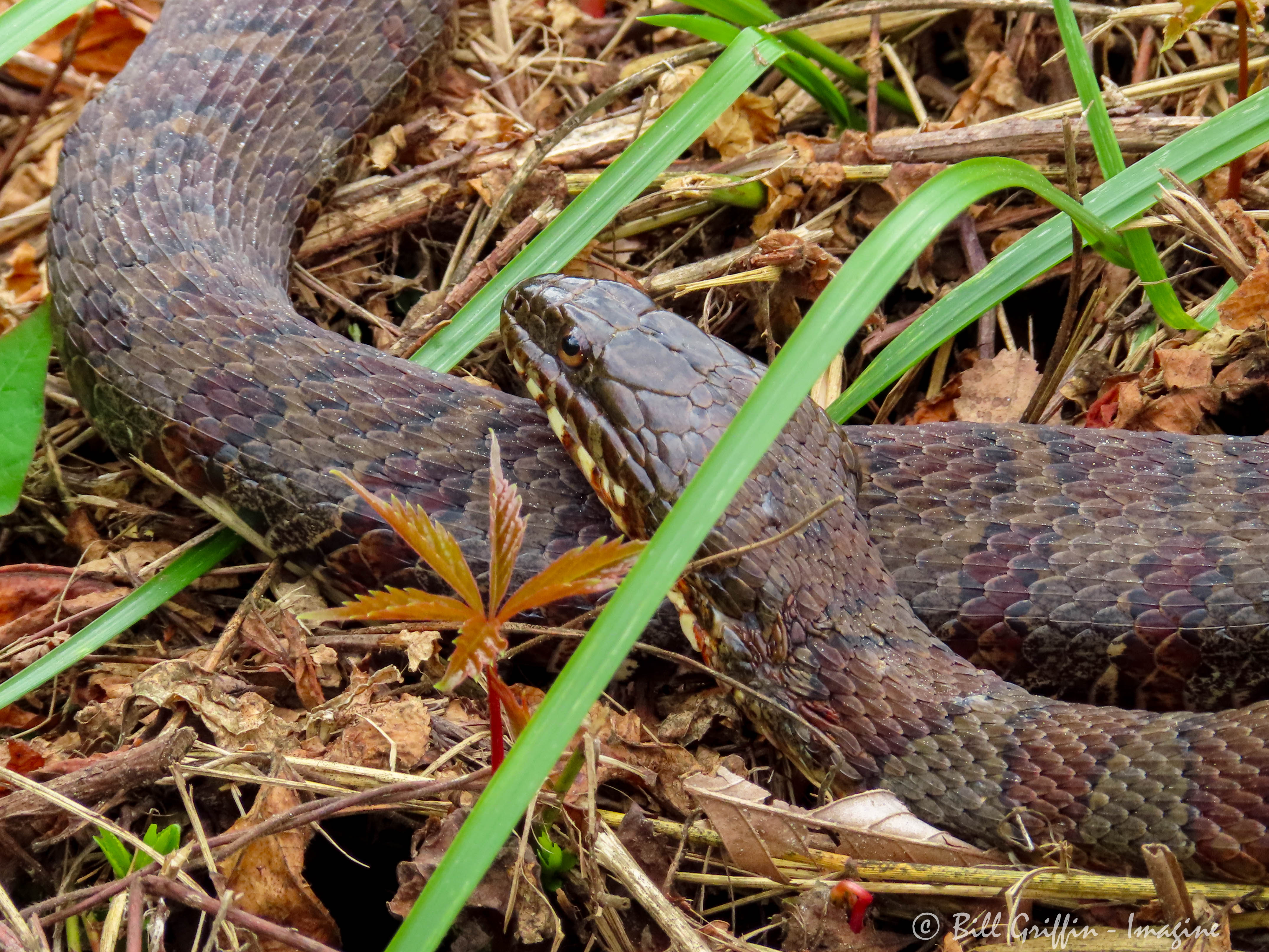
This morning the dead scent is a shroud of grief. I need to leave for Winston right now but first I walk the drive’s margin sniffing like a reluctant hound. It comes from everywhere. The compost heap? Down the hill, a dead rabbit or squirrel? I’m avoiding the birdhouse. When I reach it, though, I suddenly know. We couldn’t see from the porch but at the back of the post in webbing I tacked up to deter snakes is one. A large black rat snake.
 . 
So to save the eggs, the nestlings, I’ve killed a beneficial serpent. One just like all those I’ve swerved to avoid running over, one that no doubt has contributed to the absence of copperheads on our property. One I should thank, not destroy. The bluebird parents we saw were mightily upset by him even though he could never reach them. No feathered visitations this morning, no chirping. Have the young ones flown? Or for fear of the snake did the parents abandon the nest?
 . 
I will know when I clean out the birdhouse. But I can’t make myself do it this morning.
 . 
 . 
❦ ❦ ❦
 . 
Ars Poetica
 . 
“I learned to talk from my mother,” I said,
and was startled: Doesn’t everyone?
But “learned from” –
as if it were playing the piano,
or making the sylsalat at Christmas?
But it was: Her speech,
invented for me, her patience
letting my mouth and tongue
work the vowels, open
and open, then clench consonants
hard in my teeth, all nibbled edge,
and me still making of it a gibberish,
a babble; a glottal soup,
a drool;
 . 
My answering nothing but a rhythmic rumination
of nonsense syllables. But she kept on,
now a whisper, now a song, and in a while
the words became words: Epitome
and punctilio, modicum
and masterly; plenty of slang
like vamoose and delish, and play
in the “Ditto” that either one
could say, and smile, (our secret).
 . 
This language of the days
of our small world, dangled from,
rolled in, colored and toddled,
and finally slept on , a pillow,
the sun,
 . 
Is now so many vocabularies ago, fields
of cultivated speech –
 . 
But with this odd sentence I remember
what came first,
the ravishing world she made
me take, word by hungry word,
and how much more there is to tell
in our original language.
 . 
Hilde Weisert
from The Scheme of Things, David Robert Books, Cincinnati OH, © 2015
 . 
❦ ❦ ❦
 . 
As Hilde Weisert read from The Scheme of Things recently at McIntyre’s Books near Chapel Hill, I was captured in the net of imagining that she cast over her audience. For those few minutes I lived in new places and thought new ideas. Now reading her book straight through has expanded and reinforced that experience. I find it remarkable that poems that criss-cross so many years and so much distance can feel entirely local and present.
 . 
Each of the five sections – Three Stars; The Truth of Art; Skylark; Away; Where We Were and What We Were Doing – is a book unto itself. Each section weaves threads to create an entirety. Three stars: New York, Paris, Budapest, and the family relations that occupy them. The truth of art: language, science, learning to speak. Skylark: jazz, baby, jazz! Away: youth and age, what we lose, whom we lose. Where? This earth, this world, this stumbling life and all we might miss and all we might claim.
 . 
Hilde has lived many lives, it seems. Thanks to writers of books, thanks to poetry, you and I may live many lives as well.
 . 
 . 
More about David Robert Books and The Scheme of Things HERE
 . 
 . 
❦ ❦ ❦
 . 
Finding Wilfred Owen Again
 . 
Our college love affair was doomed
like all the romance I outgrew at twenty;
trench warfare’s mad embrace be damned
along with Buffy Sainte-Marie and Nietzsche.
++++ And anyway, the war in Vietnam was ending.
 . 
For decades he lay silent in a book,
moved from Brooklyn to St Louis and LA
with curling snapshots, silver rings turned black
the mildewed albums I will never play.
++++ I left him to his war; our war had ended –
 . 
Until I call, the offhand way you do old flames
(as if you hadn’t kept their trail of numbers)
when something big has changed, or Armageddon looms.
(Shamed moment: Was it Rupert I remembered?
++++ Romance imagined?) Not now: War has descended –
 . 
distant and mine. I”m dazed, feckless, as lost
as my lost country. So I come here,
to find myself standing on shattered ground he blessed
with full eyes ninety years ago and hear
++++ him tell another time how war must end
 . 
in this fell field, on this dark page. The night
opens, closes, opens, a swinging sulphur rhythm in the flare
igniting each line end, the faces lit
and then eclipsed,
but always bright the names.
 . 
Hilde Weisert
from The Scheme of Things, David Robert Books, Cincinnati OH, © 2015
 . 
❦ ❦ ❦
 . 
Anthem for Doomed Youth
 . 
What passing-bells for these who die as cattle?
++++ — Only the monstrous anger of the guns.
++++ Only the stuttering rifles’ rapid rattle
Can patter out their hasty orisons.
No mockeries now for them; no prayers nor bells;
++++ Nor any voice of mourning save the choirs,—
The shrill, demented choirs of wailing shells;
++++ And bugles calling for them from sad shires.
 . 
What candles may be held to speed them all?
++++ Not in the hands of boys, but in their eyes
Shall shine the holy glimmers of goodbyes.
++++ The pallor of girls’ brows shall be their pall;
Their flowers the tenderness of patient minds,
And each slow dusk a drawing-down of blinds.
 . 
Wilfred Owen (1893-1918)
 . 
❦ ❦ ❦
 . 
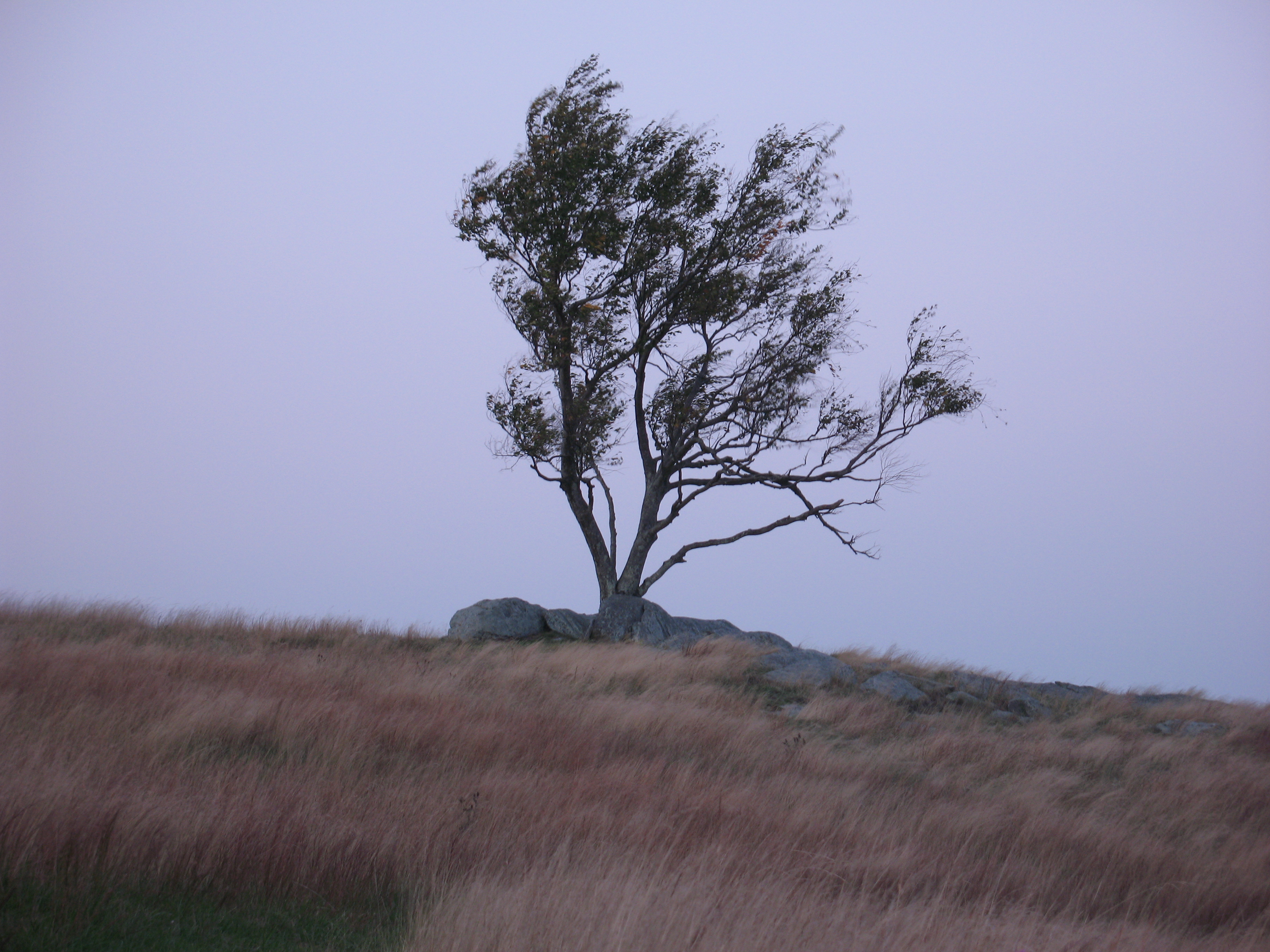
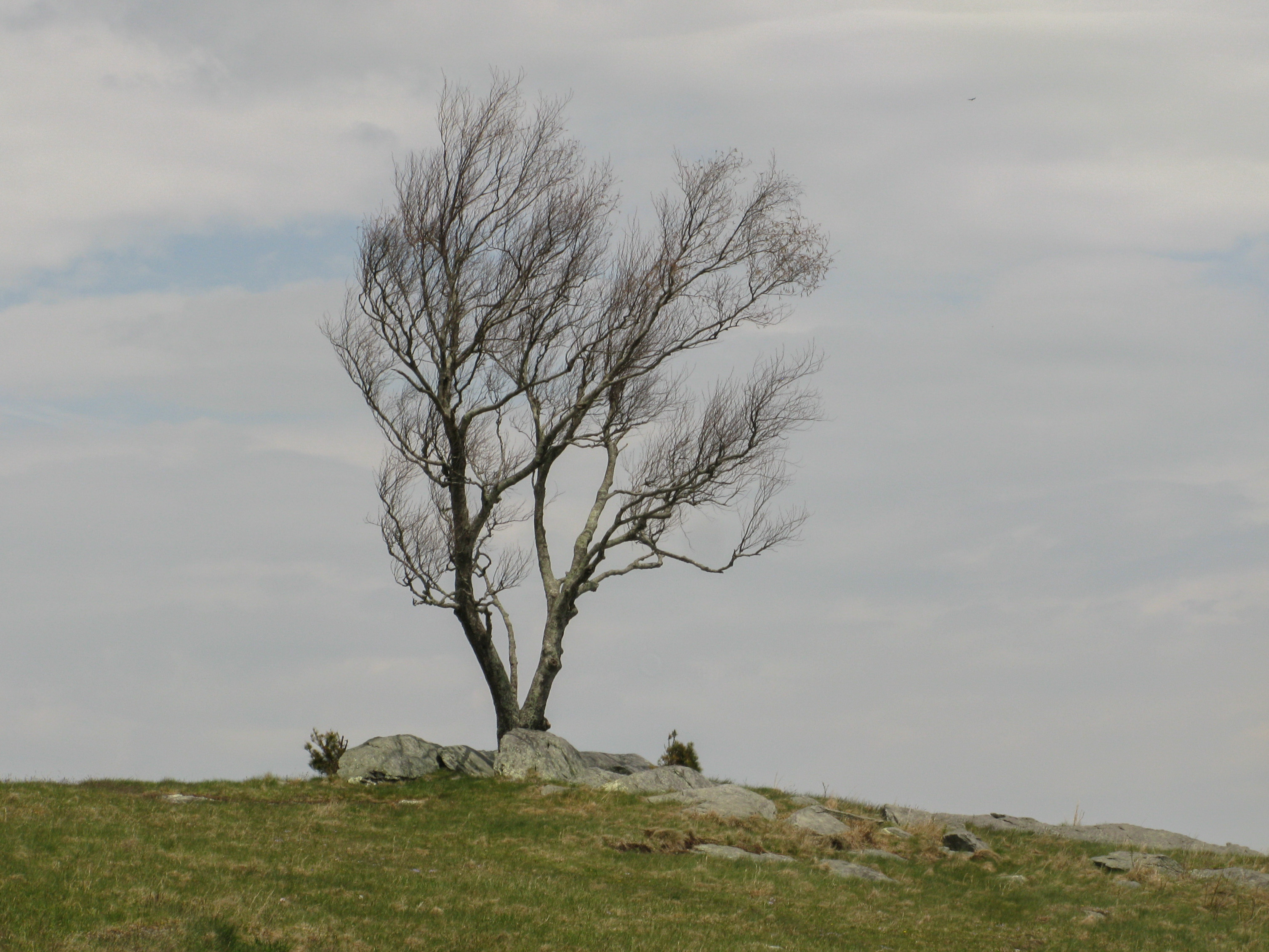
Doughton Park Tree 4/30/2022
 . 

Read Full Post »

IMG_0328
 . 
[two poems from An American Sunrise]
 . 
I Wonder What You Are Thinking,
 . 
The feathered wife asked her feathered husband –
 . 
She watches as he cleans his wings, notes how he sends his eyes
+++ over the horizon
To viridian in the flying away direction.
So many migrations stacked within sky memory.
 . 
Her body is stirring with eggs. She tucks found materials
Into their nest with her beak.
The nerves in her wingtips sense rains coming to soften the ground.
To send food to the surface of the earth.
 . 
He says nothing –
As he wonders about the careless debris that humans make
Even as it yields ribbon, floss and string.
 . 
Housecats and their sporting trails are on his mind’s map.
There are too many in this neighborhood.
 . 
A ragged yellow fellow eats birds after hours of play.
He stays out of that tom’s way, and has warned his wife
The same. Though she’s more wisely wary than him.
 . 
Dogs are easy. They bark and leap and wag their tails.
They have no concerns for most flying things.
They lap up human trails for love.
 . 
And why do we keep renewing this ceremony of nests?
Each feathered generation flies away.
What does it mean, and why
the green growing green
turning red against yellow,
then gray, gray and green again?
 . 
When I need her heartbeat
In the freeze winds why is she always there
And not somewhere else?
 . 
Her lilt question has made an echo in his ears
like a string fluttering from a bush
In the delicate spring wind:
 . 
I wonder what you are thinking . . .
 . 
He doesn’t answer.
 . 
Then he does.
 . 
“Nothing.
I was thinking about the nothing of nothing at all.”
 . 
Joy Harjo
from An American Sunrise, W. W. Norton, New York NY, © 2019
 . 
❦ ❦ ❦
 . 
I wonder what this House Wren outside my kitchen door is thinking. I think I can tell what he is thinking by watching what he is doing and listening to what he is saying, but is what I’m thinking he’s thinking really what he’s thinking?
 . 
Two weeks ago he – and I do mean “he,” no question about male behavior – discovered the new wren house my daughter and her Josh gave us for Christmas. For days he perched on it and blasted us with what he calls song: three razor sharp notes followed by high decibel jumble sounding like everyone’s tripping all over each other. He would sing for a few minutes, then I’d hear him on the other side of the neighbor’s yard, then down in the woods, then back to us. Pretty soon I caught him shoving sticks into the wren-sized hole in the little hanging house, then hopping inside before jutting his head out and singing again.
 . 
House Wren males build two or more “dummy nests” to attract a mate. If the female likes what she sees, she picks him for her chicks’ daddy and picks one site; she finishes off the nest with soft before laying eggs. My personal wren spent at least a week making the circuit of his three nests. Were there no females in this end of Surry County? Did I detect his singing becoming ever more energetic? (“Frantic” and “insistent” would also be good descriptors for that revving engine of a song.) Finally I noticed two wrens hopping branch to branch in the serviceberry tree where the nesting box hangs. Yes! And they’ve stayed, so they must be a pair. (To mere humans male and female House Wrens look absolutely identical, no trace of sexual dimorphism).
 . 
And he still sings. A few times an hour instead of every few minutes. I’m thinking those first songs conveyed him thinking, “This is my big chance. c’mon C’mon C’MON!” Now he’s thinking, “OK, off to a good start, kids to raise, you other wrens listen and weep and KEEP YOUR DISTANCE!” But how do I know? Just because that power-song jumps my heartbeat 20 points doesn’t mean it’s not, for the wren himself, the most laid back Zen-song in the Avian Class. In fact, it’s probably fruitless and a little silly for me to even think I can know what he’s thinking.
 . 
But then there is this: I am grateful for the tiny eggs and I’m positive he and she are as well. Let me sing for you, little House Wren, my song of gratitude.
 . 
 . 
Joy Harjo’s An American Sunrise is a journey, a revelation, a lament, a celebration. I featured three poems last week in THE WAY HOME and pondered what it might take for us to all become family. This week, though, I can’t leave her book without sharing these two poems about birds. They knock me out. I often suspected but now I see it’s true that I share a lot of DNA with birds (well, Family Hominidae and Class Aves are all part of Phylum Vertebrata, so YES we all share plenty of genes). If you, too, want to be a bird when you grow up, send me a comment after you finish reading.
 . 
 . 
An American Sunrise, Joy Harjo; W. W. Norton & Company, New York NY © 2019. Joy Harjo served as Poet Laureate of the United States for three terms, 2019 through 2021.
 . 
❦ ❦ ❦
 . 
 . 
❦ ❦ ❦
 . 
Redbird Love
 . 
We watched her grow up.
She was the urgent chirper,
Fledgling flier.
And when spring rolled
Out its green
She’d grown
Into the most noticeable
Bird-girl.
Long-legged and just
The right amount of blush
Tipping her wings, crest
And tail, and
She knew it
In the bird parade.
We watched her strut.
She owned her stuff.
The males perked their armor, greased their wings,
And flew sky-loop missions
To show off
For her.
In the end
There was only one.
There’s that one you circle back to – for home.
This morning
The young couple scavenge seeds
On the patio.
She is thickening with eggs.
Their minds are busy with sticks the perfect size, tufts of fluff
Like dandelion, and other pieces of soft.
He steps aside for her, so she can eat.
Then we watch him fill his beak
Walk tenderly to her and kiss her with seed.
The sacred world lifts up its head
To notice –
We are double, triple blessed.
 . 
Joy Harjo
from An American Sunrise, W. W. Norton, New York NY, © 2019
 . 
 . 
❦ ❦ ❦
 . 
2020-09-08b Doughton Park Tree
 . 

Read Full Post »

 . 
April 26, 2024
 . 
In order to see birds it is necessary to become a part of the silence.
++++++ Robert Lynd (1879-1949) – naturalist
 . 
To see a wren in a bush, call it a wren and go on walking is to have seen nothing. To see a bird and stop, watch, feel, forget yourself for a moment, to be in the bushy shadows, maybe then feel wren – that is to have joined in a larger moment with the world.
++++++ Gary Snyder
 . 
Keep a green tree in your heart and perhaps a song bird will come.
++++++ Chinese proverb
 . 
❦ ❦ ❦
 . 
November
 . 
It is an old drama
this disappearance of the leaves,
this seeming death
of the landscape.
In a later scene,
or earlier,
the trees like gnarled magicians
produce handkerchiefs
of leaves
out of empty branches.
 . 
And we watch.
We are like children
at this spectacle
of leaves,
as if one day we too
will open the wooden doors
of our coffins
and come out smiling
and bowing
all over again.
 . 
Linda Pastan (1932-2023)
from Carnival Evening: New and Selected Poems 1968–1998, W W Norton & Co, © 1999
 . 
Shared by Bradley Samore, Plano TX, who writes:
 . 
This poem by Linda Pastan reminds me of our hushed wonder toward the non-human and our tendency to imagine ourselves in relation to what we see. Perhaps there is no objective way to view something as each species, each person, has their own limitations and reference point. Like Gerard Manley Hopkins’ “Spring and Fall”, Pastan makes the connection between the leaves falling and our own human death but also hints at the possibility/impossibility of our rebirth, another budding.
 . 
++++++ Bradley
 . 
 . 
Revelation
 . 
Nothing compares to exploring the land
++++++ but what of becoming part of it
 . 
to sit so still that lizards
++++++ mate by my sandaled feet
 . 
to kneel at the grave where from shadows
++++++ a fox approaches unafraid
 . 
to lie on the grass as daylight fades
++++++ and birds feather the branches above
 . 
Bradley Samore
first appeared in Hoot
 . 
 . 
❦ ❦ ❦
 . 
The charm which Henry [David Thoreau] uses for bird and frog and mink, is patience. They will not come to him, or show him aright, until he becomes a log among logs, sitting still for hours in the same place; then they come around him and to him, and show themselves at home.
++++++ Ralph Waldo Emerson, from his journal, May 11, 1858.
 . 
I hope you love birds, too.  It is economical.  It saves going to Heaven.
++++++ Emily Dickinson
 . 
❦ ❦ ❦
 . 
Kinship
Rootless and restless and
warmblooded, we
blaze in the flare that
blinds us to that slow,
tall, fraternal fire of life
as strong
now as in the seedling
two centuries ago.
 . 
Ursula K LeGuin
 . 
❦ ❦ ❦
 . 
The cockroach and the birds were both here long before we were. Both could get along very well without us, although it is perhaps significant that of the two the cockroach would miss us more.
++++++ Joseph Wood Krutch, from The Twelve Seasons (1949)
 . 
More than at any other time, we feel the strangeness of birds when we stop and pick up a feather in our path. There is nothing on Earth to compare it to; there is no material like it, no form, nothing that functions quite the same way.
++++++ Bruce Brooks, from On the Wing
 . 
 . 
❦ ❦ ❦
 . 
Landscape with Jeffers and the Connecticut River
 . 
Oat stalks hang their oat-heavy heads.
Panic grass shakes in the wind
off a goldfinch’s wing. Cause,
++++ ++++ ++++ ++++ effect, and cause.
 . 
Drone, like the bee, of goldenrod and aster,
tool of the stick-tight and cockleburr,
I park and wade into high riverside grasses.
 . 
A dog gnaws on a box turtle, a spider rides
a floating log, straining the air of its midges and leafbits.
A fisherman lazy as late summer current,
++++ ++++ ++++ ++++ ++++ casts, reels, and casts.
 . 
It occurs to me I am alive, which is to say
I won’t be soon. Robinson Jeffers
from Carmel Point, in “an unbroken field of poppy and lupin”
 . 
ashamed of us all (of himself ), took solace in time,
in salt, water, and rock, in knowing
all things human “will ebb, and all/
++++ ++++ ++++ ++++ Their works dissolve.”
 . 
Me, too. And I’m not always so patient. I’ve caught myself
wishing our spoiler species gone, just swept away,
returned to rust and compost for more deserving earthly forms.
 . 
Meanwhile, flint arrowheads turn up among the plastic
picnic sporks, the glacial crags and bottom silt.
Hawks roost across the river on the now defunct
++++ ++++ ++++ ++++ ++++ nuclear power plant cooling tower,
 . 
flotsam left at the human high water mark.
Like mussel shells, like driftwood or seedpod,
like the current’s corrugations in the sand.
 . 
Here, on this side, a woodchuck sits up, lustrous,
fat on her chestnut haunches, (she thinks herself
queen of her narrow realm) and munches
++++ ++++ ++++ ++++ the fisherman’s crust.
 . 
Who wouldn’t smile? Who doesn’t pity—and love—
the woodchuck not only despite but for her like-human smugness?
How can I not through her intercession forgive
++++ ++++ ++++ ++++ ++++ for now a few things human.
 . 
Jennifer Atkinson
from The Thinking Eye, Parlor Press, © 2016
 . 
Jennifer Atkinson writes in Poems.com:
 . 
But how do we live with our knowledge and the emotional cloud of fear, guilt, anger, grief, and helplessness, a cloud that surrounds us, each of us alone, and all of us together? That cloud has become intrinsic to my ecopoetical work. Burdened with the beauty and loss and malicious awfulness ahead, weighted with the anxiety that hits whenever a winter day dawns without frost on the ground or another ‘unprecedented’ downpour rings in the gutter, how do I live?
 . 
 . 
❦ ❦ ❦
 . 
The bluebird carries the sky on his back.
++++++ Henry David Thoreau
 . 
We lose our souls if we lose the experience of the forest, the butterflies, the song of the birds, if we can’t see the stars at night.
++++++ Thomas Berry
 . 
It is the ancient wisdom of birds that battles are best fought with song.
++++++Richard Nelson
 . 
❦ ❦ ❦
 . 
Rain Light
 . 
All day the stars watch from long ago
my mother said I am going now
when you are alone you will be all right
whether or not you know you will know
look at the old house in the dawn rain
all the flowers are forms of water
the sun reminds them through a white cloud
touches the patchwork spread on the hill
the washed colors of the afterlife
that lived there long before you were born
see how they wake without a question
even though the whole world is burning.
 . 
W.S. Merwin (1927-2019)
from The Shadow of Sirius, Copper Canyon Press, © 2009
 . 
 . 
❦ ❦ ❦
 . 
My favorite weather is bird-chirping weather.
++++++ Terri Guillemets
 . 
You can observe a lot by just watching.
++++++ Yogi Berra
 . 
Look at everything as though you were seeing it either for the first or last time. Then your time on earth will be filled with glory.
++++++ Betty Smith, from A Tree Grows in Brooklyn
 . 
❦ ❦ ❦
 . 
 . 
Special thanks throughout these Earth Day celebrations to my hiking buddy and nature guide Mike Barnett, who has let me into the wilderness and won’t let me leave. Most of the quotations included in these sections are compiled in Mike’s Medicine Bag, which he carries with him into every new adventure
 . 
And EXTRA SPECIAL THANKS to my companion in the universe, Linda, who allows the cosmos to flow through her pen onto paper. She has given permission for me to use a few of her drawings throughout these Earth Day celebrations.
 . 
++++++  Bill
 . 
 . 

Read Full Post »

« Newer Posts - Older Posts »