.
[ poems by Sam Love, Joey Hall, Donna Wojnar Dzurilla, Ron Rash,
George Ella Lyon, Christy Hamrick, Gene Hyde, Ronnie Scharfman ]
.
Golden Spiral
.
Blowing the conch shell
can herald a call to prayer,
warn of danger,
or celebrate a victory.
.
With lips clinched the breath
enters a small hole
in the end of the shell
and bounces off the spiral cavity
.
to expand in volume.
The conch mimics nature’s designs
of spiral galaxies, spiral bacteria,
packed atomic particles,
.
and the contours of sand dunes.
This sympathetic vibration
amplifies inside the conch
until a loud ohm-like sound
.
exits the large opening.
Listen to contemporary poets
trumpet warnings of:
global warming,
.
stronger hurricanes
increased forest fires,
and beaches so hot
mollusks cook in their shell.
.
May this voicing of our survival instinct
resonate like the expanding volume
in the conch and awaken the masses.
.
Sam Love
.
I worked with a Boys and Girls Club to create some poems for a local Earth Day event on the theme of water, which we are doing in New Bern next Saturday, April 25. I was particularly pleased with a poem from an 8th grader. [see below] I am also including Golden Spiral, the opening poem for my book of environmental poems Earth Resonance: Poems for a Viable Future published by The Poetry Box.
— Sam
.
❀
.
Water
.
The ichor, the future, the blood of our earth,
older than life, and there since our birth,
The life-giving fluid of infinite worth,
still teeters yet on the edge of full dearth.
.
If you haven’t yet guessed, this ichor is water,
the crystal clear fluid and life’s grand supporter,
Our vital restorer, and marine life’s transporter,
and yet its supply just grows shorter, yet shorter.
.
You see, o’er ninety percent of this water toils,
in salty tides, but that’s not just where it spoils,
because pipes and fields leak harmful fluids and oils,
leading Earth’s greatest resource to be dirtied and soiled.
.
But actions are clear in their paths, and essential in taking,
or else this great resource may end up breaking.
So conserve it in usage, and limit your taking,
and don’t contribute to the Earth’s nigh unmaking.
.
Preserving this water, this lifeblood, is dire,
lest every dear creature on Earth soon expire,
So avoid a drought’s wrath, and Mother Nature’s mad ire,
and preserve the clear liquid that we all require.
.
Joseph ‘Joey’ Hall, Grade 8
selected by Sam Love
.

.
❀ ✿ ✾ ❁
.
Fire Along the New River Gorge
.
FAYETTEVILLE, WVA—A brush fire of unknown origin in the New River Gorge National Park & Preserve burned 1,550 acres as of 11/11/23.
.
The prehistoric Teays River
flowed northward branched
east to west cut
roots out of the old mountains.
.
Meltwaters, pulled by the moon
flowed back, filled the New River
from plateau to silted bottom—
a thousand foot drop.
.
Forests
Rise.
Fall.
Rise.
.
Steep Valley
War Ridge
Backus
Mountain
.
Sugar Maple Sweetgum White Ash Eastern Hemlock Beech Pawpaw
Yellow Buckeye Tulip Tree Basswood Eastern White Pine
Northern Red Oak Black Walnut
.
Burn.
Rain
cuts
new roots.
.
Donna Wojnar Dzurilla
from the anthology, Tributaria: Poetry, Prose, & Art Inspired by Tributaries of the Ohio River Watershed. Sherry Cook Stanforth, Richard Hague, and Michael Thompson eds. Dos Madres Press. Originary Arts Initiative. Fall 2025.
.
I wrote “Fire Along the New River Gorge” after spending time enjoying the New River Gorge National Park and Preserves. I learned of the brush fire in the epigraph on the news. I arrived home in Pittsburgh to learn that smoke from the Canadian wildfires drifted through Pittsburgh’s skies. I thought about how during the 60+ years of my life (I grew up and live in Pittsburgh) I saw the air and rivers clear (for the most part) from pollution. It may seem foolish, but it was the first time I realized that fires could be harbingers of climate change. I thought about how the ancient Teays River defined the Appalachian Mountains–that it flowed north, then backflowed, and that intrigued me. I thought of rain as rebirth and of how brush fires have always occurred; about how fire can cleanse after which rain restores. I am afraid of the Earth reaching the point of no return. I hope we, as a planet, aren’t too late and that rains will come.
— Donna
.
✾
.
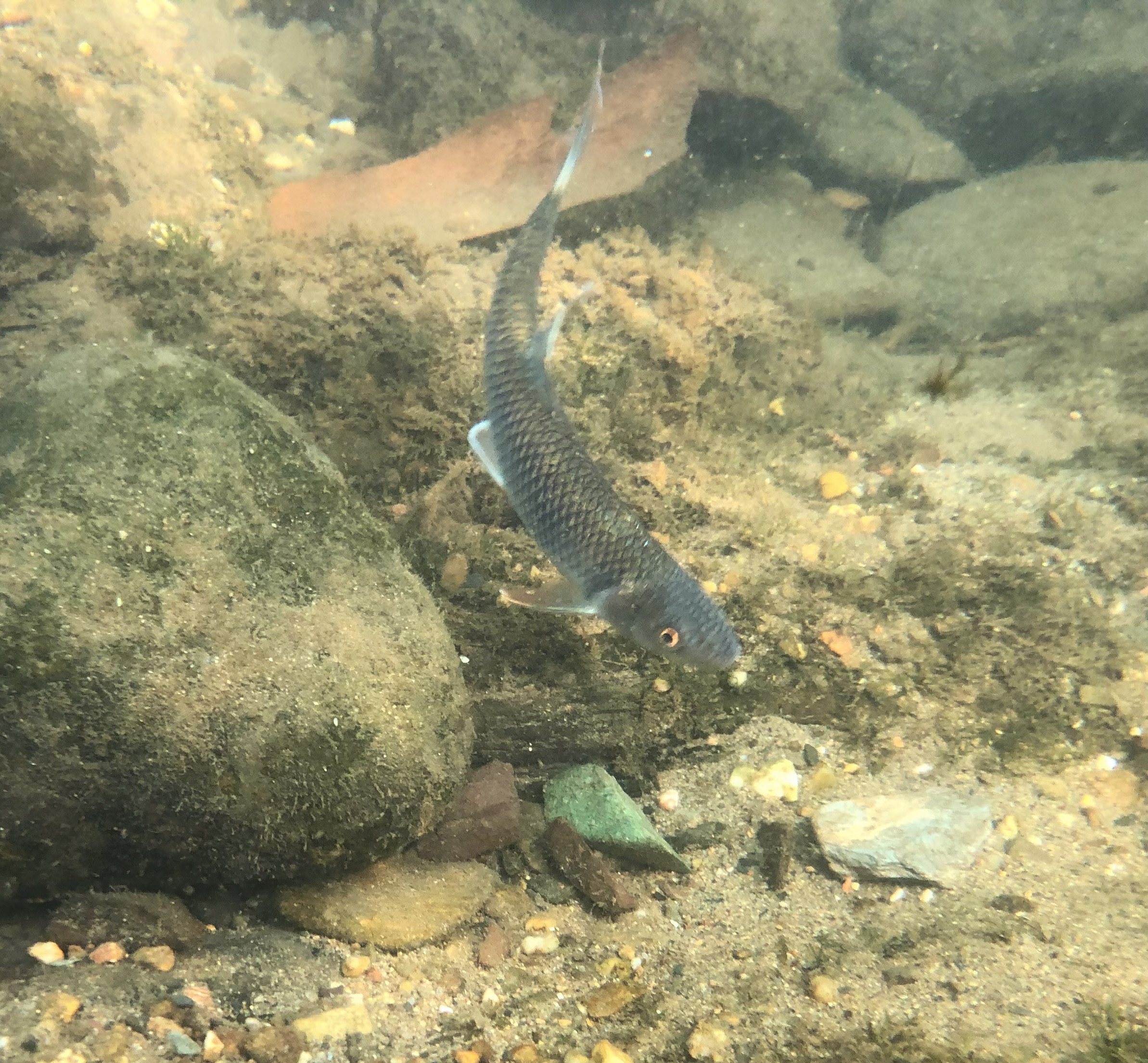
Speckled Trout
.
Water-flesh gleamed like mica:
orange fins, red flankspots, a char
shy as ginseng, found only
in spring-flow gaps, the thin clear
of faraway creeks no map
could name. My cousin showed me
those hidden places. I loved
how we found them, the way we
followed no trail, just stream-sound
tangled in rhododendron,
to where slow water opened
a hole to slip a line in,
and lift as from a well bright
shadows of another world,
held in my hand, their color
already starting to fade.
.
Ron Rash
first published in Weber Studies, 1996, and reprinted in Raising the Dead, Iris Press, 2002.
selected by Donna Wojnar Dzurilla
.
.
✾
.
What Do I Hope to Learn by Watching Birds?
.
Sunflower seed shells
pepper the snow.
A lone male
Red-bellied Woodpecker,
crimson crown
rusted ivory breast
armored against cold
by chevron wings,
worries suet
through the wire frame.
.
A spectrum of
preternatural blues,
flash of white
swoops crosswise,
Blue Jay
breast thick
like the gray mourning
doves; spooks away the
Juncos
Starlings
.
House Finches
Tufted Titmouse
Chickadees,
and little brown jobbies: the sputzies
(spatz, German for sparrow).
The woodpecker
finds perch atop
silver maple—
bare but for russet buds
hoping for sun and spring.
.
Jay claims ownership
of the full feeder.
In response to the bird’s girth,
it swings
to center of gravity;
dumps fresh pips
to dance
amidst hollow husks
strewn atop
ice-crusted snow.
.
I hear
no birdsong
through
the double-
pane window.
Careful not to:
move
make a sound
be seen
be a threat.
.
Mated cardinals
find ground. Six pair.
A flock of ghosts?
Brilliant redbirds
shoo chestnut mates
away from piles of seed,
collapse their mohawk crest;
prepare for battle,
to challenge
the blue bird. But
.
a bald eagle,
juvenile;
dark umber
black beak
ivory speckled under-feathers
no mate, no aerie,
up from the frozen river,
hunting;
shadow-tracks over
crystal battlefield.
.
Weighted pause
in the solid snow-quiet.
Ice diamonds glister,
revealing luminous
gleaming facets;
sparkle
broken by
bird
tree
dry husks.
.
My backyard a stage.
.
Donna Wojnar Dzurilla
.
I wrote “What Do I Hope to Learn by Watching Birds?” after returning from a weekly vigil that I attend, conducted each Friday by a different religious denomination in front of Pittsburgh’s I.C.E. field office. The vigil’s prayers are for those murdered and those detained, as well as prayers for peace and change. When I returned home I looked out my kitchen window at the birds at the feeders in my backyard and watched a busy snapshot of nature play out. Watching the birds made me think about the many sides of nature. It made me think about human nature and I considered whether fascism and hate are an ugly trait of human nature–something we will never be rid of, something that resurfaces and returns. In my poem, the red and blue birds mix. I don’t know if the young eagle will revert to its nature–is it a predator or a noble, heroic protector?
— Donna
.
❀ ✿ ✾ ❁
.
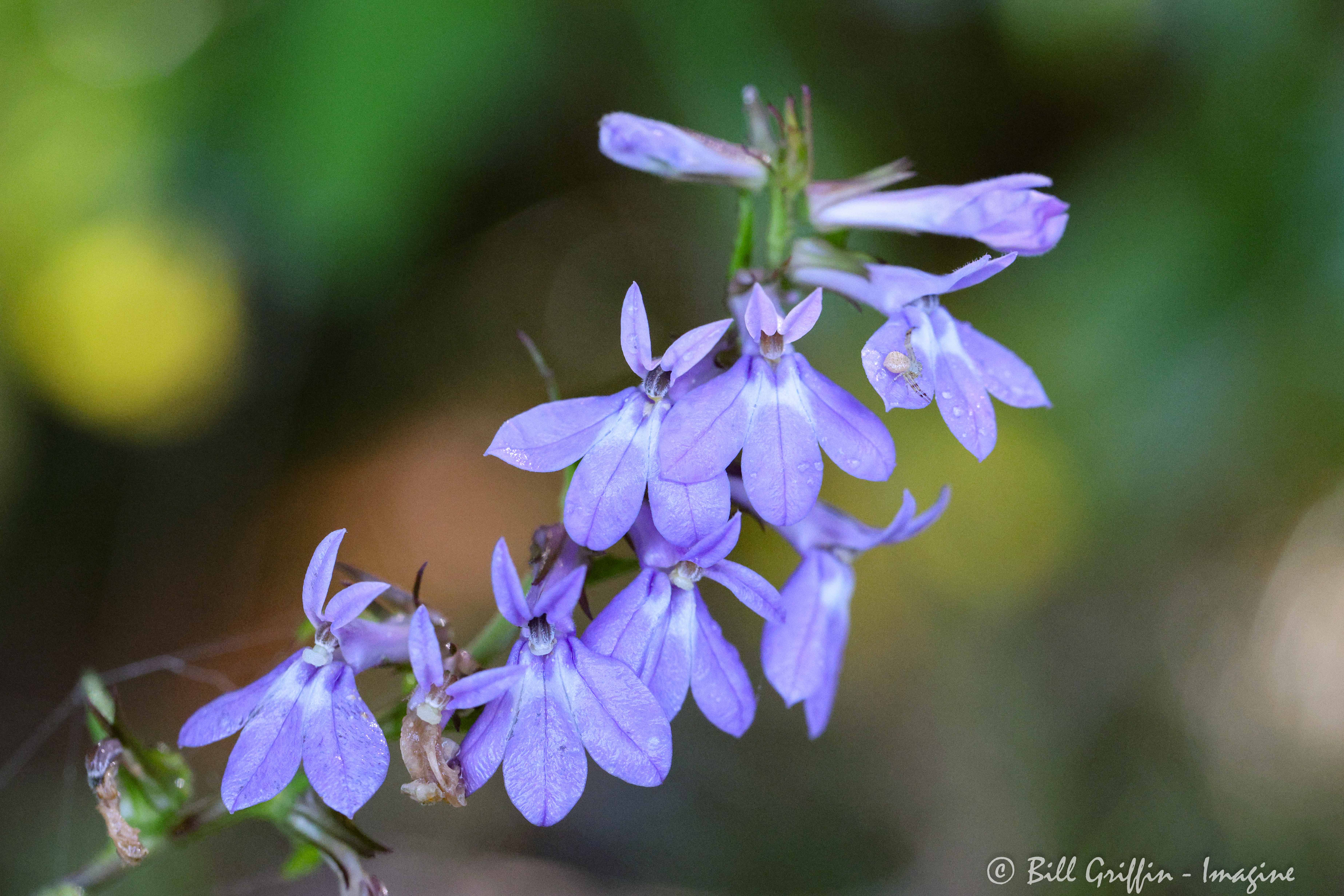
The Meadow Does Not Know
.
about the stock market.
Today she is worth
exactly what she was worth
yesterday, a year ago, at creation.
I don’t mean property value,
taxable assets. I mean
milkweed and copper moths
honeybees, cow vetch,
king snakes. Meadow life
is not money. What rises
and falls here are stems
and flowers, leaves and fruit.
No zigzag line of profit and panic
but the great wheel turning.
Here God gives of her
extravagance and here, like
flicker, viceroy, dragonfly
we come into our inheritance.
.
George Ella Lyon
from She Let Herself Go: Poems (LSU 2012)
.
In the fall of 2008, I was on a writing retreat at the Mary Anderson Center in southern Indiana. It’s surrounded by 400 acres of woods, fields, meadows threaded with trails. I was there when the subprime mortgage crisis hit. There were terrible consequences, of course, & all the talk was about how bad it could get. As a freelance writer & teacher, I was particularly worried that my jobs would disappear. Heart tight, thoughts spinning, I walked first around the lake & then through my favorite meadow. Ironweed, Joe Pye, goldenrod, more varieties of flowers & grasses than I could name. I was overcome by the beauty & faithfulness of it all, & that’s when “The Meadow Does Not Know/ about the stock market” came to me. A praise song. I kept saying it to myself till I got back to my room where some version of the rest of the poem came to me. Then I worked on it.
— George Ella
.
.
❀ ✿ ✾ ❁
.
Awe
.
A
great blue
heron spreads
its wings and squawks
rising from stream bed
we pause and hold our breath
it takes flight over Horne Creek
soaring above Yadkin Islands
easy talk picked back up as we walk
reminder tucked away to seek stillness
.
Christy Hamrick
.
❀ ✿ ✾ ❁
.
I Should Hope to Pray Like the Trees
.
The trees can’t control their lives. We can’t always control what happens to us. The trees can teach us acceptance. And metamorphosis. Linda Brown, quoted in The Nature Fix.
.
I should hope to pray
Like the trees, roots running deep,
Limbs singing above.
.
Blending earth and sky,
Supplicants sway and bow, each
Snowy branch and bough
.
A sylvan chorus,
A genuflective dance, a
Chance to waltz with God.
.
Gene Hyde
.
I’ve attached one of my ekphrastic poems, “I Should Hope to Pray like the Trees,” for your consideration. The photo was taken outside of Banff, Alberta, and the poem and photo were originally published in the Tiny Seed Literary Journal. I was moved by the way the snow-covered trees seemed to bow, looking like they were praying.
— Gene
.
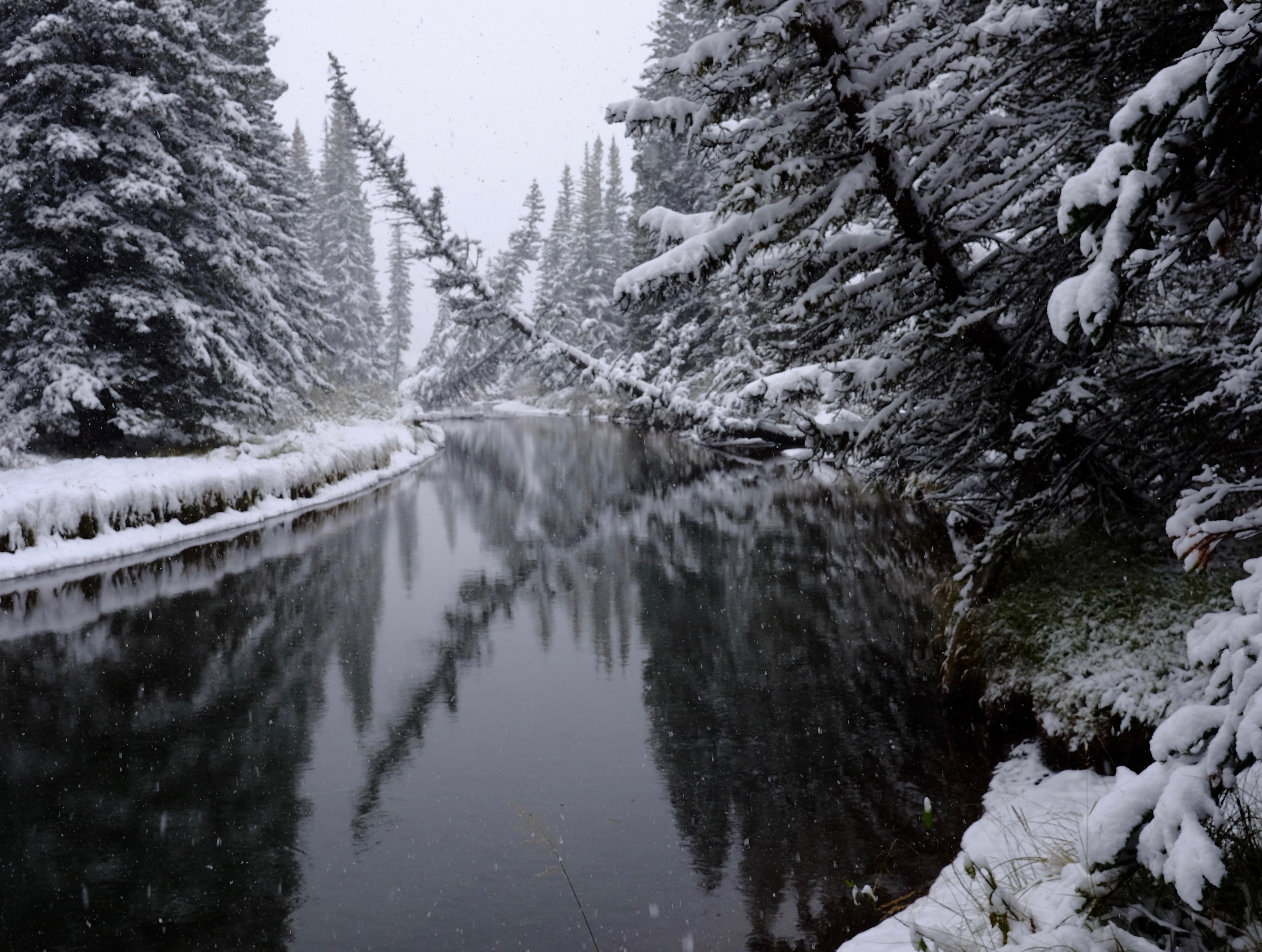
photo by Gene Hyde
.
❀ ✿ ✾ ❁
.
Serengeti Psalm
.
Let the Land Rovers be our camel caravans,
let the Masai herders, bare-legged,
wrapped in checked cloth
be our shepherds.
.
Let Your dirt roads, rain-rutted to mud,
or sun-scorched to dust
take us over savannahs, by shining lakes
flecked with flamingos, vast grassy plains
punctuated by acacia trees and majestic creatures.
.
You had Adam name them; did he see all of these?
long-legged, long-necked. giraffes browsing or grazing,
sleek velvety leopards lazing on branches,
baboon families racing by the road
as if late to a meeting,
gazelles, faces like African masks, leaping
and zebras, still, as if in prayer,
hippos wallowing like old ladies in a pool,
elephants flapping huge ears, their fans under the blazing sun,
warthogs, burrowing, backside first, ugly faces watching ours,
migrating wildebeests, crossing the horizon, strangely hideous.
.
On the endless green caldera floor, we are but specks among them all,
a moment in Your eternity.
You created them first, witness to Your glory,
Your living proof.
.
So that when it is our turn, we shall respond
with praise.
.
Ronnie Scharfman
.
My family and I recently returned from safari in Tanzania where we witnessed the variety and proximity of wildlife in awae! The game parks are their happy place, and we, tiny specks among them.
— Ronnie
.
❀ ✿ ✾ ❁
.
We need a renaissance of wonder. We need to renew, in our hearts and in our souls, the deathless dream, the eternal poetry, the perennial sense that life is miracle and magic.
— E. Merrill Root
.
The most beautiful thing we can experience is the mysterious. It is the source of all true art and science. He to who this emotion is a stranger, who can no longer pause to wonder and stand rapt in awe, is as good as dead: his eyes are closed.
— Albert Einstein
.
Thank you for celebrating the month of April with International Earth Day (April 22) and National Poetry Month. And thank you, Readers, who have selected poems to share that connect us to our planet and each other. We will continue posting EARTH POETRY throughout the month of April – and beyond April as well, of course, since EVERY DAY is EARTH DAY!
.
❁
.
Thank you for visiting Verse and Image: If you would like to receive an email each time a post appears, please SUBSCRIBE to Verse and Image using the button on the Home Page.
.
If you have a hard time finding the SUBSCRIBE button on this WordPress site, you can send me your email address and I will add you to the subscriber list. Send your request to
.
COMMENTS@GRIFFINPOETRY.COM
.
Thanks again for joining the conversation.
.
— Bill
.
❀ ✿ ✾ ❁
.

.


[…] Books […]