Feeds:
Posts
Comments

Posts Tagged ‘Denton Loving’

 . 
[with 3 poems by Denton Loving]
 . 
Lake Sagatagan Summer
 . 
After evensong at the abbey, we walk circles
in the woods, weaving through deerflies
 . 
in kamikaze flights. The cerulean warbler
mates among these trees, we’re told,
 . 
so we keep vigil for blue flickers in the leaves.
So far, nothing. On half-submerged logs
 . 
turtles perch like hard-shelled gods –
We canoe to the deepest part of the lake
 . 
before we can talk about who we were
before the other existed as witness.
 . 
Night descends, and we have to compete
with the liturgy of loons,
 . 
but here, surrounded by water, by darkness,
is the only safe place to tell the truth.
 . 
Denton Loving
from Feller, Mercer University Press, Macon GA; © 2025
 . 
❦ ❦ ❦
 . 
Last month I took a walk in the woods with my brother Bob, visiting from Montana. Here in North Carolina it was 78 and sunny, leaves still on the trees, plenty of shade. Bob wore a long-sleeve shirt rated SPF 50, sun blocking mitts, a neck gaiter pulled up over his ears, and a broad-brimmed hat. Yesterday I spent four hours with Dad at the plastic surgeon’s office. Besides freezing several superficial cancers on Dad’s scalp, she gave him the option of not treating the half-inch basal cell cancer on his nose. After all, he’s 99. What if he should choose to just ignore that cancer?
 . 
My brother seems to be choosing to live another thirty years skin cancer free. My father seems to have chosen never to wear a hat. Bob lives in the future. Dad lives with his past. The sun shines on us all. But this is not a microessay about UV protection or dermatologic wellness.
 . 
God sendeth rain on the just and on the unjust. If you are trying to farm in an arid plain like Judea, rain is not a downer but a blessing. The threatening proposition would seem to be, The sun shines on us all. But here’s a phrase even more ominous – He lives with his past. As Linda and I drive through the neighborhood this morning, she asks me if I’m OK after I let out a deep involuntary sigh. Am I OK? Where did that come from? I tick back – we had just passed the house of a man who used to be my patient. I made a bad choice in his care, he got mad, and he went and found another doctor. Fifteen years ago. You can’t live in a small town for decades without daily reminders of your choices. You can’t live on the earth, it sometimes seems, without your past constantly poking you and calling you out.
 . 
The other night at chorus we men sat and listened while the women rehearsed their own piece, SSAA. There is Linda, intent on the director and facing away from me, but the clear flute of her soprano reaches my heart. For one bright moment I am swept up in perfect love and peace. Tomorrow we’ll again flash our prickles, maybe argue about whether I’m paying attention or choosing to ignore her, but right now every choice I’ve ever made tastes sweet.
 . 
So here’s what Dad didn’t choose: to be alive on the 99th anniversary of his birth. Plenty of years for that ultraviolet to penetrate and warp his squamous cells and basal cells. And even though basal cell carcinoma never kills you, it will keep on growing until it bleeds and hurts. Especially if you are someone who vows on every birthday, as if you actually have a choice in the matter, to live five more. I tell the surgeon, “We choose the knife.” I tell myself, “Choose the music.”
 . 
 . 
This is a bit more of that passage from the fifth chapter of Matthew, Jesus speaking to a crowd of seekers who had followed up a mountainside: You have heard it said, You shall love your neighbor and hate your enemy. But I say to you, Love your enemies, bless them that curse you, do good to them that hate you, and pray for them which despitefully use you and persecute you; that you may be the children of your Father who is in heaven: for he makes his sun to rise on the evil and on the good, and sends rain on the just and on the unjust. [Matthew 5:43-45 ]
 . 
 . 
❦ ❦ ❦
 . 
The Octopus School of Poetry
 . 
Yes, that they have three hearts is remarkable.
So too, the way they navigate man-made mazes.
 . 
That their eight arms simultaneously perform
separate tasks. That they can unscrew jar lids
 . 
even when they’re trapped inside the glass.
But of all the strange facts, I can’t get past
 . 
their ability to squirt jets of black ink,
theatrical for sure, but an effective tactic
 . 
to distract a hungry eel or seal or albatross –
not unlike the poem, shooting fireworks
 . 
to ward off what haunts us. Such a nifty trick.
Almost worth the burden of those extra hearts.
 . 
Denton Loving
from Feller, Mercer University Press, Macon GA; © 2025
 . 
❦ ❦ ❦
 . 
Almost worth the burden of those extra hearts.
 . 
I try to divert my eyes from the cover endorsements when I pick up a new book of poems. You don’t read the last page of a novel first, do you? One joy of reading poetry is the sudden encounter with a line that leaps into revelation – opening a window into the writer’s heart – or into epiphany – opening the reader’s heart.
 . 
Anyhow, I figure I know Denton Loving’s poetry from his books Crimes Against Birds and Tarp. I rub my hands together in anticipation of mountains and hollers, of creatures and musk. And this new book does not disappoint. Denton displays the naturalist’s eye and ear and sensibility; every poem is rich with place and presence. But Feller is even deeper and richer than nature. The natural landscape is simply gesso for the canvas – these poems are about the burden of heart. These are love poems, and loss poems. While the naturalist observes, questions, connects, we are permitted to observe and connect with his deepest feelings and honest vulnerability. These pages are a safe place to tell the truth.
 . 
 . 
Denton Loving publishes interviews and reviews at https://dentonloving.com/ and has just announced a call for poems by Appalachian writers with and about disability, an upcoming anthology edited by Kendra Winchester. Denton is co-founder and editor at EastOver Press and its literary journal Cutleaf. For over a decade, he co-directed the Mountain Heritage Literary Festival at Lincoln Memorial University. He lives on a farm near the Cumberland Gap, where Tennessee, Virginia, and Kentucky meet.
 . 
Feller is available from Mercer University Press.
You may sample Denton Loving’s prior books here in previous posts at VERSE & IMAGE:
 . 
 . 
❦ ❦ ❦
 . 
The Eagle and the Drone
 . 
My soul leapt, you said when you witnessed
the eagle attack the drone in mid-flight –
the drone’s camera capturing its own finish,
the eagle cementing her reign of the sky.
 . 
When you read this, I think you’ll know
the triumphant eagle is not a symbol
of America, and neither is the lost drone.
This is no polemic or war-time parable;
 . 
as far as I can tell, there’s no clear wisdom
gained when we pit nature against technology.
I only know medicine men say eagles bring new vision –
like light through a lens passing obliquely
 . 
from air into a prism’s flat panel of glass,
refracting and separating the sun’s beams –
to help us understand our complicated past
and present, to guide us through the mysteries
 . 
of the future. That reminds me of the last trip
I made to visit you in Florida, when an eagle rose
from one of Highway 417’s narrow strips
of median as you drove me to the airport in Orlando.
 . 
The eagle winged directly toward our windshield,
and we agreed it was a very good omen:
how she caught our eyes, how pure white her bald
head appeared before she flew into the morning sun.
 . 
Denton Loving
from Feller, Mercer University Press, Macon GA; © 2025
 . 
❦ ❦ ❦
 . 
 . 

Read Full Post »

[poems from I Thought I Heard a Cardinal Sing]

Last week our sister Jill sent us photos from her recent camping trip in the Allegheny National Forest, a favorite spot called Kelly Pines. Big trees, moss & ferns, campfire, nylon tent – nothing lacking. There were also a few shots taken by our niece April – Jill hiking a trail between massive trunks, Hobbit Jill looking up into the giants. Jill’s comment – “Truly a magical seeming place . . .”

Gentle sun-dappled trail; open understory beneath a high canopy; mature second- (or third- or fourth- ) growth pines – a beautiful woodland setting . . . but magic? If I were to visit this spot for the first time would I discover more magic here than any other moderately impacted wood lot in the Appalachians, from Pennsylvania to northern Georgia? Ignore magic incantations and transmutations, ignore any lapses in the laws of physics, even so magic must create something around and within us that we don’t experience without magic.

But Kelly Pines (which, as a member of Linda’s family for over 50 years, I too refer to as Kelly’s Pines) does create magic. This little patch of forest, stream, rocky incline has been accruing magic since before these seven siblings were born. It’s the magic of shared stories – big Mama Bear crossing the trail just minutes after Linda had been walking there alone. It’s the magic of special visits – Linda and I camped at Kelly’s Pines for our honeymoon. Definitely the magic of roots – a bit of Linda’s Mom’s and Dad’s ashes are sprinkled there. And greatest of all is the magic of memories – those family camping expeditions have provided every sibling with their own recollections, carefully preserved treasures they dust off and pass around whenever any of the seven get together.

We make our magic. Our memories create magic. Sister Becky sums it up perfectly when she sees the photos: “It creates a great longing to be there with my loved ones.” Such magic!

Linda and I regularly hike a number of local trails where, when we listen, we hear the fey whispers of magic. Some are old trails with deep roots – we’ve visited Doughton Park on the Blue Ridge Parkway since the kids could walk. Some are newer, their magic bright and sprite and still emerging – the Grassy Creek “forest bathing” spur of the Mountains-to-Sea Trail, where our grandson worked beside me to scrape a first pathway into the riparian gloom.

Every week, in every season and weather, we discover the healing magic these footpaths through forest desire to share with anyone who’ll visit. Some magic is tangible: today the tiny Adam and Eve orchids are just opening, and to appreciate them I have to kneel with my nose in the leaf mould. Some magic is inchoate: the breeze on our necks, how it stirs ferns in the glade, the color of light ferns hold and release when we pause from all motion and let the woods overtake us.

When we return from these walks it isn’t the sweat and tired old muscles we remember. The magic of memory creates connection, shared presence, becoming one. Yes, Jill, that is a magical place. Oh yes, the trees, the mountains, but what really brings each place’s magic into being is what we share there together.

Fern Glade above Grassy Creek, MST

❦ ❦ ❦

Girl in the Woods

Before the earth became her bed, she raked away
+++++ the rubble and rocks, scraped the soil smooth.

There are no candy men here, no dope peddlers,
+++++ no pill pushers, no one to hand out 40s and 80s –

those perfect stones with their false promise to cut her
+++++ pain with their fuzz and blur – the way they do

at her apartment in the projects, a home more makeshift
+++++ than her nylon tent with its walls stretched taut,

its strings staked between oak roots. In this quiet,
+++++ she sketches her children’s faces with charcoal,

applying skills she’s learning in community college
+++++ art classes. She outlines their curved cheeks,

their almond-shaped eyes, uses long, sweeping strokes
+++++ for her daughter’s hair, a softer mark for the scar

on her son’s chin. Dark comes early beneath the trees.
+++++ Without the luxury of electric light, she’s learning

how to smudge charcoal, how to block in the mid-tones,
+++++ by battery-powered lantern – a small sacrifice

for this shelter of trees when she most misses her kids,
+++++ when her brain won’t stop buzzing.

Denton Loving
from I Thought I Heard a Cardinal Sing: Ohio’s Appalachian Voices, edited by Kari Gunter-Seymour; Sheila-Na-Gig Editions, © 2022

❦ ❦ ❦

Southern Ohio, pronounced “Ohia” if you’re from there, is Appalachia. Forget Cleveland and Toledo and their Lake Erie, forget Columbus and its gateway to the great plains. Think Athens, Portsmouth, Logan, Hocking Hills. Nearly one fourth of the area of Ohio is hills, glacial carvings, forest, and streams flowing down to the Big River that borders West Virginia and Kentucky. These poems are from the new anthology, I Thought I Heard a Cardinal Sing: Ohio’s Appalachian Voices, poetry called forth and collected by current Ohio state poet laureate, Kari Gunter-Seymour.

These voices are remarkable. Inspiring. Dire. Funny as hell. Every day I pick up the book and just leaf to a new page at random, and every poem speaks to me. It’s not just because I have family in those hills and know the smells and sounds of those back roads and farms, the funkiness of those river towns, the long lightless days of winter, the disappointment of “Ohio false spring.” It’s because these poems are honest and human and speak to anyone who has ever looked to discover another person standing beside them. Join me, open the book, let’s see where it takes us! Let’s us be part of the community, bigger and bigger.

You’n’s, us’n’s, all of us together.

❦ ❦ ❦

Some Kind of Prayer

What can I tell you that you do not already know?
Listen to the grass, its long legs whistling as it swishes.
Touch the brush of cattails, the brittle wings of pine cones,
the dry skin of chokeberries – feel
their burst. Taste rain. Say you’re sorry

not for what you did but for how you doubted
yourself for so long. This life is filled
with a million cocoons and you can choose
how long, which one, or none.

Sleep is so close. Run now, run.

Shuly Xóchitl Cawood
from I Thought I Heard a Cardinal Sing: Ohio’s Appalachian Voices, edited by Kari Gunter-Seymour; Sheila-Na-Gig Editions, © 2022

❦ ❦ ❦

To No One in Particular

I am never happy to see summer go,
earth stripped of its finest voice.
I am sitting outside in my heavy coat,
porch light off. There is no moon,
no ambient distractions, the sky a Zion.

I take solace in considering the age
of this valley, the way water
left its mark on Appalachia,
long before Peabody sunk a shaft,
Chevron augured the shale or ODOT
dynamited roadways through steep rock.

I grew up in a house where canned
fruit cocktail was considered a treat.
My sister and I fought over who got
to eat the fake cherries, standouts in the can,
though tasting exactly like very other
tired piece of fruit floating in the heavy syrup.

But it was store-bought, like city folks
and we were too gullible to understand
the corruption in the concept, our mother’s
home-canned harvest superior in every way.
I cringe when I think of how we shamed her.

So much here depends upon
a green corn stalk, a patched barn roof,
weather, the Lord, community.
We’ve rarely been offered a hand
that didn’t destroy.

Inside the house the lightbulb comes on
when the refrigerator door is opened.
My husband rummages a snack,
plops beside me on the porch to wolf it down,

turns, plants a kiss, leans back in his chair,
says to no one in particular,
A person could spend a lifetime
under a sky such as this.

Kari Gunter-Seymour
from I Thought I Heard a Cardinal Sing: Ohio’s Appalachian Voices, edited by Kari Gunter-Seymour; Sheila-Na-Gig Editions, © 2022

❦ ❦ ❦

Linda and Bill at Kelly’s Pines, 1974

❦ ❦ ❦

Read Full Post »

[with 3 poems by Denton Loving]

Life is what happens to you while you’re busy making other plans.
John Lennon, “Beautiful Boy

Tomorrow we are driving to Raleigh to see our 3-year old grandson Bert. In person! In the two months since our last in person we’ve visited at least once a week on FaceTime or extended-family Zoom sessions. Often he’s in the bath (easier to keep him in one place); he always wants to show us a toy or especially some of his many books; at least once he’s seen a toy in our background and asked to play with it.

Bert is excited to see us on the little screen but our daughter Margaret tells us that almost every day he asks, “Where’s Granny and Pappy?”

Life is busy happening to us while we’re not able to make hardly any plans at all. Where are we indeed!? All of us are no doubt in the same place: spending a lot of time thinking of things we can’t wait to start doing again when the pandemic has subsided (although it’s time for all of us who’ve learned the definition of pandemic to open the dictionary to endemic). Things to do after – you know you have a list. I’ll bet you’ve even been writing them down.

Herewith I’m starting a list of things I hope to be when the seasons of fear and loss and paranoia are past. If there has been any nano-benefit of living through a pandemic, it might be that I’ve started becoming some of these things already:

Open – to what other people need, to what they’re feeling, less fixated on self
Grateful – for the little things and what now seem like really big things, especially time spent with people I love
Aware of daily changes – in nature, in me and my family, present to the passage of time
Hopeful – life will never be the same, but then again what person actually has stepped into the same river twice? I’m glad I get to keep stepping in every day anew.

.     .     .     .     .     .     .

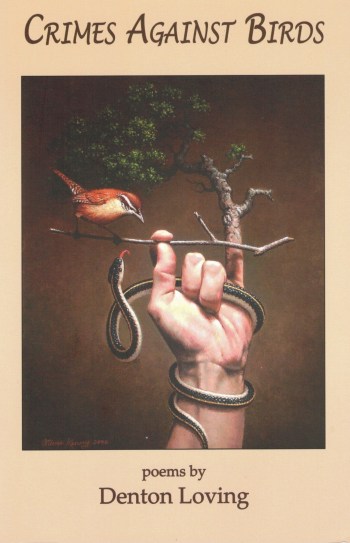
Denton Loving’s book Crimes Against Birds has been sitting beside my desk for a good while – face down because Linda is creeped out by the cover. I am so glad I’ve kept returning to it. These poems have become my pandemic companions. It’s not only because of their intimate relationship with nature, outdoors, farm life. The poems are like rocking on the porch while the sun sets across the mountains and your companions are uncertainty, death, regret, loss, but also beauty and hope – you welcome them all, invite them to sit down and tell their stories while you get to know them. There is comfort and consolation in facing what has to be faced, and as you do the moon rises through the trees.

.     .     .     .     .     .     .

.     .     .     .     .     .     .

What Was Told
(after Rumi)

What was said to the canna lily to make it
open was said here in my heart. What was
told the sycamore that made its wood hard
and bone white; what was whispered
to the storm’s wind to make it what it is;
what made the honeysuckle smell so sweet
in summer; whatever seed was planted
in the core of the mountain
people to make them love
so deeply, fiercely, beautifully;
whatever gives the catawba the pink inside
the white blooms – that is being said to me
now. I blush like the catawba’s flower.
Whatever gave life to letters and words
is happening here. The great sanctuary
within me has opened its doors; I fill
with thanksgiving as I savor the sweet
taste of honeysuckle on my lips, in love
with the voice that speaks also to me.

.     .     .     .     .     .     .

My Father Leaves Harlan on 119

He remembered
when they started the first
eight miles of this new road
from Pineville to Harlan:
it was 1958.
They had closed
the mines. You couldn’t buy
a job anywhere.

Wilse and Stan and I
were on our way to Corbin
to put in applications – I
can’t remember where now.
Was so long ago.
They didn’t take Stan’s
or mine, and they never did call
Wilse back.

We were hungry
and stopped at Grandma’s
in Barbourville.
We came in the noon
of the day. I don’t think
she was too happy to see us
right in the middle of her work
but she fed us good.
Always did.

She’s been deal all these years
and here I am
Still driving
up this new road.

.     .     .     .     .     .     .

Your Very Flesh

I knew a woman who made fudge as thick
and smooth as summer and five times better
than any you ever ate. It’s an art

to make anything that melts on your tongue,
can be savored down deep in your soul. Makes
me want to know how to do it too. Do you

know how to do something that brings simple
joy in its beauty, will be remembered
after you die? Every July, my Nana

made fourteen-day pickles. For days, she soaked
cucumbers in salt water, removed to
cut in perfect slices, submerged again,

drained them and covered them, added alum,
added sweetness, drained and boiled the syrup,
covered again, dedicated fourteen days

to create something in the end that looked too
pretty to eat. But we did anyway. Now, she
is gone, and none of the rest of us will give

fourteen days to the drudgery of pickles.
I’m not only talking food. I know a man
who can quote lines from the classics to suit

any occasion. His gift is not just memory
but also timing and recitation. He’s a walking
anthology of lost verses, forgotten lines.

This same man cuts and sells timber, and I’ve
heard said there’s no one better to use every
inch of wood a tree can yield. There’s no waste

in his bones. Another art. And I bet
when this man stands in the woods with his saw
in hand, he pauses and gives a little

eulogy for the tree he’s ready
to bring down. May, a word from Plato
or john Donne, or this from Whitman:

your very flesh shall be a great poem.


all selections from Crimes Against Birds, by Denton Loving, Main Street Rag Publishing Company, © 2014

.     .     .     .     .     .     .

.     .     .     .     .     .     .

The quotation from John Lennon’s song, “Beautiful Boy,” has also been attributed to cartoonist Allen Saunders in 1957: Life is what happens to us while we are making other plans.

When we meet with Margaret, Josh, and Bert in person we sit around in the backyard in Raleigh, masked if we’re less than 6 feet apart, but we’re allowed to get knee hugs from Bert. The chickens peck around us and garble and coo; Bert runs everywhere and shows us everything; maybe Josh has heated the wood-fired bread oven and makes pizza. If it’s too cold we have to get up and keep moving, maybe walk the Crabtree Creek Greenway. More than once it’s been too too cold and wet and we’ve just had to cancel the visit. But it will never be too cold After.

More about DENTON LOVING, his writing, himself: https://dentonlovingblog.wordpress.com/


.     .     .     .     .     .     .

2017-03-06a Doughton Park Tree

Read Full Post »