Feeds:
Posts
Comments

Posts Tagged ‘Beth Copeland’

 . 
[with 3 poems by Beth Copeland]
 . 
Fog
 . 
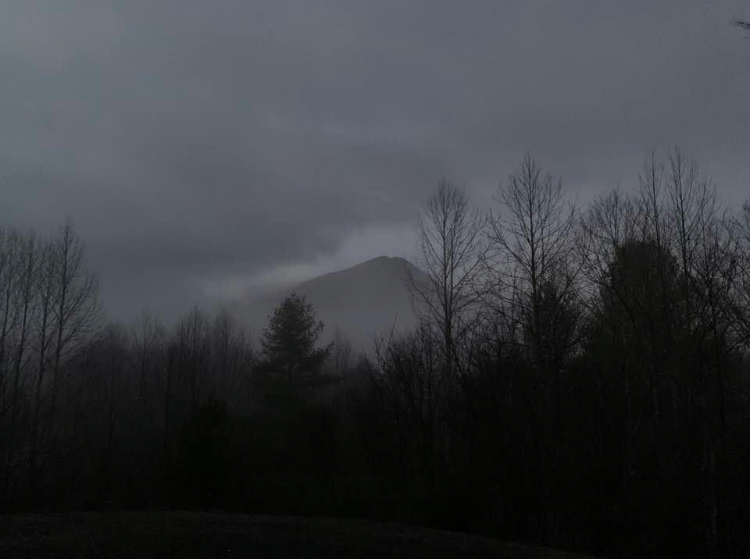
Morning fog erases the mountain and trees.
No, not an erasure but unseen.
 . 
Not an erasure but unseen.
The mountain, the laurel still green.
 . 
Unlike the mountain and laurel still green,
the dearly departed lie beneath white sheets.
 . 
The deer depart beneath white sheets
of fog, stepping into a forgotten dream
 . 
of fog slipping into a forgotten dream
the ghost mountain dreams.
 . 
The ghost mountain dreams.
Crows fly to pines on mascara wings.
 . 
Crows fly to pines on mascara wings,
mourning. Fog erases the mountain, the trees.
 . 
Beth Copeland
from I Ask the Mountain to Heal My Heart, Redhawk Publications, The Catawba Valley Community College Press, Hickory NC; © 2025
 . 
❦ ❦ ❦
 . 
It’s a big web, here in the corner of our screened porch, but I’m not ready yet to broom it down. The spider is a jointed dried kernel in its center; when I blow, she doesn’t twitch. I don’t see an egg pouch or spiderlings. The strands are not an orb but a diffuse tangle, a chaos of delicate angles and tensions — a miniature of filaments revealed by the background microwave radiation that weave the structure of our entire universe. And what are they made of, those filaments? These I can see before me are nanometer reworkings of hemolymph from mosquitoes denied the opportunity to bite me. Most visible when dusted with pollen. A mess. But I and my broom are not ready yet to offend, to say farewell to the tribe of spiders.
 . 
Last week we visited Blue Whales with our grandson, turning eight. The North Carolina Museum of Natural Sciences in Raleigh is hosting this exhibit of the largest creatures that have ever lived on our planet – the mystery of their migrations, language, culture; the vital interconnections between their diet of krill, their massive enriching orange poop, and the entire deep ocean ecology. Linda and I stood in silence before the model of a blue whale brain and a model of our own. The whale’s is twice as large and twice as complex, convoluted with its twisting gyri and deep sulci. Surely such an abundance of neurons and synapses must create thoughts as complex as our own. Or more so. And yet blue whales struggle to survive as a species in a world degraded by human beings. I am thinking of that brain and I am not ready yet to say farewell to the tribe of whales.
 . 
Chapel Hill cartoonist Keith Knight draws a weekly panel titled (th)ink. Today’s is a portrait of and quotation by James Baldwin (1924-1987): “To be a Negro in this country & to be relatively conscious is to be in a rage almost all the time.” Human being who is relatively conscious, choose your own rage focal point du jour – human beings caged like animals in a Florida concentration camp; children intentionally starved to advance a particular political agenda; boosting fossil fuels burned to appease a few billionaires; an ocean filled with plastic nanoparticles and deafening human vibrations where blue whales may soon be extinct? Some days I feel like I am not ready to go on living. Some days I am more than ready to say goodbye to the tribe of humans. In a few years I will depart as an inhabitant of planet Earth. Some years after that the last memory of my having been an inhabitant will finally depart as well. On that day, will any whales still remain to swim the depths? Will any love between humans remain, or any love for other creatures? I am not ready yet to answer.
 . 
 . 
❦ ❦ ❦
 . 
October Valentine
 . 
A heart-shaped leaf spied in the weeds on my walk
down the hill to the mailbox. I didn’t see a redbud tree
 . 
on the roadside, so it must have lifted on the wind
and dropped – a gift! – near my feet. Is it a message
 . 
from someone I love – my sweet mother in a halo of light,
my father singing the names of trees in his strong baritone?
 . 
Or is it from someone I’ve never seen and may never meet?
 . 
As I hike up the hill, I tuck the leaf in my pocket, rubbing it
with my thumb – as if I could read it – skin to skin – by osmosis.
 . 
Halfway home, I stop to study it. Cerise with splotches of green,
dark spots, a wormhole bored like a bullet wound, a battered
 . 
heart, like yours, like mine, but maybe its scars make it more
beautiful than before. My friends, there’s still so much
 . 
love in this world even when you’re alone.
 . 
Beth Copeland
from I Ask the Mountain to Heal My Heart, Redhawk Publications, The Catawba Valley Community College Press, Hickory NC; © 2025
 . 
❦ ❦ ❦
 . 
Is it strange for me to be toying with despair while reading a book of healing and love like Beth Copeland’s I Ask the Mountain to Heal My Heart? Actually, if you’re not toying with despair you are the strange one. Give grudging thanks, though. Thank the stars and the mysterious hemlocks and the dark fecund earth that in a world full of rage and despair there are poems like Beth Copeland’s. These poems know the feeling of being lost in endless night. These poems have been battered, they have fallen, they have doubted plenty of times whether there is any wholeness or healing available to them, but these poems stand up to testify, My friends, there’s still so much love in this world even when you’re alone.
 . 
Often I tell myself it is ridiculous to imagine that any sort of inner peace is possible. I have my share of personal regrets and ongoing grief, and even though I’m tempted to look around and envy those people who don’t, when I’m really honest I admit that no one escapes whipping. But peace can’t be a wall built around my sadness – walls keep more things in than out. Despair is inevitable. How foolish is it, then, and how strange, to spend a few hours with a book of words arranged in lines on paper and discover the tightness in my throat is easing? The mountain has rested in one place for 480 million; today its peak is less than a third of its height when it was first thrust up in the big crunch. Does it reflect on loss and diminishment, or does it find peace in the weight of its daily being? Am I inflamed and scarred by the revelations of Beth Copeland’s battles and pain, or am I grateful for her gratitude and strengthened by her strength?
 . 
The tribe of human beings seems determined to destroy itself. The tribe of human beings seems determined to link arms and hearts in love. Perhaps discovering a moment of beauty is not a cowardly attempt to escape dire reality – perhaps it is the only thing capable of healing us.
 . 
 . 
Explore REDHAWK Publications, including Beth Copeland’s I Ask the Mountain to Heal My Heart and Shibori Blue: Thirty-Six Views of the Peak HERE.
 . 
Sample poems from Shibori Blue at Verse & Image HERE.
 . 
More information about the North Carolina Museum of Nature Sciences HERE.
Dive into the K Chronicles with Keith Knight HERE.
 . 
 . 
❦ ❦ ❦
 . 
My Daughter Paints a Mountain
 . 
She wasn’t thinking as her brush swept
across canvas in wave-length strokes,
 . 
channeling a crest she’d never seen,
while I was still in the Sandhills
 . 
where there aren’t any hills, just fields
of cotton, soybeans, and cedar stumps
 . 
in swamp water, sleeping on an air mattress
in a small apartment with prints and paintings
propped against walls instead of hung,
newly separated, newly sober, living
 . 
between the husband and home I’d left
and a haven I hadn’t found yet.
 . 
*****
 . 
As I drove up a steep road to see a house
in the Blue Ridge, a large buck leapt
 . 
in front of the car to welcome me,
and I knew I’d found my new home.
 . 
I didn’t know the mountain seen at the top
of the hill was the mountain she’d painted
 . 
months before, and she didn’t know I’d move
to that house with a view of the mountain
 . 
she’d painted as if in a dream or fugue.
How could her mountain – purple, lavender,
 . 
pink, and forest green swirled to a peak
with white streak of snow against a blue sky –
 . 
mirror the one framed in my window?
Was it coincidence or synchronicity
 . 
that the mountain in her mind’s
eye was more map than metaphor?
 . 
It was a message from the universe:
You’re home. Open the door.
 . 
Beth Copeland
from I Ask the Mountain to Heal My Heart, Redhawk Publications, The Catawba Valley Community College Press, Hickory NC; © 2025
 . 
 . 
❦ ❦ ❦
 . 
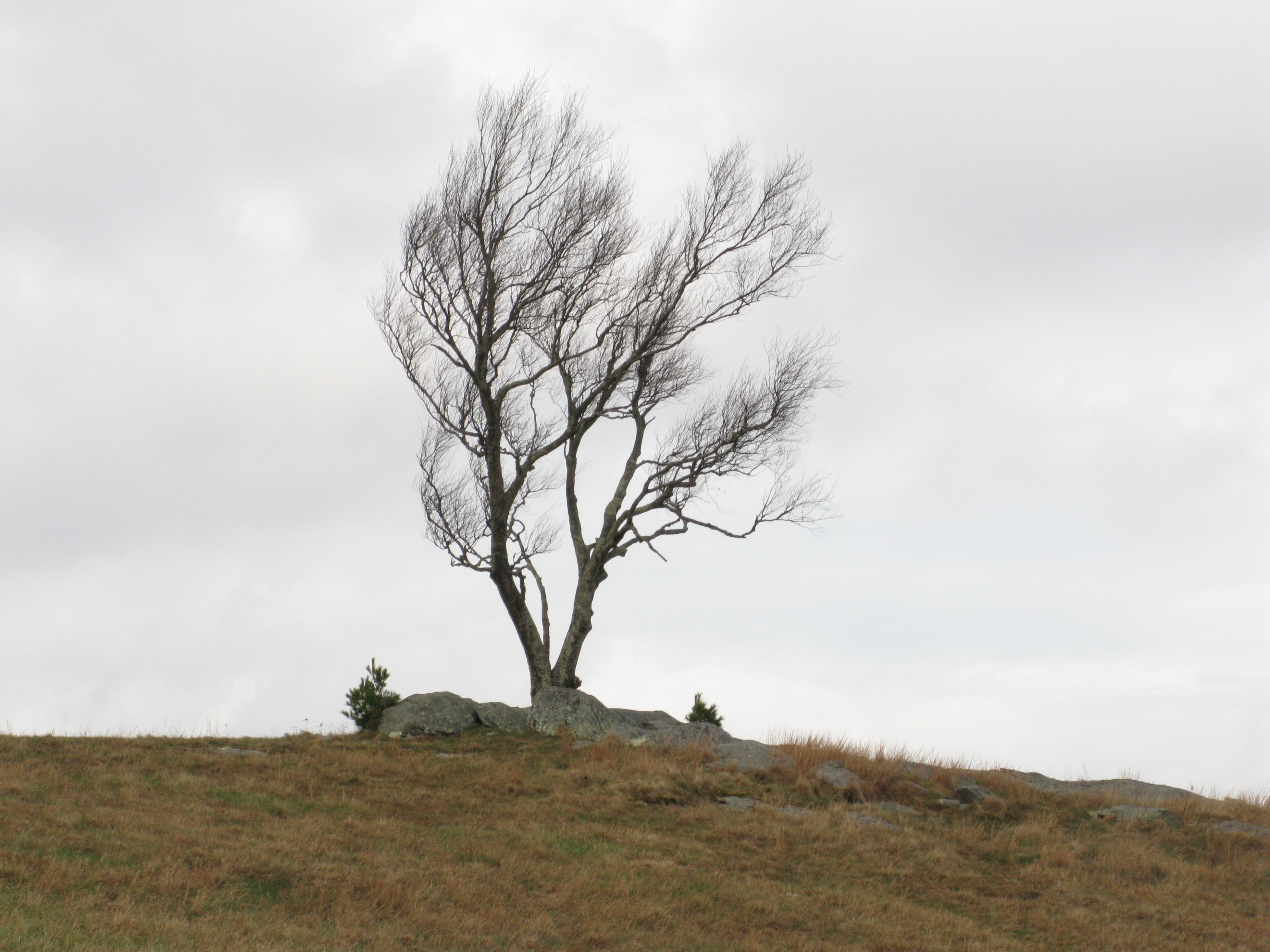
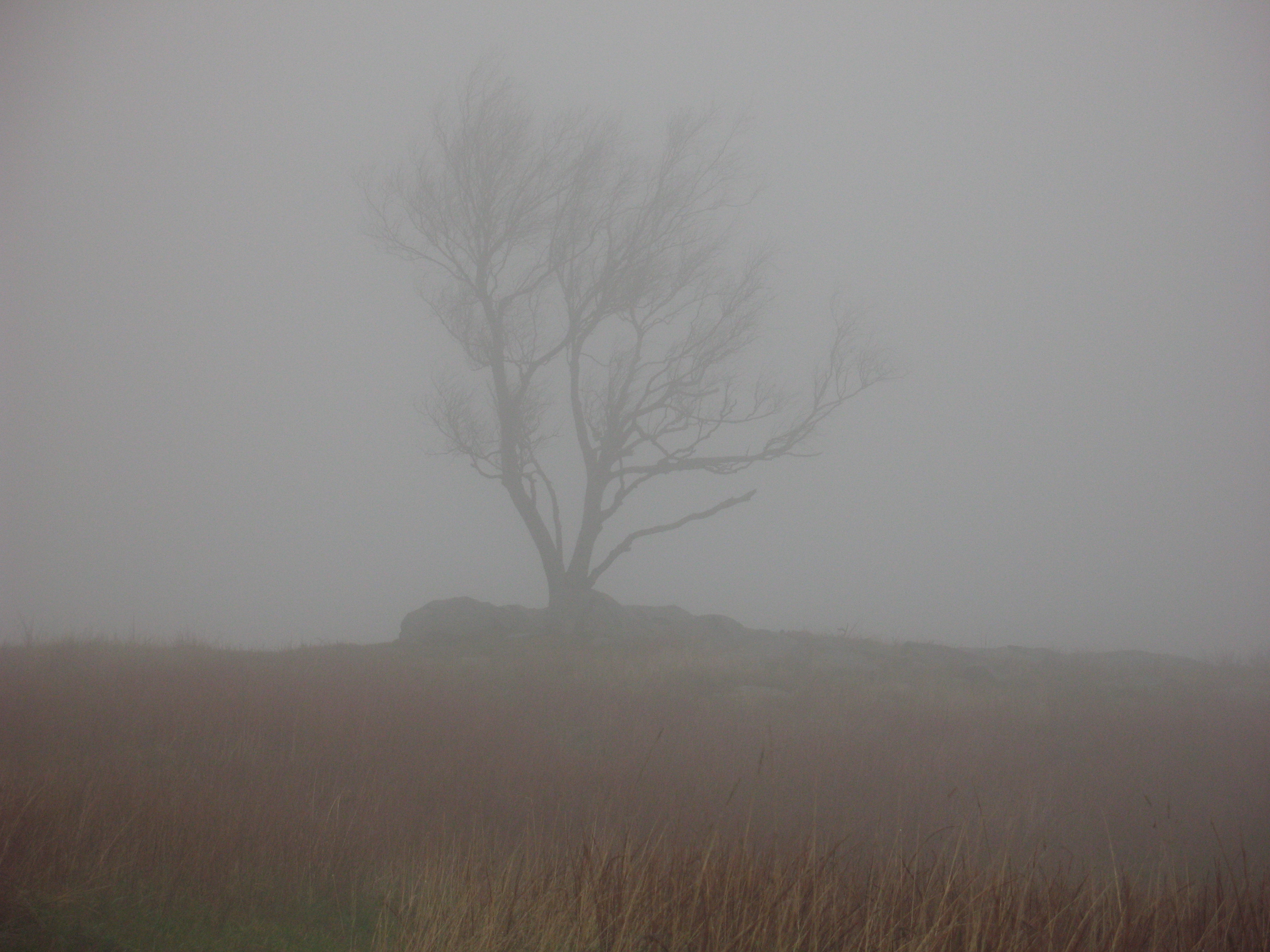
Doughton Park Tree 2020-11-22
 . 
❦ ❦ ❦
 . 

Read Full Post »

Poems and photography from Shibori Blue
by Beth Copeland
 . 
Winter passes and one remembers one’s perseverance.   –   Yoko Ono
 . 
 . 
Frost on the mountain.
Creeks freeze under skins of ice.
A broken window.
My neighbor’s chimes are silent.
Even the wind is frozen.
 . 
 . 
Spring passes and one remembers one’s innocence.   –   Yoko Ono
 . 
 . 
Does the mountain mourn
its lost children, bones buried
beneath sediment
and stone? Who gathered near its
peak? What family, what tribe?
 . 
 . 
Summer passes and one remembers one’s exuberance.   –   Yoko Ono
 . 
 . 
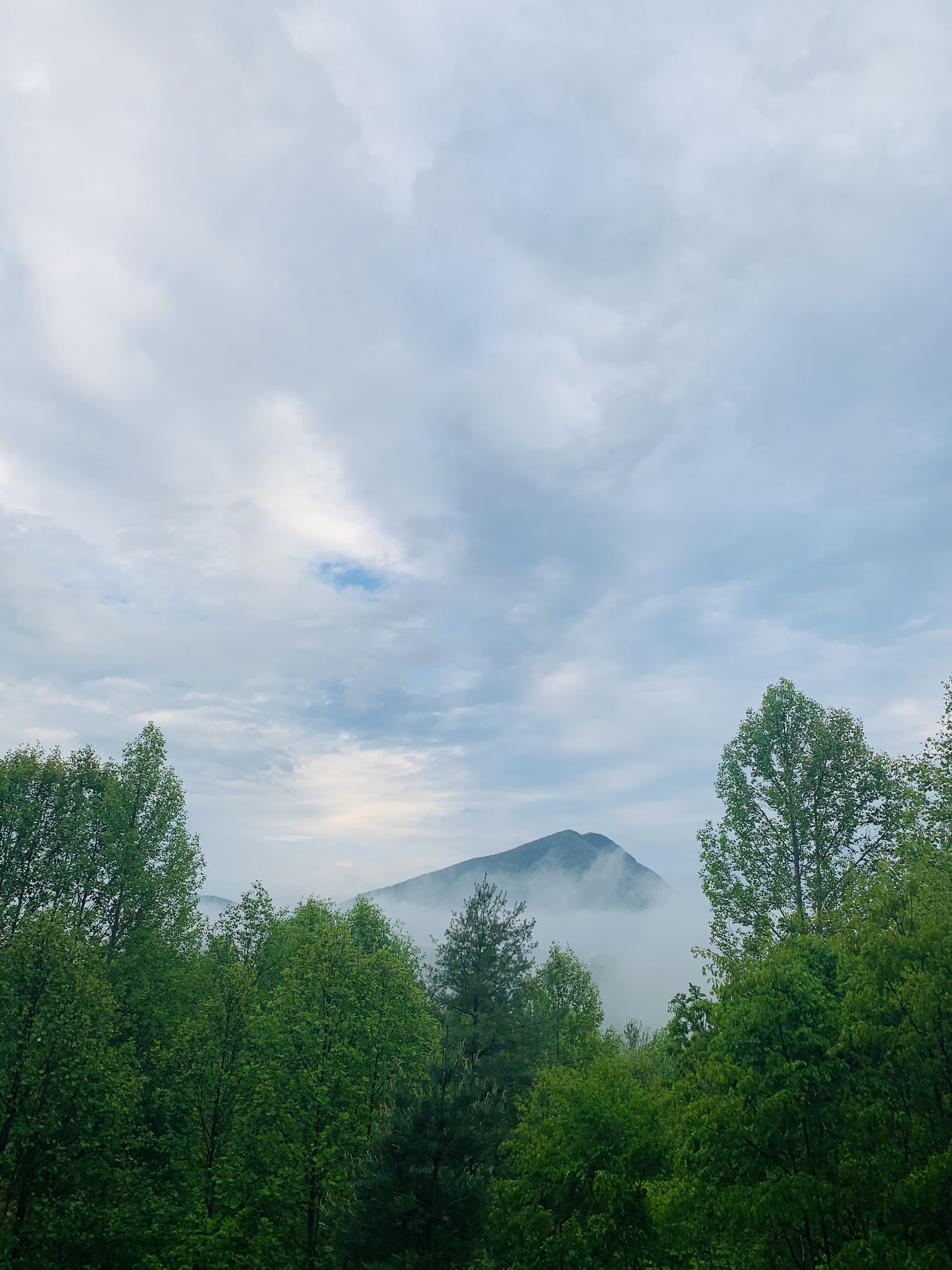
Bridal veil mountain
in May, the month of weddings.
Fog, Mist, and white clouds.
Wild daisy fleabane bouquet
fresh in a blue Mason jar.
 . 
 . 
Autumn passes and one remembers one’s reverence.   –   Yoko Ono
 . 
 . 
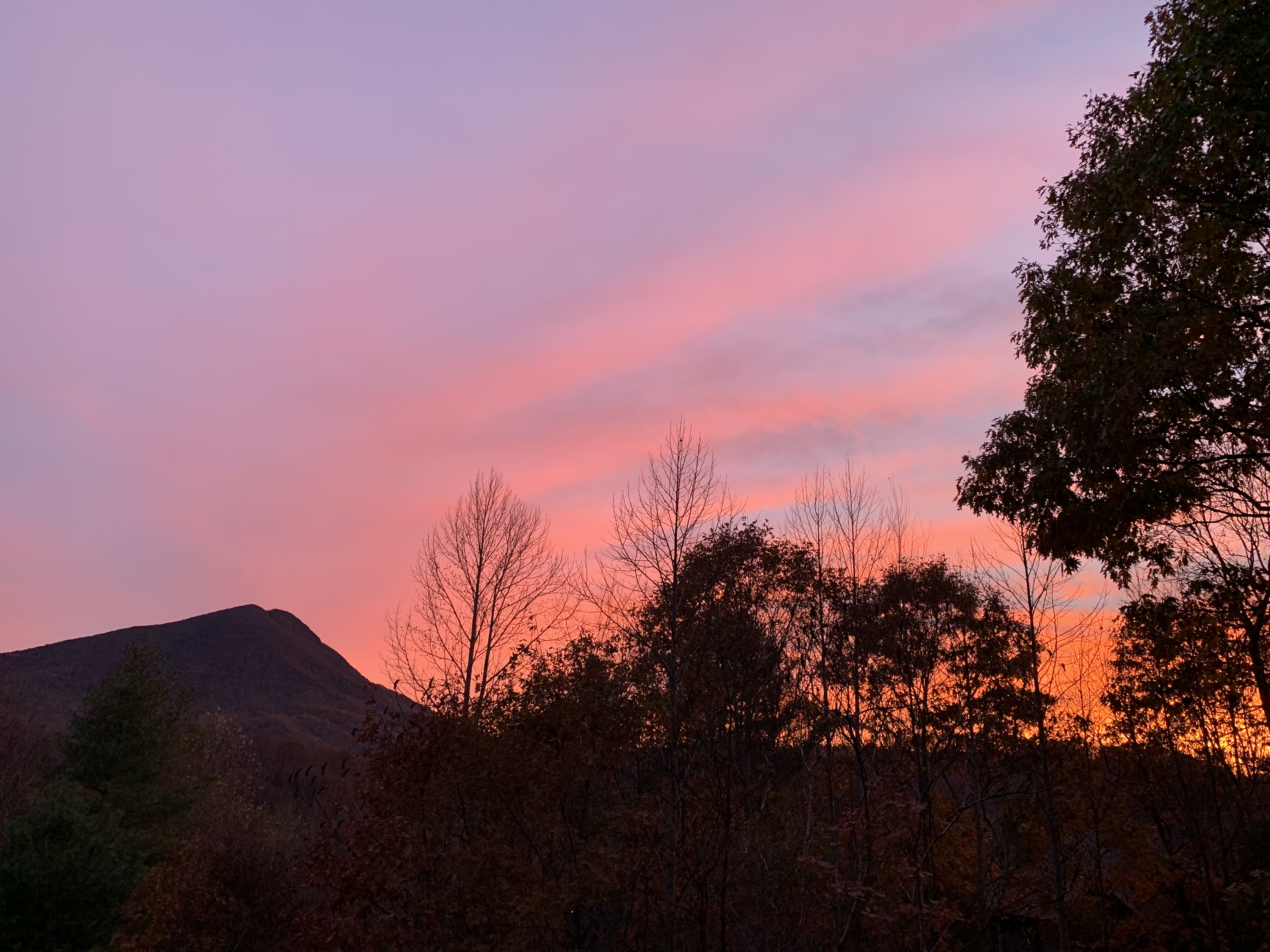
Tiger-striped sunset
above the ridge in the west.
Trees with leaves and trees
without. What are we losing,
my love, and what will we keep?
 . 
 . 
Poetry and photography by Beth Copeland
from Shibori Blue: Thirty-Six Views of The Peak, Redhawk Publications, The Catawba Valley Community College Press, Hickory NC; © 2024
 . 
❦ ❦ ❦
 . 
Beth Copeland lives in Ashe County, North Carolina, smack in the Blue Ridge Mountains. Each morning from her porch she sees The Peak, the highest mountain in Ashe County. It is solid and eternal – it is always shifting. Beth has recorded the mountain’s moods and contemplations with daily photographs, now pairing them in her new book with thirty-six poems that capture ephemera through the course of a year, moments of change through the changing seasons.
 . 
Thirty-six. A figure of truth and power. Product of two perfect squares. Multiplied by 2 to create the 72-season calendar established in 1685 by Japanese astronomer Shibukawa Shunkai. And again 36 the number of woodblock prints of Mount Fuji published by Katsushika Hokusai from 1830 to 1832. It is no coincidence that Beth chose thirty-six views of The Peak to inform her poems. She was born in Japan, the child of American missionaries, and has long revered the iconic mountain of her birth country, Fuji-san, whose profile The Peak of Ashe County so resembles.
 . 
This book invites me to slow my breathing, pause in the busy race, contemplate each page: five simple lines of verse, the silent mountain drawing my gaze. Redhawk is gathering a family of uniquely creative poets, writers, and artists to stretch our imaginations and open us to new experiences of words and images. I will leave this sentence here at rest and return to another page of Shibori Blue. And another.
 . 
 . 
More information about Shibori Blue: Thirty-Six Views of The Peak and the opportunity to purchase HERE
 . 
❦ ❦ ❦
 . 
Perseverance – Deep in winter do they dream of the music they will make, cicada song? Crescendo arpeggio decrescendo, easy combers across the long sea of summer. And does the creature measure the span of its days, egg to nymph, seasons in darkness, climb into light to mate and to die? Nothing can last, not even our song, yet we do not withhold our voices.
 . 
Innocence – She is most beautiful when she does not know I am watching. She gives her animals life, little fox blanket, cupcake kitten, and they take from her all the fear and heartache that could have been trapped within to fester. Then she begins to sing.
 . 
Exuberance – Utterly alien at once perfectly identifiable, the house wren fills its small kingdom with melody, rocketing in turn to each waypoint to pause, raise its minute cornet, FANFARE!, then swift to the next. I do not understand the words but I recognize the tune.
 . 
Reverence – What we have heard teaches us, reminds, suggests, niggles, promises, invites. What we have yet to hear offers to pull us into its presence. Listen. Be filled.
 . 
 . 
IMG_6432
 . 

Read Full Post »

[with poems from PINESONG 2023, NC Poetry Society Anthology]


Ghazal: Ghost Apples (Kent County, Michigan)


Ice-encrusted boughs from which transparent versions
of apples hang – each fragile as hand-blown glass.
+++
Their history: fruit on the cusp of rot, winter storm trundling
down a hillside, sleet coating each apple in sudden glass.
+++
Viscous fruit leaked from apertures until only icy shells
remained – December trees bearing quicksilver bulbs of glass.
+++
Imagine them a vivid red or green, like cascades of apples
even humble grocery stores offer on the far side of plate glass.
+++
If we shattered these globes, would they taste like hard cider
or the cloying sweetness of pulp, like edible versions of glass?
++++++
Soon these crystalline shells will melt to nothingness, the way
we all disappear. Beloved, step lightly upon grief’s bitter glass.
+++
Lavonne Adams
Joanna Catherine Scott Award First Place, Pinesong 2023
+++
❦ ❦ ❦
+++
Diversity often blooms at the edge. This little trail heading out from Isaac’s Trail Head on the MST is limn upon limn . . . boundary . . . transition. The wide riparian border along Grassy Creek attracts neotropical migrants for a rest stop each spring; Louisiana Waterthrush, White-Eyed Vireo, and Common Yellowthroat stay behind to breed here. The footpath parallels a pasture fenceline, and while cows with their calves stand flank-deep in meadow grass and blackberry bramble, all manner of wildflowers hug the margin of No Grazing: Blue Toadflax, Venus’s Looking Glass, Carolina Crane’s-Bill. Leaving creekside, the trail is hemmed by a moist rising woodland: Rattlesnake Fern, Sensitive Fern, Southern Lady Fern. And by the end of summer, if the farmer hasn’t sprayed, the trail edges will fill with Blue-Curl, Cardinal Flower, Goldenrod, Wingstem.
+++
Smaller fields and many interruptions make for many edges; diversity begets diversity. At one point along the trail a wide acreage of corn abuts a small hay field of mixed grasses. The corn field is solemn in its solitude; above the hay the air is filled with swallows, Bluebirds and Phoebes perch along the wire, and as we hike past we’re apt to flush an Indigo Bunting foraging.
+++
But then there are Cowbirds. For centuries they followed prairie bison herds and no doubt also the woodland bison of the Carolina piedmont. Now they follow every human disturbance, common in cow pasture but just as common on suburban lawns. Cowbirds are exclusively brood parasites, known to lay their eggs in the nests of over 220 other species. To their detriment. Kirtland’s Warbler has been pushed beyond the edge of “endangered” by Cowbird predation, and most birds do not have the ability to recognize the foreign eggs which will hatch and out-compete the rightful occupants. How to resist? Escape the edges. Reverse the fragmentation. Cowbirds will not follow into deep woods – warblers nesting deep in the forest are safe.
+++
It isn’t the Cowbird that threatens wood warblers, whip-poor-wills, vireos. It is shrinking habitat. Many species thrive at the edge. Some, though, require wide wild expanses. How much wild can we leave?
+++
+++
Upon which side of the boundary does poetry perch, thrive or decline? And what would it look like, that restored, invigorated poetry habitat, a definite nudge toward thriving? More fifth graders setting pen to page and seeing their lines is print, as they have in this year’s annual Pinesong anthology by the North Carolina Poetry Society? More opportunities and promptings to write – whatever one’s background, training, preferred theme, chosen form? And more readers?
+++
That’s where we come in. This morning I broke a nice sweat hiking miles along meadow and creek, through upland forest to lakeshore and back. This afternoon with feet up I’ve covered another rewarding meander through the pages of Pinesong. Student poets, grades 4 through undergrad; dozens more of adult poets, many names entirely new to me. I’ve traveled new places, I’ve encountered the unexpected and enlightening, I’ve paused long to reflect, and I’ve even laughed out loud. As Robert Frost wrote in The Pasture: “You come, too.”
+++
❦ ❦ ❦
+++
Eleven Lines In Search of the Perfect Rhyme
+++
Is it accidental that bereft almost rhymes with death?
+++
Watching geese rise in a chevron formation The New River
at Grassy Creek, flying south to warmer waters, I think of how
+++
sons and daughters grow up, how the nest – that like death
almost rhymes with bereft, – empties with their flight.
+++
How these words fly out of my mouth like startled birds.
+++
How we dream of loved ones who are dead. How we forget
what happened in the dream, what we did, what we said.
+++
How there are hundreds of ways to leave, not only the 50 ways
in Paul Simon’s song, and thousands of ways to grieve, bereft.
+++
How you can both the lover leaving and the lover left.
+++
Beth Copeland
Carol Bessent Hayman Poetry of Love Award Honorable Mention, Pinesong 2023
+++
❦ ❦ ❦
+++
Pinesong is the annual publication of contest winning poems by the North Carolina Poetry Society, founded in 1932. Pinesong 2023 is Number 59, edited by Sherry Pedersen-Thrasher with assistance from Joan Barasovska. This year’s volume is dedicated to David Radavich, former NCPS President and steadfast supporter of poetry and the arts.
+++
You can learn more about North Carolina Poetry Society and its contests, plus read previous years’ editions of Pinesong . . . here.
+++
If you would like to purchase Pinesong ($12, postage included) please contact NCPS Vice President of Membership Joan Barasovska: msjoan9[at]gmail[dot]com
+++
A free issue of Pinesong is available to all NCPS members in good standing who request ($2 mailing expense). Please contact Joan, as above.
+++
❦ ❦ ❦
+++
2020-09-08b Doughton Park Tree

Read Full Post »

Older Posts »