Feeds:
Posts
Comments

Semper plus discere

[with poems from Visions International]

From the ridge above the creek the tallest tulip trees poke their heads up to catch the evening sun. Hammered gold, bright lemon and lime, for a moment they torch the forest and we who look up catch their display. Without this certain angle of sun, autumn lends these trees only ochre dashed with butterbrown; without us looking up at just this certain moment we might not appreciate them at all.

Most everyone mid-October is planning their looking up. Hey Honey, wanna drive up on the Parkway on Saturday (the crowds, the crowds!)? Which weekend will be peak color? Was late summer wet enough and September nights cool enough for the maples to manufacture their anthocyanins? (Yes, most everyone is debating phytochromes and anthocyanins whether they know it or not.) Slowing the car. Craning necks. Meanwhile Linda and I are back in deep shade where beech and hickory still hold onto their leaves. We’re looking down, not up. The color we seek is reclusive, modest, avoiding the limelight.

Right now is when Beech Drops bloom. No one is noticing. If you see them at all, you probably assume they’re the leafless twigs of some summer forb that’s already succumbed. It’s hard to even realize that their bare centimeter-long appendages are flowers. Bud, bloom, and pod all look pretty much the same. In fact I didn’t even realize they were blooming until I got down on my belly with a macro lens and then blew up the images. A streak or two of deep purple up their sides; pursed lips of fused petals; one protruding yellow stigma, anthers too delicate to see – but little friends, you’re gorgeous!

Epifagus virginiana is the only member of its genus. It is parasitic, like many other members of the Broomrape family (Orobanchaceae). It attaches to roots of Beech trees for all of its nourishment; it makes no chlorophyll and the only remnants of leaves are tiny scales along its stem. There’s no sign that Beech Drops weaken or harm their host, but in late summer and fall their pale stems emerge from the leaf litter like bony fingers of the undead – just in time for Halloween! Walk through a beech grove: when you notice your first Beech Drop you’ll suddenly realize there are hundreds all around you, and when the low angle of late sun catches them, translucent purple like pale flesh, you might just get creeped out.

For years I had mistaken Beech Drops for the dry leavings of Puttyroot or Cranefly Orchid. Now that I’ve learned their identity, I make a point of seeking them out. On display, this is the one qualification of the Naturalist: Curiosity. The four steps along the path of the Naturalist: Pay attention; Ask questions; Make connections; Share. And the motto of the Naturalist, a motto I just made up and have taken for myself, at least: Semper plus discere. “Always more to learn.”

❦ ❦ ❦

Snow on the Back of Cattle

They seem, at first, dark formations of stone,
half drifted in, bunched and volcanic, rectangular
with oddly shaped outcroppings, sun glinting
on crystal, fringes of gray-green and palest
yellow: lichen, sage, bleached dry grasses
Then small puffs of steam, their breath, shift
and snuffle, soft voices lowing, hooves cracking
the frost. In two places near the herd’s edge,
bright splashes of red where calves dropped
in the darkness, where rough tongues licked
them clean and muzzles nudged small bodies
until they stood, shaking with wonder, to
search out the straining udders and drink.

B. J. Buckley (Power, Montana)
from Visions International, #106, Autumn, 2022

❦ ❦ ❦

Forty years ago Bradley Strahan collected work from poets from around the world and created the first slender volume of Visions International. Twenty years ago I first picked up a copy from a table at a poetry conference, not fully grasping what I was holding. I wondered about the title. Not the International part – holy cow, Bulgaria, Ukraine, Ireland, Italy – but the Visions. For the past several years I’ve been a subscriber and I think I’m finally getting it. To see . . . with another’s eyes, from within another’s place and persona. With every issue that arrives, the poems nudge, jostle, encourage with their quiet insistence that I open my eyes. And learn.

Semper plus discere – always more to learn. The two Latin roots disco and doceo are closely related (from the same Proto-Indo-European origin) – to learn, to understand / to teach, to instruct or show. I perceive that Bradley’s mission is to rattle us loose from the cage of our unquestioned routine, to crack a first fracture into our ossified assumptions. Always more to teach, always more to learn. And how about the homologue discern – from dis – cernere, to take apart – to be able to distinguish or perceive the differences between two things that might at first have seemed to be identical. The poems in Visions International never fail to open my eyes, my mind, my heart to a larger world, more varied, more diverse. More exciting!

❦ ❦ ❦

Tell Me Where All Past Years Are

She had a broad lap, a feed sack apron.
We sat warming on the stoop, and everything around falling
fell into her sack, golden
catkins, chinquapin burs, pods
of locust sticky with their honey,
dust of stars, dust out of the furrows.
She hummed; I translate:
+++++ When will the time come back to me
when hours were in my pocket
as man and heavy as loose pennies,
when days oozed thicker than
end-of-summer honey, when happiness
formed in my hands like butter from the churh
to squeeze and pat into a cake
and print with a petal crown of daisies?
+++++ No we both are humming, sixty or more
years between renditions, and while
we sing the sun clocks out and the moon
on the ridgetop stands and shakes out its lap,
a glowing radium dial.

J. S. Absher (Raleigh, North Carolina)
from Visions International, #106, Autumn, 2022
❦ ❦ ❦

Magpie Potential

The cloak requires to be worn lightly.
You cope with its invisibility
and, trying it on for size, dip your hands
in its deep pockets until they

smuggle up four eggs of lustrous blue,
brown-spotted, the same eggs
you climbed to find in Ballyduggan wood
in your barefoot childhood.

One by one you put the eggs
to your ear, amazed to hear from each
the whir of magpie potential.
Gently you bed them back down,

hoping for wingtips to sprout, bodies
and legs and darkly the eyes
and cowled heads
to come about. Hoping for feathered

iridescence, even for flight,
and your life of hoard-need, or reining in,
of fear that you might fail,
seems only a grounding for this

exuberant scatter and go. You withdraw
your hands, but all is empty now,
and clay, make of it what you
will, clings cold under every fingernail.

Patrick Deeley (Dublin, Ireland)
from Visions International, #106, Autumn, 2022

❦ ❦ ❦

Note: Issue Number 106 of Visions International also includes a poem by Deborah Doolittle (Jacksonville, North Carolina) that I admire, Bird Poem, plus work by poets from Italy, China, Germany, France, Bulgaria, Hungary, Ireland, Ukraine, and eleven states in the USA.

Visions International is published by Visions International Arts Synergy, a 501(c)3 non-proift group for the promotion of poetry and the arts. Subscriptions are $25 for 4 issues; Contact BLACK BUZZARD PRESS / 309 Lakeside Drive / Garner, NC 27529.

To which little magazines do you subscribe? Support poetry by reading it. I’ve got 20 years of Mainstreet Rag piled on the bookcase; the mailman brings me every issue of Tar River Poetry and Cave Wall. Semper plus discere. Semper plus legere.

❦ ❦ ❦
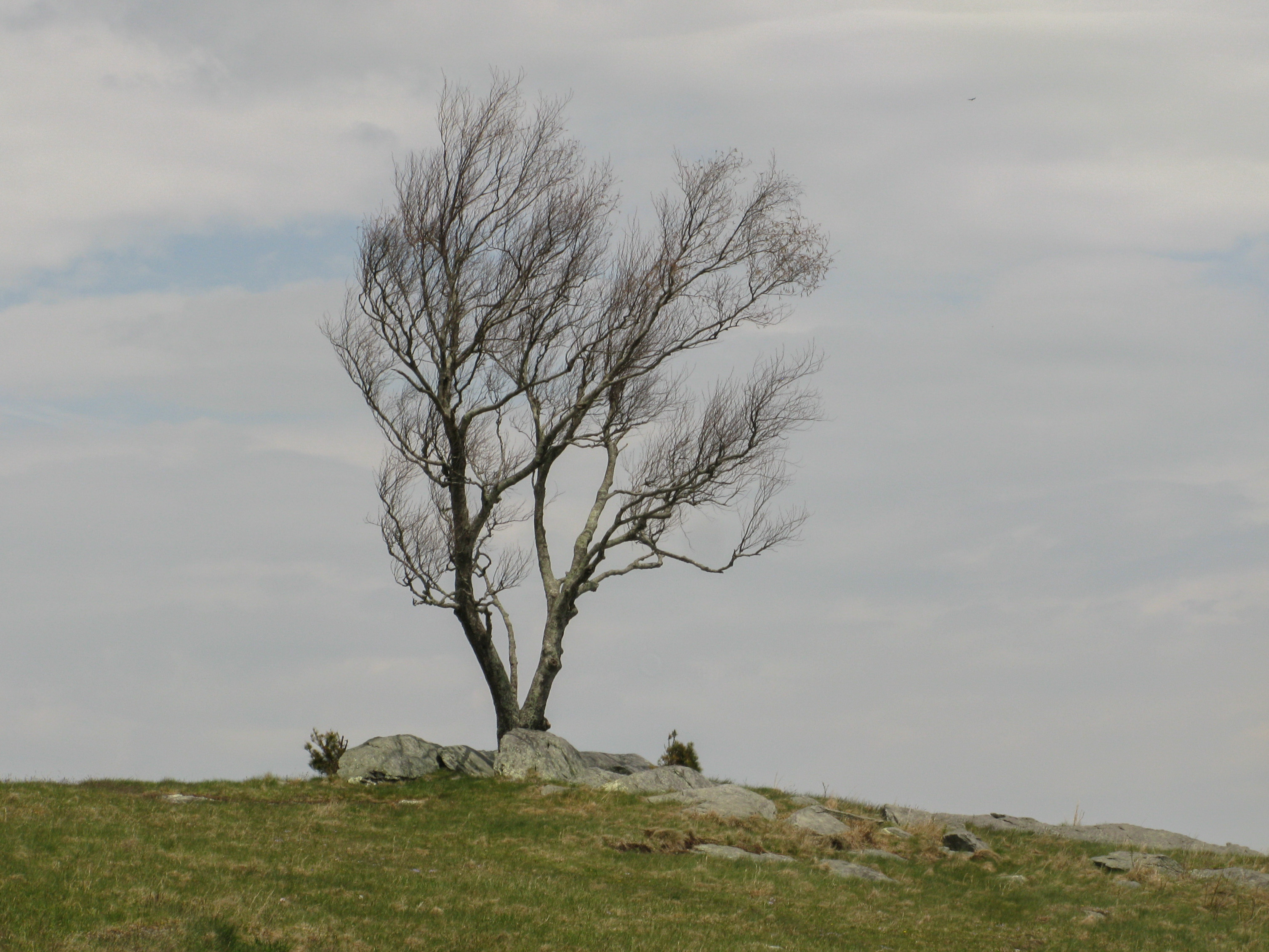
Doughton Park Tree 4/30/2022


Engaged

[with 3 poems by Cal Nordt]

Happy Birthday! Not that it’s yours today but that you’ve had one (plus a few anniversaries) and can still remember when it is. Last Thursday at the hospital I tried to keep track of how many times someone asked Dad his birth date: the clerk at registration, the orderly leading us to pre-op, every nurse at every encounter, every blood draw, every consent, every med. The Urology resident, the Anesthesiology attending. Yes, Mr. Griffin, and tell me your birthday? Even after I’d put his hearing aides in my pocket, he managed to answer them all correctly right up to and including that one last time before they parted the curtains, wheeled him to OR, and pointed me in the direction of the waiting room.

Every ask is a reminder that in four weeks Dad will be 96. More than one scrubs-clad woman remarked, “I can’t believe that’s really your age!” Does he appear so young? I can’t see it – how different does 80 look from 100? No, my theory is that it’s because he is so present. He’s watching them, telling them his story even if for the dozenth time, questioning, commenting. Some might describe him as engaged – we, his kids, tend to call it sociable. There is some ineffable quality about my father that makes people want to talk to him.

I guess that’s how a person makes it to 95. When I ask Dad, “How was your day?” his answer is to tell me who stopped by for a visit or which family member he Zoomed (after he’s told me what he had for supper). And by the time I’ve finished writing this it will be only three weeks until Dad is 96. Which makes me . . . mmm . . . don’t ask.

❦ ❦ ❦

Turning Pages

Time the destroyer is time the preserver . . . T. S. Eliot, The Dry Salvages

We rode miles of rolling country roads,
past tobacco fields, crumbling farm shacks,
vast woods of longleaf pine.

Bike Rides with My Dad was her first book,
illustrated – words and crayon drawings,
her fascicles on soft cream-colored paper
bound in bright red yarn.

When that book was made, my bike tire
had gone flat – we walked two miles home
and talked the whole way. She was eight.
Spring was off in the distance,
after a month’s turning days.

Eighteen years later, it’s almost summer;
she’s half a world away, an artist teaching
English to children near Taipei. Our first
video call, miles of talk
on aesthetics and poetics.

“Does it really exist, this destroyer, time?”
Rilke asked years ago. But isn’t time
just a tablet of blank pages we draw on
that turn one way, while memory
turns the other?

Cal Nordt
from Mystical Fictions, © 2022 Cal Nordt

❦ ❦ ❦

I don’t think Cal Nordt is nearly as old as my Dad, although if you put them in a lineup I wouldn’t bet on you being able to pick the younger 5 times out of 10. (Did I just say that once you’re 80 you don’t look any different from 100? Ask me that again in ten years). One thing the two of them share, though, is that innate push to engage. Show up at a poetry event and there’s Cal in the front row. Even if it requires block and tackle, Cal is going to stand and read a poem.

I’m sure Cal’s desire to connect and to share are a big part of what drove him to create and compile his book, Mystical Fictions, a labor of many years. As I read and reread these poems, it’s just like we’re back in a late night kitchen somewhere swapping yarns. Maybe some of the events in these poems occurred when Cal and I both still had hair, maybe entropy is having its way with us and with those we love, but the voice that sounds through these pages is fresh and wry. His delight in the quirky nature of physical reality and the quirky reality of human nature are still delightful. Are we getting old? Hell, it’s all relative.

❦ ❦ ❦

Physics

I’m still frustrated by
gravity –
things falling
down.
But I’m OK with entropy
now.
And I’m OK with the arrow
of time.
If the arrow suddenly
switched –
and it all headed crunch-ward
(galaxies, the universe, etcetera)
and the shattered glass really did
jump
back from the floor
up on the counter,
while,
I’d be perplexed – liking
the one change, but maybe not
the other.
You can’t have
everything
your
way.

Cal Nordt
from Mystical Fictions, © 2022 Cal Nordt

❦ ❦ ❦

Stop Time

In jazz, when a chord is played only on the first beat.

To freeze time:
a sculpture
in a courtyard,
a flower pressed
in a book, a butterfly
flattened behind glass.
Why can’t we see things
without stopping them?

Like particles we can’t
throw light on without changing
by a photon’s reflection,
do we make them physical
when we stop addressing them
as points in a flow
missing certain coordinates,
the folded-in dimensions?
We press things flat to understand –
the smallest bits allowed in
our philosophy or science.
We call them probabilities,
not even a thing we can hold.

Words of ink on a page,
old photos . . .
Eternal is a dead end.
Life moves, sparkles in
another’s eyes, an instant’s
shared sense of what is:
wind on a leaf, rain
on hot tar, touch
of a hand then let go.

Cal Nordt
from Mystical Fictions, © 2022 Cal Nordt

❦ ❦ ❦

I couldn’t resist sharing the book’s cover with artwork by the Nordt Grandchildren, Elding, Jane, Owen, Tommy, Maggie, Joey, and Kit. Cover and book design by Cal’s daughter, Katie LaRosa.


Mystical Fictions is available through BOOKSHOP and (omg) WAL-MART.

❦ ❦ ❦

IMG_1783


[with poems by Ana Pugatch, David Poston, Maureen Sherbondy, Joan Leotta]

The original Constitution of the North Carolina Poetry Society stated these objectives: to foster the writing of poetry; to bring together in meetings of mutual interest and fellowship the poets of North Carolina; to encourage the study, writing, and publication of poetry; and to develop a public taste for the reading and appreciation of poetry. These tenets still inspire the mission of NCPS. During the second decade of the twenty-first century that mission has expanded, metamorphosed, and grown wings.

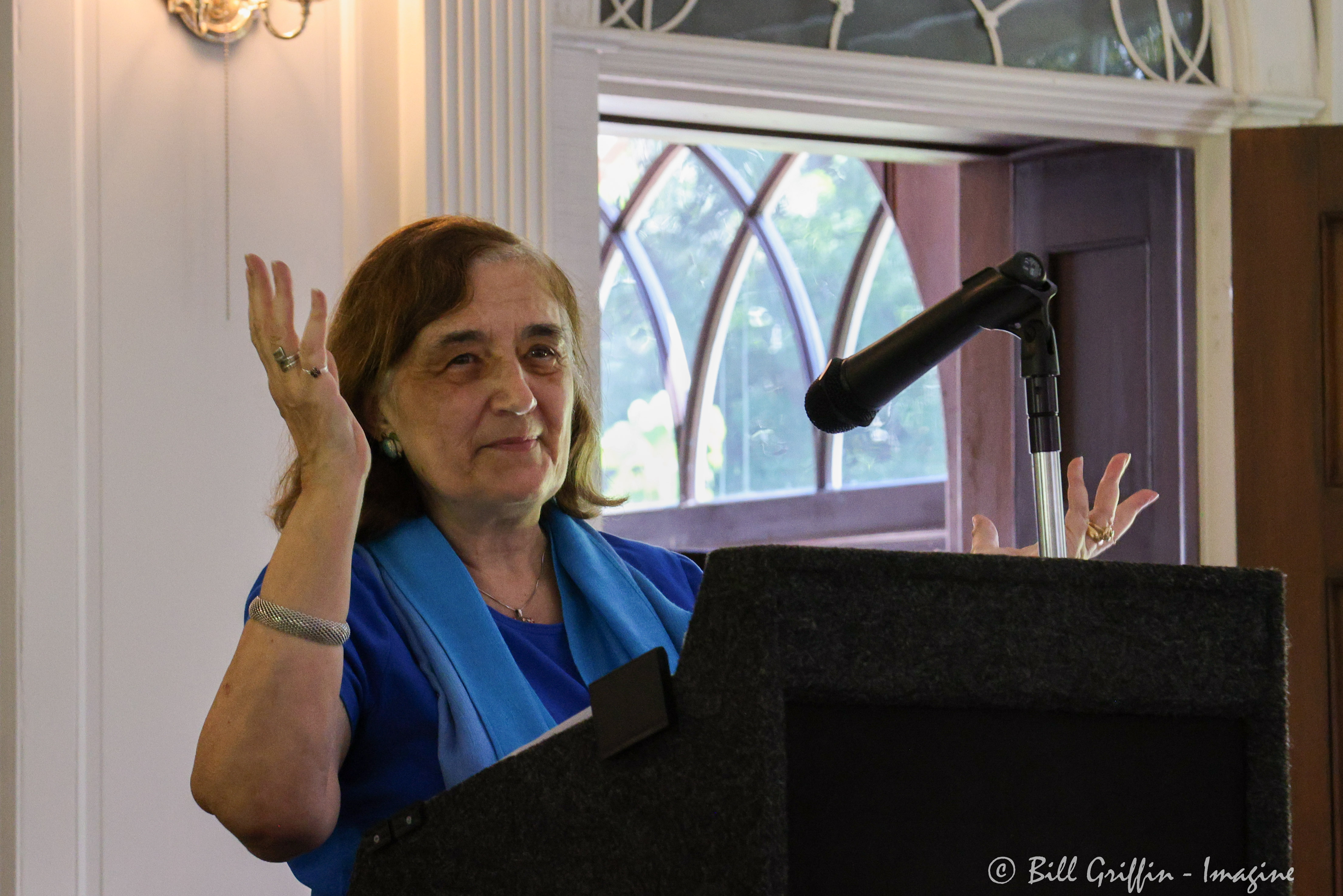
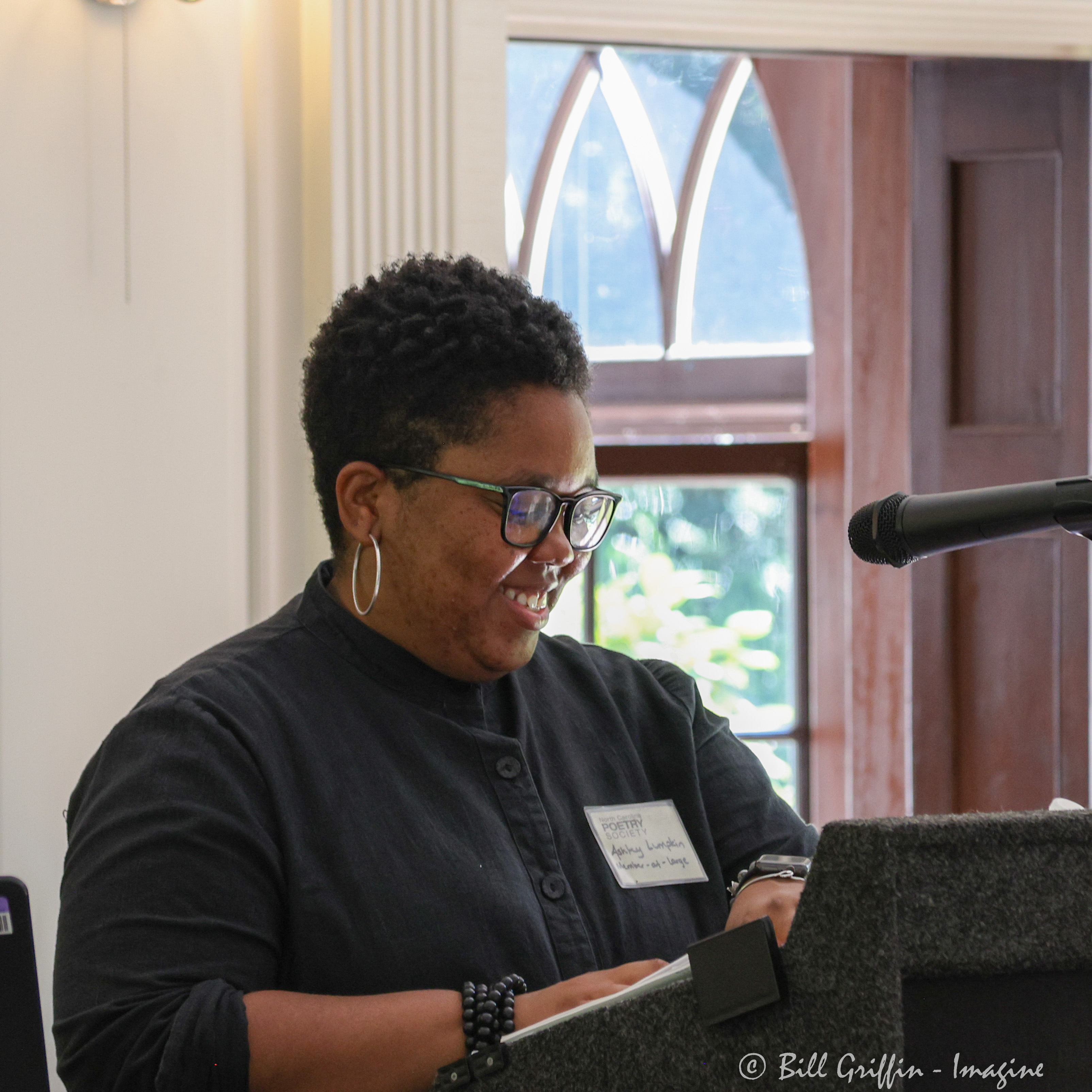
On September 17, 2022, the NC Poetry Society gathered at Weymouth Center for the Arts and Humanities for a gala celebration of our 90th Anniversary. This was the first meeting in person since the spread of COVID19 two and a half years earlier. After dozens of virtual workshops, poetry readings, Zoom programs, and online open mics, our faces had somehow remained familiar but we had come to know many new faces as well. When we walked into the Boyd House in Southern Pines the greetings were ecstatic, the hugs manifold, and behind the masks were face-splitting smiles. Joy overwhelming!

And isn’t this the essential nucleus of the mission of NCPS? Oh yes, we thrive on the unexpected metaphor, the well-honed line, the expressive reading. Poetry, though, is more than craft. It is the art and magic of connecting, the door that opens shared experience, a key to community. As we share poetry we share our self. Suddenly there are two of us walking this journey of humanness, two to delve its depths, two to breach its heights. Wherever poets and lovers of poetry gather, wherever a hard and beautiful and true word is spoken, there is joy.

❦ ❦ ❦

❦ ❦ ❦

The Lena M. Shull Poetry Manuscript Contest was established in 2013. The Poetry Council of NC disbanded and donated its residual assets to NCPS to endow an annual full length poetry manuscript contest named for Lena Shull, the founder of PCNC. NCPS publishes the winning manuscript; the author receives fifty copies, a monetary award, and featured readings. The inaugural prize was awarded to Becky Gould Gibson for her book Heading Home. The 2022 winner is Ana Pugatch for Seven Years in Asia. Finalists are David Poston for Letting Go and Maureen Sherbondy for The Body Remembers.

❦ ❦ ❦

Dissolution

You’ve come to a place that is always raining. The silence: a flood.
At five a.m., the group stands like still poplars outside
the monastery. The previous night, your white uniform had blown
from the laundry line into the dirt and the smell of earth never leaves you.

She tells you about how she cut class to go sit on the toilet,
contemplating ways to end her life. “I knew then that I had to do something,”
the monastic explains. “That something needed to change.” Your head is shaved,
each strand an earthly attachment; when you sweep up

the pile of sunlight you don’t feel any lighter. The poplars paint
their characters and you’re told to stop smiling. On Mt. Wutai, the prayer flags
flutter furiously. There’s never enough rice and your body burns
through itself; those flags are a fitful hunger. At night,

you don’t bother turning over when water drips from cracked
plaster onto your forehead and you begin to wonder
why do lay people come here—why did you come here—and has your pride
become a fist—does dukkha melt in summer snow—

You share a room with a stranger. The pilgrim’s back is hunched, her eyes
a brilliant black. “N duō dà le?” you ask. She thinks she’s eighty but can’t be sure.
You shit in a hole and shower alongside her, your frame nearly twice
her size. She doesn’t care you’re a giant or that it’s your birthday.

The mountain is chilly in July. When you give a monk your WeChat, he sends
a pixelated lotus; you reply with thank you hands. The monastics’ robes are flecks
of crimson. You can sense the five flat peaks, the thousands of vertical pines. Your skin
is so damp you become Wutai, and the well of your anger dissolves into rain.

Ana Pugatch
from Seven Years in Asia, winner of the 2022 Lena Shull Contest of the North Carolina Poetry Society. Dissolution first appeared in The Poet’s Billow and won their 2020 Atlantis Award.

Ana lives in Raleigh, NC, with her husband and son. She has taught English in China and Thailand while studying Buddhism. Ana received her MFA from George Mason University, where she was awarded the ’20-’21 Poetry Heritage Fellowship.

❦ ❦ ❦

Something Beautiful

Last month,
as the Fourth of July barrage
dissolved into the night
and people around me
gathered camp chairs and blankets
for the slog through everyone’s trash
back to their cars,
I stood there in the dark
waiting for
one more
bright flowering
I knew
would never come.

Now, lying alone
just before dawn
waiting for the Perseids
to flare across
the edge of sight
as the sky begins to pale
behind a rumple of mist
where the dark lake waits,
I shouldn’t worry about
which faint streaking
will be the last.

I’m remembering
my ninety-year-old father
bursting into laughter
at the Dairy Queen
as he ate a banana split,
and what was so funny to him
was the sudden thought-
he said this-
that it might be
the last one he ever ate,
and what could I do
but laugh with him
and remember later
that he was right?

David Poston
from the manuscript Letting Go, finalist for the 2022 Lena Shull Poetry Award.

David Poston lives with his wife Bee in Gastonia, NC, and is a frequent book reviewer for Pedestal Magazine and a co-editor of Kakalak. He has published three poetry collections, including Postmodern Bourgeois Poetaster Blues, winner of the 2007 Randall Jarrell/Harperprints Competition.

❦ ❦ ❦

Cousins I Never Met

Fire burns down the entire forest
but still one flower thrives. The moon’s
silhouette against the sky reminds me
yes, we are still alive. We ran and walked
through yesterday’s parade. You thought
the kite you ran with on the sand could
fly up to the night-imprisoned moon. My cousins, too,
(all gone too soon) watched this same light
in Germany as night-time, day-time prisoners in
rooms fit for two or three, not fifty.

Two years ago we let go of white balloons
at the newborn’s funeral. Five days
he lived. Son, nephew, brother. Five days. We looked up
until white globes blurred into white clouds.
Devoured. We throw rocks at death both now
and then. Still, death stays with you and me hours,
months, through years of lingering. Remember

painting the German Shepherd thick
with tomato juice to release the stink.
Oh, that stink, it lingers. Oh, this scent
of death too. Stink of burning flesh,
I have heard about it, read about it.
Lampshade flesh, they whisper in the halls.

Now walk with me inside
the burned-down forest, take in the sweet
perfume of one flower reaching up
to the sun and moon. My relatives made it
through until the final hours and then
and then. Auschwitz, final hour. The end
when release could be tasted, sulphur burning
on his defeated tongue. Fuhrer fury. The end arrived
when release could be swallowed from the air
so close, and yet. Their blood, our blood waters
burnt soil. We plant new seeds. We march forward.

Maureen Sherbondy
first appeared in Connotation Press

Maureen lives in Durham, NC, with her husband Barry Peters and her cat Lola, and teaches at Alamance Community College. She has published eleven poetry collections, most recently Lines in Opposition.

❦ ❦ ❦

No gathering of poets at Weymouth Center would be complete without a workshop. for the afternoon program Joan Leotta presented The Art of Poetic Storytelling, exploring how verse and narrative intersect. She used the metaphor of the moon’s phases to convey the various forms narrative may take, minimal to whole, partial to complete. One of her own poems illustrates, as Joan says, “an example of a crescent moon–only part of the story arc present, a slim piece, the rest filled in by the reader/listener:”

an owl continually questions
my identity
as I watch the stars

[first appeared in haikuniverse]

Joan also introduced her workshop with this insightful observation she solicited from Joseph Bathanti, Seventh NC Poet Laureate 2012-2014, for just this occasion:

“I fancy myself, essentially, a narrative poet, one that relies a good bit on what I call reimagined autobiography – though not all of my poems are narrative or autobiographical. I’m also a novelist, so I’m always preoccupied with story and I also think it’s important that a poem be accessible, rather than a coded conversation a poet has with him/her/their self that only the poet understands. Strong narrative poems tell stories through utilizing classic conventions of fiction such as dialogue, plot, conflict, characterization, setting/place, etc., while still relying heavily on key elements of poetry such as compressed, often impressionistic, language; rhythm; stylized line and stanza breaks; and attention to sound. They balance the image-charged voltage of poetry with traditionally discursive narrative strategies of fiction and creative nonfiction, focusing on
the occasion of the poem, and the dramatic situation that inspired it.”
++++++++++++++++++++++++++++++++ Joseph Bathanti

Joan is a Pittsburgh native who now lives in Calabash, NC. In addition to poetry she has written novels and non-fiction food and travel guides. Her poetry collection Feathers on Stone is forthcoming in 2023 from Mainstreet Rag Publishing. Besides teaching writing and performing, Joan is also herself a performer and story teller.

❦ ❦ ❦

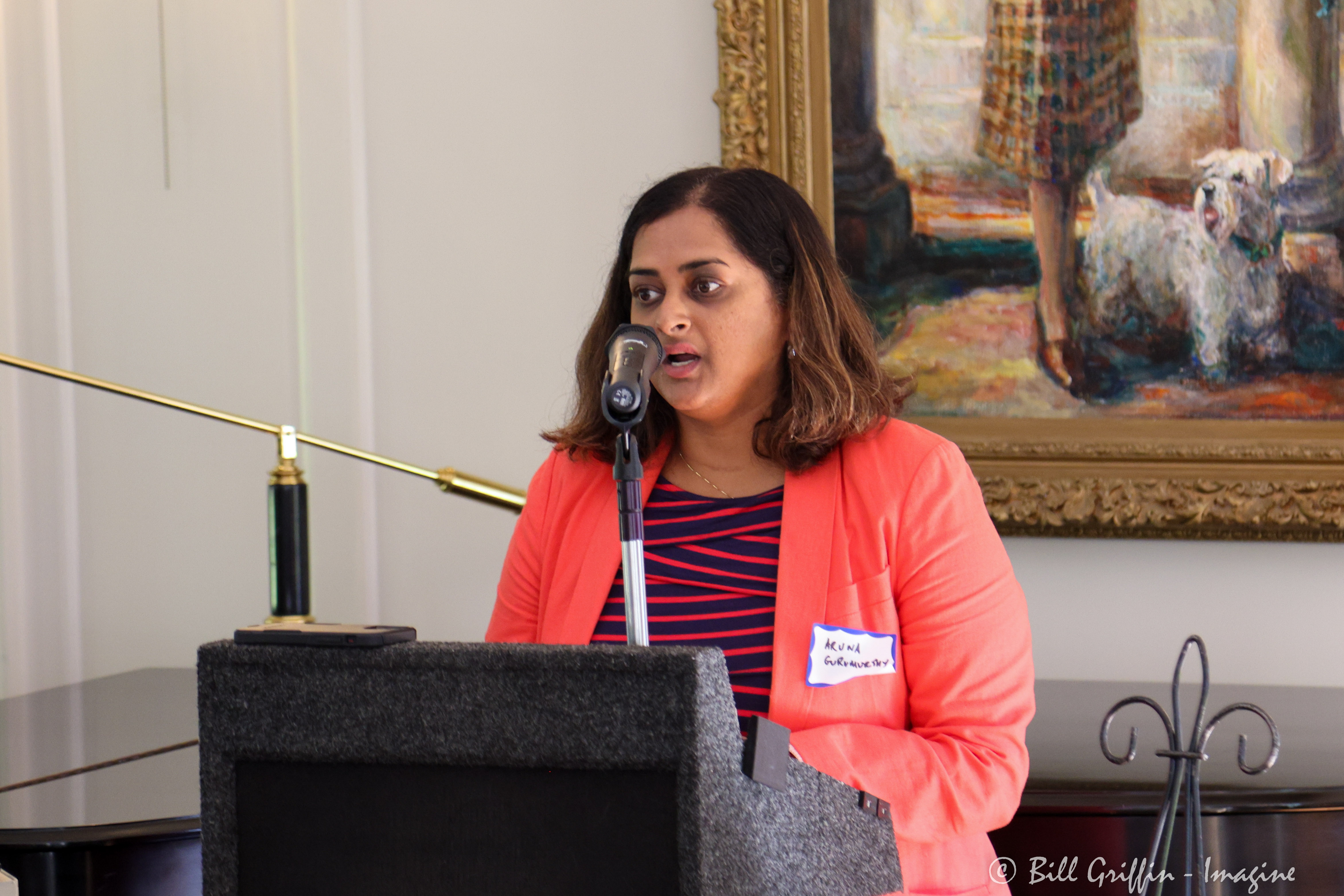
The Randall Jarrell Poetry Competition is sponsored by the North Carolina Writers’ Network; winners are invited to read at the fall NCPS meeting and this year are part of the 90th Anniversary celebrations. Their poems will be published in storySouth and we hope to present the poems here at a future date:
+++++ Winner – John Haugh: Consider the Word Pursuit on the Winter Solstice
+++++ Runner-up – Aruna Gurumurthy: Madras
+++++ Honorable Mention – Jeff Miles, Vivian Bikulege

❦ ❦ ❦

THANK YOU to so many who made this North Carolina Poetry Society 90th Anniversary gathering not only possible but truly worthy of the banner, Infusing Ceremony with Celebration: Poetry with Light, Soul, and Sound: Lynda Rush-Myers, for a year of planning and countless hours of preparation and presentation; Celestine Davis, ever-present ever-encouraging ever keeping the wheels on the bus; Regina Garcia, heart and soul and thrilling Tribute introductions, and Romeo Garcia making sure we all got lunch; the entire NCPS Board of Directors, setting up, hanging signs, welcoming and greeting, picking up the trash; and special thanks to the staff of Weymouth Center and Executive Director Katie Wyatt, we/you couldn’t do it without you/us.


LAST WEEK: additional NCPS 90th Anniversary celebrations with poems by Brockman-Campbell Book Award winner Kim O’Connor and finalists AE Hines and Cheryl Wilder, plus Susan Laughter Meyers Fellowship in Poetry winner Yvette R. Murray.

❦ ❦ ❦

Portions adapted from The North Carolina Poetry Society: Part 5 – 2012-2022, Ninety Years of Creativity, Challenge, and Change; compiled and composed by Bill Griffin with special collaborator David Radavich; © 2022 The North Carolina Poetry Society.

Doughton Park Tree 2021-03-23