Feeds:
Posts
Comments

Archive for the ‘poetry’ Category

 . 
[with 3 poems by Joy Harjo]
 . 
And the blessing began a graceful moving through the grasses of time, from the beginning, to the circling around place of time, always moving, always
++++++++ from Bless This Land, Joy Harjo
 . 
 . 
The Story Wheel
 . 
I leave you to your ceremony of grieving
Which is also of celebration
Given when an honored humble one
Leaves behind a trail of happiness
In the dark of human tribulation.
None of us is above the other
In this story of forever.
Though we follow that red road home,
one behind another.
There is a light breaking through the storm
And it is buffalo hunting weather.
There you can see your mother.
She is bus as she was ever –
She holds up a new jingle dress, for her youngest beloved daughter.
And fo her special son, a set of finely beaded gear.
All for that welcome home dance,
The most favorite of all –
when everyone finds their way back together
to dance, eat and celebrate.
And tell story after story
of how they fought and played
in the story wheel
and how no one
was every really lost at all.
 . 
Joy Harjo
from An American Sunrise, W. W. Norton, New York NY, © 2019
 . 
❦ ❦ ❦
 . 
Last night I sat silent on stage waiting as a few early arrivals took their seats in the audience. We singers had a few more selections to rehearse before filing out to prepare our official entrance, and for now we waited. Shouldn’t I have been anxious in anticipation of the harmonies we would soon raise together? Shouldn’t I have been thrilled as the strings took their places and began to tune their instruments? Shouldn’t joy live here?
 . 
No, something dark nagged me. My heart was stone. I felt suspicious of these watchers, listeners. I was afraid of their grand and thriving church. I distrusted what they would think of me if they in turn suspected I didn’t think or believe precisely as they did. I told myself I was already rejected, on the outside. I didn’t belong here.
 . 
Joy Harjo writes, The old Mvskoke laws outlawed the Christian religion / Because it divided the people. / . . . But Mvskoke ways are to make relatives. Where is the religion that makes relatives? People, plants, creatures, everything together as family? A religion that turns all people to face each other within the circle rather than turning them out? Linda and I had been thrashing with recent revelations that people were leaving our son’s church because one of the ministers has come out as gay. These people leaving – we thought we knew them, we considered them neighbors. We don’t understand the rejection, the turning apart. How can we understand?
 . 
When our chorus returns to our places before a full house, I don’t recognize many faces. But I do know a few, some from years in the past, and I remember I love them. Now lift our voices together and sing of a Creator who is always with us. We sing longing and loss, humor and fullness, songs like rivers that course and meander a long journey, that carry all the weight of time and earth. I sing. And at the end of the singing we have become one family.
 . 
The heart of stone has only hardened itself. Everything that lives wants to soften that heart. Everything that lives wants to open each heart to beauty and truth.
 . 
 . 
❦ ❦ ❦
 . 
from Exile of Memory
.    .    .
In the complex here there is a singing tree.
It sings of the history of the trees here.
It sings of Monahwee who stood with his warrior friends
On the overlook staring into the new town erected
By illegal residents.
It sings of the Civil War camp, the bloodied
The self-righteous, and the forsaken.
It sings of atomic power and the rise
Of banks whose spires mark
The worship places.
The final verse is always the trees.
They will remain.
.    .    .
When it is time to leave this place of return,
What will I say that I found here?
 . 
From out of the mist, a form wrestled to come forth –
It was many legged, of many arms, and sent forth thoughts of many colors.
There were deer standing near us under the parted, misted sky
As we watched, the smelled for water
Green light entered their bodies
From all leaved things they ate –
.    .    .
The Mvskoke laws outlawed the Christian religion
Because it divided the people.
We who are relatives of Panther, Racoon, Deer, and the other animals and winds were soon divided.
But Mvskoke ways are to make relatives.
We made a relative of Jesus, gave him a Mvskoke name
.    .    .
We could not see our ancestors as we climbed up
To the edge of destruction
But from the dark we felt their soft presences at the edge of our mind
And we hear their singing.
 . 
There is no word in this trade language, no words with enough power to hold all this we have become –
 . 
Joy Harjo
from An American Sunrise, W. W. Norton, New York NY, © 2019
 . 
❦ ❦ ❦
 . 

IMG_0262

 . 
❦ ❦ ❦
 . 
An American Sunrise opens with a map of a trail of tears, that of the Muscogee Creek Nation’s forced displacement to Oklahoma from their native homelands near Talladega, Georgia in the 1830’s. One of many trails of tears. In Joy Harjo’s preface she includes this plea and blessing: May we all find the way home.
 . 
Toward the close of the book, Joy Harjo describes how her Great-Grandfather Monahwee could bend time. The entire book is an experience of time and place bending, fluid, circular, all connected. We hear the voices of ancestors and offspring. We hear the voices of creatures on earth and of Earth herself. We are torn by hatred and injustice – we bleed. We smell the smoke of cook fires at dawn and feel the sun on our face – we are fed. We are challenged and re-challenged to connect ourselves to the thread of life that weaves through all people and all creation and leaves nothing out. As the poet says, Nobody goes anywhere / though we are always leaving and returning. And her experiences are, as for all of us . . . the giving away to history which in no means meant giving up. For a warrior it is not possible to give up. 
 . 
For any of us to find home, we must all find home. We must all witness cruelty and kindness in this land. From the book’s final poem, Bless This Land: Bless us, these lands, said the rememberer. These land aren’t our / lands. These lands aren’t your lands. We are this land. May the poems and the songs bring all things into our memory and show us the way.
 . 
 . 
An American Sunrise, Joy Harjo; W. W. Norton & Company, New York NY © 2019. Joy Harjo served as Poet Laureate of the United States for three terms, 2019 through 2021.
 . 
❦ ❦ ❦
 . 
Beyond
 . 
Beyond sunrise, there is a song we follow
Beyond clouds traveling with rain humped
On their backs, lightning in their fists
Beyond the blue horizon where our ancestors
Appear bearing gifts, wrapped in blankets woven
With sun and strands of scarlet time
 . 
Beyond the footpaths we walk every day
From sunrise to kitchen, to work, to garden, to play
To sunset, to dark, and back
 . 
Beyond where the baby sleeps, her breath
A light mist of happiness making
A fine rainbow of becoming knowledgeable around us.
 . 
Beyond the children learning alphabets
And numbers, bent over their sticks and dolls
As they play war and family, grow human paths
 . 
Beyond the grandmothers and grand fathers
Their mothers and fathers, and in the marrow of their bones
To when that song was furs sung we traveled on
 . 
Beyond sunset, can you hear it?
The shaking of shells, the drumming of feet, the singers
Singing, all of us, all at once?
 . 
In the song of beyond, how deep we are –
 . 
Joy Harjo
from An American Sunrise, W. W. Norton, New York NY, © 2019
 .  
 . 
❦ ❦ ❦
 . 
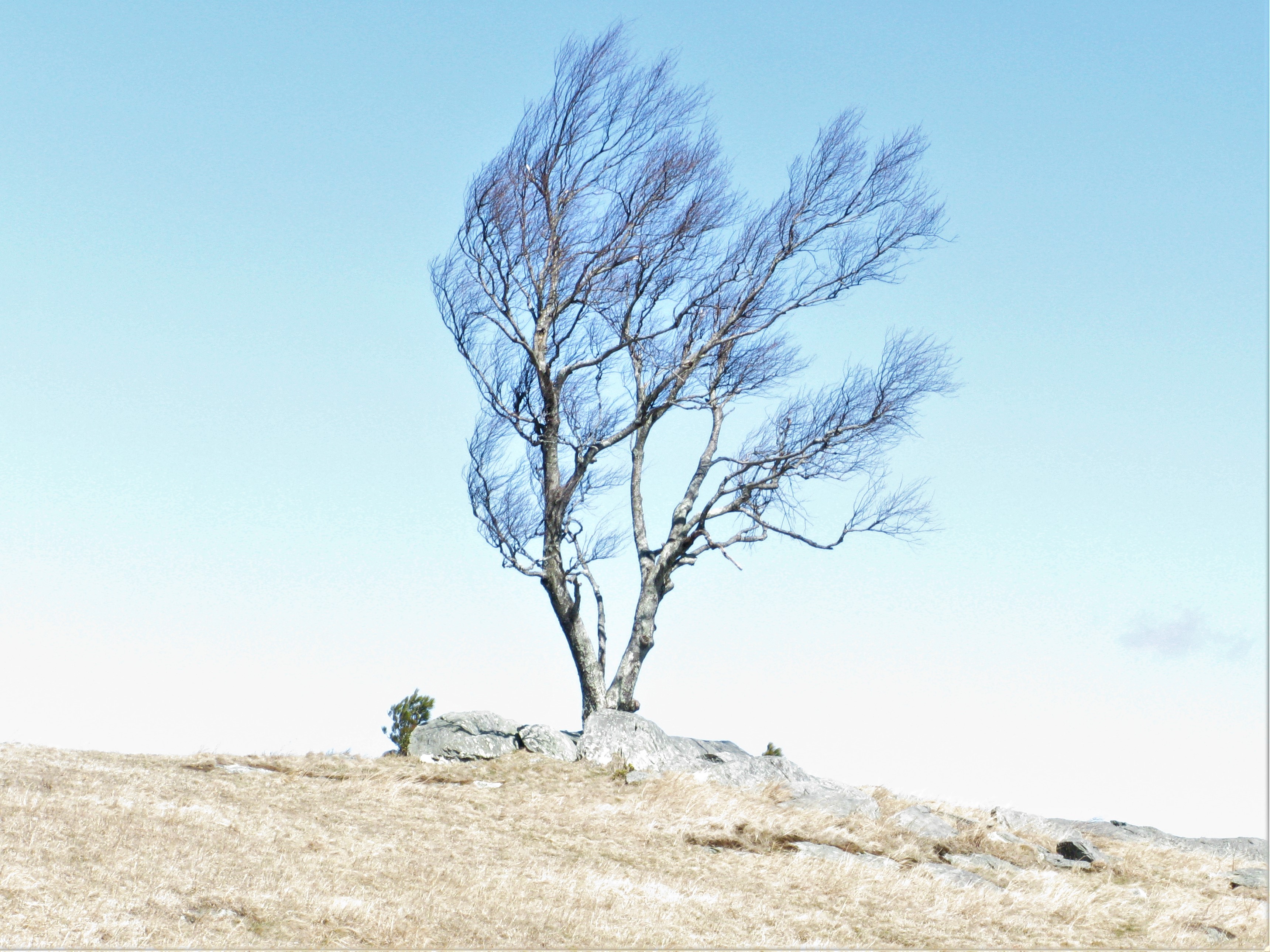
Doughton Park Tree 2020-06-11a
 . 

Read Full Post »

 . 
[with 3 poems from Visions International]
 . 
The Tending
 . 
Each day made a play for eternity then,
just as now each day shrinks
to a blurry moment’s recall. But still
there is the flat porch roof where a child
would lie down to watch
the clouds slowly changing shape,
 . 
or the blue, unfathomable sky
opening over, and puzzle where he was
before birth, before conception,
or if the world of sensation
had wiped his angel memory.
Cypress-tree shadow reached, as they
 . 
still do, across the lawn at evening,
and again I twist backwards
through a wooden sash window
into the long unoccupied bedroom
of my parents. Old clothes,
a straw-hat clinging to a wall, a stopped
 . 
alarm clock on the mantel.
And here, a navy-striped bolster,
the dent left by their sleeping heads
imagined as touchable still,
the love between us arguing against loss,
the tending they brought
 . 
to each sadness and terror of thought,
but more to an obvious wound –
the skinned knee dabbed
with Dettol; a beaker of oatmeal tipped
into a cold bath as a salve
for sunburn; a sewing needle squeezed
 . 
from a pin cushion bristling
with needles, the small hand held
forward into light, the gentle, tortuous
teasing out of a thistle thorn
and this placed – a charm,
frail tiny, golden – on the child’ palm
 . 
Patrick Deeley – Dublin, Ireland
 . 
❦ ❦ ❦
 . 
Foamflower
 . 
The last day of March – at the edge of the woods red maple, always impatient, always profligate, spreads its arms to offer a jillion winged seeds, the fire at its twigtips cooled to pale smolder. Deeper beneath the canopy leafbuds are swelling on oak and hickory, tangible pressured suspense, not yet quite to bursting. Ephemerals race to make sugar from thin sunlight before the overstory closes and their beds grow dark. Trout lily and hepatica already bloomed out; bloodroot roaring full throat; rue anemone flinging itself in galaxies up the ridge.
 . 
And what’s this? Foamflower has poked its first slender finger up between last year’s coppered leaves. A pale nubbin, a lifting spike, two or three then tomorrow a full maypole of tiny florets to comprise the rising inflorescence. Tiarella cordifolia, little crowns with heart-shaped leaves. What is its occupation in this temperate glade? What does it promise me other than its beauty?
 . 
Has it promised me anything? Should it? Perhaps I can tell you a story about the company foamflower keeps in this beech-dominated neighborhood: pussytoes, star chickweed, the throng of early blooming companions. Perhaps I’ll kneel to discover its native bee pollinators or wonder how its minute seeds disperse themselves. I might even recognize these felsic outcroppings and recall its family name, Saxifrage, Stone-breaker. But Lord of creation, save me from asking, “What good is it to me?” Expect a poultice of its leaves to heal my burns and scalds? Brew a tea to soothe my mouth and brighten my eye? Shall I read in its signature only whatever good use I can make of it?
 . 
On the seventh day the Lord looked out upon everything created and declared, “It is good!” And then rested. Never let me rest until I have looked around me, all around, water and stone, flower and tree, worm and beetle, turtle and bird, each of them good, in themselves and of themselves. Each one living usefulness that comprises its own being. What is my occupation in this temperate glade? What may I promise all these that surround me? To be a good companion in the community of all.
 . 
 . 
❦ ❦ ❦
 . 
O Doves
(Lima, Peru, 6 am)
and he saw the Spirit of God descent like a dove . . . Matthew 3:16
 . 
Shy ones, the shades of buttermilk
and cirrus cloud,
 . 
forgive the man and woman
cursing the scrabble of your bones on the
bedroom window ledge.
 . 
They are harried creatures
waking out of sleep’s egg
to the greasy clot of day.
 . 
They know only hunger,
which is the world’s stark treason,
 . 
and the mockery of iridescent necks
pecking the gray flagstones for crumbs.
 . 
How can they love the immaculate
cooing of your beaks so high in the blue air,
 . 
having forgotten the signs
of invisible things?
 . 
Maria Rouphail – Raleigh, North Carolina, USA
 . 
❦ ❦ ❦
 . 
the gilded angel on the spire / draws the sun to its dewy face
 . 
landscapes advance / and dig their hooks in the elongated shadow/ you drag behind you
 . 
a child’s sleep soothed by rain’s ticking / on the other side of the earth
 . 
an accordion of hands fixing my hair
 . 
I smooth my quilt, where her dress scraps are stitched
 . 
a pair of wired gold rim glasses / like John Lennon’s
 . 
the water above the springs squeaks like pebbles
 . 
Here is the plain brown envelope with the hand-printed address and the Pete Seeger postal stamp. I slip out the slender booklet, cardstock cover illustrated by Malaika Favorite. Inside a listing of poems and their poets – Bulgaria, North Carolina, Wales, Macedonia, Texas, Ireland. And then the saddle-stapled pages, their lines wandering in the familiar, distinctive font, and the words . . . language . . . images.
 . 
After reading many issues of Visions International over many years, I still wonder how editor Bradley Strahan draws these voices to him. How he creates this international community of human soul. I wonder how he accomplishes it, but I may be learning a bit of what he is listening for, what he seeks and chooses as he compiles each collection. Even more compelling than the stories the poems tell are their images: elemental, bedrock, true. I read phrases that ring with harmonies I’ve never quite heard before and yet they strike as perfectly right and correct. The language is new and yet it enters me and becomes me. (And I have to confess, there is just something about those Irish poets.)
 . 
Here are old neighbors, like Maria Rouphail from Raleigh and Jessie Carty from Huntersville, but here are my new old neighbors from every corner of the earth, all drawn together through their poems. Drop Bradley a line and join the community.
 . 
Visions International / 309 Lakeside Drive / Garner, NC 27529 – 4 issues = $25
 . 
 . 
❦ ❦ ❦
 . 
Drive
. . . roll down the window, and let the wind blow back your hair.
+++ – Bruce Springsteen, Thunder Road
 . 
My first love and I would circle the Blue Ridge
listening to Thunder Road, caught in a spiral –
the song, the earth, and us – a springboard
for leaping. Ancient and settled,
those mountains, a silhouette absorbing music
from our high school parties at the VFW.
Moths and gnats reduced to a fever
clouding porchlights, while kissing was its own
stratosphere. Who needed to breathe anyway?
Not when you’re a new mythology
sharing sixpacks of beer and meadows jacked
in the sweet everlasting – a wildflower
native to the state from which we’d grown.
We kept the geographies of each other’s
bodies beneath our tongues, but the sky
was an impossible parallel. Never mind that
we craved nothing linear. He and I, divergent lines,
a palm reader would have said about the future,
lanterning us in, cloud-swept from the open road.
W didn’t we marry at eighteen, honeymoon
nearby at the Peaks of Otter like all the other
teenage brides? You never asked me if I wanted to
stop. The truth is, I didn’t. I needed to witness
the horizon unobstructed by mountains
where trees shook colors from their crowns,
their roots tangled in bedrock. It was
something of a dance, the way our feet flew
over tar and gravel, spun around blind turns.
The valley that had fevered and pushed us out,
lay spent and sprawled beneath the open windows.
Those nights we rumbled through, we left nothing
but music growing fainter until it was gone.
 . 
Laura Ross – Mount Dora, Florida, USA
 . 
❦ ❦ ❦
 . 
 . 
 . 

Read Full Post »

IMG_9629, flower
. .
[with two prose poems by Mark Cox]
. .
Poem at Forty I Could Not Finish Until I Turned Sixty
. .
The seas below our house pitch deep and soundless. Like sweat engrained in handrails, or the oil darkened edges of our dining room table, every shadow implies more shadow.
. .
Late summer has quieted the cicadas, damped their dwindling number with the lastness of their deaths. There is a chill to the air, no wind at all. My youngest son is twenty days old, feeble, burrowing in and out of awareness, still unsure his body isn’t trying to kill him. He cries to eat, he cries to sleep, he cries as his tiny gut rejects what all must go to waste.
. .
Last week, scientists discovered the bones of a humanoid who fell into a well shaft three million years ago. His wife said he’d turn up! That the world has no pity for the individual life, this is no secret to anyone, yet we just can’t get over it. I am here in the middle of a bed, in the middle of the night, in the middle of my life, my son nestled as if he were my own bones, as if we’ve both toppled forty years down into positions we’ll retain forever. There is no chiropractor for the soul.
. .
The museum of loss has at last opened its doors to me. Scholars cannot agree, the docents say, but almost certainly arms encircling the body was an omen of intimacy. Little is known of the fabled kiss; what remains of crude glyphs and mosaic shards indicate our elders once believed that souls were exchanged. One cannot, of course, touch anything in the museum of oss. One can only view what was once there. Nothing can be imagined and remain the same.
. .
Just what does this portend? There will always be a thermos next to the detonator, a pair of reading glasses weighting the sentence handed down without mercy. An airman in WWII, John Ciardi recounted how once from the blister all gunners sat in, he watched the bomber beside him burning. His counterpart waved up as that other plane went down.
. .
Each age has its designated bandwidth. Without warning, my son is twenty and in love. We are belted in. Splitting space. In his lap, he holds one hand with another, as if to keep its fingers from detaching, as if I’d helped him hurry to the car, and was driving to a hospital. I want my tree back the way it was, he whined, one autumn morning. He was four or so and knew even then what he’s now not able to share.
. .
Much is felt that resists being known. If there are seven billion human beings on earth, then every day is 19 million years of experience, just all at once. Somehow, I find this comforting, though by now you’d think we’d know what we are doing.
. .
Mark Cox
from Knowing, Press 53, Winston-Salem NC; © 2024
. .
. .
❦ ❦ ❦
. .
Better to resist the flux and believe that something stays. At last, he thinks, that is his answer. How still it all is, so utterly clear. Then one bright leaf lets go and changes everything.
++++++Knowing, Mark Cox
. .
It all begins with a question. No, that comes second, first there’s noticing, and noticing that something is different. Wait, even before the noticing there has to be paying attention. No, no, it all begins with this: just being there, moving through the world, part of all the changes.
. .
Joe just texted Cynthia and me a remarkable photo taken along a path we’ve walked together more than a few times. Looks like Bloodroot – nothing else has those freaky leaves emerging from the earth like fingers of the undead – but the petals are different. Instead of a circle of daisy-like petals (radial symmetry) they are bunched and doubled. And the center is almost naked as a belly button.
. .
A hybrid, we ask ourselves? But there are no other species in genus Sanguinaria with which to hybridize. A mutant, then. Sure enough, we discover online images of Bloodroot Multiplex with these peony-like blossoms, all of them propagated from a spontaneous mutation first discovered in Ohio years ago. Sterile flowers in which the stamens have reverted to petals. Evolution amok. Now we have the same mutation here in our backyard.
. .
. .
Plants that make flowers first appear in the fossil record 360 million years ago. Their flowers left the seeds exposed – they were naked (gymnosperms = conifers and gingko). Gymnosperms ruled for over 200 million years until the first flowering plants evolved forms that keep their seeds enclosed. But the outcome of the mutations that eventually resulted in plants with such protected seeds, angiosperms, was so successful that they have filled the earth with their variety and diversity. Every plant you see with flowers blooming this spring is an angiosperm (and even a lot whose flowers you don’t see, like grass for goodness sake).
. .
The enclosing ovary which cradles the ovule which will become the seed – what an excellent evolutionary idea! It most likely developed from mutations in fertile leaves which caused progressive curling and enfolding. All the parts of the flower – sepal, petal, stamen – are specialized modified leaves. But whenever we discover a Bloodroot flower with more than eight petals, we can assume that some of the extra petals are stamens which have turned back the evolutionary clock to become petals again.
. .
Is there anything we can hold on to that stays, fixed and static? Is it even possible to imagine something that never changes? Do I even really know what I think I know?
. .
. .
There is only one thing that each and every one of us knows. Mark Cox reminds us what it is in Knowing – it’s something no one likes to talk about, but something Mark’s poetry is able to face and say in a hundred ways until we readers become more than willing to join the conversation. We’ve known it all along, maybe at times we’ve even braced for the brief plunge toward otherness, but in these prose poems we have a guide and a friend who is just as afraid as we are but braver about sharing his fear.
. .
Does a prose poem occupy some evolutionary niche between verse and narrative? Forget its phenotype: brevity, blockiness, absent linebreaks. What’s down deeper in its DNA? It seems to carry all the genes of its poetry forebears – language and imagery, rhythm and music, even internal rhyme – but it is its own genus. Unlike a story, it has no beginning, middle, and end – it is all middle. Crisis and denouement might embrace each other in the same line. (And can we even call them lines when they are all one? Sort of like the question how many grooves there are  on a 33 ⅓ rpm LP.) In the poem, everything is happening, but how is it happening? Oh wait, as I read the poem everything is happening in me.
. .
And what happens in me over and over as I read these poems, as it dawns on me that the one thing we all know, each and every one of us, is that we will die, is this: I look up from the page and talk to myself. I query, I wonder, I argue, I confess. I pick up the threads of so many internal conversations left dangling because they were difficult, or scary, or just pushed out of the present by quotidian distractions. I’m not saying that by reading a book by Mark Cox titled Knowing I have gained or been granted my own cosmic knowing. But I have been reminded that I want to.
 . 
. .
❦ ❦ ❦
. .
Music Box
++ For Ralph Angel
. .
Everything’s just peachy, comes the world report: all clear. We are not pirouetting on the tip of time’s scalpel; we are not screwing deeper into the ground’s veneer. It is just the fleeting dance we do until the delicate box closes, having learned now to bow before hurting ourselves.
. .
Today is Thursday once again and the man next door is off to get his mail. He will wander back reading, as is his wont to do, his wizened leashed dachshund dog sniffing the leaves. The breeze passes over our shrubs and still they stand. A wary sparrow peers from them be we shouldn’t call it hiding.
. .
Yes, we have learned how to brace for the brief plunge toward otherness. We have learned to keep our eyes open to the dark, even if it doesn’t matter. We see most vividly what cannot be seen, and this is always the case.
. .
In the caves of our past, flames flickered on the rough walls. Fear grew there beyond reason and all sense of proportion. Our shadows have always been bigger than we are, the house lights shining up as they do, not down.
. .
It would make sense to be offered a tune now. Something simple and genuine, a tale of longing fulfilled. Something to do with a childhood nightlight, a mother’s cool palm. Whatever it is, it will have to be a memory wound long ago.
. .
Such a blessing might be broadcast from just about anywhere. We receive it on this bureau with no clue wherefrom it issues, which ancient satellite or lofty transmission tower. On and off like a warning beacon, the message beams. Once all is said, one has no choice but to choose. Call it grace, call it wonder, just, as they say, keep it calling.
. .
Mark Cox
from Knowing, Press 53, Winston-Salem NC; © 2024
Music Box first appeared in The Connecticut River Review
. .
❦ ❦ ❦
. .
Mark Cox is chair of the Department of Creative Writing at University of North Carolina, Wilmington. He also teaches in the Vermont College of Fine Arts MFA Program. His six previous books include Sorrow Bread: Poems 1984-2015 (2017) and Readiness (2018). Read more about and purchase Knowing at Press 53 HERE
. .. .
 . 
❦ ❦ ❦
. .
IMG_0768, tree

Read Full Post »

« Newer Posts - Older Posts »