Feeds:
Posts
Comments

Archive for the ‘Photography’ Category

[with 3 poems by Denton Loving]

Life is what happens to you while you’re busy making other plans.
John Lennon, “Beautiful Boy

Tomorrow we are driving to Raleigh to see our 3-year old grandson Bert. In person! In the two months since our last in person we’ve visited at least once a week on FaceTime or extended-family Zoom sessions. Often he’s in the bath (easier to keep him in one place); he always wants to show us a toy or especially some of his many books; at least once he’s seen a toy in our background and asked to play with it.

Bert is excited to see us on the little screen but our daughter Margaret tells us that almost every day he asks, “Where’s Granny and Pappy?”

Life is busy happening to us while we’re not able to make hardly any plans at all. Where are we indeed!? All of us are no doubt in the same place: spending a lot of time thinking of things we can’t wait to start doing again when the pandemic has subsided (although it’s time for all of us who’ve learned the definition of pandemic to open the dictionary to endemic). Things to do after – you know you have a list. I’ll bet you’ve even been writing them down.

Herewith I’m starting a list of things I hope to be when the seasons of fear and loss and paranoia are past. If there has been any nano-benefit of living through a pandemic, it might be that I’ve started becoming some of these things already:

Open – to what other people need, to what they’re feeling, less fixated on self
Grateful – for the little things and what now seem like really big things, especially time spent with people I love
Aware of daily changes – in nature, in me and my family, present to the passage of time
Hopeful – life will never be the same, but then again what person actually has stepped into the same river twice? I’m glad I get to keep stepping in every day anew.

.     .     .     .     .     .     .

Denton Loving’s book Crimes Against Birds has been sitting beside my desk for a good while – face down because Linda is creeped out by the cover. I am so glad I’ve kept returning to it. These poems have become my pandemic companions. It’s not only because of their intimate relationship with nature, outdoors, farm life. The poems are like rocking on the porch while the sun sets across the mountains and your companions are uncertainty, death, regret, loss, but also beauty and hope – you welcome them all, invite them to sit down and tell their stories while you get to know them. There is comfort and consolation in facing what has to be faced, and as you do the moon rises through the trees.

.     .     .     .     .     .     .

.     .     .     .     .     .     .

What Was Told
(after Rumi)

What was said to the canna lily to make it
open was said here in my heart. What was
told the sycamore that made its wood hard
and bone white; what was whispered
to the storm’s wind to make it what it is;
what made the honeysuckle smell so sweet
in summer; whatever seed was planted
in the core of the mountain
people to make them love
so deeply, fiercely, beautifully;
whatever gives the catawba the pink inside
the white blooms – that is being said to me
now. I blush like the catawba’s flower.
Whatever gave life to letters and words
is happening here. The great sanctuary
within me has opened its doors; I fill
with thanksgiving as I savor the sweet
taste of honeysuckle on my lips, in love
with the voice that speaks also to me.

.     .     .     .     .     .     .

My Father Leaves Harlan on 119

He remembered
when they started the first
eight miles of this new road
from Pineville to Harlan:
it was 1958.
They had closed
the mines. You couldn’t buy
a job anywhere.

Wilse and Stan and I
were on our way to Corbin
to put in applications – I
can’t remember where now.
Was so long ago.
They didn’t take Stan’s
or mine, and they never did call
Wilse back.

We were hungry
and stopped at Grandma’s
in Barbourville.
We came in the noon
of the day. I don’t think
she was too happy to see us
right in the middle of her work
but she fed us good.
Always did.

She’s been deal all these years
and here I am
Still driving
up this new road.

.     .     .     .     .     .     .

Your Very Flesh

I knew a woman who made fudge as thick
and smooth as summer and five times better
than any you ever ate. It’s an art

to make anything that melts on your tongue,
can be savored down deep in your soul. Makes
me want to know how to do it too. Do you

know how to do something that brings simple
joy in its beauty, will be remembered
after you die? Every July, my Nana

made fourteen-day pickles. For days, she soaked
cucumbers in salt water, removed to
cut in perfect slices, submerged again,

drained them and covered them, added alum,
added sweetness, drained and boiled the syrup,
covered again, dedicated fourteen days

to create something in the end that looked too
pretty to eat. But we did anyway. Now, she
is gone, and none of the rest of us will give

fourteen days to the drudgery of pickles.
I’m not only talking food. I know a man
who can quote lines from the classics to suit

any occasion. His gift is not just memory
but also timing and recitation. He’s a walking
anthology of lost verses, forgotten lines.

This same man cuts and sells timber, and I’ve
heard said there’s no one better to use every
inch of wood a tree can yield. There’s no waste

in his bones. Another art. And I bet
when this man stands in the woods with his saw
in hand, he pauses and gives a little

eulogy for the tree he’s ready
to bring down. May, a word from Plato
or john Donne, or this from Whitman:

your very flesh shall be a great poem.


all selections from Crimes Against Birds, by Denton Loving, Main Street Rag Publishing Company, © 2014

.     .     .     .     .     .     .
.     .     .     .     .     .     .

The quotation from John Lennon’s song, “Beautiful Boy,” has also been attributed to cartoonist Allen Saunders in 1957: Life is what happens to us while we are making other plans.

When we meet with Margaret, Josh, and Bert in person we sit around in the backyard in Raleigh, masked if we’re less than 6 feet apart, but we’re allowed to get knee hugs from Bert. The chickens peck around us and garble and coo; Bert runs everywhere and shows us everything; maybe Josh has heated the wood-fired bread oven and makes pizza. If it’s too cold we have to get up and keep moving, maybe walk the Crabtree Creek Greenway. More than once it’s been too too cold and wet and we’ve just had to cancel the visit. But it will never be too cold After.

More about DENTON LOVING, his writing, himself: https://dentonlovingblog.wordpress.com/


.     .     .     .     .     .     .

2017-03-06a Doughton Park Tree

Read Full Post »

[with 2 poems by Beth Copeland]

February 23, 2021

It’s all downhill from here. That’s what someone told me when I retired last September and it didn’t sound much like a benediction. Today though, sitting down to eat lunch half way through my long day’s hike and knowing that this is, indeed, the highest point on the Blue Ridge I’ll reach, all downhill sounds pretty inviting.

Today is my “birthday hike.” Every February I spend one day hiking the 17-mile perimeter trail at Doughton Park on the Blue Ridge Parkway. A few times I’ve had to break trail through fresh snow, once freezing sleet slicked my balaclava into a glass helmet, but today it’s supposed to reach the 40’s up here near 3,000 feet. I might get sunburned. I’m eating lunch at the 8.5 mile mark, a stone NPS shelter at the top of Alligator Back that looks down into Basin Cove, and across the holler I can trace this morning’s elevation profile.

Park at Basin Creek, climb the trail a quick 800 feet or so, then another more gradual 800, then continue following the ridgeline to encircle the cove – up / down \ up / down \ up / up / up, the final ice-encased switchbacks climbing Alligator Back especially gruesome. But here I am half way done and now it’s all downhill! Hmmm, after more than 20 years of hiking this trail I know better. For every moderate descent there’s another knob rising up ahead, down \ up /down until the final mile of narrow white-knuckle hairpins back to the creek.

It’s not how long the trail, it’s the elevation change. Mom turns 93 tomorrow and Dad at 94 is right there with her. She can hear better than he; he can remember better than she. They practice exercises the Therapist is teaching them so they can walk the mild uphills and downhills around their block every afternoon. So far this year they haven’t really had any net elevation change in independence, well, not enough to sweat; we’re all living day to day on pretty level ground. For her birthday Linda and I have given Mom a book of animal photography by Joel Sartore – her face shines as she turns each page. My sister Mary Ellen and her partner Wendy gave her a patio fire pit table and Mom and Dad look happy as Hobbits hunched around it.

From this vantage that we call today we can look across the blue mountains of time and retrace in memory what brought us here. The trail ahead is less clear, or maybe our vision is perfectly clear even if not clearly perfect. Rough paths, slick spots – inevitable. It can get steep. For today let’s share the view together.

.     .     .     .     .     .     .

I’m reading Beth Copeland’s Blue Honey for the second time and I know I will be reading it yet again. Most of the poems are set during the years her parents were entering their 90’s and declining as Alzheimer’s Disease progressed. She meets each waypoint of loss, theirs and hers, with tenderness and clarity. From vignettes of memories and intense moments she paints a portrait of their lives and reveals her own.

When we lose a parent to death the moment is etched on our hearts but also the calendar. We recall where we were, what was said; we commemorate the date. With Alzheimer’s we lose our parent in random bits like sparks that fly up from a campfire and extinguish in the night. Eventually the body sitting before us contains nothing of the person except an occasional glimpse as ephemeral as ash. Beth Copeland shows us that this sort of loss will make you cry, will make you pissing angry, and will also sometimes thank God make you laugh! Her poems are intensely personal but I also discover myself in so many of them. These lines are, from their first step along the trail and through all the sweaty climbs and bittersweet descents, perfectly human.

.     .     .     .     .     .     .

Sandhills Gold

. . . in the Sandhills of North Carolina,
a few lucky beekeepers strike blue gold.
– Chick Jacobs

The year Daddy died, beekeepers found blue
honey in their hives. How it turns

blue or why it only happens
here no one knows. Some

think bees feed on bruised huckleberries, scuppernongs
or kudzu blossoms. Too far inland, Daddy

never found it in the forty-five years
he kept hives. In the nursing home, I talked

blue honey into blue eyes that
stared back in a blur

of lost memory and sleep. What
was he thinking? I spoke

of his veiled hat and long gloves,
bellowing hives

with smoke so he could pull combs and
honey from inside, and pour sourwood

into old Mason jars in slow motion
like the lengthening summer day

when the sky was so delphinium
it could be music, or the blue

shadow that followed me through the doorway
into the buzzing of bees when I

was thirteen, crying behind the pear tree because
I wasn’t popular enough to be

May Queen. This is what I choose
to keep against forgetting:

You’ll always
be my queen,

he said, bending
to kiss my forehead. I carry

that moment like a bee
in amber on a gold chain

above my heart to ward off wintering
broods and dark swarms, a queen without

a country or hive, standing in slanted light
as bees droned

around my head, weaving a crown of wings
and buzzing with sweetness.

* * * * *

Grief like honey left too long in the jar,
like the pint we bought last year

from a beekeeper who used to sell pot,
in the pantry all winter flanked by bottles

of blackstrap and Hungry Jack
crystallizing in the dark,

too solid to spoon onto bread unless you melt it
in water on the stove. Impatient,

I spread the gold grains on my toast, remembering
when he was alive and it

poured in slow
measures onto my mother’s home-baked bread. One

summer he visited me in Chicago after robbing
his hive of a quart jar of sourwood, his

ankles so swollen
from stings he slept with his feet propped

on pillows. I want this
grief to dissolve like a lemon

lozenge on my tongue, I want
to taste the sweetness

of mornings
before sorrow, anger, remorse

soured my vision of being
young and oblivious to his

pain, I want my words to flow
like a vein

onto the blue-lined page as holy
honey flowed from his white

hives onto our bread, our tongues, our lives.

from Blue Honey, Beth Copeland, The Broadkill River Press, © 2017


.     .     .     .     .     .     .

Nothing Blue

When I leave she asks, Are you
going to that cabin with Phil? She can’t

recall our wedding. She wore
a periwinkle dress she bought at Belk’s

so she wouldn’t
embarrass me garbed in something

old as she sipped champagne and nibbled
cake. I live there. We’re

married, remember? She blinks. Oh,
that’s right. Not her fault, but I’m so

tired of wanting
her to hold onto that

one day. When I arrive to chauffeur
her to the doctor, she’s not

dressed but tells the nurse, I could live
on my own if I had a family. What

am I, chopped
liver? She tells her friends I never

visit because she forgets. On the drive
home, I pass a blur of chicory

growing wild around
a crinoline of Queen Anne’s

Lace – something
old, nothing

new, one thing borrowed,
almost blue

from Blue Honey, Beth Copeland, The Broadkill River Press, © 2017

.     .     .     .     .     .     .

Blue Honey won the 2017 Dogfish Head Poetry Prize from The Broadkill River Press. Not long after the book’s release Beth, Teresa Price, and I read together at Malaprop’s Bookstore in Asheville. A brilliant day! I still have the Poetrio Author! April 8, 2018 bookmark in my copy of Beth’s book. Zoom is a congenial gathering of sorts but reading beside another author you admire before a phalanx of expectant mostly strangers, well, that’s adrenaline.

.     .     .     .     .     .     .

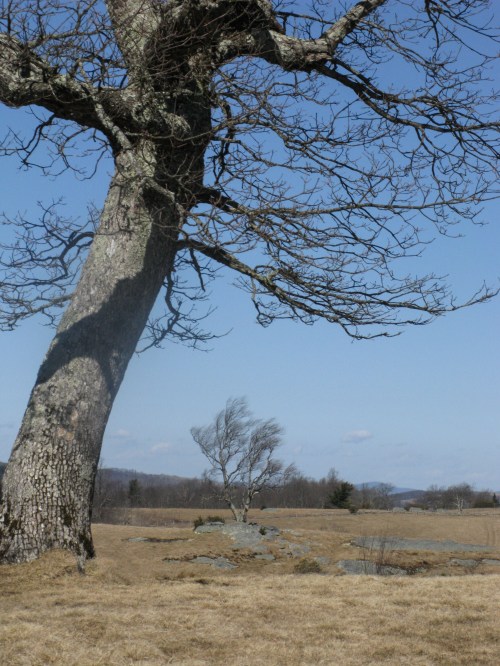
View across Basin Cove from Flat Rock Ridge — see the speck of a tree all by itself in the bald patch on the horizon? Watch for it . . . !

.     .     .     .     .     .     .

Read Full Post »

[with 3 poems by Patricia Hooper]

Great Smoky Mountains Institute at Tremont, February 05-07, 2021

the assurance of things hoped for, the evidence of things not seen . . .

Faint tracks – but when has life ever laid it out plain, an open book, page upon page with footnotes? Aren’t I still searching between the lines, faint traces, no clear prints? Lately I dream every night of making diagnoses, explaining treatments, buffing up my charts. Is Jung telling me that this was my only purpose in life and now it’s over?

Deer walk a diagonal gait – each hoof print is really two impressions, the forefoot overlaid with the rear. If the rear hoof strikes a little lateral within each fore print it means the pelvis is wider = you are following a female.

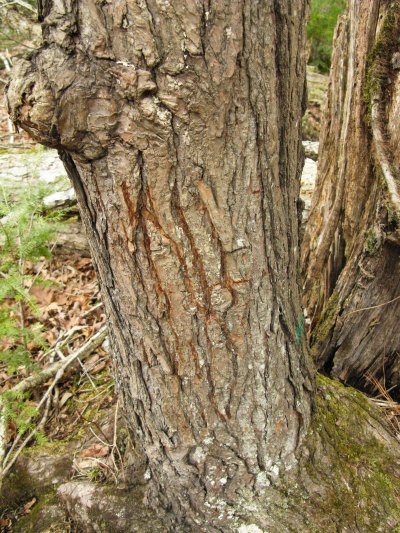
Don’t plan on seeing a bear in the Smokies in February. Mom is asleep in a hollow tree with her cubs and Dad is dozing under a bush somewhere (he snores), though he might rouse up to forage on a warm afternoon. So why are we studying mammals at Tremont in February? In the sere meadows, the leaf-littered groves, under the pale unforgiving sky the book of all their signs is open for us to read. Let’s hike up to that oak tree and see who’s been scratching for acorns, see who has left us some scat. Let’s follow that faint trail through dry brown stalks to check out predator and prey. Who clawed up this white pine? Who stepped in the mud?

Canids: dog paw prints show deep claw marks with claws of outer toes angled outward; coyote claw marks are less distinct but all aligned strait ahead; gray fox claw marks are the least distinct since they save the claws for climbing trees, and the rear pad looks scalloped like a chevron.

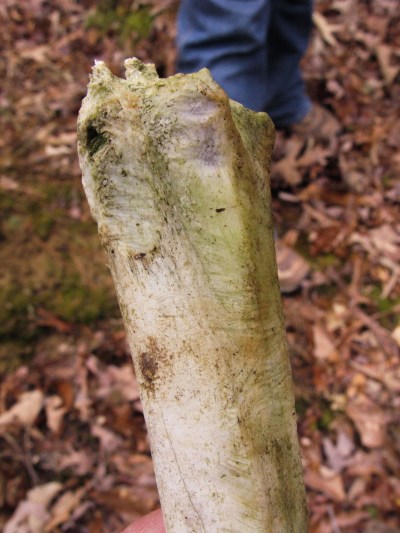
But clear prints are maybe 1% of tracking. We’re learning a new vocabulary of chewed nut and compressed grass. Tracking is patterns and connections, habitats and behaviors. Measure the size of the incisors that gnawed this antler. Measure the bits of skull and femur in this dropping.

And can I learn a new language? Maybe all these dreams are about knitting up the years, tying the last knot, laying it away to pull out when I need to reminisce. Or maybe I need to discover something missed. Life is not disjunctive – the end of every moment flows into the beginning of the next. The assurance of past creates future. Tracking in Cades Cove – a metaphor for opening oneself to an unseen message within, to the evidence of human purpose. Connections, convictions. We track a personal ecology that leaves signs for us to discover, to question, to wonder.

To follow.

Tracks have lead us to this place, maybe with a lesson or two that sunk in along the way. Some wisdom. And the tracks that still lead forward?

.     .     .     .     .     .     .

Patricia Hooper’s bright clear poetry touches earth with a feather – to bring color and flight. Garden, feeder, wild crag, starry night, in all seasons she observes the particular and discovers its connection to the universal. Nature is her palette but human nature is the canvas she illuminates. The poems of her latest book, Wild Persistence, taken singly seem to open our eyes to brief moments or localities, but as a whole these poems weave a complex narrative of family, longing, grief, redemption. I find joy in her art.

Patricia moved to North Carolina in 2006 and lives in Gastonia. In 2020 she was awarded the Brockman-Campbell Award of the North Carolina Poetry Society for Wild Persistence, awarded for the year’s best book of poetry by a North Carolina author.

.     .     .     .     .     .     .

Elegy for a Son-in-Law

1.

A distant figure on the mountainside
seems to be coming closer, then it turns,
a blue, retreating cap, a scarlet jacket.
Without another sign, I know you’re there,
climbing again the way you used to climb
before you were a ghost. I want to call
Don’t go! Come back! I have your two small sons
sleeping behind me in the car, their mother
watching the sky for falcons. But you move
farther away. Or we do. Now you’re gone,
back toward Mount Sterling where she took your ashes.
I hope it’s peaceful there. I hope you know
they’re doing well. I hope you didn’t see us.

2.
These are the mountains where you were a boy,
broad waves of mountains rolling like an ocean
into the distance, no horizon, only
these smoky contours where you knew each rise
and hemlock forest, plunging stream. Your friends
tell how you often left them for a while
after you’d reached the top, to be alone,
then met them at the camp, all tales and laughter.
Today, a red-tailed hawk riding the breeze,
gold leaves, cascading creeks, – your kind of joy:
cold rushing currents, then the ecstatic slide.

3.
This is the world you wanted: brisk fall air,
the valleys hung with haze, that long blue range
half-hidden by the clouds. It’s coming clear.
How far you must have seen from there! And here?
It’s hard to see around so many hills,
so many peaks and gorges, and the curves
are slippery on the parkway, miles of turns.
We’re heading home. The boys are waking now,
their mother’s passing crackers, pointing out
the overlook ahead: blue waterfall,
deep river valley, autumn leaves, the pines
along the ridge, the rising trail – and there,
the summit you’d have shown them. Mist and shine.

from Wild Persistence, Patricia Hooper, University of Tampa Press, 2019

.     .     .     .     .     .     .

In Tennessee

The Blue Ridge at sunset – hardly a missed note
in the hemlocks where a mockingbird is singing
while to the west a falcon dips, then glides
over the valley, indistinct from here
except that the bird falls lower than the chair
I’m sitting in, and disappears. The sky
is the color of pomegranate, and the balcony
slips into shadow like the distant hills.
No wonder that the mockingbird is singing
a medley of every song he knows,
no matter whose. No wonder that he sits
in the glow of a single flood lamp high above
the roof, a pool he must mistake for sunlight,
enough to urge him on and on and through
his repertoire that bird by bird is ringing
over the day’s end, over the night’s coming.
Maybe he has to sing to know himself
as part of things – finch, cardinal, wren, and now
that long coarse call that sounded like the crow
or Steller’s jay – whatever voice he’s pulling
out of himself, some sound against the silence,
against the signs of brightness vanishing.
The railing of the porch dissolves in mist,
the sun has set, and now we’re weightless, drifting
as if suspended in the blackening air.
His sphere of light no longer seems as clear.
Maybe he knows the lamplight isn’t sunlight.
Maybe he feels he too is disappearing
into the darkness like this porch and chair.
he has to sing, he has to keep on singing,
to know he’s really there.

from Wild Persistence, Patricia Hooper, University of Tampa Press, 2019

.     .     .     .     .     .     .


.     .     .     .     .     .     .

At the Rifle River

When the eagle unfurled, clearing
the green dome of the forest,
I almost missed it

till somebody cried, “Look up!”

and there it was
in the sky over the river

which I saw it must have owned
the way it spanned the rapids
with a single stroke,

and the sky parted.

I can’t say I believe
in messengers from the clouds,

but I didn’t believe
this was an accident either,

the way its light
tore through the drab morning
I barely lived in, and then

it rose over the steaming
forest, it disappeared.

*
At the time I was only watching
my own path by the river,

but afterward
I knew it must still be there
over the rim of maples

its white helmet, its fire,
and its gold eye turned toward me,

or something enough like it,
something powerful and amazing
which someone else sees.

Imagine my certainty
the moment before it rose
through the world, crossing the water,
that there was nothing anymore to surprise me.

Imagine my emptiness.

Imagine my surprise.

from Separate Flights, Patricia Hooper, University of Tampa Press, 2016

.     .     .     .     .     .     .


GSMIT // SANCP

Special thanks to Jeremy Lloyd and John DiDiego directors and instructors at Great Smoky Mountains Institute at Tremont, for the weekend Mammals course, which is part of the Southern Appalachian Naturalist Certification Program, and to Wanda DeWaard, guest instructor for the day and master tracker and naturalist.

The Southern Appalachian Naturalist Certification Program at GSMIT comprises eight weekend courses designed to provide fundamental and specialty skills in Southern Appalachian ecology and interpretive techniques. Each weekend includes 15 hours and more of lecture and hands-on field study. Upon completion the student receives the non-credit Southern Appalachian Naturalist Certificate from the University of Tennessee.

.     .     .     .     .     .     .

IMG_1827

Read Full Post »

« Newer Posts - Older Posts »