Feeds:
Posts
Comments

Archive for the ‘Photography’ Category

[with 3 poems by Diana Pinckney]

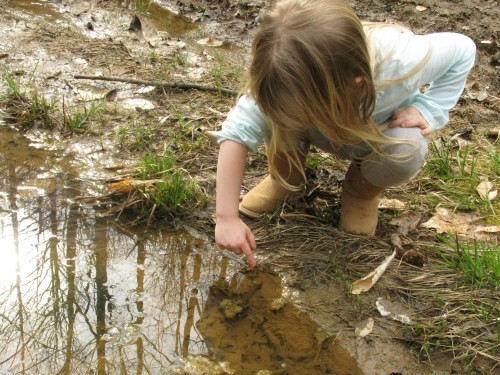
No hesitation. Out the back door she takes my hand and we hike down through the woods, steep switching trail, slick moss rocks, sliding on last fall’s leaves. Big brother is not with us today; she is the explorer. I wonder if she’ll hold back at the wash but she hops rocks across the rivulet and even runs ahead of me along Dutchman Creek. Threading the briers, skirting mud, twigs in her hair – she is all go today.

When we reach our destination, the shallow pools that linger from winter floods and may be dry by August, I hesitate. Not so many months ago she would make me check the playroom floor for millipedes, back away from pillbugs on the porch steps, want to be carried to the car.

I squat in a squishy place beside the water and show her clumps of clear jelly. Most of the eggs have hatched, some larvae still in their shivery globes, many tadpoles swimming free. With one finger I push algae aside so she can see them wriggle. Instantly her fingers are in the water, too. Tickling the tiny black wigglers. Oblivious to muck and slime. Pappy, can we come back here tomorrow?

This is what I would wish for her at five and all her life – to be innocent and yet be bold. To face the new and the scary and not look away. To discover, to wonder. And to remember the immense power of NO! bursting from her body, now when her brother thwarts her playful imaginings and always when the world conspires to steal that innocence from her.

And, for as long as I’m able, I wish for her to still want me to carry her.


.     .     .     .     .     .     .

Who is completely innocent and who is entirely beast? Diana Pinckney’s poems are subtle like a rustle in the night but lucid, windows breathing light and fragrance into the world. Her language and lines are effortlessly elegant. Her poems seem to arrive from all the points of the compass to create community: persona poems in which the reader comes to inhabit a new being; poems of family, loss, commemoration, revelation; ekphrastic poems that uncover hidden truth in painting, sculpture, representation.

And woven throughout her book, The Beast and the Innocent, lurks the wolf: tyrant predator, misunderstood victim; purity and profane. Who is the threat and who the threatened? Aren’t we all only doing what it takes to survive?
.     .     .     .     .     .     .

Ghost Wolves, for My Grandchildren

You may see one in a zoo
***** and ask, does he howl
********** and I may say, what would

he howl about? What, you ask, does a wild
***** wolf sound like? What could I answer? Wind
********** when it rises from the deepest

canyon to the tops of spruce
***** or the fog’s blue surge, the drift
********** above dying embers. Smoke alone

moves toward the stars in a world
***** where nothing is heard and only the moon
********** knows then the last tree falls.

Emptiness that whispers
***** after the wilderness
********** has forgotten what it longs for.

from The Beast and the Innocent, Diana Pinckney, FutureCycle Press, © 2015

.     .     .     .     .     .     .

My Brother Sings
after Raymond Carver’s “What the Doctor Said”

He sings when the dogwoods are blooming as I drive
him and his wife along the highway from Asheville,
away from a hospital where we waited in the doctor’s office,
sitting in gray chairs, joking about my allergy

to their six cats, ow I can’t sleep in their house
and still breathe. I watched my brother move
his fingers over swollen knuckles that he used to
crack when I was little just to tease. There to hear

the results of the lung biopsy, now we know.
Traveling through Blue Ridge mountains, we see
dogwoods, redbuds, cherry trees heavy
with April’s abundance. When my brother

begins the song, his wife in the back seat on her cell
interrupts, Dabney, will you please stop singing
while I’m telling Sis you have cancer. Oh, sorry, he says.
He glances at me while petals drift with us

down the mountain. Our laughter’s almost soundless.

from The Beast and the Innocent, Diana Pinckney, FutureCycle Press, © 2015

.     .     .     .     .     .     .

The Beast and The Innocent

Of course, dogs and cats go to heaven,
my mother announce from her deathbed.
Welcomed into heaven, my childhood cat
will groom Grandmother’s canary, feathers the same
yellow as the black cat’s eyes, the bird

he ate when I was seven. In paradise
pointers lap at duck ponds while cockatiels
screech and perch on each dog’s white- or black-
spotted back. Heaven’s way is,

as we have heard, the lion lying down
with the lamb. A place where Christians kindle
the eight candles of Hanukkah, Muslims unfurl
prayer rugs for Hindi, and the roped Tibetan prayer

flags flutter good fortune for the Chinese.
The wine and wafer bless a round wooden table, a feast
celebrated with unleavened and leavened,
mango and oyster, babel unlimited. And the spaniel
that killed my brother’s rabbits will lie

on the wide-bladed grass of my youth, all manner
of four- and two-legged creatures leaping
over him, some stroking the red-and-white silk
of his fur for pure pleasure, for the grace.

from The Beast and the Innocent, Diana Pinckney, FutureCycle Press, © 2015

.     .     .     .     .     .     .

.     .     .     .     .     .     .

Doughton Park Tree 2021-03-23

Read Full Post »

[with 3 poems by Tony Abbott]

. . . each morning as a wrapped gift.

We parried, a friendly joust, this poet I knew who anchored his lance upon all poetry is about love. Later I would think how odd, a paradox in fact: this person seems to thrive on hate and even infected me for a time. Even later I read more of his poetry and reconsidered: perhaps hate is simply the anger and loss that bleed from us, caustic, when love is too distant, too longed for, too impossible.

But during our little tournament I countered with this novel thrust: all poetry is about death. You don’t, I asked him, believe the immortals on Olympus write poetry, do you? With no death to undergird, to prod, to threaten, without death they have no muse. They must rely on us mere humans to wrench and wrest verse from the earth of our dark condition.

How odd, a paradox in fact: I don’t think anyone would consider me the moody type. I don’t ruminate on death – or do I? The loved one whose problem seems to have no solution; the 4 a.m. wakefulness when all mistakes made and all hurts caused crowd around the bed with their sharpened sticks; the bitterness of an imagined future when I will not be there for my granddaughter, my grandsons – why do I invite such overshadowing darkness into my heart?

What might cleave the darkness, fill it with light? How is it possible, which indeed it is, that every one of us may discover some joy in a fragrant afternoon, a laughing child, a lingering kiss without inevitably asking what if this is the last?

.     .     .     .     .     .     .

the moment which gives to all life / the aura of the mysterious, the sacred . . .

How does the man facing darkness bestow such light on all around him? I believe these poems by Tony Abbott. I believe the voices that have spoken to him and his voice that still speaks to us. That speaks of darkness becoming light.

During the last year of his life Tony treasured moments. He captured luminous moments and has held them up for us, to turn this way and that, to peer and to ponder, to treasure along with him and let in the light. A wrapped gift is one that must be opened to be loved. Light is something to be entered with regrets laid to rest.

.     .     .     .     .     .     .

.     .     .     .     .     .     .
The Man Who Loved Trees

kept his distance this year as if he knew,
as if the dark possibility which haunted
his inner mind could only be kept at bay
by stark denial, a looking the other way.

And then one day, he forgot, and found
himself there at the very spot, and when
he finally brought his eyes up from the brick
walk to the tree itself, he knew he was right.

She was ordinary now, leaves still intact
but mustard brown and dry, dry as the dust
which had choked the air that fall, dry as his
own heart, which had slowed to a walk.

If you don’t wake her, he thought, the muse
goes back to sleep, malnourished, the roots die.

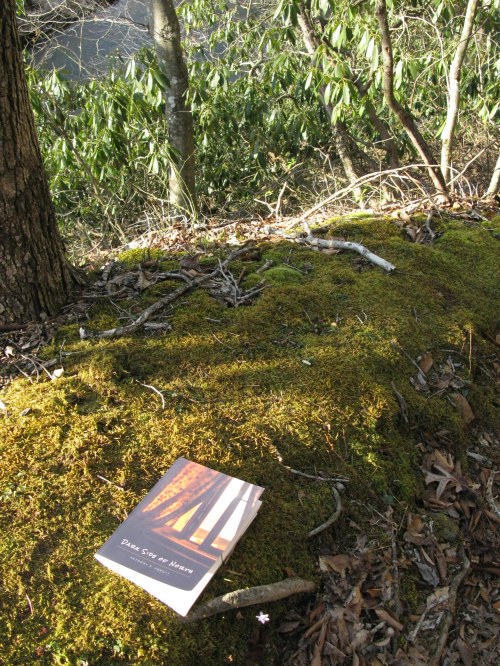
from Dark Side of North, Anthony S. Abbott, Press 53, Winston-Salem NC, © 2021 by the estate of Anthony S. Abbott

.     .     .     .     .     .     .

That Without Which

The moment itself not being but coming into
or having been the moment itself that which
we wait for live for then like the five o’clock
winter sun fading into a rustle, a blowing
of the window curtains door to the balcony
open to the wind the walking on the beach
the stars the ringing of the communion bell
and the knowledge priceless that this might
have never been could never be but was
and is the moment which gives to all life
the aura of the mysterious, the sacred,
blessed and consecrated by the heart under
another name not known but felt how could
we live otherwise

from Dark Side of North, Anthony S. Abbott, Press 53, Winston-Salem NC, © 2021 by the estate of Anthony S. Abbott

.     .     .     .     .     .     .

The Last

The last walk, he thinks, the last stroll
down the wooded path with the dog
sniffing in the cool morning air.

The last knock on the red door.

The last subway ride – New York,
London, Paris. The ungovernable
steps. The violins at the Louvre.

The last sigh under the stone stairs.

Better not to know. Tomorrow
or ten years. Better to receive
each morning as a wrapped gift.

The last glimpse of the crescent moon at midnight.

The last swim in the smooth lake,
the last flash of the sun
as it sinks into the sea.

The last wave reaching high and sliding back.

The last poem, the last linking
of lines, nothing more to be said
anyway – the last silence between words.

The last of the lasts that have already been.

The last kiss, the last touch, the last
image of arms at midnight
the last breath before

the last.

from Dark Side of North, Anthony S. Abbott, Press 53, Winston-Salem NC, © 2021 by the estate of Anthony S. Abbott

.     .     .     .     .     .     .

Thank you, Tony, always. We do continue trying, and we will not stop trying, to make something beautiful from the brokenness that we are. Together. May it be and become so.

.     .     .     .     .     .     .

The North Carolina Poetry Society has honored Anthony S. Abbott’s memory and shared Tony’s poetry at its January, 2021 literary meeting and with a commemoration in the Winter, 2021 edition of its quarterly publication, Pine Whispers.

Better to receive / each morning as a wrapped gift.
The Last

the moment which gives to all life / the aura of the mysterious, the sacred . . .
That Without Which

Links to biographies and more information about Tony Abbott and his work.

.     .     .     .     .     .     .

2014-06-30a Doughton Park Tree

Read Full Post »

[with 3 poems by Tony Abbott]

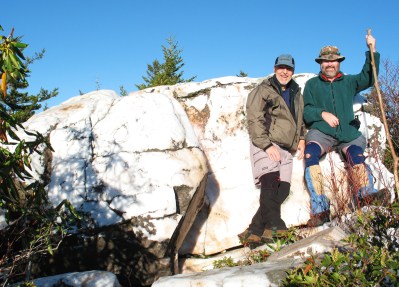
Mike and I met at a remote trailhead below Mt. Pisgah to hike up into Shining Rock Wilderness. We planned to spend one night at our favorite site after reaching it by this unfamiliar approach. End of September, gorgeous reds and golds, brittle blue sky, and we were prepared for cold above 5,000 feet.

No camp fires permitted in a Wilderness Area. We made tea over a little alcohol stove, sat on the ground, and talked until it grew too dark to see. The ultralight 2-person tent Mike had packed was cozy, which is to say it was more like a 1 ½-person tent. We’d be keeping each other warm.

I woke up after midnight in dense darkness and couldn’t breathe. Got out of the tent, pulled on my balaclava, walked away to pee, sat on a log – deep silence, no owl hoot, no chitter of flying squirrels, not one breath of wind. When my butt started to freeze I tried squeezing back into my mummy bag. No good. My chest tightened, the thick black pushed down on my face, I had to claw its hand away. Worst claustrophobia ever.

I finally dragged my sleeping pad and bag out to a level space in the pine needles, wrapped a jacket around my feet, and hunkered in just as the moon rose through the red spruce. Cold light expanded my lungs. At some point, hours creeping, moon in my eyes, I fell asleep. Mike woke me at first sun.

.     .     .     .     .     .

What can bring light into darkness? What hand comforts the clench of fear? What consoling faith casts away doubt? What companion banishes loneliness?

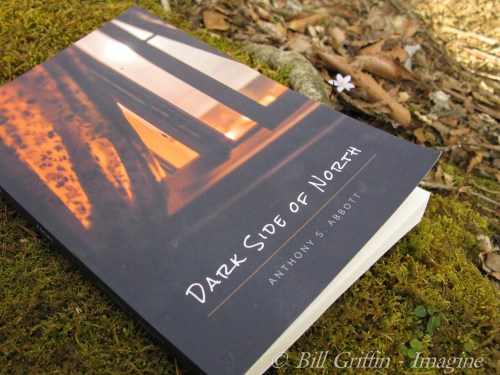
The forward to Anthony S. Abbott’s book Dark Side of North, published posthumously by Press 53 this year, consists of a remembrance presented by Dr. Jacqueline Bussie at Tony’s memorial service on October 17, 2020. Here is an excerpt:

Suffering didn’t make Tony unique. What he did with it did. Tony was the first adult, and the first teacher, I’d ever met in life who was willing to talk about the hard stuff. He taught us that suffering sucks. That suffering denied is suffering unhealed. He taught us to never sugarcoat suffering, smack a pink bow on it, or shove it to the back of the drawer. In one of my favorite lines in Tony’s poetry, he urges us to get down to “the Humpty-Dumpty business of trying to make a jewel out of the cracked pieces of the heart.”

Dr. Jacqueline Bussie, page xiv, Dark Side of North

.     .     .     .     .     .

The Boy from Somewhere Else

lived in the open mouth of the world.
He chewed on the dry branches of time.
He was handsome enough, to be sure,

but there was in his voice
the deep well of absence.
He was with them, but not of them.

His speech was familiar, but not theirs,
and when he told tales
of his drunken uncles and stage-struck

sisters, they nodded politely
and they spoke in their apple-round voices
of kith and kin, and told how their

grandfathers had founded the first
bank in Hitchcock County.
He would wait, this boy.

He would find one day the person
who could hear his music
as blood red leaves matched autumn.

He could not be mistaken about this.
When she came, he would recognize her
at once – as one knows the coming storm

by the first, distant clap of thunder.
Perhaps he could not keep her.
Perhaps one can never keep such a gift.

But, still, she would grace his years – the buds
of his growing up, the rattling trains of the
middle passage, the brittle bones of the slow

descent, the icy nights of the final coming down.

from Dark Side of North, Anthony S. Abbott, Press 53, Winston-Salem NC, © 2021 by the estate of Anthony S. Abbott

.     .     .     .     .     .

The Light in the Window
In memory of Nancy Abbott Hieronymus (1926-2017)

How early I must have known that she was
my true mother, that when she packed her bag
I must go with her. She would keep me safe.

How early I must have known that she was
my true teacher, making the sounds of the words
with her mouth so I could learn them, too.

How early I must have known that she was
my true protector, throwing herself across me
slashing her knee on the broken windshield glass.

Later, when I was nearly grown, cocky sophomore
in prep school, riding the subway home at 2 a.m.,
she left a light in the window on that I

would turn out when I came in. I didn’t know
she stayed awake until she heard the door open
and close, heard the click of the light going off.

Now I sit by her bed and watch her sleep and wake,
sleep and wake, and tell me how she loves
her precious Dick, how she will hold his hand

all the way to heaven. Beyond the light in her window
the evening comes over the island, the deer prick up
their ears, the foxes peek from their dens. In the pines

the gold crowned kinglet waits. She is coming, they say,
our friend is coming, the one who loved us all these years.
Tonight I will go home, and the friends who loved her so

will arrive, one by one, to take her in their arms,
and the next night the angel will stand at the foot
of her bed. You are loved, he will say, and enfold her

with his bright wings. And she will go where that brightness
is and, like a light in the window, shine upon us all.

from Dark Side of North, Anthony S. Abbott, Press 53, Winston-Salem NC, © 2021 by the estate of Anthony S. Abbott

.     .     .     .     .     .

The Long Afternoon

All through the long afternoon
the wind moved in the branches.
I had lived in the city and had seen
only the dust from the tires,
the diesel gas from the gray brown
buses with their leaden burdens.

Here it was different. Here on the grass
we had found by chance, walking
away, just away from everything
and then, a clearing and green
grass and the wind moving
like silver over the water
and in the branches, too. Yes,

all through the long afternoon
the wind moved and we were silent
in awe of the day and leaves
yellow and red and orange,
which floated slowly down
into our waiting hands.
aaaaaaaaaaaaaaaaa Later
I found these leaves in a book
where you had put them for
safe keeping, a book you knew
I would take down and read
some distant starry night.

from Dark Side of North, Anthony S. Abbott, Press 53, Winston-Salem NC, © 2021 by the estate of Anthony S. Abbott


.     .     .     .     .     .

Thank you, Tony. We will continue trying, and we will not stop trying, to make something beautiful from the brokenness that we are. Together. May it be and become so.

.     .     .     .     .     .

The North Carolina Poetry Society has honored Anthony S. Abbott’s memory and shared Tony’s poetry at its January, 2021 literary meeting and with a commemoration in the Winter, 2021 edition of its quarterly publication, Pine Whispers.

The line “the Humpty-Dumpty business of trying to make a jewel out of the cracked pieces of the heart.” is from Tony’s poem Before Forty in his book The Girl in the Yellow Raincoat (St. Andrews Press, 1989) and collected in New & Selected Poems (Lorimer Press, 2009).

.     .     .     .     .     .


.     .     .     .     .     .

2015-06-15Doughton Park Tree

Read Full Post »

« Newer Posts - Older Posts »