Archive for the ‘family’ Category
Wanting to Be a Forest
Posted in family, Imagery, poetry, tagged Bill Griffin, Civil War, family, Frank X Walker, Load in Nine Times, nature photography, poetry, Southern writing, USCT on November 22, 2024| 6 Comments »
.
[with 3 poems by Frank X Walker]
.
Grove
.
This was the first time
we really look at each other
and not be able to tell
who master the cruelest
who sorrow the deepest
who ground been the hardest to hoe.
.
We was lined up like oaks in the yard
standing with our chins up,
proud chests out, shoulders back,
and already nervous stomachs in.
.
We was a grove wanting to be a forest,
ready to see what kind of wood we made from.
.
The only thing taller or straighter
than us be the boards
holding up the barracks at our backs,
.
though most our feets feel pigeon-toed
and powerful sore
from marching back and forth, every day,
for what seem like more miles
than we walked to get here.
.
It take more than pride to stand still
‘neath these lil’ hats not made for shade.
.
Soldiering ain’t easy, but it sure beats
the bloody leaves off a bondage.
.
Frank X Walker
from Load in Nine Times, Liveright Publishing Corporation (W. W.Norton), New York, NY; © 2024
[based on a photo taken at Camp Nelson, Kentucky, of troops standing at attention outside the Colored Soldiers Barrack]
.
❦ ❦ ❦
.
1861 One month after Confederate forces fire on Fort Sumter, South Carolina, Kentucky’s Governor issues a formal proclamation of neutrality, but he retreats from any denunciation of slavery, which he believes is not a “moral, social, or political evil.” Four months later Kentucky decides to end neutrality and enters the Civil War on the side of the Union; 200 delegates vote to secede from the rest of the state and form a separate Confederate Kentucky with Bowling Green as capital.
.
1862 Abraham Lincoln’s EMANCIPATION PROCLAMATION declares freedom for all enslaved persons in states which are in rebellion against the United States. This leaves slaves in Union-aligned Kentucky still the property of their masters, however.
.
1864 The U.S. government’s progress towards making universal emancipation a war aim has caused support for the war and the government among White Kentuckians to dwindle. Military recruitment ebbs. On June 13, U.S. SPECIAL ORDER NO. 20 allows enslaved persons to enlist in the U.S. Army without their owner’s consent and be granted their freedom, the first pathway to legal emancipation in Kentucky. That summer and fall, 14,000 Black men enlist.
.
Only Black men who are fit for military duty are emancipated, however. If they are ineligible, they are returned to enslavement, and there is no offer of freedom for their families. Camp Nelson, Kentucky’s largest recruitment and training base, becomes a haven for refugees from slavery, whether escaping from Tennessee, Virginia, and North Carolina or arriving with their newly enlisted Kentucky husbands or fathers. Freedom seekers from the South are considered “contraband of war” and granted freedom, but slaves of White Kentuckians remain legal property of their masters with no formal protections.
.
On November 22, 1864, in the midst of a winter storm, Brigadier General Speed S. Frye orders all refugees surrounding Camp Nelson expelled and their shacks destroyed. Of 400 people immediately displaced without shelter or recourse, at least 102 die of exposure and starvation. Frye’s order is quickly rescinded by his superiors in Kentucky but headlines cause an outcry across the States. On December 15, Adjutant General L. Thomas issues ORDERS NO. 29 to require that “all camps enlisting Negroes provide suitable housing and provisions for their families.”
.
Within months, the War Department creates the Home for Refugees at Camp Nelson. On March 3, 1865, the US Congress passes laws to emancipate the wives and children of United States Colored Troops soldiers.
.
Camp Nelson, Kentucky, is now a National Monument, and includes a memorial obelisk to honor the 102 African Americans who perished in The Expulsion.
.
.
❦ ❦ ❦
.
We Will Prove Ourselves Men
++ Sewn on the regimental flag
++ of the 127th U.S. Colored Troops
.
I don’t look the stars and stripes
nor the eagle for mustard
.
like the white officers
and some of my free brothers do.
.
I think on the slender fingers
that stitched our proud colors
.
snapping in the wind,
the same steady hands
.
that last held me close,
and pray they hold me again.
.
That’s why I’m willing
to trade bullets in a cloud.
.
Some confuse our bravery and courage
with our love for our women,
.
but many of us just eyeing that flag
and trying our best to get back home.
.
Frank X Walker
from Load in Nine Times, Liveright Publishing Corporation (W. W.Norton), New York, NY; © 2024
.
❦ ❦ ❦
.
My Grandpop died when he was 67 and I was 5. Our families lived hundreds of miles apart – we in New York, then Tennessee, he and Nana in North Carolina – so we visited only two or three times a year. I can’t recall the sound of his voice, I’m not sure if he ever hugged me, but I know a story about him and me that I have retold myself so many times that it is tangibly real. Totally, unquestioningly, personally real:
.
We are in the dining room of his house that overlooks Bogue Sound. He, a surgeon, is holding my fingers in his. In the pressure of his fingers I am aware of the bones beneath my skin, and he is teaching me: Carpals, Metacarpals, Phalanges.
.
I have many photos of Grandpop, his enigmatic smile. I have copies of articles he published, things he crafted with his hands, an oil painting. I have photos he took of me, even an old 35 mm. silent movie. But the most real, the most present, is this story I keep and hold. Perhaps the artifacts helped me create the story. Perhaps hearing the story as it was told to me by Nana and Mom. However the story comes into being, into life, it brings reality with it.
.
So it is with Frank X Walker and his poems in Load in Nine Times. Frank was already deeply involved in resurrecting and creating the stories of Black Civil War soldiers in Kentucky and their families, using scant artifacts to create short biographies and allow these men and women to live (for a project at Reckoning.com). Then he thought to ask the archivist to research a possible relative of his own. And the sky opened.
.
Frank’s dedication for the collection of some 100 poems reads thus: For my ancestors, Mary and Randal Edelen, 125th U.S. Colored Infantry and Elvira and Henry Clay Walker, 12th U.S. Colored Troops Heavy Artillery. These folks speak and are joined by dozens of others who lived and suffered and sometimes triumphed. Through poetry they have all come to life, along with the middle decades of 19th century Kentucky. Slave and slave owner, soldier and widow, parent of despair and parent of hope – Frank has honored them and exposed them, judged them and sometimes forgiven them, given them sharp tongues and sharp features and brought their years into sharp, sharp focus.
.
And our years as well. What did I know about Civil War Kentucky, USA? As soon as I laid down the book I had to know more. More! Frank educates with timelines and resources but his greatest gift is to enlighten me, in the sense of casting light into dark corners where I had never thought to look. When I discover online some of the photographs he must have used for his own inspiration, those slightly blurred faces now suddenly stand out to me – real men, real women. We each owe it to ourselves to continue to tell our stories and to listen to new ones. Somehow, in this harsh and enervating world, perhaps this is the way we will become more real to each other.
.
❦
.
Read the excellent interview with Frank X Walker by Jacqueline Allen Trimble as she explores with him the creation of Load in Nine Times, in the Oct 19, 2024 edition of Salvation South.
.
.
❦ ❦ ❦
.
A Black Father Dreams a Son
++ Brig. Gen. Charles Young,
++ 9th U.S. Cavalry Regiment
.
It was twelve miles to Maysville and the Ohio River and another
ten to Ripley. A runaway could escape from Mays Lick,
at night, head north, follow the smell of the river and make
the entire distance and crossing by sunrise. A determine one,
on horseback, like Gabriel Young, could make it in half the time.
.
Ignoring racism at West Point was easier knowing
my father survived slavery. He joined the 5th and risked his life
so our people would know freedom. I risk mine to protect it.
.
If his sacrifice and commitment freed my body, my mother’s books
free my mind. Her skirt was my first classroom.
Every big and small thing I’ve done began at their feet.
.
Though born into slavery in Kentucky, I learned to play piano
and violin, speak French and german, before becoming a teacher,
before graduating from West Point, before a career in the military,
and public service.
.
Growing up in Ripley showed me what this country could be.
What my parents instilled in me, and Wilberforce proved it.
.
I am America’s promise, my mother’s song,
and the reason my father had every right to dream.
.
Frank X Walker
from Load in Nine Times, Liveright Publishing Corporation (W. W.Norton), New York, NY; © 2024
[Charles young, born in 1864 into slavery to Gabriel Young and Armenta Bruen in Mays Lick, Kentucy, was the first Black man to achieve the rank of colonel in the Unites States Army, and the highest ranking Black officer in the regular army until his death in 1922. In 2022, in recognition of his exemplary service and barriers he faced due to racism, he was posthumously promoted to brigadier general.]
[these addenda are taken from the Author’s notes]
.
❦ ❦ ❦
.
.
Moving Day
Posted in family, Photography, poetry, tagged Bill Griffin, Bradley Strahan, family, I-70 Review, nature photography, NC Poets, poetry, Rebecca Baggett, Richard Widerkehr, Southern writing on October 18, 2024| 6 Comments »
.
[with 4 poems from I-70 Review]
.
Bears Active in This Area
.
++++ warning sign in my mountain cabin
.
This time, others have seen you,
treading circles on the gravel drive,
shouldering through grapevine tangles.
The possibility of you was always here,
in the night-mouth of the cave that gapes
below my porch, in dark boulders
hulking along the trail.
.
Your presence countermands silence –
I chatter and sing as I walk the open road,
snatches of carols, toddler songs –
and shy from the path that meanders
to a sunlit filed strewn with windfalls
from long-neglected trees. I imagine
you keeping pace, just out of sight,
your huffs mocking my jabber,
your heavy steps a counterpoint
as I scurry past thickets, scan uneasily
the curving trail ahead, intruder
in a world that was never mine,
though you are the first to insist
that I acknowledge it.
.
Rebecca Baggett
from I-70 Review, Eighteenth Edition, 2024
.
❦ ❦ ❦
.
What would a toddler remember about moving away? The apartment in Niagara Falls is a dream of stairwells and windows and darkness outside; the new house in the new subdivision with no grass at all is a neighbor’s dog named Bishy. Or was Bishy the neighbor’s toddler I played with?
.
I am four when we move away again, from New York to Tennessee, and I remember plenty about Marion Road: Bob and I watching Little Rascals until Mom declares, “You’re going to turn into rascals!”; our little sun room Aunt Ellen fitted up as a bed-sit while she attended Memphis State, and we kids hiding giggling under her covers until she came home each afternoon; the neighbor boy who introduced us to the word butt and we thought we were the first humans ever to utter something so outrageous. Memories of the neighborhood, yes, but memories of moving there? Packing and unpacking? Worrying that Puppy would get lost in the shuffle or that somehow Mom wouldn’t be there when we arrived? None of that remains.
.
Our family makes one more inconsequential move just blocks away when I am six, but then when I’m twelve the Big Away arrives. Up until this what a tranquil 1950’s childhood: I walk to Colonial Elementary every morning with my friends and play with the same friends every evening until the streetlights come on. Serene. Now I’m midway through sixth grade, still coasting, when the bomb drops. Did I protest when Dad announced in January we were leaving Memphis to move to Delaware? Maybe, I don’t recall; that memory is muddy, but this one is sharp as crystal – I walk into class in my new school and my new classmates all turn to look. My clothes aren’t right, my accent is a joke (literally – within about sixty seconds I will have the nickname “Memphis,” which sticks), and I have a different teacher for every subject. And then in just six more months we will move to Michigan. Just over a year beyond that, two months into eighth grade, we move to Ohio.
.
So, my friend, is it any wonder that some sixty years later I have trouble remembering your name until the fourth or fifth time we meet? That as we converse in a group you notice me smiling and nodding and slowly drifting off into space? That I would rather write this blog into the wee hours than drop by your house for coffee? I want to be a good friend to you, and in fact I like you and this hug from me to you is real, but ah, it’s risky. There’s always that possibility, without warning and with no desire on my part, that someday soon I might be moving away.
.
❦
.
It never occurred to me to wonder how Dad felt about all those moves. The moving was his fault, after all, necessary for his promotions and advancement with DuPont, for whom he worked all his life. I can scarcely imagine the million details he had to sift through to put his family into boxes and take them out again hundreds of miles away. I’m not surprised that as I clean out his house I find drawers full of lists on yellow pads, on the backs of junk mail, on bills and receipts. Half the time when he calls me, it’s to add something to the shopping list. And then there are still those boxes in the attic labeled Allied Van Lines.
.
But what about the rest of us? Did Dad wake sweating in the middle of the night worrying how moving away would affect his family? Just one time he blinked: after I was married and gone but Mary Ellen was still at home, a junior in high school, Dad turned down a promotion so she could graduate with her class. A sacrifice that stalled his career for a decade.
.
Tomorrow is Dad’s last moving day. Since Mom died in July, Dad has agreed to move closer to us. For a week I’ve ferried boxes and duffels, checked off my lists and then made new ones, and tomorrow after lunch I’ll drive Dad to a nursing center just two miles from our house. He says he’s willing to move as long as the food is good (it is). We’ve hung portraits of the grandkids, pastels by Mom. His Duke pillow is on the recliner and his new Duke banner hangs on the door of room 507 to welcome him. God knows I’ve been waking in the middle of the night sweating the million details. Let us hope that after 98 years of moving, Dad will discover in this new and final home a place to rest.
.
.
❦ ❦ ❦
.
Porta Nigra *
.
++++ Trier, Germany
.
The breath of sun and rain
only darkens on my face.
The cat-claws of millennia,
the graffiti of tourists,
fade into my walls.
.
I, who guarded this city so long,
sit truncated now.
My frieze the sweaty flesh
of lovers on cool bare stones.
.
Catch me in another thousand years,
your eyes as hard and dark as mine.
See if these holes will match
the mysteries of death
and flesh on blackened stone.
.
Bradley Strahan
from I-70 Review, Eighteenth Edition, 2024
.
* a gate in the remaining piece of Trier’s old Roman wall
.
❦ ❦ ❦
.
The 2024 issue of I-70 Review arrived in last week’s post. Besides many wonderful voices new to me, I discovered within its pages several old friends who’ve agreed to let me reprint their poems.
.
I-70 Review, Writing and Art from the Middle and Beyond is based in Kansas, USA, but publishes poetry, short fiction, and art from around the world. They also sponsor the annual Bill Hickok Humor award for poetry.
.
Submission guidelines HERE
Purchase a copy HERE
.
.
❦ ❦ ❦
.
Messenger in Early November
.
++++++ – in memory of Jay Klokker
.
Driving past Agate Bay, I catch a glimpse
of this deer in a splotch of sun and shadow –
the brown-tail’s flanks on the edge of the road
in yellow leaves, thin branches. Las May
after your death, a bear cub loped beside my car
like a lost Labrador, seemed to disappear
under my front bumper. Slamming on the brakes,
I felt no thud, heard nothing. Amazing, the cub
as if uninjured, clambered up the ditch-bank.
Only later, after your memorial, did I reread
your last poems, that black bear nosing
at your sleeping bag in the camp site
in Arizona; recalled marmots whistling
in the pillow basalt near Mt. Baker; the grouse
thumping its tail near our driveway,
feasting on red hawthorn berries.
You noticed. I cannot believe you said no
to another go-round on the cancer wish machine,
you called it, completed your book First Stars.
On you last hike, you raced downhill
in your wheelchair, shouting. You must
be in these sun spots, mottled shadows.
Too excellent a camouflage, my friend –
thin, flickering branches, a few gold leaves,
before all the color goes away.
.
Richard Widerkehr
from I-70 Review, Eighteenth Edition, 2024
this poem will appear in Richard’s new book, Missing The Owl (Shanti Arts Press)
.
❦ ❦ ❦
.
The Other
.
Last night coyotes laughed
at the neighbor’s bulked-up lab restrained
behind his chain-link, his fearful bark,
their yips of liberty and mild derision;
.
are coyotes such demons, or just particular
about whom they allow to know them?
Or are they perhaps spirits of the other,
avatar of all we hominids in our marrow
.
know to fear? How to live beside that feeling?
Afraid of attack I stab; afraid of pain I cause it.
.
In the woods before daylight willingly lost,
soft tread, a twist in the trail then face to face –
perhaps she and I look into each other’s eyes
for two seconds, perhaps the rest
.
of my life; coyote impassive,
considerate, measures our distance,
our closeness, then softly pivots
and pads away, prudent, fearless,
.
willing to allow the two of us
to share the universe.
.
Bill Griffin
from I-70 Review, Eighteenth Edition, 2024
.
❦ ❦ ❦
.
.
❦ ❦ ❦
Spontaneous
Posted in family, Imagery, tagged Bill Griffin, imagery, In the Palms of Angels, nature photography, NC Poets, poetry, Press 53, Southern writing, Terri Kirby Erickson on August 30, 2024| 19 Comments »
.
[with 3 poems by Terri Kirby Erickson]
.
Heaven
.
You wake in a sun drenched room
with knotty pine walls and open windows,
.
white curtains billowing. The warm,
salt-scented breeze carries
.
the sound of waves, the laughter of children,
the cry of gulls. Somewhere
.
inside the house, bacon sizzles in a pan,
coffee drips into a pot – and there are voices,
.
familiar voices – your grandmother,
your brother, your best friend. It’s been
.
so long since you have seen them.
So you sit up in bed, stretch your strong,
.
supple limbs. There is no pain,
no stiff shoulders and creaky joints.
.
There is no weight of sorrow or regret –
only a kind of soaring joy that lifts
.
and circles inside you like a kit.
And when you move across the floor,
.
it feels like floating, as if your body is made
of light and air – but solid when
.
they reach for you, when their arms
open wide and you walk in.
.
Terri Kirby Erickson
from In the Palms of Angels, Press 53, Winston-Salem NC; © 2011
.
❦ ❦ ❦
.
Spontaneous combustion – when a ten-year old reads about such a thing of course he’s going to think, Fire! Cool! My friends and I weren’t allowed to play with matches (although we could have swiped some from our Dads, all smokers, and we certainly smoldered plenty of stuff with our magnifying glasses during the Memphis summers). So fire blossoming up all on its own?! We scrounged an old t-shirt, sopped up some oil that had leaked from a lawn mower, and stashed the rags in a dark corner of Mike Slattery’s garage. And waited. I moved away from that neighborhood two years later and I have yet to hear that the garage burned down.
.
I have a friend with a gift. She can wake up in the morning first thing and fire off to the rest of us in the writers group what has just flowed from her pen into her journal. “Can” as in willing and able and unrestrained. Ten lines or twenty, she shares something always fresh, light breaking, a window open to her soul. Meanwhile, I’ve re-written this paragraph three times in my head, twice on paper, and six times on the screen. I need the t-shirt my brother-in-law Skip wears: “Hold on a minute while I overthink this.”
.
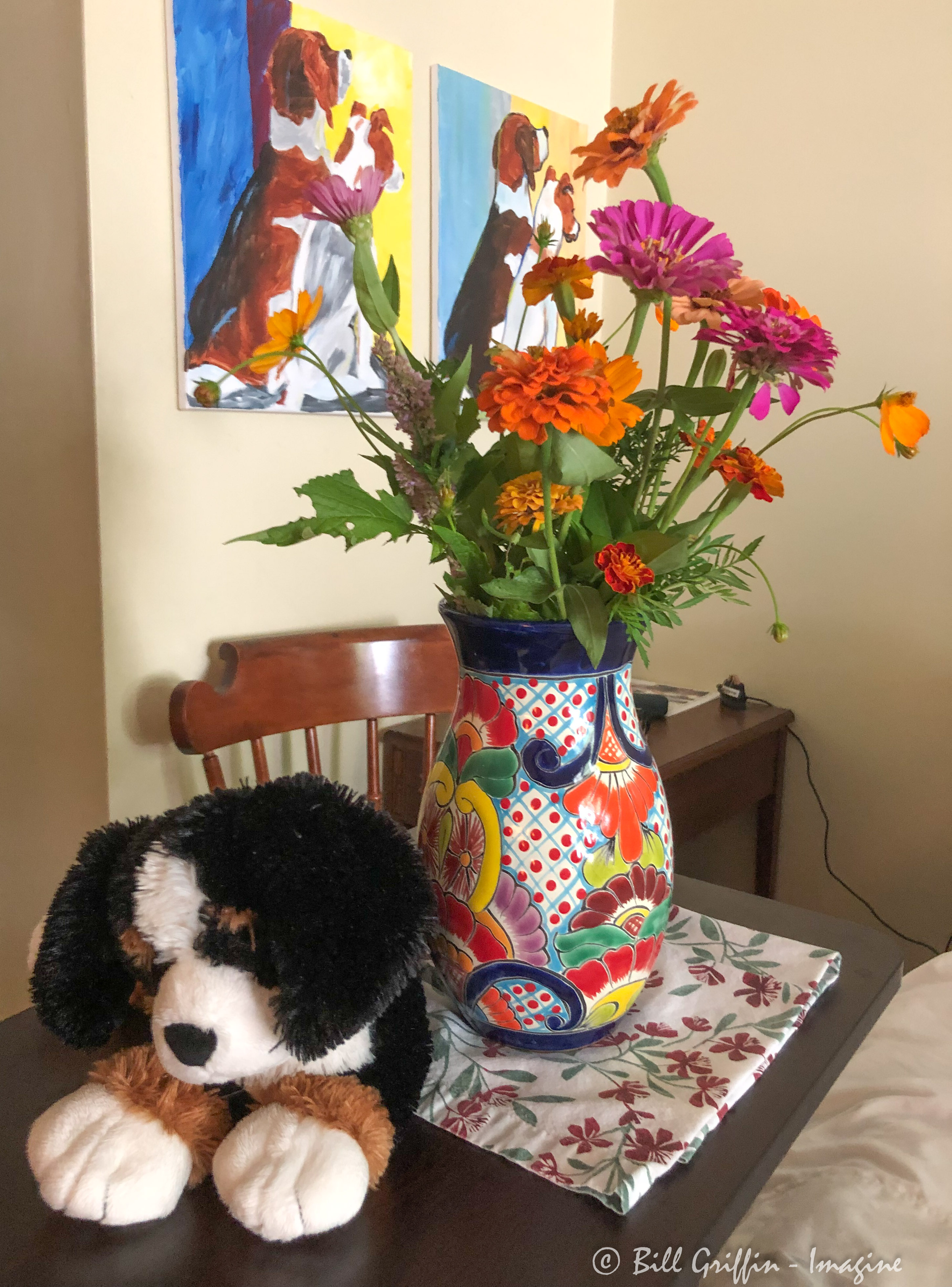
Now I’m stashing stuff in the car for this morning’s drive to Winston, errands to be accomplished for Dad: laptop, check; Power of Attorney docs, check. Wait, I was thinking of taking Dad some flowers from the front yard today. No, too tired. Next time.
.
And when might that next time arrive? Snipping zinnias, marigolds, anise hyssop, coaxing their stems into an old bread bag with a wet paper towel in the bottom, fitting the fresh bouquet into my cup holder – oh, my! Flames of purple and scarlet and bright orange, scent of mint and musky asters – pulling out of the driveway, how spontaneously I combust!
.
❦ ❦ ❦
.
Sunflowers
.
In our well-manicured yard
where a clover can’t show its face
or risk dire consequences, a row
of sunflowers sprang up by the bird
feeder, claiming the kitchen
.
window for their own. Such thick
stalks and heavy flowers belong
in children’s stories, where
gardens bloom in shapes
and colors seldom imagined
.
and mushroom grow as big
as houses. With great dark eyes
surrounded by yellow lashes,
they follow the sun on its daily
journey – a bevy of bold young
.
girls in love with the same boy.
Dazzling beauties all, showing
up our prim blades of grass
and trimmed bushes like hula
dancers in a room full of pilgrims.
.
Terri Kirby Erickson
from In the Palms of Angels, Press 53, Winston-Salem NC; © 2011
.
❦ ❦ ❦
.
clouds cast shadows across the ground like whales swimming through clear water
a bevy of bold young girls in love with the same boy [sunflowers]
the yellow-haired girl whose hands rested in her lap like fresh-picked lilies
her fingers dancing over tubes of lipstick as if they were piano keys, and she, learning a new song
.
Terri Kirby Erickson’s poems delight in the perfect image, the lance of daylight that makes shadows radiant. She populates her lines with characters from every neighborhood and every family, her own included, and she reveals their secrets, unknown sometimes even to them, but she does it with language so airy and effortless that I imagine her raising her pen like a lightning rod and drawing to it from heaven a bright spark of inspiration. Spontaneous, emerging fully formed from the heart. The rest of us bail the bilge as we adhere to the adage, “Writing is re-writing,” while Terri is skipping stones across the water.
.
❦
.
In the Palms of Angels by Terri Kirby Erickson is available at PRESS 53
More by Terri at Verse & Image HERE
.
.
❦ ❦ ❦
.
Grandmother’s Lamp
.
In the quiet stillness of a snowy evening,
the earth is white as angel wings and the sky
purple as lilacs pressed against the window
.
pane. The soft glow of Grandmother’s lamp,
with its yellowed shade and pattern
of porcelain roses, falls on the antique tabletop
.
and the picture of my mother, the ballet
dancer, posing. From the street,
it’s just another lamp in a long row of lighted
.
windows, but to me, it is the sweet comfort
of my grandmother’s face, bent earnestly
over her needle point, or patiently putting together
.
another scrapbook of memories, pasted just so
on the page. It is her quiet certainty that this, too,
shall pass, that God hears our prayers,
.
and the heaven is not the stuff of fairy tales
woven to quiet our fears, but as real as the lamp
she left for me, to light my way there.
.
Terri Kirby Erickson
from In the Palms of Angels, Press 53, Winston-Salem NC; © 2011
.
❦ ❦ ❦
.
.
❦ ❦ ❦
.


Thanks Les. Witness to the pain and the joy. ---B