Feeds:
Posts
Comments

Archive for the ‘family’ Category

 . 
[with 3 poems by Linda Annas Ferguson]
 . 
Family Reunion
 . 
I have to reach deeper each year
for all that is stored
in the pockets of this house.
 . 
This is a day we have to slow ourselves
to feel what time has deepened.
My own body, half-remembering,
lingers in a doorway.
 . 
Children pick plums
off the near-bare tree
outside the kitchen.
The day dissolves into hungry reaching.
 . 
Mother watches at the window
drinking in the one life she must live,
rolls lint in her apron packet,
suffers love in the smallest of things.
 . 
She is tired now, a fragile cup
to be hummed into.
I can hear a familiar lullaby
in her good-byes.
 . 
We leave all at once
like awkward adolescents
avoiding an intimacy,
Mother’s hands folded on her lap
to fill its emptiness.
 . 
We are already
thinking of tomorrow
as if the past
is just a house we visit.
 . 
Linda Annas Ferguson
from Bird Missing from One Shoulder, WordTech Editions, Cincinnati OH; © 2007
 . 
❦ ❦ ❦
 . 
“Hey, Bert, how about if your Mom rides with Aunt Jodi?” We are visiting Linda’s youngest sister in West Virginia, first time since Bert was a toddler. This afternoon he’s been running, toad-hopping, climbing, all out exploring the old house and the new one going up beside it. If there is a tether between him and his mother, it has not been visible. Now we’re preparing to drive to nearby Babcock State Park, but we won’t all fit in one car and there’s just the one car seat, in ours. So how about it, Bert? “No! I want Mommy to ride with me.”
 . 
Perihelion for comet Tsuchinshan-ATLAS is just weeks away, mid-September 2024; what will happen as it reaches its orbit’s closest point to the sun? How many thousands or millions of years has it been since it last passed this way? It is so small and it will grow so hot, nearer to the sun than Mercury – will it crack like cold glass filled with hot tea? Or will it hold together, swing wide, its long tail swishing across its face to become anti-tail, a leash preceding the body back into darkness and cold? Those who follow the comet don’t see its tether of gravity but they measure its pull and calculate its path, a once in a million years opportunity.
 . 
I haven’t lived in the same home with my mother since June 15, 1974. Even before that there was the year in West Berlin as an exchange student and the three years away at college. Then came fifty years with just a week here and a week there under the same roof, vacations, taking for granted that Mom would still scramble my eggs and make red-eye gravy every morning. And then these last few weeks. Sitting beside her on the couch helping her fill out the Jumble on the comics page. (Me helping her? Inconceivable.) Trying to convince her to eat one more bite of pudding. Bringing fresh flowers from my front yard which never fail to raise a smile. I’ve been saying little goodbyes for months (be honest, for years) and convinced myself I’d laid aside the tether with gentleness and with calm. Perhaps, to be even more honest, I’m only now really feeling its strength.
 . 
 . 
❦ ❦ ❦
 . 
Mother’s Funeral, the Family Viewing
 . 
You linger in the room, a dark silk.
We sit around in massive silence,
then pleasant and uneasy,
discuss how you willed yourself to die.
 . 
We all saw you going,
never waved to you to come back,
as if we did not think
you would really go.
 . 
Your body lies life-like
as if dreaming motion.
I feel my own aging,
my hands cold like yours.
 . 
I rinse my lips after kissing your cheek
as if death will wash off. I can still see
your closed eyes, your mouth
poised as if forming a thought.
 . 
I turn around, expect you
to be standing in the doorway.
you are not there.
You have finally stopped leaving.
 . 
Linda Annas Ferguson
from Bird Missing from One Shoulder, WordTech Editions, Cincinnati OH; © 2007
 . 
❦ ❦ ❦
 . 
I learned this in grade school: the roots we can’t see are as big as the branches we can. What tethers the tree to earth and nourishes it is so easy to take for granted. Reading Bird Missing from One Shoulder by Linda Annas Ferguson, I imagine her writing these poems twenty years ago and revealing, first for herself and today for me, much that must have once been hidden. Much that must have been difficult to see as it was happening and difficult to return to later. But Linda’s poetry takes nothing for granted. The connections, the ties, the necessary tug and pull of the heart, all are made beautifully plain.
 . 
What is the soil that covers these roots of ours and conceals what should be so plain that we learn it in grade school? Time, of course, saps memory. Yesterday I asked my father about something my mother had told me that I wanted to recall, but it was beyond him. More than time, though, are the curtains we ourselves hang or with which we allow the dailyness of life to cloak us. Some memories are painful; I hold them at bay until the veil frays at 4 AM and they intrude. Some I push aside and promise to deal with later. And some connections, even when truly vital, can’t compete with worrying about the bills and getting to an appointment on time.
 . 
Enter poetry. To write, one must pause at least long enough to pick up a pen. Not that a placid morning free of responsibilities is required – I confess I keep a blank page on a clipboard in the passenger seat beside me and start most of my poems at 65 MPH. The “pause,” though, is metaphor for willingness – to open oneself; to glimpse the unseen; to accept that there are tethers that weave through all of our moments and all of our relationships. Sweet, strong, nourishing roots that hold us down, that hold us up. Love, pervasive and powerful as gravity, swings me every day around the sun.
 . 
 . 
❦ ❦ ❦
 . 
Mama’s Closet
 . 
I can feel her here under the stairs
where she stores pieces of herself
on shelves in yellowed shoe boxes,
 . 
a report card from fifth grade,
her mother’s signature in faded pencil
on the bottom line.
 . 
A group picture, women workers
outside on the gray grass of the cotton mill,
its tall brick wall the only background,
 . 
her fourteen-year-old face
lost in frowns
and fixed smiles of the front row.
 . 
Another photo at twenty, a Saturday afternoon
on a steel bridge, Daddy’s arm
around her shoulder posed for a future.
 . 
Three purses on ten-penny nails, full of notes,
mementos, money she hides for a child’s needs,
a winter coat, a Sunday dress.
 . 
I can feel her here, under the stairs,
every corner collecting her plain
unperfumed warmth,
 . 
every photo, saving the girls she wants
to remember, every small portion of paper
a folded page of herself.
 . 
Linda Annas Ferguson
from Bird Missing from One Shoulder, WordTech Editions, Cincinnati OH; © 2007
 . 
❦ ❦ ❦
 . 
 . 
❦ ❦ ❦
 . 
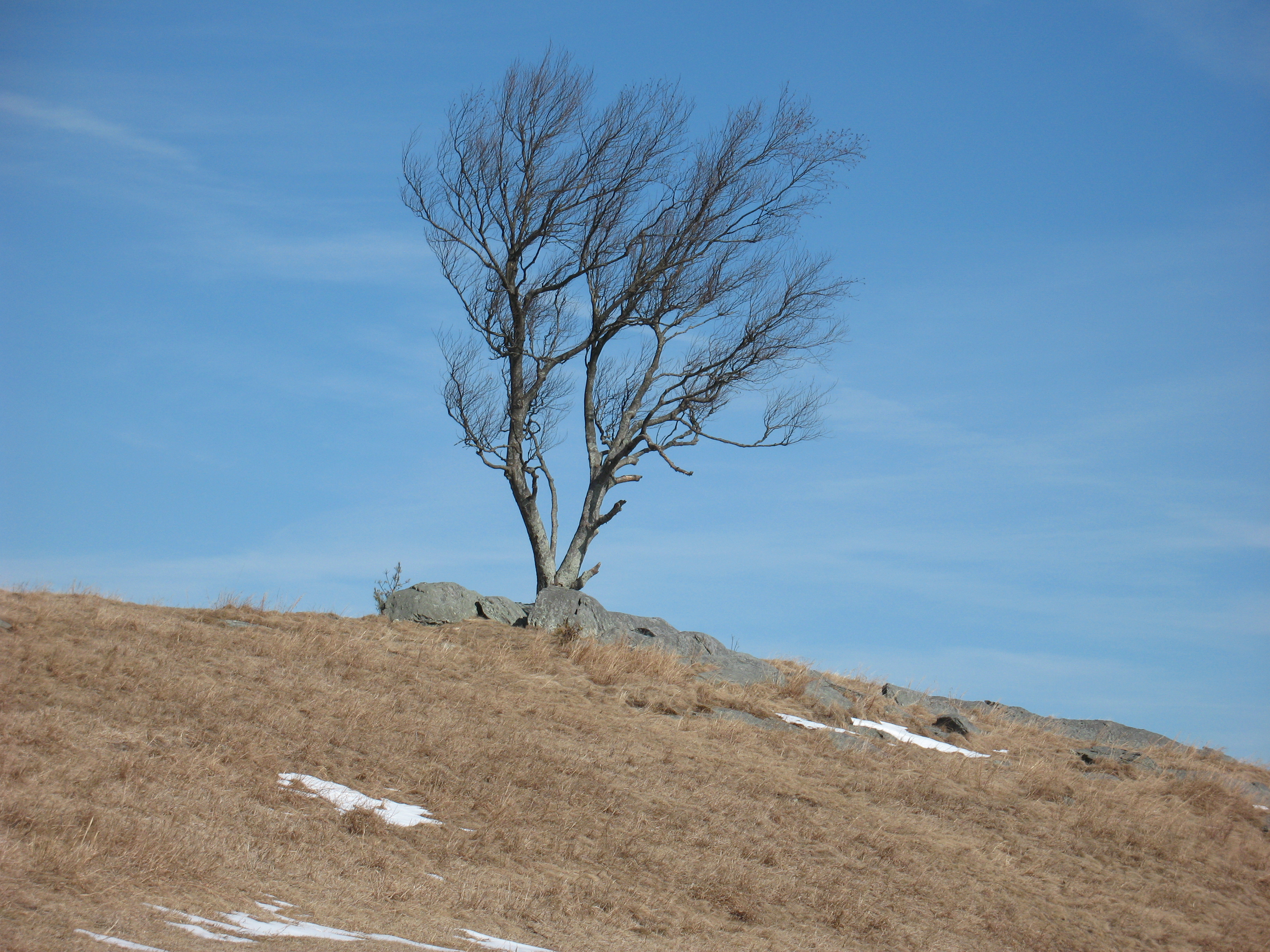
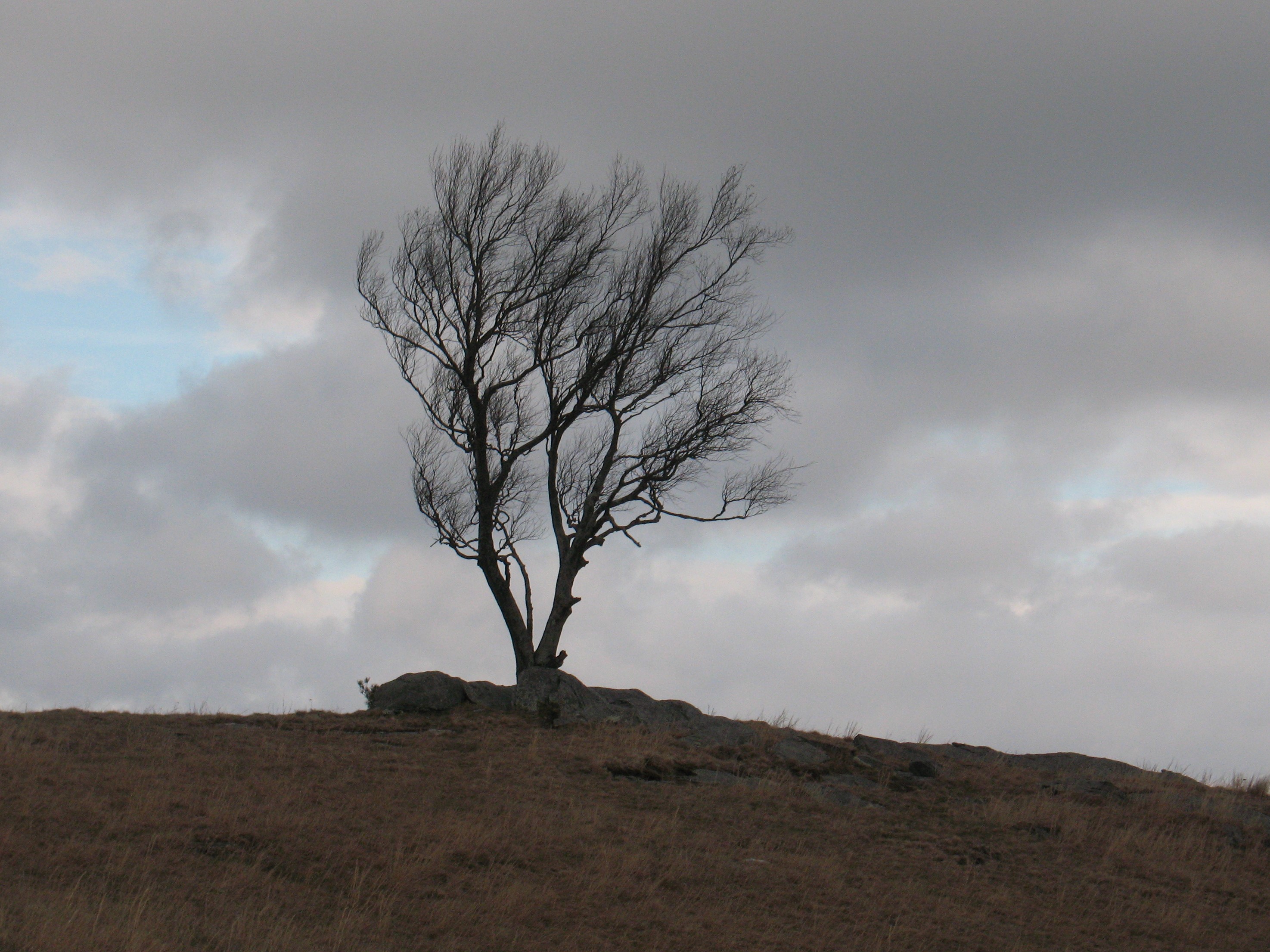
Doughton Park Tree 4/30/2022

Read Full Post »

 . 
[with poems from Duet by Dorianne Laux and Joseph Millar]
 . 
Listening to Paul Simon
 . 
Such a brave generation.
We marched onto the streets
in our T-shirts and jeans, holding
the hand of the stranger next to us
with a trust I can’t summon now,
our voices raised in song.
Our rooms were lit by candlelight,
wax dripping on the table, then
onto the floor, leaving dusty
starbursts we’d pop off
with the edge of a butter knife
when it was time to move.
But before we packed and drove
into the middle of our lives
we watched the leaves outside
the window shift in the wind
and listened to Paul Simon,
his tindery voice, then fell back
into our solitude, leveled our eyes
on the American horizon
that promised us everything
and knew it was never true:
smoke and cinders, insubstantial
as fingerprints on glass.
It isn’t easy to give up hope,
to escape a dream. We shed
our clothes and cut our hair,
our former beauty piled at our feet.
And still the music lived inside us,
whole worlds unmaking us in the dark,
so that sleeping and waking we heard
the train’s distant whistle, steel
trestles shivering across the land
that was still our in our bones and hearts,
its lone headlamp searching the weedy
stockyards, the damp, gray rags of fog.
 . 
Dorianne Laux and Joseph Millar
from Duet, Jacar Press, Durham, NC; © 2016
 . 
❦ ❦ ❦
 . 
Here I am again, six years old this time, sitting cross-legged on the floor beside the pinnacle of 1959 technology. I wind it up, carefully lay the 6-inch plastic disc on the little turntable (it’s bright yellow plastic, I will never forget that), and position the needle at the outer groove. The wind-up box is white and red and has a picture of Mickey Mouse grinning; it looks like Mickey’s arm is what holds the stylus. The needle itself juts from a hollow flat cylinder, sort of like a tuna can with perforations; the little holes are what transmit the sound. No electronics, no electricity involved.
 . 
I push a lever and the disk begins to rotate. The needle finds its groove (at least a decade before finding one’s groove will mean anything to me) and in between all the scratches from a hundred earlier renditions – music! The little record finishes, I lift the needle from where it’s begun making little whump whump sounds with each revolution, I place the needle back at groove one, and it starts all over again.
 . 
And even so my mother remained sane to her dying day.
 . 
As the years passed, Mom and Dad began to let me listen to their records on the Hi-Fi (mono, not stereo; Uncle Carlyle soldered it himself). It never seemed to drive them crazy to hear Peter and the Wolf or The Music Man a dozen times a day, or even Bobby Darin singing Mack the Knife. Hard core. Finally the big day – I was 11, I had saved my birthday money, I had laid awake at night tallying which of their songs were included: I bought my first LP, Introducing . . . The Beatles.
 . 
Introducing . . . is an anomaly in Beatles discography. It was released by Vee-Jay Records because Capitol/EMI had farted around about agreeing to a first USA Beatles album and Vee-Jay scooped them. Apparently it was only on the market for a year or so before the suits prevailed and forced them to cease and desist. Anyhow, I listened to that vinyl disc about a thousand times before I bought Beatles ‘65. In fact, I might just go slap it on the old turntable right now. Scratches and all. Please, please me!
 . 
 . 
 . 
And that little yellow record? Easter Parade. Sixty-five years later I still find no evidence that there has ever been such a parade, but now the melody has wormed it’s way in again: “In your Easter bonnet, with all the frills upon it . . .” And even so, my mother somehow remained sane.
 . 
 . 
❦ ❦ ❦
Mick Jagger (World Tour, 2008)
 . 
He stands on stage
after spot-lit stage, yowling
with his rubber mouth. If you
turn off the sound he’s
a ruminating bovine,
a baby’s face tasting his first
sour orange or spitting
spooned oatmeal out.
Rugose cheeks and beef
jerky jowls, shrubby hair
waxed, roughed up, arms
slung dome-ward, twisted
branches of a tough tree, knees
stomping high as his sunken chest.
Oddities aside, he’s a hybrid
of stamina and slouch,
tummy pooch, pouches under
his famous invasive rolling eyes.
He flutters like the pages
of a dirty book, doing
the sombrero dance, rocking
the microphone’s
round black foot, one hand
gripping the skinny metal rod,
the other pumping its victory fist
like he’s flushing a chain toilet.
Old as the moon and sleek
as a puma circling the herd.
The vein in this forehead
pops. His hands drop into fists.
he bows like a beggar then rises
like a monarch. Sir Mick,
our bony ruler. Jagger, slumping
off stage shining with sweat.
O please don’t die. Not now,
not ever, not yet.
 . 
Dorianne Laux and Joseph Millar
from Duet, Jacar Press, Durham, NC; © 2016
 . 
 . 
❦ ❦ ❦
 . 
Uno Voce – when Sandy Beam rehearsed an a capella selection, he required us to blend our tone with each person singing near us until it was as if we all sang with one voice. Vibrato is anathema; sibilance is sin! Of course, Sandy would have been happiest if we had all been boy sopranos, but at least we could strive for that brilliant transparent evocation of light he desired.
 . 
Light and truth evoked by a single voice – not at all unlike these poems in Duet. They are each about music – Bo Diddley, Lightnin’ Hopkins, Paul Simon, James Taylor, Ladysmith Black Mambazo, Cher. They build a portrait in layers of color, tone, and years, filled with the music that infuses our past and vibrates in our bones to create our present. And they are written by the duet of Dorianne Laux and Joseph Millar, but the tones and melodies blend until we readers hear a single voice.
 . 
Not an ear worm in the bunch.
 . 
 . 
Duet is one in the continuation of the Greatest Hits Series, originally conceived by editor Jennifer Bosveld at Pudding House Press in 2000 and acquired by Sammy Greenspan of Kattywampus Press in 2010. Jacar Press was asked to take over the series under the careful eye of series editor David Rigsbee in 2017. More about the book, the Series, and Jacar Press HERE
 . 
 . 
❦ ❦ ❦
 . 
 . 
 . 
❦ ❦ ❦
 . 
 . 
 . 

Read Full Post »

 . 
Night Shift in the Home for Convalescents
 . 
There is much in this drawer that is no longer in use:
a notebook with ribbon to mark passages
once of some importance, a tortoiseshell comb sadly
made of tortoise shell, a prayer book bound
in mother-of-pearl. Mother-of-pearl.
And sounds: a blurring of bees in the air
no longer heard in the wild.
Everything at once, she had said. All that you
remember must be written down.
Bed linens sailing the wind, curtains flaring
beyond the windscreens, lilacs soon to lie on the ground.
There was a quickening in the heart whenever I saw him
standing in a field of bloom and hum then suddenly not there.
The field gone. The house. The road now under a newer road.
Trees along it long cut down. No canopy of hope.
And the swamp? Who knows what became of it.
Skunk cabbage and buttercups, cattails,
polliwogs and crayfish with their pulse-train song.
We caught them in jars of pond water.
Not for eating, no. To watch them live.
Wash your mother’s clothes one last time and put them away—
like wrapping a scoop of snow in tissue paper.
 . 
Carolyn Forché
from You Are Here: Poetry in the Natural World, edited by Ada Limón and published by Milkweed Editions in association with the Library of Congress; 50 new poems by 53 contemporary poets; © 2024
 . 
❦ ❦ ❦
 . 
There I am, the four-year old peeking around the kitchen door while two women fry chicken, my Nana and the person she is calling ‘Clara Jean’. Uncle Carlyle passes through, nabs a crispy crackling from the platter, says, “Mmm, good, Sister.” I’ve heard cousins and aunts call her ‘Sister’, too, but I know her real name – Mommy.
 . 
By 1949, when Clara Jean Cooke had her first date with Wilson who would become my father, everyone around her knew her as ‘Cookie’. Everyone at church; all her Reynold’s High School friends; the roommates, pals, and profs at Women’s College – ‘Cookie’. It was her name, stuck fast for eight decades, although sometime in the 1990’s my little sister Mary Ellen would christen her ‘Big Momso’ and we’d trot that one out for a joke on birthday cards and such.
 . 
Now I’m shaking hands at the open house eleven days after Mom’s death. Neighbors, caregivers, a cousin’s family, her Sunday school: “Cookie was a dear friend.” “Cookie had the sweetest smile every time I saw her.” “Cookie was so special to us.” I’m nodding and smiling and shaking the next hand, and they are all so right. The kindest, the dearest, the funniest and funnest; the most talented to ever pick up chalk and create a perfect likeness; the brightest to ever pick up pencil and defeat the NY Times Crossword; the best to ever fry up a pullet crispy and juicy. The Cookiest.
 . 
 . 
After the guests have trickled away and Dad is conked out in his hospital bed, Mary Ellen and I are in the kitchen stowing leftovers in the fridge and bagging the trash. Mom is peeking around the kitchen door. Nana and Carlyle died in another century – there’s no one left to call her Clara Jean or Sister. Mom’s middle son is two time zones distant. It’s just her and her eldest and youngest here. I lean against the stove. Mary Ellen is drying her hands. All the busyness of the past two weeks pauses long enough for us to take deep breaths and begin to tell stories about our Mother.
 . 
❦ ❦ ❦
 . 
 . 
❦ ❦ ❦
 . 
Clara Cooke Griffin
February 24, 1928  – July 23, 2024
 . 
Clara “Cookie” Griffin, 96, died peacefully at her home in Winston-Salem, North Carolina, on July 23, 2024, surrounded by the love of her family. She was born in Winston-Salem on February 24, 1928, to Ellen McBride Cooke and Grady Carlyle Cooke MD. Cookie is preceded in death by her parents and her two brothers, Sammie and Carlyle. She is survived by her husband Eugene Wilson Griffin Jr;  her children Bill (Linda), Bob (Kathy), and Mary Ellen (Wendy); her grandchildren Josh (Allison), Margaret (Josh), Natalie, Lauren, and Claire; her great-grandchildren Saul, Amelia, and Bert; and her much loved cousin Michael Childs (Pam) and family.
 . 
Cookie was an accomplished, caring, and creative woman throughout her life. She was the first woman in her family to earn a bachelor’s degree, majoring in art at UNC Greensboro (then known as Women’s College of North Carolina), graduating with the class of 1949. After college she returned to Winston-Salem, where she worked professionally as a medical illustrator, and soon met her husband Wilson on a blind date. They married in 1950 and moved several times for his career, living in Atlanta GA, Niagra Falls NY, Memphis TN, Farmington MI, Aurora OH, and twice in Wilmington DE. Cookie became a full-time mother when her children were born. She continued her art as an avocation and also enriched the family’s life with music and a love of reading and education. She shared her love of gardening and the outdoors and taught her children the names of every bird at the feeder, but perhaps the greatest gift she shared has been her eternally optimistic and encouraging spirit.
 . 
In her 40’s, Cookie obtained a second bachelor’s degree in early childhood education at Kent State University. She was especially gifted working with young children and served as a beloved kindergarten and first grade teacher in the Aurora Public Schools for over ten years. She practiced an educational philosophy called The Open Classroom. Observers were amazed to see twenty or more 5- or 6-year olds in one room, quietly and simultaneously engaged in small group activities including art, science, and reading corner! When she and Wilson moved again to Wilmington, DE, she continued working in early education conducting preschool reading readiness assessments for the public school system.
 . 
In retirement, Cookie continued to pursue her artistic talent. She took classes to develop her craft, and her media spanned pencil drawing, charcoal, pastels, acrylics, and oils. Her subjects included plein aire, landscapes, still life, figure painting, abstracts, and always portraits. Her grandchildren and great nieces and nephews benefitted from her gifts with art and early education, both as subjects of her paintings and with hands-on instruction: she always had art projects at the ready for the children when they visited the family’s summer home on Bogue Banks at the North Carolina coast! Throughout her life, even into her 90’s, Cookie frequently drew or painted portraits of children or pets as gifts for family, friends, and community groups. These works of art are cherished by many as mementoes of Cookie’s creativity, generosity, and her love for children and animals.
 . 
In 2012, Cookie and Wilson returned to Winston-Salem. They renewed friendships dating to Cookie’s elementary school years, made new friends with neighbors in their South Marshall Street community, and joined First Presbyterian Church, where they especially loved their Adult Sunday School Class. Cookie’s life-long love of music, which had included playing piano for her young family, now expanded to enjoying violin performances by her granddaughters and regular attendance at the Winston-Salem Symphony. Throughout her life, the joy of family was paramount to Cookie, and in her final decades she spent many happy hours visiting with and sharing stories about her children, grandchildren, and great-grandchildren. We who love her will continue telling her stories.
 . 
The family wishes to thank all those who have loved and supported Cookie in recent years and months, including friends, neighbors, and the dedicated and talented caregivers at Bayada Home Health, Home Helpers of the Crystal Coast, and Trellis Supportive Care. A memorial service has been planned for September 29.
 . 
 . 
❦ ❦ ❦
 . 
Thank you to my sibs, Mary Ellen and Bob, for assisting in the composition of this obituary. Thank you to poet friend Suzanne Bell for sending me this poem by Carolyn Forché and recommending You Are Here by Ada Limón. As I was tidying up to prepare for Mom’s memorial open house, I happened to look in the top drawer of her dressing table. Beads, earrings, one silk glove – Mom would have been able to come up with any number of words for the collection there. Oddments. Hodgepodge. Gallimaufry. Maybe even Omnium-gatherum, such a nice ring to it. I gazed at the contents for the span of three or four deep breaths. I closed the drawer. Later.
 . 
❦ ❦ ❦
 . 
 . 
 . 

Read Full Post »

« Newer Posts - Older Posts »