Archive for the ‘Art’ Category
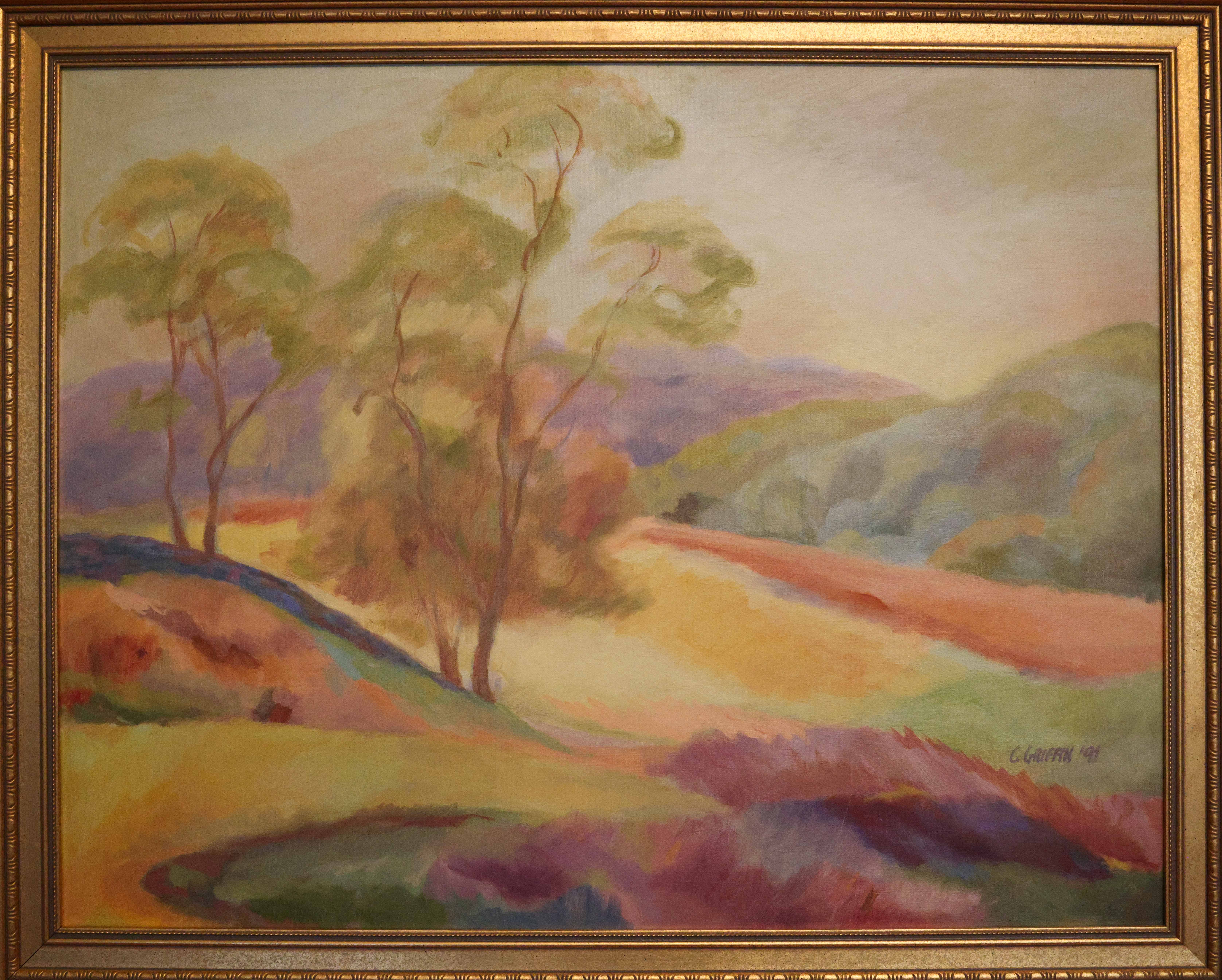
Brush Strokes
Posted in Art, family, Imagery, poetry, tagged Bill Griffin, Ekphrastic poetry, Gail Peck, imagery, Impressionism, Lena Shull Book Contest, Main Street Rag Publishing, NC Poetry Society, NC Poets, poetry, Southern writing, The Braided Light on February 14, 2025| 5 Comments »
Making Magic
Posted in Art, Ecopoetry, family, Imagery, Photography, poetry, tagged Bill Griffin, Denton Loving, Ecopoetry, family, imagery, Keri Gunter-Seymour, nature, nature photography, nature poetry, poetry, Shuly Xochitl Cawood on July 22, 2022| 11 Comments »
[poems from I Thought I Heard a Cardinal Sing]
Last week our sister Jill sent us photos from her recent camping trip in the Allegheny National Forest, a favorite spot called Kelly Pines. Big trees, moss & ferns, campfire, nylon tent – nothing lacking. There were also a few shots taken by our niece April – Jill hiking a trail between massive trunks, Hobbit Jill looking up into the giants. Jill’s comment – “Truly a magical seeming place . . .”
Gentle sun-dappled trail; open understory beneath a high canopy; mature second- (or third- or fourth- ) growth pines – a beautiful woodland setting . . . but magic? If I were to visit this spot for the first time would I discover more magic here than any other moderately impacted wood lot in the Appalachians, from Pennsylvania to northern Georgia? Ignore magic incantations and transmutations, ignore any lapses in the laws of physics, even so magic must create something around and within us that we don’t experience without magic.
But Kelly Pines (which, as a member of Linda’s family for over 50 years, I too refer to as Kelly’s Pines) does create magic. This little patch of forest, stream, rocky incline has been accruing magic since before these seven siblings were born. It’s the magic of shared stories – big Mama Bear crossing the trail just minutes after Linda had been walking there alone. It’s the magic of special visits – Linda and I camped at Kelly’s Pines for our honeymoon. Definitely the magic of roots – a bit of Linda’s Mom’s and Dad’s ashes are sprinkled there. And greatest of all is the magic of memories – those family camping expeditions have provided every sibling with their own recollections, carefully preserved treasures they dust off and pass around whenever any of the seven get together.
We make our magic. Our memories create magic. Sister Becky sums it up perfectly when she sees the photos: “It creates a great longing to be there with my loved ones.” Such magic!
❦
Linda and I regularly hike a number of local trails where, when we listen, we hear the fey whispers of magic. Some are old trails with deep roots – we’ve visited Doughton Park on the Blue Ridge Parkway since the kids could walk. Some are newer, their magic bright and sprite and still emerging – the Grassy Creek “forest bathing” spur of the Mountains-to-Sea Trail, where our grandson worked beside me to scrape a first pathway into the riparian gloom.
Every week, in every season and weather, we discover the healing magic these footpaths through forest desire to share with anyone who’ll visit. Some magic is tangible: today the tiny Adam and Eve orchids are just opening, and to appreciate them I have to kneel with my nose in the leaf mould. Some magic is inchoate: the breeze on our necks, how it stirs ferns in the glade, the color of light ferns hold and release when we pause from all motion and let the woods overtake us.
When we return from these walks it isn’t the sweat and tired old muscles we remember. The magic of memory creates connection, shared presence, becoming one. Yes, Jill, that is a magical place. Oh yes, the trees, the mountains, but what really brings each place’s magic into being is what we share there together.
❦ ❦ ❦
Girl in the Woods
Before the earth became her bed, she raked away
+++++ the rubble and rocks, scraped the soil smooth.
There are no candy men here, no dope peddlers,
+++++ no pill pushers, no one to hand out 40s and 80s –
those perfect stones with their false promise to cut her
+++++ pain with their fuzz and blur – the way they do
at her apartment in the projects, a home more makeshift
+++++ than her nylon tent with its walls stretched taut,
its strings staked between oak roots. In this quiet,
+++++ she sketches her children’s faces with charcoal,
applying skills she’s learning in community college
+++++ art classes. She outlines their curved cheeks,
their almond-shaped eyes, uses long, sweeping strokes
+++++ for her daughter’s hair, a softer mark for the scar
on her son’s chin. Dark comes early beneath the trees.
+++++ Without the luxury of electric light, she’s learning
how to smudge charcoal, how to block in the mid-tones,
+++++ by battery-powered lantern – a small sacrifice
for this shelter of trees when she most misses her kids,
+++++ when her brain won’t stop buzzing.
Denton Loving
from I Thought I Heard a Cardinal Sing: Ohio’s Appalachian Voices, edited by Kari Gunter-Seymour; Sheila-Na-Gig Editions, © 2022
❦ ❦ ❦
Southern Ohio, pronounced “Ohia” if you’re from there, is Appalachia. Forget Cleveland and Toledo and their Lake Erie, forget Columbus and its gateway to the great plains. Think Athens, Portsmouth, Logan, Hocking Hills. Nearly one fourth of the area of Ohio is hills, glacial carvings, forest, and streams flowing down to the Big River that borders West Virginia and Kentucky. These poems are from the new anthology, I Thought I Heard a Cardinal Sing: Ohio’s Appalachian Voices, poetry called forth and collected by current Ohio state poet laureate, Kari Gunter-Seymour.
These voices are remarkable. Inspiring. Dire. Funny as hell. Every day I pick up the book and just leaf to a new page at random, and every poem speaks to me. It’s not just because I have family in those hills and know the smells and sounds of those back roads and farms, the funkiness of those river towns, the long lightless days of winter, the disappointment of “Ohio false spring.” It’s because these poems are honest and human and speak to anyone who has ever looked to discover another person standing beside them. Join me, open the book, let’s see where it takes us! Let’s us be part of the community, bigger and bigger.
You’n’s, us’n’s, all of us together.
❦ ❦ ❦
Some Kind of Prayer
What can I tell you that you do not already know?
Listen to the grass, its long legs whistling as it swishes.
Touch the brush of cattails, the brittle wings of pine cones,
the dry skin of chokeberries – feel
their burst. Taste rain. Say you’re sorry
not for what you did but for how you doubted
yourself for so long. This life is filled
with a million cocoons and you can choose
how long, which one, or none.
Sleep is so close. Run now, run.
Shuly Xóchitl Cawood
from I Thought I Heard a Cardinal Sing: Ohio’s Appalachian Voices, edited by Kari Gunter-Seymour; Sheila-Na-Gig Editions, © 2022
❦ ❦ ❦
To No One in Particular
I am never happy to see summer go,
earth stripped of its finest voice.
I am sitting outside in my heavy coat,
porch light off. There is no moon,
no ambient distractions, the sky a Zion.
I take solace in considering the age
of this valley, the way water
left its mark on Appalachia,
long before Peabody sunk a shaft,
Chevron augured the shale or ODOT
dynamited roadways through steep rock.
I grew up in a house where canned
fruit cocktail was considered a treat.
My sister and I fought over who got
to eat the fake cherries, standouts in the can,
though tasting exactly like very other
tired piece of fruit floating in the heavy syrup.
But it was store-bought, like city folks
and we were too gullible to understand
the corruption in the concept, our mother’s
home-canned harvest superior in every way.
I cringe when I think of how we shamed her.
So much here depends upon
a green corn stalk, a patched barn roof,
weather, the Lord, community.
We’ve rarely been offered a hand
that didn’t destroy.
Inside the house the lightbulb comes on
when the refrigerator door is opened.
My husband rummages a snack,
plops beside me on the porch to wolf it down,
turns, plants a kiss, leans back in his chair,
says to no one in particular,
A person could spend a lifetime
under a sky such as this.
Kari Gunter-Seymour
from I Thought I Heard a Cardinal Sing: Ohio’s Appalachian Voices, edited by Kari Gunter-Seymour; Sheila-Na-Gig Editions, © 2022
❦ ❦ ❦
❦ ❦ ❦
All the World – Earth Day Prelude
Posted in Art, Ecopoetry, family, Imagery, Photography, poetry, tagged All the World, Bill Griffin, Earth Day, ecology, Ecopoetry, Elizabeth Scanlon, imagery, Marla Frazee, nature, nature photography, nature poetry, poetry, Southern writing on April 19, 2022| 6 Comments »
[poetry by Liz Garton Scanlon, Alice Walker,
John Hoppenthaler, Catherine Carter, David Poston]
All the World
Rock, stone, pebble, sand
Body, shoulder, arm, hand
A moat to dig, a shell to keep
All the world is wide and deep
Hive, bee, wings, hum
Husk, cob, corn, yum!
Tomato blossom, fruit so red
All the world’s a garden bed
Tree, trunk, branch, crown
Climbing up and sitting down
Morning sun becomes noon-blue
All the world is old and new
Road, street, track, path
Ship, boat, wooden raft
Nest, bird, feather, fly
All the world has got its sky
Slip, trip, stumble, fall
Tip the bucket, spill it all
Better luck another day
All the world goes round this way
Table, bowl, cup, spoon
Hungry tummy, supper’s soon
Butter, flour, big black pot
All the world is cold and hot
Spreading shadows, setting sun
Crickets, curtains, day is done
A fire takes away the chill
All the world can hold quite still
Nanas, papas, cousins, kin
Piano, harp, and violin
Babies passed from neck to knee
All the world is you and me
Everything you hear, smell, see
All the world is everything
Everything is you and me
Hope and peace and love and trust
All the world is all of us
written by Liz Garton Scanlon
illustrated by Marla Frazee
All the World, Little Simon, an imprint of Simon & Schuster, New York NY, © 2009
❦ ❦ ❦
I love this children’s book by Elizabeth Scanlon – the whirl and dance of the poetry, the absolutely beguiling illustrations by Marla Frazee. It is elemental and compelling, it is joyous and inclusive. It is all of us.
But I had to think long about whether to lead us to Earth Day with this poem. Is it Ecopoetry? Is it a little too much centered on one particular species? How do we celebrate the earth? How do we revere the one blue dot in the universe upon which we can live and thrive?
All the world is all of us. Dogwoods still blooming, warblers arriving, golden ragwort masquerading as weeds, rockfish spawning in Roanoke River, hellbender ugly as sin. Dandelions in the lawn, princess tree crowding out the basswood, wisteria strangling another neglected back lot. Celebrate us all – even while hacking the invaders – but don’t leave out the most aggressive, invasive, threatening species of all. You guessed it – you and me.
One might argue that there are far more pressing needs in our one world than environmentalism. Reminds me of a t-shirt my friend Evan brought me back from a trip to Yellowstone: along with illustrations of various animal scat and the label “Endangered Feces” is the tagline, No Species, No Feces. Which makes the other side of this argument: “No Environment, No World Problems.”
Poverty, politics of hate, racism, homophobia, nationalism, war – how can we make a place in our hearts to worry about our environment when these and so many other worries take priority? Perhaps these things are as intrinsic to our nature as the jillion seeds of princess tree and the invincible roots of wisteria. Are they?
Here’s my thesis – begin reading All the World to every kid at age 2 and by the time they can read it for themselves they may have planted a seed of love within their hearts. They might love themselves no matter what they look like. They might accept a whirling dance of neighbors as their kin. They might have room in their hearts to care about weeds and warblers and ugly giant salamanders.
Think so? Do you think that if we are going to preserve all the world as a place for all to thrive we are going to have to address the aggression, invasiveness, and threat within each one of us? For all the world is all of us . . .
❦ ❦ ❦
We Have a Beautiful Mother
We have a beautiful
mother
Her hills
are buffaloes
Her buffaloes
hills.
We have a beautiful
mother
Her oceans
are wombs
Her wombs
oceans.
We have a beautiful
mother
Her teeth
the white stones
at the edge
of the water
the summer
grasses
her plentiful
hair.
We have a beautiful
mother
Her green lap
immense
Her brown embrace
eternal
Her blue body
everything we know.
Alice Walker
Selected by Becky French (my sister), who writes: I especially like this poem by Alice Walker from her book of meditations titled We Are the Ones We Have Been Waiting For. The prose that follows the poem in the book is quite poetic as well: The earth mother, who stands behind the Human Mother, can be known by lying on her breast. She can be known by swimming in her oceans, or even by looking at them. She can be known by eating her collard greens and carrots. Savoring her fruits, walking through her wheat fields. She is everywhere, our Mother Earth; … (p. 129).
❦ ❦ ❦
The Whale Gospel
Whales have run aground off Cape Cod again.
What if God created them for us as metaphor?
How like us they are, beached and prostrate,
sand shifting under them with every wave
from heaven. Bloated and murder to move,
they slowly rot in the blurry sunshine, victims
of distress we can’t fathom. All we can think
to say is beware the giant squid, the seaquake,
beware sickness in your leaders. Beware the dark-
eyed shark, sonar’s ping and Japan’s traditional hunger.
The rusty bows of ghost ships
++++++++++++++++++ are singing through the water.
John Hoppenthaler
online in “Two Meditations on Ecology”
❦ ❦ ❦
Lactobacilli
Invisible and everywhere,
on your hands,
on your shoes,
in your nose, lining
your ells of bowel,
we lay down scraps
of chromosomes
and pick them up
like screwdrivers
or cards, if half the cards
are wild as sauerkraut-
e. coli, listeria,
seaweed, straight flush.
Nor are you you,
some single entity
cruising the lonely black
star-seas like a whale:
you are a ship, a host,
the poker table.
We are crew
and players and spirit,
your spirit, the one many-
bodied soul you can know
for sure. Genius loci.
Spirits of place.
Full house.
Catherine Carter
Southern Humanities Review, Spring 2020
❦ ❦ ❦
The Garden Takes over Itself
the world is sacred++++ it cannot be improved
snow is shadow++++ ice is light
we breathe++++ and wildness comes in
bit by bit++++ the garden takes over itself
snow is shadow++++ ice is light
the moon not only full++++ but beautiful
bit by bit++++ the garden takes over itself
after we leave it++++ we dream of falling
the moon not only full++++ but beautiful
descending and ascending++++ all our lives
after we leave it++++ we dream of falling
the space within us++++ is not our own
ascending and descending++++ all our lives
the world is sacred++++ it cannot be improved
the space within us++++ is not our own
we breathe++++ and wildness comes in
David E. Poston
from Iodine Poetry Journal XVII (2016): 105.
Reprinted as POETRY IN PLAIN SIGHT poster. NC Poetry Society, 2021.
“the world is sacred…” from Lao Tzu, quoted by Jack Turner interviewed by Leath Tonino (The Sun Aug. 2014)
“we breathe…” also from Jack Turner
“snow is shadow…” is Barbara Sjoholm in The Palace of the Snow Queen
“the moon not only full…” is from Aldous Huxley’s Meditation on the Moon
“…the garden takes over itself” is from Sandra Cisneros, in The House on Mango Street
❦ ❦ ❦
Early in April I asked readers to share a favorite poem that celebrates the interdependence and interconnection of all life on earth. I am including their offerings in three posts before, on, and after Earth Day, April 22. Thank you to those who responded, and thanks to all of you who read this page and share in the celebration.
❦ Bill Griffin ❦


You are planting wonderful seeds. ---B