Archive for August, 2023
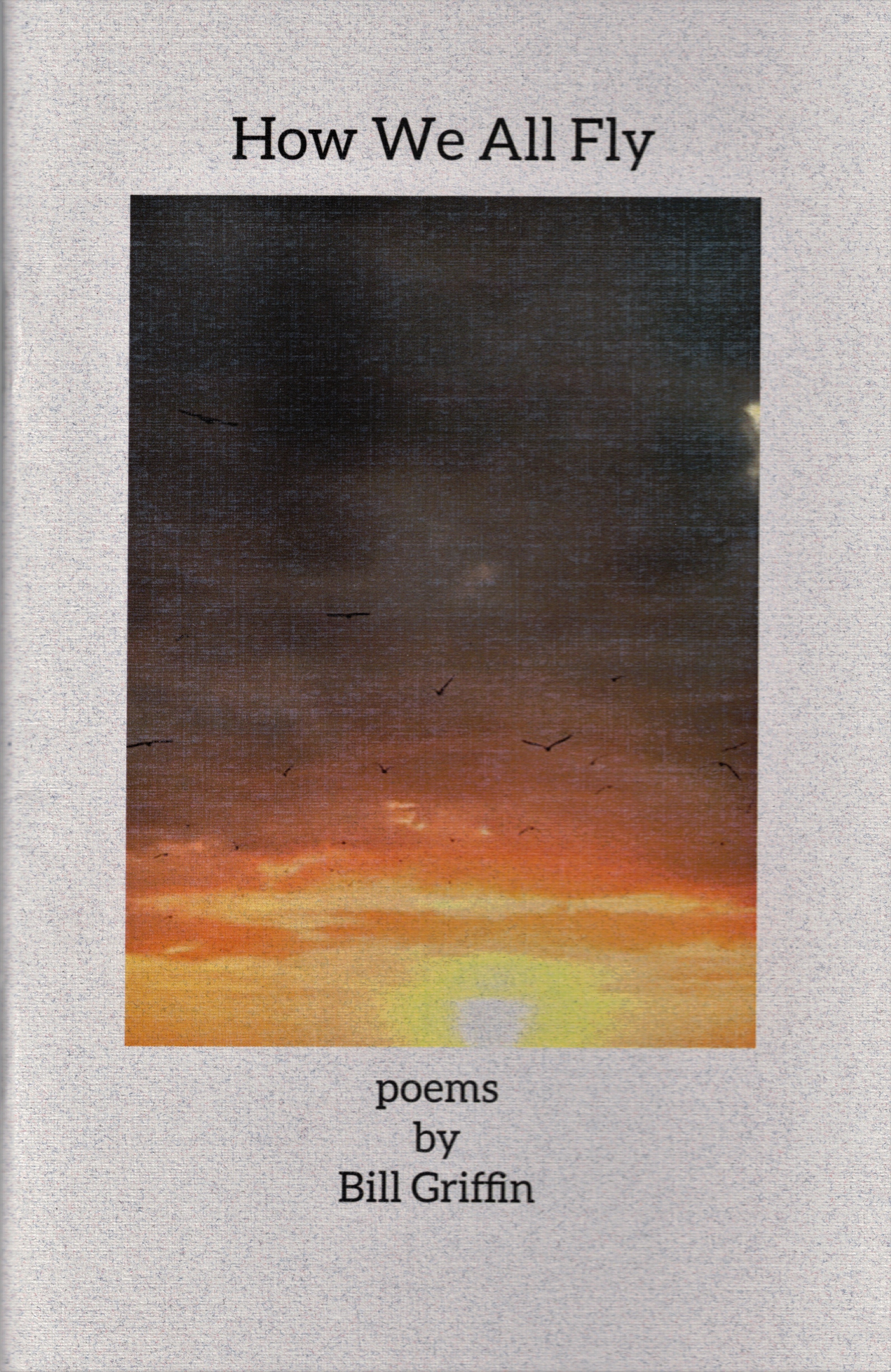
How We All Fly
Posted in Ecopoetry, family, poetry, tagged Bill Griffin, family, How We All Fly, imagery, nature, nature photography, nature poetry, NC Poets, poetry, Southern writing, The Orchard Street Press on August 29, 2023| 14 Comments »
.
[2023 chapbook by Bill Griffin]
.
We Never Give Up Hoping
.
Morning frozen hard. Pour
++++ boiling water
into the birdbath;
++++ they will come
to drink when I have gone.
.
++++ God of holy ice, holy
++++ ++++ steam,
++++ give my children
++++ ++++ water
++++ that all my hoping
++++ ++++ can’t.
.
Sound of wings, splash
++++ diminishing;
find the world again
++++ iced over.
Fill the kettle. Holy water.
.
Bill Griffin
from How We All Fly, The Orchard Street Press. Gates Mills, OH, © 2023
originally published in Quiet Diamonds
.
❦ ❦ ❦
.
Join me in celebrating the release this month of my newest chapbook, How We All Fly, from The Orchard Street Press.
.
Poet Patricia Hooper describes the collection: “Through close observations of the physical world, these clear, direct poems yield insights into the corresponding life of the spirit.” And Rebecca Baggett says this: “Throughout these poems, but particularly toward the collection’s end, How We All Fly leads the reader up and onward, infusing even inevitable losses with tenderness, trust, and hope.”
.
Patricia Hooper is author of Wild Persistence, University of Tampa Press.
Rebecca Baggett’s most recent book is The Woman Who Lives Without Money, Regal House Publishing.
.
❦ ❦ ❦
.
.
❦ ❦ ❦
.
Thank you for your support, both of the writing you discover here and of the literary arts!
.
You may purchase a copy of How We All Fly directly from me by mailing a check for $15 (postage included) to this address:
++++++ 131 Bon Aire Rd.
++++++ Elkin, NC 28621
Please make your check payable to Bill Griffin.
.
If you would prefer to pay via PayPal, please contact me for transaction details at: comments@griffinpoetry.com
.
❦ ❦ ❦
.
Plow Straight
Posted in medicine, Photography, poetry, tagged Bill Griffin, imagery, Jack Coulehan, Medical Humanities, nature photography, poetry on August 25, 2023| 2 Comments »
.
[with poetry by Dr. Jack Coulehan]
.
The Act of Love
.
How foolish Celia must look
to the Haitian cab driver
on the Medicaid run!
.
She wears a white communion dress
the week before Easter, a sign
she brings me something more pressing
.
than the pain in her shoulder
and the son who doesn’t talk to her
because his wife is embarrassed.
.
Her hips creak in conversation,
her knees grind, but even crepitant joints
are modestly silent and stand aside
.
when Celia hands me a potted plant
for my office – an act of Christian love,
she says, not a sign of being personal.
.
As for me, I’m stunned
out of the ordinary anger
at failing to help her
.
by the waxy leaves of her gesture
and I receive this wafer of the season,
heartbroken for no reason.
.
Jack Coulehan
from The Talking Cure: New and Selected Poems. Plain View Press, Austin TX, © 2020
.
❦ ❦ ❦
.
To plow a furrow straight, keep your eyes on the far edge of the field, not back over your shoulder. I didn’t much take my own advice, seems like, those forty years as a small town family doc. Most of the time I recall just struggling to make sure the big wheels were turning while the mud got deeper. Towards the end I could see the hedgerow approaching and I recognized what was calling – to have one last face to face with my patients. Except there was precious little face to face during those final six months. Pandemic saw to that.
.
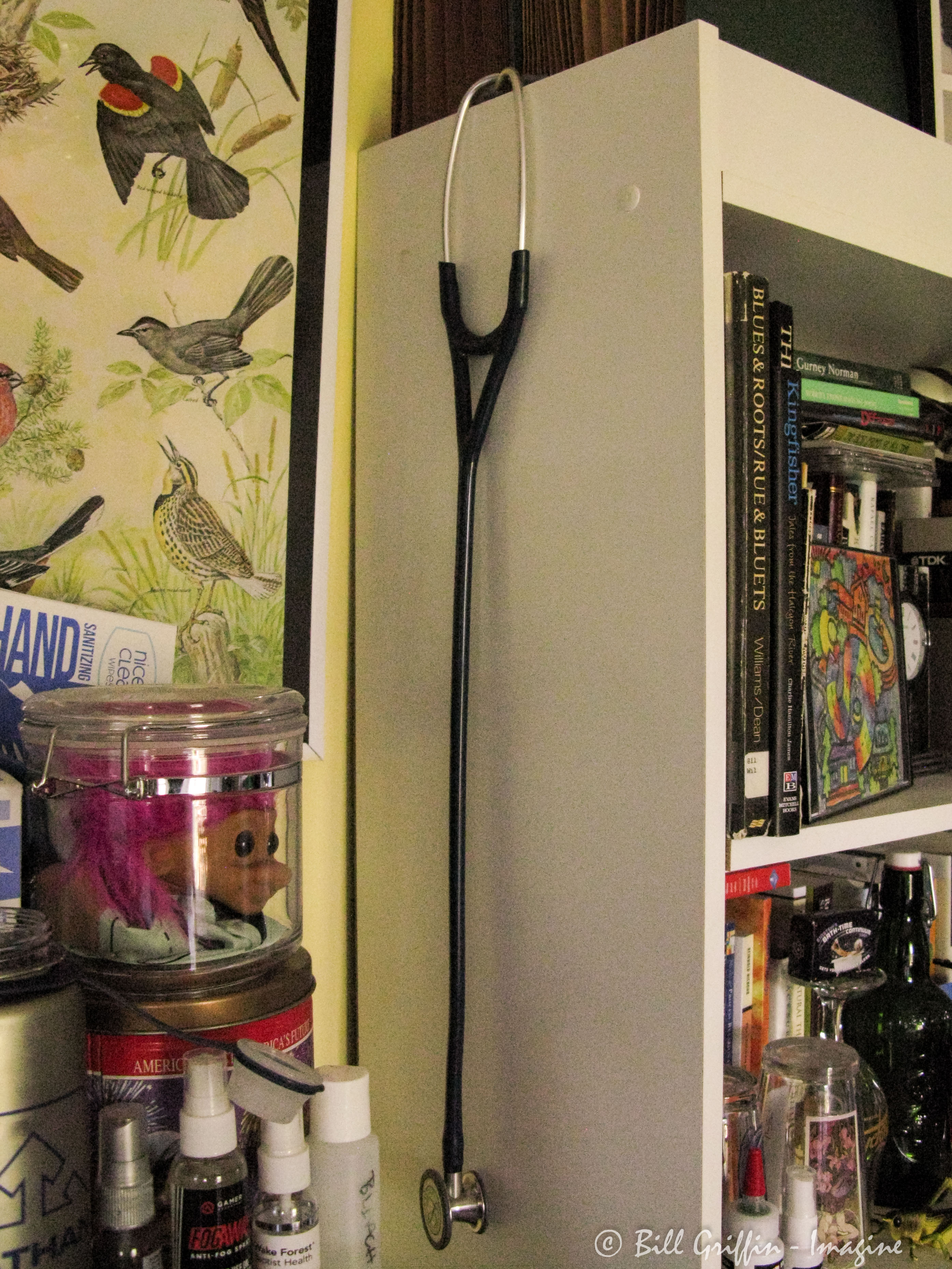
And when you finally run out of field? Wedge around and plow a parallel straight back? Or hop down, push through the hedge. See what’s waiting next field over. OK, OK enough with all this rural agronomy metaphor. It’s three years now since I, as we say, hung up the stethoscope. The anxiety dreams have settled down to just once or twice a week, or else I sleep through and don’t remember them. I passed a former patient on the nature trail last week and she didn’t recognize me. The off duty anonymity I craved for years in this little cloistered town, well, here it is. And so . . .
.
. . . I ask myself what those forty years meant. Anything? Did I do good? Did I make a difference? Does anyone besides me remember? Perfect time to open this book of poems by Dr. Jack Coulehan MD. I’ve picked it up a dozen times but laid it back down. I know his name from chance meetings in the pages of JAMA and Annals of Internal Medicine. I see that he once directed the Stony Brook Center for Medical Humanities. How does anyone make sense of anything? He’s bound to have the prescription.
.
The Talking Cure – yes, that’s it: the first hard lesson I learned and the one I never stopped relearning. Biochemistry, microbiology, pharmacology and all the rest, those were fun. Difficult and challenging, but just what I loved. What was hard, what caused this introvert to gulp and begin to sweat, was opening the door and be expected to sit down with a stranger and talk. And now I’m thinking back forty-three years, to the first week of my Family Medicine Residency at Duke: before I opened that first door to a new patient, I sat with my mentor and began to learn, not to talk, but to listen.
.
Forty years of listening. The times I failed to communicate, augured in, crashed and burned and the patient’s resultant look of anger or distrust or despair, those are all still bright daggers in my side. But the many times we connected, the moments of trust and understanding, those may not be as clarified or stark but they have left a golden glow on my western horizon. Listening is learned; listening is work; listening is an active intervention. Here comes Linda. Here comes seven-year old Amelia. There is always more listening to be done.
.
.
❦ ❦ ❦
.
Poem for David
The day you died your sheepish letter came
begging me to write Dilaudid for the pain.
On flying home – your goddamn migraines
back again. After the second bleed
your mother was as good as dead, your dad
a wreck. You begged me to forgive your sick
activities last year, frightening my kids,
bringing meth into my home. I’m clean,
you wrote, Rehabbed in the Vets for months.
.
Your drowning made the local Evening News –
a body bobbing at the rocks a quarter mile
beyond the rapids. Swimming when a seizure
took him. An accident, they said. But no.
You hated water, had never learned to swim.
Heroin, Dilaudid, meth. Your manic flight
to help the victims of explosions, earthquakes,
fires – your merciless adrenalin.
Chaos and emptiness tracked you home.
.
In our Appalachian town, I stood like wax
beside your open casket. Above you –
an arrangement of roses from a woman
names Terri. I hovered near the guttered flame
your father had become, recalling the months
you spent tending the wounded in Vietnam,
your endless shifts in hospitals back home.
I pictured forgiveness – an orchard
carpeted with apples, bruised and fallen.
.
Jack Coulehan
from The Talking Cure: New and Selected Poems. Plain View Press, Austin TX, © 2020
.
. . . . . . . .
❦ ❦ ❦
. . . . . . . . . .
The Talking Cure
+++ for David Pearson, MD
.
At eighty-one, my friend, who once was told
he’d never graduate in medicine
because his heart was tender, climbs the stairs
after seeing his last patient. For years
he’s helped a retired lieutenant examine
the slippage of his inner knots by talking.
.
We sip iced tea. They don’t teach the talking
treatment anymore. We used to be told
that words matter. Remember? He’s examined
syllables and silence as his medicine
for decades. His cheeks ravaged by the years
on steroids, twitch with dampness, and he stares
.
at melting ice cubes. He recalls the stairs
to paradise – that’s irony talking
though regret – and he’s dissecting the years
with sharp New England. wit. I never told
him of my weakness, but he knew. Has medicine
hardened his heart? I avoid examining
.
mine, not today, as we examine
the world through a kitchen window, and I stare
at Narragansett Bay, a medicine
just visible between the trees. Talking
rakes up leaves. What’s beneath? Truth be told,
neither of us has ended where those years,
.
when youth seduced us, promised. Every year
accounted for, but when I examine
my conscience – and expression that tells
a lot about my childhood – what stares
at me is gratitude, not guilt. Talking
to my friend this afternoon is a medicine
.
that pares away scarred skin, a medicine
of acceptance – his fighting for years
to be heard, the ease with which I talked
a good game – all of which we examine
with astonishment. I descend the stairs
to the door as we continue talking
.
of medicine and our examined
routes, frenetic years, a world that stares
at pain without telling while we do the talking.
.
Jack Coulehan
from The Talking Cure: New and Selected Poems. Plain View Press, Austin TX, © 2020
.
❦ ❦ ❦
.
Jack Coulehan is a Professor Emeritus of Family, Population, and Preventive Medicine at Stony Brook University, and Senior Fellow of the Center for Medical Humanities, Compassionate Care, and Bioethics. Jack graduated from St. Vincent College (BA) and the University of Pittsburgh (MD, MPH), completed his residency in internal medicine at the University of Pennsylvania and Wake Forest University, and did a fellowship in community health at the University of Pittsburgh. On the medical faculty at Pitt, he co-founded the Center for Medical Ethics and the Western Pennsylvania Ethics Consortium. Along with Marian Block, Jack developed one of the first doctor-patient communication courses required for students in American medical schools.
.
Jack’s poems and essays appear frequently in medical journals and literary magazines, and are widely anthologized. Twice a finalist in national small press poetry contests, Jack is the author of seven collections of his poems, including most recently The Talking Cure: New and Selected Poems (2020). His award-winning textbook The Medical Interview: Mastering Skills for Clinical Practice is now in its 5th edition. Jack edited Chekhov’s Doctors, a collection of Anton Chekhov’s stories with physician protagonists, and co-edited three anthologies of poems by physicians, Blood & Bone, Primary Care, and Grit, Gravity, and Grace.
.
[author bio adapted from Stony Brook University Center for Medical Humanities, Compassionate Care, and Bioethics]
.
❦ ❦ ❦
.
.
In Praise of Home
Posted in family, Imagery, Photography, poetry, tagged Bill Griffin, Fred Chappell, imagery, nature poetry, NC Poets, poetry, PRAISES, Shelby Stephenson, Southern writing on August 18, 2023| 4 Comments »
.
[with poems from Shelby Stephenson’s PRAISES]
.
The World Leads Us to the Arts and Back
+++ for Sam Ragan (December 31, 1915 – May 11, 1996)
.
How glad I am that my school helped move your hand toward journalism
and poetry and democracy with a little “d.” Cleveland High School:
This land of ours if full of schools, schools both great and
.
small; when it comes to praising them, why my school beats them all.
I’m proud you graduated from my Johnston County alma mater. I’m
sorry your family lost the farm in Granville, around Berea, Shake Rag,
.
Stem. You came to Bailey’s Crossroads, lived near Ebenezer Church,
among the Ogburns; your love of words showered acres, snuffling the
burning crosses. Hope was your story, lyric, svelte. Poverty? You
.
wrote in “That Summer”: “a wild turkey flew out of the woods / And
even if it was out of season, He fed a family for two days. / And it was
better than that mud turtle / That looked like mud and tasted
.
like mud.” I loved to walk into your office piled high with papers.
You’d peer over them, rise, jingle some change in your pocket and say,
“Well, what do you know?” “On a scale of one to five, Sam, about
.
minus two,” I’d say. Your vacations you took in your office, mostly.
Sunday mornings? When I’d drive by, I’d see your Buick parked beside
The Pilot.
.
Shelby Stephenson
from PRAISES, Main Street Rag Publishing Company, Charlotte, North Carolina. © 2021.
.
❦ ❦ ❦
.
Can a poem which is simply a list mean anything? Can a list of place names – counties and towns and neighborhoods and destinations – catch in the throat and widen the eyes? What are all these words if not the name someone has found for home?
.
Canton, Carolina, Carrollton, Carpinteria, Cary, Chapel Hill,
.
Driving south from Ohio, we exit I-77 at Pearisburg (the four-lane still under construction up the escarpment), careen switchbacks from Fancy Gap to Mount Airy, then cross the state line into North Carolina: at their first glimpse of Pilot Mountain, my parents break out in unison every time, “Here’s to the Land of the Longleaf Pine, a summer land where the sun doth shine . . . .”
.
Cleveland, Columbia, Dan, Dauphin, Durham, Edenton,
.
But I wasn’t born here. I didn’t grow up here. A couple of summer weeks in Morehead with Nana, Bogue Sound funk and fig preserves; in Hamlet, the iron bed in the back bedroom with Grandaddy’s snores, his Old Spice and gun oil; a swing past the house on Runymede near Old Salem where Mom grew up – phantoms, atavisms, only glimpses and dreams, none of them really my home. So why do the names in Shelby Stephenson’s Precedence, the introductory poem in his book PRAISES, why do they have the power to squeeze my heart?
.
Hamlet, Harnett, Highlands, Hillsborough, Huntersville,
.
Five days after we married Linda and I moved to Durham: June 20, 1974. That’s hot breath on the neck of fifty years in North Carolina and Lord how I have wanted to call this place my home! The generations of Griffins plowing fields in Union County, can they bring me home? Great-grandmother Griffin holding me on her knee in that old photo in Mt. Gilead above the dam, can she? Two kids born in Durham County General, two grandkids at Hugh Chatham in Elkin, surely they must be able. There must be something that can heal me of the apprehension that in any conversation someone may at any moment accuse, “You’re not from around here, are you?”
.
Nashville, New Bern, New Hope, Neuse, Northampton, North Wilkesboro
.
This book of Shelby’s has come as close as anything. His long and careful listing A to Z – I read and recall all the clay and sand and sod Linda and I have trod. That summer we lived in Clinton and she learned to drive. The sweet corn from his garden Dr. Murphy bestowed when I externed with him in Hillsborough. Two little kids with us on those rotations in Fayetteville, Goldsboro, Mt. Olive. Every detail of all the lighthouses climbed, of Tryon Palace, of the Town Creek Mounds, of our little patch of Blue Ridge. Hiking the state parks and greenways and nature trails in all seasons and all weathers, even Nags Head Woods in February and Roanoke Sound beginning to freeze. Years and changes and the earth moving beneath our feet.
.
Wake Forest, Waxhaw, Weaverville, Weymouth, Winston-Salem
.
Dang, I guess we are from around here. Thank you, Shelby, you who still live on Paul’s Hill in the house where you were born, thank you for opening the door that invites us all inside to discover that we’re home.
.
❦
.
After that one prefatory poem, each page of Shelby Stephenson’s PRAISES is just that – praise and homage for those who have created literature and art in North Carolina for 300 years. He begins with John Lawson (b. 1674) and George Moses Horton (b. ~1798) and ends a hundred pages later with Jill McCorkle (b. 1958) and Randall Kenan (b. 1963). Many of the poems are rooted in anecdote and personal friendship but they reach into the heart of everything that makes the writing vital. Perhaps there is no North Carolinian past or present who could have created such a treasure. As Ron Smith writes on the cover, “Shelby Stephenson does not offer lyric effusion in a neutral space; he demonstrates that Emerson’s “the mind of the Past” is best encountered through the generous sensibility of a grounded poet. . . . This volume should be in every collection devoted to Southern Studies.”
.
. . . Every form grows beauty
and impermanence, layers of voices, precise as one head, hand, face,
.
page, pen.
.
.
❦ ❦ ❦
.
Making Words Breathe Conscience
+++ for Jaki Shelton Green (June 19, 1953 – )
.
One day I went to her poetry reading.
I stole tones and breaths of her poet’s song.
I could hear Billie Holliday singing “Strange Fruit.”
I wanted to ask for mercy,
.
Undo history’s botched economics,
when the mercury’s 103 and there is
more to do with heat than trees.
.
I stubbed my toe in the room,
to doubt the river branching
blossoms, watery,
.
in Efland
running
with wild deer and rabbits,
Carolina wrens turning
oceans to hope,
a thing with hymns
and children whiling
desire, their shoes digging
ruts a flagpole schools.
.
Possums wobbled
cobbled swamps,
home of the blue-tailed hare.
.
Listen, she hears this.
.
Shelby Stephenson
from PRAISES, Main Street Rag Publishing Company, Charlotte, North Carolina. © 2021.
.
❦ ❦ ❦
.
.
❦ ❦ ❦
.
Looking for the Apple Tree
. +++ for Fred Chappell (May 28, 1936 – )
.
+++ HIS NAME that was ever used was Stovebolt Johnson and he was a short
+++ black man, heavily muscled, a chunk of a man.” (The opening sentence in
+++ the story “Blue Dive” in Moments of Light)
.
++++++++++ I
.
He loves to salute with a drink
And raise a wrinkling thumb
Towards intellection, think,
I mean, then throw all thought to some
Seeming lore a shortstop
Might snag, talking up baseball.
He can carry on about a hog-box
And make you see the hog, a Farmall
In the mix, and Pope, too,
Alexander, I mean: never would he
Name a poem for any part of the pope, though.
His work’s morality plays the wee
Canton, his stomping ground, though he left
It here and there,
For occasional sightings as allegory.
.
++++++++++ II
.
I’ve seen Lee Jones ride a bucket down
To clean out our lot-well
And to retrieve my mother’s doggie, brownie.
I read River to a bunch of students
Once and they sprouted shoots and shouts
When I danced in front of them,
Letting Virgil Campbell swear he could
Shoot the god-raging Pigeon swurging
In his pants, the yard, the rose
Garden gate, open, debris watering fast
Familiar voices gushing from a cathedral funeral,
Yet common as a mule drinking water from a trough,
.
And, lo, Fred came out with three more volumes,
Bloodfire, Wind Mountain, Earthsleep,
And I was sore surprised the tenor
Of the faces of parents and grandparents,
The children passing by, the cornered bull
.
In the pasture, all lounged animals and human flesh
In lineages for miles to keep away
The drinking Virgil put into words,
The fish slapping and sliding for lures
Snagging murmurs of drifting glasses
Shot-filled and choked with gregarious whiffs
Undoing his own talking.
.
++++++++++ III
.
In prose, essays, fiction,
Short stories, forms diction,
Multi-told tales along
Side villanelles, sestinas, you name it, Infinity, Plus One,
The scattered debris of chewed billy goat wads,
the cuds of cows on the Blue Ridge, the lows
Murmuring indolence dependent
On freedom he lends
To every piece, hails,
Then takes on the world again and nails
A greeting the page spans – he makes me laugh right out and smile
Aslant at rhythms working syllables mile by mile
Until haints themselves
.
wallow down beside me, as if to say,
Goodnight, Somewhere, there’s a beyond
The world’s engine dawdles:
The raised fist for freedom
Shines humor for consolation;
Wanting not to be bored, the Muse of Music
Surprises him with more news,
A book of verse, collection of stories, another novel.
Universes, constellations, – lower
Shoals for minnows fanning
Swirling apple blossoms bedding
.
Shelby Stephenson
from PRAISES, Main Street Rag Publishing Company, Charlotte, North Carolina. © 2021.
.
❦ ❦ ❦
.
Shelby Stephenson earned many awards for teaching during his long tenure at UNC Pembroke, where he also edited Pembroke Magazine and raised it to national prominence. He served as Poet Laureate of North Carolina 2015-2018. Recent books: Possum (Bright Hill Press), winner of Brockman-Campbell Award; Elegies for Small Game (Press 53), winner of Roanoke-Chowan Award; Family Matters: Homage to July, the Slave Girl (Bellday Books), the Bellday Prize; Paul’s Hill: Homage to Whitman (Sir Walter Press); Our World (Press 53); Fiddledeedee (The Bunny and the Crocodile Press; reprinted by Press 53); Nin’s Poem (St. Andrews University Press); Slavery and Freedom on Paul’s Hill (Press 53); Shelby’s Lady: The Hog Poems (Fernwood Press). He lives at the homeplace on Paul’s Hill, where he was born.
.
Author Clyde Edgerton says of Shelby: “He writes poems that skin raccoons, sweeten the pot-likker, shine through the window, and sing like a gold and silver bird. I’m lucky to know the boy.”
.
.
❦ ❦ ❦
.


[…] About […]