Feeds:
Posts
Comments

Archive for March, 2023


[with poems by Stan Absher, Kathleen Wakefield, Bill Griffin]

How does science work? What does it mean for me to think scientifically? I notice something (empirical observation); I draw a conclusion (hypothesis via inductive reasoning); I check it out (experimentation, testing the hypothesis); it doesn’t all hang together so I try again, maybe noticing a little more closely (refining the hypothesis).

That final bit is the kicker. Even scientists can be seduced by their theories. Scientific knowledge, however, is never fixed and final. The most beautiful deduction can be proven false by the more precise observation. A posteriori trumps a priori. Anyone can be wrong.

The Naturalist Method is a subset of the Scientific Method. When I lead a nature hike, I advise folks, “Pay attention . . . ask questions . . . make connections . . . share.” And I am not the least bit shy about announcing that I myself don’t know everything. Not knowing (but wanting to!) is my defining characteristic. Semper Plus Discere – Always More to Learn. Bring books!

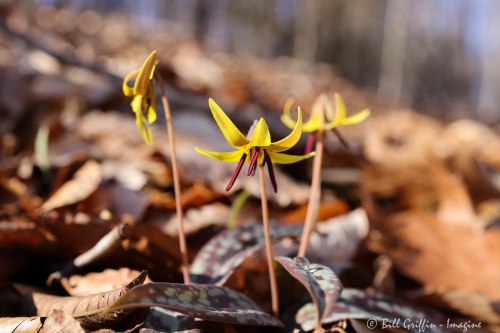
Which bit me on the butt a few weeks ago. For years I’ve walked a little section of trail where trout lilies carpet the banks every March. The first time I saw them – mottled fish-scale leaves, bright yellow recurved tepals, pendulant maroon anthers – I opened my trusty old field guide and confidently proclaimed, “Yellow Trout Lily, Erythronium americanum.” Firm, final, and correct. Never even gave it a second thought until this spring, when I decided to photograph some prime specimens in my SEEK app to add to my iNaturalist log. Click. Searching. Erythronium umbilicatum flashes up on my screen. No, no, that’s not right. Just shot ‘em from the wrong angle, try again. Every flower, every time the same – Dimpled Trout Lily.

When I got home I tore open my newer guides and references and discovered this: some thirty years ago taxonomists split the one species into two. And this: of the two, Dimpled is by far the most common in the foothills where I live. So how do you tell them apart? After a couple of hours on the NC State plant science websites, and after tracking down online photos (which I ultimately determined were mislabeled as americanum 52.3% of the time) I had my armamentarium. Back to the woods, this time with a hiking group I enlisted to find all the Trout Lily they could, especially ones gone to seed.

And what we observed was this — if still in bloom, no auricle (“ear”) at the base of the inner tepals; if gone to seed, a distinct dimple at the end of the ovary, and often lying prone on the ground. Every dang plant we found was Erythronium umbilicatum. I stand humbled and corrected.

But here is another observation to add to the guide books. Yellow Trout Lily is described as holding onto its style, still attached to the ovary after forming seeds. Many, even most, of the Dimpled we found also retained their style. Maybe we’ll come back in a week and observe again. Maybe notice a little closer.

❦ ❦ ❦

Heifer

Destined for slaughter
she wades into the water
to the belly and drinks deep.

Does she see her own sad eyes
wide and innocent in the pool
looking up out of the sky?

Soon fear will make her bellow,
but now her muzzle is cool
and wet. Her skin twitches,

scattering flies; her switch
brushes them off. Across the water
she sees a pasture

she will never graze
a clump of trees
that will never give her shade.

J. S. Absher
from Visions International #107, Black Buzzard Press, © 2023 Visions International Arts Synergy

Erythronium umbilicatum

Erythronium americanum

❦ ❦ ❦

Thirty or so poems in a modest package; writers from Europe, Asia, the Americas; no page numbers but a few hand-drawn illustrations – all this and a remarkable meditative companionability create the magic of each issue of Visions International. I ask myself how editor Bradley R. Strahan manages to pull me into these pages so warmly. Some insistent human voice calls us, the readers, to encounter distant circumstances and experiences and realize they have become close, familiar, our own. How has Brad, through the decades, made this so?

My friend Stan Absher suggests: Because he often publishes poets over a long period of years, Bradley’s readers can get to know some poets rather well. I’ll mention only the late Michael Mott (he died in 2019) and Nikolaï Kantchev, a Bulgarian poet who died in 2007 and whom Brad continues to publish in translation, but there are several others.

And Kathleen Wakefield, after reading Issue #107, commented this to Bradley: I love the cadence of these poems, their subjects and very particular visions, language that skewers you or lures you in. Some are simply magical to me, others have the strangeness and dark absurdity, fused with love, that points me back to Simic, one of my favorite poets. So glad you honored him and are always including poets from other parts of the world who write of something vital at stake. All of these poems jar me out of my usual forms of speech. That is a very good thing. It’s not just mental; the heart is altered.

I am honored to appear in these particular pages with two friends I’ve come to know through shared poetry, Stan Absher and Kathleen Wakefield. As I continue to read each issue of Visions, my circle of companions expands.

Subscribe to Visions International. For four issues, mail $25 to:
Visions International / Black Buzzard Press / 309 Lakeside Drive / Garner, NC 27529

❦ ❦ ❦

Summons

1.
I am practicing my lying down
beside the stripped spines of jay feathers,
the azures unwinged, seed heads gone to must
and rot, bones of mice cradled in mycelia
tangled and ghostlike.

I am asking the names of wildflowers to ease me into sleep,
saying them over and over, Bloodroot, Evening Lychnis,
Celandine, Enchanter’s Nightshade, Coltsfoot,
Wood Groundsel dissolving
on my tongue.

The faces of those gone before me rise up,
and those I will leave behind, my children
far flung as seeds carried by wind
and pelt and rain.

2.
Go ahead, let the dankness of earth
seep into your thighs, let dust
silt your lungs, your spine
crack like river ice

but the mind pulls you back up through snake skin and mist,
through dry creek and river bed to the trees’
green asylum, rain smacked leaves
waking you to the body’s arterial hum.

Get up while you can, full of your hunger and regret.
Get up from your knees. Taste
what you are, cloudburst, mud, burnt grass,
words buried in iron, bone, lips, and breath,
in this sorrow and honey,
this skin and ash.

Kathleen Wakefield
from Visions International #107, Black Buzzard Press, © 2023 Visions International Arts Synergy

❦ ❦ ❦

Albedo

Rare to discover you
+++++ aloft in the afternoon
your eye so blue
I can see right through
+++++ the curving edge of sight
and your face so bright
+++++ I believe the fire
of your glow must burn
within – but no,
+++++ reflected whole
where you hang on the arm
of your golden man.

Bill Griffin
from Visions International #107, Black Buzzard Press, © 2023 Visions International Arts Synergy


❦ ❦ ❦

EARTH SCIENCE: Albedo is a measure of how much light is reflected by the surface of a planet or moon; an albedo of 1 means all light is reflected; an albedo of 0 means no light is reflected – all light is absorbed by the surface and it will appear dark. The albedo of the moon is 0.12, pretty dark as celestial bodies go. Saturn’s moon Encedalus has an albedo of 0.99 due to its covering of snow and ice.

The albedo of Arctic ice is much higher than the albedo of open ocean. As more of the Arctic becomes ice-free in summer, more light (heat energy) is absorbed by the darker water. This has produced a positive feedback loop so that the Arctic is warming much faster then the remainder of the planet.

PLANT SCIENCE: The female reproductive part of a flower is the pistil, composed of the ovary (containing the ovules), the style, a slender column projecting up from the ovary, which is tipped by the stigma. Pollen lands on the stigma and sprouts tubules down through the style to fertilize the ovules and produce seeds. Of the 450+ families of flowering plants containing more than 260,000 species, each contributes its own variation to the configurations and shapes of flower, pistil, and stamen, and the strategies for insuring that pollen and ovule meet.

When the outer whorl of structures on a flower can’t be sussed out as sepals or petals, the blades are often called tepalsSepals are the outer whorl that cover and protect the bud and petals are the inner whorl, usually colored to attract pollinators. Especially in many members of the Lily family, Liliaceae, the two layers merge or fuse; the term tepal was compounded to describe them.

❦ ❦ ❦

2020-09-08b Doughton Park Tree

Read Full Post »

[with 3 poems by Richard Widerkehr]

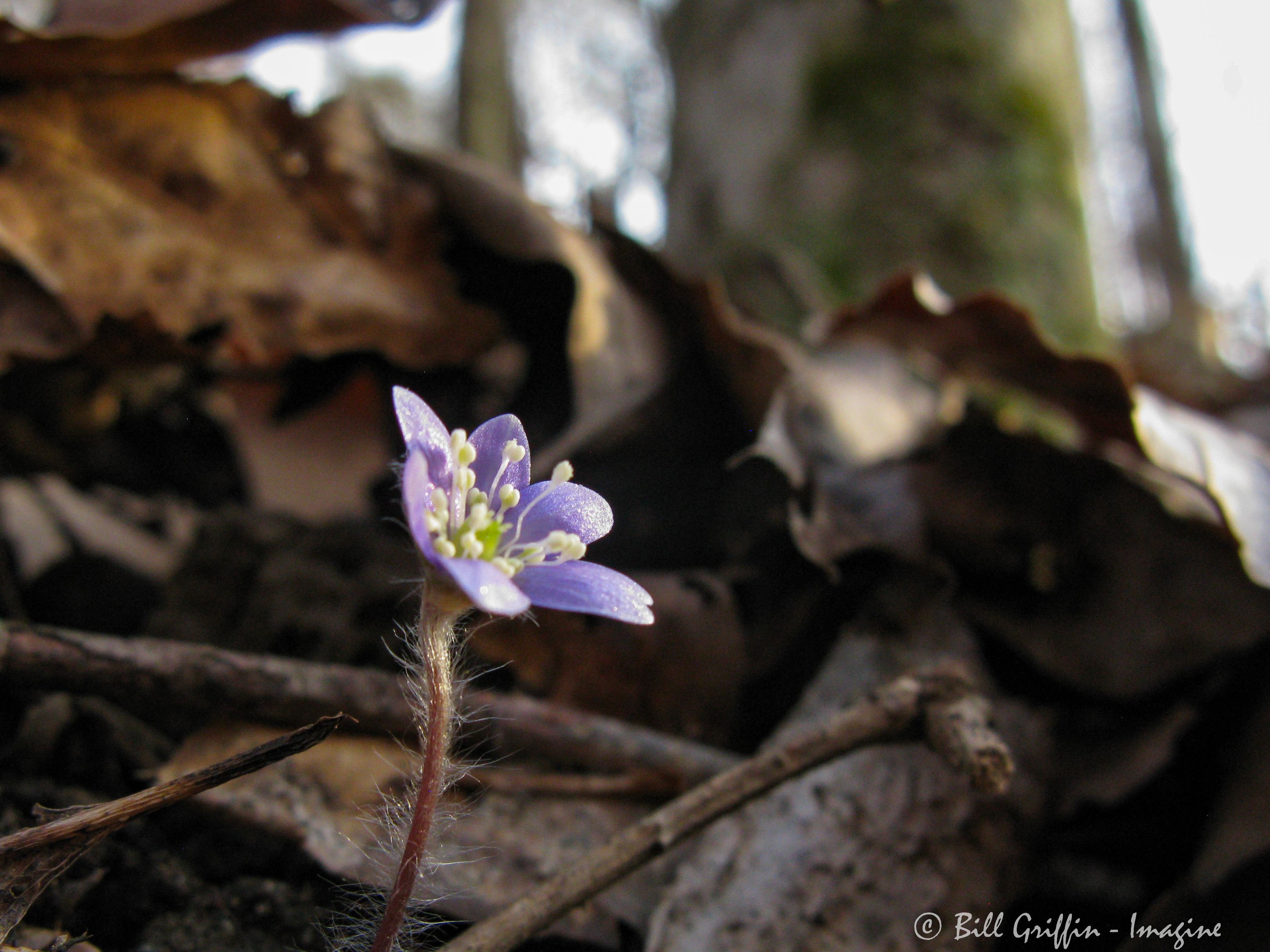
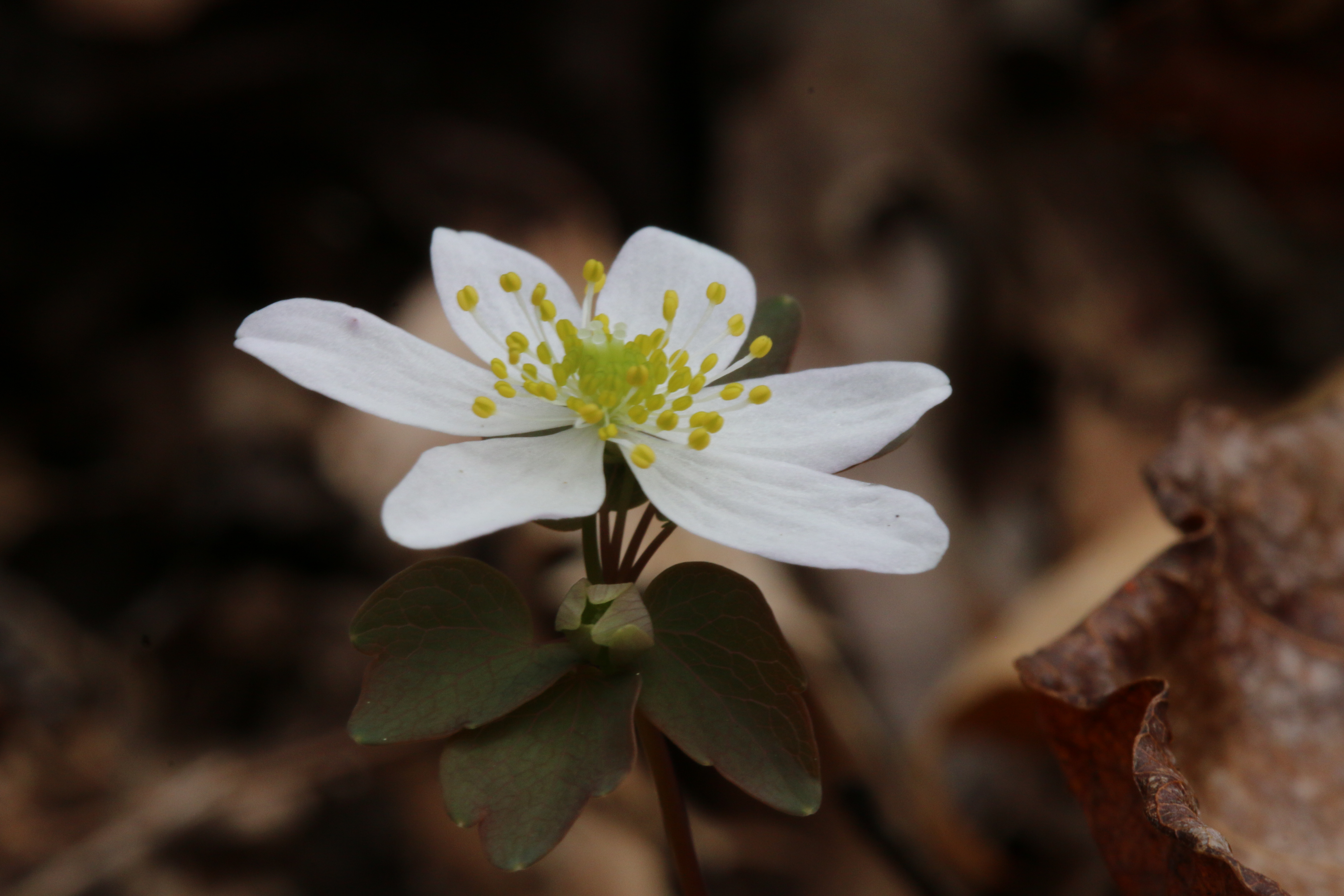
Cold March drizzle makes Hepatica nod and droop. Nevertheless, the twelve accompany me undaunted on a naturalist hike along Elkin Creek. What will we discover? Here are the last few Hepatica blossoms of the year; their sister plant opened her first bloom along this trail on February 7, five weeks earlier. Now a single flower on each silky hairy scape looks down at its feet, the winter-pocked liverleaves also fading ahead of summer’s foliage. It’s cold this morning and the vernal equinox is still three days off.

But cheek by jowl with old Hepatica are fresh patches of its second cousin, Rue Anemone. No drooping at all! Both from the same family (Buttercup, Ranunculaceae), the two flowers share many features and from a distance look similar – our crew’s task is to learn to tell them apart. Both are easily overlooked, pale blooms only a cm. or so in diameter, with 6-10 petals and a jostle of stamens crowding multiple pistils clumped in the center. Even color is not a reliable clue: the pale Hepatica in this neutral soil is only one shade of lavender removed from Anemone’s white. Rue Anemone’s smooth slender flower stem is one giveaway, and then of course the leaves, Anemone’s fine clusters like little paws climbing toward the bloom, contrasted with Hepatica’s broad, basal, waxy lobes, each like a liver. What some might casually mistake for a clump of sameness, in haste undifferentiated, what we ourselves might at first glance have misidentified have now become familiar, individual: each uniquely itself.

❦ ❦ ❦

A Sabbath of Complete Rest

I’ve been thinking what that might mean, so I listen
to the wind in the fir trees outside our red house –
how the trees stand almost like horses asleep on their feet,

how their roots touch crevices in soil, how at night
their branches, blacker than the sky, must not forget
yellow forsythias, summer, their own dark needles,

how they wait, how they’ve waited. This is no psalm
of light, Chloe, no song of white horses in the sun.
The root of the word Shalom means complete.

Richard Widerkehr
from At the Grace Café, Main Street Rag Publishing, Charlotte, NC, © 2021

❦ ❦ ❦

How does a poem draw you in? How does it invite you to live in the world it creates? Place must be one way. Just a few pages into At the Grace Café, I realize I’m damp and about to shiver in the Pacific Northwest. Not that it’s raining absolutely all the time – the great dark firs lifting their heavy sleeves also propel me into the landscape. A trail through clouds and mist leads me. A swirling lake shore is mysterious and at once consoling.

Personality is another thread that weaves through these poems and entangles me: the writer’s sister, her mental illness an elusive and threatening animal that speaks wild into every situation; his mother, reminding us that each of us must live a portion of our lives in denial; and the personality of the writer himself, illuminated by recurring heartbreak in his work as counselor and by longing for stability and resolution. Personalities approach and retreat, promise to reveal just as they again withhold – all I can do is hold on and join the dance.

Finally there is joy. Not waiting beyond all conflict or at the conclusion of all sorrows, rather joy that emerges from and lives within these troubles that we all, confess it, share. A fleeting moment with one’s beloved, a brief lifting of fog, moon on snow – a simple singular presence can form us into fellow sojourners. The poem can make us family. The poem may grant us grace.

❦ ❦ ❦

Pay Attention, You Say

No, I haven’t read updates about the orca
+++ nursing her dead calf. I try not to get
upset about too many things. Lately,

I write these poems for my sister –
+++ I can’t spare the least insect or angel,
she says. Yes, plankton lined with oil

covers some sea beds. I’ve seen orcas
+++ breach the surface, black and white,
their bodies like mountain sides

sliding under. When we were kids,
+++ my sister and I caught a tiny fish –
she cried, and our mother threw it back.

Yes, there’s the sadness of plankton,
+++ the orcas, snow fields at night.
Last evening on this mental health unit

where I work, a patient I’ll call Carla –
+++ she’d cut her left wrist – she said,
Some scars are mercy and justice.

I let out my breath. At least my sister
+++ no longer sleeps with the moon
in her cardboard box. Now

you point out two otters on the bank
+++ of No Name Slough, how they
their small black eyes on us.

Richard Widerkehr
from At the Grace Café, Main Street Rag Publishing, Charlotte, NC, © 2021

❦ ❦ ❦

Crane Flies
O for a Life of Sensations rather than of Thoughts! – John Keats

In late August, the crane flies
come back, nervously feeling their way
up windows, trying to get out. They flutter
like huge, scatter-brained mosquitoes,
scraping this way and that, sometimes just
hanging as they flex their long
front legs like feelers, emitting
a dull, frustrated buzz.
++++++++++++++++++ Is it light
they want, the world outside?
They can’t get used to glass, its cool
way of whispering about the uselessness
of struggle, also its dry comments
on their death flights.

Each time I sweep these nutty insects
out the window, more fly in, as if
I were the absence they brush against,
their life of sensations
come to an end.

Richard Widerkehr
from Disappearances, The Wind Room Series #4, Radiolarian Press, © 1996, 2003

rue anemone

❦ ❦ ❦

Richard Widerkehr has a new book from Shanti Arts Press, Night Journey. Richard has taught writing in the Upward Bound Program at Western Washington University and has worked as a case manager for the mentally ill.

❦ ❦ ❦

IMG_0880, tree

Read Full Post »

Archetype

[with 3 poems by Michael Hettich]

Linda keeps a little book beside the bed, a dictionary of Jungian dream archetypes. If she awakens from a dream of an elf, that could mean she’s searching in her conscious life for a guide for her soul. If dancing, maybe she’s expressing joy or sorrow in her role as woman. Leafing through the pages, I have to admit I notice many mundanities wandering through our normal days – dirt, a flock of birds, hiking in the forest – that when they appear in dreams basically translate into one simple message: we’re anxious about something.

No surprise, I suppose, that after I first retired from medical practice my dreamlife erupted with vivid and unrepressed energy. I had spent 8 or 10 hours a day in pretty focused cogitation for some forty years, and my subconscious was now frantically trying to re-engage the clutch. But the content! I’m at the office or the hospital but everything is off-kilter, out of sync. I can’t get from here to there. I can’t find the patient I’m looking for, or make the connection I need, or get someone to listen. Every morning I remember the dreams and struggle to imagine what they might have to do with my conscious life.

Conscious life, what a concept. Homo sapiens sapiens, man who thinks about thinking. How many hours in every day pass by without me giving them much thought, even though an observer would say I was nominally conscious? Yesterday I suddenly remembered that I wanted to know what the heck is alfalfa, anyway, and an hour of reading later I’d become the alfalfa-meister. Perhaps it would have been more useful, at least for a minute, to ask myself why I wanted to know about alfalfa (which is a member of the Pea family, Fabaceae, originated in ancient Iran 2,500 years ago, and whose name in Arabic means horse food). What I choose to think about, and why, must be formed from my inner identity even as it forms my identity.

And what about dreams? Are they created from our consciousness, or do they create our consciousness? I still have one of those work dreams about twice a week, and often, just when I have been able to complete some task, I’ll suddenly tell myself, “Wait, you don’t have a medical license any more,” and I wake up sweating. What is the object of this subjective? I could make a long list of all my actual daily challenges and try to connect the symbolic dots – loss of control, weight of responsibility, nagging uncertainty. Could it even be existential anxiety about my true identity?

Perhaps the dream is just trying to say, “How about if you just slow down for a minute and simply think about this.”

❦ ❦ ❦

Constellation

1.
Before we start shooting salt into the sky
to cool the planet and cloud our days,

perhaps we should simply
sit down in the shade
with stories – of moons that break open into flowers,
of foxes that sleep at the foot of our beds
to keep our feet wild. And before we start dreaming

floating cities adrift on a rising
ocean, perhaps we should undress ourselves
of who we’ve become, slip out of the habits
we’ve devised to feign our innocence, and swim
out into the deeper water

until whatever’s still phosphorescent
within us glows like small constellations
beneath which the huge, warm-blooded swimmers,
with minds and memories, and songs that might teach us
new ways to hear, are moving through the darkness.

2.
Imagine the feel of their huge backs rubbing
against our pale feet, as they move on through the night.

Michael Hettich
from To Start an Orchard, Press 53, Winston-Salem, NC, © 2019

❦ ❦ ❦

In each of Michael Hettich’s poems, I amble through a dreamlike landscape of the obvious, the mysterious, the unfathomable. Familiar characters behave in unexpected ways; they transpose and reform and suddenly I’ve arrived in an entirely new space. It is scary when the parents strip naked and slip into the skins of horses, then walk gaunt and slack into the field, but when you ride them bareback you remember who they are by the feel of your small legs around them. There is happiness in wailing on even when no one is listening. “In a room of rubble and brittle light, / I suddenly know things I’ll never understand: / each moment is an animal, leaping sunlight / to give us these bodies.”

To Start an Orchard is a work of unrepressed imagination and deep inner exploration. Be guided by the archetypes. The window is for seeing out of and looking into but must become a door before one can walk through. Trees and grass, things grow without your direction into what you most need them to be. And love, it may be unreachable as birds gone from the trees or turning to dust in a spider’s web, or it may be a feather dreamed in the egg and growing into flowers.

Something that is hard to grab and hold may still be possible to grasp and feel. These poems climb and fall and turn but without a lurch – I never fear being thrown clear. Where there is bleeding there is also healing. I look about and for a moment I don’t recognize my surroundings, but I find myself saying, “Yes, yes, this is just as it should be.”

❦ ❦ ❦

To Start an Orchard

Whatever silences we’d always maintained
we continued to nurture, like the fruit from a landscape
that was foreign to us, even after all these years,
a fruit we weren’t sure whether to peel,
cook, or eat raw, kept on our windowsill
until it had withered and was somehow
beautiful, like a curiosity we’d collected on the beach
that reminded us of journeys, fathomless depths,
and yet was just a piece of fruit, desiccated and black,
curled like the pit of a dream, or a nut.
And so, when you spoke, or tried to, a small plant
emerged from its folds and darkness, delicate
and proud and needing to be watered until
it could be planted outside. I could already
hear the birds singing from its wilderness of branches.
I was already humming to the buzzing of its bees.

Michael Hettich
from To Start an Orchard, Press 53, Winston-Salem, NC, © 2019

❦ ❦ ❦

Starting from Sleep

+++ She tells me our bodies are nets dropped into
the ocean. And when they are pulled up, the minnows
are spilled out to flip-flop and strangle.

+++ And then we are tossed back over, to dream:

+++ +++ I talk, she says, to my great-great-grandchildren
+++ +++ +++ by treating all things with whatever compassion
+++ +++ I’ve drawn from the grace I’ve been shown. And those children
+++ +++ +++ +++ thank me, and dream of being born.

The wild parts of everything are disappearing everywhere.

+++ +++ +++ +++ Wood grain faint fingerprint
+++ +++ +++ +++ +++ pores eyes blue breathing
+++ +++ +++ +++ wind dust mind afternoon
+++ +++ +++ +++ +++ tide lips +++ and sudden flowers.

Michael Hettich
from To Start an Orchard, Press 53, Winston-Salem, NC, © 2019

❦ ❦ ❦

Doughton Park Tree 2020-11-22


Read Full Post »

Older Posts »