Feeds:
Posts
Comments

Posts Tagged ‘Southern writing’


[with poems by Joseph Bathanti]

In my post of May 20, I wrote this: Green is God’s best idea.

I wasn’t kidding. None of us would be here without green. Slugs, snow leopards, billionaires, and all the rest of us, we only have being by the beneficence of creatures that can turn sunlight into sugar.

I expected a rebuttal, however, to the best idea position. Wait, isn’t Homo sapiens God’s best idea? Humans, are we not the pinnacle? To have dominion over all (some would say dominance)? Do grey wolves and groundhogs even have souls? Not to mention old growth hemlocks?

Perhaps we humans, with our large and complex brains of which we are so proud, are the only creatures that have evolved an awareness of God’s presence. Perhaps, though, all other creatures live their every precognitive moment within that enfolding perfect presence. Perhaps we have yet to attain the harmony of oneness which must be every creature’s reason for being – perhaps grey wolves and ground hogs are born into it.

The LORD God took the man and put him in the Garden of Eden to work it and take care of it. Genesis 2:15 (New International Version)

Here’s a good idea: Perhaps each one us, almost nine billion now, might consider one way we can contribute to the loving care we take of this single known planet in the cosmos which harbors God-aware organisms.

The contemporary ecological crisis, in fact, lays bare precisely our incapacity to perceive the physical world as impregnated with divine presence. We have swapped the lofty vision of the physical world as God’s own abode, sanctified by the incarnation of the Son of God, with the one-dimensional mechanistic outlook of modernity. Father Joshtrom Isaac Kureethadam

The tree which moves some to tears of joy is in the eyes of others only a green thing that stands in the way. Some see nature all ridicule and deformity, and some scarce see nature at all. But to the eyes of the man of imagination, nature is imagination itself. William Blake

To me, to worship God means to recognize that mind and intelligence are woven into the fabric of our universe in a way that altogether surpasses our comprehension. Freeman Dyson

Look at the animals roaming the forest: God’s spirit dwells within them. Look at the birds flying across the sky: God’s spirit dwells within them. Look at the tiny insects crawling in the grass: God’s spirit dwells within them. Pelagius

Nature is trying very hard to make us succeed, but nature does not depend on us. We are not the only experiment. R. Buckminster Fuller

❦ ❦ ❦

April Snow

The grass whelps in biblical mien –
mowers spend themselves –

a writ of greenest green,
spangled in sunbursts,

as if Van Gogh decided on
the remnant petrified thistle,

the first violets at his feet,
and painted Billings’ meadow.

Robins pompously swagger.
Swifts (little crosses)

jet above them. Birdsong.
Frog-song. Early spring

by habit exaggerates itself,
the green a blinding recognition.

To the ridge mount pines and firs.
Ancient hardwoods swell

by the day with bringing forth.
Blackberry whip the swales,

its cane shrove-purple
from the long winter.

In Sugar Grove, daffodils worship
on the abandoned Ruritan diamond.

Bases bleach in the dirt.
Home plate is a pentagon.

It forgets nothing.
Life is more than fable,

but never stops stunning earth.
And so: hushed clouds, sheepish,

sheep-shaped, yet foretold,
slip over Snake Den Mountain.

Their shadows blanket the valley floor.
The snow they release is inevitable.

This is how we must think of it –
inevitable – how we must welcome it,

the white behest of silence,
the green beneath it jade, milky.

Joseph Bathanti

❦ ❦ ❦

April Snow and Floyd County, Kentucky are from Joseph Bathanti’s new book, Light at the Seam (LSU Press © 2022). The poems are about Appalachian coal country, its people, its deep spirit, its devastation by the mining practice of mountaintop removal. Many are inspired by photographer Carl Galie’s exhibition Lost on the Road to Oblivion: The Vanishing Beauty of Coal County and these lines are deeply visual and sensual. Joseph’s language is earthy and exalted; it synergizes with his intimate observations to make us reverent participants. Care for the earth as your beloved; enter as an acolyte into this tender presence; discover, deep within, light at the seam.

❦ ❦ ❦

Floyd County, Kentucky

No lintel to speak of,
but a chicken wire screen
door hinged on twelve-inch

block and lattice, jittering,
wind chimes knelling,
each time a charge grunts –

off-thunder rumbling the hollows.
The masonry had been sound;
shock split the seams: gashes

of mortar where it’s been repointed,
caulked sashes.
Number 2 pine gone ashy, fixing

to rot; the dooryard
held in a brazen of peonies,
rickety picket once-white

to corset them, pink-red
like the font in Luke
where Jesus says to John:

. . . the Son of Man hath not where to lay His Head.
Just inside hangs a woman’s shawl,
slick, see-through as onion skin;

maybe it’s parchment,
scrivened in bodement,
the letters gone to blood.

It can drive you to your knees:
how folks set out flowers
and look upon the earth.

Joseph Bathanti

❦ ❦ ❦

❦ ❦ ❦

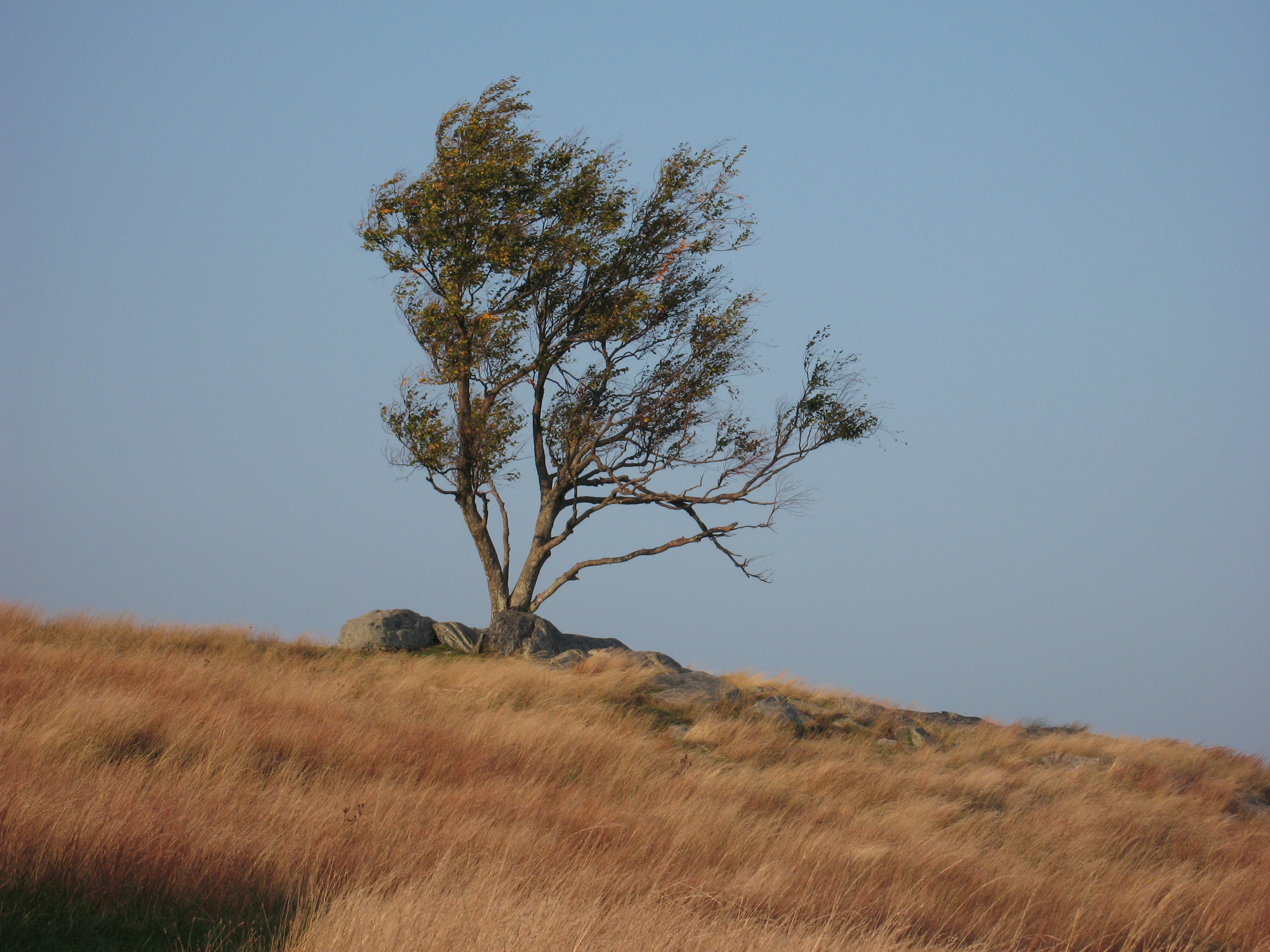
Doughton Park Tree, 2022-05-17B

Read Full Post »

[with 3 poems by Gerald Barrax Sr.]

Next month I’ll be leading a couple of nature walks for our local trails association. My fellow naturalists-for-a-morning – as we enter the world of trees and ferns, birds and bugs, what special guidance shall I give you? I’ll mention the primary tasks of the naturalist – notice; ask questions; make connections – but what might make our small journey together even more personal and meaningful?

I think I’ll say, Let’s be slow to name things. Yes, we are each going to encounter some things we recognize. We will also each see or hear or smell something unknown, maybe an odd shaped leaf, a bird call, a pungent mushroom. Either way, may we allow everyone to fill their senses with the thing, share the encounter, before we speak its name.

Am I correct in this: once I give something a name do I stop noticing it as fully? I end my close attention, my exploration of its flower, its leaf. I quit asking myself, What does this remind me of? What is this like and what is it not? I’m done. I’ve finished wondering.

Let’s be slower to name things. Let’s extend wonder as long as we can. Wonder is why we’ve come here.

On the other hand, working together to figure out something’s name is bonkers. As in, we share a crazy laugh when we’ve done it. Yesterday Linda and I visited the NC Zoo with our daughter and her family. All day and many miles of walking through Uwharrie forest to visit Africa and North America with a four-year old, what a blast.

Late afternoon SIL Josh and I lagged behind Linda, Margaret, and Bert – we’d heard a very unfamiliar bird call in the canopy and were craning our necks. Sort of a half-hearted cluck framed by a sharp tik or two fore and aft. I’d been listening to birdsong CDs and it kind of reminded me of the hiccup of Henslow’s Sparrow. Nah, super rare, plus completely wrong habitat. Then we caught a glimpse – way bigger than a sparrow or warbler, long bill, yellow all over.

A female summer tanager! High fives. Yeah, we were a little slow but we worked it out together. Totally bonkers. Or maybe not.


❦ ❦ ❦

To Waste at Trees

Black men building a Nation,
My Brother said, have no leisure like them
No right to waste at trees
Inventing names for wrens and weeds.
But it’s when you don’t care about the world
That you begin owning and destroying it
Like them.

And how can you build
Especially a Nation
Without a soul?
He forgot that we’ve built one already –
In the cane, in the rice and cotton fields
And unlike them, came out humanly whole
Because our fathers, being African,
Saw the sun and moon as God’s right and left eye,
Named Him Rain Maker and welcomed the blessing osf his spit,
Found in the rocks his stoney footprints,
Heard him traveling the sky on the wind
And speaking in the thunder
That would trumpet in the soul of the slave.

Forget this and let them make us deceive ourselves
That seasons have not meanings for us
And like them
we are slaves again.

Gerald Barrax Sr.
from Black Nature: Four Centuries of African American Nature Poetry, Edited by Camille T. Dungy, © 2009 University of Georgia Press, Athens GA

❦ ❦ ❦

As I recently began reading Black Nature I stumbled through the sections at random until I happened upon a name I recognized – a name may be an anchor or it may become a sail to catch the wind. I followed the guyline of Gerald Barrax through all the pages it touched. Lines so rich, so provoking and impeaching, I can’t be the same after reading.

Gerald William Barrax, Sr. (June 21, 1933 ~ December 7, 2019) was the first African American professor at North Carolina State University, a Pulitzer Prize nominee, and winner of the North Carolina Award for Literature. Other awards include the Sam Ragan Award and the Raleigh Medal of Arts. In 2006 he was inducted into the North Carolina Literary Hall of Fame. His teaching career at NC State spanned 27 years and he served as the editor of the Black literary journal Obsidian.

I’ll be sharing more poetry discoveries from this amazing anthology as I continue my explorations.

❦ ❦ ❦

What More?

My lawnmower has awakened the resident god of my yard
who rugs its leafy hand in anticipation
of troubling me again with one of its cruel koans,

this one a small bird dropped
from the sky, or thrown out,
out of the sweetgum tree

where I was cutting
that long triangle of grass outside
the back fence: put there

when I wasn’t looking, it lies
on its back twitching half in and out of the swath
I cut a minute before.

I’m being tampered with again,
like an electron whose orbit and momentum
are displaced by the scientist’s measurement

and observation. If I’d found something already stiff
and cold on the ground
I’d have kicked or nudged it out of my path:

but the just-dead, the thing still warm,
just taken its last breath, made its last
movement, has its own kind of horror.

I leave the small patch of uncut grass around it.
Back inside my enclosed yard
I see a brown thrasher come and stand over the body,

with some kind of food in its bill.
(I was careful to say “bill” and not “mouth.”)
By the next time I cut myself around the yard,

I see the thrasher sitting on the fence above the still dead,
still holding whatever it has in its bill. I’ve described
it all accurately. What more could anyone expect of me?

Gerald Barrax Sr.
from Black Nature: Four Centuries of African American Nature Poetry, Edited by Camille T. Dungy, © 2009 University of Georgia Press, Athens GA

❦ ❦ ❦

I Called Them Trees

The last time
+++ +++ +++ I went to the library
I looked at the flowers
surrounding the statue of Steven Collins
Foster and the old darkie ringing
+++ the banjo at his feet
+++ +++ +++ +++ +++ :flowers planted
in four triangular beds
alternating red and white.
I saw they were all the same kind.

There were others
+++ +++ +++ +++ in front of the building
in long wide rectangular rows
bordered by round clusters of pastel green
and white that were too deep, too dark
+++ red, maroon, for easy images
+++ +++ +++ +++ +++ +++ :I called

them all flowers.
And the stunted trees I
wished I had known, bending over the green

terrace above the flowers
+++ like women whose faces
I couldn’t see washing
their hair in deep green pools, I called
trees. If I had told you would you
+++ had known them?

+++ +++ +++ +++ +++ +++ There were
flowers for me. There
were trees. There were kinds
of birds and something blue
that crouched
+++ +++ +++ in the green day waiting
for evening.
If I had told you would
you have known?

I sat
+++ on a bench among flowers
and trees facing
the traffic +++ surveying all

I knew of impalas, cougars, falcons
barracudas, mustangs wild
+++ +++ +++ +++ +++ +++ cats,
marlins, watching cars
go by. +++ I named them
+++ all.

Gerald Barrax Sr.
from Black Nature: Four Centuries of African American Nature Poetry, Edited by Camille T. Dungy, © 2009 University of Georgia Press, Athens GA

❦ ❦ ❦

Doughton Park Tree 4/30/2022

Read Full Post »

[with 3 poems by Joanne Durham]

As my years advance does the bowl of my life become deeper, wider, more capacious? Joanne Durham’s new book of poetry from Evening Street Press has me reflecting, and not least because of its title. Events, experiences, memories fill the bowl; when I return to the bowl and drink I discover that the more I refresh myself the more the bowl fills itself. And me. Never emptied, always replenished. As Joanne reminds us with this opening quotation by Naomi Shihab Nye: Maybe if we re-invent whatever our lives give us we find poems . . . .

Certainly. If you are a poet the bowl of memory will give you a poem. If you’re an artist, a painting. If a novelist, a houseful of spicy characters, no doubt. Writers intentionally revisit the milestones and landmarks of the past like a traveler trying to find their way back home after a long absence. Or like a possum in the compost heap convinced there are tasty bits concealed there.

But if I am simply jotting down recollections for the purpose of crafting a few lines, I am missing the deeper power of this image: to drink from a wider bowl. Not a cup, narrow and designed for only one person; a bowl, a communal vessel, something we all may dip into. Something that perhaps actually requires more than one for it to be lifted and poured. Not necessarily to say that advancing years invariably bring wider perspective and wisdom. If only that were true.

The converse, though, certainly is true – one does not need six or seven decades to open oneself to the wider world of human feeling. The wider bowl is the horizon that embraces not only my own recalled experiences but invites me to drink understanding and compassion for the experiences of others as well. When I drink from a wider bowl, I value and treasure the lives of those I don’t even know. Poetry knows how to do that. Poetry invites, includes, embraces – three gestures the world will always need.

❦ ❦ ❦

Learning

What happens to the sun at night?
I ask the four-year-olds,
cross-legged on the carpet,
Marcos confidently explains,
It goes to New Jersey.
April, whose Mom has read her books
about everything
helpfully chirps,
The earth tilts and you
can’t see it anymore.
Darnell with raised arm churning the air
counters, The sun breaks up
Into little pieces and fills the sky
with stars. It the morning
they come back together
and make another sun.

Science and poetry
poised on the edge of cosmic battle,
until my smiling voice
intervenes, celebrates
how children’s minds tilt
on their own axes.
You are creators of stories,
to explain the world.
You carry on
an ancient tradition.

On my way home, I ponder
if we could learn
to live this way:
Each in the darkness
illuminating
one small stretch of sky,
and then together making
a brilliant, focused energy,
from all we’ve seen,
from all we’ve learned.

Joanne Durham

❦ ❦ ❦

To Drink from a Wider Bowl, Joanne Durham, Evening Street Press © 2022, Sacramento CA; winner of the 2021 Sinclair Poetry Prize.

Joanne has divided her book into seven sections to create a chronology, from recollections and tales of her grandparents, to the heritage of her parents, to today’s experiences with her own grandchildren. The themes that recur are love for family and also wider love for community and for the earth.

Perhaps Joanne’s seven sections are deliberate: if I hold a memory of my great-grandmother and my great-grandchildren have memories of me, we create a span that connects seven generations. And if our families, communities, and nations consider in all our deliberations the impact we will have down to the seventh generation, perhaps we could truly discover solutions to the world’s poverty, ignorance, disease, and injustice. Perhaps we would learn this through drinking from the widest bowl.

[Seventh Generation Ethics is recognized as an essential part of the ethos of the Iroquois Nations and that of other indigenous peoples.]

❦ ❦ ❦

Repair

The dishwasher repairman
politely speaks
with a deep Nigerian accent

reading us fine print
on the receipt: accept treatment
or pay anyway for the visit

his body rigid to absorb
the anticipated blow
of our irritation

before we leave him, disgusted,
to do the job
he’ll get a fraction

of the charge for.
Then my husband
offers him a beet

lush purple half-moons
of some alien
landscape

freshly boiled, peeled, sliced.
Ever had one?
I never cooked them before.

the gesture doesn’t
sweep the counter clean,
but it leaves

an even surface
for three people
to laugh, talk, and eat.

Joanne Durham

❦ ❦ ❦

Maps

Every home
needs a map of the world.
Hang it by the entrance.
Bless it as you might
a cross or a mezuzah
when you come and go.
Trace your finger across continents
not your own.
Say names of countries whose sounds
tickle your throat and move your lips
differently from your own language.
Be curious about who lives there,
sharing seas and stars.
Hope to meet them,
fellow earth-dwellers,
all calling this planet
home.

Joanne Durham
[ a recitation of this poem ]

❦ ❦ ❦

IMG_1822, mountain

❦ ❦ ❦

IMG_0768, tree

Read Full Post »

« Newer Posts - Older Posts »