Feeds:
Posts
Comments

Posts Tagged ‘seasonal imagery’

[with poems by Joan Barasovska and Kathy Ackerman]

Everything or nothing. The radio is off. The screen is frozen. The refrigerator snores. The clock won’t tick any faster, any slower. In an hour we leave for Raleigh to see our grandson (backyard, distanced, masked) but right now nothing is happening

I’m no good at nothing. If I wake in the dark my brain whirls venom trying to bite its tail. Where is dawn’s blessed peace? If I take deep breaths, watch the feeder, daily agendas begin to scroll down the back of my cornea. How many seconds after emptying myself before I fill back up with everything?

We are entering the season of nothing. The azalea may feint a few off-season blossoms but will we ever bloom again? We are in the season of waiting. Where is the so fragrant earth we lost so long ago? Where is the muscle and spunk of summer that convinced us we might carry through? The season of turning. What justice like waters, what righteousness like an ever-flowing stream? When? How do these shortened days stretch so long?

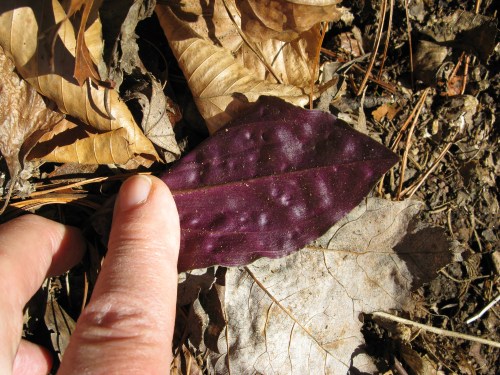
In the woods, something is happening. Orchids are making sugar. How have I missed that? One species will bloom in May, the second in August, but their leaves are now. Their delicate little tenacious tough-ass corms swell all winter waiting to rocket up a spike of summer flowers into a leafed-out overshaded world.

Something is always happening. Something is deeper than those scrolling agendas. Something in the world and something behind my optic chiasm in deep matter. Something that maybe wants me to be still and notice. Something to hope for, to wait for, to go forth and meet.

There is no nothing. It’s all everything.

.     .     .     .     .     .

These two poems are from Kakalak 2020, the annual anthology of Carolina poets. It is an eclectic volume – conversational, confessional, contemplative. Not as many COVID poems as I expected but wait until 2021.

The poems by Joan Barasovska and Kathy Ackerman speak to me of the winding thread that connects our past to our present. Knots and tangles, yes, but also a lashing to secure us in the lashing storm. The something that is happening every day is us becoming human.

.     .     .     .     .     .

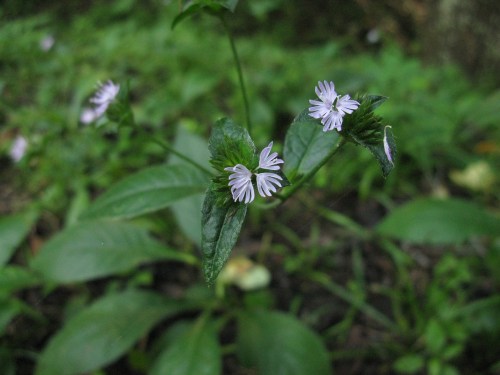
Cranefly Orchid, Tipularia discolor

.     .     .     .     .     .

Her Breath

Mike and I exchange a glance
over her cooling body.
Our eyes are dry.
Elsie wears a faded housedress
with a pattern of flowers.
Thirty minutes ago
an aide crossed
her swollen hands.

All morning we sat waiting
while Death rattled her.
She died in the afternoon
while we were out walking.
Our mother took a slow
rollercoaster ride to this day,
dragging us with her on
every shivery dip and climb.

Back from the dead,
Mike said when she woke
from a coma, angry to find herself
in a clean hospice room.
She raged until he put her back home.
Frail, sick, ninety-three, hanging on
ten hears after Dad’s death.
She scolded me yesterday.
I was late for lunch.
I had forgotten to pick up her mail.

Their old bed had been replaced
by a narrow hospital bed
rolled in the hospice workers
while she fumed in the living room
and I boiled water for tea.
Now her jaw is slack,
her last silent treatment.
Above her head hangs
a sad-eyed portrait of me at nine,
painted in blues and grays.

Mike and I are limp with relief.
the secret of Elsie’s anger died with her,
but it was probably sadness.
We are second-generation Americans,
inheritors of the sadness seed.

This mother
lying flat between us
birthed me sixty years ago.
With her last breath,
She’s in a better place
and so am I.

Joan Barasovsaka, Kakalak 2020, Main Street Rag Publishing Company

.     .     .     .     .     .

Adam-and-Eve Orchid, “Puttyroot,” Aplectrum hyemale

.     .     .     .     .     .

Misnomer
for Goliath, my father

i.
This story begins when I believed every word my daddy said.
Honeysuckle, he called them, tending the cuttings
that go all the way back to Rock Creek 50 years,
Aunt Gracie’s yard in the hills where I never lived.

Honeysuckle was all I had to root me to that ancient soil,
so every home I bought I planted some
from Daddy’s supply, rooted in plain clear water.
I wondered why it had no scent, was not a vine,
was pink, for crying out loud.

Now shopping for plants for house #5,
I see the truth in 5-gallon pots before me:
Weigela.

I imagine old Aunt Gracie shooing my father away
from her quilting or canning or sitting alone.
Go cut back that honeysuckle
before it swallows up the outhouse.

Later, seeing his mistake, she didn’t correct him –
a name is just a name –
Grace just glared at tiny Goliath
so proud of his mound of pink and green
already wilting

while the roof of the outhouse
still plushed with yellow sweetness
he’d confuse for 80 years
with a plant that belongs
to the same family, after all,
but so much harder to say.

ii.
Start me some honeysuckle, Daddy, I blurt out
in one of awkward lulls.
I want to imagine his hands on the branch,
the snip of sprigs of coal country
where Gracie’s old feist
barked me all the way to the outhouse and back
when I was too small to know
how hard it is
to keep what lives alive.

Kathy Ackerman, Kakalak 2020, Main Street Rag Publishing Company

.     .     .     .     .     .

.     .     .     .     .     .

Let justice roll down like waters, and righteousness like an ever flowing stream.
Amos 5:24

.     .     .     .     .     .
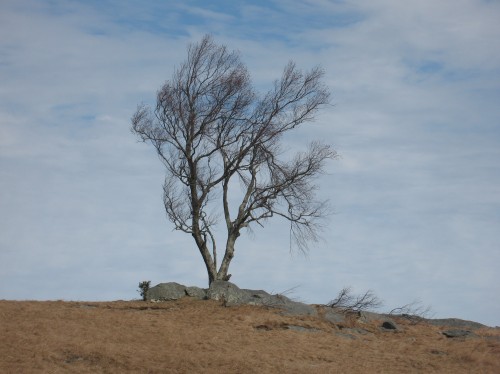
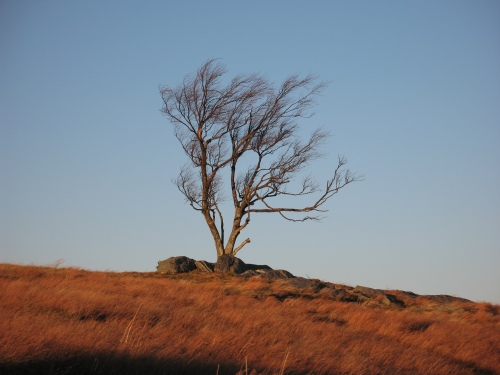
2019-02-09 Doughton Park Tree

Read Full Post »

[with two poems by Malaika King Albrecht]

The lesson you need is the one you weren’t looking for.

The lesson you keep is the one you didn’t want.

Our final exercise is to sit. Not in the open air pavilion where we’ve weathered hours of presentations and discussion. And not by any means moving along the trails we’ve hiked for hours encountering a new species every minute. Now at the close of our weekend naturalist course on plants of the Smokies we are instructed to stop, settle, sit. We are to find a green thing we don’t know or one we’ve have ignored and sit for half an hour. Pay attention. Become intimate.

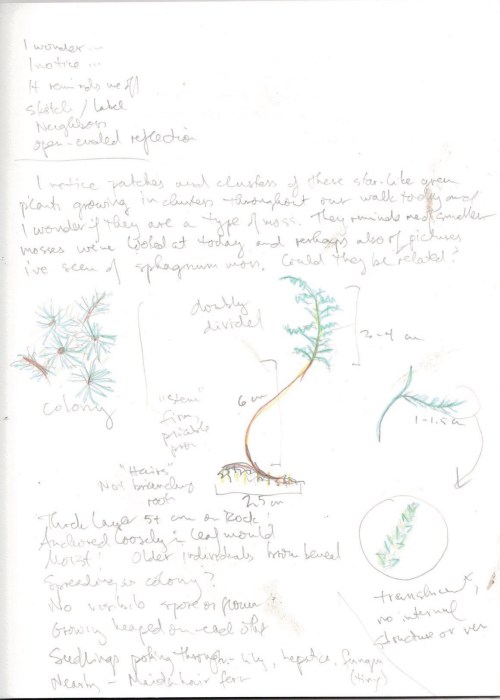
I choose to sketch a bryophyte not much bigger than my thumb. Perhaps I’ll never know its true name – starmoss? sphagnum? – but we could become friends. I won’t even give it a name. Be satisfied sometimes simply to explore, to know first with all my senses, that is what I’m learning. Where does it like to lie and spread? Whom does it choose for neighbors? How does it make its living? Naming can come later.

Moss with Doghobble leaf

Look at us all, scattered like toadstools across this mountain glade quietly noticing. For now the birds and insects get to make all the noise. Eventually our quiet must end and we gather one last time for closing and summarizing and making sense. Now Tonya has a surprise. A worm snake, while she sat, has burrowed, well, wormed into her open sandals and curled around her toe. She untangles it and cradles it for us all to see while it tries to bite her with its mere slit of a mouth, better suited for eating slugs. If we were quiet, if we paid attention, if we sat long enough would we be reclaimed by moss and crawling things and become a haven for all that is small and necessary?

We eat our lunch along the trail, we travel back to Tremont, we pack our cars. At the parking lot I congratulate Tonya upon completing her final course and receiving her Naturalist Certification. I tell her, I’m still only half way through.

Tonya turns to me. She sets down her pack. She is solid, present, her eyes deep and full as a hardwood cove. Help the new ones, she pleads. Share what you know.

And during the five hour drive back to my foothills what image recurs? Not family characteristics that differentiate Brassicaceae, Lamiaceae, Asteraceae; not frond morphology and sorus distribution. No, the image I can’t escape is of the two first-timers in our course turning a leaf over and over in their hands, turning the leaves of a guidebook, excited, figuring things out. And of me a pace or two removed, watching them, adding nothing.

Sometimes I think I have the perfect temperament and skill set to be a moss-covered log slowly digested by fungal mycelia. Ah, the long and placid observations I would make. But that’s not the lesson I need or the lesson I will keep. Instead, this: don’t imagine you know so much. But know that what you do know has value when you share it. Know that its only value is in the sharing. You have joined the circle of seekers. Now open the circle wide.

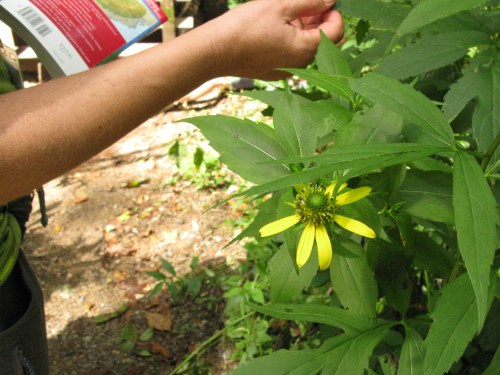
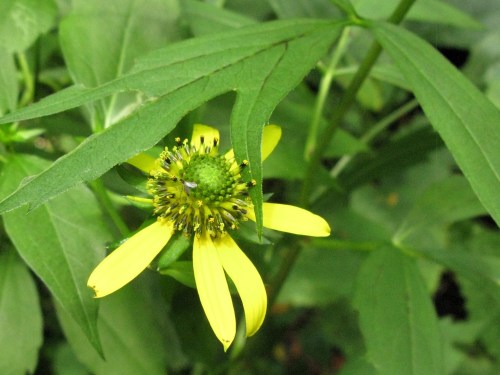
Rudbeckia lacianata; Cutleaf Coneflower; Asteraceae

Rudbeckia lacianata

.     .     .     .     .     .     .

A week ago I shared here two poems by Malaika King Albrecht from her most recent book. I’m not finished with her. Something about this collection of poetry has become very necessary for me as I continue to pile and compile the lessons from my most recent course in the Southern Appalachian Naturalist Certification Program at Great Smoky Mountains Institute at Tremont. The quantity of information itself is just shy of infinite. I’m working through a book titled, Botany in a Day, which would more realistically be In a Couple of Years. Just the new vocabulary reminds me of starting Med school (that was 1974 – what am I doing here?!) or maybe of being smacked with a breaker at Fort Macon beach.

But being overwhelmed with information is the trees, it is not the forest. That is why I need poetry. I will study the taxonomy but poetry will teach me the connections. I will feel like I can never know enough but poetry will teach me to live with and love the mystery. I will work on what to know but poetry will teach me how to know.

Malaika’s collection is just the solace and challenge and promise needed. Her poems can be grounded in the senses but spiral into the imagined and unimagined. I would say her poems make connections but even more they open me to make connections. It can be the difference between burying myself in the Field Guides and opening myself to the field.

Thanks again, Malaika!

.     .     .     .     .     .     .

Following the Wind

Everything leaves a mark:
dull grass in the morning where the raccoon
ambled away full of cat food,
antler scratches along the willow oak,
and tracks and scat everywhere.

I know what stirs in this forest:
Deer nosing the horse path,
red fox slitting the tall switch grass,
rabbit bounding, freezing, and hopping again.

At the edge of Loftin Woods, I fall
for the wind, the way it parts the grass,
makes branches speak
and vultures glide their shallow V’s.

If sky holds our dreams,
then earth, our memories,
and wind, only the now
of this moment calling,
calling from everywhere.

Elephantopus carolinianus; Elephant Foot; Asteraceae

.     .     .     .     .     .     .

Praise Song for What Is

Praise the frozen rain, the icicles daggering
the trees, the gray snow sludge. Praise
the shiver, the wet wind cutting through clothes,
the frozen water troughs. Blessed be
the hard frost, the frozen pond,
the apple sapling snapped in half.

Praise autumn and spring, the hot then cold
then hot again. Praise the corn mazes,
the haystacks, the reaping what we’ve sown.
Blessed be the fig tree, the honeycomb, the hive.
Praise the kudzu, the poison ivy,
the forsythia shouting yellow at a fence.

Praise the mosquito, the itch,
the scratch. Praise the heat waves,
the asphalt, the stopped
highway traffic. Blessed be
the dusty, the wilted, the dry
husks of corn in summer drought.

Praise the possum lumbering
into the chicken coop,
the fox slinging the wood’s edge.
The owl, the hawk, blessed be
their swift descent to prey.
Praise the failures, the losses. Blessed be
the broken path that brought me here.

.     .     .     .     .     .     .

From The Stumble Fields, Malaika King Albrecht. Main Street Rag Publishing Company, Charlotte, North Carolina. © 2020.

Botany in a Day, The Patterns Method of Plan Identification; Thomas J. Elpel; HOPS Press, LLC; © 2018; An Herbal Field Guide to Plant Families of North America

Wildflowers of Tennessee the Ohio Valley and the Southern Appalachians; Dennis Horn and Tavia Hathcart; Partners Publishing © 2018; The Official Field Guide of the Tennessee Native Plant Society


.     .     .     .     .     .     .

Read Full Post »

I don’t know anything.  I’ve got a lot of people fooled into thinking I do, but no, I don’t know anything.

Sometimes Linda accuses me of thinking I know everything.  Well, OK, maybe I do tend to blurt out answers.  I hope I’m not as obnoxious as Bill Murray watching Jeopardy in Groundhog Day, but I do suffer from a mild case of expository blatheromania.  “What is a stereoisomer?”  “How about a four letter word for ‘wing-like’?”  Linda won’t let me within fifteen feet of her when she’s working a crossword. But all this fact stuff is just trivial.  I has nothing to do with knowing.  I say things out loud to test myself, to see if I finally do know anything.

Nope, still don’t.

All of which is making me very nervous about being the featured reader (along with Debra Kaufman) at Walking into April this Saturday. [April 14, Barton College, 9:00 a.m., Sam and Marjorie Ragan Writing Center – be there and place your bets as to whether I know anything.] It’s not the reading part.  I love to read and recite – my poetry, classic poems, a Sam Ragan or two – I’m a big ham.  No, it’s the little entry on the day’s schedule at 11:00 that says “Roundtable Discussion with Griffin and Kaufman, who will present their tips on writing and reading poetry.”

Right now the anything I don’t know the most about is poetry.  As in a total mistrust of whatever I possess that passes for taste, opinion, judgement, skill.  I worry that at the very moment I begin to like a certain poem that proves that it’s inferior.  “Man, you don’t know anything about GOOD poetry.”  And those poems that appear to me as if they were compiled by a random phrase generator?  “What is the matter with you, man?  Where’s your head?”  Maybe it’s just lack of self-confidence.  Maybe it would help to beg an audience with the Wizard of Oz, who would tell me, “Nonsense, lad!  You imagine you have no poetic soul, but all you need is this . . . [fill in the blank:  MFA; Fellowship; Pushcart; One thousandth ‘like’ on WordPress].”

There’s only one cure.  Read some more poems.  Let myself get caught up in images that seem to float effortlessly from line to line like dragonflies laying eggs on the mirror of a pond.  Words never before juxtaposed that now seem as if they were meant to be married since the genesis of language.  A narrative so exotic and at once so universal that I suddenly realize it’s my own story this strophe has captured.

Maybe I’ll discover I don’t need to know anything.

IMG_0061_crop01

.     .     .    .     .

Now Debra Kaufman knows something.  I have sat in her presence.  As she shares, the lines wind and flow like silk ribbon that seems so casual but soon binds you with no escape.  Her poems may hint at a personal history at the same time they are invoking an entirely new and fantastic landscape.  I walk into that landscape, look around, and find myself at home.

I am counting on you, Debra.  Knowing you’ll be there on Saturday, I will stand up straight, put off all this sidling nonsense, and walk upright into April.

.     .     .     .     .

Autumnal Equinox

Sugar maples blaze at sunset;
leaves swoop and skirt
the chilling wind like chimney swifts.

A boy leaps into leaves,
calls to a neighbor’s Irish red,
as light falls, a cat’s white shadow,

on his grandmother’s lap.
Her hands rest there,
her grandmother’s hands,

the same boniness of wrist and knuckle,
dry fingers nearly flammable in the smoky air.
She smells ripe pears

and feels her body drawn
toward the darkness that rolls in
earlier each day.

Heat and light retreat,
and evening covers everything
except the boy, whose hair shines

silky silver light
as he tosses armfuls of color
upward, like sparks.

from The Next Moment (Jacar Press)

.     .     .     .     .

Debra Kaufman is a North Carolina poet, playwright, and educator.  The Next Moment is her most recent poetry collection.  Her short and full-length plays have been performed throughout North Carolina and elsewhere. Debra is the recipient of a North Carolina Arts Council playwriting scholarship and of a grant from the Central Piedmont Regional Artists Hub Program.

Sample her work at:

Debra Kaufman homepage

Kathryn Stripling Byer — Here Where I Am (blog)

Scott Owen’s Musings

Moon-Mirror-Whiskey-Wind

.     .     .     .     .

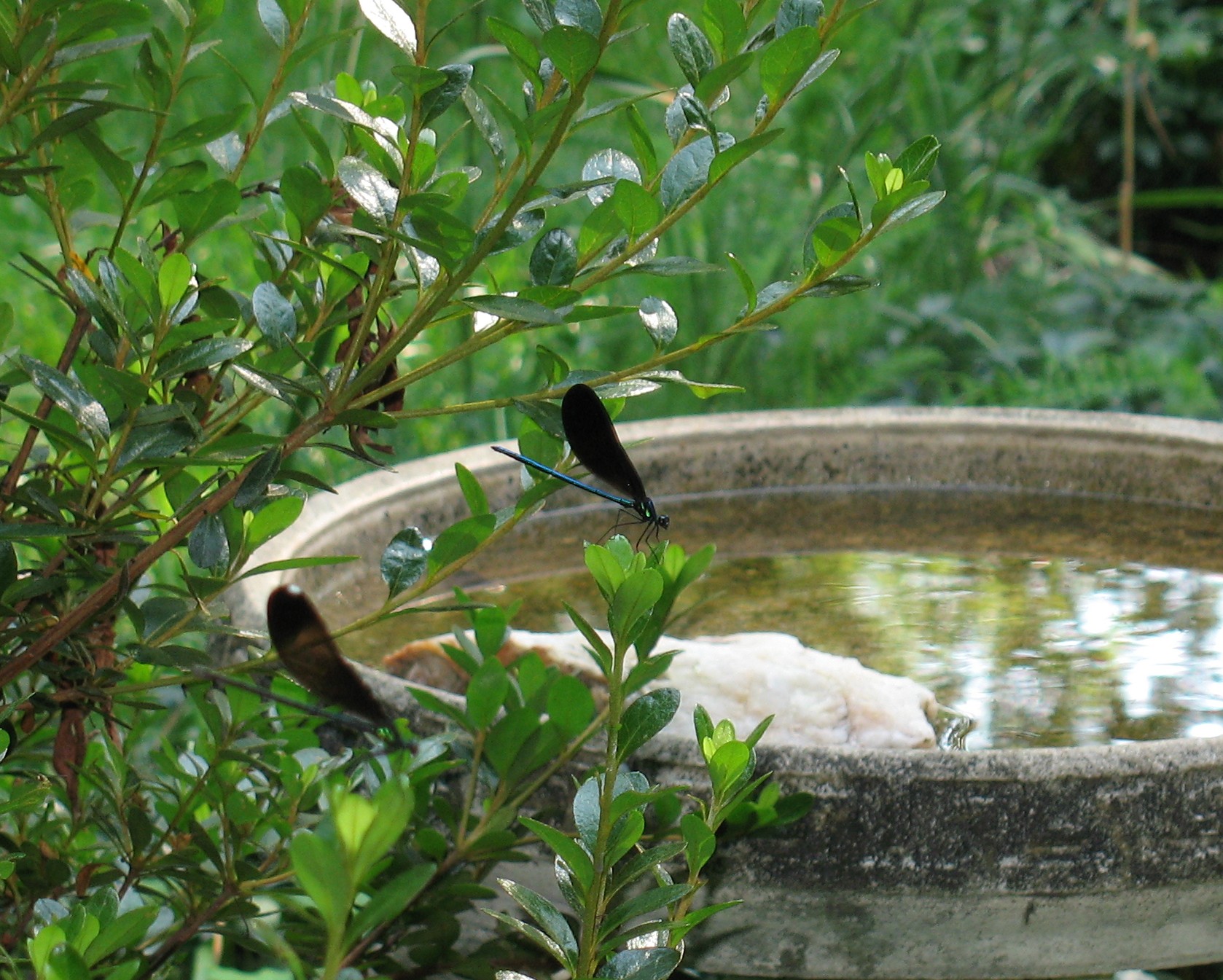
IMG_1948

Read Full Post »

« Newer Posts - Older Posts »