Feeds:
Posts
Comments

Posts Tagged ‘poetry’

Poetry Submissions Calendar – UPDATE 02/01/2022

Placing yourself at the mercy of the editors, are you?! In 2015 I originally posted a table I use to keep track of when and where to submit poems for publication. Not to say I thrive on rejection, but the occassional favorable comment from an editor, not to mention an acceptance, do feed one’s motivation.

Here is the most recent update:

……….. Poetry Submissions Table – PDF file ……….

Since my last posted update in August, 2021, I’ve added more than 25 entries and corrected several dozen, including sites no longer accepting submissions. There are currently more than 200 journals and contests listed.

.     .     .     .     .     .     .

Here’s how I use the calendar:

It’s arrayed by month – look down the column to see what journals and sources are open for submissions right now!

Subscription Calendar Screen Shot: February, 2022 —-CLICK TO ENLARGE

Each row includes the web address – be sure to check before you submit, because requirements may have changed since I last updated!

The row also includes other information such as:

Is this an online publication only?
Do they accept simultaneous submissions?
Should your submission be a single document?
What format files do they accept?

There are more instructions on the table itself. Feel free to print it out. And I would really appreciate it if you notify me of any errors or suggested changes!

In particular, if you have journals to which you’ve enjoyed submitting I can add them to the table! Please send me the details, especially the web address!

I will try to post an updated table several times a year and whenever I have made significant additions and corrections to the table.

Here’s the original post from 2015 with a little musing about rejection:

https://griffinpoetry.com/2015/08/31/editors-mercy-part-2/

.     .     .     .     .     .     .

Enjoy!

And if you find this useful or discover errors please reach me at comments@griffinpoetry.com

BILL GRIFFIN

Read Full Post »

[with poems by Augusta Wray]

1932, Charlotte, North Carolina – the Great Depression has all but silenced the constant rumble of railcars from Atlanta to D.C. through this hub of the South. Most of the cotton mills are shuttered but Ben Gossett, president of Chadwick-Hoskins, has an idea. He asks President Herbert Hoover for help. Mill workers will weave cloth from 50,000 bales of cotton sitting in idled factories and sew it into clothing for the needy. Slowly the Queen City will again stir to life.

That same year, 1932, The Charlotte Symphony Orchestra was founded. More songs were recorded in Charlotte than in Nashville (and just 4 years later Bill Monroe would make his first recording in a closed Charlotte warehouse). Seeking a different kind of music, six poets gathered that spring in the home of Edna Wilcox Talley to begin a venture dedicated to expanding the appreciation of poetry in their state. The North Carolina Poetry Society would begin to admit members whose skills “measured up.” Over the next few years they would hold monthly workshops and an annual banquet, with a prominent writer as speaker, begin publication of a regional literary journal, and slowly expand their reach from Charlotte to the entirety of the state and beyond.

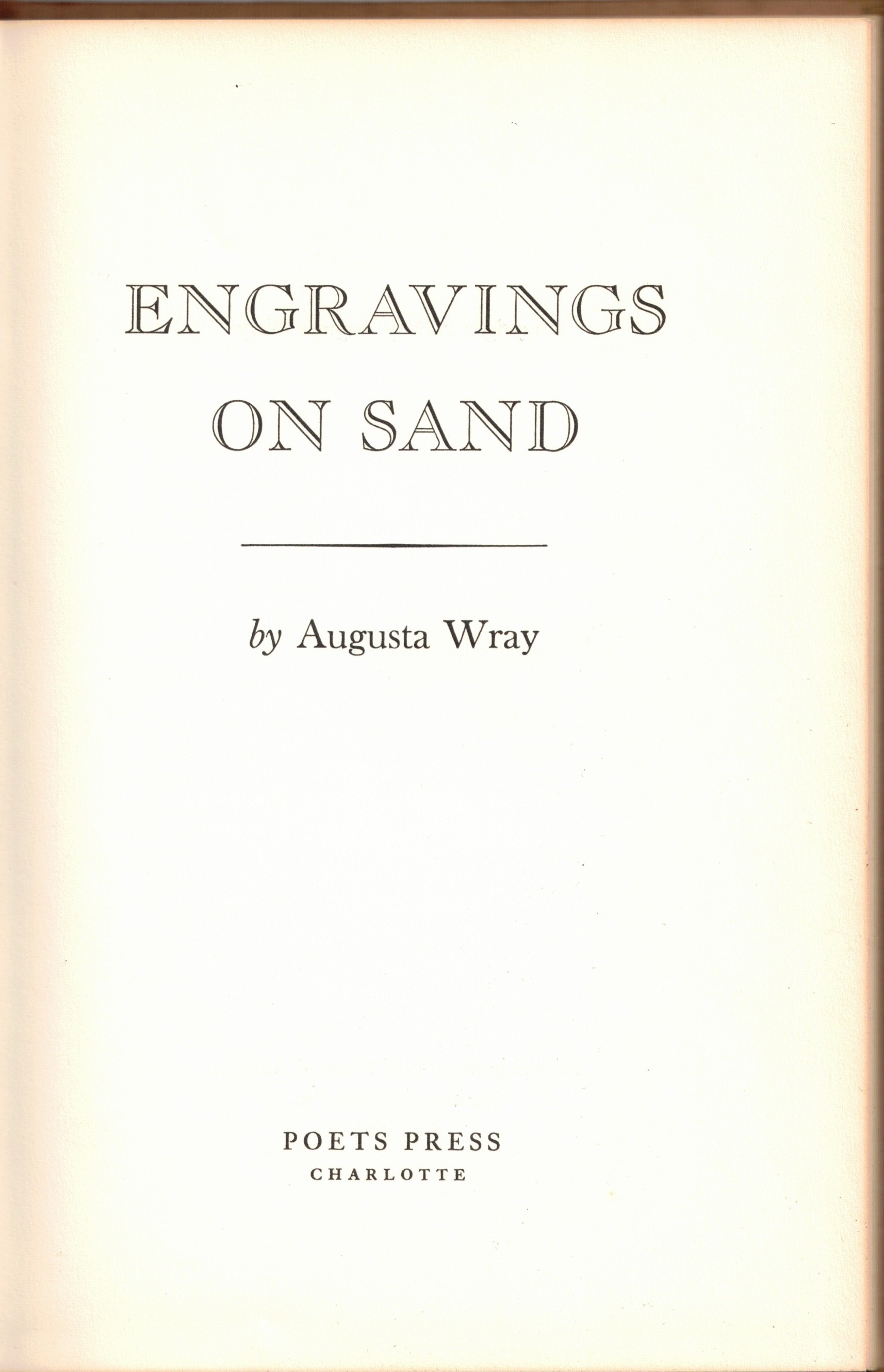
One of these Charter Members was August Wray. She had lived in Charlotte since her marriage in 1902. She attended every meeting of the NCPS through the 1950’s. Her poems would appear in The North Carolina Poetry Review, Journal of American Poetry, and many other publications, especially the poetry column of The Charlotte Observer, edited by Andrew Hewitt. She won many poetry honors and prizes in the 1930’s and 1940’s. And in 1959 she would publish a full length collection, Engravings on Sand, edited by Dorothy Edwards Summerrow.

.     .    .     .     .     .     .

Trees at Night

Ink spots upon a midnight sky – fantastic,
+++ sinister and dark –
At night, trees take on fearsome shapes
+++ with no detail of leaf or bark
To add to grace of swaying limb where
+++ branches curve and intertwine,
No carven foliage of jade – all monotone
+++ in black design,

Carbon pictures, weird and ghostly, of night
+++ Dragons crouched to spring,
Warily silent and foreboding, menacing,
+++ like a wounded thing –
Smoky masses, deeply shadowed, with outlines blurred
+++ that mystify –
Trees clutch the heart in night’s dark silence
+++ silhouetted against the sky.

Augusta Wray
+++ from Engravings on Sand, Poets Press, Charlotte NC, © 1959

.     .    .     .     .     .     .


Last week I received Engravings on Sand in the mail. Bibliophile Carmela Dodd discovered it at a flea market and upon reading its inscription by Augusta Wray to “Mrs. Charles Evans,” Carmela felt that the book deserved a home with the North Carolina Poetry Society. Thank you, Carmela! What an amazing artifact and memorial during the Society’s 90th anniversary year.

Dorothy Edwards Summerrow, who edited the collection, writes this to begin her foreward: When, at Augusta Wray’s request, I was given the pleasure of compiling and editing “Engravings on Sand,” there was turned over to me a large suitcase literally bulging with poetry manuscript. Dorothy describes excitement but also dismay at selecting the best work of one of North Carolina’s finest poets . . . because I must of necessity select for public inspection, only a small fraction of the prodigious output of her private heart.

In 1959 Augusta Wray was 83 years old. She had been widowed four years earlier. She and her husband had no children nor other close family; she told Dorothy, “My poems are my children.” Dorothy describes the treasure before her: When I opened the suitcase entrusted to me, the sparkle of the poems made the dark, rainy afternoon brilliant with the fire of many gems.

.     .    .     .     .     .     .

Release

In the dark and tranquil stillness of the night
When quietude has simulated peace,
When joy is born without the aid of light
And sorrows softly fade away and cease,
When weary eyes are drifting into sleep
That carries them afar from day’s dull care,
When dreams appear invitingly to seep
Through all perplexities and leave them bare –
Then does the spirit take command and things
Become unreal and float away like foam;
The soul is loosed and on unweary wings
takes leave of what was once its mortal home.
++ The soul and body separate, go free,
++ When sleep, or death, gives them their liberty.

Augusta Wray
+++ from Engravings on Sand

.     .    .     .     .     .     .

Nocturne in Silver

Silver shadows in somber silence
Wrap folds around the tranquil night,
Silver rain from a silver moon
Pours its radiance through silver light.

Sleeping leaves from moon-drenched branches
Drip silver pendants edged with pearl,
Flowers with their petals closing
Gleam with silver as the furl.

Cobwebs, silver-strewn with dewdrops,
Chiming tone when brushed by moth wings,
Are silken harps, tht quivering, make
Plaintive music from silver strings.

Augusta Wray
+++ from Engravings on Sand

.     .    .     .     .     .     .

The seasons . . . love . . . death . . . these are the themes of most of Augusta Wray’s collected poems. She is steeped in Carolina culture and climes. In this final poem I’ve chosen, though, I hear an understated voice of longing and regret. Perhaps she refers here to her childlessness, but perhaps she is opening herself, and her readers, to discovering beauty in the reality that is her life – who cares what it may have seemed to some to lack?

Flowering Plum

In loveliness she stands,
Blonde beauty rare,
With white and fragile hands
Folded in prayer.

Of bridal purity,
A perfumed veil
Hides with security
A body frail.

The season waits for her,
She blooms each year
When winds softly murmur:
“Spring is now here.”

Feathered choristers sing
Blithely and loud,
Sheltered beneath the wing
Of petaled cloud..

Lonely she stand apart,
No fruit she bears.
Such beauty serves the heart.
Barren? . . . Who cares?

Augusta Wray
+++ from Engravings on Sand

.     .    .     .     .     .     .

Dorothy Edwards Summerrow was a renowned Carolina poet herself, winner in 1957 of the Roanoke-Chowan Award for Poetry. She also noted in the foreward: In Silver Echoes, the poetry anthology published in the spring of 1959 by the North Carolina Federation and edited and compiled by this editor, more of [Augusta Wray’s] poetry is included that that of any other writer in the state.

.     .    .     .     .     .     .

History of the North Carolina Poetry Society

Charlotte / Mecklenburg historical timeline

Roanoke-Chowan Award for Poetry

2015-06-15Doughton Park Tree

Read Full Post »

[with 3, no, 4 poems by Paul Jones]

Oh well . . . life goes on . . .

No it doesn’t! Who ever said that? At least not on and on and on. And the problem is not growing old, the problem is everyone around me is growing older.

I’m biased and I know it – too many all-nighters in the ICU knowing my patients will never wake up, will never breathe again without that machine. Why choose to prolong those hours? Too many weekly visits to the nursing home, my patients who will never again chew, swallow, recognize, understand, smile. Why choose to prolong those days?

Still, when you are breathing and smiling there’s a huge hurdle to leap before you’re willing to talk about how you want your body treated when you can’t breathe or smile. Easy to put off making that living will when you’re in the midst of living; too late when you’re in the midst of dying.

Last year I spent a few weeks helping Dad update his and Mom’s will and estate. Gather up mounds of papers, talk things over, scratch heads, and then the final step: spending a morning with their attorney to nail it all down tight. Just because most politicians are attorneys does not imply the converse, that most attorneys are self-infatuated power-lusting villains. Not at all. Dad’s attorney, Ms. S., treated us like family. Like she was the cousin who knows a whole lot more than we do but who can explain it in a way anyone can understand.

To describe two hours with an attorney as a pleasure? Well, yes indeed.

As a family doctor I never found it easy to talk to my patients and their families about death. Necessary, yes; essential, yes; never easy. Perhaps it’s the taboo that if you name something you give it power over you. But a last will and testament is all about death. If you’re not going to die, don’t bother making a will.

Ms. S. talked with us for two hours about death, straight up, matter of fact. I learned a lot about what Dad and Mom want for their own final days and for a legacy to their children. I learned that Dad, in the right place and time, is willing and even anxious to talk about his death. We left the office smiling, arm in arm (figuratively as well as occasionally literally, 95-year old knees and all).

Of course, Dad still vows he’s going to live to a hundred. At least he’s got one helluva estate plan.

.     .     .     .     .     .     .
.     .     .     .     .     .     .

Seventy Three

When in time frost found me, leaves were gone yellow
or fallen or few on branches or fallow
fields. Limbs were empty choir lofts. Youth’s bright birds sang
then left before the cold November must bring.
I found myself in twilight, the glow on snow
or rime on those brown stems or white wisps of breath
– how many more before death plants me below? –
But here I can see further, here my life’s breadth
forms a vista. Here where flames once leapt, grey ash
is heaped, warm still from what past fires I’ve known.
Still all this going is not completely gone.
Something of those late bird songs will stay, will last.
What we see in age makes all we love more strong,
knowing what we love we leave before too long.

Paul Jones
from Something Wonderful, Redhawk Publications, © 2021

.     .     .     .     .     .     .

I’ve always been a bit in awe of Paul Jones’s poetic gifts. Envious even. Not only because he can make rhyme so damn modern but even more for his capacious breadth and depth. What an imaginative reach! I’m not reprinting To a Tuber here but read it and you will become convinced that the potato is within all the vegetable kingdom most elegant, elevated, and worthy of praise.

So I knew before I ordered my copy of Paul’s new book Something Wonderful that it would be, and it is. The sly wit is there, waiting to pounce, but also heartfelt longing and wry uncompromising looks into personal finitude. You don’t really discover why the cover is covered with 19th century illustrations of bats until page 80 and the title poem. Take the time, make the trip. It’s worth it.

.     .     .     .     .     .     .

Ireland Seen from a Porch Swing in Hickory, NC
+++ — for Adrian Rice

Ireland is a country without porches.
What they call a porch is just an entry.
No one sits there watching for neighbors
walking by with their electric torches.
Their voices, soft as blossoms, gently
fill humid summer nights with rumors.

Over there, secrets are shared in the pubs.
From unsteady high stools, the stories, tinged
with irony, rise easily as smoke.
New worlds are created by old words spoken.
even the weightiest tales take on wings,
if only whispered above the hubbub.

But here, the slow news is told by moonlight
in the lazy tease of an August night.
Too often tea, iced and sweet, is the drink
that greets the blink of stars through the dark
as our voices wander, each twang distinct,
in the dog-starred nights and the torpid days.

It’s ghosts that bind us across our weathers,
that tie the lilt and slur of daily sagas
told inside and out, in bars and open air,
to some episodic common drama.
They appear here and there, vivid and stark,
in talk that reweaves their spells in the dark.

Paul Jones
from Something Wonderful, Redhawk Publications, © 2021

.     .     .     .     .     .     .

Still Waters

I am still, waiting
for the one moment
that old Eastern sages
say gives absurdity
an absolute clarity,
the moment multiple
bald monks chant to induce.
They say the Way is
like water. It will work
its wonders at due time,
the way water always
breaks up rocks, turns them
into sand, but will not
be transformed itself.
Being water, it’s
already what it needs to be.
Winter and ice
merely redefine water.
Wind, when it works, only works
on the surface of water.
When fire meets water,
water is sent to heaven
but fire just becomes ash.
Water like saints returns
to perform its steady work.
Sleet, snow, rain or hail –
even fog – are water’s
temporary bodies.
In time, water will be
all part of one huge sea.
Water will save us all
in time. In time, they say.
In the meantime, be water
as best you can be. Me?
I am still waiting
for all waters to become
still, to run deep, and
clear a few things up.

Paul Jones
from Something Wonderful, Redhawk Publications, © 2021

.     .     .     .     .     .     .

Saint of the Trees

What is the proper sacrifice
To please our Lord, the Saint of Trees?
I asked the ferns for their advice:
What is the proper sacrifice?

“Lie here and dream of paradise,
Sink into the soil like the leaves.
That is the proper sacrifice
To please our Lord, the Saint of Trees.”

Paul Jones
from Something Wonderful, Redhawk Publications, © 2021


.     .     .     .     .     .     .
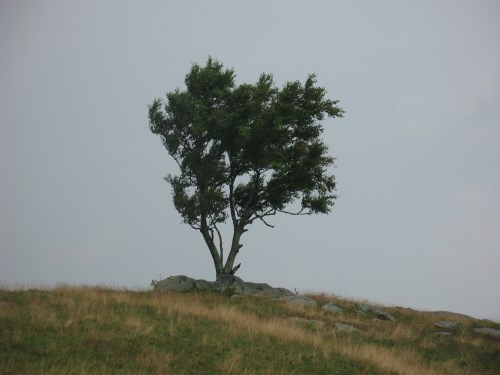
 

2014-07-13 Doughton Park Tree

Read Full Post »

« Newer Posts - Older Posts »