Posts Tagged ‘poetry’
Old & New
Posted in Imagery, Photography, poetry, tagged A. R. Ammons, Bill Griffin, Bosh and Flapdoodle, nature photography, NC Poets, New Year, poetry on January 5, 2024| 12 Comments »
.
[with 3 poems by A. R. Ammons]
.
Quibbling the Colossal
.
I just had the funniest thought: it’s the
singing of Wales and whales that I like so
.
much: you know, have you heard those men’s
groups, those coal miners and church people in
.
Wales singing: to be deeply and sweetly undone,
listen in: and the scrawny rising and
.
screechings and deep bellowings of whales,
their arias personal (?) and predatory at
.
love and prey – that makes up mind for us as
we study to make out mind in them: the reason
.
I can’t attain world view or associational
complexity is that when I read I’m asleep by
.
the second paragraph: also, my poems come in
dislocated increments, because my spine between
.
the shoulderblades gets to hurting when I type:
also my feet swell from sitting still: but
.
when the world tilts one way it rights another
which is to say that the disjunctiveness of my
.
recent verse cracks up the dark cloud and
covering shield of influence and lets fresh
.
light in, more than what little was left, a
sliver along the farthest horizon: room to
.
breathe and stretch and not give a shit, room
to turn my armies of words around in or camp
.
out and hide (bivouac): height to reach up
through the smoke and busted mirrors to clear
.
views of the beginnings high in the oldest
times: but seriously you know, this way of
.
seeing things is just a way of seeing things:
time is not crept up on by some accumulative
.
designer but percolates afresh every day like
a hot cup of coffee: and Harold, if this is
.
an Evening Land, when within memory was it
otherwise, all of civilized time a second in
.
the all of time: good lord, we’re all so
recent, we’ve hardly got our ears scrubbed,
.
hair unmatted, our teeth root-canaled: so,
shine on, shine on, harvest moon: the computers
.
are clicking, and the greatest dawn ever is
rosy in the skies.
.
++++++++++ CAST THE OVERCAST
.
A. R. Ammons
from Bosh and Flapdoodle, W. W. Norton & Company, New York, NY; © 2005
.
❦ ❦ ❦
.
January 1: The big round thermometer on the back porch reads 35 degrees Fahrenheit. A long thin coiled spring of two facing layers: each face different metals which contract differently when cooled: the spring’s central attachment a little axle free to rotate: on the axle a needle, a pointer that is able to inscribe an arc three-quarters of a circle: -40 to 140 degrees, currently 35. In 2024 when we can simply inquire of our phone, are we really meant to believe this dubious mechanical contraption?
.
My ear lobes, the back of my neck, and my nose hairs believe it. I zip up, pull my cap lower, and walk down the hill toward the river. Jason has pulled in and unlocked the gate. Soon more layered and downed figures arrive. Here we go, twenty-five of us, on our First Day Hike along this newest little section of the Mountains-to-Sea Trail beside the Yadkin River in Surry County.
.
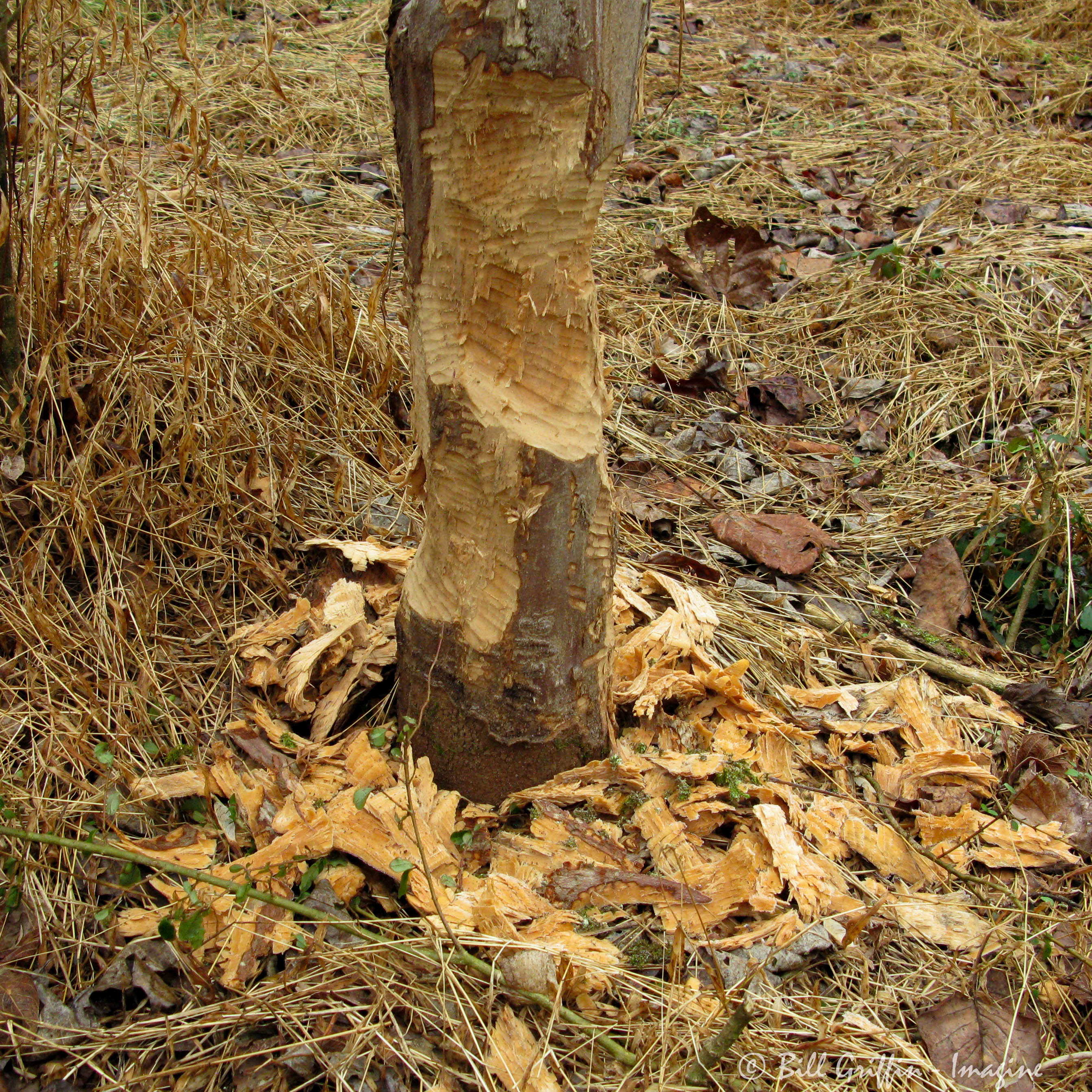
First Day Hikes have sprung up all over, parks and neighborhoods, greenways and rail trails. About half of this morning’s walkers have never before attended an Elkin Valley Trails Association event. Something new to show this old muddy river. Fresh coyote tracks on a sandy bank. In a rotting stump, a big square pileated woodpecker hole that wasn’t here 3 days ago when Jason scouted. Still-moist chips at the base of a girdled tree and bright incisor marks from the beaver.
.
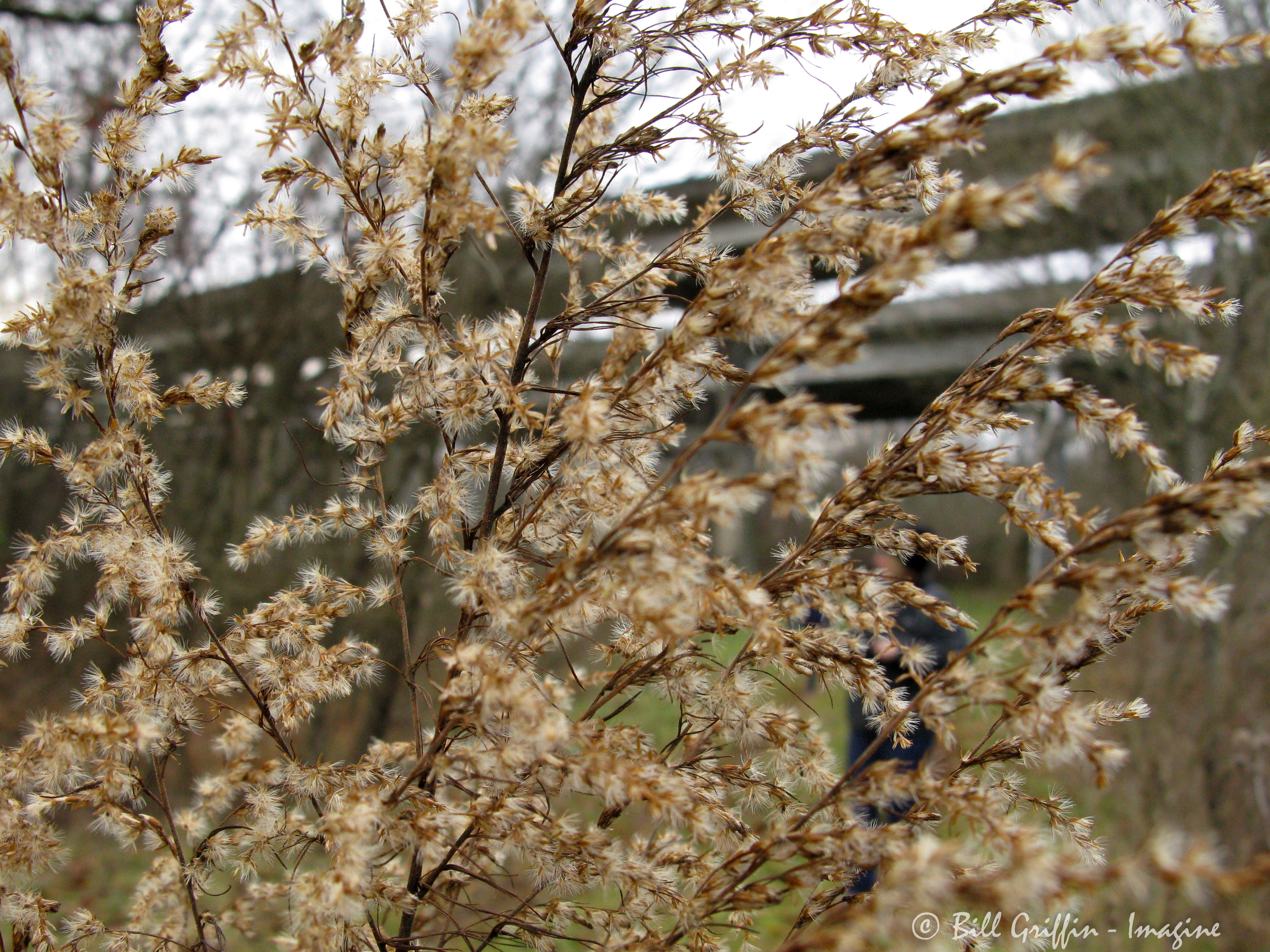
Now we’re crossing a meadow with waving heads of last summer’s asters, dry and higher than our own heads. I’m pulling goldenrod and wingstem seeds to sow on newly bare ground around the new crossing over Dutchman Creek. Dee remarks on the beauty of particular airy feathered fronds – dog fennel, no summer eye-catcher but striking in its winter browns and grays.
.
Old? New? Or just a continuous flow of moments like these? I’ll turn away from my mirror. I won’t query my knees. I’ll unzip my jacket, because now we’re moving and I’m plenty warm. I’ll enjoy a big inhale of the river-moist air. I’ll listen to the chatter of hikers and the whistle of white-throated sparrows. I’ll make myself ready to notice the next new thing before us.
.
.
❦ ❦ ❦
.
Hooliganism
.
Once (there was a time when) I was attracted
to, if not attractive to, everybody, starlet
.
and streetlet, athlete and bellybag: afire,
I burned anything, including myself: kneedeep
.
in ashen brush, even some simmering fagots, I
tried to separate the heat from the flame but
.
gave up, pouring it all into the love of a wife
now nearly half a century old – the wife a
.
little older: most of those old flames (sweet
people) have flickered away except for the
.
corner of my mind where lively they live on in
honor, honorary doctorates circling their
.
laureled heads – what schools they founded!
taking what pains, with what tears, they taught
.
me how, roaring possibilities and tenderest
glows: love, love, one learns to love, it is
.
not easy, yet not to love, even astray, leaves
something left for the grave: burnt out
.
completely is ease at last, the trunk honeyed
full as a fall hive: when the light dies out
.
at last on the darkening coals, the life
turns to jewels, so expensive, and
.
they never give the sparkle up: this was
a fancy, and not half fancy enough and somewhat
.
lacking in detail but ever true.
.
A. R. Ammons
from Bosh and Flapdoodle, W. W. Norton & Company, New York, NY; © 2005
.
❦ ❦ ❦
.
My friend Anne gave me Bosh and Flapdoodle. A. R. “Archie” Ammons wrote the collection of poems in 1996, five years before his death, and his son and friends had it published in 2005, all of the poems, as they say, “exactly as Ammons wrote them.” I am always surprised by Ammons. Throughout his life as a writer he demonstrates that poetry is everywhere, and everything. There is nothing mundane or unworthy of being noticed. That itself can be surprising, especially if you have the idea that poetry exists on some elevated plane, but I’m also often taken off guard, like a snow ball to the face, by his sudden deep connections that reveal the reality of our existence.
.
from Mouvance
. . . so if you are to get any passion out
.
of life, you’ll have to dig it out of narrow
spaces or squeeze all you have into slender,
.
if deep, circumstance: I myself have never
known what to do about anything: as I look
.
back, I see not even a clown but a clown’s
clothes flapping on the clothesline of some
.
tizzy: . . .
.
A. R. Ammons and Fred Chappell have been my enduring poetic inspirations. They are alike in that their poetry can be complex and difficult, but they both always return to the earthy assurance of our humanity. Perhaps because they both grew up in rural North Carolina, Archie in the sandhills and Fred in the mountains? This book, more than most any Ammons collection I’ve read, is personal and intimate, and of course as always irreverent, but even more than usually hilarious. He demolishes any grand notion of his greatness (he, one of the greatest 20th century American poets). He crushes any sentimentality about aging or his own approaching death. He invites, I guess he requires, his reader to just look around and really look within and stop for a minute to think about what’s going down. Yeah, it’s bosh and flapdoodle. Yeah, it’s life.
.
❦
.
More about Archibald Randolf Ammons HERE
Purchase Bosh and Flapdoodle from Bookshop.org HERE
.
❦ ❦ ❦
.
Way Down Upon the Woodsy Roads
.
Don’t you think poetry should be succinct:
not now: I think it should be discinct: it
.
should wander off and lose its way back and
then bump into a sign and have to walk home:
.
who gives a hoot about those big-Mack trucks
of COMPRESSION: what are the most words for
.
the least: take your cute little compact and
don’t tell me anything about it: just turn me
.
loose, let me rattle my ole prattle: poetry
springs greatest from deepest depths: well,
.
let her whistle: how shallow can anything
get: (rhyming on the front end): I do not
.
believe that setting words to rhyme and meter
turns prose into poetry, and having written
.
some of the shortest poems, I now like to
write around largely into any precinct (not
.
succinct) or pavilion (a favorite word) I fall
in with: I have done my duty: I am a happy
.
man: I am at large: life sho is show biz:
make room for the great presence of nothing:
.
do you never long to wander off: from the
concentrations: for it is one thing to fail
.
of them and another never to have intended
them: the love nest, men becomes a solid
.
little (mortgaged) colonial: duty become your
chief commendation: the animal in you, older
.
than your kind, longs to undertake the heavy
freedom of going off by himself into the wide
.
periphery of chance and surprise, pleasure or
terror: oh, come with me, or go off like me,
.
if only in the deep travels of your soul, and
let your howl hold itself in through all the
.
forests of the night: it’s the shortest day:
the sun is just now setting behind the branch
.
of the crabapple tree it always sets behind
this day of the year. . . .
.
++++++++++ DRAB POT
.
A. R. Ammons
from Bosh and Flapdoodle, W. W. Norton & Company, New York, NY; © 2005
.
.
❦ ❦ ❦
.
.
Foreshadowing
Posted in Ecopoetry, Imagery, Photography, tagged Adrienne Rich, Bill Griffin, Ecopoetry, Ecopoetry Anthology, Evie Shockley, Foreshadowing, Gary Snyder, imagery, nature, nature poetry, New Year, poetry on December 29, 2023| 9 Comments »
.
[with poems from The Ecopoetry Anthology by
Gary Snyder, Evie Shockley, Adrienne Rich]
.
For the Children
.
The rising hills, the slopes,
of statistics
lie before us.
the steep climb
of everything, going up,
up as we all
go down.
.
In the next century
or the one beyond that,
they say,
are valleys, pastures,
we can meet there in peace
if we make it.
.
To climb these coming crests
one word to you, to
you and your children:
.
stay together
learn the flowers
go light
.
Gary Snyder
from The Ecopoetry Anthology, edited by Ann Fisher-Wirth and Laura-Gray Street; Trinity University Press, San Antonio, TX; © 2013
.
❦ ❦ ❦
.
In the cook tent behind the Big Top, the carnies are eating breakfast together. One rowdy slurps coffee with the spoon handle jutting up from his cup. His buddy hollers, “You’ll put your eye out!” but he just ignores the danger and goes right on drinking.
.
Young Toby Tyler and I just gape, he at the jostling men and me, age eight, at the black & white TV. Both of us are convinced it’s going to happen any minute, spoon into eyeball. No matter what happens during the rest of that movie, we keep watching the guy with the doomed eye.
.
Sixty years of foreboding later and I still can’t tell you much else about the film (wasn’t there a chimp?), but it doesn’t take much for me to still feel that gut tug of imminent blinding: the teaspoon of Damocles. “Putting your eye out” was one of the more graphic horrifics that dogged my childhood. When it became the tagline for “A Christmas Story,” I couldn’t laugh with quite the same gusto as my wife. As readers we’re admonished to be vigilant for foreshadowing; as writers we’re taught to incorporate it; as kids we’re just scared into behaving ourselves.
.
Turns out the rowdy never even poked his eye. It wasn’t foreshadowing at all, just a one off Disney gag. Can you even call something foreshadowing if it never connects to the unwritten future, if there isn’t some aftshadowing of destiny that confirms the prophesy? Am I trying to tell myself to quit worrying so much about a future that may never arrive? Standing in the TSA line at the airport – oh no, do I have a weapon in my pocket, nail file of Damocles? Dad speeding toward his 95th birthday with driver’s license in his pocket, gleam in his eye, and in his ignition the key of Damocles. What could possibly go wrong?
.
Alas, I’m afraid that eight-year old kid already had thinking about, planning for, and worrying about the future inscribed deep in his psyche. In the fable about ants and grasshoppers it never even occurred to him to identify with anyone but the ant. Here I am now, all grown up, carefully rinsing the teaspoon and putting it in the washer. But what the hell: gimme another cuppa coffee!
.
❦ ❦ ❦
.
notes for the early journey
+++ for j.v.k.
.
somewhere along the way you will need to lean
over a bluff’s edge drop you shoes and keep moving use
the feel of greening grass under your feet as a guide if a
rainbow confuses you which end go the third
way on the mountain you’ll remember climb on
up to where the aspens tremble you will be alone these
high winds can knife some lungs to gasping rags but for you
.
there’s nothing to worry about breathe sniff the air like
a bloodhound and head the opposite way find the
place where the land dissolves into sand keep walking when
that sand becomes sea speak a bridge into being
I know you can do it your father’s son ain’t
heard of can’t follow the song don’t stop until you’re south
of sorrow and all yo can smell is jasmine I never
once stumbled on such a place hard to say if a brown child
is the last four hundred years has had such
a luscious dream day or night but this is your mother’s
lullaby I know she meant you to sleep sweet
.
Evie Shockley
from The Ecopoetry Anthology, edited by Ann Fisher-Wirth and Laura-Gray Street; Trinity University Press, San Antonio, TX; © 2013
.
❦ ❦ ❦
.
At Christmas we celebrate the past and resolve to be worthy of the present – to give life to the divine presence within our own hearts. At New Year’s we look to the future. In recent years that gaze forward has generally been accompanied by a soto voce “Oh, shit.” Yeah, pretty bleak outlook for 2024: politics, race, climate, war. Party’s over.
.
This is the best time to open a book of poetry. Not to escape to some idealized past but to connect to another human being who is also muttering, but who hasn’t yet given up hope. And this is especially the time I open my Ecopoetry Anthology, all hefty 0.9 kg of it. I’ve read many definitions of ecopoetry (as differentiated from nature poetry), some of them requiring thousands of words, but here’s my personal take: poems that observe the world as it is, life and geology and physics without rose-colored glasses; poems that put is in our place in the world, in the literal and figurative connotation of that phrase, no holds barred, no punches pulled; poems that, even in the face of reality, still hold onto hope that we creatures might understand, appreciate, and love every particle of it.
.
And each other. Love each other. This is the best time to read a poem, connect with the poet, and connect with every other reader of that poem. Past, present, and future. What the hell: gimme some love and hope!
.
❦
.
More information on The Ecopoetry Anthology, and where to order, HERE
.
. .
❦ ❦ ❦
.
What Kind of Times Are These
.
There’s a place between two stands of trees where the grass grows uphill
and the old revolutionary road breaks off into shadows
near a meeting-house abandoned by the persecuted
who disappeared into those shadows.
.
I’ve walked there picking mushrooms at the edge of dread, but don’t
+++ be fooled,
this isn’t a Russian poem, this is not somewhere else but here,
our country moving closer to its own truth and dread,
its own ways of making people disappear.
.
I won’t tell yo where the place is, the dark mesh of the woods
meeting the unmarked strip of light –
ghost-ridden crossroads, leafmold paradise:
I know already who wants to buy it, sell it, make it disappear.
.
And I won’t tell you where it is, so why do I tell you
anything? Because you still listen, because in times like these
to have you listen at all, it’s necessary
to talk about trees.
.
Adrienne Rich
from The Ecopoetry Anthology, edited by Ann Fisher-Wirth and Laura-Gray Street; Trinity University Press, San Antonio, TX; © 2013
.
.
❦ ❦ ❦
.
.
Immanence
Posted in Christian themes, family, poetry, tagged Bill Griffin, Christmas, Different Hours, imagery, James Webb Space Telescope, JSWT, nature photography, poetry, Process Theology, Stephen Dunn on December 22, 2023| 15 Comments »
.
[with 3 poems by Stephen Dunn]
.
Returning from an Artist’s Studio
.
Late at night in my one life
I see fireflies scintillating a field
and a fullish moon up there working
on its reputation, which I thought
was secure. And though I’m not one
to stop my car for beauty
I stop, get out, begin to understand
how the first stories winked
of another world. It’s as if
I’m witness to some quiet carnival
of the gods, or the unrisen dead
speaking in code.
.
Insects are eating each other. Stunned
beyond fear, mice are being given
their first and last flights,
talons holding them dear.
The fox has found a warren.
Everything I can’t see
is at least as real as what I can.
If I stand here long enough
I’ll hear a bark and a squeal.
.
The artist had an eye for exaggerated sunsets
splashed with rain, odd collisions
of roots, animals, seeds.
I didn’t like a thing I saw,
so much effort to be strange.
The moon is hanging from a leafy branch.
The fireflies are libidinous
and will not be denied.
.
Stephen Dunn
from Different Hours, W.W.Norton & Company, New York, NY. © 2000
.
❦ ❦ ❦
.
Its birthday is three days from now: Monday, December 25. It will be two years old. Call it, perhaps, a mote which from where we stand is invisible. Or better, call it an eye, one that sees into almost everything. Best of all, in this season of visionaries who seek truth and meaning as they follow stars, call this a new-born star. There it glints, locked in thrall of its own near infinitely larger star, to which it turns its back and pays no attention at all.
.
The James Webb Space Telescope launched from Kourou, French Guiana, on December 25, 2021. Within a few weeks it maneuvered into its orbit around the Sun, 1.5 million km from Earth, and unfolded its mirror of bright hexagons, gold-plated beryllium, the ommatidia of its compound eye. It sees the light of galaxies emitted 13.1 billion years in the past (13.1 billion light-years distant). It is already shattering theories about the earliest times of our universe’s creation. Primordial black holes, early giant stars, galaxy clusters – is this inconceivable vastness really the Universe of which our own little planet is the center?
.
We choose December 25 to celebrate the birthday of a human being who represents God’s tangible presence here on earth. Immanuel, God-with-us. Jesus, in halo orbit around the Lagrange point of God’s gravitational unity – in the phraseology of Process Theology, “perfectly synchronized to God at all moments of life”; “fully and in every way responsive to God’s call.” This is how I yearn to experience my God – fully present in the wild aster seeds I gathered and sowed yesterday, and equally present throughout a universe spanning some 10*30 cubic light years. If the JWST reveals more wonders and marvels than I could ever dream, do I deny the nature of reality or shall I enlarge my notion of God?
.
Here’s my mission this Christmas season. First, to shift myself off center. As much as I’m able, to remember that the Universe does not really revolve around me; to open myself to the persuasive power of love pushing me to its Lagrange point. Second, to unfold my compound eye. To look out as far as it takes, and as deep within, to discover God in constant process of moving and becoming. And at the same time to discover what it is that I am called to become.
.
,
❦ ❦ ❦
.
Before the Sky Darkens
.
Sunsets, incipient storms, the tableaus
of melancholy – maybe these are
the Saturday night-events
to take your best girl to. At least then
there might be moments of vanishing beauty
before the sky darkens,
and the expectation of happiness
would hardly exist
and therefore might be possible.
.
More and more you learn to live
with the unacceptable.
You sense the ever-hidden God
retreating even farther,
terrified or embarrassed.
You might as well be a clown,
big silly clothes, no evidence of desire.
.
That’s how you feel, say, on a Tuesday.
Then out of the daily wreckage
comes an invitation
with your name on it. Or more likely,
that best girl of yours offers you,
once again, a small local kindness.
.
You open your windows to good air
blowing in from who knows where,
which you gulp and deeply inhale
as if you have a death sentence. You have.
All your life, it seems, you’ve been appealing it.
Night sweats and useless strategem. Reprieves.
.
Stephen Dunn
from Different Hours, W.W.Norton & Company, New York, NY. © 2000
.
❦ ❦ ❦
.
So many bookcases. In this house are many mansions. A few days ago, on one of the less accessible shelves, I noticed a book I hadn’t opened in years. I couldn’t recall the specifics of the poems it contains but just looking at its cover recalled emotions from when I last read it: warmth, questioning, surprise, discovery, assurance that this process of living is valid, valuable, and even in its fearfulness to be cherished. Then I opened Stephen Dunn’s Different Hours and found this:
.
.
Twenty-three Christmases ago. I wonder how my parents selected this particular book for me? It had just been published but I don’t imagine it greeting folks boisterously as they entered the door at Barnes & Noble. Did Mom and Dad realize the book would win the 2001 Pulitzer Prize for Poetry? As well as I can recall, the only other book of poetry they every bought me was Maya Angelou. And then there’s the inscription, from “Dad and Mom,” although this is certainly my mother’s handwriting, still elegant and strong at the beginning of the century.
.
All these questions. In spite of them, I see that it was the perfect book for me then and that this is the perfect week to rediscover it. Stephen Dunn explores love, its foolishness and its bedrock. He explores death, of those people and things we love and our own racing toward us. And within the “different hours” of doubt and questioning, of emptiness and aimlessness, he hints at hope and wonder within this elusive reality we occupy.
.
After Christmas, as new books heap themselves on my desk, I’ll return this one to its safe berth. Whenever I next happen to chance upon it, I know it will again be the perfect time.
.
❦ ❦ ❦
.
The Metaphysicians of South Jersey
.
Because in large cities the famous truths
already had been plumbed and debated,
the metaphysicians of South Jersey lowered
their gaze, just tried to be themselves.
They’d gather at coffee shops in Vineland
and deserted shacks deep in the Pine Barrens.
Nothing they came up with mattered
so they were free to be eclectic, and as odd
as getting to the heart of things demanded.
They walked undisguised on the boardwalk.
At the Hamilton Mall they blended
with the bargain-hunters and the feckless.
Almost everything amazed them,
the last hour of a county fair,
blueberry fields covered with mist.
They sought the approximate weight of sadness,
its measure and coloration. But they liked
a good ball game too, well pitched, lots of zeroes
on the scoreboard. At night when they lay down,
exhausted and enthralled, their spouses knew
it was too soon to ask any hard questions.
Come breakfast, as always, the metaphysicians
would begin to list the many small things
they’d observed and thought, unable to stop talking
about this place and what a world it was.
.
Stephen Dunn
from Different Hours, W.W.Norton & Company, New York, NY. © 2000
.
❦ ❦ ❦
.
The James Webb Space Telescope is located near (in a “halo orbit” that keeps it in the vicinity of) the Sun-Earth L2 Lagrange Point. A Lagrange Point is an area of gravitational equilibrium in relationship to two massive bodies: Sun-Earth, Earth-Moon, etc. Positioning JWST in this way requires less energy to maintain and allows a longer functional lifespan.
.
More about the James Webb Space Telescope, and some literally awesome photographs, HERE
.
More about Process Theology, which states that each instant of Being is ever in the process of Becoming, HERE
.
Stephen Dunn (1939-2021) as described by The Poetry Foundation: Dunn’s poetry reflects the social, cultural, psychological, and philosophical territory of the American middle class; his intelligent, lyrical poems narrate the regular episodes of an everyman speaker’s growth, both as an individual and as part of a married—and later divorced—couple. His poetry is concerned with the anxieties, fears, joys, and problems of how to coexist in the world with all those who are part of our daily lives.
.
.
❦ ❦ ❦
.
.


thanks for your sharp eyes ---B