.
[with 3 poems from Visions International]
.
The Tending
.
Each day made a play for eternity then,
just as now each day shrinks
to a blurry moment’s recall. But still
there is the flat porch roof where a child
would lie down to watch
the clouds slowly changing shape,
.
or the blue, unfathomable sky
opening over, and puzzle where he was
before birth, before conception,
or if the world of sensation
had wiped his angel memory.
Cypress-tree shadow reached, as they
.
still do, across the lawn at evening,
and again I twist backwards
through a wooden sash window
into the long unoccupied bedroom
of my parents. Old clothes,
a straw-hat clinging to a wall, a stopped
.
alarm clock on the mantel.
And here, a navy-striped bolster,
the dent left by their sleeping heads
imagined as touchable still,
the love between us arguing against loss,
the tending they brought
.
to each sadness and terror of thought,
but more to an obvious wound –
the skinned knee dabbed
with Dettol; a beaker of oatmeal tipped
into a cold bath as a salve
for sunburn; a sewing needle squeezed
.
from a pin cushion bristling
with needles, the small hand held
forward into light, the gentle, tortuous
teasing out of a thistle thorn
and this placed – a charm,
frail tiny, golden – on the child’ palm
.
Patrick Deeley – Dublin, Ireland
.
❦ ❦ ❦
.
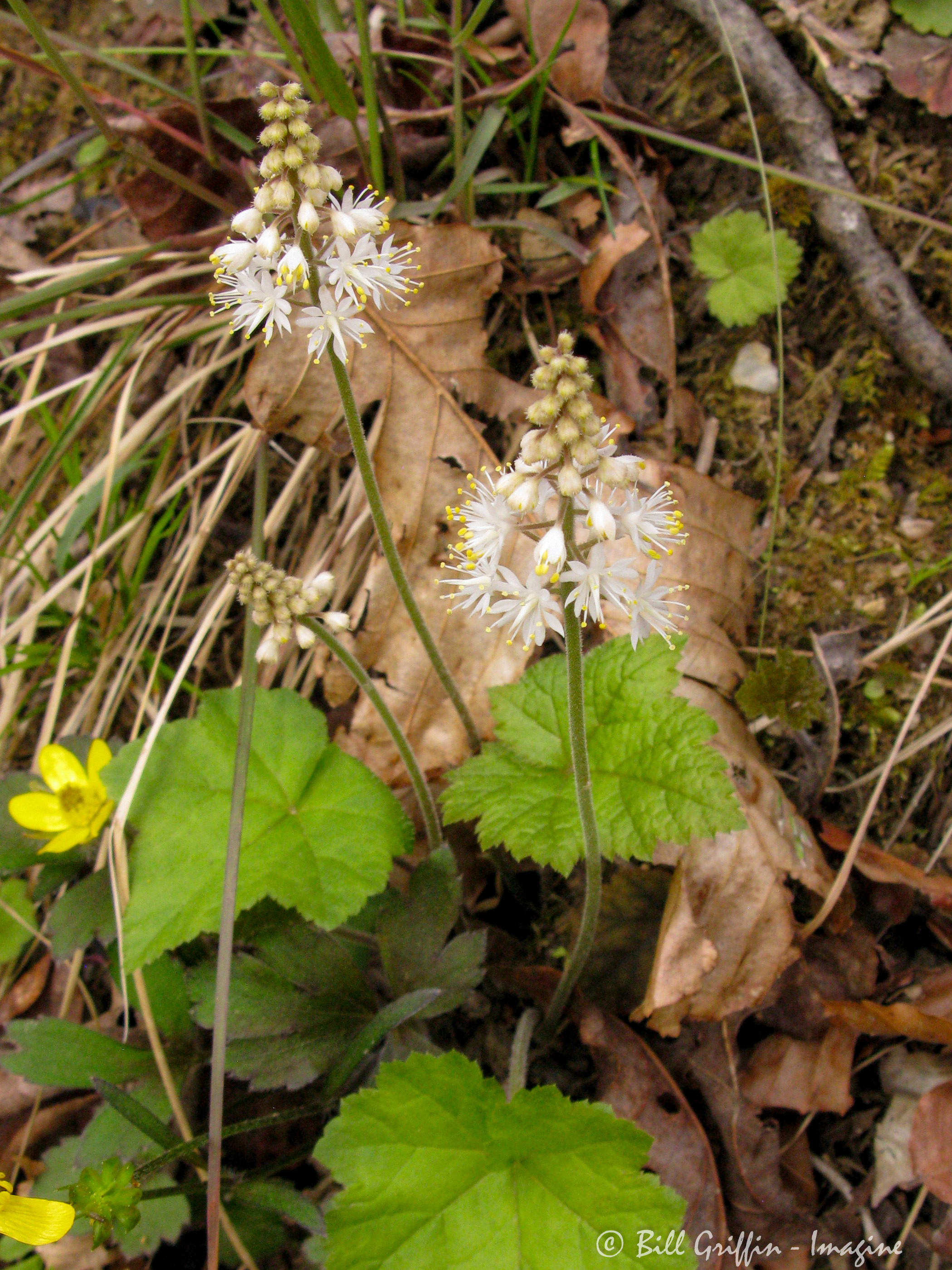
Foamflower
.
The last day of March – at the edge of the woods red maple, always impatient, always profligate, spreads its arms to offer a jillion winged seeds, the fire at its twigtips cooled to pale smolder. Deeper beneath the canopy leafbuds are swelling on oak and hickory, tangible pressured suspense, not yet quite to bursting. Ephemerals race to make sugar from thin sunlight before the overstory closes and their beds grow dark. Trout lily and hepatica already bloomed out; bloodroot roaring full throat; rue anemone flinging itself in galaxies up the ridge.
.
And what’s this? Foamflower has poked its first slender finger up between last year’s coppered leaves. A pale nubbin, a lifting spike, two or three then tomorrow a full maypole of tiny florets to comprise the rising inflorescence. Tiarella cordifolia, little crowns with heart-shaped leaves. What is its occupation in this temperate glade? What does it promise me other than its beauty?
.
Has it promised me anything? Should it? Perhaps I can tell you a story about the company foamflower keeps in this beech-dominated neighborhood: pussytoes, star chickweed, the throng of early blooming companions. Perhaps I’ll kneel to discover its native bee pollinators or wonder how its minute seeds disperse themselves. I might even recognize these felsic outcroppings and recall its family name, Saxifrage, Stone-breaker. But Lord of creation, save me from asking, “What good is it to me?” Expect a poultice of its leaves to heal my burns and scalds? Brew a tea to soothe my mouth and brighten my eye? Shall I read in its signature only whatever good use I can make of it?
.
On the seventh day the Lord looked out upon everything created and declared, “It is good!” And then rested. Never let me rest until I have looked around me, all around, water and stone, flower and tree, worm and beetle, turtle and bird, each of them good, in themselves and of themselves. Each one living usefulness that comprises its own being. What is my occupation in this temperate glade? What may I promise all these that surround me? To be a good companion in the community of all.
.

.
❦ ❦ ❦
.
O Doves
(Lima, Peru, 6 am)
and he saw the Spirit of God descent like a dove . . . Matthew 3:16
.
Shy ones, the shades of buttermilk
and cirrus cloud,
.
forgive the man and woman
cursing the scrabble of your bones on the
bedroom window ledge.
.
They are harried creatures
waking out of sleep’s egg
to the greasy clot of day.
.
They know only hunger,
which is the world’s stark treason,
.
and the mockery of iridescent necks
pecking the gray flagstones for crumbs.
.
How can they love the immaculate
cooing of your beaks so high in the blue air,
.
having forgotten the signs
of invisible things?
.
Maria Rouphail – Raleigh, North Carolina, USA
.
❦ ❦ ❦
.
the gilded angel on the spire / draws the sun to its dewy face
.
landscapes advance / and dig their hooks in the elongated shadow/ you drag behind you
.
a child’s sleep soothed by rain’s ticking / on the other side of the earth
.
an accordion of hands fixing my hair
.
I smooth my quilt, where her dress scraps are stitched
.
a pair of wired gold rim glasses / like John Lennon’s
.
the water above the springs squeaks like pebbles
.
Here is the plain brown envelope with the hand-printed address and the Pete Seeger postal stamp. I slip out the slender booklet, cardstock cover illustrated by Malaika Favorite. Inside a listing of poems and their poets – Bulgaria, North Carolina, Wales, Macedonia, Texas, Ireland. And then the saddle-stapled pages, their lines wandering in the familiar, distinctive font, and the words . . . language . . . images.
.
After reading many issues of Visions International over many years, I still wonder how editor Bradley Strahan draws these voices to him. How he creates this international community of human soul. I wonder how he accomplishes it, but I may be learning a bit of what he is listening for, what he seeks and chooses as he compiles each collection. Even more compelling than the stories the poems tell are their images: elemental, bedrock, true. I read phrases that ring with harmonies I’ve never quite heard before and yet they strike as perfectly right and correct. The language is new and yet it enters me and becomes me. (And I have to confess, there is just something about those Irish poets.)
.
Here are old neighbors, like Maria Rouphail from Raleigh and Jessie Carty from Huntersville, but here are my new old neighbors from every corner of the earth, all drawn together through their poems. Drop Bradley a line and join the community.
.
Visions International / 309 Lakeside Drive / Garner, NC 27529 – 4 issues = $25
.

.
❦ ❦ ❦
.
Drive
. . . roll down the window, and let the wind blow back your hair.
+++ – Bruce Springsteen, Thunder Road
.
My first love and I would circle the Blue Ridge
listening to Thunder Road, caught in a spiral –
the song, the earth, and us – a springboard
for leaping. Ancient and settled,
those mountains, a silhouette absorbing music
from our high school parties at the VFW.
Moths and gnats reduced to a fever
clouding porchlights, while kissing was its own
stratosphere. Who needed to breathe anyway?
Not when you’re a new mythology
sharing sixpacks of beer and meadows jacked
in the sweet everlasting – a wildflower
native to the state from which we’d grown.
We kept the geographies of each other’s
bodies beneath our tongues, but the sky
was an impossible parallel. Never mind that
we craved nothing linear. He and I, divergent lines,
a palm reader would have said about the future,
lanterning us in, cloud-swept from the open road.
W didn’t we marry at eighteen, honeymoon
nearby at the Peaks of Otter like all the other
teenage brides? You never asked me if I wanted to
stop. The truth is, I didn’t. I needed to witness
the horizon unobstructed by mountains
where trees shook colors from their crowns,
their roots tangled in bedrock. It was
something of a dance, the way our feet flew
over tar and gravel, spun around blind turns.
The valley that had fevered and pushed us out,
lay spent and sprawled beneath the open windows.
Those nights we rumbled through, we left nothing
but music growing fainter until it was gone.
.
Laura Ross – Mount Dora, Florida, USA
.
❦ ❦ ❦
.
.
.





 V E R S E and I M A G E
Very true. And not that she ignores the grief and woe of living but somehow makes all of life a…