Feeds:
Posts
Comments

Posts Tagged ‘NC Poets’

 . 
[with 3 poems by Regina YC Garcia]
 . 
Maybe God is the Moon
 . 
Maybe it was the Moon
that bore me up
placed me on its Moon back
when my light was low
so low I could not speak,
could not utter, when I was
sliced and excluded from
my own voice.
 . 
Maybe it was the Moon that
circled me through stages,
plunged me into cold and
silent darkness, turned me away
from the light of a prideful sun,
shocked and awakened my skin,
nestled me in craters where my
breath did not matter, allowed me to
emerge in stages so that I,
perched high, could witness that
indeed, the wages of living is Death,
paid early or late, and the tides
will live longer than I
 . 
Maybe it was the Moon that tenderly
slid me down its beam back into the fray
reminded me of how to walk, to hide, to emerge
to cry for, to try to find a
human space of other MoonMadeOvers
 . 
Maybe it was the Moon that reanimated
my soul, filled it with purpose, taught me
how to line this pathway back to wherever
I need to be . . .
 . 
Regina YC Garcia
from Whispers from The Multiverse: Poems from the AfroDeep, Willow Books, Aquarius Press; © 2025
 . 
❦ ❦ ❦
 . 
With every passing year we know there is more we don’t know. We have made better and more detailed maps of the surface of the moon than we have of the floor of our own oceans. When we look out into the cosmos we aren’t certain whether it would look the same to any observer from any different space or time, and we wonder: do the same laws of physics apply everywhere? The stuff that makes the sun and the earth, that makes felines and fish and blackflies, that makes oak trees and brain cells, the “ordinary matter” of atoms like Carbon, Hydrogen, Oxygen, and all those other elements, all that stuff only adds up to 15% of the matter in the universe – what is the other 85%?
 . 
The word galaxy derives from Greek, the same root as galactose, milk sugar: the Milky Way, our home sweet home. In the 1960’s astrophysicist Vera Ruben and her collaborator Kent Ford build the most advanced cosmic spectrograph to date. They used it to measure the spins of distant galaxies, their rates of revolution. The data didn’t add up. When Dr. Rubin estimated each galaxy’s mass (based on its luminous stars), it should be spinning far more slowly than their measurements showed. A whole lot of mass was missing. Were Isaac Newton and the laws of gravity wrong, or did the galaxy contain vast quantities of matter Rubin couldn’t see? Sixty years later and physicists still don’t know exactly what Dark Matter is — maybe WIMP’s (weakly interactive massive particle), maybe a proposed theoretical particle they named axion, maybe something even weirder. They know they don’t know.
 . 
The Vera C. Rubin Observatory is now coming online in Chile. It uses the largest digital camera ever produced (3.2 gigapixels) to create wide-field images of the entire Southern sky every few nights as it pursues its LSST mission, the Legacy Survey of Space and Time. Besides mapping the Milky Way (perhaps in more detail than maps of our own oceans’ floor) it will study Dark Energy and Dark Matter. Tonight I’ll be reading the final chapters of Lonely Hearts of the Cosmos by Dennis Overbye. He follows the lives and discoveries of twentieth century cosmologists like Hubble, Sandage, Hawking, Rubin as they ask the big questions: How old is the universe? How big? How did it begin? What is it made of? And Why?! Astrophysicist Overbye wrote his book in 1991. With every year that has passed since then, I know there is even more that I don’t know!
 . 
 . 
❦ ❦ ❦
 . 
Brown Girls Jumping
 . 
While seeing The Original Pinettes at Bullets NightClub, New Orleans, Louisiana
 . 
I went to Louisiana
Me, a North Carolina Bama
& I found my power
in my hair
the hair that I shook
to an all-girl brass band
Yea . . . the baddest
The trumpets blared &
the tuba thumped &
the Brown girls jumped
& shook that hair &
didn’t care
if they had a little
a lot
or none
. . . didn’t care
what vile people said
Their manes were present
or invisibly gifted through
special dispensation from God
An aura just
flowing
around their shoulders
down their back
swinging
blowing
showing the world that
it doesn’t matter what people say
Their strength comes from some
ethereal
divine
supernatural
sublime force
cloaked in music &
revealed as a spirit
felt behind
closed eyes
tingling in
dancing feet &
snapping fingers
The train from their manes
envelops
endows
entreats
favor and power
See, if Delilah had really felt her own
She would have left Samson alone
For his emasculation did not lead to her divination
Swing your hair, Brown girls &
cast your cares
to that which protects & inspires
your own strength
Brown girls jumping
Music thumping in NOLA
Me, a NC Bama on a holiday mission . . .
taking two fish, a few loaves
and a little hot sauce . . .
Hands folded in prayer . . .
. . . praying that this holy meal multiplies
before my season ends.
 . 
Regina YC Garcia
from Whispers from The Multiverse: Poems from the AfroDeep, Willow Books, Aquarius Press; © 2025
 . 
❦ ❦ ❦
 . 
Regina Garcia is a Black Whitman. She summons and channels the ancestors – within her there are multitudes. She sings the Black body electric. Songs loud and joyful, songs longing and plaintive, elegy and celebration and prophecy all flow from her pen. The voices that whisper from the multiverse crack open dimensions and crack our minds open to reveal a person, a family, a people leaping to reach for our hands and dance us into new knowing. Before I read Whispers from The Multiverse, I pattered along in a different cosmos. I am now filled with joy to have crossed into this real one.
 . 
 . 
Read more about Regina YC Garcia and Whispers from The Multiverse HERE, and order your copy from Willow Books/Aquarius press HERE.
 . 
Regina’s written and video poetry has been published widely in a variety of journals, reviews, compositions, and anthologies such as South Florida Poetry Journal, Main Street Rag, The AutoEthnographer, Amistad, The Elevation Review and others. Her poetic work for The Black Light Project, a documentary focused on real and often untold narratives of African American males in the United States, was featured on a Mid-South Emmy-Award winning episode of PBS Muse. She teaches English and is the Coordinator of Global Programs at Pitt Community College in Winterville and Greenville, North Carolina.
 . 
flower

Stellaria pubera – Star Chickweed

 . 
❦ ❦ ❦
 . 
Windsor of the Water
The Truth and Speculation of Windsor Wade
 . 
Sea misted brown skin
skirted the winds and battled the waves
that he might see a glorious
future despite his inglorious condition
. . . that his conscription to pulling nets
would not be for naught
thinking beyond bondage and living beyond
shackles . . . H would see Shackleford Banks and Jack’s
Lump as victory for himself . . . . . . for his family
 . 
. . . and so from Windsor to Nancy to
Rachael to others to me . . .
We still sing the victory
 . 
Ancestral voices still trill in the wind
as today, the wild horses run unfettered, free
 . 
Regina YC Garcia
from Whispers from The Multiverse: Poems from the AfroDeep, Willow Books, Aquarius Press; © 2025
 . 
❦ ❦ ❦
 . 
The Cosmological Principle states that the universe, when observed at a large enough scale, is homogenous – smooth, not lumpy – and that the properties of the universe are the same for all observers. In other words, the laws of physics operate the same in every part of the universe and the universe is not just playing with us when we try to observe it.
 . 
❦ ❦ ❦
 . 
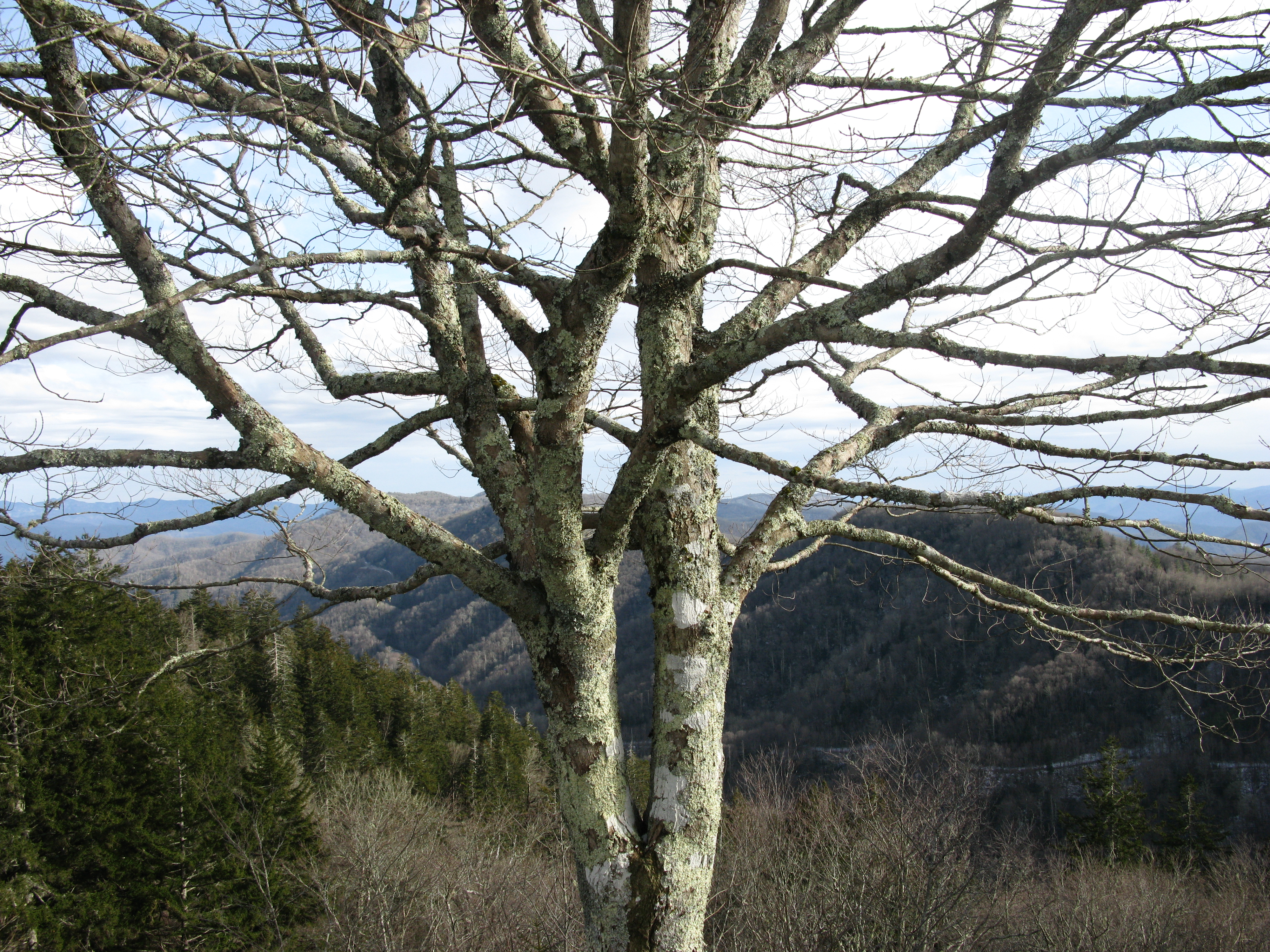
Doughton Park Tree 4/30/2022

Read Full Post »

 + 
[poems from BRILLIG: a micro lit mag]
 + 
Ghazal for sunrise
 + 
Wrens are first out of bed at sunrise. Their sharp warbled song suits the sky’s deep red at sunrise.
 + 
Down the hill a deer slips out of mist. Then her fawn, ready to be fed, at sunrise.
 + 
Then a fieldmouse, light as a wisp, climbs a spent coneflower with most careful tread – at sunrise
 + 
The night’s winds are done. Above, only a last fading star, and a few clouds sill ragged at sunrise . . .
 + 
I join this pause to which all things have led (at sunrise), I close my eyes on what he last said, at sunrise.
 + 
Matt Snyder
from BRILLIG: a micro lit mag, Winter/Spring 2025
 + 
❦ ❦ ❦
 + 
Gravity is an illusion, a charade played out behind the scenes by matter as it warps spacetime. The illusion is complete within my deep never-spoken sense that somehow the universe ponderously orbits me. Where is my wider view? Long lens and tight focus blur everything except the center where for one moment light falls.
 + 
Thoreau sits beside the pond for hours so long and so still that the otters have come to consider him simply a natural element within the universe they inhabit. They pursue their plashy play all about him unperturbed. When the otters finally leave for elsewhere, Thoreau walks to town to buy a pair of socks.
 + 
Oh Mr. Lennon, my beloved, my idol, is life really what happens while you’re making other plans? Or is life the plans the universe has made for you whether you subscribed to them or not? Evidently the universe is not a bus you can hop off at the penultimate stop before you reach the bad side of town.
 + 
I’m trying to figure this out. The mockingbird doesn’t shut up when my neighbor fires up his Terrafirminator and attacks the clover. Just sings louder, it seems. And me? An hour walking in the woods, sweat and deep cleansing breaths, but driving home I hear again that last snarling conversation and begin another rehearsal of its next installment in my head. I thought I might have hopped off that bus, but no.
 + 
The titmouse perches above the peanuts I’ve laid out and squeaks and scolds with his head thrown back, ten iterations. Then he swoops down and pecks the hell out of them. What was he saying up there? “These are mine, bug off!” – or – “Hey world, good eats here!” What am I saying to the universe? Scratch that – what am I saying to myself?
 + 
 + 
❦ ❦ ❦
 + 
Vim
 + 
Your clay pots are stacked into towers.
Stakes propped in the garden shed corner.
Out-of-use stuff claims off-season place:
a montage of tools ready to oblige.
+++++++++++++++++++++++++++ Regret
drops by every day, helps leisure select midwinter
pastimes. Our most-recent waltz only a twitch
in the calf on gray afternoons. So much
overlooked when we busy ourselves.
 + 
I rake leaves wedged into fences. Sharpen tools
in case we plant again. Zest fallen out of favor,
the Almanac forecasts weather cycles, but desire
for a new garden is shelved.
++++++++++++++++++++++++ Verve fastened
behind the shed door, our pursuits dwindle.
Intuition must carry us through seasonal tedium,
and each loss it festers. You stare at me and ask,
+++++++ Tell me again where do seasons go?
 + 
Sam Barbee
from BRILLIG: a micro lit mag, Winter/Spring 2025
 + 
❦ ❦ ❦
 + 
 + 
When Deborah Doolittle first placed in my hands a copy of her hand-made lit mag BRILLIG, all I could say was, “O Frabjous Day!” The slim booklet is delicate yet solid with surprising heft; it is simple in its turning pages yet subtle and complex with its interlockings and interweavings, concealing treasures, revealing them. But glue and ink and color are not enough to create treasure. The words, the lines, the flow, the side-steps and juxtapositions – these poems by ten authors link arms and pull me into their circle.
 + 
If you were to step into my office and attempt to calculate the mass of processed printed-upon cellulose that surrounds you, you would intuit that I have a thing for words on paper. Oh yes, most every day I read from my bright paper-white monitor the poems the internet offers up to me, but if you were to step onto my back porch today when it’s 85 degrees and 85 percent humidity and discover me there with a book nonetheless, you would intuit that real creative thought requires an adequate escape velocity from computer gravity. And if a print journal’s appeal is an order of magnitude greater than poems online, then art and quirky originality, BRILLIG, is an order greater yet.
 + 
I unfold the pages, read backwards and forwards, turn and return. These poems surround me as if I am an element of the universe they inhabit. While they pursue their plashy play, I will abide in their circle. I have all the socks I need.
 + 
 + 
Deborah Doolittle contrives and creates BRILLIG: a micro lit mag with the help of artist friends and submissions of poetry. Each issue is published in a limited edition, but she no doubt has one she would like to send you and will make an extra copy if you subscribe.
 + 
 + 
❦ ❦ ❦
 + 
Onions
 + 
I think of you prepping risotto,
stirring the pan while you add
onions, red wine and broth.
you wore a red-striped apron.
I have it still. Should have worn it.
My shirt is dotted with oil.
Oversized sweet onions
roast in the oven, ready
to add life to a sandwich.
My eyes leak. Nose drips.
I yank a paper towel off
the rack and remember.
 + 
Patricia Joslin
from BRILLIG: a micro lit mag, Winter/Spring 2025
 + 
❦ ❦ ❦
 + 
 + 
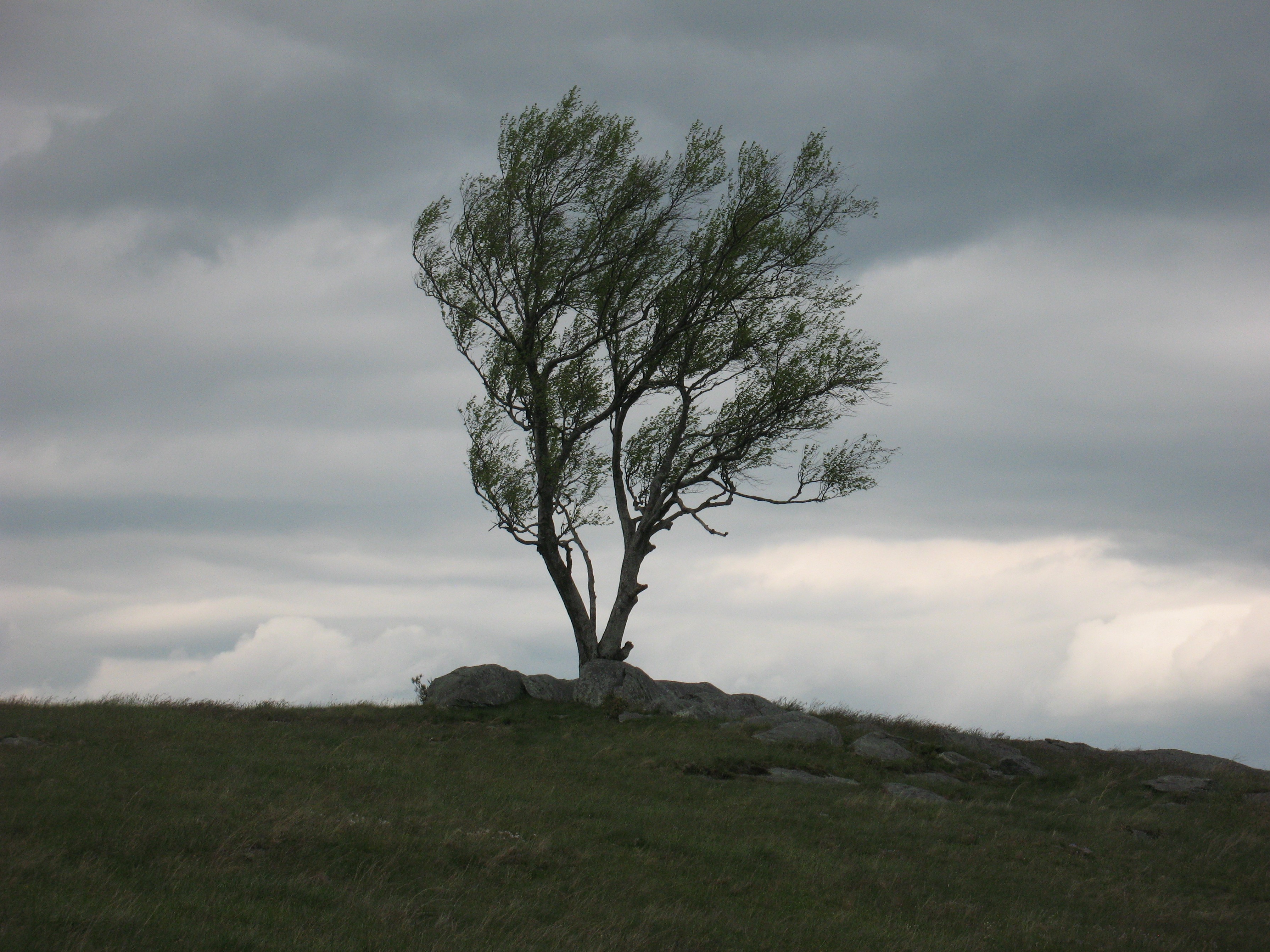
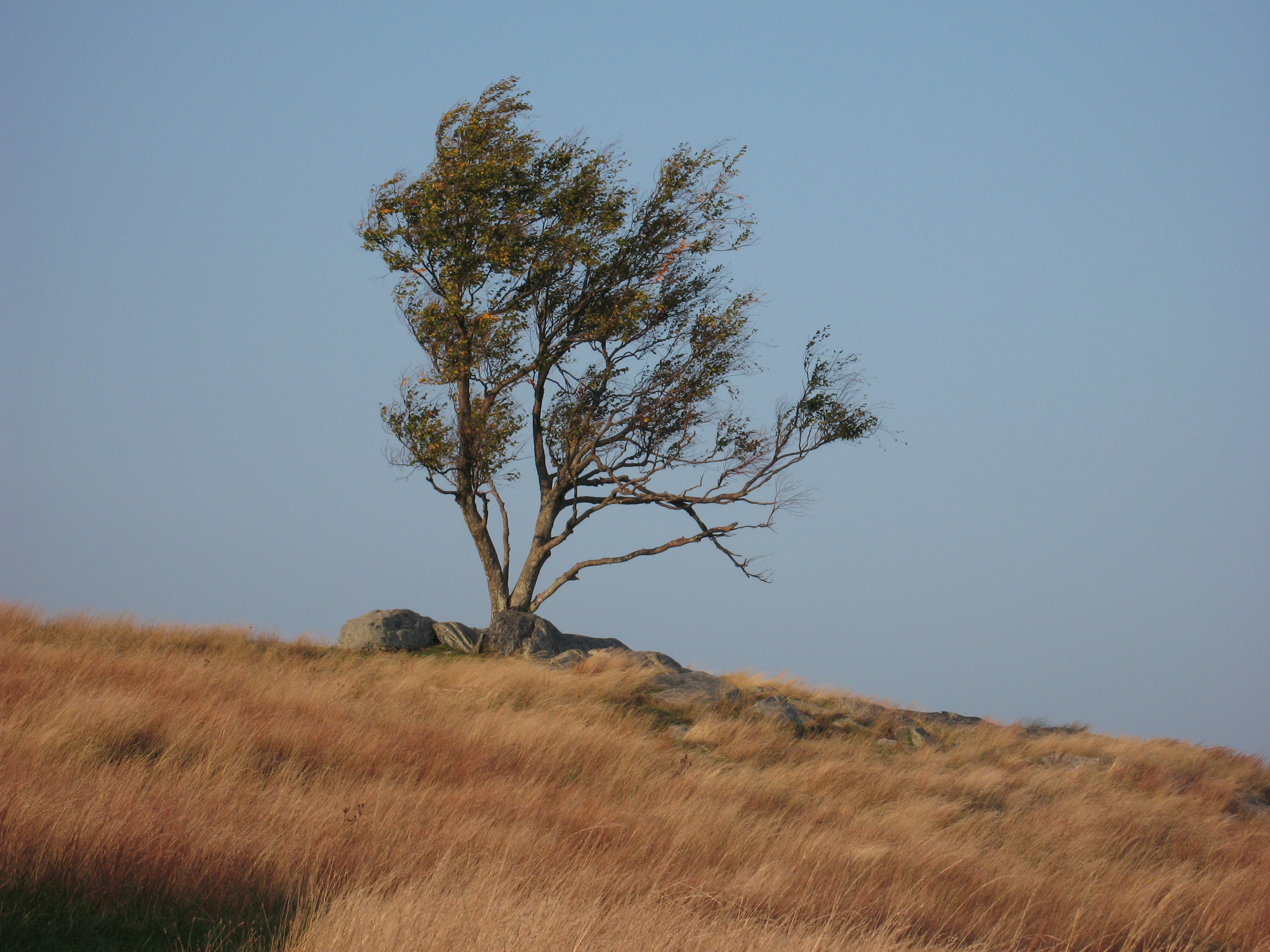
Doughton Park Tree 2021-10-23
 + 

Read Full Post »

 . 
[with 3 poems by Joan Barasovska]
 . 
The Box
 . 
They are quiet in their photographs,
my mother’s dead.
 . 
They speak to me, entreat me to explain.
 . 
A magnifying glass held to their fading faces
proves scant help.
 . 
To listen, I must listen to myself,
to memory.
 . 
Joan Barasovska
from Unblessed, Unsung, Main Street Rag Enterprises, Edinboro PA; © 2025
 . 
❦ ❦ ❦
 . 
To speak with the dead, one must listen to oneself.
 . 
Before my mother died we talked about dying. Her dying. When I helped her fill out the living will forms. Before the first visit from the palliative care nurse. As her health took yet another sudden stepwise decline. I asked her, not at all for the first time, “Do you want to go to the doctor? To the hospital?” “No. No.” And then we didn’t talk about it any more.
 . 
Instead we talked with the dead. Some people approaching the end of their life close themselves off. They draw the veil about their diminishment and turn inward. My mother, though, turned outward, like a great flower that slowly pivots throughout the day to face the sun. Like one of those giant radio telescopes that can hear the earliest whispers of creation, she became a passive receptor who welcomed anything anyone desired to bring her. I brought her the dead.
 . 
Photographs of the dead. Some were in antique frames, some dropping from ancient scrapbooks, most of them loose in envelopes or the bottom of cartons. She and I collected them all into a grand new album and along the way we told each other stories. “Isn’t that Lucy and Ted just married? Linda and I met them at Nana’s reunion 50 years ago. And there’s you with Lucy, both teenagers. Now here’s Carlyle in the little car Grandpop built for him. I guess it was already obvious he’d be crazy for cars the rest of his life.”
 . 
Some stories she told me; some I imagined while she fingered the photos and nodded in silence. At the moment of shutterclick, each photo was created within its world of vast significance. Those worlds dissipate, decrescendo in brilliance like photons that have traveled light-years to reach our eyes, red-shifted with distance in an expanding universe. But during those moments together my mother could enter their world and hear them, the dead, their voices.
 . 
Next month it will have been a year since my mother exhaled her last breath. Her living essence has joined the whispers of the cosmos. Her essence still lives in me and all who knew her and who have not yet joined the dead. Yesterday I found a photo Grandpop took of Mom at age 10 surrounded by her wonderful collection of dolls. There it is, that hint of a smile on her lips, in her eyes, the joyful teasing hint I have seen in person a million times. But looking at that photo is not when I miss her most. The pang of absence strikes me most sharply when a random question pops into my head: “Did you have boy friends before Dad? What was it like to be living 500 miles from Nana and Grandpop when I was born? Who is that standing behind you in this photo?”
 . 
Some of the questions I may once have asked but don’t recall her answers. Most are questions it never occurred to me to ask while we were together on the earth. Now when I pull that grand album off the shelf, her picture will also be among those gone mute. But not completely so. Memory tangles and untangles itself to create new stories. I will listen to my heart. I am now the one who must speak with the dead.
 . 
 . 
❦ ❦ ❦
 . 
In Shul on Rosh Hashonah
 . 
Elizabeth is home with the baby; Ben sits beside his sons
on the hard bench. All three wear yarmulkes, Ben is draped
in his tallis – Reuben and Joseph are too young. The black
straps of tefillin tightly encircle his left hand and arm;
the boxes press into his forehead and bicep.
 . 
The drone of men praying, the vibrato of the old rebbe raised
above their voices, the distant murmur and rustle of women
and girls in the balcony above, and Ben’s own chanted Hebrew,
eyes closed, davening deeply – all are as necessary and familiar
as his heart’s beats and his quiet breaths.
 . 
His boys can barely wait for the blowing of the shofar,
the twisted, ridged ram’s horn the see near the ark.
Ben hears Joe whisper to Rube, “When?” and Rube’s loud
“Shush!” Ben is clean-shaven, unlike the older men. He goes
daily to Boris Adelman, the barber on 21st Street, who keeps
a chin mug painted with his name, Benjamin Nax, on a shelf.
His disc of soap, his ivory brush. Boris strops the razor on a
lng leather strap It’s sinful to let his mind wander like this
on a Day of Awe. He gives thanks for his children: Rube,
a little man; Joseph, their angel. now Elsie.
 . 
He was once a boy sitting with is father and grandfathers
in shul. His chest hollows around their absence. They could easily
be dead, and his uncles and mother, lined up to be shot on the
edge of a ditch. No wisdom from grandfathers for his boys.
 . 
The cantor raised the shofar to his lips and fills his lungs.
Joe has fallen asleep leaning against him, and starts awake at the
first blast. Intervals of blast and chant: Tekia! Sevarim! T’ruah!
Renew our days! Mercy is aroused! Judgement is removed!
Reverberating in the small chilly building, this uncanny sound
of the desert, the First Temple, the shtetl, and the ninety-nine
synagogues of Minsk.
 . 
Ben takes his boys’ hands, and the three are surrounded
on the sidewalk by greetings: L’shonah tovah! Gut yontif!
A gut gebentsht yor! It isn’t his name, Benjamin Nax.
It was changed at Ellis Island, from Binyomin Nakhimovsky.
What is there to believe, in America?
 . 
Joan Barasovska
from Unblessed, Unsung, Main Street Rag Enterprises, Edinboro PA; © 2025
 . 
❦ ❦ ❦
 .  .  .  .  . 
Love flares in the sleeper’s dream,
blue as a Sabbath candle flame, warm as
the kitchen of her grandmother’s house.
from Elizabeth’s Travels
 . 
Her story begins in cruelty concealed and unspoken. It wends its way through hardship and regret, between guilt and resentment. It ends as it started, in death. But that is not all. That is only one harsh thread of the story. The story feeds itself with family love and devotion. It clings to hope in darkness. The story opens its pages because of the expansive heart of the one who desires to be its guardian, its intrepid explorer, its teller. Thus the journey of Unblessed, Unsung by Joan Barasovska.
 . 
There is a bit of mountain trail that winds across a mile or two of bald slopes at Bluff Ridge along the Blue Ridge Parkway. If the summer grass has grown waist high and the cows have not been pastured there this season, the trail is obscured, untraceable except for this: in the 1930’s, the Civilian Conservation Corps placed concrete markers, posts two feet tall, to guide the hiker along the path. Joan has found her own waypoints to reveal her own path into her past: a few fading sepia photographs; recollections written down by cousins; conversations with a last survivor. To these she has applied the poet’s toolkit, observation and imagination, to render this book and bring it to life.
 . 
Some of the questions Joan must ask about her grandparents have discernable answers. Where did they grow up? What year did they arrive in America? But many answers are as intangible as smoke from an extinguished candle and as difficult to clasp. Joan uses what clues she can amass – a facial expression in an old photo; a fragment of tale from a distant cousin – to build an enlarging picture. If we don’t always know exactly how this man and that woman felt, at least we know that they did feel and we can hope to project their circumstances into our own dilemmas and responses. Considering another person’s memories is a fruitful impetus to reliving our own memories. At the beginning of Unblessed, Unsung Joan quotes Zora Neale Hurston: There is no agony like bearing an untold story inside you. Here is a story borne and bared. May these poems now weave and tangle more stories, a never-completed tapestry.
 . 
 . 
Joan Barasovska lives in Orange County, North Carolina, USA, and has authored three previous poetry collections. Unblessed, Unsung is available from MAIN STREET RAG.
 . 
 . 
❦ ❦ ❦
 . 
Listen
 . 
If I told you I hear their voices
in the apartment on Christian Street,
would you visit there with me?
 . 
At the table where they take their meals,
or by the stove, where Elizabeth stands,
adding potatoes to stretch a soup?
 . 
Between husband and wife,
what heat, what chill, what
balance of force and yield?
 . 
The rooms are scrubbed raw-clean,
it’s crowded, voices are raised,
the three children witness everything.
 . 
It’s a time before parents learned
to safeguard childhood. If I told you I hear
cruelty, in word if not in deed, trust me.
 . 
Joan Barasovska
from Unblessed, Unsung, Main Street Rag Enterprises, Edinboro PA; © 2025
 . 
❦ ❦ ❦
 . 
 . 
 . 

Read Full Post »

« Newer Posts - Older Posts »