Posts Tagged ‘NC Poets’
Ear Worm #1A
Posted in family, music, tagged Bill Griffin, Dorianne Laux, Duet, Jacar Press, Joseph Millar, NC Poets, poetry, Southern writing on August 16, 2024| 11 Comments »
.
[with poems from Duet by Dorianne Laux and Joseph Millar]
.
Listening to Paul Simon
.
Such a brave generation.
We marched onto the streets
in our T-shirts and jeans, holding
the hand of the stranger next to us
with a trust I can’t summon now,
our voices raised in song.
Our rooms were lit by candlelight,
wax dripping on the table, then
onto the floor, leaving dusty
starbursts we’d pop off
with the edge of a butter knife
when it was time to move.
But before we packed and drove
into the middle of our lives
we watched the leaves outside
the window shift in the wind
and listened to Paul Simon,
his tindery voice, then fell back
into our solitude, leveled our eyes
on the American horizon
that promised us everything
and knew it was never true:
smoke and cinders, insubstantial
as fingerprints on glass.
It isn’t easy to give up hope,
to escape a dream. We shed
our clothes and cut our hair,
our former beauty piled at our feet.
And still the music lived inside us,
whole worlds unmaking us in the dark,
so that sleeping and waking we heard
the train’s distant whistle, steel
trestles shivering across the land
that was still our in our bones and hearts,
its lone headlamp searching the weedy
stockyards, the damp, gray rags of fog.
.
Dorianne Laux and Joseph Millar
from Duet, Jacar Press, Durham, NC; © 2016
.
❦ ❦ ❦
.
Here I am again, six years old this time, sitting cross-legged on the floor beside the pinnacle of 1959 technology. I wind it up, carefully lay the 6-inch plastic disc on the little turntable (it’s bright yellow plastic, I will never forget that), and position the needle at the outer groove. The wind-up box is white and red and has a picture of Mickey Mouse grinning; it looks like Mickey’s arm is what holds the stylus. The needle itself juts from a hollow flat cylinder, sort of like a tuna can with perforations; the little holes are what transmit the sound. No electronics, no electricity involved.
.
I push a lever and the disk begins to rotate. The needle finds its groove (at least a decade before finding one’s groove will mean anything to me) and in between all the scratches from a hundred earlier renditions – music! The little record finishes, I lift the needle from where it’s begun making little whump whump sounds with each revolution, I place the needle back at groove one, and it starts all over again.
.
And even so my mother remained sane to her dying day.
.
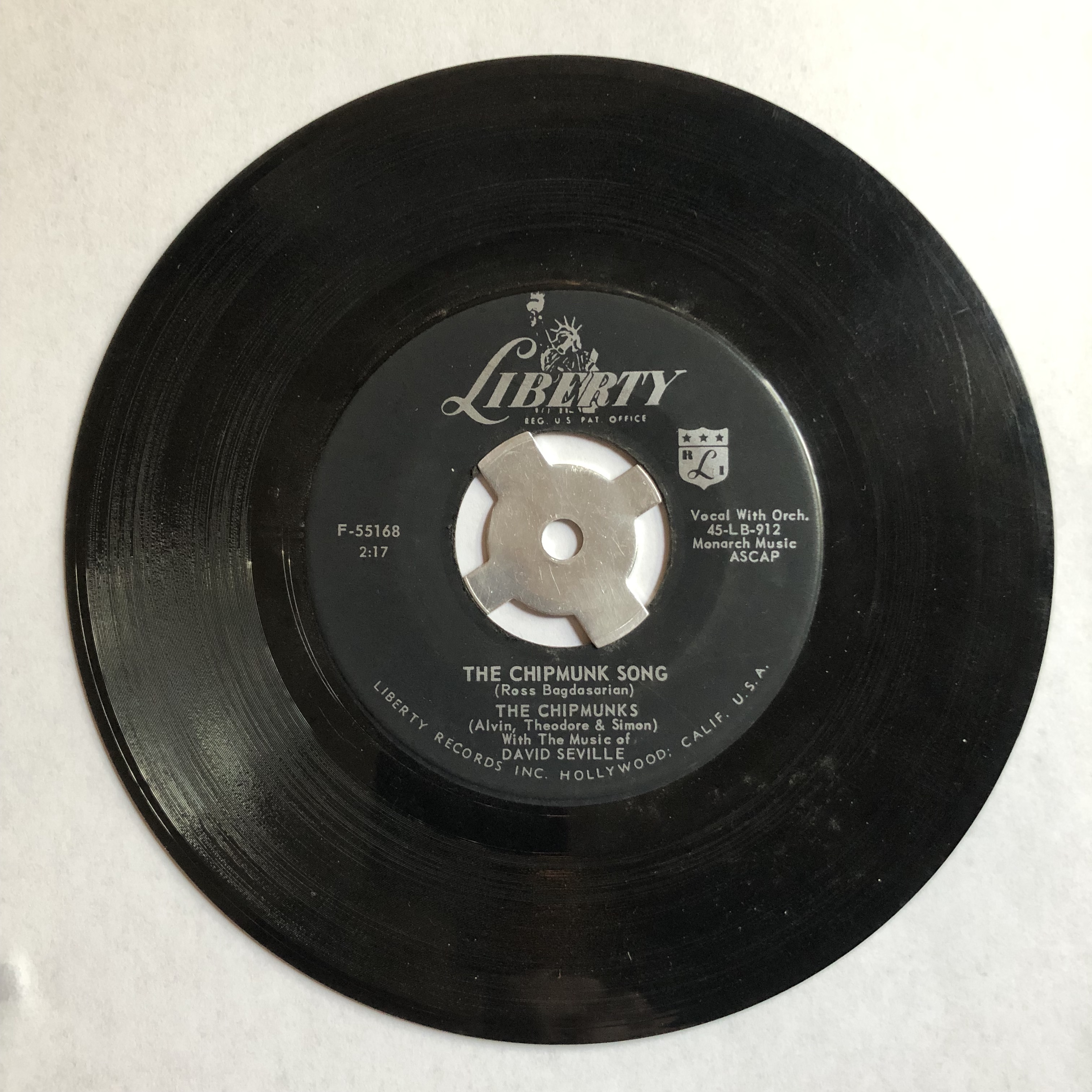
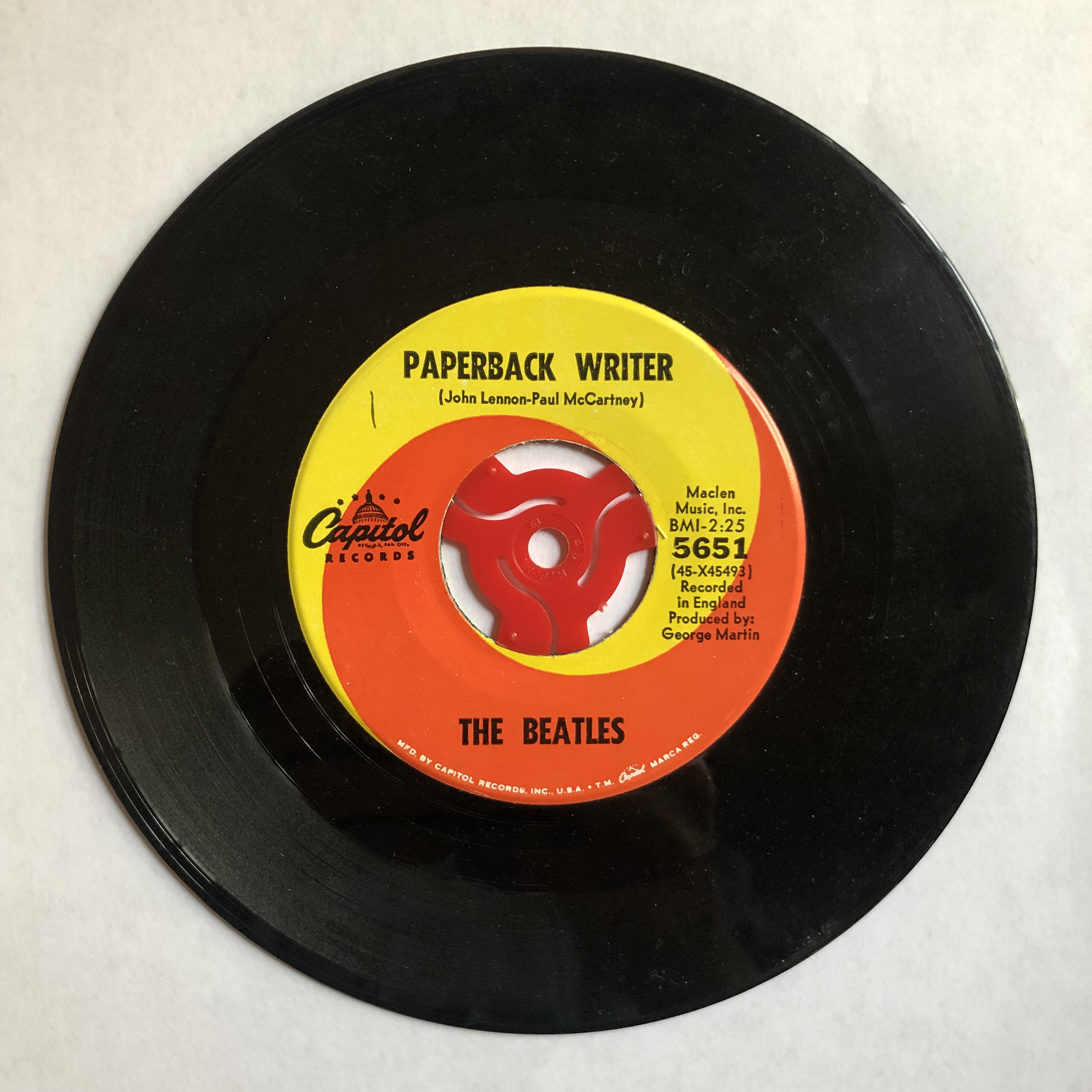
As the years passed, Mom and Dad began to let me listen to their records on the Hi-Fi (mono, not stereo; Uncle Carlyle soldered it himself). It never seemed to drive them crazy to hear Peter and the Wolf or The Music Man a dozen times a day, or even Bobby Darin singing Mack the Knife. Hard core. Finally the big day – I was 11, I had saved my birthday money, I had laid awake at night tallying which of their songs were included: I bought my first LP, Introducing . . . The Beatles.
.
Introducing . . . is an anomaly in Beatles discography. It was released by Vee-Jay Records because Capitol/EMI had farted around about agreeing to a first USA Beatles album and Vee-Jay scooped them. Apparently it was only on the market for a year or so before the suits prevailed and forced them to cease and desist. Anyhow, I listened to that vinyl disc about a thousand times before I bought Beatles ‘65. In fact, I might just go slap it on the old turntable right now. Scratches and all. Please, please me!
.

.
❦
.
And that little yellow record? Easter Parade. Sixty-five years later I still find no evidence that there has ever been such a parade, but now the melody has wormed it’s way in again: “In your Easter bonnet, with all the frills upon it . . .” And even so, my mother somehow remained sane.
.
.
❦ ❦ ❦
Mick Jagger (World Tour, 2008)
.
He stands on stage
after spot-lit stage, yowling
with his rubber mouth. If you
turn off the sound he’s
a ruminating bovine,
a baby’s face tasting his first
sour orange or spitting
spooned oatmeal out.
Rugose cheeks and beef
jerky jowls, shrubby hair
waxed, roughed up, arms
slung dome-ward, twisted
branches of a tough tree, knees
stomping high as his sunken chest.
Oddities aside, he’s a hybrid
of stamina and slouch,
tummy pooch, pouches under
his famous invasive rolling eyes.
He flutters like the pages
of a dirty book, doing
the sombrero dance, rocking
the microphone’s
round black foot, one hand
gripping the skinny metal rod,
the other pumping its victory fist
like he’s flushing a chain toilet.
Old as the moon and sleek
as a puma circling the herd.
The vein in this forehead
pops. His hands drop into fists.
he bows like a beggar then rises
like a monarch. Sir Mick,
our bony ruler. Jagger, slumping
off stage shining with sweat.
O please don’t die. Not now,
not ever, not yet.
.
Dorianne Laux and Joseph Millar
from Duet, Jacar Press, Durham, NC; © 2016
.
.
❦ ❦ ❦
.
Uno Voce – when Sandy Beam rehearsed an a capella selection, he required us to blend our tone with each person singing near us until it was as if we all sang with one voice. Vibrato is anathema; sibilance is sin! Of course, Sandy would have been happiest if we had all been boy sopranos, but at least we could strive for that brilliant transparent evocation of light he desired.
.
Light and truth evoked by a single voice – not at all unlike these poems in Duet. They are each about music – Bo Diddley, Lightnin’ Hopkins, Paul Simon, James Taylor, Ladysmith Black Mambazo, Cher. They build a portrait in layers of color, tone, and years, filled with the music that infuses our past and vibrates in our bones to create our present. And they are written by the duet of Dorianne Laux and Joseph Millar, but the tones and melodies blend until we readers hear a single voice.
.
Not an ear worm in the bunch.
.
❦
.
Duet is one in the continuation of the Greatest Hits Series, originally conceived by editor Jennifer Bosveld at Pudding House Press in 2000 and acquired by Sammy Greenspan of Kattywampus Press in 2010. Jacar Press was asked to take over the series under the careful eye of series editor David Rigsbee in 2017. More about the book, the Series, and Jacar Press HERE
.
.
❦ ❦ ❦
.
.
.
❦ ❦ ❦
.
.
.

Treats
Posted in Imagery, Photography, tagged Adam in the Garden, AE Hines, Bill Griffin, Charlotte Lit, family, imagery, nature, nature photography, NC Poets, poetry, Southern writing on August 2, 2024| 10 Comments »
.
[with 3 poems by AE Hines]
.
A foot of new snow
.
and down the middle
+++++ of our icy street
a dawn congregation
+++++ of ravens, all blue-black
and wing, hunch
+++++ in their strange bureaucracy,
as if arrived to divide
+++++ the daily assignments. Even
at this age, I still see signs. Even
+++++ a gathering of black birds
on a snow-covered road,
+++++ a Rorschach test
that conjures a warning
+++++ in my anxious machinery:
.
an assembly of plague doctors –
+++++ with folded feather arms, dark
nodding heads. I wonder what
+++++ they are here to tell me.
None of us is promised green lights
+++++ and straightaways, but sometimes
the bloodwork comes back
+++++ quietly, the tumor
benign. Sometimes, just up the road
+++++ from where you lie in bed,
brakes give way and barrel
+++++ a terrified trucker across four
frozen lanes into your
+++++ could-have-been path.
.
AE Hines
from Adam in the Garden, Charlotte Lit Press, Charlotte NC; © 2024
.
❦ ❦ ❦
.
Imagine you really like to eat. No, I don’t mean you enjoy sitting down at the table, plate in front of you, bite by bite, chew & swallow, push away and say, “That was good!” What I’m talking about is when your eldest son calls and asks, “How’re you doin’?”, the first thing out of your mouth is, “For supper I had . . .”
.
It’s a blessing that Dad likes to eat. My experience from forty years of geriatric practice is that once you lose your appetite you’re going to have a tough time ever finding it again. The first thing Dad usually brings up when we talk is what he needs me to pick up at the store. He’s thinking two meals ahead, tonight’s supper, tomorrow’s breakfast. He can’t walk as far as the kitchen any more, he can’t rummage through the cupboards or the fridge, in fact there may not be many things left in life for him to enjoy, but he can think about something good to eat.
.
That’s why this morning I’m poking around in the freezer and shifting unidentifiables in the back of the refrigerator, holding a shopping list and a yellow pad. Besides chucking out the old and vaguely greenish, I’m making Dad a list. A “MENU” I’ll leave at his bedside. There’s a column for meals in the fridge, a column for freezer, and at the bottom is that most important header of all: TREATS. I found four kinds of cookies in the pantry. Four flavors of pudding we originally bought for Mom. Chocolate brownies with M&M’s his cousin June brought by. Some zucchini bread a neighbor dropped off (and it is good). Please don’t forget the Trader Joe’s Vanilla Ice Cream.
.
From here, then, it’s off to Harris Teeter. I’m sure I’ll see some more things Dad would like as I cruise the aisles. They say the olfactory sense is tightly cross-linked to the hippocampus – a familiar smell instantly evokes vivid memories of old associations. I suspect for Dad the gustatory sense is equally evocative. Maybe he needs a little country ham with red eye gravy. Maybe spoon bread or hushpuppies. Maybe I can find the recipe for Mom’s famous German chocolate cake.
.
In our final days, may we all treat ourselves to what brings us joy.
.
.
❦ ❦ ❦
.
Eden
.
I recall placing ripe plantain on the lowest
branch of eucalyptus, and the tree
filling with small wings: toucans
and motmots, a flock of miniature finches
dusted with pale blue chalk. There are so few
days I would – if I could – set on repeat
and live over and over:
+++++++++++++++++ Here, the man
I love, sight of him a reviving breath,
carrying plates of chorizo and fried eggs.
Then the two of us reclined in dappled grass,
drinking hot chocolate from a single,
chipped cup beneath prehistoric ferns
that tower and sway just as they must have
with the world still new.
+++++++++++++++++ I like to pretend
then too – didn’t I? – that we were the first
and last of our kind, a multitude
of wings beating the air under a sun
that never set, our queer, middle-aged bodies
never a day older.
.
AE Hines
from Adam in the Garden, Charlotte Lit Press, Charlotte NC; © 2024
.
❦ ❦ ❦
.
Some quiet evenings I go out / to sit with them, all the men / I’ve been . . .
.
When has there ever been an evening that quiet? A space filled with invitation and empty of demands? When has my mind ever been that pliant, willing to contemplate such things much less able? Is there a garden somewhere waiting for each of us, waiting for our return?
.
Adam in the Garden by AE Hines offers no simple answers but it certainly invites questions. These poems span many years and many situations; even more so they span the many conditions of one human person. Broken and reborn, dead and exalted – you nor I are not one immutable creature, none of us an unvarying beam transiting the years allotted to our individual existence. If we discover a quiet moment and stop to think, we may discover the many persons we have been and are being.
.
Where could there be such a quiet space? Turn the page. Again. The poet invites us to join him here. He makes himself vulnerable to our gaze. He makes no other demand on us than to enter the quiet with him, to be with him and with our selves. And truthfully, I confess that I need this! I need the quieting of all those voices, external but really mainly internal, the quieting which is required to read a poem. Not to escape myself but to sit down with myself. Thank you for the invitation and for the welcome. Thank you for the sharing. It is, I assure you, a treat.
.
❦
.
Adam in the Garden by AE Hines is published by Charlotte Center for the Literary Arts, Inc., through Charlotte Lit Press.
.
.
❦ ❦ ❦
.
Green Satin
.
++++++++++++++for Ginny
.
Perhaps, it’s not the drugs
when you tell me you plan
to come back as a tree, wearing
.
green satin gowns and scarves
made of wind. No more ridiculous,
you say, than dying, or your wig
.
teetering from the nightstand.
Last night, a cypress lifted its dark
roots from the earth, and lay down
.
Like a great, leafy-maned beast
across your yard, making room
for more morning
.
to flood your window, dawn
a spotlight across a hospice bed
where you labor over breathing,
.
a potter over clay, spinning
and kneading the mud of yourself
into finer and finer pieces.
.
“It must be time,” you tell me,
with summer’s sun shining
and sparrows flinging
.
shadows on your walls.
When even the cypress lies down
and points the way home.
.
AE Hines
from Adam in the Garden, Charlotte Lit Press, Charlotte NC; © 2024
.
❦ ❦ ❦
.
.
❦ ❦ ❦
Planting Orchids
Posted in Ecopoetry, Imagery, Photography, tagged A Coming of Storms, Bill Griffin, Ecopoetry, imagery, Les Brown, Main Street Rag Publishing, nature, nature photography, nature poetry, NC Poets, poetry, Southern writing on July 26, 2024| 6 Comments »
.
[with 3 poems by Les Brown]
.
Pause
.
I placed my hand on the moon
++++ to keep it from its course,
to stop time in the comfort of night
++++ when sleep subdues sounds
of machines and urgent voices.
++++ Starlight and still moon
are enough to guide my stroll.
++++ I cross the meadow
among sparse trees,
++++ where snowy crickets cry fast
with time kept by heat
++++ of past day’s searing sun.
I lie down and listen
++++ for the whippoorwill
whose call is rare now,
++++ watch fireflies wink love calls.
I will hold the moon until
++++ the world stirs and wonders
why the night endures,
++++ with dreams of Earth
where fires do not rage,
++++ floods do not drown,
spiraling winds cease,
++++ oceans retreat from shores
and the cricket cries slow
++++ once again.
.
Les M. Brown
from A Coming of Storms, Main Street Rag Publishing, Charlotte, NC; © 2024
.
❦ ❦ ❦
.
Light rain in the woods, droplets coalesce and cascade through the upper canopy, tuliptree, oak, & hickory, until they freefall onto our heads and shoulders. A fat drop flicks a browned leaf or blinks in the duff. We imagine small creatures leaping up from the earth and then they do! Angel-winged insects are bobbing up and down to touch the fresh damp with the tips of their abdomens, animated by moisture. Linda watches one female Cranefly, notices nearby a delicate floral spike with angel-winged florets, and says, “Look, it’s planting orchids!”
.
Cranefly Orchid and Cranefly, so like each other, elongated nectar tube of the flower resembling the long abdomen of the insect ending in its ovipositor, but so unlike! Except in our visual imagination they’re not related at all . . . or are they? Both favor moist woodlands with a nice layer of decomposing vegetation. Both reproduce in midsummer, by bloom and seed or egg and larvae. Both look a little creepy if you’re not fond of long spindly legs.
.
Altogether unrelated, entirely different Kingdoms – Animalia and Plantae – and yet these two are related ecologically, if simply by the places in which they thrive and by the company they keep. They live in community. But mightn’t the relationship go deeper? All living creatures on this planet are genetically related; we share many of the same genes for basic functions like metabolism, DNA replication, and protein synthesis, share them with every bacteria, archaea, fungus, protist, and plant. Compare the genome of any plant – Cranefly Orchid – and any animal – Cranefly – and you’ll discover hundreds of identical genes. It’s one big family tree, this Kingdom Earth, with some pretty twisted and winding branches, and yet all connected to the same trunk.
.
❦
.
Alas, the Cranefly is not planting orchids. She’s laying eggs in the moist duff; they’ll hatch into larvae called leatherjackets. She doesn’t care a whit for her namesake orchid, which is pollinated by Owlet Moths (Noctuidae). The Cranefly Orchid’s tiny flowers twist either left or right as they progress up the stalk (raceme), so that as the moth’s long proboscis probes the nectar tube she gets a dusting of pollen on one or the other of her large compound eyes. And carries it with her to the next flower.
.
.
❦ ❦ ❦
.
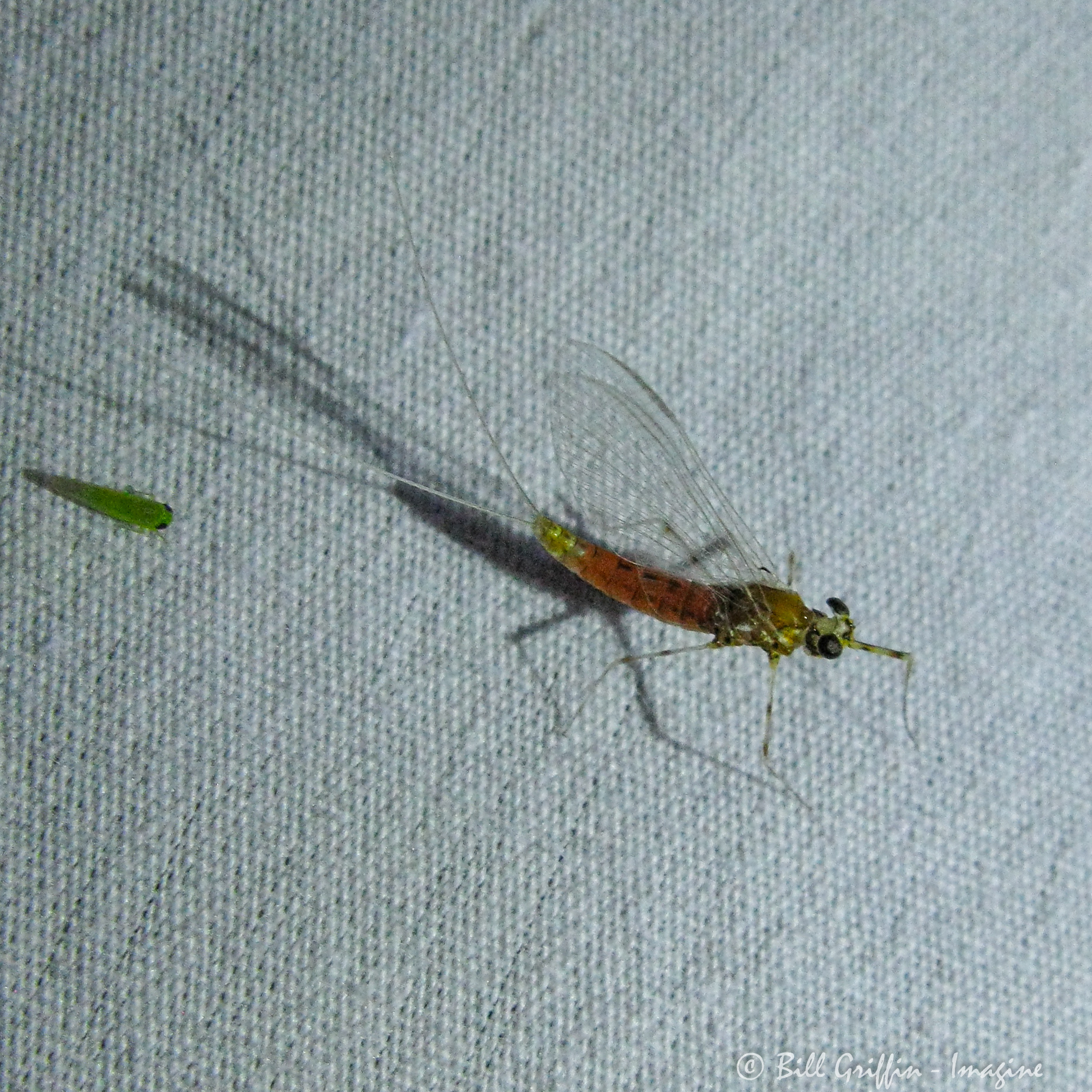
Mayfly Swarm
.
Night on the Pearl River, steaming warm –
our small boat pierces the tunnel of blackness.
Beams of head-bound lights play
across the dark slow current.
.
We tease out an occasional moccasin,
quiescent in boughs of bald cypress.
Lock on bright-lit eyes of river frogs,
the hungry raccoon eating a mussel.
.
The motor pusher our johnboat upstream –
Suddenly, a blinding blizzard
of white-winged snow rises.
Shimmering mayflies fill the blackness.
.
They are in our eyes, nostrils, mouths, ears,
and hair, an erupting silent lace-winged storm.
Millions rise in singular ecstasy, then die.
Their gossamer bodies blanket the river.
.
Fertile eggs drift into black depths.
Frog, fish, and bird devour the dead,
a one-night feast, a gift, a magic cycle
of lovers, death, and satiated flesh.
.
Les M. Brown
from A Coming of Storms, Main Street Rag Publishing, Charlotte, NC; © 2024
.
.
❦ ❦ ❦
.
Les Brown’s new book, A Coming of Storms, has plenty of vivid and hair-raising (literally) descriptions of black cumulonimbus monsters plowing down the mountainside to batter us with hail and impale us with jagged barbs of lightning. The storm he’s really warning us of, however, is metaphorical and of our own making: the devastation of Planet Earth by that most destructive invasive species, Us. Among these poems are Lamentations for the now diminished towns and farms where our lives were once so rich, Jeremiads proclaiming the dire future we’re creating for ourselves, and the Psalmist’s tender recollection of family homestead, tender sojourns in nature, and all the smells and tastes and feel of our fertile world at its best.
.
Les has all the necessary credentials of a prophet. He grew up in the rural mountainscape of North Carolina; his poetry is most poignant when populated by his grandparents, uncles, neighbors. He earned a Ph.D. in Biology and taught ecology to college students all his working life. He himself feels most personally and pointedly our loss of unspoiled fields and forests, our disconnection from the earth that sustains us. I wish he were here beside me this afternoon so we could both get our knees dirty investigating Cranefly Orchids and Rattlesnake Plantain. I’ll be looking forward to his next observation, and holding my breath for a cooling breeze of hope.
.
❦
.
A Coming of Storms is available from Main Street Rag Publishing.
.
❦ ❦ ❦
.
Think seeds, not bullets
.
++++ melons instead of bombs.
Drink wine, rest a while
++++ instead of scorching earth.
Rip off epaulets
++++ and but on bedroom shoes.
Call mothers. Tell them
++++ their children are safe
Revere the earth,
++++ cool it.
Grow chanterelles,
++++ not mushroom clouds.
Bend barrels
++++ and weld triggers
into metallic art.
++++ Read a different Good Book.
Let only birds tweet.
++++ Read only magazines
instead of loading them.
++++ What is beneath the skin
of an apple?
++++ It is a simple question.
.
Les M. Brown
from A Coming of Storms, Main Street Rag Publishing, Charlotte, NC; © 2024
.
❦ ❦ ❦
.
.


Glad to hear from you Jenny. May life continue to surprise . . . ---B