Feeds:
Posts
Comments

Posts Tagged ‘NC Poets’

 . 
[with 4 poems from I-70 Review]
 . 
Bears Active in This Area
 . 
++++ warning sign in my mountain cabin
 . 
This time, others have seen you,
treading circles on the gravel drive,
shouldering through grapevine tangles.
The possibility of you was always here,
in the night-mouth of the cave that gapes
below my porch, in dark boulders
hulking along the trail.
 . 
Your presence countermands silence –
I chatter and sing as I walk the open road,
snatches of carols, toddler songs –
and shy from the path that meanders
to a sunlit filed strewn with windfalls
from long-neglected trees. I imagine
you keeping pace, just out of sight,
your huffs mocking my jabber,
your heavy steps a counterpoint
as I scurry past thickets, scan uneasily
the curving trail ahead, intruder
in a world that was never mine,
though you are the first to insist
that I acknowledge it.
 . 
Rebecca Baggett
from I-70 Review, Eighteenth Edition, 2024
 . 
❦ ❦ ❦
 . 
What would a toddler remember about moving away? The apartment in Niagara Falls is a dream of stairwells and windows and darkness outside; the new house in the new subdivision with no grass at all is a neighbor’s dog named Bishy. Or was Bishy the neighbor’s toddler I played with?
 . 
I am four when we move away again, from New York to Tennessee, and I remember plenty about Marion Road: Bob and I watching Little Rascals until Mom declares, “You’re going to turn into rascals!”; our little sun room Aunt Ellen fitted up as a bed-sit while she attended Memphis State, and we kids hiding giggling under her covers until she came home each afternoon; the neighbor boy who introduced us to the word butt and we thought we were the first humans ever to utter something so outrageous. Memories of the neighborhood, yes, but memories of moving there? Packing and unpacking? Worrying that Puppy would get lost in the shuffle or that somehow Mom wouldn’t be there when we arrived? None of that remains.
 . 
Our family makes one more inconsequential move just blocks away when I am six, but then when I’m twelve the Big Away arrives. Up until this what a tranquil 1950’s childhood: I walk to Colonial Elementary every morning with my friends and play with the same friends every evening until the streetlights come on. Serene. Now I’m midway through sixth grade, still coasting, when the bomb drops. Did I protest when Dad announced in January we were leaving Memphis to move to Delaware? Maybe, I don’t recall; that memory is muddy, but this one is sharp as crystal – I walk into class in my new school and my new classmates all turn to look. My clothes aren’t right, my accent is a joke (literally – within about sixty seconds I will have the nickname “Memphis,” which sticks), and I have a different teacher for every subject. And then in just six more months we will move to Michigan. Just over a year beyond that, two months into eighth grade, we move to Ohio.
 . 
So, my friend, is it any wonder that some sixty years later I have trouble remembering your name until the fourth or fifth time we meet? That as we converse in a group you notice me smiling and nodding and slowly drifting off into space? That I would rather write this blog into the wee hours than drop by your house for coffee? I want to be a good friend to you, and in fact I like you and this hug from me to you is real, but ah, it’s risky. There’s always that possibility, without warning and with no desire on my part, that someday soon I might be moving away.
 . 
 . 
It never occurred to me to wonder how Dad felt about all those moves. The moving was his fault, after all, necessary for his promotions and advancement with DuPont, for whom he worked all his life. I can scarcely imagine the million details he had to sift through to put his family into boxes and take them out again hundreds of miles away. I’m not surprised that as I clean out his house I find drawers full of lists on yellow pads, on the backs of junk mail, on bills and receipts. Half the time when he calls me, it’s to add something to the shopping list. And then there are still those boxes in the attic labeled Allied Van Lines.
 . 
But what about the rest of us? Did Dad wake sweating in the middle of the night worrying how moving away would affect his family? Just one time he blinked: after I was married and gone but Mary Ellen was still at home, a junior in high school, Dad turned down a promotion so she could graduate with her class. A sacrifice that stalled his career for a decade.
 . 
Tomorrow is Dad’s last moving day. Since Mom died in July, Dad has agreed to move closer to us. For a week I’ve ferried boxes and duffels, checked off my lists and then made new ones, and tomorrow after lunch I’ll drive Dad to a nursing center just two miles from our house. He says he’s willing to move as long as the food is good (it is). We’ve hung portraits of the grandkids, pastels by Mom. His Duke pillow is on the recliner and his new Duke banner hangs on the door of room 507 to welcome him. God knows I’ve been waking in the middle of the night sweating the million details. Let us hope that after 98 years of moving, Dad will discover in this new and final home a place to rest.
 . 
 . 
❦ ❦ ❦
 . 
Porta Nigra   *
 . 
++++ Trier, Germany
 . 
The breath of sun and rain
only darkens on my face.
The cat-claws of millennia,
the graffiti of tourists,
fade into my walls.
 . 
I, who guarded this city so long,
sit truncated now.
My frieze the sweaty flesh
of lovers on cool bare stones.
 . 
Catch me in another thousand years,
your eyes as hard and dark as mine.
See if these holes will match
the mysteries of death
and flesh on blackened stone.
 . 
Bradley Strahan
from I-70 Review, Eighteenth Edition, 2024
 . 
* a gate in the remaining piece of Trier’s old Roman wall
 . 
❦ ❦ ❦
 . 
The 2024 issue of I-70 Review arrived in last week’s post. Besides many wonderful voices new to me, I discovered within its pages several old friends who’ve agreed to let me reprint their poems.
 . 
I-70 Review, Writing and Art from the Middle and Beyond is based in Kansas, USA, but publishes poetry, short fiction, and art from around the world. They also sponsor the annual Bill Hickok Humor award for poetry.
 . 
Submission guidelines HERE
Purchase a copy HERE
 . 

 . 
❦ ❦ ❦
 . 
Messenger in Early November
 . 
++++++ – in memory of Jay Klokker
 . 
Driving past Agate Bay, I catch a glimpse
of this deer in a splotch of sun and shadow –
the brown-tail’s flanks on the edge of the road
in yellow leaves, thin branches. Las May
after your death, a bear cub loped beside my car
like a lost Labrador, seemed to disappear
under my front bumper. Slamming on the brakes,
I felt no thud, heard nothing. Amazing, the cub
as if uninjured, clambered up the ditch-bank.
Only later, after your memorial, did I reread
your last poems, that black bear nosing
at your sleeping bag in the camp site
in Arizona; recalled marmots whistling
in the pillow basalt near Mt. Baker; the grouse
thumping its tail near our driveway,
feasting on red hawthorn berries.
You noticed. I cannot believe you said no
to another go-round on the cancer wish machine,
you called it, completed your book First Stars.
On you last hike, you raced downhill
in your wheelchair, shouting. You must
be in these sun spots, mottled shadows.
Too excellent a camouflage, my friend –
thin, flickering branches, a few gold leaves,
before all the color goes away.
 . 
Richard Widerkehr
from I-70 Review, Eighteenth Edition, 2024
this poem will appear in Richard’s new book, Missing The Owl (Shanti Arts Press)
 . 
❦ ❦ ❦
 . 
The Other
 . 
Last night coyotes laughed
at the neighbor’s bulked-up lab restrained
behind his chain-link, his fearful bark,
their yips of liberty and mild derision;
 . 
are coyotes such demons, or just particular
about whom they allow to know them?
Or are they perhaps spirits of the other,
avatar of all we hominids in our marrow
 . 
know to fear? How to live beside that feeling?
Afraid of attack I stab; afraid of pain I cause it.
 . 
In the woods before daylight willingly lost,
soft tread, a twist in the trail then face to face –
perhaps she and I look into each other’s eyes
for two seconds, perhaps the rest
 . 
of my life; coyote impassive,
considerate, measures our distance,
our closeness, then softly pivots
and pads away, prudent, fearless,
 . 
willing to allow the two of us
to share the universe.
 . 
Bill Griffin
from I-70 Review, Eighteenth Edition, 2024
 . 
❦ ❦ ❦
 . 
 . 
❦ ❦ ❦
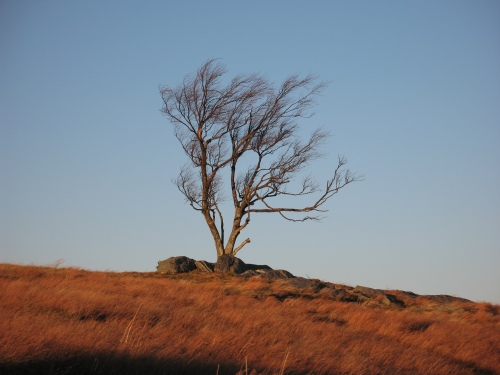
Doughton Park Tree 2020-09-08b

Read Full Post »

I learned today from our friends at CHARLOTTELIT that Dannye Romine Powell died on October 10, 2024. She was a joyful and fearless supporter of literature, the arts, and poetry in North Carolina for many decades, and whenever I asked her advice or permission to use her work, she was a gracious friend.

I am re-printing this post from December 30, 2020 so that we can share again these evocative poems by Dannye. In Memoriam.

 . 

❦ ❦ ❦

 . 

NEW

 . 

[with poems by Dannye Romine Powell]

When we lower her pack from the tree where it has swung all night like a bell mocking the bear, the skunk, she opens it and screams: a fairy crown atop her sweatshirt and socks, a perfect round nest and four perfect hairless mouse pups like squirming blind grubs. We peer in awe, shepherds at the manger.

Mother mouse has hidden herself — she is not in the pack with her babies. We lift the nest intact, hide it in a bush beside the tree, nestle leaves around. Mother will sniff out her precious ones, reclaim her treasure. But we have other lambs to tend.

We eat, stow gear, shoulder our packs, face the trail, and consider: the pack was in the tree just one night; the nest is woven from meadow grass where we slept; the mother who climbed – how many trips up and back? – was heavy with her brood.

Miles before us, a new year before us – how heavy will each day’s burdens become before night brings rest?

.     .     .     .     .     .     .

A new book by Dannye Romine Powell arrived in the mail this week: In the Sunroom with Raymond Carver from Press 53 in Winston-Salem. I meant to read one or two poems this morning but I have read them all. A central persona that weaves through the collection is Longing: she visits rooms in old houses, unfolds memories into the light, shares the pain that others might lock in closets. Grief shared conceives within us hope to rekindle joy. Sharing grief, sharing joy, we become more human.

.     .     .     .     .     .     .

The Secret

Light glazes the near-empty streets
as I drive. Beside me, my grown son asks
if a secret I thought I’d kept buried
is true. A secret
that can still catch fire.
We stop on red. A bird flies
by the windshield. My father’s words:
Easier to stand on the ground
and tell the truth than climb a tree
and tell a lie. Now, I think. Tell him.
I stare at my son’s profile,
straight nose, thick lashes.
I remember, at about his age,
how a family secret fell
into my lap, unbidden.
That secret still ransacks a past
I thought I knew, rearranging its bricks,
exposing rot and cracks,
changing the locks on trust.

.     .     .     .     .     .     .

In the Night, the Wind in the Leaves

swirled and rustled
out our open window as if
for the first time,
as if we never were,
the earth newborn, sweet.

And what of us – asleep
on the too-soft bed
in the old mountain house?

Gone.

Also our children.
the ones who lived, the ones who died
before they grew whole. All night

the breeze swirled and rustled
through the leaves as if it played
a secret game, swirling
and rustling all night

as if we never were.

from In the Sunroom with Raymond Carver, Dannye Romine Powell, © 2020 Press 53

.     .     .     .     .     .     .

Dannye Romine Powell has won fellowships in poetry from the NEA, the North Carolina Arts Council, and Yaddo. Her poems have appeared over the years in The Paris Review, Poetry, Ploughshares, The Southern Review, Harvard Review Online, Beloit, 32 Poems, and many others. She is also the author of Parting the Curtains: Interviews with Southern Writers. For many years, she was the book editor of the Charlotte Observer. In 2020 she won the Randall Jarrell Poetry Competition for her poem “Argument.”

.     .     .     .     .     .     .

Read Full Post »

 . 
[with 3 poems by Britt Kaufmann]
 . 
Constant
 . 
The only constant is change.
 . 
In any function, the constant is the number
hanging out alone, no variable at its side.
It is what it is.
Until calculus, when C becomes fixed but unknown.
 . 
The coach’s wife says to him,
“Nothing changes, if nothing changes.”
He says nothing, but nods.
 . 
Always plot time on the x-axis:
It’s the independent variable, always marching on.
Until it isn’t.
Like the shortest distant between two points is a straight line.
Except it might not be.
 . 
I remember the non-trad who thought she could effectively argue
against non-Euclidian geometry to my old math professor,
both of whom then were younger than me now.
 . 
How flat our first knowledge becomes.
 . 
My future-physics-professor daughter
returns from the equator where she learned the Pachamama hug:
a spiral, like how they see time:
each moment a chord with harmonics of past and future.
What did they learn, so close to the sun,
watching the stars,
which is seeing time . . .
 . 
We learn orbits, as if the sun didn’t also fly.
The helix of our DNA, more akin
to our planets’ corkscrew through the dark.
 . 
I stare at images from the newest telescopes at the planetarium
in my Appalachian Mountains:
lost and dizzy trying to fathom the immense void.
Alone in the universe is really
alone in time.
 . 
And what of the twins:
One went to space,
traveled so fast he became measurably younger.
Sure that plot twist shows on a graph,
crumpled into a ball, tossed in a trash can,
so he could keep his birthright.
 . 
how precious this tiny world we burn. A magi’s gift:
watch chain and tortoise shell become slag and ash.
For what purpose, this rain of myrrh?
 . 
Britt Kaufmann
from Midlife Calculus, Press 53, Winston-Salem NC; © 2024
 . 
❦ ❦ ❦
 . 
TIME must be straight as an arrow, because you know if an arrow’s shaft has the least warp the bolt will veer and never come near the target, no matter how perfect your aim. Time must be restricted and prescripted like the graph’s x-axis, proceeding forever to the right with its hatchmark divisions each precisely the same distance from the last one and to the next one. Time must have some plan that makes everything make sense.
 . 
Time being so steady, so reliable, how is that I’ve awakened from this busy dream, its urgencies and deviations and long drawn out doings, convinced that I’ve surely slept sound until down only to press the alarm and it’s 1:00 AM? How has time, restless and relentless, accelerated through these past two months of scheduling and planning Mom’s memorial service, then continued speeding right up to the flurry of texts and calls that crowd the minute when I shut off my phone and enter the chapel and the music begins, still stretching and rapping even until the reaching into my pocket and the unfolding of the poem I will read just before the closing hymn?
 . 
And now time unspools and uncoils. A few hours on the porch this morning while the minute hands takes its own good time to tick over, everything shared with family over the past 48 hours seems to slow and spread. The passage is not yet in focus but shows its desire to take shape. Hours became minutes, now expanding again into hours. Time an arrow, or time a wave? Sinusoidal – will it crash or will the long swell fetch from some distant shore and lap our toes? One deep breath. I can’t yet recognize what I’m seeing, but I see that recognition might become possible, might just possibly someday arrive.
 . 
 . 
The past is everything that has slipped the shackles of the present, but a memory is a bit of present still cupped in your hands. Not a crystal of time, not preserved in amber, but a flickering candle of time whose flame creates shapes of its own.
 . 
My younger sister tells me her earliest memory of our mother is being rocked in the wicker chair in which she still rocks herself at her home in Black Mountain. My memories are wisps and phantasms; I can’t say I see those moments, more that I can feel brief spaces and elapses shared with Mom when I was a toddler.
 . 
One vignette is clearer, though. We have boarded an airplane (in New York where we still lived? bound for NC to see Mom’s parents?) and we suddenly realize I don’t have Puppy. Did I leave him behind in the taxicab? Perhaps I wail, but when Mom hands me to the stewardess (this is 1955) and rushes away to find that cab, I feel a shriek rising even though I can’t hear it in memory. How long? How long? But now here she comes, Mom holding Puppy, back at last. Memory complete. Did we take off and land and get hugs from Nana and Grandpop? Perhaps, but all that memory tells me is that my mother was brave and undaunted, and that she would do anything for the little boy she loved.
 . 
 . 
❦ ❦ ❦
 . 
Coastal Prayer
 . 
In the pre-dawn glow, the pelican aunties
look down on me from their pier posts in sleepy disapproval,
their eyes set in Dia de los Muertos faces
as I paddleboard the calm intracoastal
before the boats wake.
 . 
No, not me, out to sea, among the crashing waves,
yet still in waters beyond my depth on tremulous footing
where little fishes leap like dashes on a slope field,
the beauty of their tiny splashes mar the surface and make light
a terror flight from a predatory snapper.
 . 
Give me a rule to follow:
+++ The constant rule through all these changes,
+++ The power rule to not give in,
Devise some rule so I make a difference
 . 
Britt Kaufmann
from Midlife Calculus, Press 53, Winston-Salem NC; © 2024
 . 
❦ ❦ ❦
 . 
Why poetry, if not to struggle to make sense of life? (And if poetry can make sense of calculus and astrophysics at the same time, well, bonus!) And what is life if not its changes? An academic physician I knew referred to an unplanned occurrence which produced an unexpected benefit as “a fortuitous concatenation of events.” How fortuitous for Britt Kaufmann to concatenate calculus, the mathematics of change, with the middle years of life, that time of accelerating change in our bodies, our psyches, our circumstances, and reveal to us such a beneficial poetry.
 . 
The set of all mathematical metaphors, as Britt so skillfully displays in Midlife Calculus, is very large, perhaps approaching infinity. The obtuse angles of her students’ exasperating density; the pointed and poignant trigonometry of the arc of her aunt’s dementia; even the calculating language of literary journal rejections: all of these and many more become functions and variables in the grand equation Britt sets herself: the struggle to make sense of it all. Perhaps there is no solution. Perhaps we can find some small gateway to acceptance, even joy, in irrational numbers. Perhaps I will come to the final page of this engrossing book, breathe deeply, and turn back again to page one.
 . 
 . 
Midlife Calculus is available from Press 53.
 . 
 . 
❦ ❦ ❦
 . 
outlier
 . 
+++ with gratitude for Julian of Norwich
 . 
. . . but all shall be well
of a morning when
the dog thumps her thick tail on the kitchen tile,
a greeting, like the first cup of black coffee
 . 
and all shall be well
of an afternoon when
in February’s chill, green cotyledons
sprout under lights in the laundry room
 . 
and all manner of things shall be well
of an evening when
the weather warms, so windows are thrown wide
to the spring peepers’ sundown song
borne in on eddies laden with lilac
 . 
. . . all shall be well,
and all shall be well,
and all manner of things shall be well
 . 
Britt Kaufmann
from Midlife Calculus, Press 53, Winston-Salem NC; © 2024
 . 
❦ ❦ ❦
 . 
 . 
 . 

Read Full Post »

« Newer Posts - Older Posts »