
.
[with poems by Michael Hettich, Kenneth Chamlee, Katherine Soniat]
.
First View – Chicago Lakes
.
Sleet needles past my fastened collar
as we rise into the house of rain.
Mr. Byers of the Mountain News
has horsed us up this flyspeck path
with avowals of Alpine views but
now is silent. I think he has missed
the spur trail. My blood is gelid,
fingers numb beyond recovery.
Clouds tickle and drip and when we crest
this timbered ridge I will ask that-Oh!
Sublime cirque! The Alps surpassed again!
Stay the mules-I must-I need my paints,
stool. Fifteen minutes, please you; see how
the near lake mirrors the breaking storm
with light fine as milkweed fluff, that one
pearled peak soft as the edge of heaven!
.
Kenneth Chamlee
from The Best Material for the Artist in the World; Albert Bierstadt, a Biography in Poems, Stephen F. Austin University Press, Nacogdoches TX; © 2023. Finalist for the 2024 Brockman-Campbell Award for the best book of poetry published by a North Carolina writer.
.
❦ ❦ ❦
.
First Nature, Once Removed
.
Is childhood different from any body of (loose) clothing or rising water? Make
of it what you will. +++ I did. +++ +++ Some are grounded by target practice
.
but return with leaks known as homesickness for life. +++ +++ Wobbly
flotilla of cargo I was . . . no water-wings to inflate. Imagine those wings
.
I did not have +++ but suspected were present +++ when it was calm enough
to reflect and pull faces into focus. +++ +++ Wishing is like sadness at sea.
.
Say, you are on a beach with waves – the circular myth of family collapsing.
I had this part-time job of being a daughter apart – job that paid in tips
.
for those with damp inward pauses. +++ +++ Deep water girl
who keeps washing up anywhere. +++ +++ +++ Everywhere.
.
I was a surprise to those gathered in bed. +++ How I rose to float in
on a man and woman dancing in bed. +++ +++ Or were they clouds?
.
I could not keep them straight +++ +++ (though they were trying
hard to act happy) +++ like knives flying simultaneously as birds
.
at twilight.
.
Katherine Soniat
from Fates: Starfish Washup, Etruscan Press, Wilkes University, Wilkes-Barre PA; © 2023. Finalist for the 2024 Brockman-Campbell Award for the best book of poetry published by a North Carolina writer.
.

.
❦ ❦ ❦
.
The Parents
.
One morning, my wife and I followed our eight-year-old
daughter along a crowded beach
just far enough behind her that she wasn’t aware
we followed, as she walked with her energetic stride,
swinging her arms as though she were singing.
.
We marveled at her independence, at her
fearlessness; we compared her to other
children we knew, who would never have ventured
so far with such self-confidence.
.
We were congratulating ourselves on our excellent parenting
skills, laughing proudly at her spirit,
wondering where she was going with such
lively determination, when she stopped
.
and turned to look back: she was crying, with such
deep heaves she could hardly, breathe, desperately
lost. She’d been frantically looking for us
and the place we’d left our towels–she feared
we’d forgotten her, gone home without her.
.
What could we say, kneeling beside her
in the bright sun–we’d been right there
the whole time, behind her, laughing affectionately
at the way she walked, as she walked
.
the wrong direction to find us, at the way
she looked from behind as she searched for us,
as she howled in such terror
we thought she was singing?
.
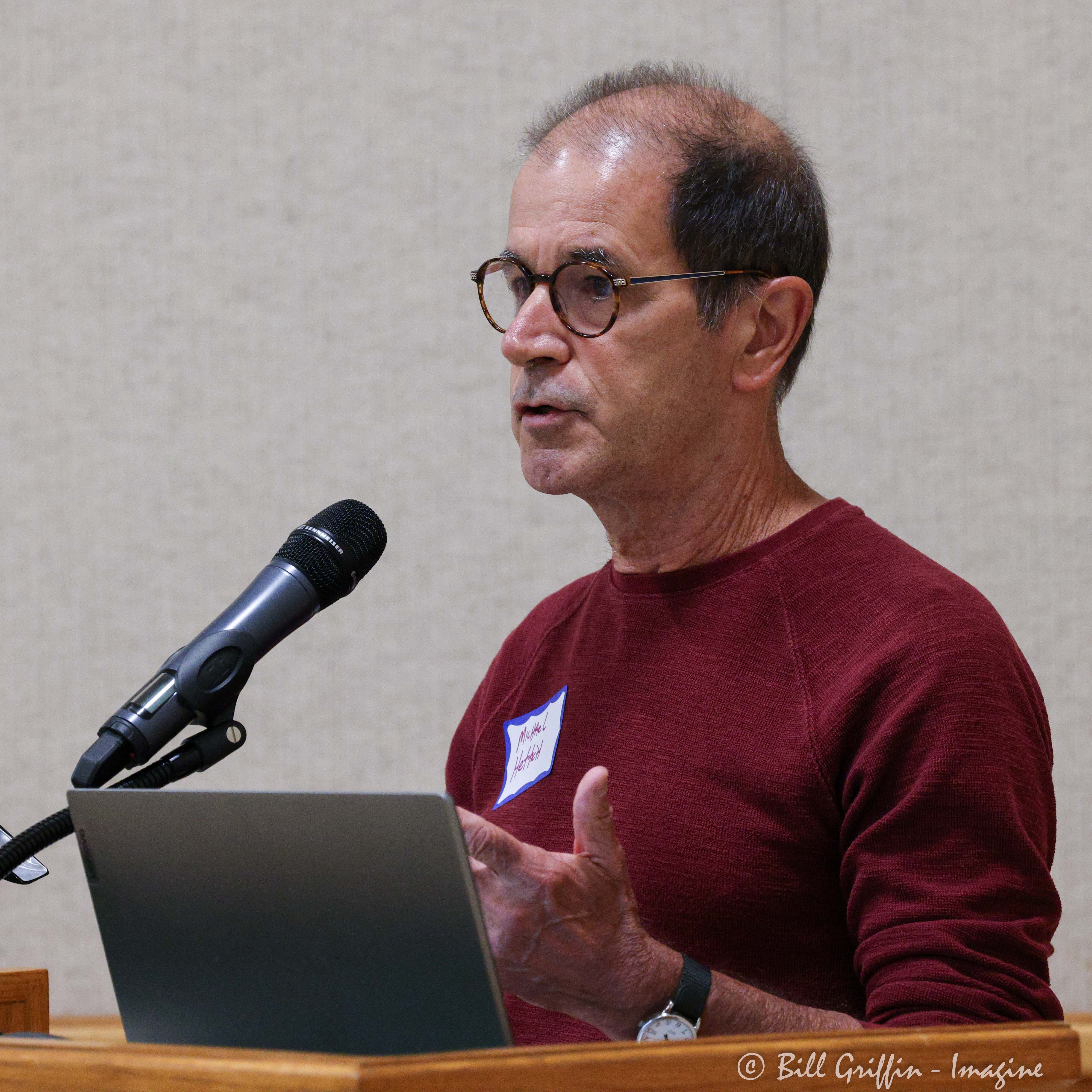
Michael Hettich
from The Halo of Bees: New & Selected Poems, 1990-2022, Press 53, Winston-Salem NC; © 2023. Winner of the 2024 Brockman-Campbell Award for the best book of poetry published by a North Carolina writer.
.
.
❦ ❦ ❦
.
Which is better, to expect beauty and encounter exactly that, or to arrive without expectation or anticipation and be surprised by joy? Which is worse, to open the window on a forecast of sun and discover drizzle, or to walk around every day under a cloud with no awareness of a sun above? Which is worse, to tool around for years just one county removed from your anger, or to cross the line and smack into it head on? Which is better, fond memories of the past or even fonder memories of the future?
.
Each of today’s three poems appears in books selected by Eric Pankey, this year’s judge of the Brockman-Campbell Award of the North Carolina Poetry Society: winner Michael Hettich for The Halo of Bees and finalists Kenneth Chamlee, The Best Material for the Artist in the World, and Katherine Soniat, Starfish Washup. What if everything we can sense and see turns into something wholly unexpected? Don’t the most beautiful creatures sometime pack the deadliest stings? What if even time itself slips us up, the solid past dissolving into mist and mud, this moment twisting inside out like a Moebius strip? What if a poem doesn’t begin or flow or lead us where we anticipated, and what if it doesn’t end as we hoped?
.
❦
.
Emerging from COVID’s virtual meetingspaces two years ago, the NC Poetry Society made a studied decision to emerge as well from its long tradition of meeting four times each year in Southern Pines at Weymouth Center for the Arts & Humanities. Last September’s meeting convened at the North Carolina Museum of Art in Raleigh. Each September meeting serves to showcase readings by contest winners: the Brockman-Campbell Book Award (NCPS); the Lena Shull Poetry Manuscript Award (NCPS); the Randall Jarrell Poetry Competition (NC Writers Network); the Susan Laughter Meyers Poetry Fellowship (NCPS and co-sponsor Weymouth Center for the Arts and Humanities); and the Jackie Shelton Green Performance Poetry Prize (NCPS in partnership with NC Literary Review and East Carolina University).
.
This September 14 NCPS gathered at the North Carolina Arboretum outside Asheville. As if award winning readings in such a beautiful venue were not enough, the afternoon program connected the gardens, mountains, and wild spaces into a workshop by Kathrine Cays, “Writing the Natural World.” Kathrine offered many prompts and led a guided meditation to coax us to listen to the voices of earth and sky around us, and to the voice within us that reaches to connect with nature. (See last week’s poem by Mary Oliver, Sleeping in the Forest, which Kathrine read to open her workshop.) How can I sense the communities and individuals that create my world? What do flower, tree, bird, beetle want to say to each other, and to me? How can I discover my true place on earth and return gratitude and reverence in a way that sustains me, and sustains the earth?
.

.

.

.
.
❦ ❦ ❦
.
2024 Contest Winners
.
Brockman-Campbell Award: given annually to the best book of poetry published by a North Carolina poet during the past year
Winner: Michael Hettich, The Halo of Bees
Finalist: Kenneth Chamlee, The Best Material for the Artist in the World
Finalist: Katherine Soniat, Starfish Washup
.
Lena Shull Award: honors the best manuscript of unpublished poetry written by a native or resident of North Carolina
Winner: Doug Sutton-Ramspeck, Smoke Memories
Honorable Mention: Maura High, Field as Auditorium
Honorable Mention: Becky Nichole James, Little Draughts and Hurricanes
.
Susan Laughter Meyers Fellowship: in honor of the life and work of Susan Laughter Meyers; co-sponsor Weymouth Center for the Arts and Humanities
Winner: John Amen
Honorable Mention: Maria Martin, Terri McCord, Claudine R. Moreau, Erica Takacs
.
Jaki Shelton Green Performance Poetry Prize: honors the best performance poem by a writer who fits the NCLR definition of a North Carolina writer; co-sponsor North Carolina Literary Review / East Carolina University
1st Place: Edward Mabrey
2nd Place: Jess Kennedy
3rd Place: Marcial “CL” Harper
Honorable Mention: Alessandra Nysether-Santos, Regina YC Garcia, Brenda Bailey
.
Randall Jarrell Poetry Competition: one poem by any writer who is a legal resident of North Carolina or a member of the North Carolina Writers’ Network; sponsored by NCWN
Winner: Lee Stockdale
Honorable Mention: Jackson Benton, Mary Alice Dixon
More information about all North Carolina Poetry Society contests HERE
.
❦ ❦ ❦
.

.
.



 V E R S E and I M A G E
Very true. And not that she ignores the grief and woe of living but somehow makes all of life a…