Feeds:
Posts
Comments

Posts Tagged ‘nature’

[with 3 poems by Val Nieman]

Great Smoky Mountains Institute at Tremont – February 5-7, 2021

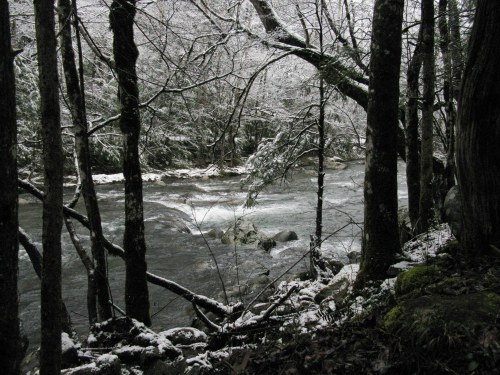
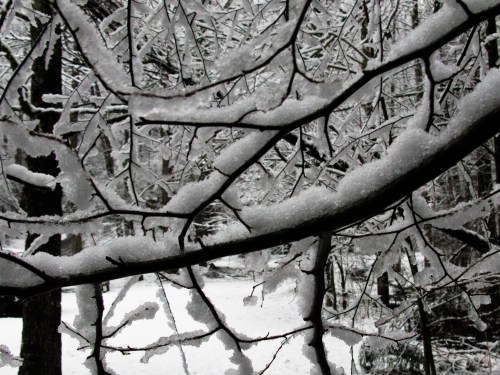
Winter on the mountain gavels its sentence, no appeal: wrestle the cold to keep it at bay; eat, feed the inner fire; light the darkness or fall and break. I pull my hood closer and hide myself. In the tent at night I bind my neck against cold fingers. I watch my feet.

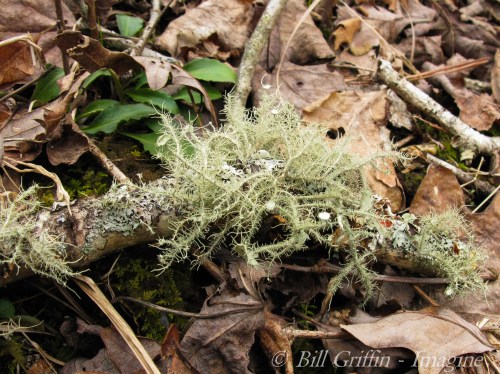
The day is short. Nevertheless we fill it and discover it filling us. Small signs begin to reveal their stories – an incisored nut, scratches in the bark, one single hair. At first we hesitate, we thirteen who’ve journeyed here to explore, but in the light we gather as closely as prudence permits. Muddy track, scrabbled duff, compressed leaf, scat: where did Bear sleep? what did Coyote eat?

Winter on the mountain: what crouches here for us to notice?

The night is long. In this valley darkness is complete. The rush and growl of Middle Prong fill the cove as well as empty it. Are we alone? In the gap of sleep a brush and skitter, a brief chittered voice – I imagine dark eyes and gliding flight. The spirit is released from the prison of his tree. In the morning we will seek signs of his passing.

Winter on the mountain – I release myself to see, to question, to wonder.
 

.     .     .     .     .     .     .

Valerie Nieman journeys landscapes of memory, family, heartache to reveal stories in the signs unearthed along the way. A path may seem clear but its meanings fissure and deepen into many layers. A bud, a leaf, a branch – are they simply of themselves wholly themselves? Look deeper: there are mysteries unfolding.

Val teaches creative writing at North Carolina A&T State University but she is preparing to retire this summer and replace syllabus revisions with fly selection for a day on the trout stream. Her poetry has appeared widely and has been published in numerous anthologies, including Eyes Glowing at the Edge of the Woods and Ghost Fishing: An Eco-Justice Poetry Anthology. Her fifth novel, Backwater, will be published in 2021.

.     .     .     .     .     .     .

Becoming Ariel
for Gerald Stern

Groundhog in a tree, behaving like a bird, like a squirrel,
nibbling tender green buds at branch end, high-wiring
above a bog. Any burrow dug here would be swamped,

front door to back stoop – how did he come to cross water
and ascend, diggers curved deep in the bark as a lineman’s spikes?
A crow would think twice about lighting on a branch so frail.

Soil-shoveling wedge of a face, a fat tail that never could balance
his loose bulk: this creature was not meant for such heights.
His round belly was destined to bloat in a ditch beside the road.

Still, he sways against the sky, close to the sun, Caliban
joyously drunk on spring sap drawn up from the mud
and darkness he was born to, tiny feet dancing and dancing.

from The Georgia Review, University of Georgia

.     .     .     .     .     .     .

Captures

I sprayed for tiny ants
late last night, killing the spider
doing its best to corral them.

Between the sheets I struggled
hand to hand with old lovers
and other aliens

descending cosmic ladders
to pincer my heart,
boiling them in the ichor

my bare claws released
from their flesh.
But this morning,

I catch a humpback cricket
in the sink, cup it
between my hands

and toss it out
the back door
to take its chances.

This morning, I’m
mild as a painted virgin,
my hands empty of slaughter.

from Change 7

.     .     .     .     .     .     .

Approach

Arms stretched wise,
right hand to the dawn,
left toward eventual night,
I face north.

As latitude rises,
life flattens:
forest to taiga,
to tundra, to permanent ice.

Everything will have
a name of cold:
polar bear, arctic fox,
glacier flea, snowy owl.

~ ~ ~

A compass is known to stray
from true north, lured
by the earth’s magnetic heart.
Now the needle swings

at the approach
of a frost spirit
from those barrens
I’ll have to cross

without advice,
without a companion,
or a harness of wolf-dogs,
or good boots.

from Hotel Worthy, Press 53, Winston-Salem, © 2015

Becoming ArielCapturesApproach  © Valerie Nieman


.     .     .     .     .     .     .

The Southern Appalachian Naturalist Certification Program at Great Smoky Mountains Institute at Tremont comprises eight weekend courses designed to provide fundamental and specialty skills in Southern Appalachian ecology and interpretive techniques. Each weekend includes 15 hours and more of lecture and hands-on field study. Upon completion the student receives the non-credit Southern Appalachian Naturalist Certificate from the University of Tennessee.

Ariel, the spirit in Shakespeare’s The Tempest, is released from his prison in the split pine by the magician Prospero.


.     .     .     .     .     .     .


IMG_7952

Read Full Post »

Wilderness Advent
(Pisgah Stranger)
Lyrics: Bill Griffin . . . . . . . . . . Music: David L. McCollum


Elkin Community Chorus 58th Annual Concert
December 2nd, 2018 – First Baptist Church, Elkin, North Carolina

.     .     .     .     .     .     .

This year (2020) would have been the 60th annual concert of the Elkin Community Chorus. The ensemble draws singers from towns and counties across northwest NC, rehearses for seven weeks, and gives two free concerts to the public on the 2nd Sunday in Advent. Linda and I have sung with the group for more than 30 years. We miss it. We’re listening to our stack of recordings from previous years and holding onto the hope that we’ll all be vaccinated and singing together again next fall.

David McCollum has been one of the group’s directors for more than 20 years. Several years back he asked me to write a Christmas poem for which he would compose the music. ECC debuted Wilderness Advent in 2018. Thank you, David, thank you Amy Johnson and Amy Tayloe for your accompaniment, thank you Tonya Smith, co-director, and thanks to the 90 or more of our neighbors whose voices make the waiting, the yearning, the anticipation of Christmas a sacrament.

.     .     .     .     .     .     .

Wilderness Advent
(Pisgah Stranger)

A stranger here, I sleep beneath the slash of stars,
The Pisgah forest deep and friendless.
I close myself to love, my heart requires the dark;
Can night within this cove be endless?

Come, you’ve slept too long
And love grows dim.
Awaken to a song – Can it be Him?

Is it madness or a dream that seems to whisper here?
The murmur of a stream or singing?
It chants, a still small voice, I’ve nothing now to fear
For tidings of great joy it’s bringing.

Come, you’ve slept too long
And love grows dim.
Awaken to a song and welcome Him!

And now the music swells as every fir and spruce
Unloose their boughs to tell the story:
May all God’s creatures wake, hearts quickened by the truth,
Invited to partake of mercy.

Come, we’ve slept so long
That love grows dim.
Awaken that our song may worship Him.

Come sing it with the wind and all the Pisgah throng:
The Child reclines within the manger!
With owl and bear and deer my soul’s reborn in song
For none of us is here a stranger.

Come, you’ve slept too long;
If love grows dim
Awaken to a song for it is Him!

Waken . . . welcome . . . worship . . . it is Him!

IMG_7974

.     .     .     .     .     .     .

MERRY CHRISTMAS!

.     .     .     .     .     .     .


IMG_1948

Read Full Post »

Forest Bathing Trail, Grassy Creek off Mountains-to-Sea Trail

[with poems by Lucinda Trew and Jane Craven]

Last week I took a walk in the woods with my oldest friend Bill (distanced by 2-meter dog leash). We were forest bathing (shinrin yoku): phones off, listening to Grassy Creek accompany our rustic trail, smelling leafmold, fungus, pines, going nowhere and getting there; reflecting on the moment, simmering in our conjoined past which stretches all the way back to our grandfathers who worked together on the same railroad 60 years ago.

Every trail, though, has a way of turning. Almost back to our cars, Bill happened to ask, “What are you going to do with your stuff before you die?” Us old guys, especially old poets, think about dying. Good story fodder. Let me tell you the one about . . . . Just not usually as concrete as what will become of our earthly matter when no one wants it any more.

Stoff: German, translates as substance. Two synonyms for Oxygen are Sauerstoff and Atemluft, the first meaning acid substance (early chemists’ misconception that all acids must contain oxygen) and the second meaning air for breathing. We humans can live about 3 minutes without oxygen before our brains lose neurons and our substance begins to degrade, but oxygen is pure poison to many microorganisms and tricky to deal with even for our own mammal cells (or why else would anti-oxidants be such a big deal?).

Stuff is pretty frangible. Are the moment’s mental occupations or the day’s consuming concerns any more tangible? Bill shared with me a photo of his granddad Enoch Blackley in his engineer’s gear from the 30’s, outline of pocket watch visible through the denim of his overalls. I have one very similar of my granddaddy Peewee Griffin. The bit of stuff comprising those old prints, grains of silver on paper, is mere milligrams of matter; the cubic volume of memory those images reveal is larger than many lives.

My Stoff – carbon, nitrogen, phosporus – will feed the trees. May I leave behind the tempo of my walk, the sound of laughter, honest tears of compassion, a couple of good poems. Maybe that’ll do.

.     .     .     .    .     .     .

These two poems are from Kakalak 2020, the annual anthology of Carolina poets, by writers whom I don’t know and hadn’t read before. Lucinda Trew’s Of Stars fills me with wonder, all the universe in a crow-eye seed, somewhere within the secrets of universe wanting to be spilled out. Jane Craven’s Speaking of the World does just that, the image of a small flower expanding to hold the pain and contradictions of the most intimate relationships.

Metaphor is the tool that communicates the mysteries which swirl around us and within us, the inexplicable spark of our synapses, the spin of our electrons. Some things can’t be spoken, only sung.

Forest Bathing Trail, Grassy Creek off Mountains-to-Sea Trail

.     .     .     .    .     .     .

Of Stars
If you wish to make an apple pie from scratch, you must first invent the universe. – Carl Sagan

The conjuring orchard man
holds hemispheres in sturdy hands
cupping chaos and creation
presenting apple halves
for inspection
and the revelation

of stars
a crop circle enigma etched
within sweet flesh
five symmetrical rays cradling
crow-eye seeds
small enough to spit
vast enough to hold eternity –
the very dust and stuff

of stars
carbon, nitrogen, oxygen
phosphorus – the breath and wingbeat
of birds who rise from reeds and nest

the rush and thrum
of boys who scrabble up bark, swagger
wave applewood swords

the sway and silhouette
of branches, girls dancing
longing for the moon

of pulse and surge
of cities, song, engines
prayer

the earthen realm
of roots and worm, turnips
and bones

the axial turn
of tides and shells
molecular chains

and of apples
twisted exquisitely, evenly
in half
spilling stars
and seeds and secrets
of the universe

Lucinda Trew, Kakalak 2020, Main Street Rag Publishing Company

.     .     .     .    .     .     .

Forest Bathing Trail, Grassy Creek off Mountains-to-Sea Trail

.     .     .     .    .     .     .

Speaking of the World

Pinprick faces open in a violet fever behind my house – swathes
of mazus flowering downhill. A cultivar

from the Himalayas, it’s bred to survive scarcity and climate extremes.

In your world, the doctors have gone, left your body

a prescribed burn, lightly
elevated in a rented hospital bed, handfuls of pills labeled for days.

The trees, to a one, freeze beneath a milky lichen – and you who sleep

year round with open windows are speaking of the world –
of the last deer you saw weaving through balsam, of the bear

who bent double the birdfeeder, wild turkeys and their long-
neck chicks, a lone slavering coyote crossing the yard.

Grief, you say
three times,
each a dry leaf
papering
from your lips.

I left you in the boreal world, rushed back to my own life.
And I admit this with unnatural ease, like there’s no shame

in turning toward the sun, in enduring.

Jane Craven, Kakalak 2020, Main Street Rag Publishing Company

.     .     .     .    .     .     .

Lucinda Trew: http://trewwords.com/about/
Jane Craven: https://www.janecraven.com/bio

.     .     .     .    .     .     .

2020-11-03b Doughton Park Tree

Read Full Post »

« Newer Posts - Older Posts »