Feeds:
Posts
Comments

Posts Tagged ‘nature’

[with 3, no, 4 poems by Paul Jones]

Oh well . . . life goes on . . .

No it doesn’t! Who ever said that? At least not on and on and on. And the problem is not growing old, the problem is everyone around me is growing older.

I’m biased and I know it – too many all-nighters in the ICU knowing my patients will never wake up, will never breathe again without that machine. Why choose to prolong those hours? Too many weekly visits to the nursing home, my patients who will never again chew, swallow, recognize, understand, smile. Why choose to prolong those days?

Still, when you are breathing and smiling there’s a huge hurdle to leap before you’re willing to talk about how you want your body treated when you can’t breathe or smile. Easy to put off making that living will when you’re in the midst of living; too late when you’re in the midst of dying.

Last year I spent a few weeks helping Dad update his and Mom’s will and estate. Gather up mounds of papers, talk things over, scratch heads, and then the final step: spending a morning with their attorney to nail it all down tight. Just because most politicians are attorneys does not imply the converse, that most attorneys are self-infatuated power-lusting villains. Not at all. Dad’s attorney, Ms. S., treated us like family. Like she was the cousin who knows a whole lot more than we do but who can explain it in a way anyone can understand.

To describe two hours with an attorney as a pleasure? Well, yes indeed.

As a family doctor I never found it easy to talk to my patients and their families about death. Necessary, yes; essential, yes; never easy. Perhaps it’s the taboo that if you name something you give it power over you. But a last will and testament is all about death. If you’re not going to die, don’t bother making a will.

Ms. S. talked with us for two hours about death, straight up, matter of fact. I learned a lot about what Dad and Mom want for their own final days and for a legacy to their children. I learned that Dad, in the right place and time, is willing and even anxious to talk about his death. We left the office smiling, arm in arm (figuratively as well as occasionally literally, 95-year old knees and all).

Of course, Dad still vows he’s going to live to a hundred. At least he’s got one helluva estate plan.

.     .     .     .     .     .     .
.     .     .     .     .     .     .

Seventy Three

When in time frost found me, leaves were gone yellow
or fallen or few on branches or fallow
fields. Limbs were empty choir lofts. Youth’s bright birds sang
then left before the cold November must bring.
I found myself in twilight, the glow on snow
or rime on those brown stems or white wisps of breath
– how many more before death plants me below? –
But here I can see further, here my life’s breadth
forms a vista. Here where flames once leapt, grey ash
is heaped, warm still from what past fires I’ve known.
Still all this going is not completely gone.
Something of those late bird songs will stay, will last.
What we see in age makes all we love more strong,
knowing what we love we leave before too long.

Paul Jones
from Something Wonderful, Redhawk Publications, © 2021

.     .     .     .     .     .     .

I’ve always been a bit in awe of Paul Jones’s poetic gifts. Envious even. Not only because he can make rhyme so damn modern but even more for his capacious breadth and depth. What an imaginative reach! I’m not reprinting To a Tuber here but read it and you will become convinced that the potato is within all the vegetable kingdom most elegant, elevated, and worthy of praise.

So I knew before I ordered my copy of Paul’s new book Something Wonderful that it would be, and it is. The sly wit is there, waiting to pounce, but also heartfelt longing and wry uncompromising looks into personal finitude. You don’t really discover why the cover is covered with 19th century illustrations of bats until page 80 and the title poem. Take the time, make the trip. It’s worth it.

.     .     .     .     .     .     .

Ireland Seen from a Porch Swing in Hickory, NC
+++ — for Adrian Rice

Ireland is a country without porches.
What they call a porch is just an entry.
No one sits there watching for neighbors
walking by with their electric torches.
Their voices, soft as blossoms, gently
fill humid summer nights with rumors.

Over there, secrets are shared in the pubs.
From unsteady high stools, the stories, tinged
with irony, rise easily as smoke.
New worlds are created by old words spoken.
even the weightiest tales take on wings,
if only whispered above the hubbub.

But here, the slow news is told by moonlight
in the lazy tease of an August night.
Too often tea, iced and sweet, is the drink
that greets the blink of stars through the dark
as our voices wander, each twang distinct,
in the dog-starred nights and the torpid days.

It’s ghosts that bind us across our weathers,
that tie the lilt and slur of daily sagas
told inside and out, in bars and open air,
to some episodic common drama.
They appear here and there, vivid and stark,
in talk that reweaves their spells in the dark.

Paul Jones
from Something Wonderful, Redhawk Publications, © 2021

.     .     .     .     .     .     .

Still Waters

I am still, waiting
for the one moment
that old Eastern sages
say gives absurdity
an absolute clarity,
the moment multiple
bald monks chant to induce.
They say the Way is
like water. It will work
its wonders at due time,
the way water always
breaks up rocks, turns them
into sand, but will not
be transformed itself.
Being water, it’s
already what it needs to be.
Winter and ice
merely redefine water.
Wind, when it works, only works
on the surface of water.
When fire meets water,
water is sent to heaven
but fire just becomes ash.
Water like saints returns
to perform its steady work.
Sleet, snow, rain or hail –
even fog – are water’s
temporary bodies.
In time, water will be
all part of one huge sea.
Water will save us all
in time. In time, they say.
In the meantime, be water
as best you can be. Me?
I am still waiting
for all waters to become
still, to run deep, and
clear a few things up.

Paul Jones
from Something Wonderful, Redhawk Publications, © 2021

.     .     .     .     .     .     .

Saint of the Trees

What is the proper sacrifice
To please our Lord, the Saint of Trees?
I asked the ferns for their advice:
What is the proper sacrifice?

“Lie here and dream of paradise,
Sink into the soil like the leaves.
That is the proper sacrifice
To please our Lord, the Saint of Trees.”

Paul Jones
from Something Wonderful, Redhawk Publications, © 2021
 

.     .     .     .     .     .     .


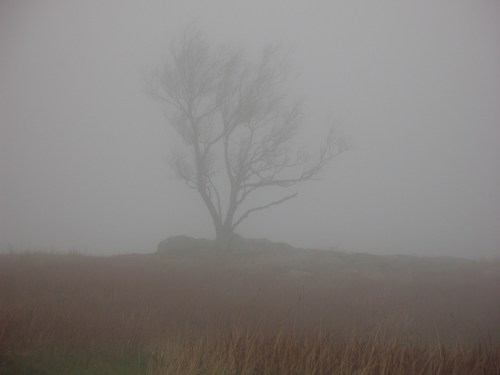
2014-07-13 Doughton Park Tree

Read Full Post »

I believe this globed earth not all by chance and fortune brings forth her broods, but feels and chooses

[with a longer poem by Robinson Jeffers]

The winter-gray trunks reveal their true nature. Stick-straight tuliptree, angled encroaching oak, perfected symmetry of beech, funky slipped-disc hickory – now in the rarified morning after frost, all mysticism stripped from the breath rising up Dutchman Creek, the trees allow us to know their inmost inclinations, their gestures and attitudes freeze-tag obvious: Fill this space. Drink the light. Every drop.

Summer is the mystery, all bluster and concealment. Signature leafshapes swallowed in jostling overflow of green – in winter we discover how they do it. Branches ramified ever finer, each species has invented its own geometry, each distinct inscrutable math of its evolving. Here they crouch and rise and stand and lean behind our house, here they create this little patch of forest just like all other patches and utterly unlike any but itself.

These trees aren’t old. Maybe seventy years since last the loggers passed. Perhaps that white oak is a hundred. One big silverbell beside the water has had time to cast her progeny up the ridge, seven generations. The early prodigies succumb to shade – dogwood, hornbeam. Not many pines remain, mostly a few holy snags favored by woodpeckers.

This winter we first realized a respectable Liriodendron had fallen last summer, twenty-inch diameter and a hundred feet from the house but we never heard the crash, parallel to power lines so we never lost light. She rests beside a sister that lay down before we bought this place forty years ago. The old tree is almost returned to earth; the newly fallen still clings to a few black leaves. Up the hill, in full sun, another sister is at least double their size, heaving our driveway, flaunting her strange orange-yellow flowers a hundred feet high, prodigal with her seedlings.

I am old. Seventy soon. God speaks that tuliptree’s name in the space it fills, in jadegreen leaves and roots that smell of musk and camphor. How difficult is it for me to imagine my name also on God’s lips, imagine some webline of my self will extend its existence onward when the frame that supports it collapses, when the blood, the electricity cease to flow? Dutchman Creek will still complain after heavy rain. The twigs will twist to find their places. Light will fill a new day and expect to be drunk. Every drop.

.     .     .     .     .     .     .

now all’s empty, a bone bubble, a blown-out eggshell


De Rerum Virtute
[The Virtue of Things]
++++ Robinson Jeffers (1887-1962)

++++ I
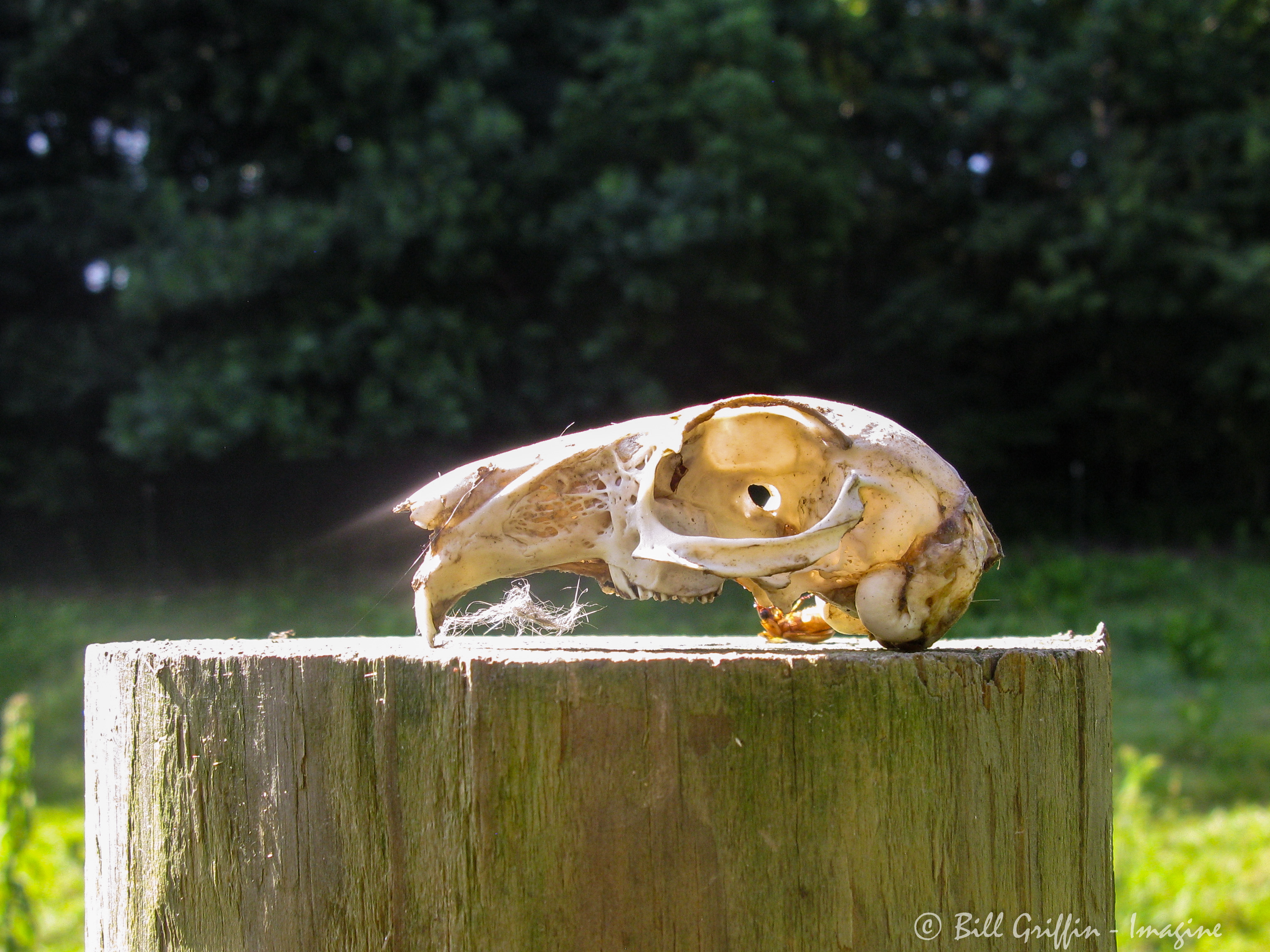
Here is the skull of a man: a man’s thoughts and emotions
Have moved under the thin bone vault like clouds
Under the blue one: love and desire and pain,
Thunderclouds of wrath and white gales of fear
Have hung inside here: and sometimes the curious desire of knowing
Values and purpose and the causes of things
Has coasted like a little observer air-plane over the images
That filled this mind: it never discovered much,
And now all’s empty, a bone bubble, a blown-out eggshell.

I believe the first living cell had echoes of the future in it

++++ II
That’s what it’s like: for the egg too has a mind,
Doing what our able chemists will never do,
Building the body of a hatchling, choosing among the proteins:
These for the young wing-muscles, these for the great
Crystalline eyes, these for the flighty nerves and brain:
Choosing and forming: a limited but superhuman intelligence,
Prophetic of the future and aware of the past:
The hawk’s egg will make a hawk, and the serpent’s
A gliding serpent: but each with a little difference
From its ancestors—and slowly, if it works, the race
Forms a new race: that also is a part of the plan
Within the egg. I believe the first living cell
Had echoes of the future in it, and felt
Direction and the great animals, the deep green forest
And whale’s-track sea; I believe this globed earth
Not all by chance and fortune brings forth her broods,
But feels and chooses. And the Galaxy, the firewheel
On which we are pinned, the whirlwind of stars in which our sun is one dust-grain, one electron, this giant atom of the universe
Is not blind force, but fulfils its life and intends its courses. “All things are full of God.
Winter and summer, day and night, war and peace are God.”

the sun will be strangled among his dead satellites, remembering magnificence

++++ III
Thus the thing stands; the labor and the games go on—
What for? What for? —Am I a God that I should know?
Men live in peace and happiness; men live in horror
And die howling. Do you think the blithe sun
Is ignorant that black waste and beggarly blindness trail him like hounds,
And will have him at last? He will be strangled
Among his dead satellites, remembering magnificence.

I believe that man too is beautiful

++++ IV
I stand on the cliff at Sovranes creek-mouth.
Westward beyond the raging water and the bent shoulder of the world
The bitter futile war in Korea proceeds, like an idiot
Prophesying. It is too hot in mind
For anyone, except God perhaps, to see beauty in it. Indeed it is hard to see beauty
In any of the acts of man: but that means the acts of a sick microbe
On a satellite of a dust-grain twirled in a whirlwind
In the world of stars ….
Something perhaps may come of him; in any event
He can’t last long. —Well: I am short of patience
Since my wife died … and this era of spite and hate-filled half-worlds
Gets to the bone. I believe that man too is beautiful,
But it is hard to see, and wrapped up in falsehoods. Michael Angelo and the Greek sculptors—
How they flattered the race! Homer and Shakespeare—
How they flattered the race!

the beauty of things means virtue and value in them

++++ V
One light is left us: the beauty of things, not men;
The immense beauty of the world, not the human world.
Look—and without imagination, desire nor dream—directly
At the mountains and sea. Are they not beautiful?
These plunging promontories and flame-shaped peaks
Stopping the sombre stupendous glory, the storm-fed ocean? Look at the Lobos Rocks off the shore,
With foam flying at their flanks, and the long sea-lions
Couching on them. Look at the gulls on the cliff wind,
And the soaring hawk under the cloud-stream—
But in the sage-brush desert, all one sun-stricken
Color of dust, or in the reeking tropical rain-forest,
Or in the intolerant north and high thrones of ice—is the earth not beautiful?
Nor the great skies over the earth?
The beauty of things means virtue and value in them.
It is in the beholder’s eye, not the world? Certainly.
It is the human mind’s translation of the transhuman
Intrinsic glory. It means that the world is sound,
Whatever the sick microbe does. But he too is part of it.

De Rerum Virtute
by Robinson Jeffers (1887-1962)

collected in The Wild God of the World, An Anthology of Robinson Jeffers, Selected, with an introduction, by Albert Gelpi, Stanford University Press, 2003

.     .     .     .     .     .     .

it means that the world is sound

.     .     .     .     .     .     .

I
now all’s empty, a bone bubble, a blown-out eggshell

II
I believe this globed earth not all by chance and fortune brings forth her broods, but feels and chooses

I believe the first living cell had echoes of the future in it

III
the sun will be strangled among his dead satellites, remembering magnificence

IV
I believe that man too is beautiful

V
the beauty of things means virtue and value in them

Robinson Jeffers, the Poetry Foundation

.     .     .     .     .     .     .

IMG_6432

Read Full Post »

[New Year’s Eve, poems by Mary Oliver and Jane Mead]

“Are spirits’ lives so short?” asked Scrooge.
“My life upon this globe is very brief,” replied the Ghost. “It ends to-night.”

The worm Ouroboros eats its tail, every day renewed, ever renewing. Cycles unending. The Neuse River snakes to New Bern, clouds lift inland, each little feeder stream is filled. Rain, ice, lichen eat the stone, phosphate creeps its migration through generations: rock to soil, leaf to masticator, herbivore to predator and all decomposing back to soil. I breathe out what the tree breathes in and breathes out for me to breathe. And the cycle we mark today: the dying Year gives birth to the New.

So many cycles. One enormous round. Every thing connected, interconnected, and we sense ourselves as spokes of the wheel or sometimes the never-ceasing motion of its rim that grinds along the path that is our life. As daylight diminishes it grows harder to hold onto our imagining of that wheel, its endless turning, that path it pursues still stretching on beyond the horizon. Harder to hold onto hope that the path’s end is indeterminate and out of sight.

Yes, it grows harder in these years of death’s overwhelming harvest to push aside imagining our own death. Too many deaths, COVID and otherwise, to pay attention; too many deaths to ignore a single one. In a few minutes I’ll set this page aside when my son arrives. He’ll leave Amelia here while the rest of the family attends their next-door neighbor’s funeral. A sudden death – our friend M was not old or ill. A shock to the fragile wall we build around our own mortality. Linda and I find ourselves tallying all the deaths that have touched us this month. The man who fixes our cars. A friend’s best friend. Names and faces more than we ever expect, doesn’t it seem? Death hunches at our shoulder, sometimes intrusive, sometimes silently lingering, sometimes perched like a moth that’s invisible until it flies into our face.

Tonight at midnight we will celebrate the Newborn Year but perhaps with even more enthusiasm we’ll celebrate a moment’s permission to ignore its haggard, dissipated forebear. The Old Year dies in winter darkness; death, the ultimate consuming dark. But notice – twelve days enfold the span of solstice to new year’s morning. The Ghost of Christmas Present senescent and dying yet retains some presence within us. Twelve days already lengthening, light seeping in even before the old year succumbs. Perhaps endings and beginnings are false markings along the ever-flowing course. Perhaps encircled by death it is possible, vital even, to engage with life. Perhaps death itself is not darkness but enfolding light.

.     .     .     .     .     .     .

.     .     .     .     .     .     .

White Owl Flies Into and Out of the Field

Coming down out of the freezing sky
with its depths of light,
like an angel, or a Buddha with wings,
it was beautiful, and accurate,
striking the snow and whatever was there
with a force that left the imprint
of the tips of its wings — five feet apart —
and the grabbing thrust of its feet,
and the indentation of what had been running
through the white valleys of the snow —
and then it rose, gracefully,
and flew back to the frozen marshes
to lurk there, like a little lighthouse,
in the blue shadows —
so I thought:
maybe death isn’t darkness, after all,
but so much light wrapping itself around us —

as soft as feathers —
that we are instantly weary of looking, and looking,
and shut our eyes, not without amazement,
and let ourselves be carried,
as through the translucence of mica,
to the river that is without the least dapple or shadow,
that is nothing but light — scalding, aortal light —
in which we are washed and washed
out of our bones.

Mary Oliver  — 1935-2019
this poem first appeared in The New Yorker, January 2, 1989


.     .     .     .     .     .     .

I Wonder if I Will Miss the Moss

I wonder if I will miss the moss
after I fly off as much as I miss it now
just thinking about leaving.

There were stones of many colors.
There were sticks holding both
lichen and moss.
There were red gates with old
hand-forged hardware.
There were fields of dry grass
smelling of first rain
then of new mud. There was mud,
and there was the walking,
all the beautiful walking,
and it alone filled me –
the smells, the scratchy grass heads.
All the sleeping under bushes,
once waking to vultures above, peering down
with their bent heads they way they do,
caricatures of interest and curiosity.
Once too a lizard.
Once too a kangaroo rat.
Once too a rat.
They did not say I belonged to them,
but I did.

Whenever the experiment on and of
my life begins to draw to a close
I’ll go back to the place that held me
and be held. It’s O.K. I think
I did what I could. I think
I sang some, I think I held my hand out.

Jane Mead — 1958-2019
this poem first appeared in The New Yorker, September 20, 2021

.     .     .     .     .     .     .

Mary Oliver was a guide to the intersection between human life and the natural world; her voice affirms the expression of person in nature in person and affirms that no voice can fully express that oneness. Jane Mead, who for years was Poet-in-Residence at Wake Forest University in Winston-Salem, NC, expected poetry to move people to preserve the earth; at the end of her life she was a guide to the landscape and ecology of dying.

.     .     .     .     .     .     .


Doughton Park Tree 2021-10-23

Read Full Post »

« Newer Posts - Older Posts »