Feeds:
Posts
Comments

Posts Tagged ‘nature’

 . 
[with 3 poems by Les Brown]
 . 
Pause
 . 
I placed my hand on the moon
++++ to keep it from its course,
to stop time in the comfort of night
++++ when sleep subdues sounds
of machines and urgent voices.
++++ Starlight and still moon
are enough to guide my stroll.
++++ I cross the meadow
among sparse trees,
++++ where snowy crickets cry fast
with time kept by heat
++++ of past day’s searing sun.
I lie down and listen
++++ for the whippoorwill
whose call is rare now,
++++ watch fireflies wink love calls.
I will hold the moon until
++++ the world stirs and wonders
why the night endures,
++++ with dreams of Earth
where fires do not rage,
++++ floods do not drown,
spiraling winds cease,
++++ oceans retreat from shores
and the cricket cries slow
++++ once again.
 . 
Les M. Brown
from A Coming of Storms, Main Street Rag Publishing, Charlotte, NC; © 2024
 . 
❦ ❦ ❦
 . 
Light rain in the woods, droplets coalesce and cascade through the upper canopy, tuliptree, oak, & hickory, until they freefall onto our heads and shoulders. A fat drop flicks a browned leaf or blinks in the duff. We imagine small creatures leaping up from the earth and then they do! Angel-winged insects are bobbing up and down to touch the fresh damp with the tips of their abdomens, animated by moisture. Linda watches one female Cranefly, notices nearby a delicate floral spike with angel-winged florets, and says,  “Look, it’s planting orchids!”
 . 
Cranefly Orchid and Cranefly, so like each other, elongated nectar tube of the flower resembling the long abdomen of the insect ending in its ovipositor, but so unlike! Except in our visual imagination they’re not related at all . . . or are they? Both favor moist woodlands with a nice layer of decomposing vegetation. Both reproduce in midsummer, by bloom and seed or egg and larvae. Both look a little creepy if you’re not fond of long spindly legs.
 . 
Altogether unrelated, entirely different Kingdoms – Animalia and Plantae – and yet these two are related ecologically, if simply by the places in which they thrive and by the company they keep. They live in community. But mightn’t  the relationship go deeper? All living creatures on this planet are genetically related; we share many of the same genes for  basic functions like metabolism, DNA replication, and protein synthesis, share them with every bacteria, archaea, fungus, protist, and plant. Compare the genome of any plant – Cranefly Orchid – and any animal – Cranefly – and you’ll discover hundreds of identical genes. It’s one big family tree, this Kingdom Earth, with some pretty twisted and winding branches, and yet all connected to the same trunk.
 . 
❦
 . 
Alas, the Cranefly is not planting orchids. She’s laying eggs in the moist duff; they’ll hatch into larvae called leatherjackets. She doesn’t care a whit for her namesake orchid, which is pollinated by Owlet Moths (Noctuidae). The Cranefly Orchid’s tiny flowers twist either left or right as they progress up the stalk (raceme), so that as the moth’s long proboscis probes the nectar tube she gets a dusting of pollen on one or the other of her large compound eyes. And carries it with her to the next flower.
 . 
 . 
 . 
❦ ❦ ❦
 . 
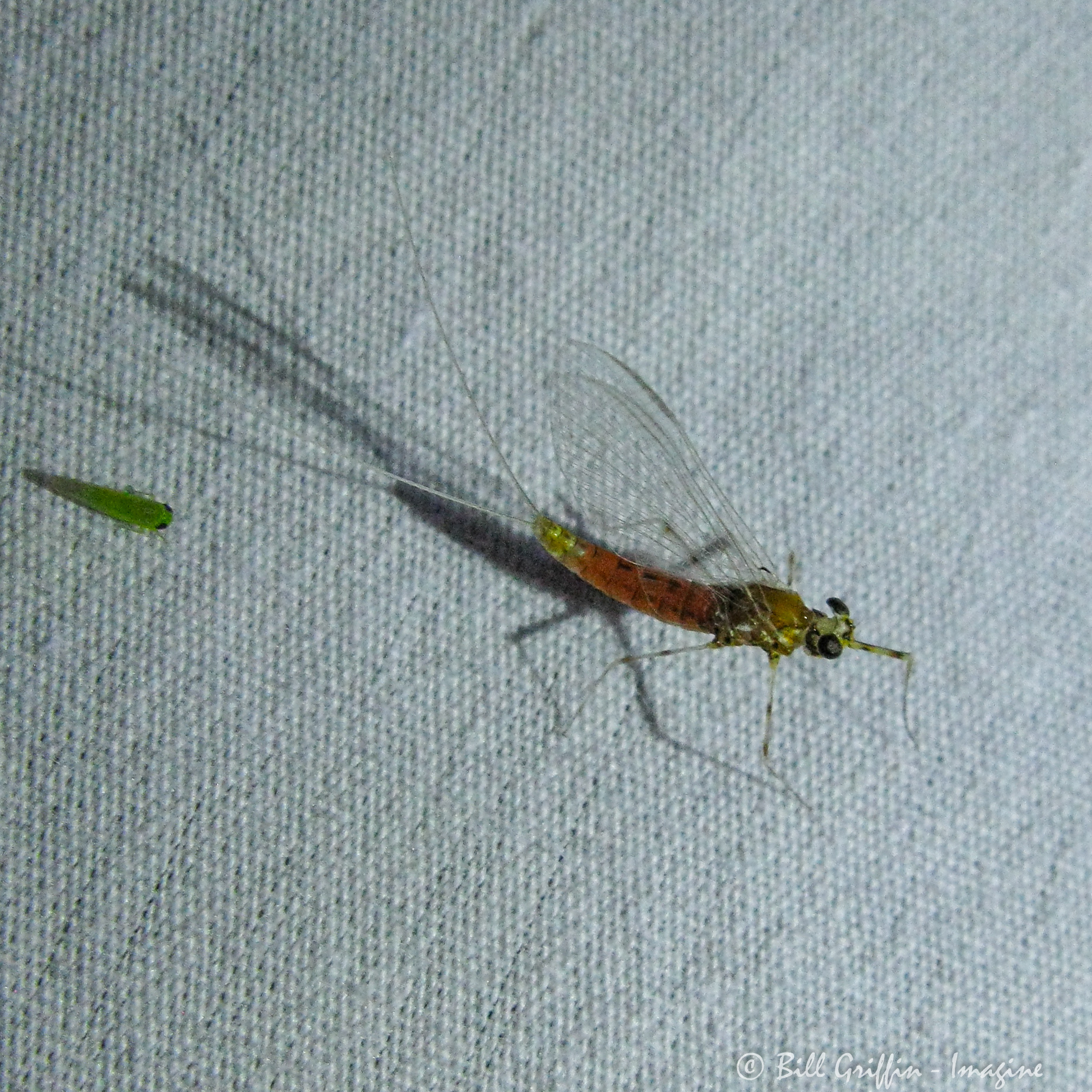
Mayfly Swarm
 . 
Night on the Pearl River, steaming warm –
our small boat pierces the tunnel of blackness.
Beams of head-bound lights play
across the dark slow current.
 . 
We tease out an occasional moccasin,
quiescent in boughs of bald cypress.
Lock on bright-lit eyes of river frogs,
the hungry raccoon eating a mussel.
 . 
The motor pusher our johnboat upstream –
Suddenly, a blinding blizzard
of white-winged snow rises.
Shimmering mayflies fill the blackness.
 . 
They are in our eyes, nostrils, mouths, ears,
and hair, an erupting silent lace-winged storm.
Millions rise in singular ecstasy, then die.
Their gossamer bodies blanket the river.
 . 
Fertile eggs drift into black depths.
Frog, fish, and bird devour the dead,
a one-night feast, a gift, a magic cycle
of lovers, death, and satiated flesh.
 . 
Les M. Brown
from A Coming of Storms, Main Street Rag Publishing, Charlotte, NC; © 2024
 . 
 . 
❦ ❦ ❦
 . 
Les Brown’s new book, A Coming of Storms, has plenty of vivid and hair-raising (literally) descriptions of black cumulonimbus monsters plowing down the mountainside to batter us with hail and impale us with jagged barbs of lightning. The storm he’s really warning us of, however, is metaphorical and of our own making: the devastation of Planet Earth by that most destructive invasive species, Us. Among these poems are Lamentations for the now diminished towns and farms where our lives were once so rich, Jeremiads proclaiming the dire future we’re creating for ourselves, and the Psalmist’s tender recollection of family homestead, tender sojourns in nature, and all the smells and tastes and feel of our fertile world at its best.
 . 
Les has all the necessary credentials of a prophet. He grew up in the rural mountainscape of North Carolina; his poetry is most poignant when populated by his grandparents, uncles, neighbors. He earned a Ph.D. in Biology and taught ecology to college students all his working life. He himself feels most personally and pointedly our loss of unspoiled fields and forests, our disconnection from the earth that sustains us. I wish he were here beside me this afternoon so we could both get our knees dirty investigating Cranefly Orchids and Rattlesnake Plantain. I’ll be looking forward to his next observation, and holding my breath for a cooling breeze of hope.
 . 
❦
 . 
A Coming of Storms is available from Main Street Rag Publishing.
 . 
❦ ❦ ❦
 . 
Think seeds, not bullets
 . 
++++ melons instead of bombs.
Drink wine, rest a while
++++ instead of scorching earth.
Rip off epaulets
++++ and but on bedroom shoes.
Call mothers. Tell them
++++ their children are safe
Revere the earth,
++++ cool it.
Grow chanterelles,
++++ not mushroom clouds.
Bend barrels
++++ and weld triggers
into metallic art.
++++ Read a different Good Book.
Let only birds tweet.
++++ Read only magazines
instead of loading them.
++++ What is beneath the skin
of an apple?
++++ It is a simple question.
 . 
Les M. Brown
from A Coming of Storms, Main Street Rag Publishing, Charlotte, NC; © 2024
 . 
❦ ❦ ❦
 . 
 . 
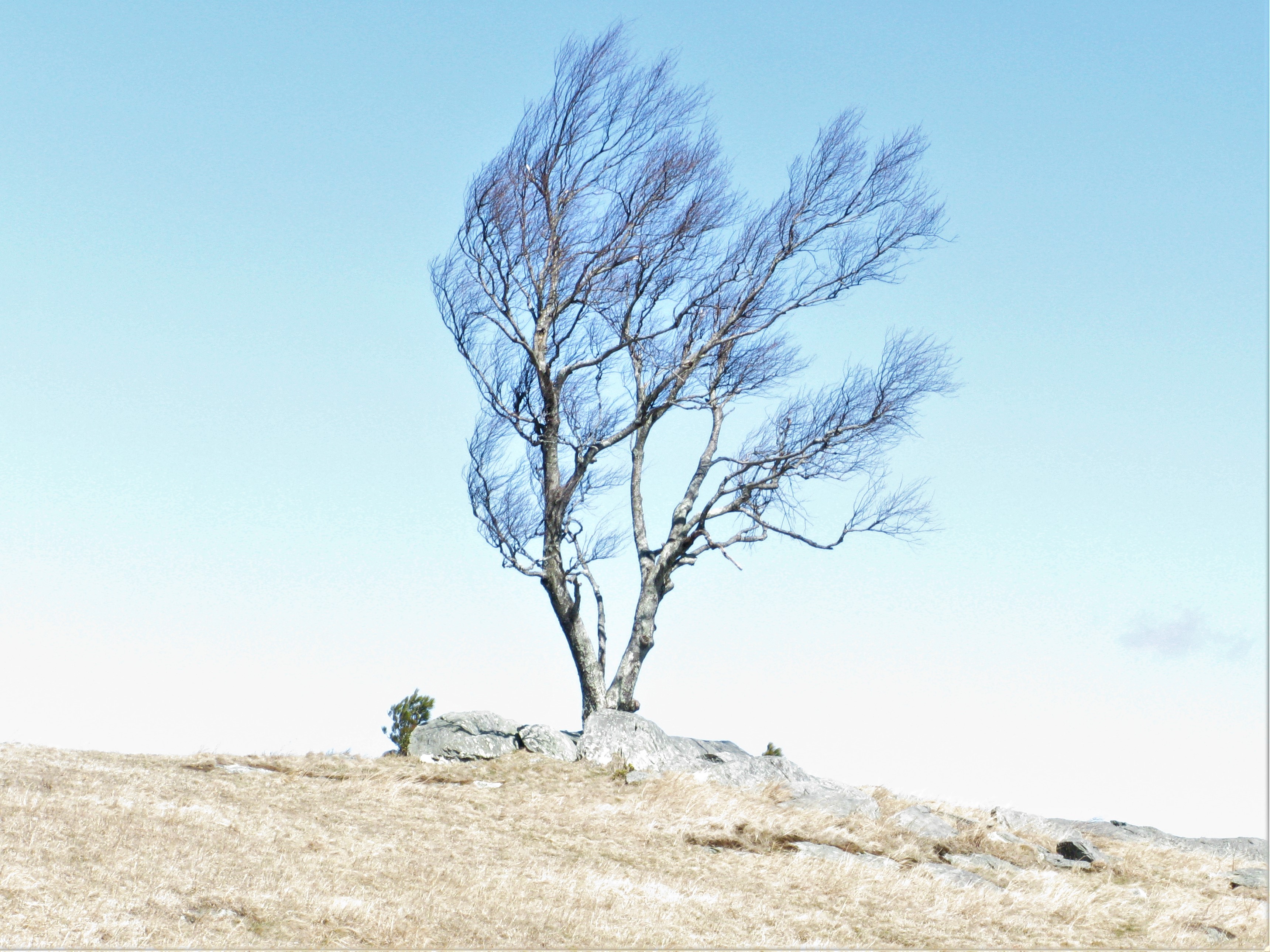
Doughton Park Tree 2014-07-13

Read Full Post »

[with Pilot Snake by Mary Oliver]

On June 21, I wrote in Tangled my distress at killing, by trying to protect nesting bluebirds, a four-foot long black rat snake. It became entangled in the collar of plastic mesh I’d attached at the base of the birdhouse pole to keep snakes from climbing up the pole to the nesting box. I never saw it there until it began to stink.

The snake’s presence explained the bluebirds’ agitated behavior over the past several days. Once I discovered the dead snake at the base of the post, though, I didn’t see the parent birds visiting the nest any more at all. Had they abandoned the chicks they’d been feeding so obsessively for two weeks? What would I find inside that house? I couldn’t bring myself to look. I hadn’t wanted to kill that snake; I didn’t want the death of birds on my heart as well.

❦

This morning I take down the bird house. I unscrew it and open it for cleaning: an empty nest. A few smears of bird lime but no desiccated baby bird carcasses. They have fledged and flown.

And now in the humidity and sweat of this heat dome morning, I’m moving the cleaned birdhouse to a new location and a new pole. This torpedo-shaped baffle should prevent snakes from climbing to the house, and I’ve added a spiky frill to deter the most persistent climbers. To deter, not to harm. Eat all the mice and voles you desire, O Snake. All my weedy property is yours to roam. Just let me enjoy Bluebird Song this summer.

 . 

 . 

❦ ❦ ❦

Pilot Snake
 . 
had it
lived it would have grown
from twelve inches to a
hundred maybe would have
 . 
set out to eat
all the rats of the world and managed
a few would have frightened
somebody sooner or later
 . 
as it crossed the road would have been
feared and hated and shied away from
black glass lunging
in the green sea
 . 
in the long blades of the grass
but now look death too
is a carpenter too how all his
helpers the shining ants
 . 
labor the tiny
knives of their mouths
dipping and slashing how they
hurry in and out
 . 
of that looped body taking
apart opening up now the soul
flashes like a star and is gone there is only
that soft dark building
death.
 . 
Mary Oliver
 . 

Read Full Post »

 . 
[with 3 poems by Rick Campbell]
 . 
The Light We Call Winter
 . 
If you see me walking down
the shell road under myrtle
 . 
and Spanish moss, don’t worry.
The road’s a circle and it brings me
 . 
back to my yellow mailbox.
You might give me the name
 . 
of the bird that sat all morning
on the thin branch.
 . 
Give me the last lost months gone
in a haze, sloughed off like an old dog
 . 
shakes himself dry.
Walk with me.
 . 
I won’t say
I don’t need you.
 . 
Rick Campbell
from Fish Streets Before Dawn, Press 53, Winston-Salem NC; © 2024
 . 
❦ ❦ ❦
 . 
When the first Human woke up on their first morning on Mother Earth, they discovered all the other persons watching them. The Plant persons, the Animal persons, the Lichen and Fungus persons, all of them had already been living together on Mother Earth for a very long time and they knew how to get along. Now here was this new member of the family, this Human. No doubt everyone was asking themselves whether this new person would also learn how to get along.
 . 
The Human opened their eyes and the first thing they said was, “How did I get here?” A question Humans would spend a very, very long time trying to answer. Then the Human stood up, looked all around, and asked, “What am I doing here?!”
 . 
At this point the Creator of Mother Earth and Every Living Thing smiled. Yep, those are the right questions. Two of the big ones. And don’t forget the third, maybe even bigger and maybe even more important. The Human noticed all the persons watching – Plant, Animal, Fungus, all of them – and asked, “Who are you?” The Creator smiled even wider. Yep!
 . 
❦
 . 
A nod to Robin Wall Kimmerer and Braiding Sweetgrass for inspiring this little parable. And a nod to Rick Campbell for poking at all the questions until they wake up and try to swim to the surface. The answers you’re going to get in this life depend on the questions you ask.
 . 
Be sure to ask, really, the questions no one knows the answers to. I almost wrote “the questions no one knows how to ask,” but how is something you certainly do know. The more you pay attention, the more you wonder, the more you know how to ask those questions. Not ask like Rodin’s Thinker with your chin on your fist in placid contemplation. More like lying awake at 4 a.m. in a sweat and doubting but asking anyway whether there’s any reasonable hope for you, you Human.
 . 
What am I doing here? I haven’t needed an answer as long as I’ve been always doing, doing. In fact I don’t even know there’s a question until I stop. (Maybe Rodin’s silent seated ponderer is an apt image after all.) In that momentary pause, in that engulfing silence, the questions suddenly loom huge and overwhelming. Why am I? What is my purpose? And cold, dark nothing threatens to bring its answer.
 . 
But then I look around. Who are all these others? All these persons, Human and not, sharing this circle with me? Can we get along? May I know them? It’s never too late to ask. Never too late to try.
 , 
 . 
❦ ❦ ❦
 . 
Practicing Silence
 . 
Outside of NYC, it’s
almost impossible
to be mistaken
 . 
for a mime. Here,
at the edge of the country
I’m just a guy who moves
 . 
silently down crushed shell
roads, through pine forests
in deep sand, past the harbor’s
 . 
broken docks. Ok, yes,
I could talk more, but to whom,
the clerk at the Dollar General?
 . 
What would I find worth saying
more than thanks? Buzzards whirl
over my head like synchronized swimmers.
 . 
Rick Campbell
from Fish Streets Before Dawn, Press 53, Winston-Salem NC; © 2024
 . 
❦ ❦ ❦
 . 
Frank X. Gaspar writes this in the introduction to Fish Streets Before Dawn: In the poem Throwing Starfish Back into the Sea [Rick] wonders how much “good he has done” with his uncertain act of kindness. It is an apt poem, and taken in the context of this collection and its outcries, we see that Rick Campbell’s wanderings and questing are testimony to the core of his art: surviving, yes, but surviving as the step that allows us to pursue any small good we can bring along with us.
 . 
Rick Campbell lives in Alligator Point, Florida, and teaches in the University of Nevada-Reno’s MFA program. He has published seven earlier poetry collections, plus a collection of essays, Sometimes the Light. His most recent poetry collection, Fish Street Before Dawn, from Press 53 in Winston-Salem, North Carolina, is available HERE
 . 
 , 
❦ ❦ ❦
 . 
Xenoglossy
 . 
I once wrote of my mill town
that you can want all your life here.
I was in love with words and
the directions they might lead:
into the temple of furnace fire
and out again? Along
a ridge with hawks drafting
thermals? Blues as it’s bent
at the crossroads? Freight trains
clacking downriver under the cloaked moon?
Just empty space?
 . 
At night I speak in the tongues
of angels and fools: babble
imperfect definitions of desiderate, lack,
+++++++++++++++++++ ought.
 . 
Yesterday, blades of grass parted
as the pygmy rattler sidled away
from my boot. I wanted to call
the hawk in the pine tree
down to snatch it up, but
I had no tongue for hawk.
 . 
What did I know? I am older.
It wasn’t just home that wanted,
not just the valley that lacked.
 . 
Rick Campbell
from Fish Streets Before Dawn, Press 53, Winston-Salem NC; © 2024
 . 
❦ ❦ ❦
 . 
 . 
❦ ❦ ❦
 . 
2020-03-07 Doughton Park Tree

Read Full Post »

« Newer Posts - Older Posts »