Feeds:
Posts
Comments

Posts Tagged ‘nature poetry’

 . 
[with 4 poems by Robert Morgan]
 . 
Time
 . 
Snow-covered peaks gather in the north
like arabs talking.
You can’t be sure you see them
but they leave an afterimage, detached
from the horizon, floating on haze.
Rugged seconds around the sky’s dial.
If you look long enough they seem to march
like bishops shuffling toward hell.
I know the ground is a bridge
leading there –
to the white tents
and altitudes of death –
but I don’t believe it. I don’t
believe you can get there by just walking
the earth one step after another,
but must be snatched miraculously away,
fall upward into the terrible
blue emptiness.
When I stand in a field,
the field and I are a sundial.
But the body alone is a clock, and each
motion it makes.
Something must distract us, anything.
The cornfield slapping in the rhythm of a tennis game,
a crow flying his clockhands on a face
without surface.
The will always hungry.
 . 
Robert Morgan
from Collected Early Poems of Robert Morgan, Press 53, Winston-Salem NC; Carolina Classics Editions; © 2024
originally published in Red Owl, W.W.Norton & Company; © 1972
 . 
❦ ❦ ❦
 . 
Two squirrels in my beech tree just can’t get along. I’ve named them Buddy and Holly. Buddy attacks my squirrel-proof feeder like he’s going to buzzsaw right through the metal bars. Meanwhile Holly is perched on a high branch eating beechnuts like popcorn and raining the pointy tetrahedrons on my deck, little caltrops.
 . 
Until I arrive to refill the feeder. Then Buddy has to scoot; he takes a flying leap into the silverbell. Holly continues to observe. I always spill some seeds – careless me – and when I re-hang the feeder Buddy scrabbles back to snarf a few then spring back up to the squirrel-proof, legs spread and clawed toes splayed like a cheetah bringing down a gazelle. At this point Holly climbs down to check out Buddy’s leavings. When he spies her, things get tense.
 . 
“Hey! Those are my seeds. Those are all my seeds!”
 . 
Holly sits up on her little haunches and rolls her eyes. “I didn’t see you planting any sunflowers last summer, Bottlebrush. You just play with your feeder toy while I have a nice lunch.”
 . 
“But I want those seeds. You might eat something I’m going to need later. Quit being so mean! Don’t you know this is where bad feelings come from?”
 . 
“Listen, Furbrain, this is where bad feelings come from.” She pokes his fuzzy chest with a foreclaw. “If you’re having bad feelings, I didn’t give them to you. You gave them to yourself.”
 . 
“Selfish, selfish, selfish.”
 . 
“Can I help it if it’s in my squirrel-nature to be hungry? And isn’t it squirrel-nature when you’re hungry to eat? Why don’t you pull up a chair (speaking entirely figuratively, of course) and enjoy a little lunch yourself.”
 . 
“Hmph, sez you,” Buddy grumbles. He picks up a seed and nibbles. Palpable silence I think you could call it.
 . 
“Hey,” Buddy finally offers after a few minutes, “When we finish these seeds, how about you hop up on that feeder with me. Maybe together we can shake out a few seeds. And . . . you could have some, too, if you want.”
 . 
 . 
Years ago Linda and I watched an episode of X-Files that has become our byword. Scully and Mulder were at a rest home investigating paranormal events involving gruesome mutilation, the usual stuff. One of the rest home residents was assisting them with their inquiries. Should he also be a suspect? The old man was wincingly meek, not very bright, and whenever he messed up or something went wrong he would hang his head and apologize, “I’m just a human being.”
 . 
I am just a human being. And how often am I compelled to admit that I inhabit a planet full of people that are also just human beings? How did Linda and I end up with so many family members who seem incapable of living up to our expectations? Oh well, they are just human beings. And so are the people we attend church with, and sing with, and meet at the store, and whose yard signs and bumper sticks are so aggressively in our faces. “What a world,” said the Wicked Witch of the West when she was doused. So many of these human beings have the power to give me endless heartburn; I could use some of that cold water.
Or I could quit giving them so much power. I’m lucky that I have Holly to remind me – when there are flickers of bad feelings, maybe some human being has struck the spark but I provide the fuel. Let’s just cool down for a minute. Aren’t we in this thing together? I’ll try to cut you the same slack I’d want you to cut me. After all, the two of us are just human beings.
 . 
 . 
❦ ❦ ❦
 . 
Land Diving
 . 
Though it’s no disgrace refusing
some things must be done.
And present accomplishment
is no guarantee
of future.
You must come close
as possible without touching
to prove brinksmanship, fly
from the sapling girdered tower
before the whole village, leaping with a scream
against the wall of fear, step onto
the white-hot floor
of emptiness
holding only to yourself.
You will know the pure isolation of fall.
The vines bound to your feet must not snag
on the scaffolding
or they will swing you crushing
into the frame and braces.
They must not break
or be an inch too long
or you will be smothered by
the swat of earth.
Yet the meaning is the closeness.
No stretching out your arms;
you must be jerked to a stop face against
the trampled dirt
by the carefully measured
bonds.
Only they can save you.
 . 
Robert Morgan
from Collected Early Poems of Robert Morgan, Press 53, Winston-Salem NC; Carolina Classics Editions; © 2024
originally published in Land Diving, Louisiana State University Press; © 1976
 . 
❦ ❦ ❦
 . 
In a journal he kept in the 1970’s, The Transfigured Body, Robert Morgan wrote this: “It is objectivity and precision that can be translated and that translates, the love of the humble detail, a sensitivity to the eros of all things, focused recognition; . . . I write to establish the reality of things. It’s as if I’m afraid they aren’t there unless substantiated by language, and consubstantiated.” [from the introduction by Robert M. West to Collected Early Poems of Robert Morgan]
 . 
Consubstantiation is a new word for me. I recognize transubstantiation, which means transmutation, to utterly change the character or substance of a thing. But consubstantiation is more personal, more intimate – to exist together in one and the same time and space. To unite and blend and merge. To become one. I yearn to be attuned to the smallest detail. I long to feel it, that shared presence with other humble creatures in the midst of creation, that eros of all things.
 . 
I prepare myself for that love by learning: botany, taxonomy, ecology. But I experience eros by kneeling and feeling the waxy winter leaf of a cranefly orchid; by turning its shadow green face to reveal the rich burgundy of its obverse; by remembering July blossoms when I see the dry seed stalk in January; by imagining the scant slant sunlight kissing that tough leaf to grant life for another summer’s blooms.
 . 
And I experience the eros of all things through a poet’s careful observation, through the power of  language to create juxtaposition and connection. Robert Morgan’s poems are often set in the North Carolina mountains, but his poetry is about everything. Perhaps we, who are just human beings after all, cannot overcome our hominid urges to circle around our small fires and fear and demonize all outsiders. Perhaps we can’t regain our ancestors’ connections to the earth, its plants and its animals, its textures and its smells. Sometimes I imagine we are determined to extinguish every spark that makes us human. But then I spend a quiet hour with poems to are determined to rekindle those sparks.
 . 
 . 
The Collected Early Poems of Robert Morgan, available HERE from Press 53reprints in their entirety his first four published volumes: Zirconia Poems (1969); Red Owl (1972); Land Diving (1976); Trunk & Thicket (1978).
 . 
Read additional selections from this new book at last week’s VERSE & IMAGE.
 . 
 . 
❦ ❦ ❦
 . 
Whippoorwill
 . 
The dead call at sundown from their places
on the mountain and down by the old mill.
They rise from the cellars of trees
and move up and down the valley
all night grazing like deer.
The call:
a rusty windmill creaks on the prairie.
Bats dipping and rising on ski jumps
are antennae
receiving and transmitting the code.
The whippoorwill interprets the news
from the dead, the unborn.
 . 
 . 
2 A.M.
 . 
A dog barks through the horn of a valley.
Low moon burning in a cedar.
The creek mutters like an old woman
who walks in her sleep among the trees
dreaming of the life after death
when she will lie down like the stream
and flow to the darkness.
 . 
Robert Morgan
from Collected Early Poems of Robert Morgan, Press 53, Winston-Salem NC; Carolina Classics Editions; © 2024
originally published in Red Owl, W.W.Norton & Company; © 1972
 . 
❦ ❦ ❦
 . 
 . 
IMG_7491

Read Full Post »

 . 
[with 4 poems by Robert Morgan]
 . 
Foxfire
 . 
Bright lace on the darkness grows
heavy as the meat of lightning bugs
crushed on bark, rotting leaves.
*
Flakes of the moon stuck to spongy logs.
*
Seconds sprinkled from a luminous dial on bearskin.
*
Glow worms crawl all night in stump water
without moving. St. Elmo’s fire.
Foxfire swims like fish of the deepest troughs.
*
City lights seen from a bomber.
*
the eyes of dead wood stare like jack-o-lanterns
burning last year’s sun
after a wet spell.
*
Coals of unlife,
chilly owls.
 . 
Robert Morgan
from Collected Early Poems of Robert Morgan, Press 53, Winston-Salem NC; Carolina Classics Editions; © 2024
originally published in Zirconia Poems, Lillabulero Press; © 1969
 . 
❦ ❦ ❦
 . 
When I was a Junior in High School I was going steady with the daughter of our town’s elementary school librarian. If you think Linda’s house wasn’t filled to the rafters with books, you’ve got another think coming. When we were in college, still dating, I decided for Christmas I would build her bookshelves.
 . 
During Junior High all the seventh grade boys took Home Ec with the girls and all the girls took Wood Shop with the boys. I got an A in sock darning and jello salad; on my woodworking project, a sculpture of a fish in walnut, I got a B+. Seven years later I gathered pine planks and 1×2’s in our basement to devise the Christmas present. Measure twice, cut once? Not so much as I recall, although I do remember wood glue, finishing nails, Minwax stain and varnish. Steel wool between coats. Linda seemed to like her present. Enough to marry me a year later and move the shelves to our 3rd floor apartment on Duke Street in Durham.
 . 
That little book case was not fine cabinetry, but the shelves didn’t sag beneath Linda’s textbooks: history, art, religion, all the heaviest stuff. My design was basic, mostly a ladder, something we and the years might climb together, or maybe an altar where she could cherish and display her first and truest loves. It was good as I could make it, the only thing I knew to build.
 . 
What did I know of all we and the years would build? The propagating books we’d carry home to become our family? Children grow and leave and carry their children back to you for an afternoon, but books are always close at hand to read to grandchildren like we read them to the grandchildren’s parents. A child is here for but a moment but bright spines and colored pages rest and wait for their return.
 . 
My work was not to build a house, or a home, or even rooms, but simply room enough for something she would never finish loving. Every birthday, every holiday, another book; any old occasion is fit time to add to the welcome weight of pages. They fill the hours and our hearts – and I foresee there will never be quite enough shelves for all.
 . 
 . 
❦ ❦ ❦
 . 
Very Old Man
Hounds bay in his breath,
face a wilderness, eyes like frozen fountains.
He speaks from a foreign country, words drunk
with exhaustion, wornout
habits of the tongue.
His shoulders are small as a child’s.
 . 
Sits on the cold peak watching us climb,
or doesn’t bother.
 . 
 . 
Elegy
 . 
Guess I’ll light a rag out of here, he said
and blindness rose in his open eyes.
 . 
Tilted chessmen, tombstones graze on the hill,
drag shadows at the setting moon.
Eighty years go down
 . 
like a ship.
 . 
Robert Morgan
from Collected Early Poems of Robert Morgan, Press 53, Winston-Salem NC; Carolina Classics Editions; © 2024
originally published in Zirconia Poems, Lillabulero Press; © 1969
 . 
❦ ❦ ❦
 . 
Saturday, September 15, 2001: Robert Morgan has managed to travel to Southern Pines to read at Weymouth Center before the North Carolina Poetry Society. So healing, so encouraging to us fellow mortals; I remember his tone and demeanor more than I remember his words, but many of his words have never left me. Actually, his words have grown in me and flourished. Audubon’s Flute – I have to pull that one out and read it every Earth Day.
 . 
Audubon in the summer woods
by the afternoon river sips
his flute, his fingers swimming on
the silver as silver notes pour
 . 
by the afternoon river, sips
and fills the mosquito-note air
 . 
So many notes before and after that morning in Weymouth Woods, so many words. No wonder that when I learn that Press 53 has collected Robert Morgan’s first four books of poetry into a single volume, I hear the silver tones calling me. In the lyrical introduction to Collected Early Poems of Robert Morgan, Robert M. West shares this quotation: Asked, ‘What is the highest praise that could be given to a poet’s work, southern or otherwise?’ Morgan responded, “ ‘You must read this.’ The greatest honor is to be read.”
 . 
And so we shall read and honor Robert Morgan. I am picking up his book every day for the next several weeks, and we will see where the music leads us.
 . 
Collected Early Poems of Robert Morgan, with an introduction by Robert M. West (co-editor of Robert Morgan: Essays on the Life and Work), is a Carolina Classics Edition from Press 53, available HERE.
 . 
 . 
❦ ❦ ❦
 . 
Distances
 . 
Mind wanders down the long slope of trees
like small cat fur
turning blue in the midday sunlight of December
into a short valley
with only a cabin and a juniper
and one horse nibbling the dried grass
around an Indian grave.
 . 
Clear through the distance of memory
into the cabin where my great grandmother, a bride
sits by the fire smoking her clay pipe
and watching through the door the gap in the mountains
where her man may come any moment
with gun on shoulder and quail swinging
and steps so rhythmic
they leave tracks in the mind.
 . 
Robert Morgan
from Collected Early Poems of Robert Morgan, Press 53, Winston-Salem NC; Carolina Classics Editions; © 2024
originally published in Zirconia Poems, Lillabulero Press; © 1969
 . 
❦ ❦ ❦
 . 
 . 
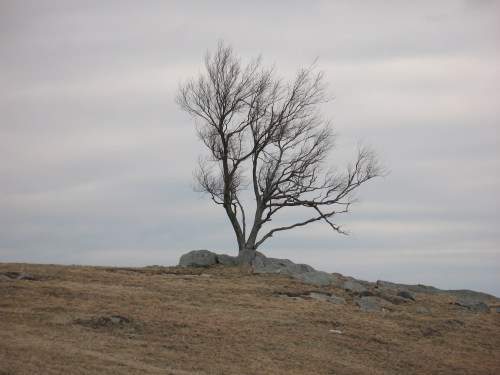
IMG_0768, tree

Read Full Post »

Thunderhead Sandstone outcrop below Ft. Harry Falls, GSMNP

 . 
[with poems about Geology . . . (say what?!)]
 . 
Erosion
 . 
Edges fall first,
silt grains cemented
under thousands of years
sloughed away by wind, rain,
footstep of dog,
sandstone alchemized beneath
weight of mountain
turns sand again
 . 
Subtle rubbing of days shapens us anew,
weathering, the
slowest song of change
 . 
No wonder we wake up some days
wondering at who we used to be.
No wonder we don’t always notice
as our outer edges strip away.
 . 
No wonder the children build castles
made of sand at water’s edge,
even though the castles fall.
 . 
They are practicing for
when they too will feel
what once seemed enduring
slip inside the rising tide.
 . 
Emilie Lygren
from What We Were Born For, Blue Light Press, San Francisco CA. © 2021. Reprinted by permission of the author.
 . 
❦ ❦ ❦
 . 
Geology never intended to trip us up. A mountain’s day is steady and measured, calm as the drip of water, languid as the North Pole’s precession that turns to aim the spinning globe at heaven. All night the mountain’s flow, her stretch, recumbent but restless; at first light she yawns and shudders, her turn and crouch and slow rise; then all morning’s long knotting and gathering to her full height; her relentless stride; a forceful journey, this full day’s labor into evening even as her form, still imposing, diminishes and she reclines.
 . 
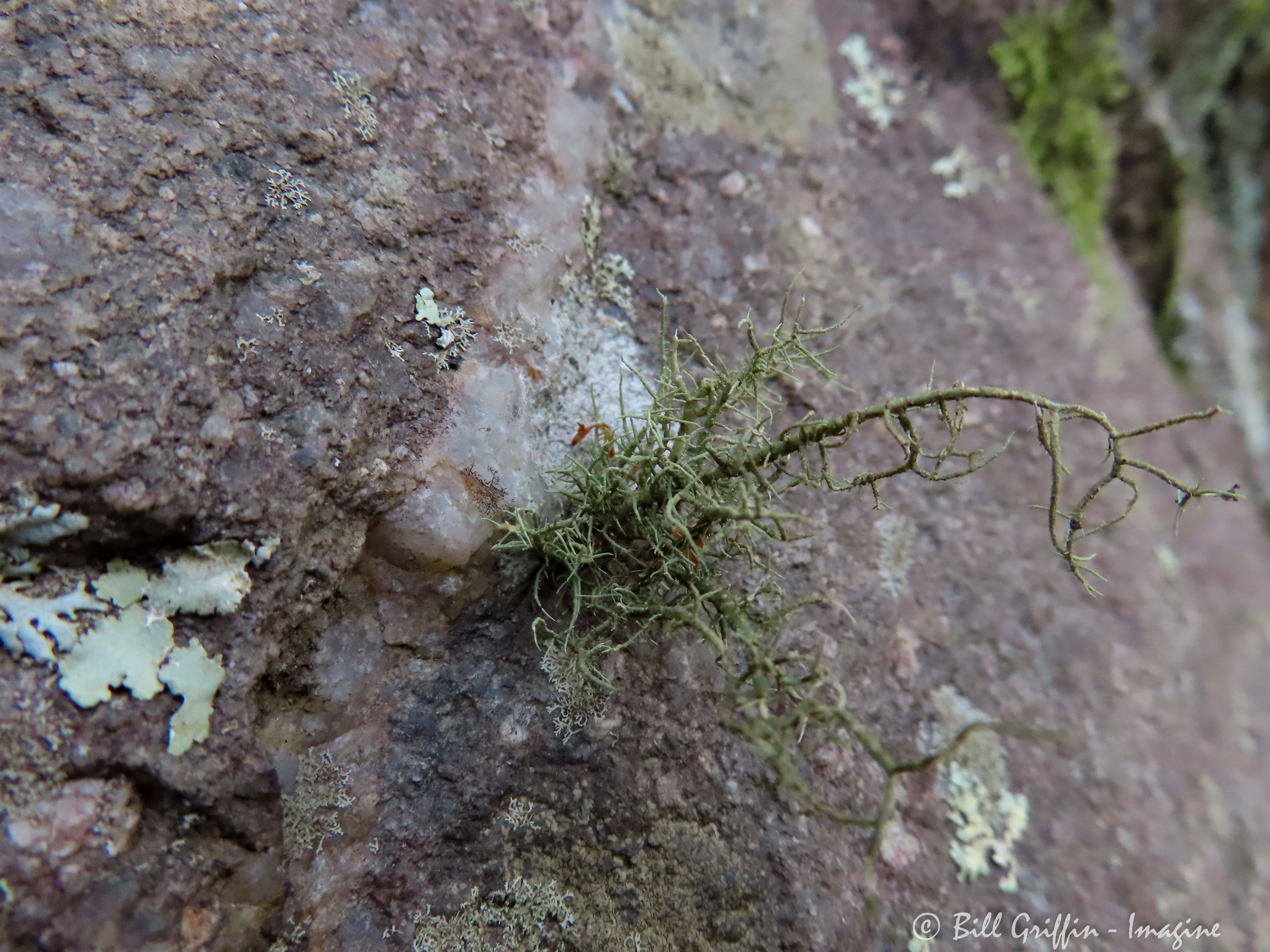
Did the mountain even feel the pinprick of water seeping and freezing in minute fissures at her neck? Perhaps a vague itch as lichens scratch to enlarge their circumference, little acid fingernails, a thimbleful of soil. Windborne seeds – would she notice such a light caress when one descends, then its rootlets, its swelling cambium and lignin? One and now another trunk emerges from the crevice, breathing, drinking sunlight, and here comes the day in mammal-time when gravity prevails. A crack, thunder without lightning, slabs and chunks release and roll downslope until they hold at a narrow rib where it crosses below the mountain’s shoulder. Bedrock settled into the new bed it has found.
 . 
Ten thousand human-years pass until you and I puff into view. We slow our pace to climb over and around. Here embedded in the footpath is a softer stratum that has been polished to ebony by a thousand boots. Here alongside the trail we greet the rounder edges and pitted face of earliest falls, sharper clefts and angles  from falls a mountain-day later. Water proving its strength. Lichens still hard at work. Wait a while and this path will open. Geology never intended to trip us up. She simply hopes that we will slow our frantic climbing. Pause here with her for a moment. Look, and simply see.
 . 

USGS map & quartzite vein in Elkmont (?) Sandstone GSMNP

 . 

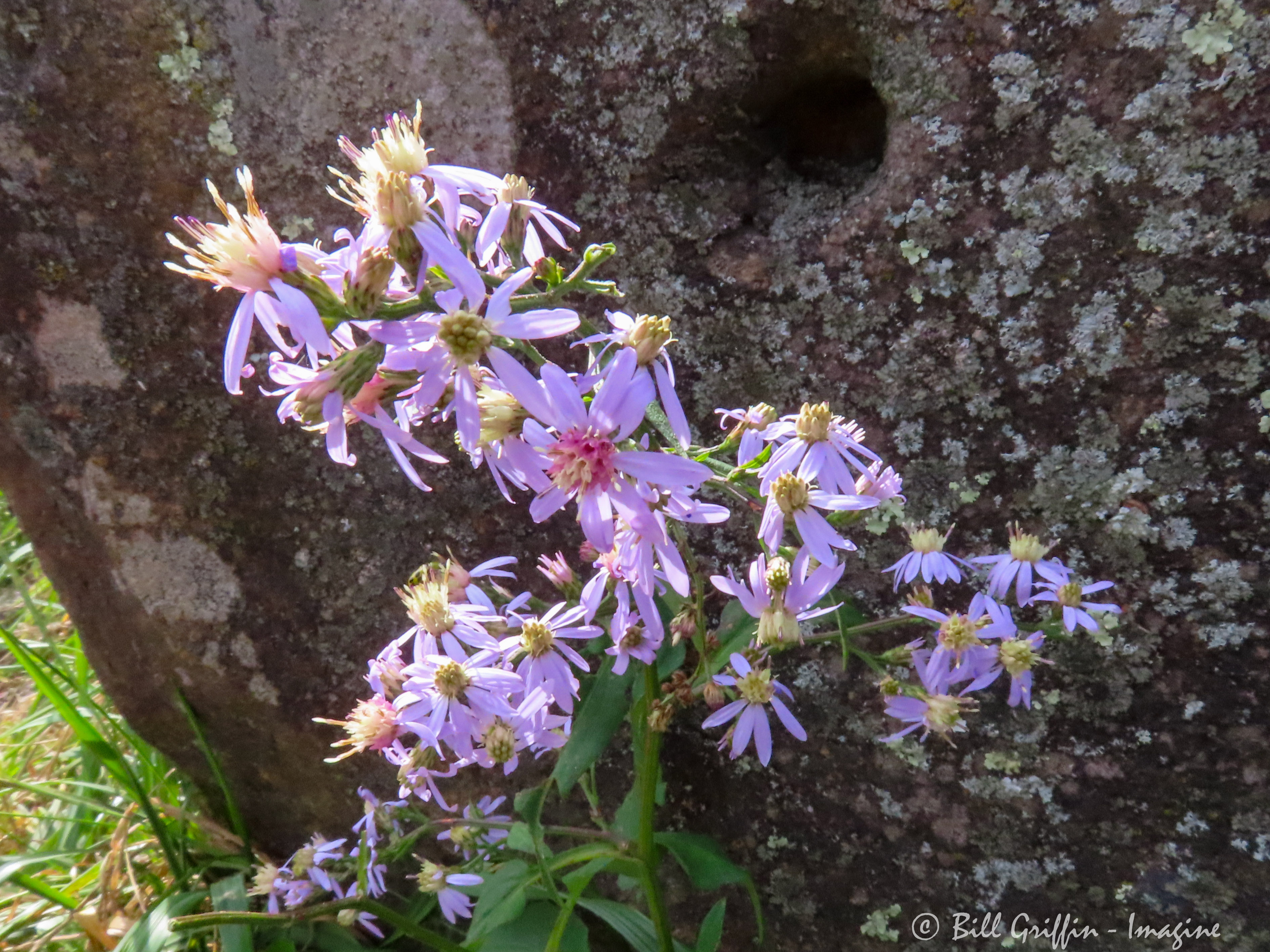
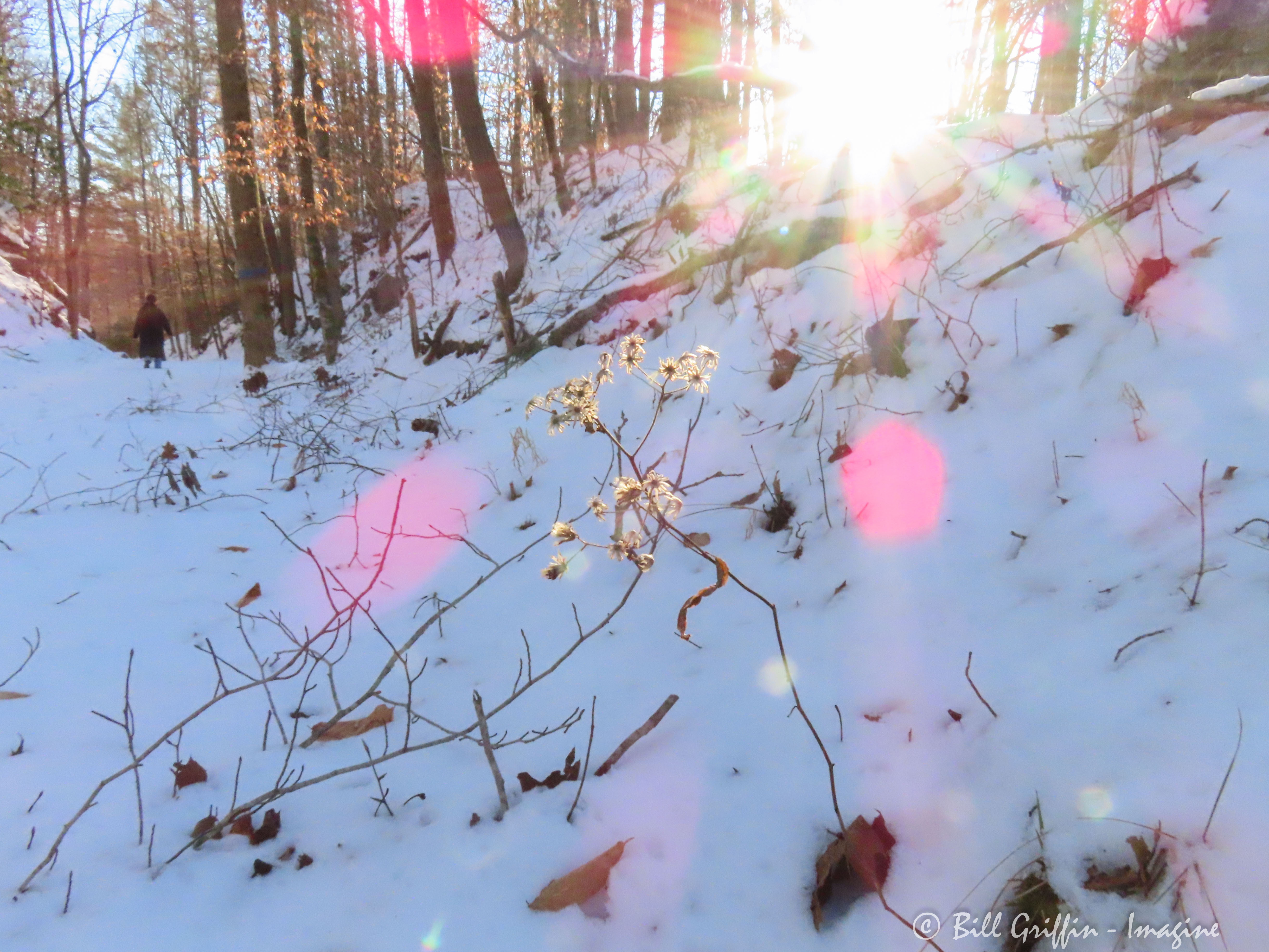
Common Blue Wood Aster & Thunderhead Sandstone GSMNP

 . 
❦ ❦ ❦
 . 
Anything the River Gives
 . 
Basalt, granite, tourmaline, the male wash
of off-white seed from an elderberry,
the fly’s-eye, pincushion nubbins yellow
balsamroot extrudes from hot spring soil,
confetti of eggshell on a shelf of stone.
Here’s a flotilla of beaver-peeled branches,
a cottonwood mile the shade of your skin.
Every day I bring some small offering
from my morning walk along the river:
something steel, blackened amber with rust,
an odd pin or busing shed by the train
or torqued loose from the track, a mashed penny,
the buddy bulge of snowmelt current.
I lie headlong on a bed of rocks,
dip my cheek in the shallows,
and see the water mid-channel three feet
above my eyes. Overhead the swallows
loop for hornets, stinkbugs, black flies and bees,
gone grass shows a snakeskin shed last summer.
The year’s first flowers are always yellow,
dogtooth violet dangling downcast ans small.
Here is fennel, witches’ broom and bunchgrass,
an ancient horseshoe nailed to a cottonwood
and halfway swallowed in it spunky flesh.
Here is an agate polished over years,
a few bones picked clean and gnawed by mice.
Her is every beautiful rock I’ve seen
in my life, here is my breath still singing
from a reedy flute, here the river
telling my blood your name without end.
Take the sky and wear it, take the moon’s skid
over waves, that monthly jewel.
If there are wounds in this world no love heals,
then the things I haul up – feather and bone,
tonnage of stone and the pale green trumpets
of stump lichens – are ounce by ounce
a weight to counterbalance your doubts.
In another month there won’t be room left
on the windowsills and cluttered shelves,
and still you’ll see me, standing before you,
presenting some husk or rusty souvenir,
anything the river gives, and I believe
you will love.
 . 
Robert Wrigley
from The Ecopoetry Anthology, edited by Ann Fisher-Wirth and Laura-Gray Street, Trinity University Press, San Antonio, TX. © 2020
 . 
❦ ❦ ❦
 . 
“Find yourself a stone, one you can pick up and carry,” our instructor tells us. “Then find me bedrock.” All weekend Elizabeth will be offering us something new every few minutes  – strange vocabulary, stranger stories in deep time, paths upward toward heath balds and downward into the past – but first she offers these two commands. Our substratum. We will build everything upon a stone from the Middle Prong of the Little River, edges knocked round, compressed bits of texture a hundred shades of gray (soon we’ll know to call those bits clasts); and ponderous gray stone rising beside the river, its layers, its planes and fissures (soon we’ll know which is bedding and which foliation). Here we begin our weekend course in the Smokies, 500 million years beneath our feet, asking how it all got here.
 . 
I’m taking my final elective offered by Great Smoky Mountains Institute at Tremont in their Southern Appalachian Naturalist Certification Program – Geology of the Smokies. This is the first time Linda has accompanied me to Tremont, so she’s taking her first course. We know from our readings that these are the most folded, tortured, elevated/eroded/re-elevated/re-eroded square miles in North America. We know that for the next 48 hours we’ll be continuously outdoors except a few hours to eat and sleep. From my previous nine courses, I know Elizabeth Davis as an excellent teacher, patient yet challenging. What we don’t yet fully know is just how truly challenging, physically and intellectually, this weekend is going to be. But here we are on Friday night and we should be getting a clue – Elizabeth is leading us on a hike into pitch darkness, across the shallows on a single-log bridge, and has turned us loose on an island to find our river stones.
 . 
Success. No one falls into the river.
 . 
Tomorrow morning we’ll be picking our way up through a pathless boulder field to a massive outcrop of Thunderhead Sandstone (its compressed sediment, clasts, recycled from the Grenville mountains built almost a billion years ago). We’ll spend the afternoon literally on hands and knees beneath laurel and rhododendron, climbing to a heath bald summit where some really cool rocks are exposed and where we’ll take samples of the low pH soil. Sunday morning we’ll hike a trail so hazardous that the Park won’t even include it on their maps, but along the way we’ll cross major and minor fault lines to discover their rocky transitions, investigate geology’s effect on plant communities, devise some crazy poems and songs about our findings, and end up at beautiful Spruce Flat Falls.
 . 
Late Sunday night, after driving five hours, Linda and I will pull into our driveway and our old bones will creak as we lug our gear back into the house in pitch darkness. At least we don’t have to cross a log bridge to make it to the kitchen door, but when we wake in the morning, stiff and aching, will Linda have a few choice cusswords for me after dragging her along on this adventure? Oh yeah, we’re sore, but only in body. What Linda does have for me is a list of books I need to order. And this proclamation: “You know, after this weekend I really love Geology!”
 . 

Nodding Ladies Tresses growing up through Anakeesta Slate GSMNP

 . 

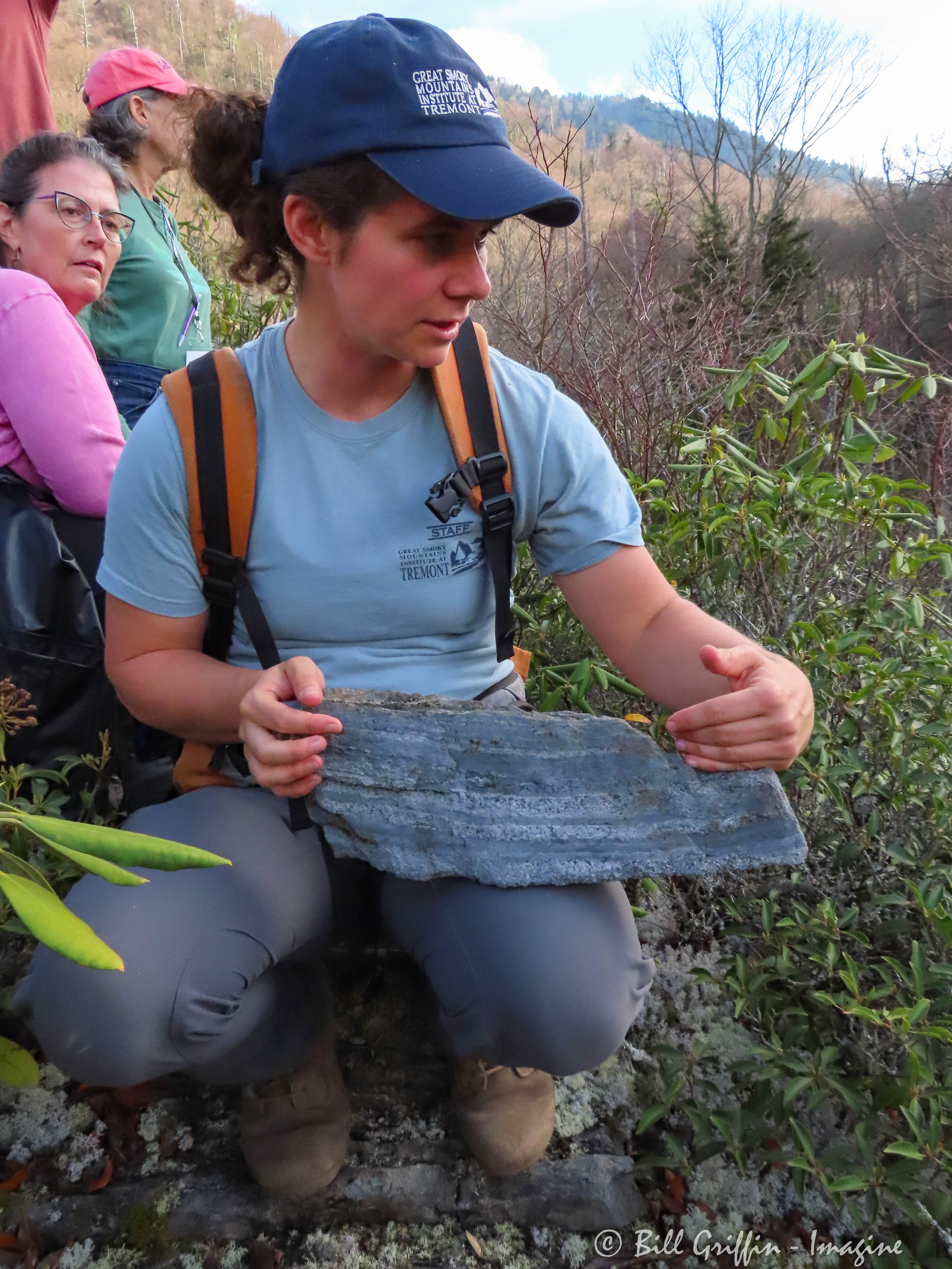
Elizabeth displays bedding vs cleavage at summit of heath bald near Chimney Tops GSMNP

 . 
❦ ❦ ❦
 . 
The End of the Age
 . 
With wash and ripple and with wave,
Slow moving up the long deserted sand,
The little moon went watching the white tide
Flood in and over, spread above the land,
Flood the low marshes, make a silver cover
Where the green sea-weed in a floating mist
Creeps under branch and over.
The wide water spreads, the night goes up the sky,
The era ends.
 . 
Tomorrow comes warm blood with a new race,
Warm hearts that ache for lovers and for friends,
And the pitiful grace
Of young defeated heads.
Tomorrow comes the sun, color and flush
And anguish. Now let the water wash
OUt of the evening sky the lingering reds,
And spread its coolness higher than the heart
Of every silver bush.
Night circles round the sky. The era ends.
 . 
 . 
Geology
 . 
“Look,” said God;
And with slow fingers
Drew away the mantle rock.
Man followed groping
To touch the flesh of his true mother;
And, standing in great valleys,
He saw the ages passing.
 . 
 . 
Fossil
 . 
I found a little ancient fern
Closed in a reddish shale concretion,
As neatly and ans charmingly shut in
As my grandmother’s face in a daguerreotype,
In a round apricot velvet case.
 . 
Janet Loxley Lewis (1899-1998)
from Poetry Magazine, No. 111, The Poetry Foundation. © June, 1920
 . 
❦ ❦ ❦
 . 
Emilie Lygren has published poems and anthologies and developed dozens of publications focused on outdoor science education. Her first collection of poems, What We Were Born For, was selected by the Young People’s Poet Laureate as the Poetry Foundation’s monthly book pick for February 2022.
 . 
Robert Wrigley has said that “poetry can have a redemptive function. It can look at the chaos you see and make a kind of sense of the smallest part of it.” His poems are concerned with rural Western landscapes and humankind’s place within the natural world.
 . 
Janet Loxley Lewis (1899-1998) wrote novels, stories, and librettos, but she considered poetry the superior form. Theodore Roethke describes her poetry as “marked by an absolute integrity of spirit and often by the finality in phrasing that can accompany such integrity.”
 . 
❦ ❦ ❦
 . 
 . 

Great Smoky Mountains Institute at Tremont GEOLOGY course November, 2024

 .  . 
 Doughton Park Tree 2018-02-09

Read Full Post »

« Newer Posts - Older Posts »