Feeds:
Posts
Comments

Posts Tagged ‘nature poetry’

June 1, 2012

This is Dan Lawler at Great Smoky Mountains National Park.  May I speak to Bill Griffin?

Hi, I’m Bill.

Listen, Bill, it’s about your back country permit.  You’re not going to be able to stay at Cosby Knob Shelter on June 9.

What is it? Too many hikers?

No, too much bear activity.  A bear tore up a couple of hikers’ . . . packs.  We’re closing the shelter for a month or two until he gets the message and moves on.  Those Cosby Creek bears – ha, ha – they give us problems every spring.

Ah . . . well . . . that’s fine.  I’m not all that fond of sleeping with bears.

IMG_2438

.     .     .     .     .

July 23, 2000

Today Mary Ellen and I embarked on the Great Sibling Bonding Adventure.  My sister and I spent a week backpacking the Appalachian Trail from Springer Mtn., GA to Deep Gap, NC, something shy of 100 miles.  Growing up separated in age by six years we never spent much time together, never had a lot in common.  Now we’re sweating up every steep ridge together, eating out of the same pot, sleeping in the same little tent.

Along the way we count the birds and name the wildflowers, and make up names if we don’t recognize them.  We make supper in pitch dark at Gooch Gap.  We make up funny songs (“Nothing Like a Log” to the tune of “Nothing Like a Dame”).  We make it to Muskrat Creek Shelter on our last night and celebrate Mary Ellen’s thirty-eleventh birthday with a stale cake I’ve stashed in my pack all week.  We make friends.

IMG_2465

.     .     .     .     .

June 8, 2012

Now it’s Friday morning and we’re cinching up our hip belts at Big Creek ranger station to head into the back country again.  Last month Mary Ellen called me and said she was overdue for some big brother quality time.  We broke out the trail maps and chose a non-old-guy-destructive three-day loop in GSMNP.  Since we’ve been shut out of Cosby Knob by the bears, we’ll hike 5 1/2 miles to Walnut Bottom and spend both nights there, Big Creek chuckling beside us.  On Saturday we’ll hike a ten-mile loop that takes us up to the AT and right past the bear-haunted trail shelter (and while we fill our bottles from the spring there we’ll keep whistling the entire time).

We’ll name every flower, tree and shrub — in twelve years damn if Mary Ellen hasn’t learned them all, right down to the Latin binomials.  After supper we’ll hang our food up high, and while dusk settles into Walnut Bottom we’ll sit on mossy creek boulders, sip mint tea with powdered milk, and wonder if the bears have discovered unattended dinners on the Tennessee side of the ridge.  Or if at this very moment they’re watching us from within the dog hobble and rhodies, just waiting for full dark . . .

.     .     .     .     .

Bear

If you hear me, it will be a nut falling
from the buckeye.  If you hear me,
it will be a dry branch
seeking earth,
it will be slender fingers
of mountain ash waving praises
to the ridgelined sky.

If you see me, it will be a shadow
only one breath deeper
than twilight.
If you see me, it will be the twist
of heart that skips
a beat, the stark
of pupils gone abruptly wide.

I am mist that enfolds the laurel.
I am stone that reclines beneath black hemlocks.
I am a rumor at Maddron Bald,
a tremor at Mt. Guyot.

Raven is mistaken – this Ridge is mine.

And if you hear me, it will be the rising chest
of the mountain and its timeless slow
exhale,
and if you hear me
it will only be because
I didn’t hear you first.

.     .     .     .     .

2000_H

IMG_2482

Afterword

In some twenty years of backpacking the Southern Appalachian mountains and Great Smokies, I’ve encounered a bear exactly once.  Mike Barnett and I were hiking without the noisy accompaniment of teenagers.  We’d set up camp one evening and I had walked back up the trail to spot some birds.  I’d been standing completely still for about twenty minutes, waiting for a Pileated Woodpecker I’d been hearing to show itself, when I heard a soft crack behind me.  I figured it was a buckeye falling.  Crack again.  I turned.  Slowly.  Twenty feet from me a large black mass with a pointed nose was staring towards camp where Mike was fixing supper.

And where did that happen?  Cosby Knob shelter.  That night I wrote the first draft of Bear in the AT log book and next morning left it in the shelter.

.     .     .     .     .

IMG_2490

and a p.s. . . .

Hey Sister — I’m looking closer at all the wildflower photos we took and I believe we saw BOTH lesser and greater purple fringed orchids!   (Platanthera psychodes and grandiflora).    —    your Bro

.     .     .     .     .

[Bear first appeared in the journal Cave Wall, and was the first poem I wrote in the collection Snake Den Ridge, a Bestiary (March Street Press, 2009.]

Bear Crop 02

IMG_7491

Read Full Post »

April 27, 2012 – first scarlet tanager of spring, Elkin, NC.

If I had an hour and good binoculars I could spot him, but I know he’s there.  There’s no other song like his, just exactly like a robin with a 40 pack-year smoking history.  He always arrives about a week after the big oaks in our neighborhood have fully leaved, and then he hangs out way up in the canopy.  I’ll come back tomorrow when the sun is high, follow my ears, and when he lunges from the greenery for a moth or a beetle, I’ll have him.  A red like no other red.

Last week Linda was drawing at her desk when Saul ran in from the next room.  “Granny, I seed a red-headed woodpecker on the bird feeder!”  He pulls her into the den and there is indeed a woodpecker on the feeder, a male downy, patch of red at his nape.  “Good, Saul!  That is a woodpecker.  But a red-headed woodpecker has a head that is red all over.”  About fifteen minutes later Saul is back.  “Granny, see this red-headed woodpecker!”  And it’s head is red all over.  A bright fiery cardinal.

Red birds.  So startling!  So noticeable, so eye-catching!  Is the northern cardinal, Cardinalis cardinalis, the state bird of seven out of fifty because it’s so familiar and recognizable or because it is exotic, unbelievable that something so bright would allow itself to be seen by mortals?  I remember the first time I actually saw Piranga olivacea, the scarlet tanager.  I’d heard plenty calling and singing but never spotted one.  June 17, 1994, I was visiting my brother-in-law Skip for a weekend at his place in southern Ohio (off the beaten path doesn’t half do it justice).  Mid-morning with the binocs, about to quit because of warbler-neck (cricked back searching the tops of trees for spots of color), and there he was.  Perched high in brightness, not even attempting to conceal his flame.

Just to share a moment of that creature’s living breath, to see something in clarity and commonplace that up until that moment has been so elusive and so desired, it is to feel the earth, nature, creation expanding around me and I am a single cell in the body of God.  And if the sun is shining tomorrow, I think I’ll walk around the block and try to see another.

IMG_2128

.     .     .     .     .

It’s been almost a year since I last saw a scarlet tanager.  It’s been about a year since I last read Mary Oliver’s book, Red Bird.  I need to return to both.  Scarlet tanagers aren’t rare, although one has to go where they are to see one.  And look up.  Mary Oliver’s poems don’t seem rare.  So conversational, so commonplace.  Being alive is not particularly rare.  Six-plus billion of us Homo sapiens are engaged in it today. Out of the one-thousand four-hundred and forty minutes in each day, I don’t pause to consider many of them rare.

Shouldn’t I?  Read this poem with me.  Read and let us, you and I, share a moment of each other’s living breath.

.     .     .     .     .

Red Bird Explains Himself

“Yes, I was the brilliance floating over the snow
and I was the song in the summer leaves, but this was
only the first trick
I had hold of among my other mythologies,
for I also knew obedience: bringing sticks to the nest,
food to the young, kisses to my bride.

But don’t stop there, stay with me: listen.

If I was the song that entered your heart
then I was the music of your heart, that you wanted and needed,
and thus wilderness bloomed there, with all its
followers: gardeners, lovers, people who weep
for the death of rivers.

And this was my true task, to be the
music of the body.  Do you understand?  for truly the body needs
a song, a spirit, a soul.  And no less, to make this work,
the soul has need of a body,
and I am both of the earth and I am of the inexplicable
beauty of heaven
where I fly so easily, so welcome, yes,
and this is why I have been sent, to teach this to your heart.”

from Red Bird, Mary Oliver, Beacon Press, © 2008 by Mary Oliver

.     .     .     .     .

Read Full Post »

July, Knife Lake, half a mile from the Canadian border.  The vireos begin to sing at 4 a.m. and dawn follows right on their tails.  I crawl out of my tent before the boys awaken.  We’re camped on a bluff high enough above the water that the mosquitoes don’t find me for a while, so I just sit among the red spruce, wait for water to boil, and watch the dance of colors on the water.

We paddled to this remote spot yesterday at dusk.  In the Boundary Waters Canoe Area Wilderness, northern Minnesota, you’re only permitted to camp at specified sites, perhap just one in the smaller lakes, half a dozen in large lakes.  Of course there are hundreds of lakes, interconnected by creeks and sloughs and overland portage trails.  This will be our fourth day on the water out of ten.  Yesterday afternoon every campsite we passed had a couple of canoes pulled up the bank; we were afraid we’d be portaging ourselves and our gear to the next lake in the dark before we’d find an unoccupied spot.  Then we glided through a straight, passed a promontory, and the lake opened before us.  No tent, no campfire smoke for miles.  The designated campsites, like the portage trails, are indicated “approximately” on the map — a red dot, no signs anywhere in the wilderness.  On a hunch a boy in the lead canoe tied up to a sapling, rock-hopped to shore, climbed the abrupt bank, and fifty feet above the water there it was.  A fire grate.  Here we were allowed to spend the night.

Now the sun promises to return, a coy suggestion through the conifers on the far shore.  A loon cries, its liquid call mimicked in pastel ripples.  Every minute the lake is different from the minute before.  A phantom of mist here, a reflection of pale sky there; color rising, flowing . . .breathing.

I snapped a photo.  For several years it hung in my office.  I could name the landmarks: that curve of shoreline, sharp flint mouthing the shallows, trees reaching down to the distant notch where our next portage hid.  But where was the dance of sky in water?  Where the ephemeral colors that have no name?  The print on my wall was like words on a page, a dead thing.  It couldn’t breathe, it couldn’t speak . . . except in the fire it lit within my mind.

.     .     .     .     .

Can a poem breathe?  Can it live?  Can it set you down on some elevated vantage you’ve never visited and reveal a place you’ve never dreamed?

I’m looking for that poem.  I want to stare across its rippled surface and discover in its reflections something that words can’t name.

Bud Caywood’s poems have taken me at times to that unnamed place.  He is an artist, a canoer, a fellow birder, and his verse often endeavors to capture that singular moment of inchoate atmosphere.  You want to enter the words he’s placed on the page.  You want to return there.

.     .     .     .     .

GoodMorning

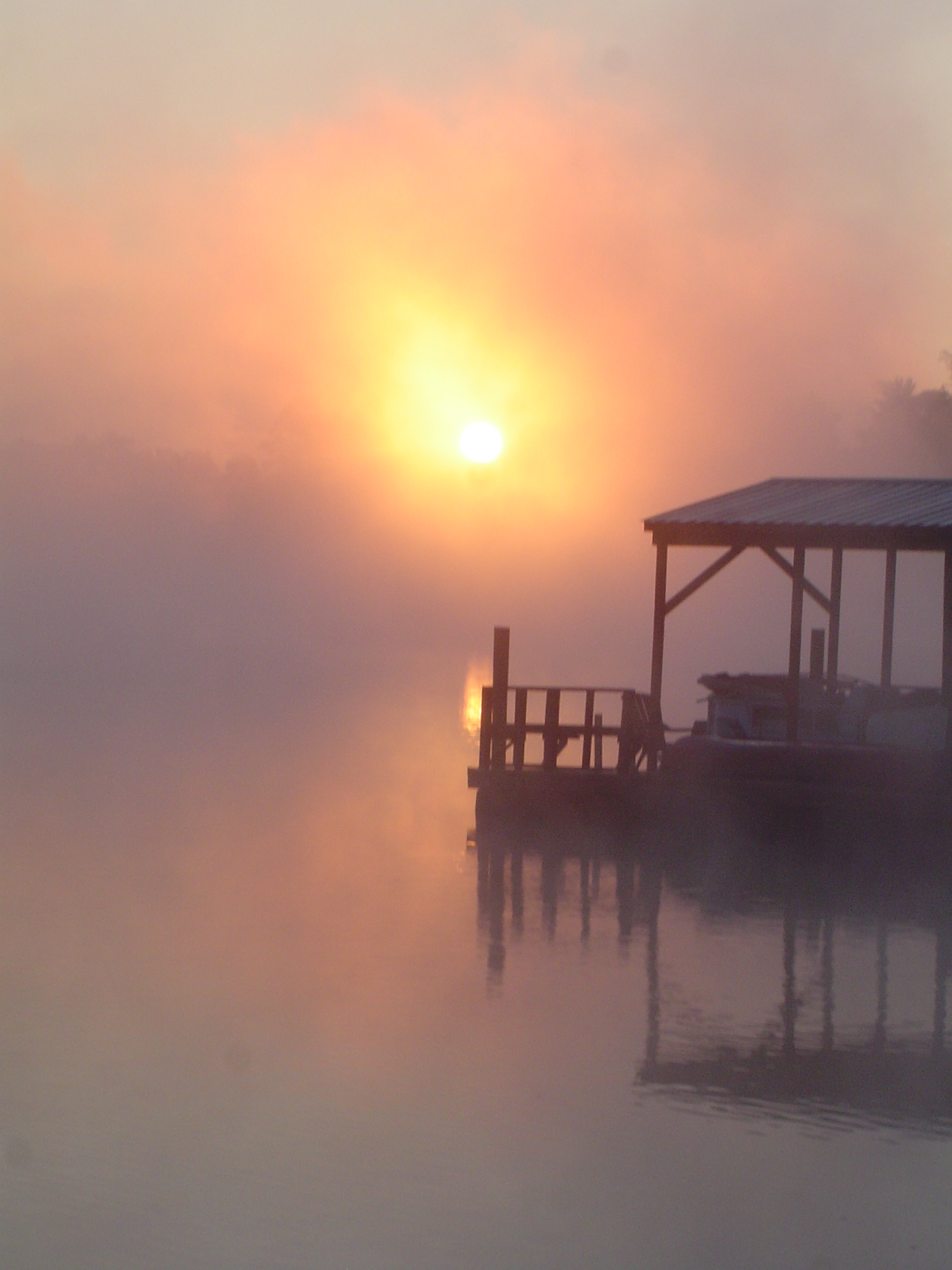
Morning in the World of Fog

See the fisherman crossing the stippled lake,
cutting a swath through the layered

fog of morning.  See how his image
darkens the falling light, brushed out

like a blurred black and white photo,
until thicker fog washes over him.

Now watch the boat docks quiver
in their eerie caress of the wake,

or the skeleton-like crepe myrtles
light-speared through their branches,

or the boathouse holding its stillness
against the thick gray-orange blanket,

while its squeaking hinge strums
one-chord songs again and again and again.

See the gulls appear like angles,
disappear like apparitions,

unwinding the velvet, circle after circle,
as if the sky’s whole element is one in them.

Now hold open your palm;
even the air around you has weight.

.     .     .     .     .

I first met Bud years ago at a reading in Hickory.  He invited me to join the “e-Poets,” and for several years we shared poems with each other every month or so.  We’ve continued our friendship and mutual admiration through the NC Poetry Society and now Poetry Hickory, a monthly reading organized by Scott Owens.  Last month Bud invited me to read, along with Adrian Rice and Tyree Maddox, at an annual poetry night at the Bethlehem Branch Library near Hickory.  Bud arranges art, sometimes accompanied by poetry, every month at the library; he is one of the stalwart perennials who are keeping verse alive in our modern culture.

And I admire his poetry.  Images that breathe.  I will hold onto and return frequently to that closing couplet: “Now hold open your palm; / even the air around you has weight.”

IMG_1964_crop01

Additional poetry by Bud Caywood

Wild Goose Poetry Review

Dead Mule School of Southern Literature

.     .     .     .     .

IMG_6432

Read Full Post »

« Newer Posts - Older Posts »