Feeds:
Posts
Comments

Posts Tagged ‘nature poetry’

[with two poems by Malaika King Albrecht]

The lesson you need is the one you weren’t looking for.

The lesson you keep is the one you didn’t want.

Our final exercise is to sit. Not in the open air pavilion where we’ve weathered hours of presentations and discussion. And not by any means moving along the trails we’ve hiked for hours encountering a new species every minute. Now at the close of our weekend naturalist course on plants of the Smokies we are instructed to stop, settle, sit. We are to find a green thing we don’t know or one we’ve have ignored and sit for half an hour. Pay attention. Become intimate.

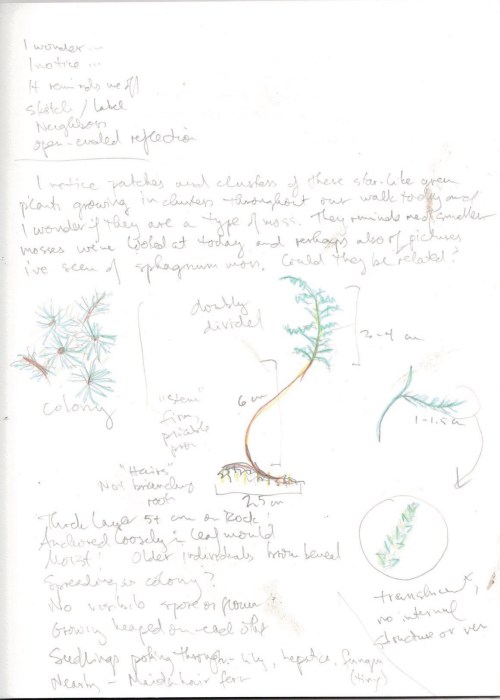
I choose to sketch a bryophyte not much bigger than my thumb. Perhaps I’ll never know its true name – starmoss? sphagnum? – but we could become friends. I won’t even give it a name. Be satisfied sometimes simply to explore, to know first with all my senses, that is what I’m learning. Where does it like to lie and spread? Whom does it choose for neighbors? How does it make its living? Naming can come later.

Moss with Doghobble leaf

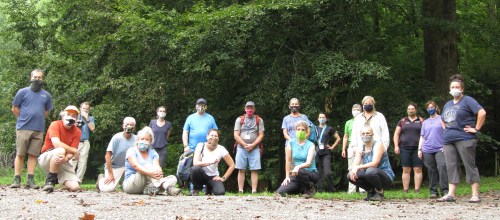
Look at us all, scattered like toadstools across this mountain glade quietly noticing. For now the birds and insects get to make all the noise. Eventually our quiet must end and we gather one last time for closing and summarizing and making sense. Now Tonya has a surprise. A worm snake, while she sat, has burrowed, well, wormed into her open sandals and curled around her toe. She untangles it and cradles it for us all to see while it tries to bite her with its mere slit of a mouth, better suited for eating slugs. If we were quiet, if we paid attention, if we sat long enough would we be reclaimed by moss and crawling things and become a haven for all that is small and necessary?

We eat our lunch along the trail, we travel back to Tremont, we pack our cars. At the parking lot I congratulate Tonya upon completing her final course and receiving her Naturalist Certification. I tell her, I’m still only half way through.

Tonya turns to me. She sets down her pack. She is solid, present, her eyes deep and full as a hardwood cove. Help the new ones, she pleads. Share what you know.

And during the five hour drive back to my foothills what image recurs? Not family characteristics that differentiate Brassicaceae, Lamiaceae, Asteraceae; not frond morphology and sorus distribution. No, the image I can’t escape is of the two first-timers in our course turning a leaf over and over in their hands, turning the leaves of a guidebook, excited, figuring things out. And of me a pace or two removed, watching them, adding nothing.

Sometimes I think I have the perfect temperament and skill set to be a moss-covered log slowly digested by fungal mycelia. Ah, the long and placid observations I would make. But that’s not the lesson I need or the lesson I will keep. Instead, this: don’t imagine you know so much. But know that what you do know has value when you share it. Know that its only value is in the sharing. You have joined the circle of seekers. Now open the circle wide.
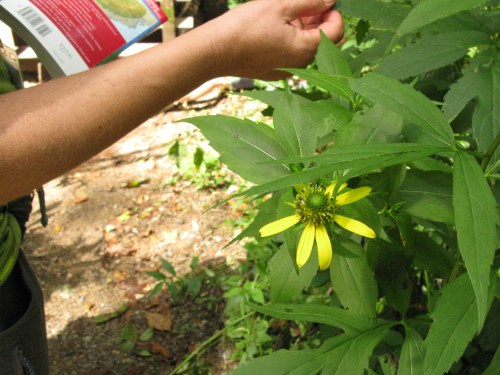
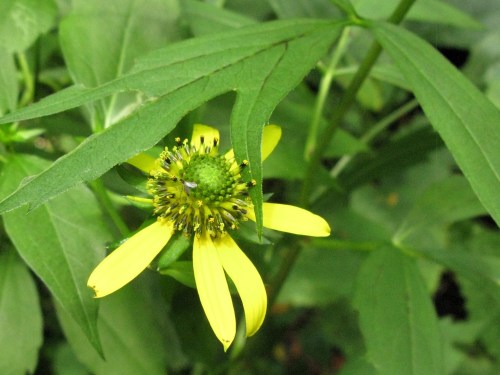
Rudbeckia lacianata; Cutleaf Coneflower; Asteraceae

Rudbeckia lacianata

.     .     .     .     .     .     .

A week ago I shared here two poems by Malaika King Albrecht from her most recent book. I’m not finished with her. Something about this collection of poetry has become very necessary for me as I continue to pile and compile the lessons from my most recent course in the Southern Appalachian Naturalist Certification Program at Great Smoky Mountains Institute at Tremont. The quantity of information itself is just shy of infinite. I’m working through a book titled, Botany in a Day, which would more realistically be In a Couple of Years. Just the new vocabulary reminds me of starting Med school (that was 1974 – what am I doing here?!) or maybe of being smacked with a breaker at Fort Macon beach.

But being overwhelmed with information is the trees, it is not the forest. That is why I need poetry. I will study the taxonomy but poetry will teach me the connections. I will feel like I can never know enough but poetry will teach me to live with and love the mystery. I will work on what to know but poetry will teach me how to know.

Malaika’s collection is just the solace and challenge and promise needed. Her poems can be grounded in the senses but spiral into the imagined and unimagined. I would say her poems make connections but even more they open me to make connections. It can be the difference between burying myself in the Field Guides and opening myself to the field.

Thanks again, Malaika!
.     .     .     .     .     .     .

Following the Wind

Everything leaves a mark:
dull grass in the morning where the raccoon
ambled away full of cat food,
antler scratches along the willow oak,
and tracks and scat everywhere.

I know what stirs in this forest:
Deer nosing the horse path,
red fox slitting the tall switch grass,
rabbit bounding, freezing, and hopping again.

At the edge of Loftin Woods, I fall
for the wind, the way it parts the grass,
makes branches speak
and vultures glide their shallow V’s.

If sky holds our dreams,
then earth, our memories,
and wind, only the now
of this moment calling,
calling from everywhere.
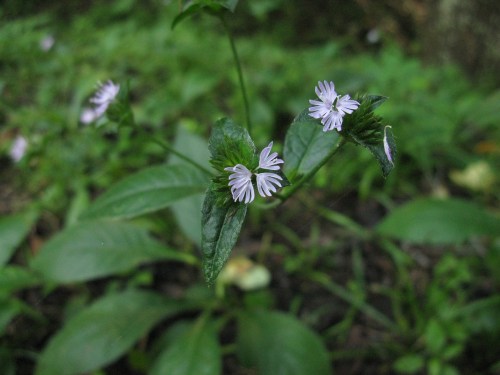
Elephantopus carolinianus; Elephant Foot; Asteraceae

.     .     .     .     .     .     .

Praise Song for What Is

Praise the frozen rain, the icicles daggering
the trees, the gray snow sludge. Praise
the shiver, the wet wind cutting through clothes,
the frozen water troughs. Blessed be
the hard frost, the frozen pond,
the apple sapling snapped in half.

Praise autumn and spring, the hot then cold
then hot again. Praise the corn mazes,
the haystacks, the reaping what we’ve sown.
Blessed be the fig tree, the honeycomb, the hive.
Praise the kudzu, the poison ivy,
the forsythia shouting yellow at a fence.

Praise the mosquito, the itch,
the scratch. Praise the heat waves,
the asphalt, the stopped
highway traffic. Blessed be
the dusty, the wilted, the dry
husks of corn in summer drought.

Praise the possum lumbering
into the chicken coop,
the fox slinging the wood’s edge.
The owl, the hawk, blessed be
their swift descent to prey.
Praise the failures, the losses. Blessed be
the broken path that brought me here.

.     .     .     .     .     .     .

From The Stumble Fields, Malaika King Albrecht. Main Street Rag Publishing Company, Charlotte, North Carolina. © 2020.

Botany in a Day, The Patterns Method of Plan Identification; Thomas J. Elpel; HOPS Press, LLC; © 2018; An Herbal Field Guide to Plant Families of North America

Wildflowers of Tennessee the Ohio Valley and the Southern Appalachians; Dennis Horn and Tavia Hathcart; Partners Publishing © 2018; The Official Field Guide of the Tennessee Native Plant Society


.     .     .     .     .     .     .
Read Full Post »

This evening at suppertime she peers into the beef and carrots simmering on the right burner; I snip pea pods and spinach into the black bean broth on the left burner. Pretty soon both pots are smelling darn good. It’s usually something like this, the scene in our kitchen all the years since I decided to stop eating meat and she didn’t. Separate skillets, or sequential nuking, then sit down together.

But then every once in a while it’s all her show. She steams the broccoli while I sit near the lamp and read. I start on a little dry white wine (she’ll accept two ounces for herself later – Pastor Jan, pretend you didn’t read this) while she simmers the pasta. She serves two blue patterned Japanese bowls we’ve owned since year one. Then we sit down together.

When I die, sorry to say, I have no faith that there will be an angel in heaven who can make broccoli Alfredo this good.


.     .     .     .     .     .     .

Getting home from the office early these days, I’m revisiting the overflowing stacks beside my desk. Poetry, philosophy, poetry, nature, poetry — I’ve rediscovered that all of Terri Kirby Erickson’s poems are home.

Lots of poetry is about home – you get a peak through the curtains and maybe you can imagine life on the other side of the pane. Terri’s poems are home. Welcome in. Don’t mind the mess. Maybe you didn’t understand this is your home but for twenty or thirty lines you will be part of the family. So many families. So many homes longed for, left behind, returned to. Soft light, hard edges. Sweet and harsh and all shades between. Come on in. Let’s sit down together.


.     .     .     .     .     .     .

from In the Palms of Angels, Terri Kirby Erickson, Press 53 © 2011


Wayfarer

He seems like a man
you’d see walking down a long
stretch of road, the kind
with dust

rising

in a red haze beneath the wheels
of pickup trucks, cutting
through fields of golden

wheat. Scudding clouds cast
shadows
across the ground like whales

swimming through clear
water, and the air carries the scent
of grain and loam.

Every few miles, the glint of a silo
(startling against the lonesome

sky)

signals a farm house
where peach pies sit cooling
on window sills, and patterned
carpets are worn-out from parents

pacing to and fro with fretful babies
in their arms.

He’s traveling toward the horizon
with the steady gait of someone
with a place to go, whose tender

gaze

will soon find home, that place
more sacred than communion wafers
nestled in the palms
of angels.

.     .     .     .     .     .     .

Rosary

Down by the creek,
we sit on dry
stones,

our shoes and socks
jumbled in a pile.
The sun

warms our toes
and casts its
net of light

from bank to bank,
where willows
trail their

fingers in the water,
and snakes look
like branches

floating by
them. Mosquitoes
lay their eggs

in stagnant pools,
far from leaves
and grasses snagged

by rocks, twisting
in the current.
Tadpoles swim

in tight formation,
wiggling their tails
in tandem,

as salamanders
scuttle by, searching
for places to nap.

Dragonflies hover,
then hurry
away,

their wings
thrumming a one-note
song – while we,

silent as nuns in prayer,
count the beads
of summer.

.     .     .     .     .     .     .

[Rosary first appeared in Basilica Review; other collections by Terri Kirby Erickson from Press 53 include: Telling Tales of Dusk; A Lake of Light and Clouds; Becoming the Blue Heron.]

Author Page, Terri Kirby Erickson, Press 53, Winston-Salem, NC.

.     .     .     .     .     .     .

IMG_0880


Read Full Post »

Let’s meet at Grandview above the New River Gorge while the sun is still working its way through the pine and bare hickory. The hardcore birders left from Shelter #4 hours ago but we will follow the same course down the abandoned mining road to the River. We will follow the wild flowers. We will walk into Spring.

We don’t see a lot blooming up here at the end of April, elevation 2,500 feet in the West Virginia Appalachians. Beneath the trees and in the sunny patches the landscape is still mostly brown, but that doesn’t hold for long. Trailing arbutus and trout lily greet us in the first quarter mile, wake robin and four more species of trillium pop up along the course of the trail, wild iris and asters appear by the time we’ve descended 1,000 feet to river’s edge – all of Spring blooming in one morning.

And just in case we miss something we have a guide: my wife’s sister Jodi French-Burr, National Park Service ranger, naturalist, and interpreter. She’ll be kneeling in the duff gently parting the leaves so we can see the wild ginger blossoms. She’ll have at the tip of her tongue the name of every growing thing we discover. She’ll tell us the history of this winding trail and point out relics and landmarks along the way. And she will usually laugh at my jokes.

Come and convince yourself that the earth is filled with beauty.

Bring water and a snack. RESERVATIONS requested by April 21, 2020: 304-465-2632 or jodi_french-burr@nps.gov.

[UPDATE 3/23/2020 — due to the COVID-19 Pandemic many NPS and New River Gorge activities may have to be canceled or rescheduled. Be sure the check this site for the latest info:

https://www.nps.gov/neri/planyourvisit/wildflower-weekend.htm

BUT . . . outdoor activities with family and small groups (maintaining your social distancing) are just what THIS doctor orders! Get out into nature! Viruses hate sunlight! . . . . . . . . Bill G  ]


Erythronium americana — Trout Lily (Dog-tooth Violet, yellow adder’s tongue, fawn lily)

.     .     .     .     .     .     .

Deborah H. Doolittle has created a unique botanical and poetic experience with her collection Floribunda, a true garden of verse. The focal point of each poem is a particular flower, from Cowslip to Gardenia, but the speaker or the style of each poem is a giant of literature, from William Blake and Lewis Carroll to Sylvia Plath and Wallace Stevens. To wander the garden path of Deborah’s poetry is to smell the fragrance and delight in the colors but also to abide in the company of great writers, Deborah H. Doolittle not the least of them. Open to any page and converse.

[all selections are from Floribunda, © Deborah H. Doolittle, Main Street Rag Publishing Company, 2017]

Hepatica americana — Round-lobed Hepatica

.     .     .     .     .     .     .

Emily Dickinson’s Wild Flowers

The way she dressed a flower was
just that extravagant.
The haute couture of wild flowers!
wild flowers! her element.

To that pale cheek she called petal,
she pressed both stem and leaf –
the lupine, like crinoline; sweet
clover, tight Damascus weave.

She had played the part of Botanist,
a child’s specialty.
Swamp candles shed no brighter light
in Latin for the bee.

Grasses of Parnassus, skullcap
of the tiny laces,
she pressed herself soft as a moth
treading through her pages.

Antennaria solitaria — Solitary Pussytoes

.     .     .     .     .     .     .

Henry David Thoreau and the Sunflower

Who among us has not followed the sun
and hated the clouds that hid its shining face?
Who else but us can claim that we have traced
across the sky the very path it runs?

We’ve traveled much through Concord, you and I.
The widest fields are fenced and most contain
cattle or corn or the stock of kitchen
gardens. The farmers never wonder why

your seeds proliferate upon their grounds.
I know how the wind blows the smallest crumb
and how the bees and birds know where to come.
The two of us, like them, know no such bounds.

The hedgerows and stonewalls can’t grow taller.
The sun is but a star and you’re its flower.

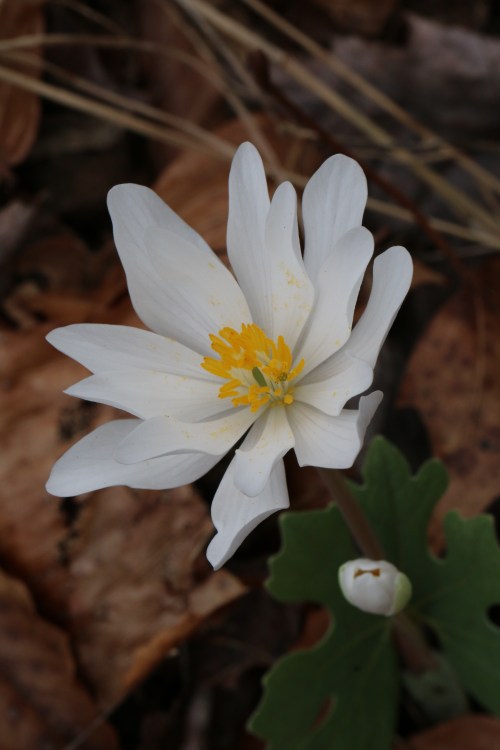
Sanguinaria canadensis — Bloodroot

.     .     .     .     .     .     .

Sylvia Plath and the Impatiens

Unlike my empty hands,
it does not just lie there
with its flowers opening

upon white bed linen.
All its seeds jettisoned,
its future guaranteed

for at least another
season, this jewel-weed,
asks for nothing that I

cannot give it. It basks
in my sunlight, breathes in
my exhalations as fast

as I can breathe them out,
again. Still, we are both
waiting for the nurses

to make their rounds, the sun
to rise up, then subside,
for the moon and the stars

to appear and disappear,
for winter’s frost to turn
us into limp black rags.

Asarum virginicum – Heart-leaf Ginger (Little Brown Jugs)

.     .     .     .     .     .     .

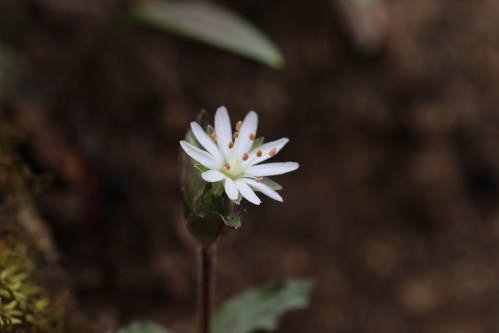
The other way to walk into Spring, although it takes a month or two, is to stroll along the same trail every day. Linda and I walk the Elkin Valley Trail Association Nature Trail along Big Elkin Creek at least three days a week. First appears trout lily, hepatica close behind, then every day or two there’s a new species in sequence: pussy-toes, wild ginger, bloodroot, rue anemone, star chickweed. In a month there will be foamflower, bellwort, jewel-weed, jack-in-the-pulpit. The photos in this post were all blooming on the same day, March 16, 2020.

Anemonella thalictroides — Rue Anemone

.     .     .     .     .     .     .

Deborah H. Doolittle moved from her birthplace in Hartford, Connecticutt through many different landscapes and gardens before settling in Jacksonville, North Carolina. She has an MA in Women’s Studies and and MFA in Creative Writing and teaches at Coastal Carolina Community College. She serves on the Board of the North Carolina Poetry Society and she loves flowers.

Stellaria pubera – Star Chickweed

.     .     .     .     .     .     .

IMG_0880

Read Full Post »

« Newer Posts - Older Posts »