Feeds:
Posts
Comments

Posts Tagged ‘nature poetry’

photo by Saul Griffin

[with 3 poems by Becky Gould Gibson]

Amelia’s Papa Jimmy brought the bunnies to playschool yesterday. Four of them had fallen from a nest destroyed as he cleared a field two weeks ago. No mother in sight.

When we heard he’d bought bunny milk at Tractor Supply and was feeding them four drops every two hours we first thought, Is he raising them for the dogs? Not to eat, to teach. He trains young beagles to hunt; maybe they need to learn the smell of rabbits?

But no, not at all, it’s just that Jimmy can’t leave helpless young to die. Tractor Supply will mix up formula for any small critter you may have need of. He used a dropper until they learned to suck from a nipple. Two weeks later they’re hopping, eating tasty greens.

Yesterday each four- and five-year old got to hear the bunnies’ story, touch their soft ears and heads. Today Jimmy will release them at the edge of the woods, restored to bunny-ness, preserved for no other purpose than themselves.

.     .     .     .     .     .     .

Stand of Birches

The woods are wet this morning – rain yesterday
or the day before, maybe – such a sense of quiet,
all the damp peace of it, mostly trees to be with,
birches especially, minimalists in chic black and white,
raw silk with horizontal markings like wounds
slashed across white paper, dashes, staples, lines
of ghostly scansion, every beat, every syllable
of wood and glade accented, no scales or hierarchies
scored in their bark, rather universal emphasis,
as if everything mattered – this tiny white-headed
flower, this ant on some errand, even the mosquito
buzzing my ankles, these low-growing grasses,
branch with its bark pulled back, underbelly softening,
chartreuse mosses – though brief, briefly important.

Becky Gould Gibson

photo by Saul Griffin

.     .     .     .     .     .     .

These poems by Becky Gould Gibson are from her book Heading Home, the winner of the inaugural Lena Shull Book Contest in 2013. The poetry is strongly rooted in family and place but also richly steeped in literary tradition and history. I keep coming back to Stand of Birches for its eloquent, even spiritual expression of the deepest premise of Ecology: not utilitarian, not exploitative, not derivative or charismatic or anthropocentric – each living thing in all its interconnectedness is of value in and for itself.

Yes, yes, OK, OK, even mosquitoes.

In 2012 the Poetry Council of North Carolina elected to dissolve its organization and merge its residual funds with the North Carolina Poetry Society. Since 1949 PCNC had promoted the craft of poetry in the state with its annual contests; now in collaboration with NCPS it established an endowment to sponsor the annual Lena Shull Book Contest for an unpublished full length manuscript by a North Carolina writer, named for founder and first president of PCNC. Becky Gould Gibson was the first Lena Shull winner.

.     .     .     .     .     .     .

Scuppernongs
+++ Immortal life will be given . . .
+++ The Lord of harvest gathers us, / Sheaves of the dead –
++++++++++++++++++++++ for Bill

When death lifts its edge a little,
as in the first movement of Mahler’s C minor symphony,
you wonder will you be ready.
We finish a bowl of scuppernongs from the market,
wild bronze from childhood,
delighting in the bite, thick skin between our teeth,
touch tongue-tip to tongue-tip.
You taught my tongue to talk back.
I recall all those summers,
you in another county, nearly a decade before we would meet.

Now, come with me.
We’re together, then. It’s a languid afternoon in late August.
I’m eight. You’re ten.
As for death, I still think I can talk my way out of it.
Follow me across the un-mowed yard,
weeds tickling our legs,
to the scuppernong bush at the edge of Mr. Marcus’s field.
For you, death is no fiction.
At six, made to duck under your desk at school,
wear a dog tag, so someone could identify your body.
No bucket. We stuff ourselves madly.
Know what happens if you swallow a seed? We laugh.

No, love. It is not my own death I worry about, but yours –
will I ever be ready for it?
To be alone as I was that distant August,
memory plucking the fruit of you, scuppernong ripe in my mouth.

Becky Gould Gibson

.     .     .     .     .     .     .

Lines to Yeats on the Anniversary of His Death
++++ January 28, 1939
++++ for Alice

To a soul just fledged, still damp, in a nest
Of paper, flimsy bits of Plato, Paul,
Shelley, Wordsworth, Tennyson, all the rest
Who believed (or even half-believed) soul
Could soar above the earth (earth a mere cast
Of heaven), spirit somehow separable
From flesh, you came, William (my dear Willie)
With your poems of pure song, heart’s own music.

No wonder it entered my veins, my pulse
Learned to tick your rhythms. No matter you
Warned not to pleasure soul at the expense
Of body, who could even listen to
Such warning with such a beat, sound and sense
So perfectly married, as if to show
A manmade thing could become immortal,
Gold bird on a gold limb sing out its soul.

You made me more impatient than ever
To conceive such a poem of my own.
Your artless art merely fed the fever,
Yet every line fell stillborn from my pen.
Blood had become a colorless liquor
Nourished on symbols. Life had to happen,
And it did. Not a woman but a child,
Rather a child’s birth. It was a girl-child

Split me apart. No way to staunch the flood
(Nothing’s sole or whole that has not been rent)
Of blunt necessity. You had your Maud.
I had my Alice. She caught me up, lent
Me her knowledge. She, no man or bird-god,
Made loins shudder, roused me from those years spent
In abstraction, taught me bone, bowel, breath,
Body’s mortal work. She taught me my death.

Becky Gould Gibson

three poems from Heading Home, Winner of the 2013 Lena Shull Book Contest, Main Street Rag Publishing Company, © 2014 Becky Gould Gibson

.     .     .     .     .     .     .

.     .     .     .     .     .     .

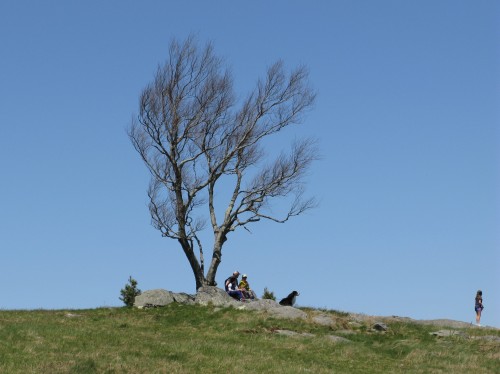
2016-05-08a Doughton Park Tree

Read Full Post »

[with 3 poems by Jenny Bates]

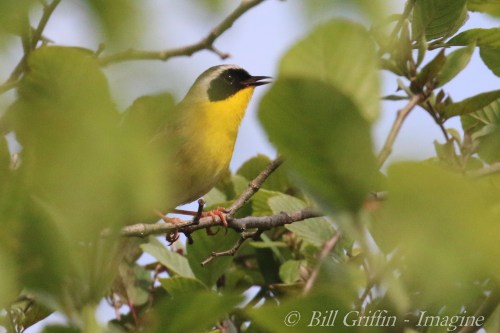
Yellowthroats sing from three compass points. Who triangulates whom? One sings, flits, sings and a farther one answers, flits, answers. I stand motionless in the mud beside the lake’s lazy inflow. I want a bright bird to fly from his thicket and show himself to me.

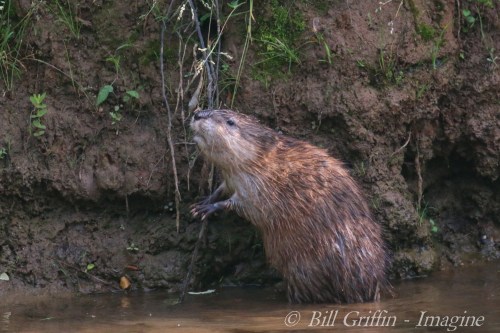
As I stare into the leaves, still no success with my x-ray vision, something moves beside me. Down low. A muskrat six feet away is swimming upstream utterly unconcerned. I turn only my head. It reaches up the bank for a tasty green, swims some more, jeweldrops of water on its whiskers. It stops to scratch its nose. It swims on.

I look up and a yellowthroat is watching me.

.     .     .     .     .     .     .

Triangulate: to discern your true position within the vital features that surround you.

After a couple of weeks with Jenny Bates’s books I learned not to read her poems to ferret out their meaning but to read to enter the poetry. Stare at the Pleiades in the night sky and they slip away from you; look slant and the Seven Sisters reach to you from the darkness. Let a line of Jenny’s verse slip into your awareness with eyes half closed, fortuitous inadvertency.

An intimate acquaintance / that leaves nothing but / earth.

I learned not to read Jenny like a field guide but like I read the breeze greeting sweat on my back when the trail stretches uphill, like I read the sun’s flagrant liason with blackberry blossoms.

Bent twig alphabet, language mist-twist
revises with no sequels, no chapters that leave-off.

I learned to read Jenny not like a genealogy of contracts and progeny but exactly like a genealogy of creatures and connections and the family of the one.

The bee does not claim originality as it takes
something from every flower.

.     .     .     .     .     .     .

3 poems by Jenny Bates

.     .     .     .     .     .     .

Merlot and Thyme
++++ with a Hummingbird Chaser

I uncork old resting places, no maps needed.
Just strange-tongued travelers of
++++ bird, wine and spice.
I sip Merlot, write in cloud-light
++++ missing mother’s voice
Conversations become riddles, coaxing the truth
out of her children, eventually.
Thyme and tarragon fill the clear jar
in front of me: I smell her there
++++ in herbal comfort.
No still dark corners to hide in her memory,
she emptied her children like clearing a table
set by despair, without lingering.
With an edge that never dropped off.

Hummingbirds have no brink to pass to their young.
Wisps of winding birds tousle leaves, jiggle air under
++++ diving, dancing, levitating.
Homing devices, trade routes birthed into them.
Swift and common lessons to grow by. Shade brings
++++ less frantic maneuvers.

I wear pink and grey – the first colors I liked
++++ as a child.
My grandparents farmhouse in Northern Michigan
was grey with pale pink shutters.
Dove colors for a delicate landing grandmother
would say. I hear mom in the background talking to
bees, kittens, mule, land. For a city girl, she could
ambush nature, then heal its wounds.
++++ No time was distant then.


.     .     .     .     .     .     .

Engagement Rings

Morning insect yoga.
Grasshopper extends himself
in heat-stretching air.
Jumps into space, disappears.
No fossil fuels, no footprint.
Fly stuck to a metal merry-go-round,
a centrifuge so man can stick to
ceilings in his quest for flight.
Prometheus moth wings dismantled,
grounded, still-payment for
bringing man fire.

I walk earthling steps, marker-less,
circling your grave.
Mob of ants scurry in loops,
larvae in pincers turn you from
solid to liquid to solid again.
Jealous in my exile,
++++ lucky ants get to spend time with you
you continue in unending generosity.

The angel tree had sung a copperhead
right out of his skin.
I bring it, fresh and warm to my
neighbor who sculpts it into
suspended twists.
Hung it through a metal ring
at the studio door.
Bow Tie markings coiled to dry,
venom empty, benign husk.

Heat draws new flycatcher parents
to drink from your round water bowl
filled each day to the brim.
Parched squirrel’s half cry bubbles out,
scampers then hangs in shade relief.
Skinks run full speed in swirling chase
across the deck.
++++ don’t come out of the nest too soon . . .
++++ ++++ don’t fall . . .
the newly hatched chick yawns,
bellyful of ground up ants.


.     .     .     .     .     .     .

How to Spell Sorrow

It’s beautiful, your words,
but I’ve read better in the eyes of my dog.

In spider webs and spider spaces.
When hummingbirds leave, you feel it –
empty air without fashion.

You put more sweet water out anyway,
wait for Buddhas and fools.

You wonder about ellipsis of Truth
wrapped in coyote calls.

You watch a groundhog prostrate like a saint
on the gravel drive – surrender play or
cooling his belly on the stones.

you see a murder of crows line their toes
straight and tight along the split rail fence.

Gripping the wood like text on your arms
becoming the word on your hand.

You curl your fingers into your palm
twist and spell – Sorrow.

.     .     .     .     .     .     .

“Merlot and Thyme,” “Engagement Rings,” “How to Spell Sorrow” by Jenny Bates from her book Slip, Hermit Feathers Press, September, 2020

Jenny lives in the North Carolina foothills and is an animal whisperer and helping hand at Plum Granny Farm, an organic local farm in Stokes County, North Carolina.

.     .     .     .     .     .     .

Header Artwork © Linda French Griffin

2016-10-17a Doughton Park Tree

Read Full Post »

[with 3 poems by Denise Levertov]

. . . Who can utter the poignance of all that is constantly threatened . . .

Toward the end of March Amelia and I explored the vernal pool near Dutchman Creek and discovered frog eggs with hundreds of newly hatched tadpoles. We visited a couple more times to watch them grow (no legs yet!). Week before last I was walking along the creek on my own and decided to check their progress.

I edged through the muck and grass, taller now, leaned over the little pool, and counted all the tadpoles. There were exactly zero. None. Well, I did scare off a few big second-year tads, but all of the little black wigglers were gone.

I stared a long time. Plenty of water. A little algae, weeds and water plants. Maybe they were all hiding under leaves. I leaned all the way down. What is that in the water there, arc of a cylinder covered with hieroglyphics, almost stepped on it? I poked with my stick and a 3-foot long Northern Water Snake shot sinusoidal through the water then veered back towards me and disappeared into a hole, I guess, because I never could spot it again.

Hungry snake, OK, gotta eat, but did you have to finish off every one? Isn’t there some sort of ecological balance that guarantees next year’s balmy spring evenings on the porch listening to peepers, tree frogs, and the long mellifluous trill of the American toad? I guess the older, bigger tads were experienced, too wily to be caught, better at hiding themselves in the silt, so maybe a few will indeed live to sing. I don’t think I’ll be telling Amelia about the snake any time soon, though.

.     .     .     .     .     .     .

This afternoon I walk down to the creek to see what’s become of the pool after a two-week dry spell. One year it dried up altogether. Still plenty of muck; grass and weeds even higher. The pool has shrunk but as I thread my way closer there are two big plops and a swirl of silt slowly settling. And there they are: brand new, a couple of hundred little black tadpole wigglers, freshly hatched.

More life, says Nature. More, please.

.     .     .     .     .     .     .

Three poems by Denise Levertov

bring the planet / into the haven it is to be known

.     .     .     .     .     .     .

Web

+++++Intricate and untraceable
+++++weaving and interweaving,
+++++dark strand with light:

+++++designed, beyond
+++++all spiderly contrivance,
+++++to link, not to entrap:

elation, grief, joy, contrition, entwined:
shaking, changing,
++++++++++forever
+++++++++++++++forming,
++++++++++++++++++++transforming:

all praise,
+++++all praise to the
+++++++++++++++great web.

– Denise Levertov

.     .     .     .     .     .     .

In California: Morning, Evening, Late January

Pale, the enkindled,
light
advancing,
emblazoning
summits of palm and pine,

the dew
lingering,
scripture of
scintillas.

Soon the roar
of mowers
cropping the already short
grass of lawns,

men with long-nozzled
cylinders of pesticide
poking at weeds,
at moss in cracks of cement,

and louder roar
of helicopters off to spray
vineyards where braceros try
to hold their breath,

and in the distance, bulldozers, excavators,
babel of destructive construction.

Banded by deep
oakshadow, airy
shadow of eucalyptus,

miner’s lettuce,
tender, untasted,
and other grass, unmown,
luxuriant,
no green more brilliant.

Fragile paradise.

. . . .

At day’s end the whole sky,
vast unstinting, flooded with transparent
mauve,
tint of wisteria,
cloudless
over the malls, the industrial parks.

the homes with the lights going on,
the homeless arranging their bundles.

. . . .

Who can utter
the poignance of all that is constantly
threatened, invaded, expended

and constantly
nevertheless
persists in beauty,

tranquil as this young moon
just risen and slowly
drinking light
from the vanished sun.

Who can utter
the praise of such generosity
or the shame?

– Denise Levertov

.     .     .     .     .     .     .

Tragic Error

The earth is the Lord’s, we gabbled,
and the fullness thereof
while we looted and pillaged, claiming indemnity:
the fullness thereof
given over to us, to our use
while we preened ourselves, sure of our power,
wilful or ignorant, through the centuries

Miswritten, misread, that charge:
subdue was the false, the misplaced word in the story.
Surely we were to have been
earth’s mind, mirror, reflective source.
Surely our task
was to have been
to love the earth,
to dress and keep it like Eden’s garden.

That wold have been our dominion:
to be those cells of earth’s body that could
perceive and imagine, could bring the planet
into the haven it is to be known,
(as the eye blesses the hand, perceiving
its form and the work it can do).

– Denise Levertov

all selections are from The Life Around Us, selected poems on nature, by Denise Levertov, New Directions Books, 1997

.     .     .     .     .     .     .

Denise Levertov (1923-1997) was a naturalized American poet born in England. Her first book of poetry was published shortly after World War II; she moved to the U.S. in 1948 and became influenced by the Black Mountain Poets and William Carlos Williams such that her writing ultimately came to express a uniquely American voice with a world vision. Her poems are often strongly ecological and political. She writes in the forward to The Life Around Us: As I have quite frequently found myself obliged to skip back and forth from book to book when reading to audiences composed of people whose work and vocation was in ecology, conservation, and restoration, it was suggested that I put together a selection of thematically relevant poems, which would be useful not only to the many earth-science people who, I have found, do love poetry, but also to the general public.

Poetry Foundation
Academy of American Poets
Works by Denise Levertov
Chronology of Denise Levertov’s life

.     .     .     .     .     .     .

Header Artwork © Linda French Griffin

Doughton Park Tree -- 5/1/2021

Read Full Post »

« Newer Posts - Older Posts »