Feeds:
Posts
Comments

Posts Tagged ‘nature poetry’

[with 3 poems by Terry Blackhawk]

Monty and I are trying some new knots, big husky knots, and we’re pretty sure we have it right this time. The stalwart little paratrooper I got for Christmas, his broad red and white plastic parachute and the web of thin strings that fix to his shoulders – they just won’t hold together. Each time we fold the chute just so, roll the trooper carefully so nothing tangles, throw it as hard and as high as we can, but the lines come loose as soon as the plastic banner deploys. Our man has plummeted to his death over and over.

It’s 1965. I’ve only been living in Wilmington, Delaware for a few months; the heritage of where I moved from to get here is firmly affixed in the nickname all the other sixth graders have given me – “Memphis.” My new school might as well be Mars Colony A, so distant it seems from Colonial Elementary. I have four different teachers, most of them are men, and they seem determined to require a boy to think. On this final afternoon of winter break, Monty and I are determined to have our last hour of fun.

The breeze has picked up. Most of the snow has melted but our hands are red and chapped – you can’t tie knots with gloves on. We pull the last string tight, tighter, fold and roll, and we’re ready. I hold the soldier like a grenade, lean back, and lob him straight up with a grunt. At the peak of its arc the little package unrolls; red and white unfurls and fills with evening’s breath. The knots hold.

And the wind takes our paratrooper higher and higher into the east.

Monty and I give chase through backyards and down long sidewalks in our housing development. The parachute dims and shrinks in the distance. We run until our sides ache and the brave soldier is out of sight. Gone. We stop, gasping, and stare into the lowering dusk as lights blink on in windows around us.

I imagine my little man has crossed the Delaware River, surprising people who happen to look up from the railroad yards, the factories and warehouses. He holds his lines tight; he swings and sways. Catching the last light from that high vantage, now he can see the Atlantic. I imagine him never coming down.

❦ ❦ ❦

The Woodcock

Weary of the daily terror I turn
to the mystic body of the bird. A woodcock
I found crackling the twigs and ivy,
barely escaped from a cat’s clumsy claws.
I feared for the odd angle of its wing,
the surprised flopping it made there,
but I did not fear the extreme length
of its beak or the eyes popping diametrically
on either side of its head. I loved the feathers’
deckled edges and the light weight it made
as I scooped it up and put it, limpsy and weak,
into an old canvas book bag, and when I
released it from that soft safe space
some time later, out on Belle Isle, I missed it
at once, as one would miss a friend.
It whirred straight up, explosively,
toward freedom on the other side of the river,
its pulse now gone from my hands.

Terry Blackhawk
from One Less River, Mayapple Press, Woodstock NY, © 2019 Terry Blackhawk

note: “samples Song of Myself, 10, in which the speaker imagines succoring a runaway slave”

❦ ❦ ❦

Sometimes a knot is so twisted and curlicued you can’t make out whether it’s one string or a handful, much less how it all connects. Let’s see, Catherine Carter told me about Katherine Wakefield’s book, which led me to Patricia Hooper, who inspired me to read Terry Blackhawk. Or maybe the lines snake in and out along different paths; maybe I’m leaving out a thread here and there, most likely it goes back way farther even than that. I know, however, that I can count on this – the connections stretch and extend and I’ve not yet reached the end.

Such a warp and weft Terry threads through her book, One Less River. The Detroit River, subtropical shorelines, paths through dunes and forest, paths through myth and memory – the poems take us someplace new with each turning page. But despite shadows and storms these poems don’t cast us alone into dark landscapes. There is light. Light rises from the companionship of solid friends like Whitman and Dickinson, from companionable invitations to partake and be filled of rich intent and novel images. It is possible to wander through this book and be surprised and also reassured. The path will definitely challenge, because living is a challenge and preserving our world is a challenge. At the end we may discover that we are all tied together a little more closely. Our knots are not fetters but the shared bonds of humanness.

❦ ❦ ❦

The Extinct Fresh Water Mussels of the Detroit River
+++++++++++++++ for Kathryne Lindberg (1951-2010)

These are gone: the deer-toe maple leaf, the fat
mucket, the snuffbox, the rainbow shell. Here, still,

the rusted manhole cover and the chipping paint,
the lights and arches of the elegant bridge,

all coated no doubt then in ice. Here the breeze,
here the freighters but not the car. Quiet as it’s kept,

it’s no secret the keys were left in the ignition.

Absence makes the fond heart wander, the mind
meander, the river to swallow its flow –

the self-same river, the self-same self, even the one
that knew better, the self that knew better

than to pick up a phony ten-dollar bill folded
to disguise some evangelical come-hither.

Com hither, said the bridge.

Little earwig mussel, pimpleback, northern riffle shell,
something lacy yet along the rim.

In the print gallery a dry-point fox in outline
(“Running Fox,” R. Sintemi, Germany, 1944) floats
as if on the surface of a river, water swelling upward
on the verge of breaking up its lines –

Did you float, dear bat-out-of-hell, dear gnashing teeth –
the pointed ears, the flowing tail outlined on water not water,

on paper not paper, on the not-water before there only was
water, where we are floating now, as over a great uncertainty,
a mirroring surface that hides as much as it reveals.

No more rayed bean, purple warty back, O fragile paper shell
Where was the artist in 1944? What did he do in 1939?

You would have wanted to know.

Terry Blackhawk
from One Less River, Mayapple Press, Woodstock NY, © 2019 Terry Blackhawk
❦ ❦ ❦

Again, the Moon

And now the moon, its vitreous pour
so quickly come again
moonstruck moon melon moon

I drive the unfamiliar
town, going where Siri tells me
through unlit streets

I cannot dial back to another
moon, although there have been many –
moons of loss, lists, listing oh the self-
consciousness of the moon

Look at the moon in the sky,
not the one in the lake, says Rumi
The pleasures of heaven are with me
and the pains of hell are with me, says Whitman

So which is the lake and which
the sky? With a moon this bright
I cannot find the stars.

Terry Blackhawk
from One Less River, Mayapple Press, Woodstock NY, © 2019 Terry Blackhawk

❦ ❦ ❦

❦ ❦ ❦

Read Full Post »

[with 3 poems from Quiet Diamonds
Bob Wickless, Susan Craig, Bill Griffin]

O narrow track, how I have missed you! O wee well trodden way, favorite mile, little path through pasture and wood that my right knee has refused to let me walk for all these weeks, I am so glad to see you again. Last visit you had all but shed your autumn yellows, not to mention cardinalflower reds and pastel meadowbeauties. Now here you are blowing snow across my path.

The season has arrived of whites and browns, feathers and fluff, crowns and rounds – seeds! Hello little calico aster whose name I just learned last summer; now your stems are strung with new stars so fine. Hello crownbeard; petals fallen, you lift your regal head. And hello snowy boneset and thoroughwort; one puff of breeze is all it takes to loft your feathered promises across the meadow.

There is a bare patch below my house beneath the powerline. There is an empty bag in my pocket. You won’t mind, prodigal wingstem, goldenrod, ironweed, if I catch a bit of your seedstuff and carry it home to a new bed? You won’t run short of provender when goldfinches and sparrows come to call. You won’t ever hear me, like some others, name you weeds.

❦ ❦ ❦

Prayer in Spring

beginning with a line from Seneca

Not hoping without doubt,
Not doubting without hope,
We enter the slow country
Of change, clad in the garment
Thread through the loom of change,
Woven in green doubt
Though woven in hopes

Greener than any hopes are:
May the clothes of the world
Still fit, in the eye’s mind
And in the mind’s eye, may
Our vision still clear
As the iced eye of the river
Cataracts, loosens, the view

In the breeze of the green flag
That is not failure, in one light
That will melt the white flag
Of surrender – Lord, we had not
Given up though the air had said
Surrender, through the vines, trees
Were all blasted with failure,

Though no light shone
Through the fabric of sky
But one pale and unaccomplished,
Wan, washed out as our vision,
Faded divinity, in the blank
Washed out country called snow,
A world neglected, blue

Now, Lord, even as the sky

Bob Wickless (Reidsville, NC)
from Quiet Diamonds 2022, The Orchard Street Press, Gates Mill OH

❦ ❦ ❦

Today in Elkin this blowing snow is windborne seeds of last summer’s asters, but inches of the cold frozen sort are accumulating in northeastern Ohio around Lake Erie. Snow belt – that’s where Linda and I met, dated, and graduated from the high school we walked to through slush & drifts. Call off school for a “snow day” in Ohio? Bah! The last time we visited Portage County was for Linda’s birthday six years ago. The old Aurora Country Club had been converted to a nature preserve – how many species of goldenrod filled those reclaimed fairways? The Cuyahoga Valley National Recreation Area had since 2000 become a National Park; we still talk about the canal trail, every ten meters another chipmunk to chirp and run across our feet.

Northeastern Ohio lives fondly in our hearts. Just up Chillicothe Road from the Cuyahoga and our old school is the village of Gates Mills and The Orchard Street Press, another font of fondness. OSP editor Jack Kristofco published my chapbook Riverstory : Treestory in 2018, so I most certainly love him, but even more I love the anthology his press produces every year, Quiet Diamonds. This year’s collection is deep and various and moving. The poems can be personal and at the same time universal. I find myself leafing back and forth through the book reading each one several times, in a different sequence, discovering new moods with each passage. So many I would love to feature on this page, wonderfulness from poets all over the US, but here I continue my focus on us Southerners.

Check in with The Orchard Street Press in January for their 2023 contest.

❦ ❦ ❦

Looking for the Banded Sphinx

++++++ I’d seen clutched last night to the railing
its wings of veined mahogany like a master craftsman’s
the way my brother’s finest tables
were inlaid in gold and amber

++++++ yet, only the marsh hawk waits
atop the same wooden rail outside the same glass door
its wing-shoulders brownish-gray
as any familiar relative

++++++ and even its flight, when it senses
the small breeze of my arrival, appears
blasé as a loping dog

++++++++++ Last night, the next-door young couples
played guitar as midnight lapsed into new year
sang Jolene in a lusty chorus
that rose and fell like the distant sea pulled
by a stranger’s violin

++++++ I ask my husband about the banded moth
Gone, he says, at first light
without a hint of nuance
++++++ the same way wonder disappears, the way
dust becomes fugitive

++++++++++ My eyes trace mid-morning’s
pale pentimento of moon
while at the edge of marsh a stalking ibis
is osmosed in plumes of fog
where sun glints cold creek
++++++ and we find no reason to speak
as the hawk melds like another riddle into winter’s
moss-draped bones

Susan Craig (Columbia, SC)
from Quiet Diamonds 2022, The Orchard Street Press, Gates Mill OH

❦ ❦ ❦

We Never Give Up Hoping

Morning frozen hard. Pour
++++boiling water
into the birdbath;
++++ they will come
to drink when I have gone.

++++ God of holy ice, holy
++++++++ steam,
++++ give my children
++++++++ water
++++ that all my hoping
++++++++ can’t.

Sound of wings, splash
++++ diminishing;
find the world again
++++ iced over.
Fill the kettle. Holy water.

Bill Griffin (Elkin, NC)
from Quiet Diamonds 2022, The Orchard Street Press, Gates Mill OH

❦ ❦ ❦

EARLY SNOW: ASTERACEAE

Stare across any random autumn afternoon and soon you’ll notice the jig and curtsey of little airborne tufts. Catch one and see if there isn’t a tiny hard seed hanging from that feathery wisp. The early snowflake you’re holding is a member of family Asteraceae.

Except for Cardinal flower (Bellflower family, Campanulaceae) and Meadowbeauties (Meadow Beauty family, Melastomataceae), all the flowers mentioned in my homage above are members of the Composite family (Asteraceae). This is the largest family of flowering plants in North America and vies for the world title with Orchidaceae. Besides typical species like asters, sunflowers, black-eyed susans, and coneflowers, Asteraceae includes less obvious suspects like Joe-Pye Weed, goldenrod, ragweed.

Study a daisy: you figure you’re seeing one standard flower, right? A ring of petals around the edge (corolla), eye in the center. Basic taxonomy of flowers depends on the configuration of their reproductive apparatus – flowers. But a daisy is a Composite – each “petal” is 3 or more fused petals from a complete individual Ray flower; each spot in the eye is an individual Disc flower with its own minuscule petals, pistil, and stamen, ready to make a seed. (And if that’s not already confusing, some Composites have only Ray flowers, no Disc (Dandelion), and some have only Disc flowers with no Rays (Fireweed).)

So what about this early snow, then? Ah, sepal and pappus . . .

In most flowers, sepals are the layer, just outside the petals, that make up the protective bud cloak. After the bud opens, the ring of sepals is called the calyx. In Composites, each “flower” actually multiple little florets all clumped together with zero elbow room, the calyx is diminished to almost nothing: the pappus, sometimes visible only with a microscope where it’s fixed to the seed. Except . . . those members of Asteraceae whose pappus is a bristle, hair, tendril, feather. For wind dispersal, but also for wonder and delight. When a breeze puffs the boneset or fireweed or lowly dandelion, one might imagine the pasture will soon be knee deep.

❦ ❦ ❦

❦ ❦ ❦

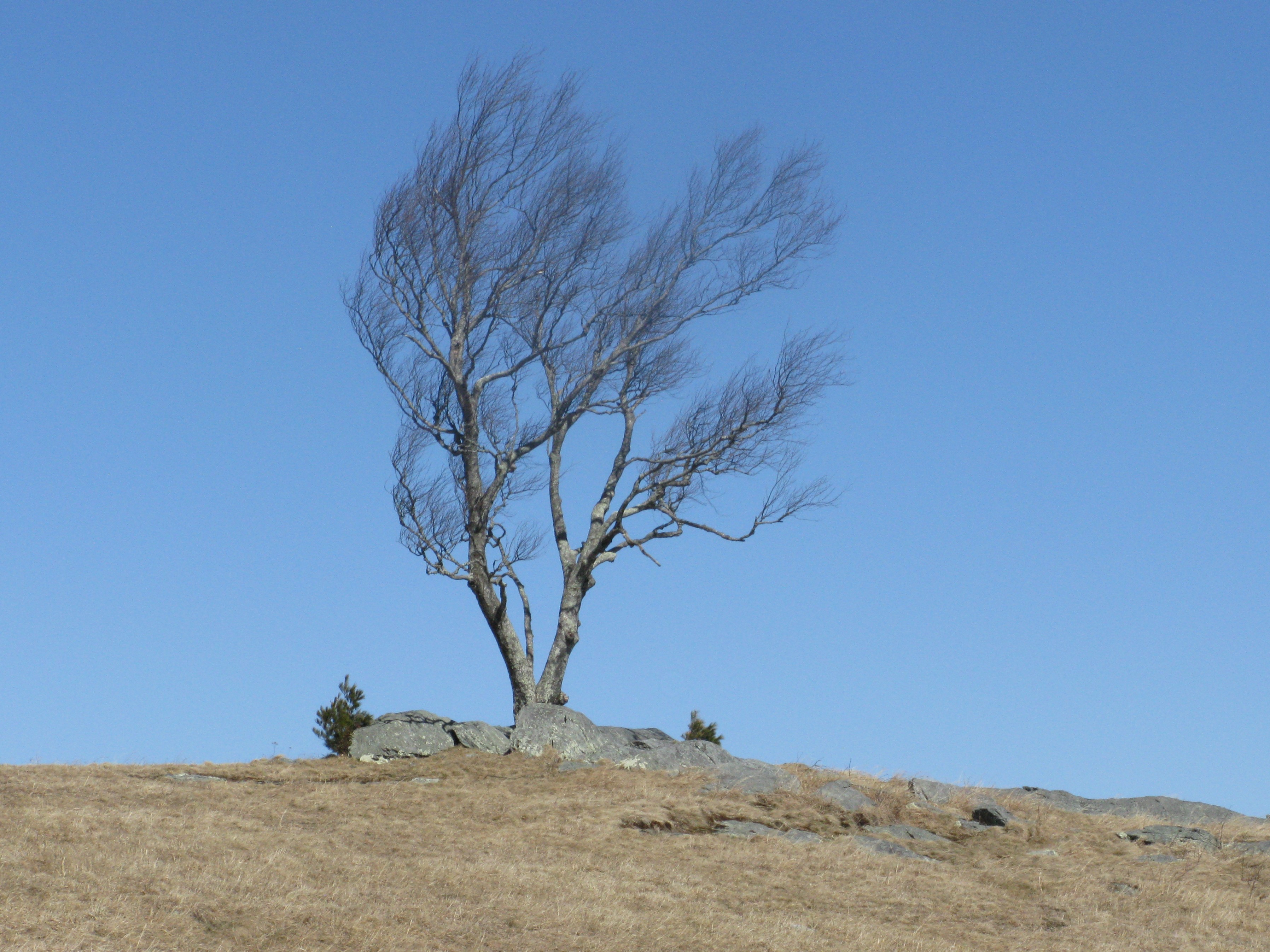
Doughton Park Tree 2021-02-23

Read Full Post »

[with poems from Visions International]

From the ridge above the creek the tallest tulip trees poke their heads up to catch the evening sun. Hammered gold, bright lemon and lime, for a moment they torch the forest and we who look up catch their display. Without this certain angle of sun, autumn lends these trees only ochre dashed with butterbrown; without us looking up at just this certain moment we might not appreciate them at all.

Most everyone mid-October is planning their looking up. Hey Honey, wanna drive up on the Parkway on Saturday (the crowds, the crowds!)? Which weekend will be peak color? Was late summer wet enough and September nights cool enough for the maples to manufacture their anthocyanins? (Yes, most everyone is debating phytochromes and anthocyanins whether they know it or not.) Slowing the car. Craning necks. Meanwhile Linda and I are back in deep shade where beech and hickory still hold onto their leaves. We’re looking down, not up. The color we seek is reclusive, modest, avoiding the limelight.

Right now is when Beech Drops bloom. No one is noticing. If you see them at all, you probably assume they’re the leafless twigs of some summer forb that’s already succumbed. It’s hard to even realize that their bare centimeter-long appendages are flowers. Bud, bloom, and pod all look pretty much the same. In fact I didn’t even realize they were blooming until I got down on my belly with a macro lens and then blew up the images. A streak or two of deep purple up their sides; pursed lips of fused petals; one protruding yellow stigma, anthers too delicate to see – but little friends, you’re gorgeous!

Epifagus virginiana is the only member of its genus. It is parasitic, like many other members of the Broomrape family (Orobanchaceae). It attaches to roots of Beech trees for all of its nourishment; it makes no chlorophyll and the only remnants of leaves are tiny scales along its stem. There’s no sign that Beech Drops weaken or harm their host, but in late summer and fall their pale stems emerge from the leaf litter like bony fingers of the undead – just in time for Halloween! Walk through a beech grove: when you notice your first Beech Drop you’ll suddenly realize there are hundreds all around you, and when the low angle of late sun catches them, translucent purple like pale flesh, you might just get creeped out.

For years I had mistaken Beech Drops for the dry leavings of Puttyroot or Cranefly Orchid. Now that I’ve learned their identity, I make a point of seeking them out. On display, this is the one qualification of the Naturalist: Curiosity. The four steps along the path of the Naturalist: Pay attention; Ask questions; Make connections; Share. And the motto of the Naturalist, a motto I just made up and have taken for myself, at least: Semper plus discere. “Always more to learn.”

❦ ❦ ❦

Snow on the Back of Cattle

They seem, at first, dark formations of stone,
half drifted in, bunched and volcanic, rectangular
with oddly shaped outcroppings, sun glinting
on crystal, fringes of gray-green and palest
yellow: lichen, sage, bleached dry grasses
Then small puffs of steam, their breath, shift
and snuffle, soft voices lowing, hooves cracking
the frost. In two places near the herd’s edge,
bright splashes of red where calves dropped
in the darkness, where rough tongues licked
them clean and muzzles nudged small bodies
until they stood, shaking with wonder, to
search out the straining udders and drink.

B. J. Buckley (Power, Montana)
from Visions International, #106, Autumn, 2022

❦ ❦ ❦

Forty years ago Bradley Strahan collected work from poets from around the world and created the first slender volume of Visions International. Twenty years ago I first picked up a copy from a table at a poetry conference, not fully grasping what I was holding. I wondered about the title. Not the International part – holy cow, Bulgaria, Ukraine, Ireland, Italy – but the Visions. For the past several years I’ve been a subscriber and I think I’m finally getting it. To see . . . with another’s eyes, from within another’s place and persona. With every issue that arrives, the poems nudge, jostle, encourage with their quiet insistence that I open my eyes. And learn.

Semper plus discere – always more to learn. The two Latin roots disco and doceo are closely related (from the same Proto-Indo-European origin) – to learn, to understand / to teach, to instruct or show. I perceive that Bradley’s mission is to rattle us loose from the cage of our unquestioned routine, to crack a first fracture into our ossified assumptions. Always more to teach, always more to learn. And how about the homologue discern – from dis – cernere, to take apart – to be able to distinguish or perceive the differences between two things that might at first have seemed to be identical. The poems in Visions International never fail to open my eyes, my mind, my heart to a larger world, more varied, more diverse. More exciting!

❦ ❦ ❦

Tell Me Where All Past Years Are

She had a broad lap, a feed sack apron.
We sat warming on the stoop, and everything around falling
fell into her sack, golden
catkins, chinquapin burs, pods
of locust sticky with their honey,
dust of stars, dust out of the furrows.
She hummed; I translate:
+++++ When will the time come back to me
when hours were in my pocket
as man and heavy as loose pennies,
when days oozed thicker than
end-of-summer honey, when happiness
formed in my hands like butter from the churh
to squeeze and pat into a cake
and print with a petal crown of daisies?
+++++ No we both are humming, sixty or more
years between renditions, and while
we sing the sun clocks out and the moon
on the ridgetop stands and shakes out its lap,
a glowing radium dial.

J. S. Absher (Raleigh, North Carolina)
from Visions International, #106, Autumn, 2022

❦ ❦ ❦

Magpie Potential

The cloak requires to be worn lightly.
You cope with its invisibility
and, trying it on for size, dip your hands
in its deep pockets until they

smuggle up four eggs of lustrous blue,
brown-spotted, the same eggs
you climbed to find in Ballyduggan wood
in your barefoot childhood.

One by one you put the eggs
to your ear, amazed to hear from each
the whir of magpie potential.
Gently you bed them back down,

hoping for wingtips to sprout, bodies
and legs and darkly the eyes
and cowled heads
to come about. Hoping for feathered

iridescence, even for flight,
and your life of hoard-need, or reining in,
of fear that you might fail,
seems only a grounding for this

exuberant scatter and go. You withdraw
your hands, but all is empty now,
and clay, make of it what you
will, clings cold under every fingernail.

Patrick Deeley (Dublin, Ireland)
from Visions International, #106, Autumn, 2022

❦ ❦ ❦

Note: Issue Number 106 of Visions International also includes a poem by Deborah Doolittle (Jacksonville, North Carolina) that I admire, Bird Poem, plus work by poets from Italy, China, Germany, France, Bulgaria, Hungary, Ireland, Ukraine, and eleven states in the USA.

Visions International is published by Visions International Arts Synergy, a 501(c)3 non-proift group for the promotion of poetry and the arts. Subscriptions are $25 for 4 issues; Contact BLACK BUZZARD PRESS / 309 Lakeside Drive / Garner, NC 27529.

To which little magazines do you subscribe? Support poetry by reading it. I’ve got 20 years of Mainstreet Rag piled on the bookcase; the mailman brings me every issue of Tar River Poetry and Cave Wall. Semper plus discere. Semper plus legere.

❦ ❦ ❦

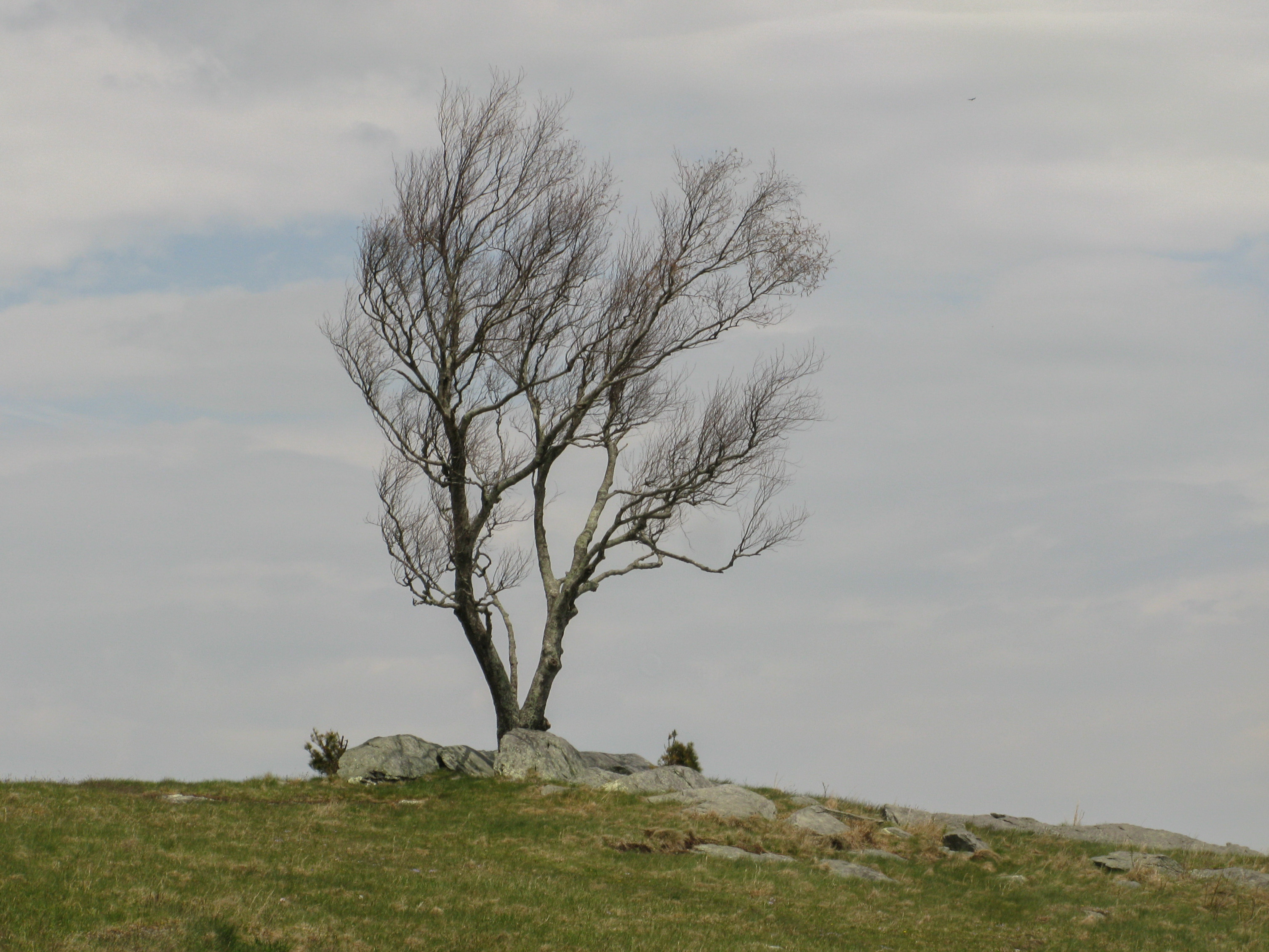
Doughton Park Tree 4/30/2022


Read Full Post »

« Newer Posts - Older Posts »