Feeds:
Posts
Comments

Posts Tagged ‘Maria Rouphail’

Saturday morning readers share:
Maria Rouphail and Joan Barasovska
 . 
This small house, this big sky . 
 .  . Shapes of things: so much the same
 .  .  .  . they feel like eternal forms
 .  .  .  .  . (Adrienne Rich, “Sources”)
 . 
This small house
my heart’s center
where the world entered and sat down
and I greeted it
as a mysterious guest
my first words swelling into
sentences and song
north to the barred owl in the backyard oak
and the clothesline strung with bedsheets post to post
south to the sawmill
and the draft horses pulling flatbeds of logs
east where a gravel road snaked toward the bay
and long clouds steamed from the loud freight train
west and a highway curving into the pines
and the pond where we swam
where a laughing boy in my class
did not drown one afternoon
but caught polio instead
he never walked again
his mother cried
my mother kept me close
and the sky stared at us in silence
every day in those days
I wondered why
that boy
and not me
 . 
Maria Rouphail
 . 
This is the title poem of my 2025 book, This small house, this big sky (Redhawk Press).  I deliberately avoided punctuation, hoping to effect a kind of seamless stream of consciousness.
 . 

Papa and me, circa 1952

 . 
Here’s something weird: since childhood I’ve had the ability to “mirror write,” and spontaneously and without pause. Could be because I’m left-handed. Long ago, I was told that DaVinci had the same ability, but I’m certainly no DaVinci! 
 . 
Additional poetry by Maria Rouphail at Verse and Image:
 . 
❀   ❀   ❀   ❀   ❀
 . 
Scarcity
 . 
Love, ever a torment,
a yearning—the knot
 . 
I’ve got for what I need.
Love, not blind, but stupefied
 . 
like grief, like bleeding.
The trouble with me
 . 
is agony, the piercing note
of longing, its persistence.
 . 
It’s plainly the shame
of scarcity, the freeze
 . 
of what I sprang from.
I guess I cried.
 . 
Joan Barasovska
 . 
Scarcity is forthcoming in the winter edition of Persimmon Tree.
 . 
I am sitting at my small desk, above which I have placed many, many things: a photo of the sign that hangs outside of the Grolier Poetry Book Shop in Cambridge, Massachusetts; the cracking cover of an old Penguin paperback of George Bernard Shaw’s Saint Joan with Joan in armor on her steed looking skyward; a clipping of a newspaper headline: “The Courage to Be Alone”; my dad’s business card; a Bazooka Joe comic in Hebrew; the poem “Crossing” by Jericho Brown; lines from Eudora Welty, Borges, Eliot, Mark Strand, Raymond Carver; Bertolt Brecht; a note from Bill Griffin: “You are the beating heart of NCPS, not to mention spleen and gizzard”; a framed arrangement of dried flowers and ginkgo leaves. More. But there’s a yellowed, brittle piece of newsprint, probably from The American Poetry Review, with these lines: “There the wind blows / There the rain falls / There god roams / on his palms, on his all four palms” Can anyone identify this? Is it familiar? I would love to know.
 . 
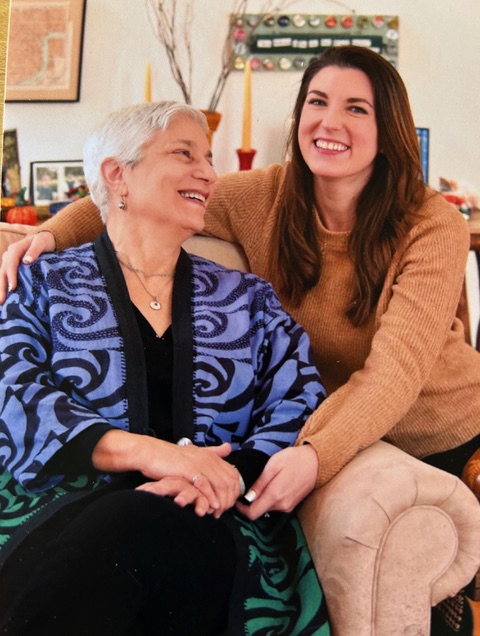
Also on my desk, this photo with my daughter Clare in my living room 
 . 
Additional poetry by Joan Barasovska at Verse and Image:
❀   ❀   ❀   ❀   ❀
 . 
Saturday Morning Submissions – Once a week on Saturday I feature one or two poems shared with me by readers. If you would like to consider having a favorite poem appear, either by you or by a poet you admire, please see the GUIDELINES here:
 . 
 . 
 . 

Read Full Post »

 . 
[with 3 poems from Visions International]
 . 
The Tending
 . 
Each day made a play for eternity then,
just as now each day shrinks
to a blurry moment’s recall. But still
there is the flat porch roof where a child
would lie down to watch
the clouds slowly changing shape,
 . 
or the blue, unfathomable sky
opening over, and puzzle where he was
before birth, before conception,
or if the world of sensation
had wiped his angel memory.
Cypress-tree shadow reached, as they
 . 
still do, across the lawn at evening,
and again I twist backwards
through a wooden sash window
into the long unoccupied bedroom
of my parents. Old clothes,
a straw-hat clinging to a wall, a stopped
 . 
alarm clock on the mantel.
And here, a navy-striped bolster,
the dent left by their sleeping heads
imagined as touchable still,
the love between us arguing against loss,
the tending they brought
 . 
to each sadness and terror of thought,
but more to an obvious wound –
the skinned knee dabbed
with Dettol; a beaker of oatmeal tipped
into a cold bath as a salve
for sunburn; a sewing needle squeezed
 . 
from a pin cushion bristling
with needles, the small hand held
forward into light, the gentle, tortuous
teasing out of a thistle thorn
and this placed – a charm,
frail tiny, golden – on the child’ palm
 . 
Patrick Deeley – Dublin, Ireland
 . 
❦ ❦ ❦
 . 
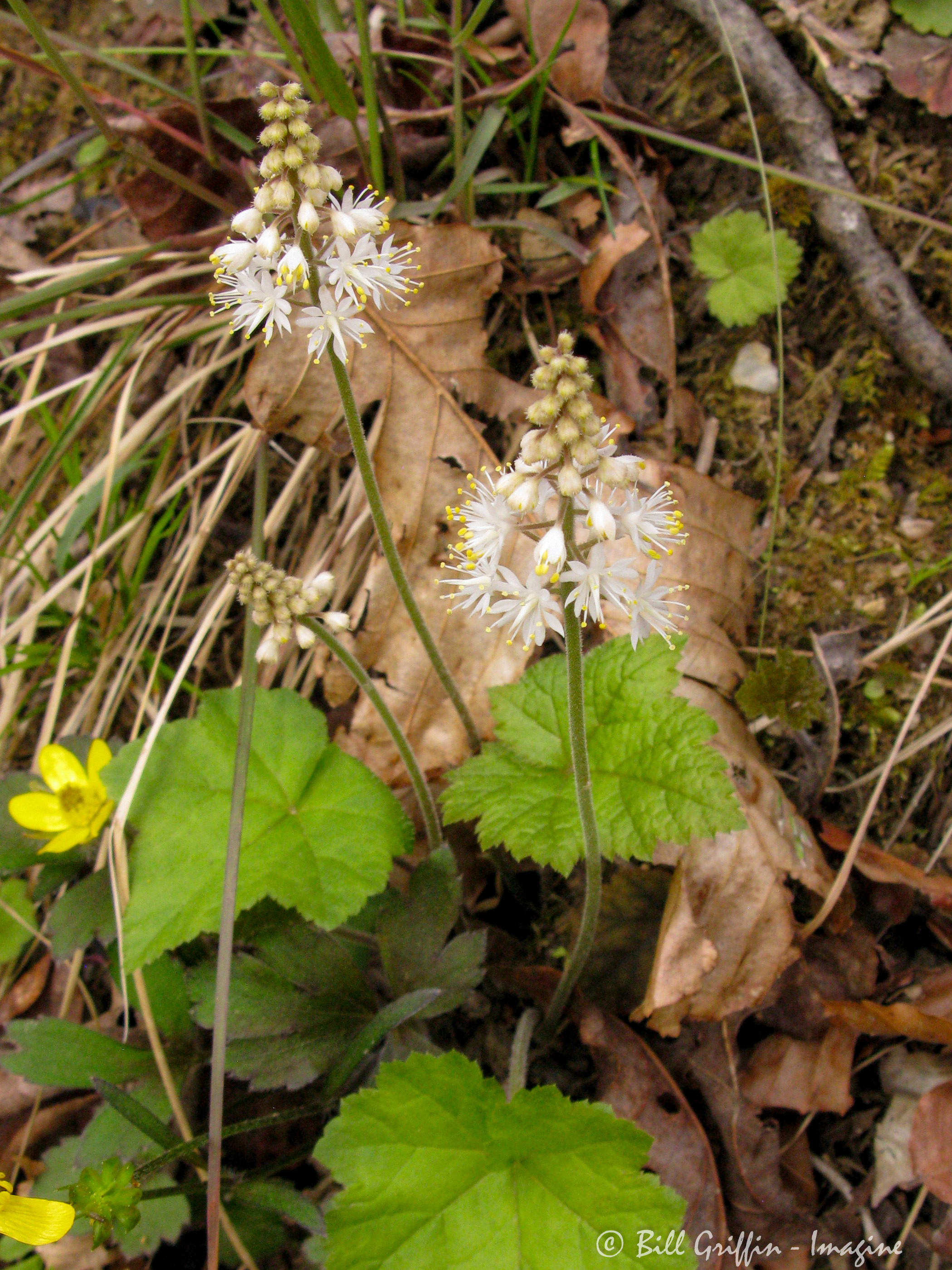
Foamflower
 . 
The last day of March – at the edge of the woods red maple, always impatient, always profligate, spreads its arms to offer a jillion winged seeds, the fire at its twigtips cooled to pale smolder. Deeper beneath the canopy leafbuds are swelling on oak and hickory, tangible pressured suspense, not yet quite to bursting. Ephemerals race to make sugar from thin sunlight before the overstory closes and their beds grow dark. Trout lily and hepatica already bloomed out; bloodroot roaring full throat; rue anemone flinging itself in galaxies up the ridge.
 . 
And what’s this? Foamflower has poked its first slender finger up between last year’s coppered leaves. A pale nubbin, a lifting spike, two or three then tomorrow a full maypole of tiny florets to comprise the rising inflorescence. Tiarella cordifolia, little crowns with heart-shaped leaves. What is its occupation in this temperate glade? What does it promise me other than its beauty?
 . 
Has it promised me anything? Should it? Perhaps I can tell you a story about the company foamflower keeps in this beech-dominated neighborhood: pussytoes, star chickweed, the throng of early blooming companions. Perhaps I’ll kneel to discover its native bee pollinators or wonder how its minute seeds disperse themselves. I might even recognize these felsic outcroppings and recall its family name, Saxifrage, Stone-breaker. But Lord of creation, save me from asking, “What good is it to me?” Expect a poultice of its leaves to heal my burns and scalds? Brew a tea to soothe my mouth and brighten my eye? Shall I read in its signature only whatever good use I can make of it?
 . 
On the seventh day the Lord looked out upon everything created and declared, “It is good!” And then rested. Never let me rest until I have looked around me, all around, water and stone, flower and tree, worm and beetle, turtle and bird, each of them good, in themselves and of themselves. Each one living usefulness that comprises its own being. What is my occupation in this temperate glade? What may I promise all these that surround me? To be a good companion in the community of all.
 . 
 . 
❦ ❦ ❦
 . 
O Doves
(Lima, Peru, 6 am)
and he saw the Spirit of God descent like a dove . . . Matthew 3:16
 . 
Shy ones, the shades of buttermilk
and cirrus cloud,
 . 
forgive the man and woman
cursing the scrabble of your bones on the
bedroom window ledge.
 . 
They are harried creatures
waking out of sleep’s egg
to the greasy clot of day.
 . 
They know only hunger,
which is the world’s stark treason,
 . 
and the mockery of iridescent necks
pecking the gray flagstones for crumbs.
 . 
How can they love the immaculate
cooing of your beaks so high in the blue air,
 . 
having forgotten the signs
of invisible things?
 . 
Maria Rouphail – Raleigh, North Carolina, USA
 . 
❦ ❦ ❦
 . 
the gilded angel on the spire / draws the sun to its dewy face
 . 
landscapes advance / and dig their hooks in the elongated shadow/ you drag behind you
 . 
a child’s sleep soothed by rain’s ticking / on the other side of the earth
 . 
an accordion of hands fixing my hair
 . 
I smooth my quilt, where her dress scraps are stitched
 . 
a pair of wired gold rim glasses / like John Lennon’s
 . 
the water above the springs squeaks like pebbles
 . 
Here is the plain brown envelope with the hand-printed address and the Pete Seeger postal stamp. I slip out the slender booklet, cardstock cover illustrated by Malaika Favorite. Inside a listing of poems and their poets – Bulgaria, North Carolina, Wales, Macedonia, Texas, Ireland. And then the saddle-stapled pages, their lines wandering in the familiar, distinctive font, and the words . . . language . . . images.
 . 
After reading many issues of Visions International over many years, I still wonder how editor Bradley Strahan draws these voices to him. How he creates this international community of human soul. I wonder how he accomplishes it, but I may be learning a bit of what he is listening for, what he seeks and chooses as he compiles each collection. Even more compelling than the stories the poems tell are their images: elemental, bedrock, true. I read phrases that ring with harmonies I’ve never quite heard before and yet they strike as perfectly right and correct. The language is new and yet it enters me and becomes me. (And I have to confess, there is just something about those Irish poets.)
 . 
Here are old neighbors, like Maria Rouphail from Raleigh and Jessie Carty from Huntersville, but here are my new old neighbors from every corner of the earth, all drawn together through their poems. Drop Bradley a line and join the community.
 . 
Visions International / 309 Lakeside Drive / Garner, NC 27529 – 4 issues = $25
 . 
 . 
❦ ❦ ❦
 . 
Drive
. . . roll down the window, and let the wind blow back your hair.
+++ – Bruce Springsteen, Thunder Road
 . 
My first love and I would circle the Blue Ridge
listening to Thunder Road, caught in a spiral –
the song, the earth, and us – a springboard
for leaping. Ancient and settled,
those mountains, a silhouette absorbing music
from our high school parties at the VFW.
Moths and gnats reduced to a fever
clouding porchlights, while kissing was its own
stratosphere. Who needed to breathe anyway?
Not when you’re a new mythology
sharing sixpacks of beer and meadows jacked
in the sweet everlasting – a wildflower
native to the state from which we’d grown.
We kept the geographies of each other’s
bodies beneath our tongues, but the sky
was an impossible parallel. Never mind that
we craved nothing linear. He and I, divergent lines,
a palm reader would have said about the future,
lanterning us in, cloud-swept from the open road.
W didn’t we marry at eighteen, honeymoon
nearby at the Peaks of Otter like all the other
teenage brides? You never asked me if I wanted to
stop. The truth is, I didn’t. I needed to witness
the horizon unobstructed by mountains
where trees shook colors from their crowns,
their roots tangled in bedrock. It was
something of a dance, the way our feet flew
over tar and gravel, spun around blind turns.
The valley that had fevered and pushed us out,
lay spent and sprawled beneath the open windows.
Those nights we rumbled through, we left nothing
but music growing fainter until it was gone.
 . 
Laura Ross – Mount Dora, Florida, USA
 . 
❦ ❦ ❦
 . 
 . 
 . 

Read Full Post »

[with 3 poems by Maria Rouphail]

A stroll down the beach at dusk – I was sixteen and she was almost. Would you call it our first date? I think we held hands. I know we didn’t kiss. Fifty-four years later the beach is still there, although not the pier we walked beneath, things the earth makes, less so human desires. This afternoon she is upstairs writing a letter and I have just cleaned up after lunch. Where have we been and where are we going? Well, in an hour we’ll take a walk beside the river.

Oh Wise One, long-married, specialist in domestic bliss and expert in the cultivation of love, impart your secrets! Are you kidding me? I’ve spent all morning making a list and it is exactly two items long: (ONE) Never Imagine You Know; and, (TWO) Never Quit Working to Find Out. Number One becomes apparent every time I assume or jump to a conclusion or utter as comfort some empty platitude (or, cardinal sin, just wasn’t paying attention). Number Two is the quick corollary as Number One’s immediate aftermath and the sooner engaged the better – not Working to Find Out usually invites conflagration.

Which is probably why love is such a necessary obsession of poetry. Infatuation is the hot minute of attraction; love is the cool hour of reflection. Poetry may germinate unseen underground as the temperature rises, but its sprout becomes visible when the creature is leaned back in chair, pen hovering listless over paper, the image of affection growing into clarity within the cool, reflective mind. And as I reflect further, I perceive that the seeds of most of my own love poems involve messing up with Number One and Two, above, only to be rescued and reconciled by the big sighs and small gods of forbearance and forgiveness.

Even now I imagine her at her desk, pen and paper, that elegant typographer’s script, those meticulous phrases – oh yes, I want to love her and I do.

❦ ❦ ❦

Annunciation
++++ (after Lynn Emmanuel)
+++++++ for Robert

He wants to be born.
So first he enters the dream of the woman
a doctor has told will never conceive.

He lets himself in through the gate
of her sleeping brain
during a hard snow
in late November.

He give himself eyes and hair like hers,
wraps himself in thick fleece, his fingers curving
over the hem, like a paws of a burrowing mammal.

She wakes with the dream of him still clinging,
I’ve birthed a back-eyed baby boy, I’ve carried him
up the aisle of the church to the baptismal font.

She goes to the window where slantwise
snow erases the houses across the street.
Only a curbside lamp on its iron stalk breaks through,
++++ a yellow clot in the boreal blur.

After she has laid aside the dream or forgotten it,
he enters her body sometime in January.
His arrival ignites engines and fires up turbines

with power unknown to her, making her whole
being a construction zone for the laying of foundations,
the framing of the many rooms of his evolving body.

In April, cornerstone and beam well set and level,
he shows her his brain and spine, a string of perfect lights
blinking the in the midnight sky of the sonogram.

The doctor is speechless. But the woman
rehearses the names of her beloved living and dead.
She will pick one of them.

She watches the tiny heart strobe in its cage.
Beacon of what is coming in October.
A swaddling blanket. A christening.

Maria Rouphail
from All the Way to China, Finishing Line Press, © 2022

❦ ❦ ❦

One line echoes in each poem I read in Maria Rouphail’s collection: Even then, / I could not say you did not love me. All the Way to China is a conversation between daughter and mother that spans decades, even generations. Many different speakers inhabit the poems, in many places and circumstances, but the voice of daughter/mother is audible in each, even if only as a whisper. Through harsh treatments, neglect, destructive choices, and pain that whisper of love still works to keep itself alive.

Love is work. In one of Fred Chappell’s novels, a youngster asks his old grandfather how is it possible that he and grandmother have managed to stay married for so many years. The old guy’s answer? “You don’t leave, and you don’t die.” In Maria’s poems, leaving is a frequent threat and dying too soon is a reality, but the magical work of poetry allows the dialogue to continue in spite of, maybe even because of, mortality. Telling a story allows it to discover its meaning. Telling a hard and painful story allows it to discover new meaning that just may open a door to healing.

The final two poems in the book bring meaning and healing forward and invited me to turn back to the first page and read the cycle again: Laudate Omnes (in praise of everything), and Mother and Daughter, Two Voices – III, Daughter. Yes, this collection is the work of love.

❦ ❦ ❦

Laudates Omnes
++++++(for Asher, young grandson)

Let’s talk
to the bees.

++++++Let’s say

Ladies, thank you
each and all

for coming this day
to the hyssop and bergamot.

Thank you
for diving

into the boggy throats
of pale blue sage.

Thank you
for letting sticky

pollen crawl
up your hairy legs.

Thank you
for the sweet spit of the hive.

Now to the trees turn and say,
Brothers,

I don’t know all your name
or what families you belong to,

but you over there,
tall and handsome with your spiky green:

if you and I were lone survivors
of a meteorological catastrophe,

I’d live with you.
I’d hole up under your branches.

Leaves and rain
would be our food and drink each day.

Now let’s say thanks and thanks and thanks
for the hive’s honeyed paradise,

for meadows of thick-maned mares
drowsing with their foals,

for bees, horses, and trees,
ocean, plains, and the sky.

Let’s say thanks
for the darkness between stars

which is not an emptiness,
but a rookery

where God dreams us.
And if we found ourselves

on a comet flying
beyond Pluto’s orbit,

even there we would
be not separate and alone,

but we would be
as now we are

in the heart of things,
the very heart.

Maria Rouphail
from All the Way to China, Finishing Line Press, © 2022

❦ ❦ ❦

Margie’s Daughter Talks Back

Wood. Shell. Bone. Buttons
in every size and color your mother saved for mending.

You, too, saved them,
in the round cookie tin on a high shelf.
Rainy days, and you’d take it down
and we’d remember
buttons from faded summer dresses,
buttons from coats returned from war,
buttons with bits of garments still clinging,
flesh and tendon of them. Red grosgrain,
shock of silver wedding silk,
fingers of fragrance still clinging.
Attar of rose and vetiver still clinging.
Heft and pour, the cascading clack and clatter
of buttons, like coins or pretend jewels.

You, too, loved them.
You and I together breathed the old secrets hanging
like the kitchen smells in that Bronx apartment.
Buttons from a man’s flannel before zippers were.
Your father’s, you said. And the blue bruise
your mother tried to hide with a lock of hair when
you, looking, and in your small voice, asked,
What happened to your eye, Mama?
as she reattached the right arm of your school sweater.
In the next room the bleats of a baby boy,
and a darkness you hoisted onto your twelve-year-old hip
and hauled through the rest of your life.
Hauled it into my life, too.

Would you believe me if I told you?
I have survived the winter.
Here is the faith I’ve entered with myself,
rule, rite, and rigor of it:
I will not belong to whatever happens to me.
It’s OK to say these things.

Maria Rouphail
from All the Way to China, Finishing Line Press, © 2022

❦ ❦ ❦


❦ ❦ ❦

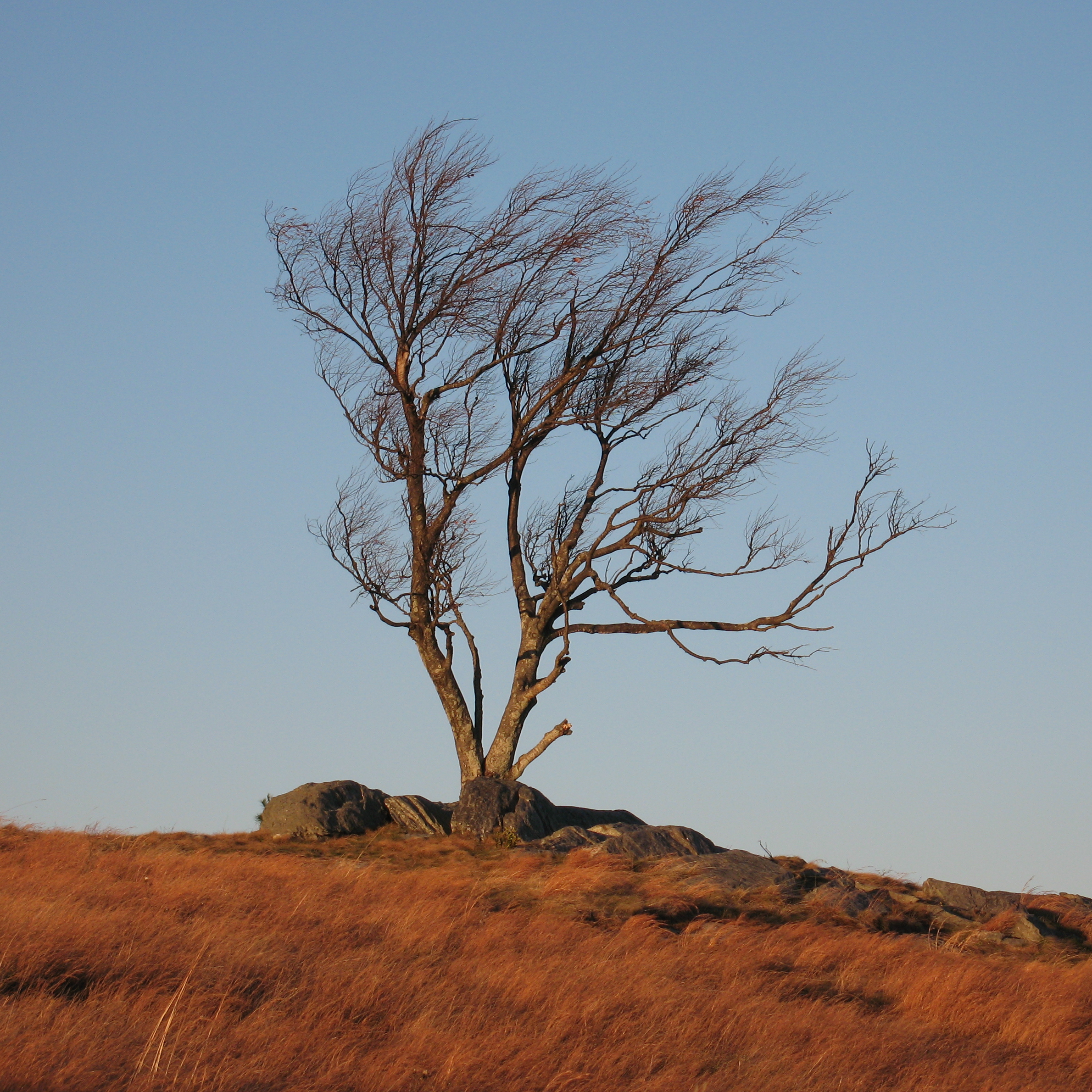
2019-02-09 Doughton Park Tree

Read Full Post »

Older Posts »