Feeds:
Posts
Comments

Posts Tagged ‘imagery’


[with 4 poems by Ruth Moose]

I’m driving from Elkin up to Dobson, our county seat, smack in the center of Surry. About half way there, as Mountain Park Road peels off to the left, Poplar Springs Road completes its transformation to Zephyr Road. I love that – Zephyr Road. There are farms and rolling hills and plenty of zephyrs, though some of them are perfumed with a whiff of chicken house or skunk. Soon winter wheat will green the fields, then Spring will raise corn, soybeans, finally tobacco. Off to the south you can see vineyards pruned and expectant.

While the pastures are still winter brown, pay attention. Look, there’s one – close to that big oak in the middle of an empty field, a little patch of green. Come March you’ll spy the yellow nod of daffodils. Why out there of all places?

Those daffodil plots, slowly spreading, most likely once knelt at the front stoop of a farm cabin. A century ago, even longer? No sign of it from the road but if I walked around the oak I might scuff up a few squared off stones that were its foundation or that hoisted a step up to the porch. The daffodils remember. And maybe it was the same man and the woman who hoed the corn, milked the cow, every winter killed the hog, two together across the years who some quiet evenings found an hour to sit on that porch, maybe they’re the ones who named the wagon track below the field Zephyr Road. I love that.


.     .     .     .     .     .     .

Ruth Moose’s poems reflect the North Carolina icon she is. She draws on generations of memory to weave her stories and sketch her vivid images of locality and personality. Her sly wit, cloaked but never hidden by gentility, brings out the quirky individuality of the denizens of her world, real and imagined. And she reveals the deep, deep heart of longing, loss and yearning, our fragile mortality.

These poems are from three of her collections spanning decades. Ruth has also published novels, many short stories including two collections, and has won many awards and fellowships. Charles Edward Eaton said of her: Few writers can handle both prose and poetry, but Ruth Moose does them equally well, and with this double grasp has become one of North Carolina’s best writers. Ruth taught creative writing at the University of North Carolina until her retirement and she continues to support the creative life our home state.

.     .     .     .     .     .     .

Smith Grove

There is a heaven
for farmhouses.
Acres of them
lit by cloud hills
that plunge and wind
past creeks
where cows crowd on hot days.
A million windows watch
where farm wives waited,
minded those who came,
those who left,
counted the colors
of morning, evenings,
the sky at noon.
From back door stoops
they marked storm clouds,
summers rent with heat lightning,
saying both aloud and under
their tongues the chant
of superstitions, old tales,
familiar talk until the dark
dissolved.

In the museum
of porch swings and farm tools,
kitchen work is rusted,
thick with the oven of meals,
baked enamel, porcelain polished
like plates.

from Smith Grove, Sow’s Ear Press, Abingdon, Virginia, 1997
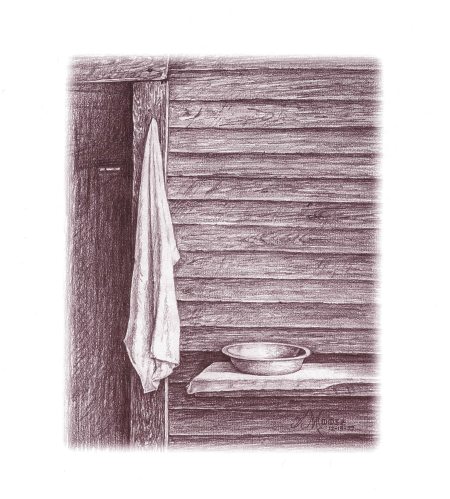
Illustrations are by Ruth’s husband the late Talmadge Moose, widely published and displayed artist and illustrator; read more at Life As He Saw It in Our State Magazine, April, 2011, by Ruth Moose.

.     .     .     .     .     .     .

.     .     .     .     .     .     .

Making the Bed

No matter how well
or worse the sleep
someone must take
the four cornered world
and set it straight.
Two can do it better,
take turns with edges,
coverlet, shams,
blanket and bolster,
wait in turn.

You can do it in the dark,
by feel, familiarity,
plumping feathers or foam.
You know your own scent,
shallow spots your knees
seek, the place you
fall into, dark and faraway,
taking you back or forward
like a train, all scenes
lighted cars you can look into,
out again. You hear the engine
that goes nowhere, the solitary
shriek as daybreak unrolls,
all wrappings out like flowers.

We go on with our lives.

from Making the Bed, Pure Heart Press / Main Street Rag Publishing, 1995

.     .     .     .     .     .     .

.     .     .     .     .     .     .

Almost a Pantoum on Being

A script is not needed; our place is already there.
We come into the world naked, unafraid.
Helpless we learn as we go, if somebody cares.
From water we swim, kicking into blue air.

We come into the world naked, unafraid.
The spell is everywhere, something the soul knows.
From water we swim, kicking into blue air.
Alive as the earth is alive and newly green.

The spell is everywhere, something the soul knows.
No angels hover over us, sit on our shoulders.
We are alive as the earth is alive and newly green.
Taking the flight one wing at a time.

No angels hover over us, sit on our shoulders.
Celebration waits in the arms of others.
We learn the dance one step at a time.
Moving to tunes heard in our heads.
No script is needed. Our place is already there.

.     .     .     .     .     .     .

How I Think It Will Be

My mother never talked about that winter
she had a husband in the VA hospital
not knowing how or if or when
he’d recover, three children sick
with the big red measles and twelve
inches of show on the ground
for over a week. She mentioned
it once, that’s all I remember
and the sound of her sewing
machine late, late into the night.
What did she sew? Her sanity?
Her soul? I only know I woke
suddenly, had gone from hot to cool,
my fever broken, my pillow wet.
I felt her hand on my forehead,
her touch, her voice as I left
that darkness and came into light.

I imagine it will be as she said then,
“Oh, here you are.”

both selections from The Librarian and Other Poems, Main Street Rag Publishing 2009
dedicated to HWLWG – HE WHO LEFT WITHOUT GOODBYE

.     .     .     .     .     .     .

Chatham Arts Council bio of Ruth Moose
Poetry Foundation listing


.     .     .     .     .     .     .

IMG_0768

Read Full Post »

[ with poems by Iain Twiddy and Martin Figura]

Question: What do these 3 scenarios have in common?

1 – “What do you want for supper?”
“I dunno, anything’s OK, whatever you want.”
“I could make some soup.”
“I don’t really feel like soup but anything you want’s OK.”
“I could heat up that Chinese.”
“Nah, I’m all left-overed out.”
“All right, what do you want.”
“I dunno. What do you want?”

2 – “OK Amelia, it’s time for lessons.”
“But I want to color.”
“You know every morning is lesson time. This week is the letter ‘N’.”
“I don’t feel like letters. I want to color.”
“Hmm, how about color for fifteen minutes and then letters?”
[Silence. Wiggles.] “OK. You can set the timer.”

3 – “Damn, look how muddy the creek is today.”
“Yeah, all that rain, looks like tomato soup.”
“It’s all the runoff from those tobacco fields. Isn’t there a law against that?”
“Hey, it’s their land. They can do whatever they want.”
“Maybe so but it’s our drinking water.”

Answer: 3 scenarios, all politics.

Politics with a little ‘p’: transactions in which each party has a stake. No stake = no politics. If it really doesn’t matter what we have for supper then all choices are equal, but if it does matter and I don’t make my position plain then I’m practicing passive aggressive politics. If there’s room within our politics for each of us to have our positions honored then we are practicing egalitarian politics. And if my right to life, liberty, and the pursuit of happiness are infringed by the practice of your similar rights, then it’s time for reality politics.

Whose stake is most important? Whose voice is loudest? Whose choice carries the greatest weight? Sounds like we’re edging into the realm of big ‘P’ Politics.

.     .     .     .     .     .     .

This week I received in the post from Ireland Poets Meet Politics 2020, an anthology of poems from the Hungry Hill Writing Tenth International Open Poetry Competition. The winning poem is Contactless by Isabel Palmer, about COVID-19, but the range of politics with big ‘P’ and little ‘p’ ranges from war, genocide, and sectarian violence to displacement, racism, sexism, redundancy, and annoying neighbors.

These two poems from the anthology in particular spoke to me: the wholeness of the earth cast aside for the extraction of profit; the wholeness of individuals cast aside once profit has been extracted. Whose voices are stifled and ignored? Whose choices are judged unworthy and irrelevant?

.     .     .     .     .     .     .

Borderlands

We found the world had already been claimed,
so ground out, drained, ironed in straight lines
– like the bed of the Red Sea to the verges –
that churches were ships, farmsteads treasure islands,

every centimetre weighed up for worth,
milked for produce, mined for living ores.
So existence thinned to frail causeways,
like streaks of light leaking from bellies of cloud,

to quaggy headlands, trench-squidge tracks, rivers
unassailable through the stars of barbed wire,
where even the wind seemed prevailed upon
to hurry and be gone the way of the sea;

we were deigned becks and streams like beaten dogs,
drains that ushered in, eeled for Holland,
fenced-off trees extending the invitation to climb
like an amputated limb, and holiday lashings

of untrampable grass, the spurt of trespass,
the ballast crunchy as bone between tracks,
feeling the self stripped into sin like a corpse
dumped overnight by the trash-flowered siding.

And so it went on, drilling, implanting – until,
surveying the banished domains, roaming
the crumbling borders – it gradually exposed
how if the world was lack, and doing without,

there was nothing to stop us making it up.

Iain Twiddy

.     .     .     .     .     .     .

The Remaining Men

When the men surfaced for the last time and dispersed
some were left over. These men wandered about the town
until the each found their own particular sweet spot.
Then they just stood there, looking out over the scarred coast
through red-rimmed eyes to the rough brown sea.

As the days went by people gave up asking them
why so still and could they fetch someone
or something? They became like street signage,
A-boards, parked prams or tied up dogs; something
to be manoeuvred around. As the months when by

the men became hardened to difficult weather
filling their coat pockets with hail. During the great storm
of Eighty-Seven, their caps blew off and went cartwheeling
down the streets with bin lids. As the years went by
the slagheaps faded to green and saplings were planted.

The men began to petrify into monuments. When
the new road for the business park went through
a lot of them were tipped back onto trollies, like the ones
railway porters used to use, then loaded on to flatbed trucks
with the traffic cones. Most were broken down for aggregate.

The lucky ones were sold off as novelty porch lights
and stood outside front doors on the new estate
illuminating small front lawns and driveways.
As the decades went by, saplings became sycamores
and elms and named Colliery Wood. In autumn

the early morning light on them was glorious
and cycle paths made their way there. The remaining
men were defaced by graffiti and badly worn
by then; many considered them to be an eyesore.
When children asked what they were, not everyone

could remember and of those that did, few were believed.
As the centuries went by, they all but disappeared,
only the circle in the park remained. Archaeologists
and historians disagree about how they came to be there
and what they might have been used for.

Martin Figura

.     .     .     .     .     .     .

Both selections are from Hungry Hill Writing Anthology: Poets Meet Politics international open poetry competition 2020, judged by Bernard O’Donoghue. Editor Jennifer Russell. © 2020 Hungry Hill Writing and contributors. hungryhillwriting.eu.

Iain Twiddy studied literature an university and lived for several years in northern Japan. His poetry has appeared in The Poetry Review, Poetry Ireland Review, Harvard Review, Stand, The Stinging Fly, and elsewhere.

Martin Figura lives in Norwich with Helen Ivory and sciatica. Together they began hosting Live from The Butchery Zoom readings during Lockdown with leading guest poets. A new edition of Whistle (Cinnamon Press) was published in 2018. His new theatre show Shed is interrupted but ready to go.

My own poem, Phenology Notebook April 7 2020, was shortlisted and appears in the anthology. Thank you!

.     .     .     .     .     .     .

.     .     .     .     .     .     .

AfterwordThe essential benefit of having grandchildren is that they provide the grandparents with something to talk about over supper which is not politics!

.     .     .     .     .     .     .

2020-06-11a Doughton Park Tree

Read Full Post »

[with three poems by Wendell Berry]

Y’all sure do favor!

So folks say when they first see my father and me together. He’s 94. I can’t say I see it but others do so there you are.

On the bookshelf in his living room is a small framed photo of my father about age 3, the same age as our grandson Bert right now. Now those two do favor! Two peas in a pod, cut from the same cloth, much of a muchness. Look at them with that one smile between them, look at those eyes, little imps, look at the domes of those foreheads. Let me just scroll through all these photos Bert’s parents have texted us and you’ll surely see how Wilson and Bert favor.

But where are the photos of my father at 3 making a face, lining up his lead soldiers, stacking his rough-cut handmade blocks? Where dancing? I suspect that framed studio portrait was a Christmas present from Grandmother’s brother Sidney – the rest of the family was surviving the depression on grits and squirrel gravy, the occasional bartered hog shoulder, never two nickels to rub together. The rare snapshots we have of aunts and cousins are from Uncle Sidney’s camera, the only one in the family.

Another depression is upon us now. We are all doing without something. Photos abound but Bert is not free to stand beside his great-grandfather, to show us their one smile between them. When will the day return that may show us how much we all do favor?

.     .     .     .     .     .     .

The poetry of Wendell Berry returns me to the center: the center of the fields and woods he walks; the center of time that stretches from long before me to long after; the center of meaning in a universe in which I am not the center but which nevertheless makes a place for me.

These three poems are from Mr. Berry’s book Sabbaths, published in 1987. A moment of stillness, of contemplation, of connection to the earth and all that fills it makes any place sacred and any day Sabbath. My dread, my grief, my struggle during these times are no different really from any times. These things don’t recede, they don’t disappear. They simply take their place in this moment: no before, no after, only now, and I and you and all of us connected in the journey to discover within them some promise of peace.

.     .     .     .     .     .     .

VIII (1979)

I go from the woods into the cleared field:
A place no human made, a place unmade
by human greed, and to be made again.
Where centuries of leaves once built by dying
A deathless potency of light and stone
And mold of all that grew and fell, the timeless
Fell into time. The earth fled with the rain,
The growth of fifty thousand years undone
In a few careless seasons, stripped to rock
And clay – a “new land,” truly, that no race
Was ever native to, but hungry mice
And sparrows and the circling hawks, dry thorns
And thistles sent by generosity
Of new beginning. No Eden, this was
A garden once, a good and perfect gift;
Its possible abundance stood in it
As it then stood. But now what it might be
Must be foreseen, darkly, through many lives –
Thousands of years to make it what it was,
Beginning now, in our few troubled days.

.     .     .     .     .     .     .

X (1982)

The dark around us, come,
Let us meet here together,
Members one of another,
Here in our holy room,

Here on our little floor,
Here in the daylit sky,
Rejoicing mind and eye,
Rejoining known and knower,

Light, leaf, foot, hand, and wing,
Such order as we know,
One household, high and low,
And all the earth shall sing.

.     .     .     .     .     .     .

III (1982)

The pasture, bleached and cold two weeks ago,
Begins to grow in the spring light and rain;
The new grass trembles under the wind’s flow.
The flock, barn-weary, comes to it again,
New to the lambs, a place their mothers know,
Welcoming, bright, and savory in its green,
So fully does the time recover it.
Nibbles of pleasure go all over it.

all selections from Sabbaths, Wendell Berry, North Point Press, San Francisco, 1987
Thank you, Anne Gulley, who gave Linda and me this book many years ago.

.     .     .     .     .     .     .


.     .     .     .     .     .     .

IMG_7952

Read Full Post »

« Newer Posts - Older Posts »