Feeds:
Posts
Comments

Posts Tagged ‘imagery’

Poems and photography from Shibori Blue
by Beth Copeland
 . 
Winter passes and one remembers one’s perseverance.   –   Yoko Ono
 . 
 . 
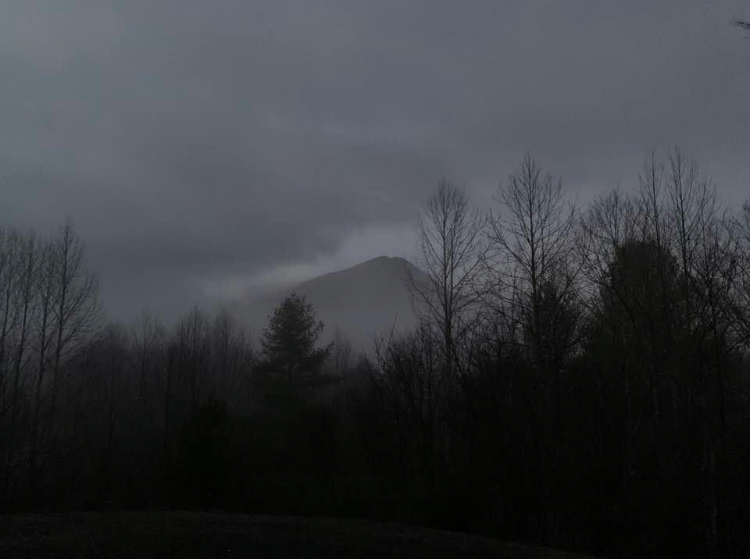
Frost on the mountain.
Creeks freeze under skins of ice.
A broken window.
My neighbor’s chimes are silent.
Even the wind is frozen.
 . 
 . 
Spring passes and one remembers one’s innocence.   –   Yoko Ono
 . 
 . 
Does the mountain mourn
its lost children, bones buried
beneath sediment
and stone? Who gathered near its
peak? What family, what tribe?
 . 
 . 
Summer passes and one remembers one’s exuberance.   –   Yoko Ono
 . 
 . 
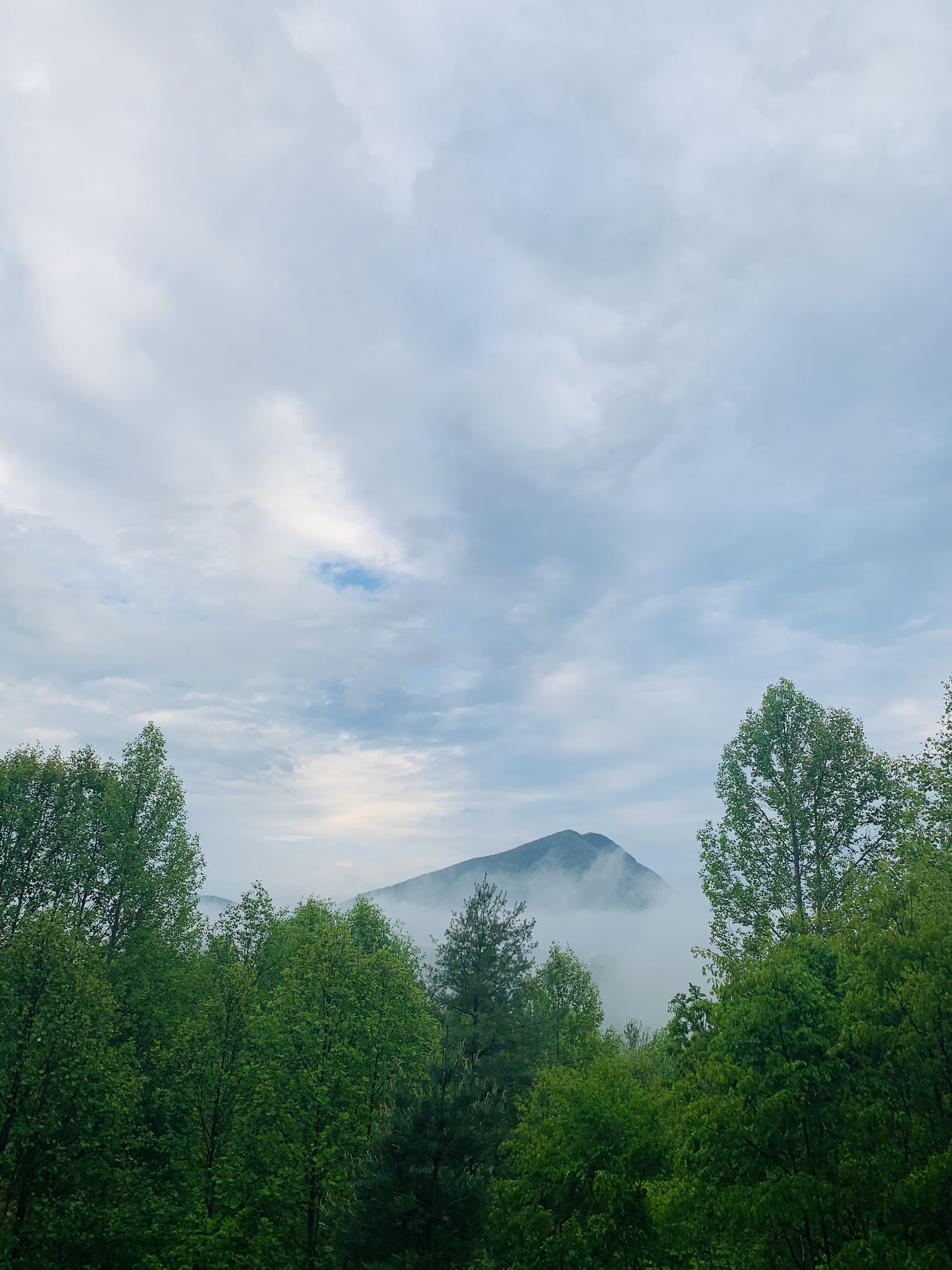
Bridal veil mountain
in May, the month of weddings.
Fog, Mist, and white clouds.
Wild daisy fleabane bouquet
fresh in a blue Mason jar.
 . 
 . 
Autumn passes and one remembers one’s reverence.   –   Yoko Ono
 . 
 . 
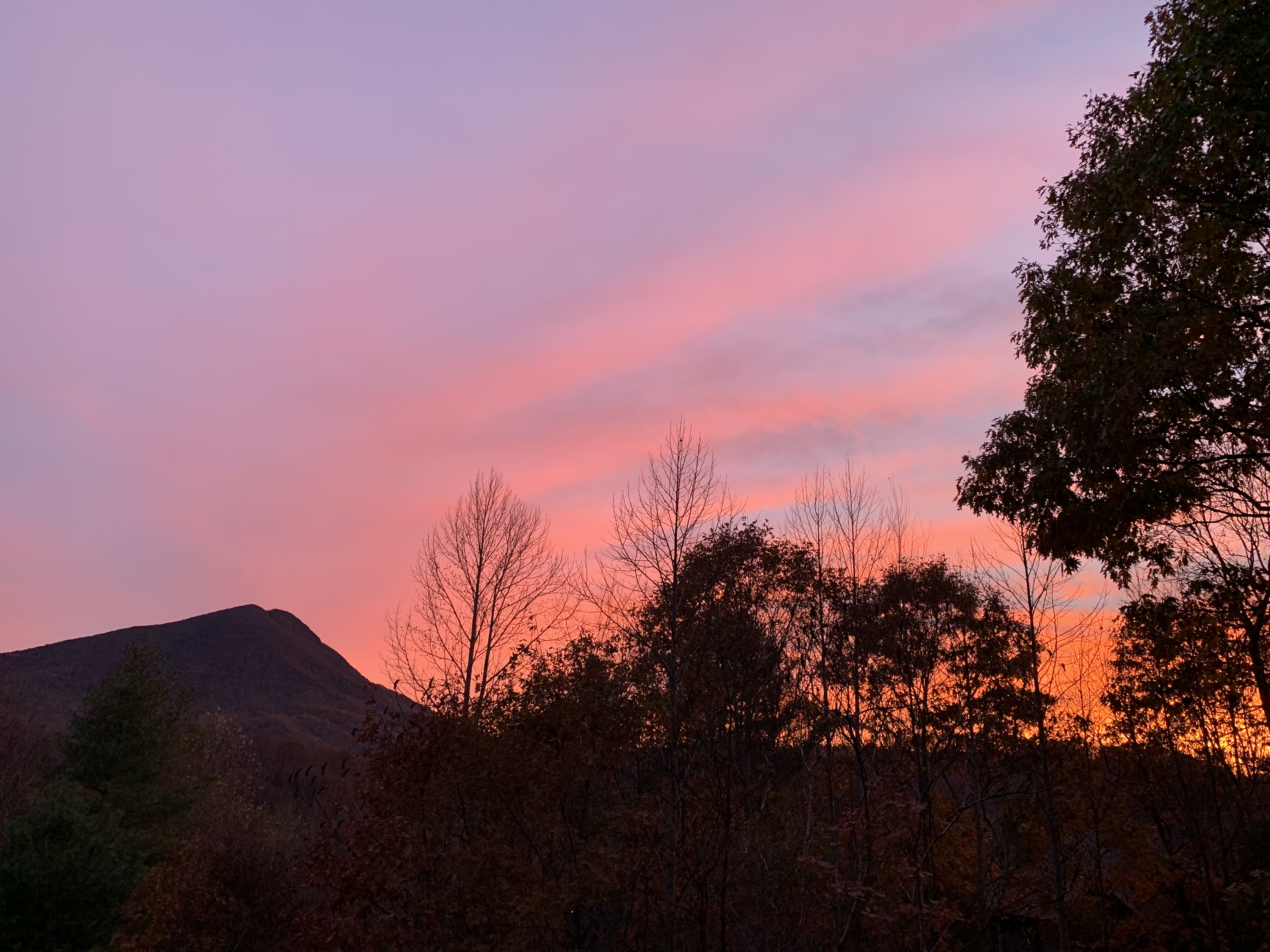
Tiger-striped sunset
above the ridge in the west.
Trees with leaves and trees
without. What are we losing,
my love, and what will we keep?
 . 
 . 
Poetry and photography by Beth Copeland
from Shibori Blue: Thirty-Six Views of The Peak, Redhawk Publications, The Catawba Valley Community College Press, Hickory NC; © 2024
 . 
❦ ❦ ❦
 . 
Beth Copeland lives in Ashe County, North Carolina, smack in the Blue Ridge Mountains. Each morning from her porch she sees The Peak, the highest mountain in Ashe County. It is solid and eternal – it is always shifting. Beth has recorded the mountain’s moods and contemplations with daily photographs, now pairing them in her new book with thirty-six poems that capture ephemera through the course of a year, moments of change through the changing seasons.
 . 
Thirty-six. A figure of truth and power. Product of two perfect squares. Multiplied by 2 to create the 72-season calendar established in 1685 by Japanese astronomer Shibukawa Shunkai. And again 36 the number of woodblock prints of Mount Fuji published by Katsushika Hokusai from 1830 to 1832. It is no coincidence that Beth chose thirty-six views of The Peak to inform her poems. She was born in Japan, the child of American missionaries, and has long revered the iconic mountain of her birth country, Fuji-san, whose profile The Peak of Ashe County so resembles.
 . 
This book invites me to slow my breathing, pause in the busy race, contemplate each page: five simple lines of verse, the silent mountain drawing my gaze. Redhawk is gathering a family of uniquely creative poets, writers, and artists to stretch our imaginations and open us to new experiences of words and images. I will leave this sentence here at rest and return to another page of Shibori Blue. And another.
 . 
 . 
More information about Shibori Blue: Thirty-Six Views of The Peak and the opportunity to purchase HERE
 . 
❦ ❦ ❦
 . 
Perseverance – Deep in winter do they dream of the music they will make, cicada song? Crescendo arpeggio decrescendo, easy combers across the long sea of summer. And does the creature measure the span of its days, egg to nymph, seasons in darkness, climb into light to mate and to die? Nothing can last, not even our song, yet we do not withhold our voices.
 . 
Innocence – She is most beautiful when she does not know I am watching. She gives her animals life, little fox blanket, cupcake kitten, and they take from her all the fear and heartache that could have been trapped within to fester. Then she begins to sing.
 . 
Exuberance – Utterly alien at once perfectly identifiable, the house wren fills its small kingdom with melody, rocketing in turn to each waypoint to pause, raise its minute cornet, FANFARE!, then swift to the next. I do not understand the words but I recognize the tune.
 . 
Reverence – What we have heard teaches us, reminds, suggests, niggles, promises, invites. What we have yet to hear offers to pull us into its presence. Listen. Be filled.
 . 
 . 
IMG_6432
 . 

Read Full Post »

 . 
[with 3 poems by Claudine R. Moreau]
 . 
Lesson on Cryovolcanism
 .  . 
How can a moon cry?
I wonder as I display the face
of Enceladus, the Saturnalian moon,
to students pecking on cell phones.
Their saltwater brains
enmeshed in everything
but this moon dressed
in bright fresh eruptions
of sow fall, pockmarked
craters, and frozen blue
rivers of tears.
 . 
It is January, my season
for venting and remembering –
the snow packed mountain
road which winded up
to the Flat Rock Church
that my father rebuilt,
post and beam. Every nail
hand-hammered,
every cement block place
and trialed with his patience
in finding God in hard work.
 . 
I want to tell the class
that humans are the only
species known to cry
from emotion.
Instead, I get locked
inside my mind’s
digital inventory –
to see a wooden pin
box engraved
with his name next
to the pulpit, wreathed
with baby’s breath, steam
and smoke escapes every seam.
 . 
Claudine R. Moreau
from Demise of Pangaea, Main Street Rag Publishing, Charlotte NC, © 2024
 . 
❦ ❦ ❦
 . 
Here’s how science works: observation – hypothesis – test – revise – test again – etc. Even gravity, which so far has bruised me every single time I’ve fallen, has chinks in its unassailable wall of theory. Revise – test – revise again. Science is less about nailing down and more about thrusting open.
 . 
What would happen if a scientist were to investigate love? A review of the literature would be in order, but the theories of Masters & Johnson and the Kinsey Report are to love as Newton is to Heisenberg. Perhaps the poetry of love would be more helpful, but wouldn’t that be like trying to map the cosmos without a standard candle, no reference point from which all other distances can be calculated? Uncertainty indeed!
 . 
And yet poets just can’t quit writing love poems. (And death poems. I argue that without an awareness of mortality there would be no poets and no poems at all. Perhaps knowing that all of this that is me will one day cease makes me even more desperate for love.) How would a science of love work? Is it a two body problem? Where each body’s mass and velocity keep changing and changing without pattern or predictability? A recipe for crashing or flying apart. Or, on some more beneficent cosmos, might each body practice its love science – observe, contemplate, revise – and at least on some days experience a stable orbit?
 . 
Clearly the chance for a unified theory of love is pretty slim. And yet, in the cold and darkness of space, how can we not be drawn to warmth and light? Each love poem is another data point. Each fond glance is a photon arriving from the void. I will allow myself to be encouraged and not afraid of infinite complexity in this expanding universe.
 . 
 . 
❦ ❦ ❦
 . 
Red Nebula
 . 
The doctor examines
every inch of me, every defect
I’ve collected on this skin.
When she gets to my breasts
she sees it –
a spoonful of jam dropped
by mother at birth,
beacon of wonder or disgust.
 . 
All my life I”ve wanted it gone.
I lied about it like a bad tattoo.
The doctor measures,
collects data on her notepad –
radius and diameter,
sketches its blurred perimeter.
 . 
Her eyes are cosmic cameras
lit even now by the big bang
of my birth. They rove the dried
alluvium of hips, descend
into the canyon of my C-section.
 . 
She zeroes in with calipers
to the belt’s middle more – my Alnilam.
Without warning,
she scoops it out,
as if it were a black hole
and would consume me
atom by atom.
 . 
This is when I am certain
that I love my mark of Cain –
imagine the nebula
going into a lover’s mouth.
Its sweetness, red
texture like cotton candy,
its wholesome intention
swelling the brain.
 . 
Claudine R. Moreau
from Demise of Pangaea, Main Street Rag Publishing, Charlotte NC, © 2024
 . 
❦ ❦ ❦
 . 
I recall my one conversation with Claudine Moreau some twenty years ago, learning she teaches physics and astronomy at Elon University, and saying to myself, “Hell, Yes!” Poetry is required to grasp modern physics; physics requires a poet to convey it. A beautiful equation is a crystal of metaphor; reality is no click of billiard balls but a cloud of imaginings. Every decade or two I re-read The Dancing Wu Li Masters to marinate myself again in what cannot be touched but only felt.
 . 
Like these poems. Demise of Pangaea – Moreau’s lines contain hard images which one might collect like fragments of iron in permafrost after a meteorite explodes, but the collection, the whole, is the flash and steam and momentary brilliance of matter and atmosphere colliding. Halfway through the book I grumbled, “These are not at all chronological. How am I to connect these poems and make them make sense?” Exactly, exactly. Whose life makes any sense at all as it unspools? Contemplating my life is like looking through a telescope – the moments that seem separated by only a fraction of an arc-second are actually years apart, light-years distant. These poems are raisins in a pudding: as it cooks and expands, they separate so that when we open it, each sweet, pungent moment stands out by itself. Galaxies in an expanding universe.
 . 
And so I return to the title poem for my reference point, my Alnilam in the center of Orion’s belt. Once the earth was whole, a single land mass, and seemed surely destined to remain so forever. But deep forces and dark machines work on us and our desires, and no one can bridge every chasm and rift as the continent splits in two. Hold on to the bright moments. Seek a high point from which you can embrace the Milky Way. Every star burns out, as it must. Fix it in your memory. Perhaps in the glimmer of a star, in a poem about love, you may for a moment forget how heavy / Earth makes all of this.
 . 
 . 
Sample additional poems and purchase Demise of Pangaea at Main Street Rag, HERE
 . 
 . ❦ ❦ ❦
 . 
Demise of Pangaea
 . 
It’s June and the sky never goes dark –
the solstice sun entombing night.
 . 
An endless red dusk
seeps like a wound,
 . 
bleeds through Oslo’s
barcode skyline.
 . 
Harbor fjords become gnomons,
track the day’s slow radioactive decay.
 . 
We are in bed, midnight sun exposes
the long ridge between our bodies.
 . 
I watch your chest rise,
a hundred tiny moles move outward –
 . 
the continents pull apart by slow churn,
some invisible thing rising through rock.
 . 
Claudine R. Moreau
from Demise of Pangaea, Main Street Rag Publishing, Charlotte NC, © 2024
 . 
❦ ❦ ❦
 . 
IMG_0880, tree
 . 

Read Full Post »

 . 
[with 3 poems by Hilde Weisert, plus Wilfred Owen]
 . 
Imagination Itself
 . 
++++ To the eyes of a man of imagination,
++++ Nature is imagination itself.
++++ ++++ — William Blake
 . 
Who needs half a million unpronounceable forms of life
Half a world away? Ah, you do, they say,
And enumerate the ways:
++++ Glues, dyes, inks,
++++ Peanuts, melons, tea,
++++ Golf balls, paint, and gum,
++++ Mung beans, lemons, rice,
++++ And a fourth of all the medicines you take,
++++ And a fifth of all the oxygen you breathe,
++++ And countless life-prolonging secrets their wild cousins know
++++ to tell the Iowa corn and the garden tomato.
++++ And if that’s not enough, think of rubber —
++++ and where we’d all be, rattling down the interstate
++++ on wooden wheels.
 . 
And that’s only the stuff we know how to use,
And that’s only the half-million species we know how to name.
 . 
And in the time it took to tell you this
Five thousand acres more are gone.
And by the time that this year’s kindergarten class
is thirty-five, most of what is now alive —
 . 
But wait. What if — what if this deluge of mind-boggling
statistical connectedness were, true as it is,
only the least of it? What if the real necessity
were of another kind, the connection
 . 
Not with what you consume, or do, but who you are?
 . 
With your own imagination, the necessity there
of places that have not been cleared to till,
of the luxury of all that buzzing in the deep,
of a glimpse of feather or translucent insect wing
a color that’s so new it tells you light and sound
are, indeed, just matters of degree, and makes your vision hum
 . 
And makes you think the universe could hum
in something like the wild, teeming equilibrium
of the rain forest.
 . 
Hilde Weisert
from The Scheme of Things, David Robert Books, Cincinnati OH, © 2015
++++ originally published in THE SUN, Chapel Hill, NC
 . 
❦ ❦ ❦
 . 
Semi trailer in the right lane, speed almost matched, I can’t see green flashing past its far shoulder and the close cropped median is no consolation. Another morning driving to Winston to care for my parents, often a highway hour of calm & reflection, but today none of that. The hugeness of the truck, how much steel and rubber son to squat corroding and stinking in a back lot; the miles of asphalt and concrete, how much of the world we have eaten and smothered; myself no better than any, spewing carbon, cranking high this premature heat of summer – what is this world we have so mangled?
 . 
Linda and I caught a whiff of dead thing two days ago. Cool morning leaving for church then on to Duke Gardens for an outing, just a faint premonition of amines and putrefaction. Pre-stench. That night stronger when we returned too tired to seek its source near the driveway. Yesterday pungent but impossible to pinpoint. I didn’t want to find it. The bluebirds all weekend had been fretful and flighty around the birdhouse, bringing insects less frequently although chirping still audible inside. No chirping yesterday morning. Had the fledglings flown? Or . . .? I didn’t want to see what I feared in the nest.
 . 
This morning the dead scent is a shroud of grief. I need to leave for Winston right now but first I walk the drive’s margin sniffing like a reluctant hound. It comes from everywhere. The compost heap? Down the hill, a dead rabbit or squirrel? I’m avoiding the birdhouse. When I reach it, though, I suddenly know. We couldn’t see from the porch but at the back of the post in webbing I tacked up to deter snakes is one. A large black rat snake.
 . 
So to save the eggs, the nestlings, I’ve killed a beneficial serpent. One just like all those I’ve swerved to avoid running over, one that no doubt has contributed to the absence of copperheads on our property. One I should thank, not destroy. The bluebird parents we saw were mightily upset by him even though he could never reach them. No feathered visitations this morning, no chirping. Have the young ones flown? Or for fear of the snake did the parents abandon the nest?
 . 
I will know when I clean out the birdhouse. But I can’t make myself do it this morning.
 . 
 . 
❦ ❦ ❦
 . 
Ars Poetica
 . 
“I learned to talk from my mother,” I said,
and was startled: Doesn’t everyone?
But “learned from” –
as if it were playing the piano,
or making the sylsalat at Christmas?
But it was: Her speech,
invented for me, her patience
letting my mouth and tongue
work the vowels, open
and open, then clench consonants
hard in my teeth, all nibbled edge,
and me still making of it a gibberish,
a babble; a glottal soup,
a drool;
 . 
My answering nothing but a rhythmic rumination
of nonsense syllables. But she kept on,
now a whisper, now a song, and in a while
the words became words: Epitome
and punctilio, modicum
and masterly; plenty of slang
like vamoose and delish, and play
in the “Ditto” that either one
could say, and smile, (our secret).
 . 
This language of the days
of our small world, dangled from,
rolled in, colored and toddled,
and finally slept on , a pillow,
the sun,
 . 
Is now so many vocabularies ago, fields
of cultivated speech –
 . 
But with this odd sentence I remember
what came first,
the ravishing world she made
me take, word by hungry word,
and how much more there is to tell
in our original language.
 . 
Hilde Weisert
from The Scheme of Things, David Robert Books, Cincinnati OH, © 2015
 . 
❦ ❦ ❦
 . 
As Hilde Weisert read from The Scheme of Things recently at McIntyre’s Books near Chapel Hill, I was captured in the net of imagining that she cast over her audience. For those few minutes I lived in new places and thought new ideas. Now reading her book straight through has expanded and reinforced that experience. I find it remarkable that poems that criss-cross so many years and so much distance can feel entirely local and present.
 . 
Each of the five sections – Three Stars; The Truth of Art; Skylark; Away; Where We Were and What We Were Doing – is a book unto itself. Each section weaves threads to create an entirety. Three stars: New York, Paris, Budapest, and the family relations that occupy them. The truth of art: language, science, learning to speak. Skylark: jazz, baby, jazz! Away: youth and age, what we lose, whom we lose. Where? This earth, this world, this stumbling life and all we might miss and all we might claim.
 . 
Hilde has lived many lives, it seems. Thanks to writers of books, thanks to poetry, you and I may live many lives as well.
 . 
 . 
More about David Robert Books and The Scheme of Things HERE
 . 
 . 
❦ ❦ ❦
 . 
Finding Wilfred Owen Again
 . 
Our college love affair was doomed
like all the romance I outgrew at twenty;
trench warfare’s mad embrace be damned
along with Buffy Sainte-Marie and Nietzsche.
++++ And anyway, the war in Vietnam was ending.
 . 
For decades he lay silent in a book,
moved from Brooklyn to St Louis and LA
with curling snapshots, silver rings turned black
the mildewed albums I will never play.
++++ I left him to his war; our war had ended –
 . 
Until I call, the offhand way you do old flames
(as if you hadn’t kept their trail of numbers)
when something big has changed, or Armageddon looms.
(Shamed moment: Was it Rupert I remembered?
++++ Romance imagined?) Not now: War has descended –
 . 
distant and mine. I”m dazed, feckless, as lost
as my lost country. So I come here,
to find myself standing on shattered ground he blessed
with full eyes ninety years ago and hear
++++ him tell another time how war must end
 . 
in this fell field, on this dark page. The night
opens, closes, opens, a swinging sulphur rhythm in the flare
igniting each line end, the faces lit
and then eclipsed,
but always bright the names.
 . 
Hilde Weisert
from The Scheme of Things, David Robert Books, Cincinnati OH, © 2015
 . 
❦ ❦ ❦
 . 
Anthem for Doomed Youth
 . 
What passing-bells for these who die as cattle?
++++ — Only the monstrous anger of the guns.
++++ Only the stuttering rifles’ rapid rattle
Can patter out their hasty orisons.
No mockeries now for them; no prayers nor bells;
++++ Nor any voice of mourning save the choirs,—
The shrill, demented choirs of wailing shells;
++++ And bugles calling for them from sad shires.
 . 
What candles may be held to speed them all?
++++ Not in the hands of boys, but in their eyes
Shall shine the holy glimmers of goodbyes.
++++ The pallor of girls’ brows shall be their pall;
Their flowers the tenderness of patient minds,
And each slow dusk a drawing-down of blinds.
 . 
Wilfred Owen (1893-1918)
 . 
❦ ❦ ❦
 . 
Doughton Park Tree 4/30/2022
 . 

Read Full Post »

« Newer Posts - Older Posts »