Feeds:
Posts
Comments

Posts Tagged ‘imagery’

 . 
[with 3 poems by Mark Smith-Soto]
 . 
Sunroom Twilight
 . 
Another thunk against the window glass,
another broken wing or neck, as like as not,
another muted spill of feathers on the grass –
I love this space, but it’s been dearly bought.
 . 
Of course, the same might well be said
of the lamb we grilled last night, honoring
its sacrifice with salad and good bread.
The whole-grain loaf, the baby kale, everything
 . 
sundered from daylight for my sake,
floods the mind in unforgiving surge,
sweeps me into the sobering give / take
 . 
that underpins life / death. In the sun’s wake,
birdsong dapples the gold air with its dirge.
Or rather, hymn of wonder; my mistake.
 . 
Mark Smith-Soto
from Daybreak, Unicorn Press, Greensboro, NC; © 2024
 . 
❦ ❦ ❦
 . 
Passenger side floorboard there’s a Mason jar of flowers, black-eyed susan and zinnia, marigold and mint. I cut them from our garden this morning for Mom’s bedside table. On I-77 South just past Jonesville there’s a field of sunflowers blooming, another field near the coverleaf with 421, all looking southeast right now because it is still morning. I’m driving to Winston to visit Mom and Dad in Kate B. Reynold’s Hospice Home. Life surely does suck. Life surely is exalted.
 . 
This is a respite care admission, scheduled so we can upgrade their bathroom and bedroom. Make their home more liveable while dying. Their dates of death are not clearly visible to us over the horizon, certainly not etched in stone, but how distant can they be? Is this what people mean when they say live one day at a time? Mom can still laugh when we joke around, although each day a bit more of her releases into airy nothingness. Dad’s crash has been more sudden, broken neck, delirium, bedfast, but he still seems to add a few more good minutes to each ensuing day. All three of their children will be under the same roof today, now that’s red-letter. We’ll be helping them with lunch, sitting with Mom in the flower garden for a half hour, logrolling Dad in bed to rub ointment on his back. And while the two nap, we three will have a long conversation in another room about next week, and the weeks after.
 . 
Yesterday afternoon my son called after he returned from a few hours visit with his grandparents. Josh took Granddaddy grits and collards and says he spent most of their visit eating. Yeah! Josh has been afraid to see the changes in the two up close and had put been putting this day off for months. I told him I know he still hurts from Jonathan, his best friend all through school, right after graduation the cancer. But then at the end of talking, Josh says to me, “So how are you doing, Dad?”
 . 
Don’t get that question a lot and even less often do I say anything more than, “Fine.” I hear the sincerity when Josh asks. All the drive down today and all the drive back what I’m really thinking about is how to continue the conversation. I’ll stop at his house before I get home to drop off a cooler he left at Granddaddy’s house. I’ll begin by taking him outside and telling him how much I appreciate what he said. I’ll ask how he’s doing. And then I’ll ask another – rehearsed in my head for days, weeks, months: “And how are you doing on your path to quit drinking?” Life can surely do its best to convince you it sucks. But I have a feeling the two of us standing in the driveway for a half hour talking is going to show life it doesn’t have to.
 . 
 . 
❦ ❦ ❦
 . 
Segue
 . 
Now that you mention it: death,
the cherry outside the kitchen
in full bloom, the novel I left
open on my bed, the stitch in
 . 
my side riding a rib, the small
hole at the center of my retina
where nothing registers at all,
the rip in the screen letting in a
 . 
gnat adrift on the whiff of daphne
blooming along the broken driveway,
the sudden abandon of your laugh, me
forgetting what I was going to say,
 . 
closing my eyes, holding my breath,
and now that you mention it, death.
 . 
Mark Smith-Soto
from Daybreak, Unicorn Press, Greensboro, NC; © 2024
 . 
❦ ❦ ❦
 . 
The poet notices a little something, a little nothing, really: breakfast, a chess board, chalk dust; light across a woman’s profile, flowers that shouldn’t be there, a word that carries on its back two meanings. Common things, every day things. The poet notices and his smile as he points out what he has noticed is almost sly; the pointing is all about what he’s not quite saying. Then all at once you notice, too. And you smile.
 . 
In Mark Smith-Soto’s world you might discover wonder in commonplace, joy in commonalities, mystery in what we share and have always shared without noticing that we do. You might join him in memories that make you cry, realizations that lift from within you a deep sigh, possibilities that sober you right down before they exalt you. In Mark’s ultimate collection, Daybreak, every single one of the 56 sonnets has touched me, gently but insistently, until I admit I’m relieved: I am / a human being. I’m pretty sure of that. [Biology Lesson]. After reading these poems, I begin to notice the flowers in the cracks of my walkway with new eyes; they implore me that death [is] a lifetime of hours away [Aria da Capo].
 . 
During the years of this twenty-first century, my orbit and Mark’s intersected only a handful of times, for only a handful of hours. But what gravity and what luminosity! In life I knew Mark only a little; I am glad to know him much more in poetry.
 . 
 . 
Mark Smith-Soto (1948-2023) was born in Washington, DC, and lived in Costa Rica until the age of 10, when his bilingual family returned to Washington, his father’s native city. Mark’s awards include a fellowship in creative writing from the National Endowment for the Arts and the NC Writers Network’s Persephone Competition for his chapbook Green Mango Collage, among many others. Daybreak is his seventh poetry collection and is available from Unicorn Press in Greensboro, NC.
 . 
Thank you, Michael Gaspeny, for sending me Mark’s book as a gift. A treasure.
 . 
❦ ❦ ❦
 . 
There You Are
 . 
I do feel somehow exiled here, outside
the frame – just what is it about a woman
at an open window, seen from the side,
an opalescent half light on her hands
 . 
holding the curtains apart, head tilted,
questioning? Maybe her gaze has stranded
on the naked lady half-hidden by the shed,
a blossom she knows she never planted,
 . 
her wondering, These small, random gifts,
why do they touch one so? But of course,
I can’t begin to guess her mind, it’s
 . 
me trespassing here, I should go before
she sees me, leave her to her thoughts –
“Oh, there you are, amor. Come look at this.”
 . 
Mark Smith-Soto
from Daybreak, Unicorn Press, Greensboro, NC; © 2024
 . 
 . 
❦ ❦ ❦
 . 
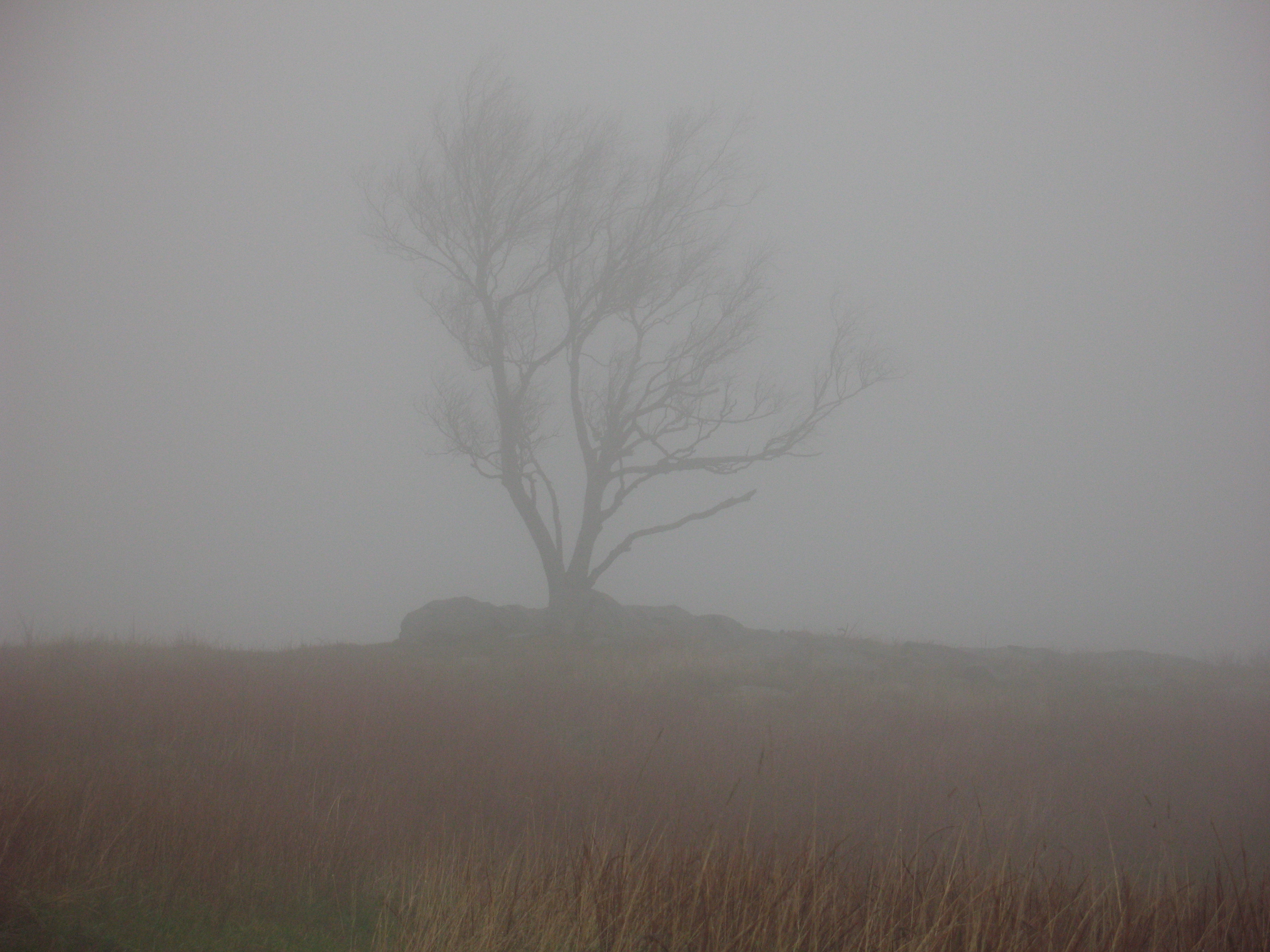
Doughton Park Tree 2016-10-17a
 . 

Read Full Post »

Poems and photography from Shibori Blue
by Beth Copeland
 . 
Winter passes and one remembers one’s perseverance.   –   Yoko Ono
 . 
 . 
Frost on the mountain.
Creeks freeze under skins of ice.
A broken window.
My neighbor’s chimes are silent.
Even the wind is frozen.
 . 
 . 
Spring passes and one remembers one’s innocence.   –   Yoko Ono
 . 
 . 
Does the mountain mourn
its lost children, bones buried
beneath sediment
and stone? Who gathered near its
peak? What family, what tribe?
 . 
 . 
Summer passes and one remembers one’s exuberance.   –   Yoko Ono
 . 
 . 
Bridal veil mountain
in May, the month of weddings.
Fog, Mist, and white clouds.
Wild daisy fleabane bouquet
fresh in a blue Mason jar.
 . 
 . 
Autumn passes and one remembers one’s reverence.   –   Yoko Ono
 . 
 . 
Tiger-striped sunset
above the ridge in the west.
Trees with leaves and trees
without. What are we losing,
my love, and what will we keep?
 . 
 . 
Poetry and photography by Beth Copeland
from Shibori Blue: Thirty-Six Views of The Peak, Redhawk Publications, The Catawba Valley Community College Press, Hickory NC; © 2024
 . 
❦ ❦ ❦
 . 
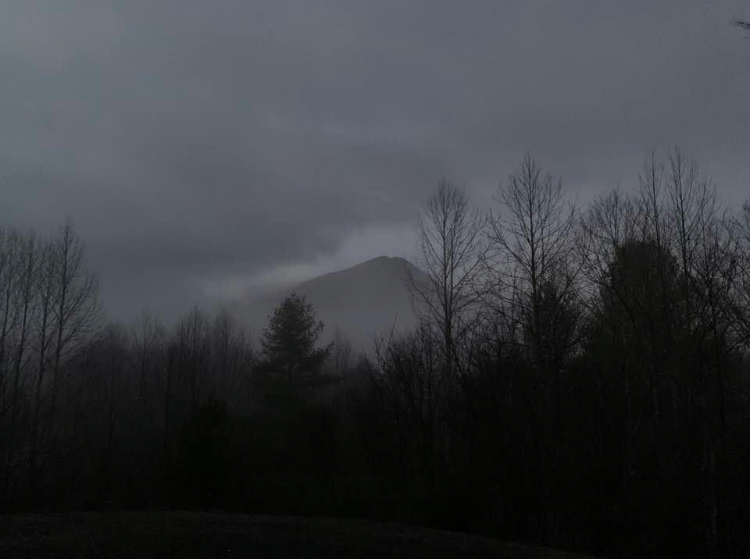
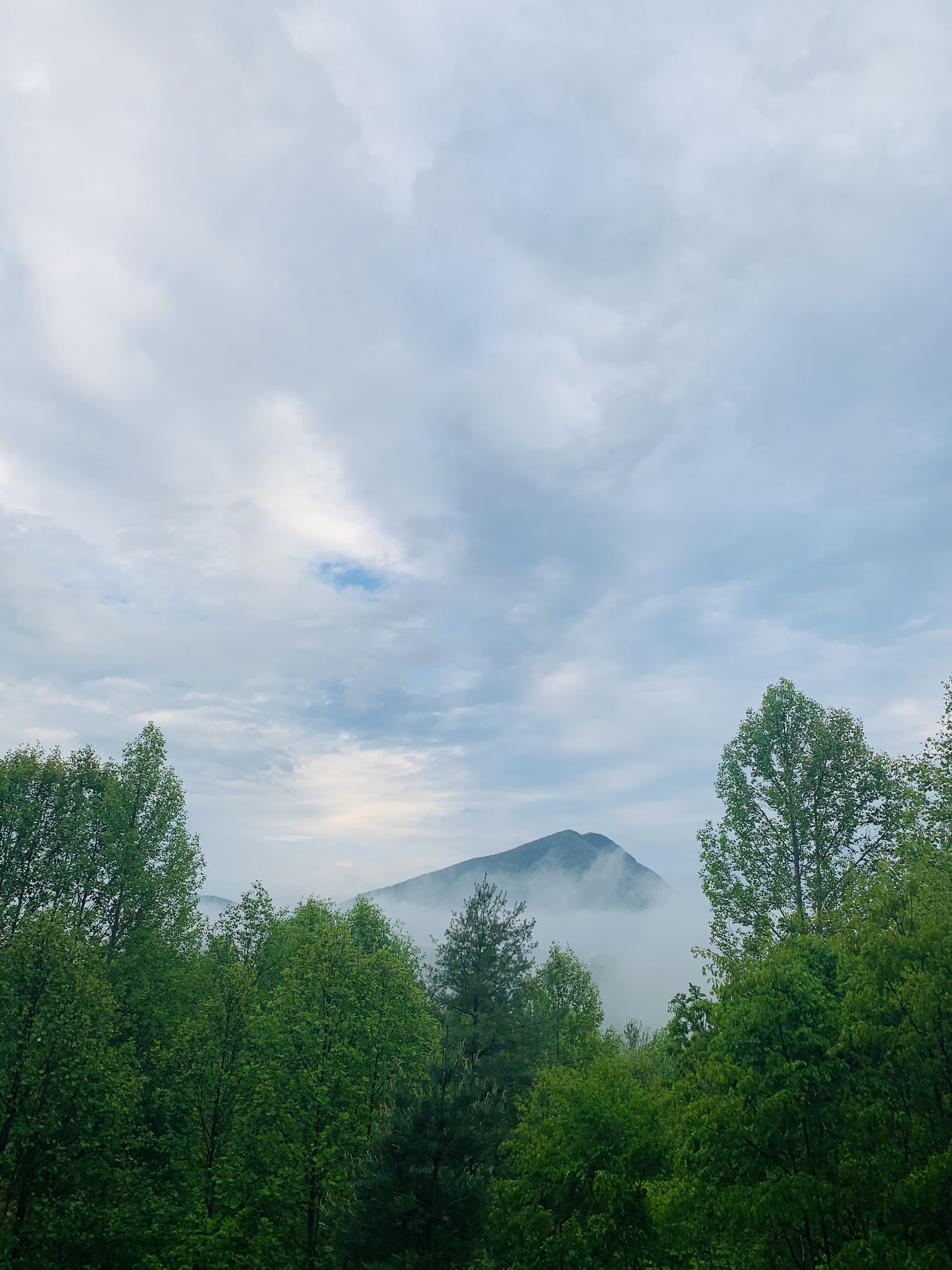
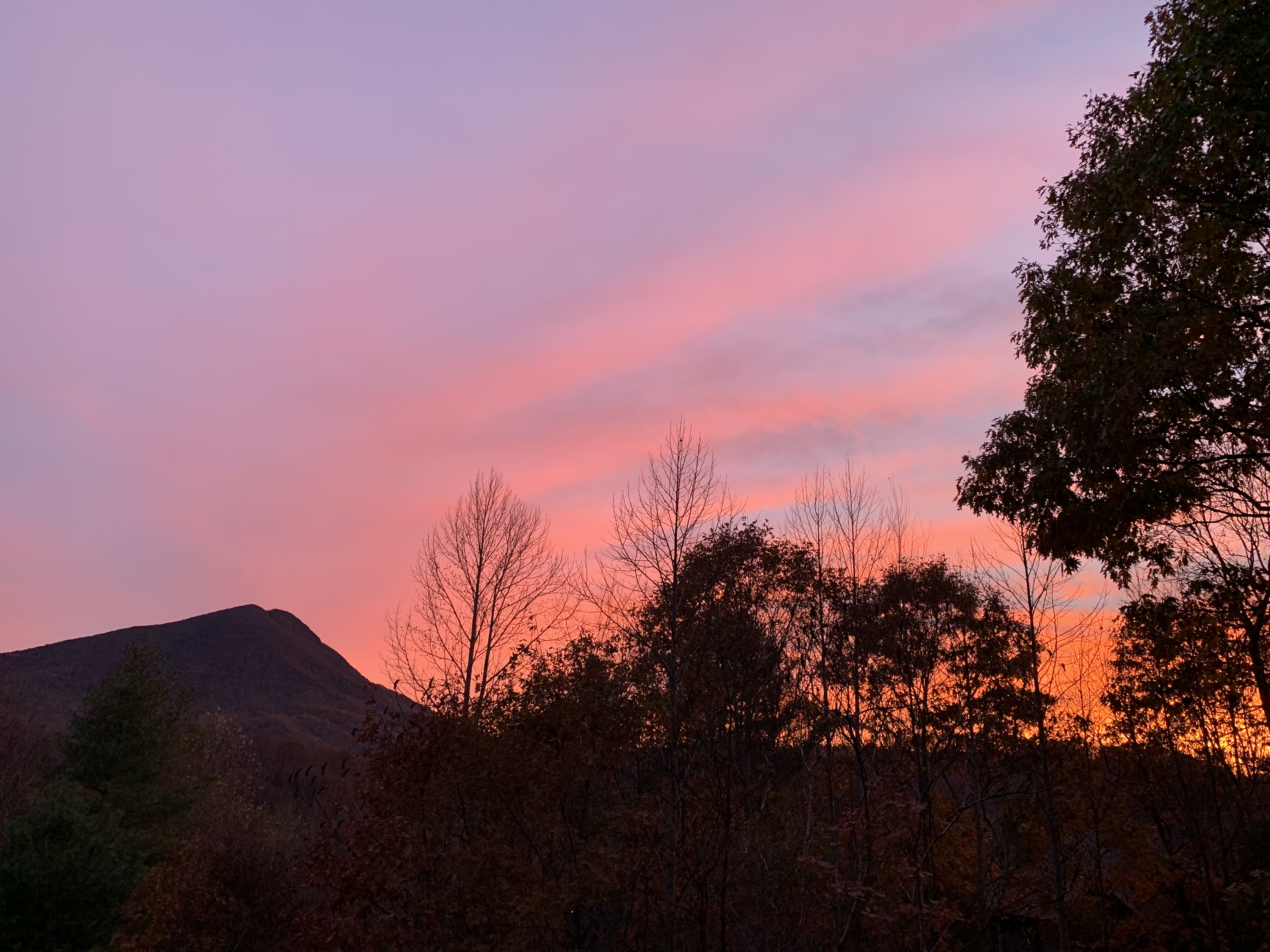
Beth Copeland lives in Ashe County, North Carolina, smack in the Blue Ridge Mountains. Each morning from her porch she sees The Peak, the highest mountain in Ashe County. It is solid and eternal – it is always shifting. Beth has recorded the mountain’s moods and contemplations with daily photographs, now pairing them in her new book with thirty-six poems that capture ephemera through the course of a year, moments of change through the changing seasons.
 . 
Thirty-six. A figure of truth and power. Product of two perfect squares. Multiplied by 2 to create the 72-season calendar established in 1685 by Japanese astronomer Shibukawa Shunkai. And again 36 the number of woodblock prints of Mount Fuji published by Katsushika Hokusai from 1830 to 1832. It is no coincidence that Beth chose thirty-six views of The Peak to inform her poems. She was born in Japan, the child of American missionaries, and has long revered the iconic mountain of her birth country, Fuji-san, whose profile The Peak of Ashe County so resembles.
 . 
This book invites me to slow my breathing, pause in the busy race, contemplate each page: five simple lines of verse, the silent mountain drawing my gaze. Redhawk is gathering a family of uniquely creative poets, writers, and artists to stretch our imaginations and open us to new experiences of words and images. I will leave this sentence here at rest and return to another page of Shibori Blue. And another.
 . 
 . 
More information about Shibori Blue: Thirty-Six Views of The Peak and the opportunity to purchase HERE
 . 
❦ ❦ ❦
 . 
Perseverance – Deep in winter do they dream of the music they will make, cicada song? Crescendo arpeggio decrescendo, easy combers across the long sea of summer. And does the creature measure the span of its days, egg to nymph, seasons in darkness, climb into light to mate and to die? Nothing can last, not even our song, yet we do not withhold our voices.
 . 
Innocence – She is most beautiful when she does not know I am watching. She gives her animals life, little fox blanket, cupcake kitten, and they take from her all the fear and heartache that could have been trapped within to fester. Then she begins to sing.
 . 
Exuberance – Utterly alien at once perfectly identifiable, the house wren fills its small kingdom with melody, rocketing in turn to each waypoint to pause, raise its minute cornet, FANFARE!, then swift to the next. I do not understand the words but I recognize the tune.
 . 
Reverence – What we have heard teaches us, reminds, suggests, niggles, promises, invites. What we have yet to hear offers to pull us into its presence. Listen. Be filled.
 . 
 . 
IMG_6432
 . 

Read Full Post »

 . 
[with 3 poems by Claudine R. Moreau]
 . 
Lesson on Cryovolcanism
 .  . 
How can a moon cry?
I wonder as I display the face
of Enceladus, the Saturnalian moon,
to students pecking on cell phones.
Their saltwater brains
enmeshed in everything
but this moon dressed
in bright fresh eruptions
of sow fall, pockmarked
craters, and frozen blue
rivers of tears.
 . 
It is January, my season
for venting and remembering –
the snow packed mountain
road which winded up
to the Flat Rock Church
that my father rebuilt,
post and beam. Every nail
hand-hammered,
every cement block place
and trialed with his patience
in finding God in hard work.
 . 
I want to tell the class
that humans are the only
species known to cry
from emotion.
Instead, I get locked
inside my mind’s
digital inventory –
to see a wooden pin
box engraved
with his name next
to the pulpit, wreathed
with baby’s breath, steam
and smoke escapes every seam.
 . 
Claudine R. Moreau
from Demise of Pangaea, Main Street Rag Publishing, Charlotte NC, © 2024
 . 
❦ ❦ ❦
 . 
Here’s how science works: observation – hypothesis – test – revise – test again – etc. Even gravity, which so far has bruised me every single time I’ve fallen, has chinks in its unassailable wall of theory. Revise – test – revise again. Science is less about nailing down and more about thrusting open.
 . 
What would happen if a scientist were to investigate love? A review of the literature would be in order, but the theories of Masters & Johnson and the Kinsey Report are to love as Newton is to Heisenberg. Perhaps the poetry of love would be more helpful, but wouldn’t that be like trying to map the cosmos without a standard candle, no reference point from which all other distances can be calculated? Uncertainty indeed!
 . 
And yet poets just can’t quit writing love poems. (And death poems. I argue that without an awareness of mortality there would be no poets and no poems at all. Perhaps knowing that all of this that is me will one day cease makes me even more desperate for love.) How would a science of love work? Is it a two body problem? Where each body’s mass and velocity keep changing and changing without pattern or predictability? A recipe for crashing or flying apart. Or, on some more beneficent cosmos, might each body practice its love science – observe, contemplate, revise – and at least on some days experience a stable orbit?
 . 
Clearly the chance for a unified theory of love is pretty slim. And yet, in the cold and darkness of space, how can we not be drawn to warmth and light? Each love poem is another data point. Each fond glance is a photon arriving from the void. I will allow myself to be encouraged and not afraid of infinite complexity in this expanding universe.
 . 
 . 
❦ ❦ ❦
 . 
Red Nebula
 . 
The doctor examines
every inch of me, every defect
I’ve collected on this skin.
When she gets to my breasts
she sees it –
a spoonful of jam dropped
by mother at birth,
beacon of wonder or disgust.
 . 
All my life I”ve wanted it gone.
I lied about it like a bad tattoo.
The doctor measures,
collects data on her notepad –
radius and diameter,
sketches its blurred perimeter.
 . 
Her eyes are cosmic cameras
lit even now by the big bang
of my birth. They rove the dried
alluvium of hips, descend
into the canyon of my C-section.
 . 
She zeroes in with calipers
to the belt’s middle more – my Alnilam.
Without warning,
she scoops it out,
as if it were a black hole
and would consume me
atom by atom.
 . 
This is when I am certain
that I love my mark of Cain –
imagine the nebula
going into a lover’s mouth.
Its sweetness, red
texture like cotton candy,
its wholesome intention
swelling the brain.
 . 
Claudine R. Moreau
from Demise of Pangaea, Main Street Rag Publishing, Charlotte NC, © 2024
 . 
❦ ❦ ❦
 . 
I recall my one conversation with Claudine Moreau some twenty years ago, learning she teaches physics and astronomy at Elon University, and saying to myself, “Hell, Yes!” Poetry is required to grasp modern physics; physics requires a poet to convey it. A beautiful equation is a crystal of metaphor; reality is no click of billiard balls but a cloud of imaginings. Every decade or two I re-read The Dancing Wu Li Masters to marinate myself again in what cannot be touched but only felt.
 . 
Like these poems. Demise of Pangaea – Moreau’s lines contain hard images which one might collect like fragments of iron in permafrost after a meteorite explodes, but the collection, the whole, is the flash and steam and momentary brilliance of matter and atmosphere colliding. Halfway through the book I grumbled, “These are not at all chronological. How am I to connect these poems and make them make sense?” Exactly, exactly. Whose life makes any sense at all as it unspools? Contemplating my life is like looking through a telescope – the moments that seem separated by only a fraction of an arc-second are actually years apart, light-years distant. These poems are raisins in a pudding: as it cooks and expands, they separate so that when we open it, each sweet, pungent moment stands out by itself. Galaxies in an expanding universe.
 . 
And so I return to the title poem for my reference point, my Alnilam in the center of Orion’s belt. Once the earth was whole, a single land mass, and seemed surely destined to remain so forever. But deep forces and dark machines work on us and our desires, and no one can bridge every chasm and rift as the continent splits in two. Hold on to the bright moments. Seek a high point from which you can embrace the Milky Way. Every star burns out, as it must. Fix it in your memory. Perhaps in the glimmer of a star, in a poem about love, you may for a moment forget how heavy / Earth makes all of this.
 . 
 . 
Sample additional poems and purchase Demise of Pangaea at Main Street Rag, HERE
 . 
 . ❦ ❦ ❦
 . 
Demise of Pangaea
 . 
It’s June and the sky never goes dark –
the solstice sun entombing night.
 . 
An endless red dusk
seeps like a wound,
 . 
bleeds through Oslo’s
barcode skyline.
 . 
Harbor fjords become gnomons,
track the day’s slow radioactive decay.
 . 
We are in bed, midnight sun exposes
the long ridge between our bodies.
 . 
I watch your chest rise,
a hundred tiny moles move outward –
 . 
the continents pull apart by slow churn,
some invisible thing rising through rock.
 . 
Claudine R. Moreau
from Demise of Pangaea, Main Street Rag Publishing, Charlotte NC, © 2024
 . 
❦ ❦ ❦
 . 
IMG_0880, tree
 . 

Read Full Post »

« Newer Posts - Older Posts »