Feeds:
Posts
Comments

Posts Tagged ‘imagery’

[#Beginning of Shooting Data Section]<br /> Nikon CoolPix2500<br /> 0000/00/00 00:00:00<br /> JPEG (8-bit) Normal<br /> Image Size: 1600 x 1200<br /> Color<br /> ConverterLens: None<br /> Focal Length: 5.6mm<br /> Exposure Mode: Programmed Auto<br /> Metering Mode: Multi-Pattern<br /> 1/558.9 sec - f/4.5<br /> Exposure Comp.: 0 EV<br /> Sensitivity: Auto<br /> White Balance: Auto<br /> AF Mode: AF-S<br /> Tone Comp: Auto<br /> Flash Sync Mode: Front Curtain<br /> Electric Zoom Ratio: 1.00<br /> Saturation comp: 0<br /> Sharpening: Auto<br /> Noise Reduction: OFF<br /> [#End of Shooting Data Section]

 . 
[with 3 poems from Had I a Dove]
 . 
Grief for These Trees
 . 
Nearly half, we’re told, downed by wind,
wrenched from river-flooded ground.
 +++ Clogging streets, parks, schoolyards,
 . 
blocking our hiking trails. Our town is dank
as a worn graveyard, branches and brambles
 +++ strewn among marble stones.
 . 
 +++ So what to do with the haunt
of these crippled trees? My muse would say
go to the woods, hike the trail anyway.
 . 
And I will. But before lacing my boots,
let me honor what we’ve learned of nature,
 +++ how in mystery
 . 
trees speak to one another – give support
 +++ and shade, share water and sun.
And like old friends, mourn when one dies.
Let me rub my fingers into the wound
 +++ of this tulip poplars’s bark,
nod to the beetles and lichen who thrive.
 . 
Smell the sweet air of pine sap.
 +++ Scrunch my body
over broken bones of oaks and willows,
 . 
cling to the dead the way I’d cling
as a kid to our sugar maple
 +++ next to Daddy’s tomato patch.
 . 
Limbs holding me safe,
 +++ a flutter of breeze through leaves
always whispering my name.
 . 
Let me linger here in the trees I”ve known,
the ones now gone, the ones
 +++ still upright and grieving.
 . 
Barbara Conrad
from Had I a Dove: Appalachian Poets on the Helene Flood, edited by Hilda Downer. Redhawk Publications, Hickory NC; © 2025
 . 
❦ ❦ ❦
 . 
It was cold enough to frost last night but I hear music outside my bedroom window and raise the sash. A sparrow is calling, perched on a branch just a few feet from the house. He swivels his head west-south-east and at each turn chirps a metallic almost musical tink. He means business. He is not just any little brown bird – he’s a White-Throated Sparrow, migrated here from Canada to spend the winter. And his perch is not just any tree – it’s a native dogwood. It holds onto color, its coppery leaves, while the tuliptree and maple are already browning in the road. This tree holds onto life when so many of its kinfolk have been taken down by blight.
 . 
Tink, tink, tink. I am here. Brassy foliage and scarlet berries. I am here. We are here for each other.
 . 
Poets who survived hurricane Helene mourn their trees. The poems in Had I a Dove bear witness – trees uprooted, splintered, tumbled down mountainsides, tangled in rivers. Trees crushing houses and blocking roads, trees wiped from entire ridgelines, and with every fresh breeze our own reborn fear of trees falling. We being a species which can grasp large numbers, we try to calculate. How many trees destroyed by wind and flood? Millions? Dozens of millions? It becomes unimaginable. At the loss of even one tree, the heart suffers. That big hickory that shaded the garden. The righteous oak that lifted and held the kids’ tire swing. The dogwood where sparrows perched.
 . 
Hurricane Hugo roared through Charleston in 1989 and felled thousand-year old cypresses in the blackwater swamps, then stomped on up the Appalachian chain to leave behind downed trees all the way to Ohio. Near our home a hundred year old oak blocked Flat Rock Ridge trail where it winds from Basin Cove up to the Blue Ridge Parkway. An anonymous Park Service volunteer with a huge chain saw cleared the trail, and into the face of that massive stump he carved “Hugo 9-21-89.” I have paid homage every time I hike past, until a couple of years ago I had to stop and cast about to find the stump. Rot and lichen and a thick beard of moss had cloaked the inscription. Overhead, the canopy had closed as fellow trees shouldered their way in. In the midst of grief and loss, we hold onto life.
 . 
 . 
❦ ❦ ❦
 . 
I could not hear the trees fall
the morning that yowling she-wolf,
Helene stormed up from Florida,
sank blood-stained fangs into Appalachia,
her torrential mad-drool rain,
drowning wide river valleys,
and all those skinny little hollers.
 . 
From a kitchen window I watched
her lay into a neighboring ridge, her super-charged
breath knocking down magnificent oaks,
colossal hickories, and hundreds of tall pines
which dominoed one by one by one.
She left nothing standing in the upper hillside grove.
 . 
The next day, after that noisy bitch moved on,
I heard an immense tree fall somewhere
close by. There was a crack,
a ghostly groan, a swoosh of leaves,
then, as it met the ground, a tremendous bellow.
And I whispered a prayer for the passing.
 . 
Suzette Clark Bradshaw
from Had I a Dove: Appalachian Poets on the Helene Flood, edited by Hilda Downer. Redhawk Publications, Hickory NC; © 2025
 . 
❦ ❦ ❦
 . 
Barbara Conrad has lived in North Carolina all her life and in Asheville since COVID. She edits Waiting for Soup, an anthology created by her writing group with houseless folks.
Suzette Clark Bradshaw lives in western North Carolina, writes and sculpts, and is employed by her county to manage Helene recovery projects and FEMA grants.
Molly Bolton lives in Foscoe, North Carolina, and upholds the spiritual practice of collective liberation with weekly posts at enfleshed.com.
Had I a Dove: Appalachian Poets on the Helene Flood, an anthology collected and edited by Hilda Downer, includes a preface by Joseph Bathanti. More than 80 poets, voices as various and deep as those wild mountain ridges and hollers, share the night that hurricane Helene’s “thousand year” flooding and gales devastated the mountain counties of North and South Carolina, Georgia, and Tennessee. They share the days and weeks and now months that have come after, the scars and healing. Available from Redhawk Publications at Catawba Valley Community College Press in Hickory, NC.
 . 
 . 
❦ ❦ ❦
 . 
somehow bloodroot
 . 
For Western North Carolina & Gaza
 . 
still blooms, the same
spot as last year
at the crumbling edge
 . 
of the driveway
in the seam
of march and April
 . 
under the body
of a fallen elder oak
each flower coming up
 . 
wrapped around
its stem like a windless
white flag.
they say
among the rubble
there will be dancing –
 . 
beautiful people
in ancient lands
tending fires
 . 
while they are hunted
ghosts unsurprised
by the power of greed
 . 
to route bombs towards
children, a hurricane
to the mountains. my sister
 . 
had to come get me
through maze of
washed-out roads &
 . 
Here
I am, still alive
same spot as last year
 . 
bumming a cigarette outside
the todd community square dance
just to watch smoke rise
 . 
from the creaky porch
past the blown-open riverbank
to the cold white stars.
 . 
Molly Bolton
from Had I a Dove: Appalachian Poets on the Helene Flood, edited by Hilda Downer. Redhawk Publications, Hickory NC; © 2025
 . 
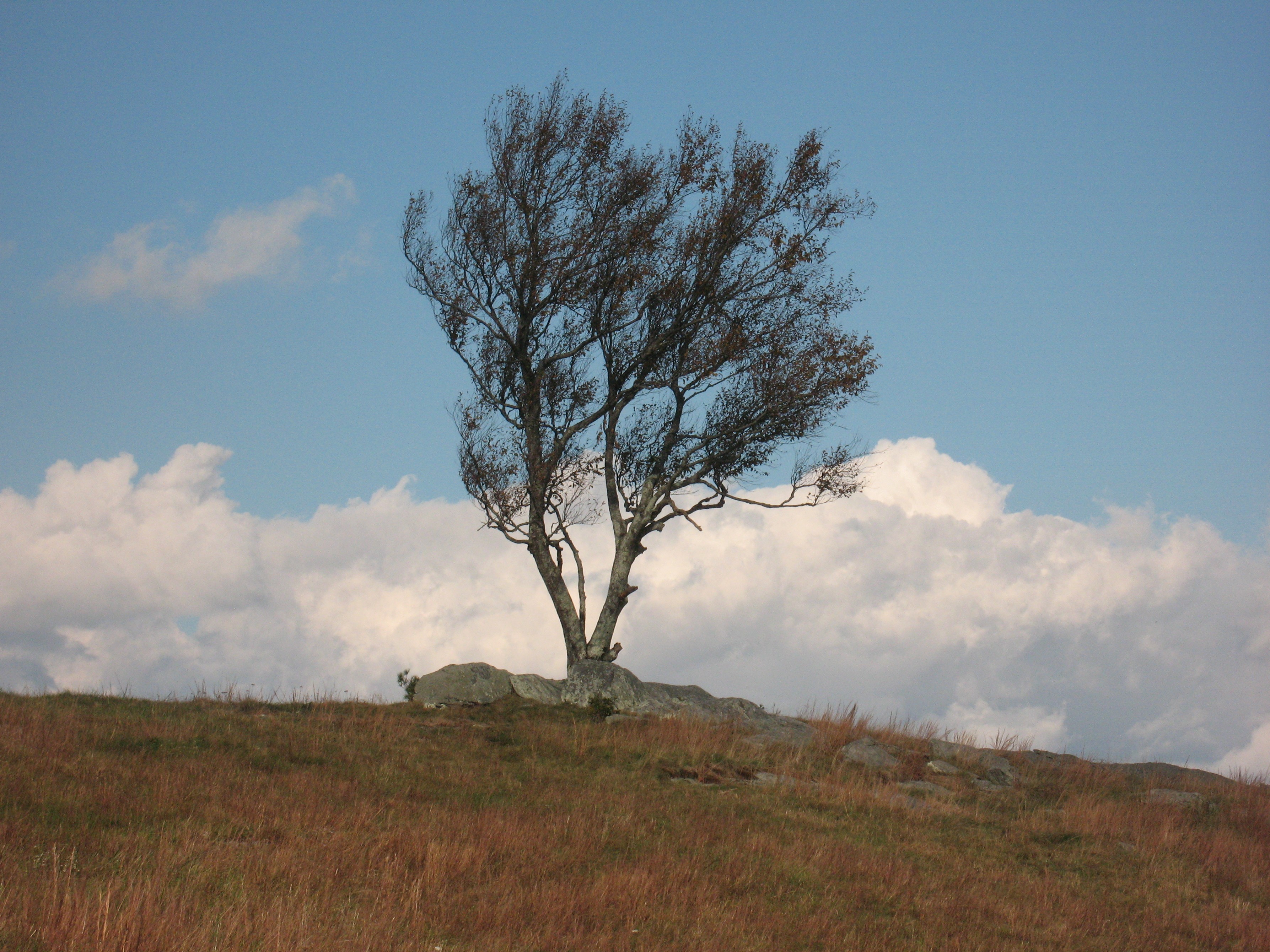
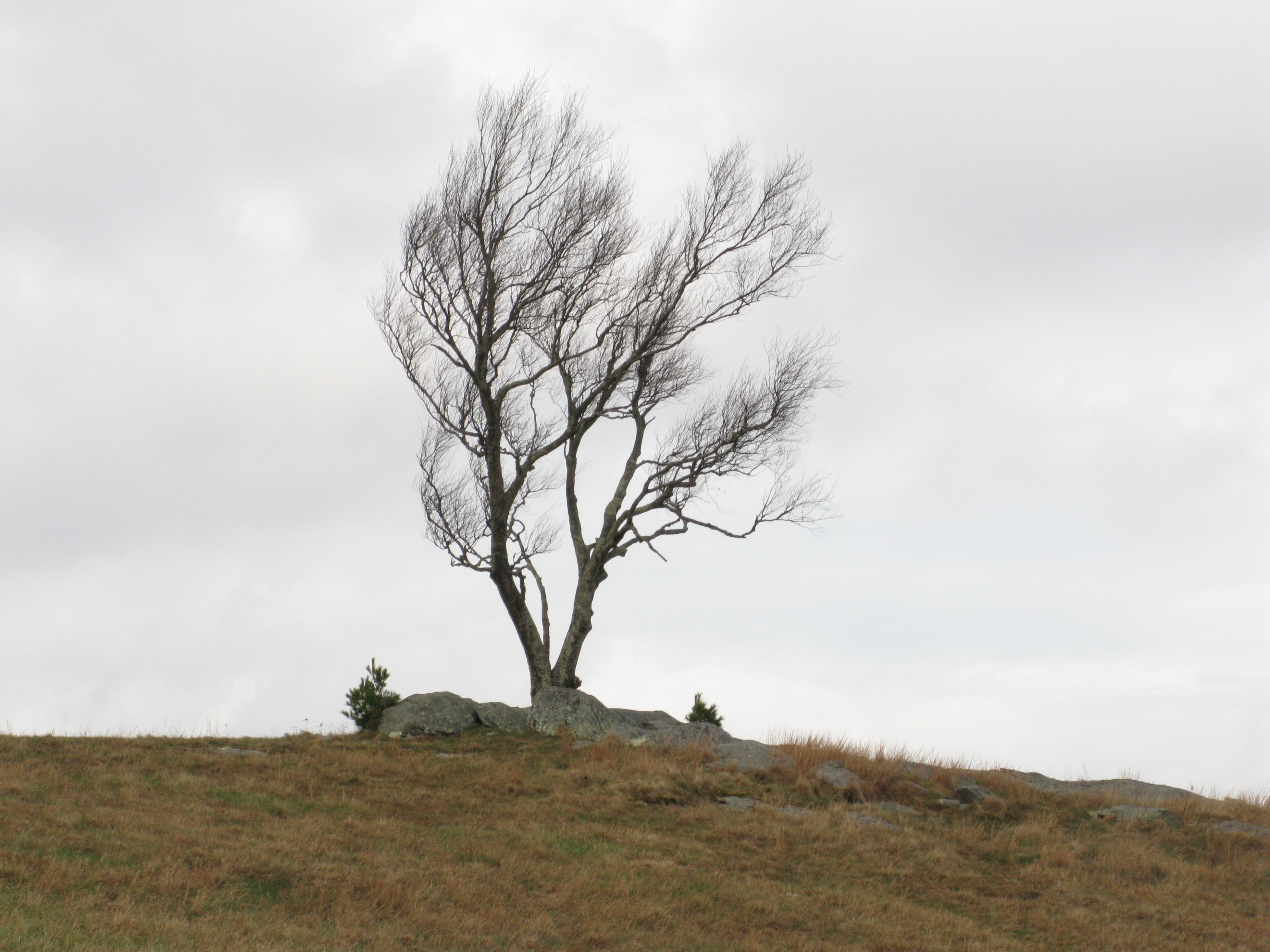
2016-05-08b Doughton Park Tree
 . 
❦ ❦ ❦
 . 
2015-06-15Doughton Park Tree
 . 

Read Full Post »

 .
 . 
[with 3 poems by Robin Greene]
 . 
Everyone is Someone Else
 . 
Everyone is someone else tonight.
Sitting on hallway stairs, bowl of packaged candies
on my lap, I rise to greet four princesses – facemasks
hard and identical, two Energizer bunnies,
an army soldier in fatigues, and three wise men –
brothers they tell me. Later, as my son peels off
his Ninja costume to sleep in the chaos of his take,
two new moons, discovered around Uranus,
appear on CNN. And strangely, Uranus
is one of his spelling words this week.
The world seems driven by repetitions:
the ant’s legs scrambling across the kitchen tile,
sheet rain blowing against window glass,
the perennial grass relentless beneath
our feet. Robert Creeley once removed
his glass eye in a poetry workshop and described life
as a dress rehearsal, but never said for what . . . .
And once there was a man I loved and married.
We made three babies, but one died inside me,
and I bled for a month. Sometimes I pretend
that shit like this just happens, and whatever
meaning I search for is like searching for the faces
of strangers on this Halloween: behind masks
are masks, behind motion is motion.
 . 
Robin Greene
from Lateral Drift, Windows on History Press, Durham NC; © 2002
 . 
❦ ❦ ❦
 . 
For now we see through a glass, darkly; but (even) then face to face.
I Corinthians 13:12 (KJV – adapted)
 . 
Is everyone someone else, or just me? Am I who I seem to be, and would I let you know if I weren’t? I was that kid in English class who read every story in the book even though only four were assigned. I was the guy mixing and measuring in the back of the lab while the chemistry teacher was up front confounding the class. In college they had to drag me out of the science building every night when it closed. I chose medicine as my profession from some hazy expectation that it would let me keep learning new stuff all my life.
 . 
Now in my closing decades I want to say, “Stop! I’ve learned enough!” I don’t need to know any more than I do right now about all the hard stuff. Parent, caregiver, worrier, fuckup – enough! There is only one way, however, that life will finally drag you out of the classroom. To paraphrase a caution about Nature: Life gives you the test first, then teaches you the lesson.
 . 
A mirror, like a person, ages. Over a century shiny metal applied to glass tarnishes and darkens. It reveals its pits and blemishes. Attrition, wearing down, is not far from contrition, wearing ashes. Paul writing his first letter to the Corinthians expects us to outgrow our foolishness and confusion, set aside childish ways and think like grownups. He dangles the promise that we may experience eternity with God face to face. I hope that’s true, that my self is more durable than my molecules, but I wonder about all this learning and knowing in the meantime. Life – has it been worth it? Even the person who passes with an “A” still answered 5% wrong. That adds up to a lot of foolishness and confusion I am carrying.
 . 
Even gazing into a dark mirror, I still see myself face to face. Who is that looking back? All the knowing I’ve tried so hard to accumulate and hold onto, all the elements I’ve combined into myself, in that mirror they become shadows fading away at the periphery. The person in that mirror – who is he really? Perhaps on my final day, when the blazing light of the universe is revealed and ultimate mysteries are mysterious no longer, I will also see, clear and defined, face to face, me.
 . 
 . 
❦ ❦ ❦
 . 
The Necklace
 . 
Under cool running water, my mother clutches
a knife, debones chicken breasts the color
 . 
of a winter moon; I’ll never be a woman,
I think and rise from my half-lotus
 . 
on the countertop – eight years-old –
my flat, tight body still an ally.
 . 
My mother and I never speak of this
apprenticeship, field archeologist
 . 
I’ve become, unearthing the glyphs
and ruins of my gender
 . 
until my father and brother arrive,
noisy as blind men,
 . 
bumping their way across the linoleum tiles –
breaking our silence
 . 
as though it were neither real
nor holy.
 . 
Later, the smells of cologne, hairspray
filter through the house.
 . 
Steam from the iron sizzles
on its aluminum pad
 . 
as mother presses
my father’s slacks and shirt,
 . 
and sets up snacks for the babysitter –
fashioning each small part of our lives
 . 
as though they were hand-made beads
for a necklace some Inca woman
 . 
might make and pass down
to her only daughter.
 . 
Robin Greene
from Lateral Drift, Windows on History Press, Durham NC; © 2002
 . 
❦ ❦ ❦
 . 
Just as an earthquake or long drought may expose new strata to the paleontologist’s questing eye, so a pile of books tumbling off a desk. Robin Greene wrote these poems in Lateral Drift twenty-five years ago. When I open the book today for the first time, how powerfully the lines still reach out to me and into me. How truthfully they speak; how in the present they are; how they open themselves, and me. Who is the voice in these unsheathed knives of stories? Who was she then, and is she still? But why even ask such a thing? The poems are who they are made to be; they carry the light and the darkness they were created for.
 . 
Better to ask instead, Who am I as I read these poems? I am a man opening myself to receive the truth of a woman’s struggles and the marrow of her knowing. I am a person old enough to have grandchildren yet I become a child and a young parent and Lord knows what in the tangle and turbulence of these stories. I am someone who knows little, perhaps nothing at all, until I am willing to sit down for a moment in this silence filled with words.
 . 
After I’ve read the book, read it through a second time, spoken some poems, typed out a few favorites in order to learn them through my fingers as well as through my eyes and breath, then I turn back to the title page and test memory and find this: 11/17/01 To Bill, Best wishes, Robin Greene. Time is not metallic, unspooling keen enough to slice you if you try to hold it still or alter its shape; time is froth and broth and no telling what may next boil to the surface. There you discover the one advantage of having lived seventy years  – you have plenty to add to the stew.
 . 
 . 
Robin Greene has bubbled and boiled plenty since she signed my copy of Lateral Drift. She is cofounder of Longleaf Press and also cofounder of Sandhills Dharma Group. She retired as Professor of English and Writing, and Director of the Writing Center at Methodist University in Fayetteville, NC. She continues to write and publish poetry, fiction, and non-fiction from her home in Hendersonville, NC.
 . 
Robin Greene – Artist’s Statement
 . 
 . 
❦ ❦ ❦
 . 
What the Leaves Said
 . 
As I walked in the woods today,
early October, the leaves fell –
 . 
individually – through stark, shining air,
until one of them unfolded its
 . 
blood-red palm in my outstretched
hand and whispered a word
 . 
before joining its kin on the forest floor.
I had stopped for a moment, noticing
 . 
sunlight opening up shadows,
shifting its radiance in light wind
 . 
across the new landscape as leaves
shook from beech and oak,
 . 
and I listened: one word becoming
many, becoming one.
 . 
Robin Greene
from Lateral Drift, Windows on History Press, Durham NC; © 2002
 . 
❦ ❦ ❦
 . 
 . 
IMG_1783
 . 

Read Full Post »

 . 
[with poems by Janis Harrington]
 . 
Suicidal Ideation
 . 
Think of dark starlings, each a ringleader,
invading your hanging backyard feeder.
Magnets for their kind, they muster, rout
more timid species from seed and suit.
Fast and fertile breeders, they multiply,
a flock of hundred swells to thousands.
Screeching and squawking rapacious hoodlums,
they give no quarter and sing no harmony,
waging war with incessant cacophony.
No calm, no détente; nonstop attack.
In waves, like bombers, they dive and peck.
Wing to wing, they block sun, moon, stars, finally
 . 
blot out all light, transforming noon to midnight.
No escape. a full eclipse of hope.
 . 
Janis Harrington
from How to Cut a Woman in Half, Able Muse Press, San Jose CA; © 2022
 . 
❦ ❦ ❦
 . 
Life is a dream. / You are the projector. You are the screen.
 . 
Dad is sitting at the new table beside the front window. The sun has settled; the ocean is pink and purple, at rest. Someone has helped Dad transfer into an upholstered chair and pushed his wheelchair into a corner. He is talking with his youngest grandchild while they work a puzzle. Everyone has arrived. Everyone surrounds him.
 . 
This is the image I create and cultivate after hanging up the phone. Bob has called to assure me that their eight-hour drive to the coast presented only surmountable obstacles. Now they’ll spend a week at the beach house celebrating Dad’s 99th birthday. Dad has been longing to be there for a year. He started asking me how soon he could go even before Mom’s memorial service last September.
 . 
Last night Linda and I argued about a related family wrangle. She was angry at the person sharpening their claws. I told her it was bedtime and I was determined to put conflict out of my mind for eight hours. Let dreams sort it. Of course, I then woke at 3:00 and ruminated for an hour or two. Isn’t this supposed to be the week of no worries, Dad safe in the arms of my brother and his family? After a year of all manner of arrangements, finagles, and complications, after each nurse’s phone call and the anticipation of the next one, aren’t I allowed to flip the ON switch for peace?
 . 
What the hell does that even mean, I am the screen and the projector? That I alone make my life what it is? Or that I imagine I do? In dreams the tangle of images and juxtapositions is supposedly the effort by my unconscious to shuffle into some semblance of meaning all my disparate and disconnected moments. Perhaps Dad won’t scuffle out of an unfamiliar bed after midnight and break his hip. Perhaps the worst is not always just about to happen. Scientists have discovered through meticulous testing and observation that there are indeed other species besides Homo sapiens that can imagine and anticipate the future. God help them.
 . 
 . 
❦ ❦ ❦
 . 
How to Cut a Woman in Half
 . 
Fate, a cruel magician, vanishes her husband,
leaving her table with half as many plates,
shower rack missing half its towels,
bed half empty. The trick: after the blade falls,
she shrinks herself into half of her former life.
But is he truly absent? She wills
each day’s crawling hours to end, certain
he waits in sleep’s tempting garden –
there’s no hope of persuading her
that dreams are merely pan’s sleight of hand.
Eventually, she will emerge on stage,
appearing unharmed, performance complete.
Does it matter what is real or illusion if,
when she steps from grief’s box, she feels whole?
 . 
Janis Harrington
from How to Cut a Woman in Half, Able Muse Press, San Jose CA; © 2022
 . 
❦ ❦ ❦
 . 
Solo
 . 
The Buddhist acupuncturist, gazing beyond
the veil, report that Nick at last, has shed
earth’s weight. His soul, presently in the astral state,
has embraced its destiny – like the wayward
gray whale, whose biological mandate
to migrate finally required
his recent swim from bay to open ocean.
 . 
Annie’s turn, now, to exit sorrow’s cul-de-sac,
navigate rocky channels to new seas,
resisting the sirens’ call of what used to be,
accepting she and Nick must make solo passages:
his voyage, to collective consciousness,
without form or visible home;
hers, to find a port in life’s physical realm.
 . 
Janis Harrington
from How to Cut a Woman in Half, Able Muse Press, San Jose CA; © 2022
 . 
 . 
❦ ❦ ❦
 . 
This sonnet sequence by Janis Harrington is mournful, painful, piercing. It reveals every face of suffering but also every facet needed for healing. How to cut a woman in half? Divide her from the person she loves most dearly. Dissect away with blunt shears half of her being, her essence. How to put her back together? That is a long and painful process and no certain sunrise on the horizon, although a sister is required and is present. I treasure the metaphor nearing the book’s final pages: Together, we flew close to grief’s center, / our wings sturdier than wax and feather.
 . 
How to Cut a Woman in Half was finalist for the 2020 Able Muse Book Award and is available HERE. Janis Harrington’s first book, Waiting for the Hurricane (St. Andrews University Press © 2017) won the Lena M. Shull Book Award of the North Carolina Poetry Society. Discover more about Janis HERE.
 . 
❦ ❦ ❦
 . 
Acroyoga
 . 
Flex your trust muscle, the instructor advises,
making us giggle. Annie and I alternate
as flyer or base, each of us able
to bear a sister’s weight. Now, my back on the mat,
our hands clasped, my feet supporting her thighs,
I straighten my legs to ninety degrees –
my turn to hold her aloft. Acrobat of strength
and grace, she soars, escaping sorrow’s labyrinth.
Her liberty has freed me. Being her spotter,
daily witness to her reckoning with loss,
released my heart’s stubborn resistance
to Pete’s fate, long mourning of his absence.
Together, we flew close to grief’s center,
our wings sturdier than wax and feather.
 . 
Janis Harrington
from How to Cut a Woman in Half, Able Muse Press, San Jose CA; © 2022
 . 
❦ ❦ ❦
 . 
 . 
2020-09-08b Doughton Park Tree
 . 

Read Full Post »

Older Posts »