Feeds:
Posts
Comments

Posts Tagged ‘GSMIT’


[with a Possum Poem]

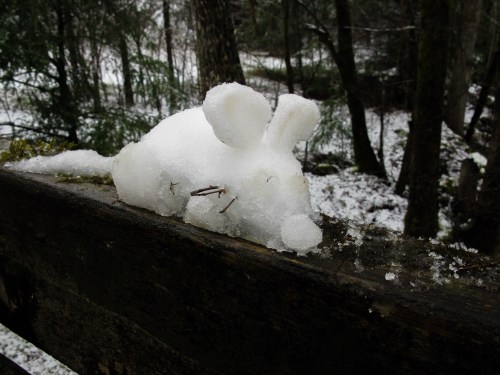
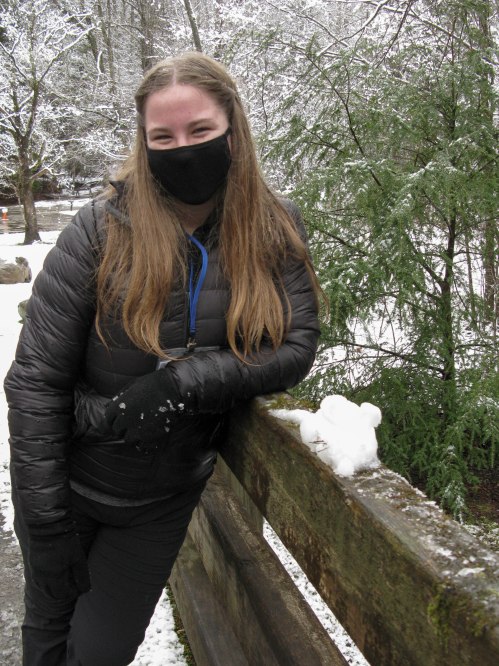
In case you missed it, February 7, 2021 was Smoky Mountains ‘Possum ‘Preciation Day. Not that we blame you for overlooking the date – Joyce, Kimber, and I had just declared it that very morning. As part of our presentation on Didelphis virginiana to the Mammals class at Tremont we were determined to remedy the bad rap opossums get. And since we’re all friends here let’s just call them ‘possums’.

Possums are not big gross rats. Well, yes, when you try to shoo them away from the compost heap they do hiss and show all 50 teeth in their long pointy jaws, but let’s give them credit for having the most teeth of any North American mammal. And a pouch – they’re our one and only marsupial. Plus possums can be positively stylish and glowing when you give them a nice shampoo, blow dry, and brush up, although unfortunately that’s usually done by the taxidermist.

Back to those teeth – one of Ms. Possum’s super-powers is time travel. Her jawbone and dentition haven’t changed much at all from those little early mammals who lived side by side with Cretaceous dinosaurs. From Ms. Possum, mammalogists can figure out how those prehistoric critters chewed and what they most likely ate. Which by the way for our current day possums is basically anything and everything. (If we refer here to Ms. Possum it’s because Mr. is totally out of the picture after the mating is finished. Like, two minutes. And he doesn’t have a pouch – boring.)

At this point you’ll certainly be ready to agree it’s no coincidence that Possum rhymes with Awesome. Joyce, Kimber, and I were very happy to enlighten our classmates about the admirable features of this little pouched prehensile-tailed omnivorous non-endangered darling. And hey, we could have drawn the assignment that one of the other teams got stuck with: Appalachian Wood Rat.
.     .     .     .     .     .     .

Requiem

I won’t walk back this way tonight
to not-see in the darkness the damp splay of fur,
the jawful of Pliocene needles, the blind worm
of a tail. And not only for fear that I’ll tread
on the red-brown seep or the pitiful snout;
no, I also don’t wish to meet its little ghost
ranging, anxious to cross the road,
baffled by its body’s long play of possum,
denied its marsupial rest.

But perhaps in mercy I should return
and pronounce, O pouched spirit,
linger only until the crows have said grace
and the sun awakens your baking humors, then flee
with the blessing of one who has swerved
to avoid your brothers. Go now and find peace
on the other side.

© Bill Griffin; first appeared in North Carolina Literary Review Number 12, 2003

.     .     .     .     .     .     .

One of the numerous hands-on nature experiences offered by Great Smoky Mountains Institute at Tremont is the Southern Appalachian Naturalist Certification Program. Eight weekend courses (which may be completed over a span of years) are designed to provide fundamental and specialty skills in Southern Appalachian ecology, biodiversity, and interpretive techniques. Most of the time is spent outdoors; for the winter Mammals course we spent Saturday in Cades Cove discovering tracks, scrapes, signs, and scat that testify of the denizens and their activities. Each course also involves keeping a nature journal and practicing interpretation skills – sharing Nature with others. Upon completion the student receives the non-credit Southern Appalachian Naturalist Certificate from the University of Tennessee.

Joyce, Kimber, and I were Team Possum. We did not discover any possum tracks during the weekend and we reprimand Tremont for not providing us with a possum skull to play with among all the other skulls, bones, and pelts in their collection. We are DEEPLY grateful, however, to master tracker and instructor Wanda DeWaard, who brought with her a little jar of possum scat. Treasure!

.     .     .     .     .     .     .


.     .     .     .     .     .     .
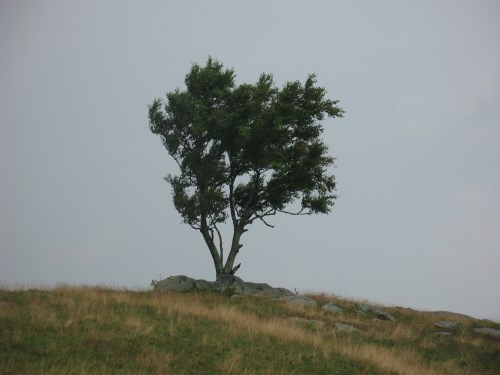
 

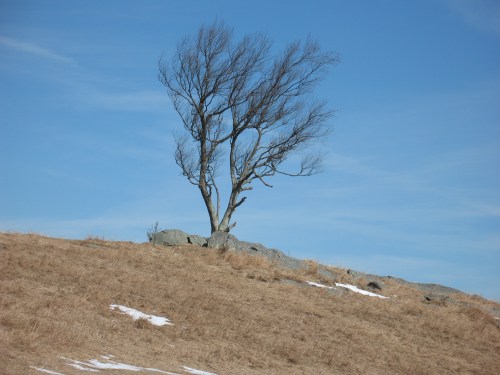
2014-07-13 Doughton Park Tree

.     .     .     .     .     .     .

POSTSCRIPT

My birthday is February 11. Here’s the card I opened from Mike and Nancy that day. Mike is the guy who first invited me to come backpacking in the Southern Appalachians 25 years ago and talked me into enrolling for my first SANCP course at Tremont. And he did not know I’d pulled Virginia Opossum for my small group presentation — he’s just prescient.

Read Full Post »

[with 3 poems by Val Nieman]

Great Smoky Mountains Institute at Tremont – February 5-7, 2021

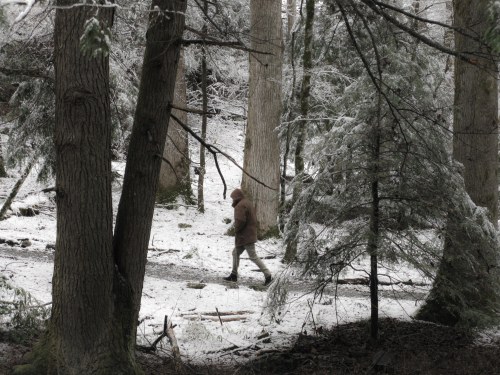
Winter on the mountain gavels its sentence, no appeal: wrestle the cold to keep it at bay; eat, feed the inner fire; light the darkness or fall and break. I pull my hood closer and hide myself. In the tent at night I bind my neck against cold fingers. I watch my feet.

The day is short. Nevertheless we fill it and discover it filling us. Small signs begin to reveal their stories – an incisored nut, scratches in the bark, one single hair. At first we hesitate, we thirteen who’ve journeyed here to explore, but in the light we gather as closely as prudence permits. Muddy track, scrabbled duff, compressed leaf, scat: where did Bear sleep? what did Coyote eat?

Winter on the mountain: what crouches here for us to notice?

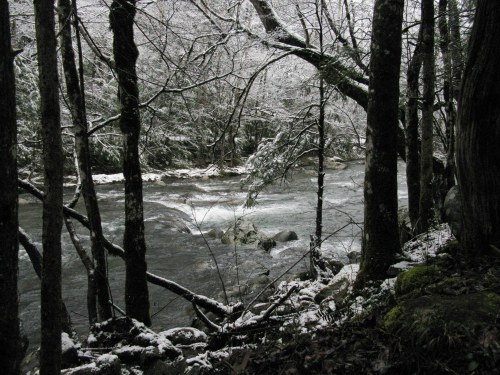
The night is long. In this valley darkness is complete. The rush and growl of Middle Prong fill the cove as well as empty it. Are we alone? In the gap of sleep a brush and skitter, a brief chittered voice – I imagine dark eyes and gliding flight. The spirit is released from the prison of his tree. In the morning we will seek signs of his passing.

Winter on the mountain – I release myself to see, to question, to wonder.


.     .     .     .     .     .     .

Valerie Nieman journeys landscapes of memory, family, heartache to reveal stories in the signs unearthed along the way. A path may seem clear but its meanings fissure and deepen into many layers. A bud, a leaf, a branch – are they simply of themselves wholly themselves? Look deeper: there are mysteries unfolding.

Val teaches creative writing at North Carolina A&T State University but she is preparing to retire this summer and replace syllabus revisions with fly selection for a day on the trout stream. Her poetry has appeared widely and has been published in numerous anthologies, including Eyes Glowing at the Edge of the Woods and Ghost Fishing: An Eco-Justice Poetry Anthology. Her fifth novel, Backwater, will be published in 2021.

.     .     .     .     .     .     .

Becoming Ariel
for Gerald Stern

Groundhog in a tree, behaving like a bird, like a squirrel,
nibbling tender green buds at branch end, high-wiring
above a bog. Any burrow dug here would be swamped,

front door to back stoop – how did he come to cross water
and ascend, diggers curved deep in the bark as a lineman’s spikes?
A crow would think twice about lighting on a branch so frail.

Soil-shoveling wedge of a face, a fat tail that never could balance
his loose bulk: this creature was not meant for such heights.
His round belly was destined to bloat in a ditch beside the road.

Still, he sways against the sky, close to the sun, Caliban
joyously drunk on spring sap drawn up from the mud
and darkness he was born to, tiny feet dancing and dancing.

from The Georgia Review, University of Georgia

.     .     .     .     .     .     .

Captures

I sprayed for tiny ants
late last night, killing the spider
doing its best to corral them.

Between the sheets I struggled
hand to hand with old lovers
and other aliens

descending cosmic ladders
to pincer my heart,
boiling them in the ichor

my bare claws released
from their flesh.
But this morning,

I catch a humpback cricket
in the sink, cup it
between my hands

and toss it out
the back door
to take its chances.

This morning, I’m
mild as a painted virgin,
my hands empty of slaughter.

from Change 7

.     .     .     .     .     .     .

Approach

Arms stretched wise,
right hand to the dawn,
left toward eventual night,
I face north.

As latitude rises,
life flattens:
forest to taiga,
to tundra, to permanent ice.

Everything will have
a name of cold:
polar bear, arctic fox,
glacier flea, snowy owl.

~ ~ ~

A compass is known to stray
from true north, lured
by the earth’s magnetic heart.
Now the needle swings

at the approach
of a frost spirit
from those barrens
I’ll have to cross

without advice,
without a companion,
or a harness of wolf-dogs,
or good boots.

from Hotel Worthy, Press 53, Winston-Salem, © 2015

Becoming ArielCapturesApproach  © Valerie Nieman


.     .     .     .     .     .     .

The Southern Appalachian Naturalist Certification Program at Great Smoky Mountains Institute at Tremont comprises eight weekend courses designed to provide fundamental and specialty skills in Southern Appalachian ecology and interpretive techniques. Each weekend includes 15 hours and more of lecture and hands-on field study. Upon completion the student receives the non-credit Southern Appalachian Naturalist Certificate from the University of Tennessee.

Ariel, the spirit in Shakespeare’s The Tempest, is released from his prison in the split pine by the magician Prospero.


.     .     .     .     .     .     .


IMG_7952

Read Full Post »

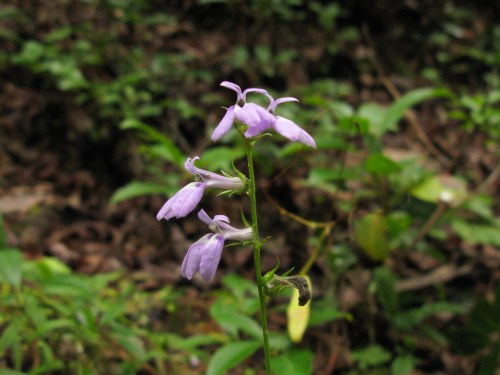
Southern Lobelia, Lobelia amoena, Campanulaceae (Bellflower family)

[with poems by Robert Frost, Paulann Peterson, Edwin Markham]

Tree At My Window

Tree at my window, window tree,
My sash is lowered when night comes on;
But let there never be curtain drawn
Between you and me.

Vague dream head lifted out of the ground,
And thing next most diffuse to cloud,
Not all your light tongues talking aloud
Could be profound.

But tree, I have seen you taken and tossed,
And if you have seen me when I slept,
You have seen me when I was taken and swept
And all but lost.

That day she put our heads together,
Fate had her imagination about her,
Your head so much concerned with outer,
Mine with inner, weather.

Robert Frost (1874-1963)

.     .     .     .     .     .     .

Why the Aging Poet Continues to Write

At a coneflower’s seed-making center,
hundreds of tiny dark florets—
each stiff and sharp—
take turns oozing
their flashes of pollen.
A flagrant
bee-stopping show.

Making a bright circle,
the outermost spiky blossoms
open first to then fade.
Shrinking day by day,
the ring of yellow flame
moves inward.
That heart—what’s at
the flower’s very core—
blazes last.

Paulann Petersen, from Understory, Lost Horse Press, 2013

.     .     .     .     .     .     .

These two poems are collected in The Poetry of Impermanence, Mindfulness, and Joy; edited by John Brehm; Wisdom Publications, 2017.

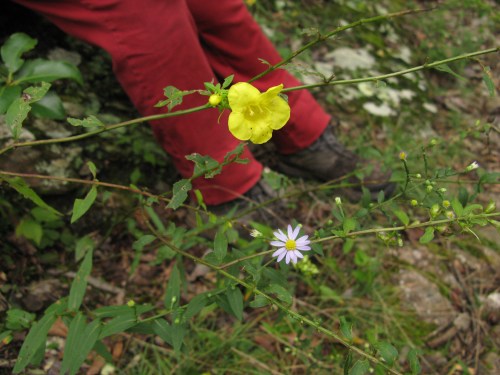
Spreading False Foxglove, Aureolaria patula, Scrophulariaceae (Figwort family)

.     .     .     .     .     .     .

No plant community is static. Even the “climax forest” is in constant flux, the flow that is the marker of time’s passage, that is time. All things flow: change, the primary mutable immutable that creates reality.

Observe the climax forest for enough generations (its generations, not ours) and see that its steady state is illusion. Water cycles, carbon cycles, death and reclamation and regeneration: constant flux. Apt metaphor for our life as human individuals. Observe the plant community’s encroachers and invaders, its fuzzy boundaries, its balance never balanced for long – also a metaphor for human communities.

During pandemic if there is one factor that underlies our existential fears it must be separation from community. How small has our circle shrunk? How unwilling are we to step outside or let in the unknown? Anger, anxiety, dread: they must all have the same roots.

When the soil is shallow the tree sends its roots wider. When moisture or minerals are scarce the rootlets’ embrace by mycorrhizal fungi becomes even more welcome.

Human ecology: I watch the Zoom gallery nod and smile and imagine that they are seeing me, too. I step off the trail when other hikers pass but we wave and share a few words at distance. I sit nearby during Linda’s long phone calls with sisters: essential, restoring, redeeming. I even (gasp!) write a few letters. Aren’t we all reaching out to discover some new way of connecting, some way amidst the flux to re-forge community?

Wider, draw the circle wider!

.     .     .     .     .     .     .

He drew a circle that shut me out-
Heretic, rebel, a thing to flout.
But love and I had the wit to win:
We drew a circle and took him in!

Outwitted – Edwin Markham (1852-1940)

.     .     .     .     .     .     .

Many thanks to the organizers and instructors of Great Smoky Mountains Institute at Tremont who continue their mission of connecting people with nature even during pandemics. Their science-based educational programs have evolved with science-based precautions and modifications to allow small communities to form for a weekend at a time.

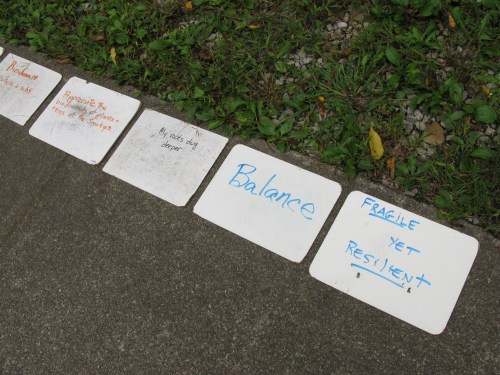
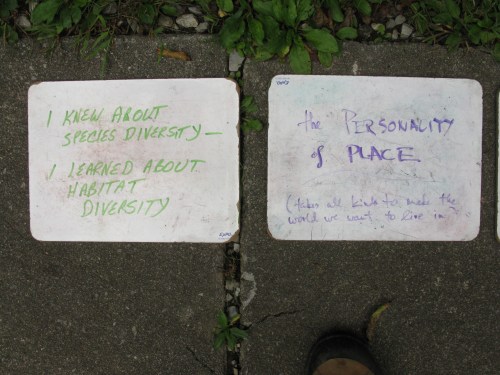
One word sums the program and purpose of Great Smoky Mountains National Park: BIODIVERSITY. These photos are from the September 2020 GSMIT program Southern Appalachian Ecology. Immersed in that diversity, I continue to absorb the enrichment, root, stem and blossom, of that community of seekers.


.     .     .     .     .     .     .

Read Full Post »

« Newer Posts - Older Posts »