Feeds:
Posts
Comments

Posts Tagged ‘Great Smoky Mountains National Park’

Thunderhead Sandstone outcrop below Ft. Harry Falls, GSMNP

 . 
[with poems about Geology . . . (say what?!)]
 . 
Erosion
 . 
Edges fall first,
silt grains cemented
under thousands of years
sloughed away by wind, rain,
footstep of dog,
sandstone alchemized beneath
weight of mountain
turns sand again
 . 
Subtle rubbing of days shapens us anew,
weathering, the
slowest song of change
 . 
No wonder we wake up some days
wondering at who we used to be.
No wonder we don’t always notice
as our outer edges strip away.
 . 
No wonder the children build castles
made of sand at water’s edge,
even though the castles fall.
 . 
They are practicing for
when they too will feel
what once seemed enduring
slip inside the rising tide.
 . 
Emilie Lygren
from What We Were Born For, Blue Light Press, San Francisco CA. © 2021. Reprinted by permission of the author.
 . 
❦ ❦ ❦
 . 
Geology never intended to trip us up. A mountain’s day is steady and measured, calm as the drip of water, languid as the North Pole’s precession that turns to aim the spinning globe at heaven. All night the mountain’s flow, her stretch, recumbent but restless; at first light she yawns and shudders, her turn and crouch and slow rise; then all morning’s long knotting and gathering to her full height; her relentless stride; a forceful journey, this full day’s labor into evening even as her form, still imposing, diminishes and she reclines.
 . 
Did the mountain even feel the pinprick of water seeping and freezing in minute fissures at her neck? Perhaps a vague itch as lichens scratch to enlarge their circumference, little acid fingernails, a thimbleful of soil. Windborne seeds – would she notice such a light caress when one descends, then its rootlets, its swelling cambium and lignin? One and now another trunk emerges from the crevice, breathing, drinking sunlight, and here comes the day in mammal-time when gravity prevails. A crack, thunder without lightning, slabs and chunks release and roll downslope until they hold at a narrow rib where it crosses below the mountain’s shoulder. Bedrock settled into the new bed it has found.
 . 
Ten thousand human-years pass until you and I puff into view. We slow our pace to climb over and around. Here embedded in the footpath is a softer stratum that has been polished to ebony by a thousand boots. Here alongside the trail we greet the rounder edges and pitted face of earliest falls, sharper clefts and angles  from falls a mountain-day later. Water proving its strength. Lichens still hard at work. Wait a while and this path will open. Geology never intended to trip us up. She simply hopes that we will slow our frantic climbing. Pause here with her for a moment. Look, and simply see.
 . 

USGS map & quartzite vein in Elkmont (?) Sandstone GSMNP

 . 
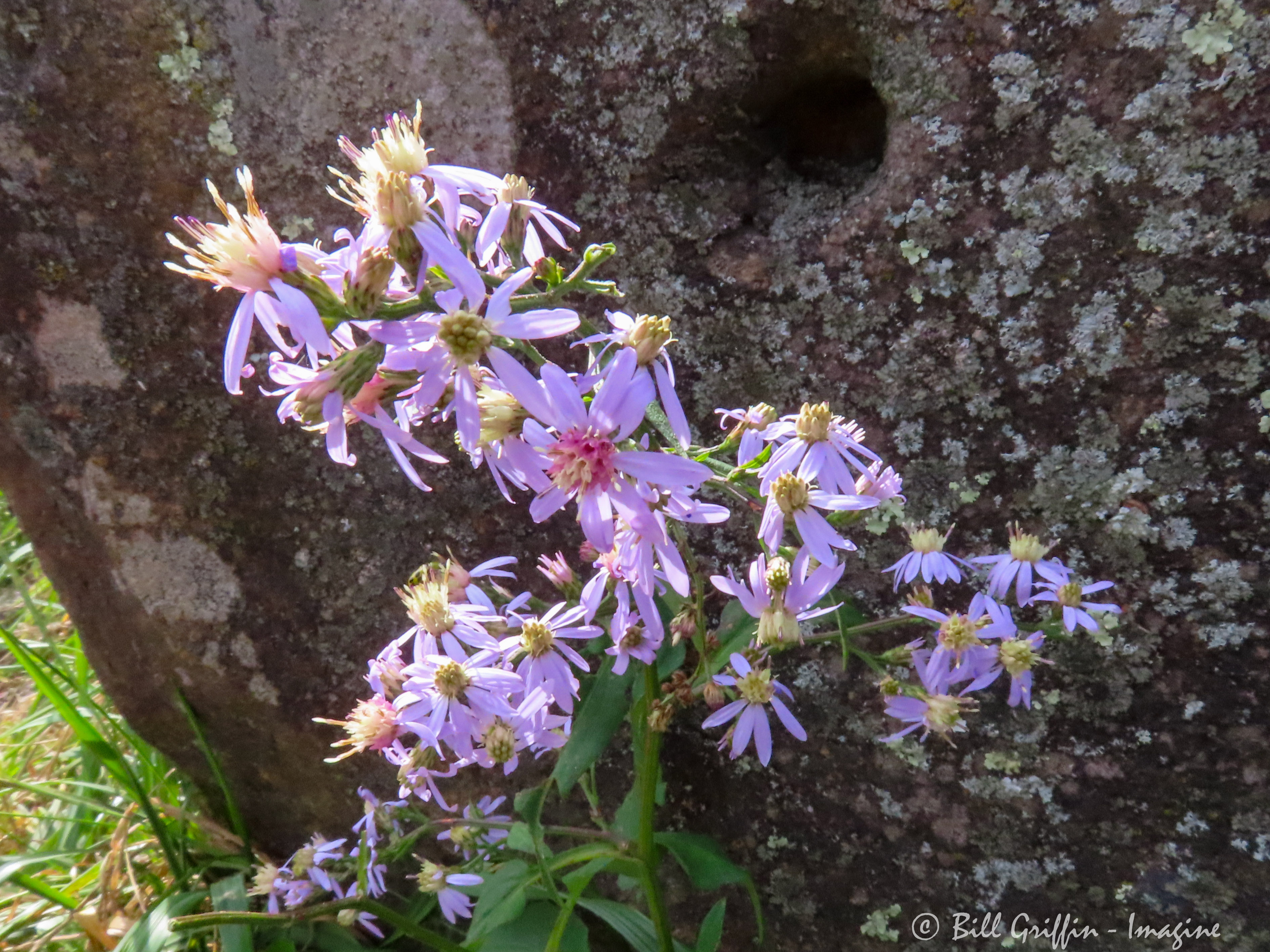
Common Blue Wood Aster & Thunderhead Sandstone GSMNP

 . 
❦ ❦ ❦
 . 
Anything the River Gives
 . 
Basalt, granite, tourmaline, the male wash
of off-white seed from an elderberry,
the fly’s-eye, pincushion nubbins yellow
balsamroot extrudes from hot spring soil,
confetti of eggshell on a shelf of stone.
Here’s a flotilla of beaver-peeled branches,
a cottonwood mile the shade of your skin.
Every day I bring some small offering
from my morning walk along the river:
something steel, blackened amber with rust,
an odd pin or busing shed by the train
or torqued loose from the track, a mashed penny,
the buddy bulge of snowmelt current.
I lie headlong on a bed of rocks,
dip my cheek in the shallows,
and see the water mid-channel three feet
above my eyes. Overhead the swallows
loop for hornets, stinkbugs, black flies and bees,
gone grass shows a snakeskin shed last summer.
The year’s first flowers are always yellow,
dogtooth violet dangling downcast ans small.
Here is fennel, witches’ broom and bunchgrass,
an ancient horseshoe nailed to a cottonwood
and halfway swallowed in it spunky flesh.
Here is an agate polished over years,
a few bones picked clean and gnawed by mice.
Her is every beautiful rock I’ve seen
in my life, here is my breath still singing
from a reedy flute, here the river
telling my blood your name without end.
Take the sky and wear it, take the moon’s skid
over waves, that monthly jewel.
If there are wounds in this world no love heals,
then the things I haul up – feather and bone,
tonnage of stone and the pale green trumpets
of stump lichens – are ounce by ounce
a weight to counterbalance your doubts.
In another month there won’t be room left
on the windowsills and cluttered shelves,
and still you’ll see me, standing before you,
presenting some husk or rusty souvenir,
anything the river gives, and I believe
you will love.
 . 
Robert Wrigley
from The Ecopoetry Anthology, edited by Ann Fisher-Wirth and Laura-Gray Street, Trinity University Press, San Antonio, TX. © 2020
 . 
❦ ❦ ❦
 . 
“Find yourself a stone, one you can pick up and carry,” our instructor tells us. “Then find me bedrock.” All weekend Elizabeth will be offering us something new every few minutes  – strange vocabulary, stranger stories in deep time, paths upward toward heath balds and downward into the past – but first she offers these two commands. Our substratum. We will build everything upon a stone from the Middle Prong of the Little River, edges knocked round, compressed bits of texture a hundred shades of gray (soon we’ll know to call those bits clasts); and ponderous gray stone rising beside the river, its layers, its planes and fissures (soon we’ll know which is bedding and which foliation). Here we begin our weekend course in the Smokies, 500 million years beneath our feet, asking how it all got here.
 . 
I’m taking my final elective offered by Great Smoky Mountains Institute at Tremont in their Southern Appalachian Naturalist Certification Program – Geology of the Smokies. This is the first time Linda has accompanied me to Tremont, so she’s taking her first course. We know from our readings that these are the most folded, tortured, elevated/eroded/re-elevated/re-eroded square miles in North America. We know that for the next 48 hours we’ll be continuously outdoors except a few hours to eat and sleep. From my previous nine courses, I know Elizabeth Davis as an excellent teacher, patient yet challenging. What we don’t yet fully know is just how truly challenging, physically and intellectually, this weekend is going to be. But here we are on Friday night and we should be getting a clue – Elizabeth is leading us on a hike into pitch darkness, across the shallows on a single-log bridge, and has turned us loose on an island to find our river stones.
 . 
Success. No one falls into the river.
 . 
Tomorrow morning we’ll be picking our way up through a pathless boulder field to a massive outcrop of Thunderhead Sandstone (its compressed sediment, clasts, recycled from the Grenville mountains built almost a billion years ago). We’ll spend the afternoon literally on hands and knees beneath laurel and rhododendron, climbing to a heath bald summit where some really cool rocks are exposed and where we’ll take samples of the low pH soil. Sunday morning we’ll hike a trail so hazardous that the Park won’t even include it on their maps, but along the way we’ll cross major and minor fault lines to discover their rocky transitions, investigate geology’s effect on plant communities, devise some crazy poems and songs about our findings, and end up at beautiful Spruce Flat Falls.
 . 
Late Sunday night, after driving five hours, Linda and I will pull into our driveway and our old bones will creak as we lug our gear back into the house in pitch darkness. At least we don’t have to cross a log bridge to make it to the kitchen door, but when we wake in the morning, stiff and aching, will Linda have a few choice cusswords for me after dragging her along on this adventure? Oh yeah, we’re sore, but only in body. What Linda does have for me is a list of books I need to order. And this proclamation: “You know, after this weekend I really love Geology!”
 . 

Nodding Ladies Tresses growing up through Anakeesta Slate GSMNP

 . 
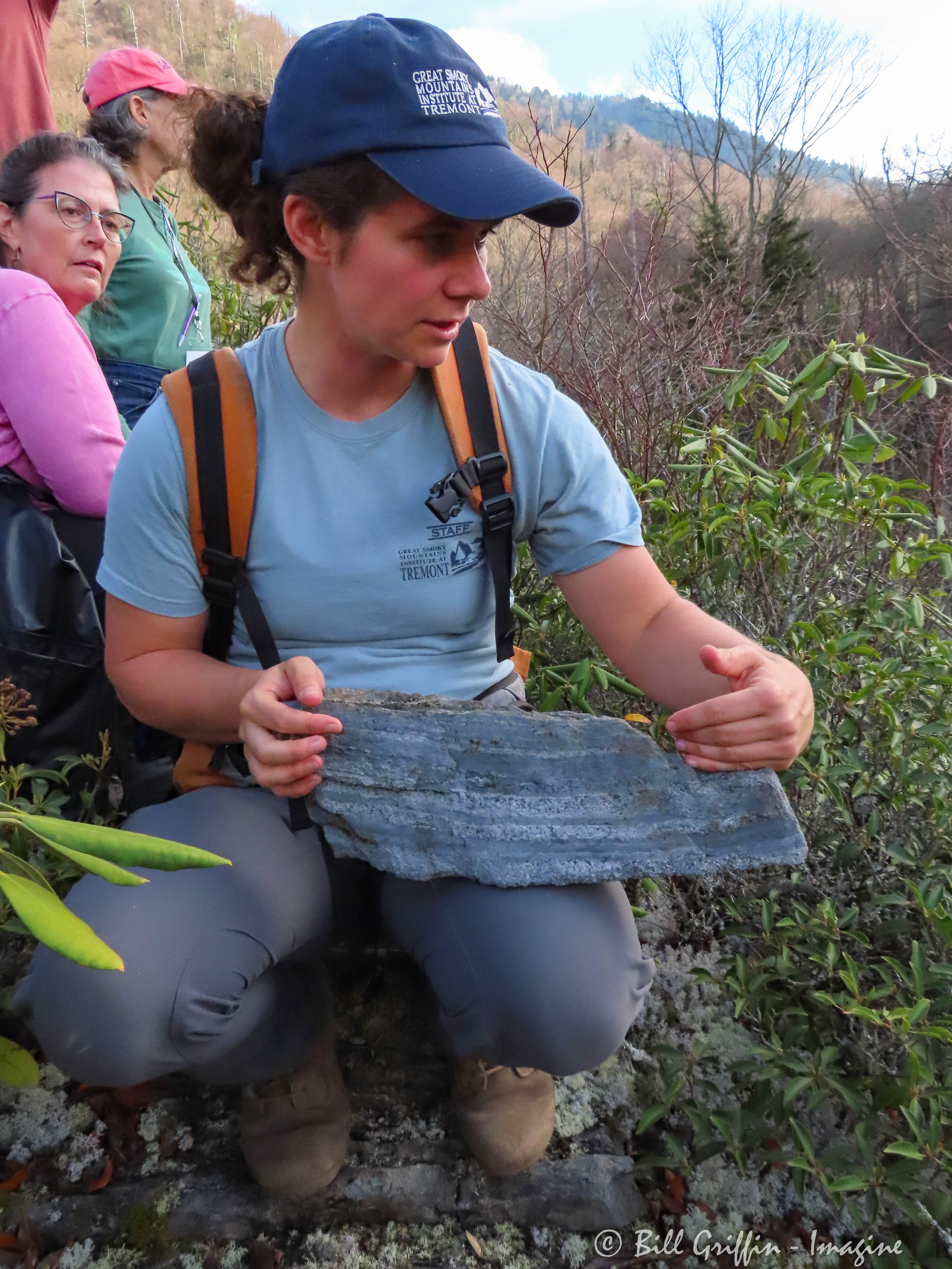
Elizabeth displays bedding vs cleavage at summit of heath bald near Chimney Tops GSMNP

 . 
❦ ❦ ❦
 . 
The End of the Age
 . 
With wash and ripple and with wave,
Slow moving up the long deserted sand,
The little moon went watching the white tide
Flood in and over, spread above the land,
Flood the low marshes, make a silver cover
Where the green sea-weed in a floating mist
Creeps under branch and over.
The wide water spreads, the night goes up the sky,
The era ends.
 . 
Tomorrow comes warm blood with a new race,
Warm hearts that ache for lovers and for friends,
And the pitiful grace
Of young defeated heads.
Tomorrow comes the sun, color and flush
And anguish. Now let the water wash
OUt of the evening sky the lingering reds,
And spread its coolness higher than the heart
Of every silver bush.
Night circles round the sky. The era ends.
 . 
 . 
Geology
 . 
“Look,” said God;
And with slow fingers
Drew away the mantle rock.
Man followed groping
To touch the flesh of his true mother;
And, standing in great valleys,
He saw the ages passing.
 . 
 . 
Fossil
 . 
I found a little ancient fern
Closed in a reddish shale concretion,
As neatly and ans charmingly shut in
As my grandmother’s face in a daguerreotype,
In a round apricot velvet case.
 . 
Janet Loxley Lewis (1899-1998)
from Poetry Magazine, No. 111, The Poetry Foundation. © June, 1920
 . 
❦ ❦ ❦
 . 
Emilie Lygren has published poems and anthologies and developed dozens of publications focused on outdoor science education. Her first collection of poems, What We Were Born For, was selected by the Young People’s Poet Laureate as the Poetry Foundation’s monthly book pick for February 2022.
 . 
Robert Wrigley has said that “poetry can have a redemptive function. It can look at the chaos you see and make a kind of sense of the smallest part of it.” His poems are concerned with rural Western landscapes and humankind’s place within the natural world.
 . 
Janet Loxley Lewis (1899-1998) wrote novels, stories, and librettos, but she considered poetry the superior form. Theodore Roethke describes her poetry as “marked by an absolute integrity of spirit and often by the finality in phrasing that can accompany such integrity.”
 . 
❦ ❦ ❦
 . 
 . 

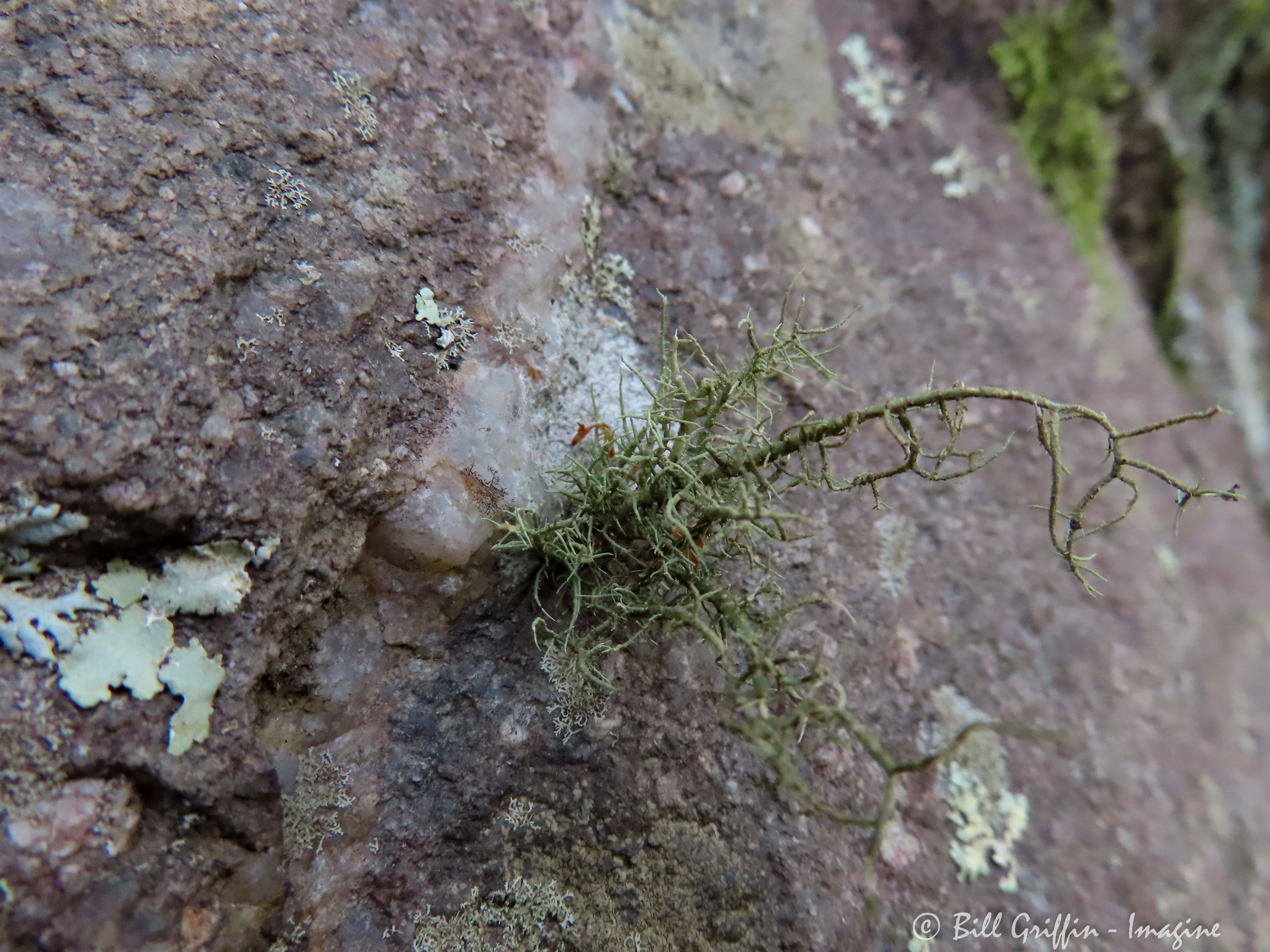
Great Smoky Mountains Institute at Tremont GEOLOGY course November, 2024

 .  . 
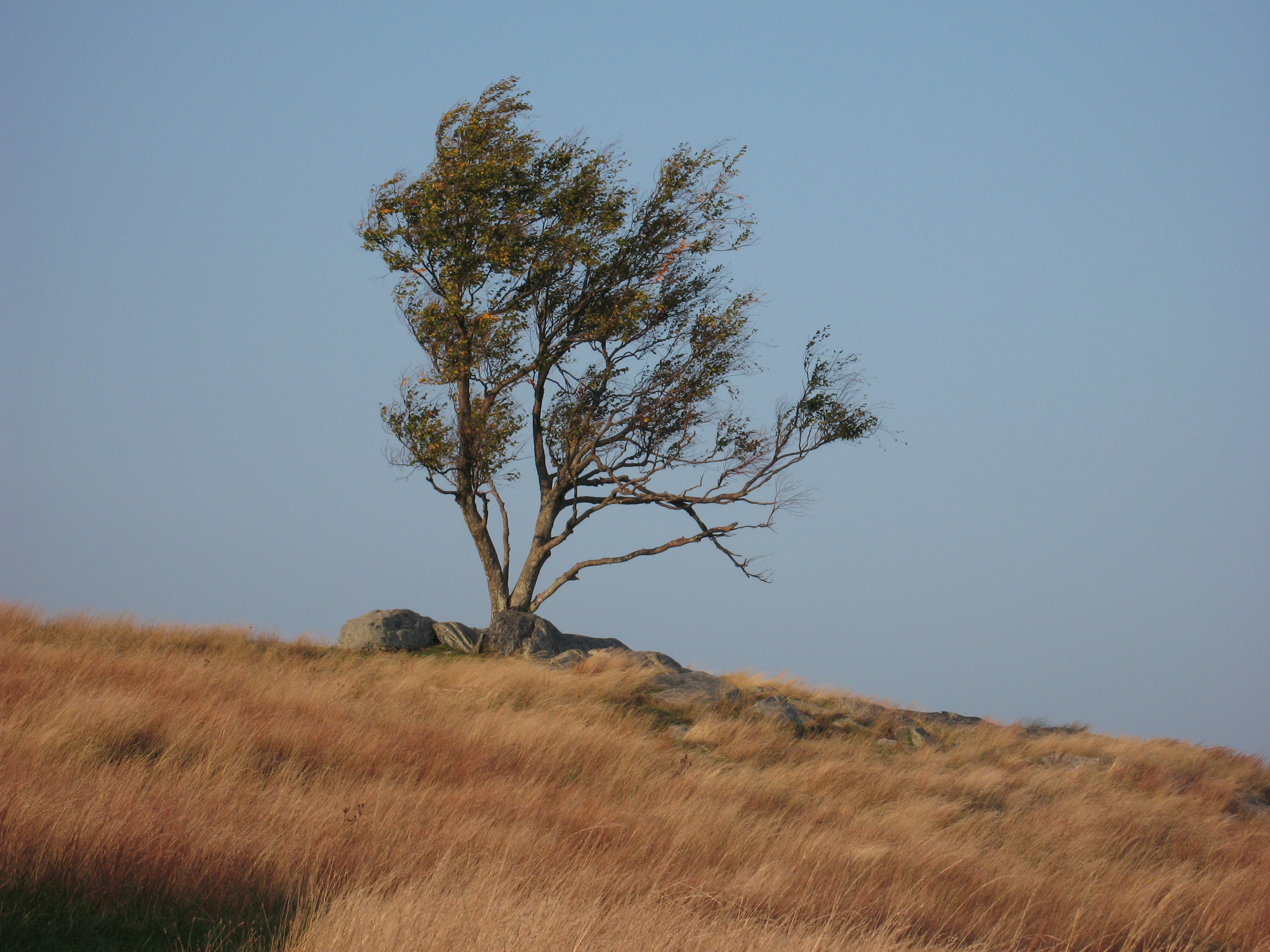
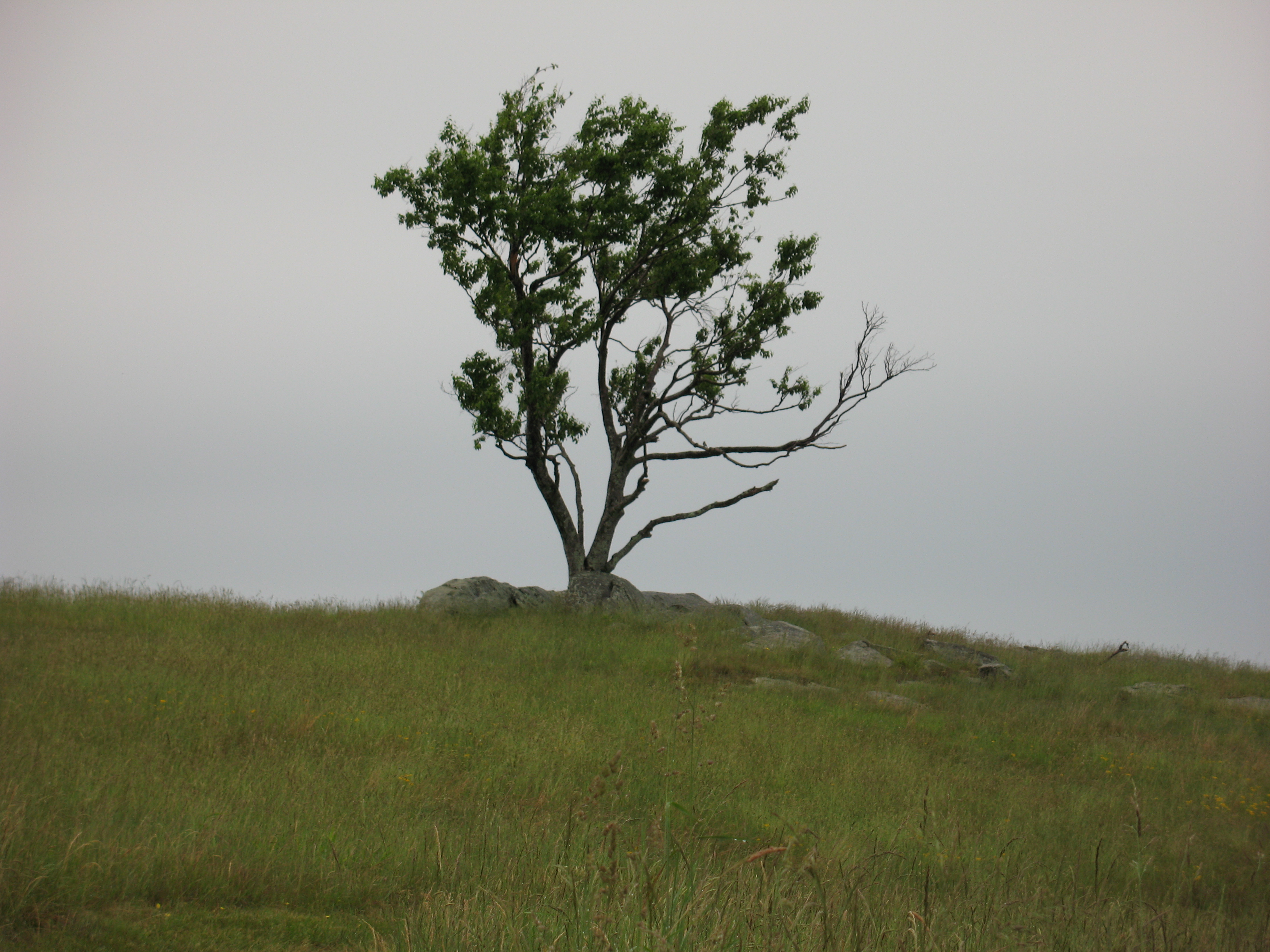
 Doughton Park Tree 2018-02-09

Read Full Post »

 . 
[with poems by the 2023 Tremont Poetry Cohort]
 . 
Awaken
 .  . 
You came because the river quiets your soul,
the sassafras soothes and sweetgum settles.
Have you gotten your breath? Do you remember who you are?
Leave us, now; it’s our time to sleep. You go, awake.
 . 
Sarah Small / Alcoa, Tennessee
postcard – Mother bear & cubs
 . 
❦ ❦ ❦
 . 
The Little River is singing ‘October Blues’ and I can listen if I’ll just roll down my window. Leaving the Smokies on a Sunday morning, who would have imagined such a glut of traffic, but I can make the choice to gentle my right foot and blend with the flow. And here on the right comes another choice: I pull off at Chimneys and flush the press of schedule and itinerary from my mind.
 . 
A ten minute climb into old growth hardwood cove and road noise no longer penetrates. Every few steps another chipmunk whistles its alarm. Fecund – whoever coined that word was smelling this place. The carpet is bright green hepatica saving up to flower in just a few months, the understory is summer seedhead bounty and autumn wood asters blooming like crazy, and the overstory is way up there, crooked and knobbed, reaching and mingling and only allowing an occasional glimpse of Balsam Point.
 . 
I’ve been waiting since breakfast and now I pull out the small slip of lined paper Renée gave me, a personal parting note; she prepared one for each of us in the cohort. “Read it later,” she had said. I’m going to trust she won’t mind if I share one line: “I came to this conference with some heaviness and I’m leaving with light and a sense of belonging.” A mystery, a wonder, an inexplicable blessing that in just a few days eight strangers can so deeply connect.
 . 
 . 
❦ ❦ ❦
 . 
[untitled]
 . 
You’re not a flightless bird,
+++++ your wings held tight
against your breast;
+++++ unfurl your plumage,
Go from here with boldness,
+++++ revel in your glory.
 . 
Jeannine Jordan / Lima, Ohio
postcard – Wild Turkey
 . 
 . 
Community
(the Park speaks)
 . 
Inspire, breath in, be filled with spirit –
think I’d tip you like a funnel and pour
right in? Look around this circle and take
a lesson from the Queen of Connection.
 . 
Bill Griffin / Elkin, North Carolina
postcard – entrance to GSMNP
 . 
❦ ❦ ❦
 . 
Frank fans the deck and asks us each to select one. They’re postcards, of Great Smoky Mountains National Park, face down so we can’t see what we’ve picked. “The card has picked you,” Frank suggests. “What is it telling you about why you are here and what you’ll take with you when you leave?”
 . 
This is our last exercise during our last session of this inaugural Tremont Writers’ Conference. Can it be only three days ago that Frank X Walker introduced himself to us as an artist who speaks Poet? Besides the language of linebreak and word choice, what Frank so incisively speaks is creativity, challenge, connection, community. Oh yes, we learn to critique each other’s poems through his quiet observations. Yes, we engage in color studies and sound studies and we write to prompts. But Frank is not teaching us to be writers – he is teaching us to be human. His carefully considered comments touch our gifts and expose our needs, and even more than that he weaves us seven into a whole whose true commitment is to bring out the best in each other.
 . 
After ten or fifteen minutes of writing – channeling the voice we are hearing in our card’s image – Frank stops us and presents his next to last prompt: now break that all down into four lines. We probably should have seen this coming. We really aren’t ready, though, for his final instruction. He has us each pass our card two people to the left, write our home address on the fresh card we’re holding, then pass it back right to its original owner. Each of us will write our four-line poem on our card and mail it, and in a few days we will each receive a poem from one other member of the cohort.
 . 
We won’t be driving home from this gathering to resume our scribbling in isolation. We will be watching the mailbox (and text messages) with a tingle. We are now a creative family. We are connected.
 . 
 . 
❦ ❦ ❦
 . 
The Experience
 . 
Like me, a yearling bear,
caged and carried away.
You came for the experience.
Imagine me gone. Write it.
 . 
Kim Hayes / Weaverville, North Carolina
postcard – Ursus americanus, Black Bear
 . 
 . 
Somewhere, Sometime
 . 
Sunlight  in this open field
Safely wander, graze
Trust the treeline
Grow. (I am growing, too.)
 . 
Suzanne Bell / Pisgah Forest, North Carolina
postcard – deer graze in Cades Cove
 . 
❦ ❦ ❦
 . 
Connecting People with Nature is the motto of Great Smoky Mountains Institute at Tremont. Amen! In completing the Southern Appalachian Naturalist Certification Program at Tremont, I have felt the web of connections forged there welling up in me and changing me. One begins with the name of a thing, then comes to recognize how it makes its living and gets along with its neighbors, until at last there dawns an appreciation of the deep interdependence and kinship of all life, place, and planet. One living community.
 . 
But if ecology is the study of living communities, poetry also has its ecology. How does the poem bring together all these living bits that make it come alive? Its images, its allusions, its music? How does the poem make its world equally real to or perhaps even more real than the world speeding by outside my window?
 . 
It seems to me that the technique we learn at Tremont, the Naturalist Method, is entirely congruent with the Poetic Method – Pay Attention; Ask Questions; Make Connections; Share. All of this we try to do when we “speak Poet.” And Frank X Walker has certainly enabled every bit of this in us during our few days of communion with mountains, rivers, bears, each other. It is a language of laughter and surprise. It is a language of change and growth. It is a language of discovery, insight, and awe. We are leaving Tremont bubbling with its voice and overflowing with its joy. Poetry, and Nature, are how we connect.
 . 
 . 
 . 
❦ ❦ ❦
 . 

[untitled]
 .
Born on the top, nestled through the sides, tumbled to the bottom.
Again and again.
Those mountains captured and created.
Then they carried.

Renée Whitmore / Vass, North Carolina
postcard – sunrise through mountains in Cades Cove

 . 
 . 

Clouds in my Skin

You are here
Not to burn through the mist
To roll around in the slick slopes
Of your soft hope—this knowing, this peace

Sophia Fortunato / Bozeman, Montana
postcard – mountain ridges fading into blue mist

 . 
❦ ❦ ❦
 . 
The Poetry Cohort of the First Tremont Writers’ Conference, October 15-29, 2023, is Jeannine Jordan, Bill Griffin, Sophia Fortunato, Sarah Small, Renée Whitmore, Kim Hayes, and Suzanne Bell. Our teacher, mentor, guide, and brother is Frank X Walker from Lexington, Kentucky, speaker of poetry, professor at University of Kentucky, and former state Poet Laureate.
 . 
Other instructors at this inaugural conference are Janet McCue (Non-Fiction) and Annette Saunooke Clapsaddle (Fiction) and the featured speaker is Richard Powers, Pulitzer Prize-winning author of The Overstory. Jeremy Lloyd, Tremont Manager of Field and College Programs, has been the primary organizer, assisted by Tremont staff Elizabeth Davis, Erin Cantor, Lyndsey Kessler, education director John DiDiego, and many others.
 . 
This conference was also made possible through the integral participation and partnership of Great Smoky Mountains Association and Creative Services Director Frances Figart. Thank you!
 . 
 . 
 . 
 . 
 . 
❦ ❦ ❦
 . 
IMG_1783

Read Full Post »

[with 3 poems by Scott Owens]

Which came first? Separate a few of the living creatures in the photo above and see what you can identify: the distinctive mottled leaf of Saxifrage; beneath it a glimpse of moss, its diminutive creeping green; a big hairy leaf, I should know that one but I don’t. Down in the damp there’s bound to be a little township of bacteria, waterbears, wormy things, arthropods.

And what’s that right in the center? A little stemmed goblet corroded like verdigris growing out of that patch of gray-green flakes (squamules)? Center stage – lichen, probably Cladonia pyxidata. Its tiny cup is pebbled within by extra lichen bits growing there (more squamules!) and some of the rough and powdery appearance may be an obligate lichen-loving fungus taken up residence. So which came first in this little community of many kingdoms and phyla?

Most likely the lichen comes first. It can hold onto bare rock where nothing else lives. It gathers moisture into itself out of the very air and how could a wandering moss spore resist? Anything drifting by may land and latch. Plus that little lichen chemical factory can break down rock so that others may use the minerals. Pretty soon a Saxifrage seed finds just enough earth to sprout and enough wet to grow and wedge its roots further into rock (saxifrage = rock-breaker). Everything discovers what they need; everyone adds to the life of the community.

What gifts may I add to my little community? A bit of cautious optimism and encouragement. An appreciation for all living things (OK, yes, that does extend to human beings, at least I’m trying my best). Appreciation of a good joke and appreciation as well of the folks who tell bad jokes. Curiosity and a sense of wonder. The world’s best recipe for Nutty Fingers.

We all need something but we all bring something. Who knows, maybe what I’ve got is just what you need. When one really gets down to it, all the stuff growing in that photo looks pretty haphazard and messy. Just like a real community. Just like life.

And if you know what that hairy leaf is, please tell me!

.     .     .     .     .     .     .

In the Cathedral of Fallen Trees

Each time he thinks something special
will happen, he’ll see the sky resting
on bent backs of trees, he’ll find
the wind hiding in hands of leaves,

he’ll read some secret love scratched
in the skin of a tree just fallen.
Because he found that trees were not
forever, that even trees he knew

grew recklessly towards falling,
he gave in to the wisteria’s plan
to glorify the dead. He sat down
beneath the arches of limbs reaching

over him, felt the light spread
through stained glass windows of leaves,
saw every stump as a silent altar,
each branch a pulpit’s tongue.

He did not expect the hawk to be here.
He had no design to find the meaning
of wild ginger, to see leaves soaked
with slime trails of things just past.

He thought only to listen
to the persistent breathing of tres,
to quiet whispers of leaves in wind,
secrets written in storied rings.

Each time he thinks something special
will happen. He returns with a handful
of dirt, a stone shaped like a bowl,
a small tree once rootbound against a larger.

Scott Owens
from Sky Full of Stars and Dreaming, Red Hawk Publications, © 2021

.     .     .     .     .     .     .


I’ve admired Scott Owens for many years, not only as a poet but even more so as a builder of community. Scott’s writing wields its openness, its wonder, its unflinching honesty to invite us to realize we are all part of one human family. As in his poem, Words and What They Say: the hope we have / grows stronger / when we can put it into words. Not only words – in everything else he does Scott is building as well. He teaches, he mentors, he makes opportunities happen for the people around him. Perhaps his poems are a window into why he values people as he does, and why he works so hard to make hope a reality.

Sky Full of Stars and Dreaming is Scott Owens’s sixteenth poetry collection. He is Professor of Poetry at Lenoir Rhyne University, former editor of Wild Goose Poetry Review and Southern Poetry Review, and he owns and operates Taste Full Beans Coffeehouse and Gallery where he coordinates innumerable readings and open mics, including POETRY HICKORY, and enlarges the community of creativity.

.     .     .     .     .     .     .


The Possibility of Substance Beyond Reflection

I didn’t see the V of geese fly overhead in the slate gray sky as I sat waiting for a reading in my Prius in front of the Royal Bean Coffee House & Gift Shop in Raleigh, NC.

What I saw was the V of geese presumably flying overhead in the slate gray sky reflected in the slate gray hood of the Honda CRV parked before me in front of the Royal Bean Coffee House & Gift Shop in Raleigh, NC.

And they took a long time to travel such a short distance, up one quarter panel, across one contoured crease, then the broad canvas of the hood’s main body, down the other crease and onto the edge of the opposite quarter panel before

disappearing into the unreflective nothingness beyond, where even they had to question just how real they were or just how real they might have been.

Scott Owens
from Sky Full of Stars and Dreaming, Red Hawk Publications, © 2021

.     .     .     .     .     .     .

Sharing a Drink on My 55th Birthday

Sharing a drink on my 55th birthday,
my son, his tongue firmly planted
in his cheek, asks what advice I have
for those not yet as old as I,
and I, having had too much to drink,
miss his humor and tell him
always get up at 5
as if you don’t want to miss
any part of any day you can manage.
Clean up your own mess
and don’t clean up after those who won’t.
Take the long way home,
hoping to see something new,
or something you don’t
want to not see again.
Stay up late, drink in as much
of every day as you can.
Be drunk on life, on love, on trees,
on mountains, on spring,
on rivers that go the way
they know to go,
on words, on art, on dancing,
on poetry, on the newborn
fighting against nonexistence,
on night skies, on dreams, on mere minutes,
on the ocean that stretches beyond
what you ever imagined forever could be.
And when someone asks you
what advice you have, give them,
as you’ve given everyone and everything,
the best of what you have.

Scott Owens
from Sky Full of Stars and Dreaming, Red Hawk Publications, © 2021

.     .     .     .     .     .     .


.     .     .     .     .     .     .


*** Extra Geek Credit — the lichen Cladonia pyxidata is host to the lichenicolous (lives on lichens) fungus Lichenoconium pyxidatae. Such fungi are parasites of their lichen host and mostly specific to a single genus or even to single species of lichen, but although some may be pathogens for the lichen in many cases the relationship is commensal. No harm done. Join the party!

Read Full Post »

Older Posts »