Feeds:
Posts
Comments

Posts Tagged ‘Earth Day’

 . 
[poems selected by and written by the students
of West Carteret High School, Morehead City, North Carolina, USA]
 . 
Earlier this month I asked Jessi Waugh, teacher/scientist/poet and instructor in Earth and Environmental Science, if she would like to have her high school students contribute Poems for the Earth. Jessi replied Yes! and then this:
 . 
Several days before the poem-writing lesson, I gave my students the assignment to post an EcoPoem to a class discussion. They could post any poem or song lyrics related to nature. In this discussion format, students are able to see each other’s posts and like or comment. Few interacted, but they did see each other’s poems as I scrolled through the class submissions.
 . 
This assignment saw some of the expected favorites: Robert Frost, Shel Silverstein, Dr. Seuss. It also saw poems obviously chosen by a Google Search for “ecopoem example,” as I knew it would. But I got unexpected and delightful responses as well, such as:
 . 
Stick your leaves back on
 . 
My mother planted you the day I was born.
I grew with you.
I remember trying to stick your leaves back on in autumn;
I was scared of you changing.
Yet as time passed, my attempts stood no chance.
The cruel seasons ripped apart your branches.
The cruel season ripped me apart, too.
You looked so unrecognizable by the time winter ended,
I didn’t even wanna be near you.
My mother made me blow out a candle for you every year.
She hasn’t lit one in 1…2…3… I lost count.
I grew without you.
You stood tall, but I only kept changing.
I was scared of changing.
I’m 16 now.
A storm ripped you from the earth.
I’m trying to stick your leaves back on.
I wish you could do the same to me.
 . 
Emily M
 . 
 . 
The Rose that Grew from Concrete
 . 
Did you hear about the rose that grew
from a crack in the concrete?
Proving nature’s law is wrong it
learned to walk without having feet.
Funny it seems, but by keeping its dreams,
it learned to breathe fresh air.
Long live the rose that grew from concrete
when no one else ever cared.
 . 
Tupac Shakur
 . 
 . 
❦ ❦ ❦
 . 
Before they wrote a poem, Jessi gave her students this assignment: “Analyze the connections between the biosphere and other Earth systems (geosphere, hydrosphere, atmosphere).” She took them to the back soccer field at their school, which is surrounded on three sides by forest and powerline land. She had cut 2′ x 2′ pieces of an old tarp for them to sit on, and once they were outdoors she handed them a clipboard along with the assignment log sheet and told them to sit facing the forest and far enough apart so they couldn’t distract each other.
 . 
When we first got out there, many students sat in the middle of the field or facing away from the forest, and I came around to encourage them to sit near the wild areas and turn towards them. Most did. Others were not comfortable and chose to stand or remain near the middle of the field, especially girls wary of jumping spiders.
 . 
Students documented the abiotic and biotic factors in the ecosystem, reinforcing those terms, and created a food web with the 10 organisms they observed. These were concepts from class (trophic level, energy flow, limiting factors) put into practice. They then answered a series of questions about interactions between ecosystem components and biodiversity, and then crafted their poems, all while outside.
 . 
Before taking them outside that day, I read the students one of my own poems, Dunation, but didn’t tell them it was mine. I told them to listen for the repetition of sounds and them suggested they repeat sounds in their poems as an easy literary device.
 . 
It was a beautiful day, perfect for sitting in the back field for an hour. We saw at least 20 species between all the different insects, herbaceous perennials, trees, and birds. Likely closer to 50. In general, students were quiet and reflective and did a great job of observing the ecosystem.  – Jessi Waugh
 . 
❦ ❦ ❦
 . 
selected student poems . . .
 . 
The Great Outdoors
 . 
When I step outside to the great outdoors
I see nothing but change, out of our culture nothing
stays the same
not the trees, not the grass, not the very ground you stand on
everything around us is just waiting on its moment
 . 
When I step outside to the great outdoors
I notice change is inevitable but nothing to fear
everything changes even just saying
“the last time I was here”
or the time and age you got, like the sound
of the creek, of the animals above, or even the things
that all of us take for granted like a mother’s love
 . 
Everything changes
please don’t be afraid
be glad you have what you have
and enjoy the change
 . 
Kevin Hunter, Student at West Carteret High School
 . 
 . 
In the Back Soccer Field 
 . 
With all these limiting beige walls I’m stuck with
for over 5 hours a day, it feels
refreshing to see the leaves, feel the breeze
crunch the brittle soil like the wandering ant
I make my pilgrimage
toward NATURE
 . 
My eyes are stimulated by something that isn’t
a screen but the echoes of human
development still make their unpleasant sounds
nature is something that can’t be replicated
truly by plastic or plaster models or
the dull green of money, as nature is
VIBRANT and cannot be comprehended by man
no matter what
 . 
Kyndall Griffin, Student at West Carteret High School
 . 
 . 
Life Cycle
 . 
Green
Life abounds
Sunlight kisses leaves
Insects buzz, a symphony of life
Grass
 . 
Tiny world
Hidden, teeming
spiders spin, frogs leap
nature’s dance, a vibrant scene
Balance
 . 
Stillness
Whispers softly
Decomposers working
Life to death, death into life
Cycle
 . 
Jazireyah Johnson, Student at West Carteret High School
 . 
 . 
❦ ❦ ❦
 . 
and another favorite selected by Jessi’s students . . .
 . 
rises the moon
 . 
Days seem sometimes as if they’ll never end
Sun digs its heels to taunt you
But after sunlit days, one thing stays the same
Rises the moon
 . 
Days fade into a watercolour blur
Memories swim and haunt you
But look into the lake, shimmering like smoke
Rises the moon
 . 
Oh-oh, close your weary eyes
I promise you that soon the autumn comes
To darken fading summer skies
 . 
Breathe, breathe, breathe
Days pull you down just like a sinking ship
Floating is getting harder
But tread the water, child, and know that meanwhile
Rises the moon
 . 
Days pull you up just like a daffodil
Uprooted from its garden
They’ll tell you what you owe, but know even so
Rises the moon
 . 
You’ll be visited by sleep
I promise you that soon the autumn comes
To steal away each dream you keep
Breathe, breathe, breathe
 . 
lyrics and music by Liana Flores
 . 
❦ ❦ ❦
 . 
Dunation
 . 
The sorrows they pile heart-high
head-high, sky-high like peaks
of primary dunes against winter-white
an accumulation of minutia
a hummock too precipitous to persist
Spring’s avalanche comes
grains slip-slide down dune slipfaces
so suddenly, the sound akin to arctic ice breaking
tern eggs crackling, oak limbs fracturing
in furious full-February gales
Hearts, heads, skies on fire
here comes March’s awakening
dunes crash-topple into manageable talus
Here we come
tip-toeing across the tops
paper children tumbling
over ridges and ruins
 . 
Jessi Waugh, Earth and Environmental Science Teacher, West Carteret High School
 . 
The main reaction from students to this project was appreciation for the time sitting outdoors, and they enjoy the social aspect of posting “favorite’ ecopoems on our class discussions. As much as I’d like to turn it into a week of poetry discussions, that would be terribly off-topic for my science class, and I used it primarily as a way to reflect on the connections between earth’s “spheres” (atmo, hydro, litho, geo) and how they interact in ecosystems. In general, I notice that students are disillusioned with politics and technology. They, like all students I’ve taught, enjoy hands-on experience and labs. I think poetry and teens could mix well in many places. – Jessi Waugh
 . 
❦ ❦ ❦
 . 
West Carteret High School is in Morehead City, North Carolina, in the southeastern USA. It is a public 9-12th grade high school, with about 1100 students. Approximately 40% of students are economically disadvantaged. Jessi Waugh teaches Earth and Environmental Science, since 2000 a required course for graduation. She also teaches Biology and Marine Science as needed, and has been a teacher for 12 years. Her students are all 9th & 10th grade, ages 14-16. The poems submitted are from both the honors and standard classes. She holds a Master’s in Teaching Secondary Science and an undergraduate Biology degree. I like teaching this course and age group; it’s my niche.
 . 
IMG_0345
 . 
❦ ❦ ❦
 . 
IMG_1783
 . 

Read Full Post »

Golden Ragwort, Packera aurea

 . 
[poems by Charles Simic, Sylvia Plath, Katharine Spadaro, 
Rosanna Warren – selected and shared by 
Sharon Sharp, Kitsey Burns, Brad Strahan, Bill Griffin]
photographs in today’s post are from the banks of Dutchman Creek,
Elkin NC, within a 2 meter diameter circle, taken on April 16, 2025
Stone
 . 
Go inside a stone.
That would be my way.
Let somebody else become a dove
Or gnash with a tiger’s tooth.
I am happy to be a stone.
 . 
From the outside the stone is a riddle:
No one knows how to answer it.
Yet within, it must be cool and quiet
Even though a cow steps on it full weight,
Even though a child throws it in a river;
The stone sinks, slow, unperturbed
To the river bottom
Where the fishes come to knock on it
And listen.
 . 
I have seen sparks fly out
When two stones are rubbed,
So perhaps it is not dark inside after all:
Perhaps there is a moon shining
From somewhere, as though behind a hill-
Just enough light to make out
The strange writings, the star-charts
On the inner walls.
 . 
Charles Simic
from Selected Poems 1963-1983, George Braziller, New York; © 1990
 . 
Charles Simic’s Stone delights me because I’ve been a rockhound since childhood. This poem celebrates the mysterious, silent presence I’m aware of when holding stones, turning them in my hands, and wondering about the part of Earth’s – and even the cosmos’s – history each one represents. I keep stones as reminders of my own history, and clear scenes from various places emerge anew as I cradle these inanimate yet vibrant objects tying me to the natural world. I take Stone as an invitation to savor what is interior, silent, often overlooked, and unique in all aspects of nature.
 . 
I keep a wrinkled, often-read copy of Stone posted near some of my collected treasures, including the tektite that inspired my own poem, which follows. – Sharon Sharp
 . 
 . 
Tektite
 . 
From my necklace chain dangles a shiny,
pocked, black-glass exclamation point,
minus the dot, full of chemical clues
about celestial origins and a likely
ancient collision: a comet or an
asteroid smashing into Earth.
Upon impact, melted shards
catapulted back into the
outer atmosphere, then
descended, cooling.
The hard rain that
pelted hundreds
of miles still
mesmerizes
dreamers.
 . 
Sharon A. Sharp
from Pinesong, North Carolina Poetry Society; © 2018
 . 

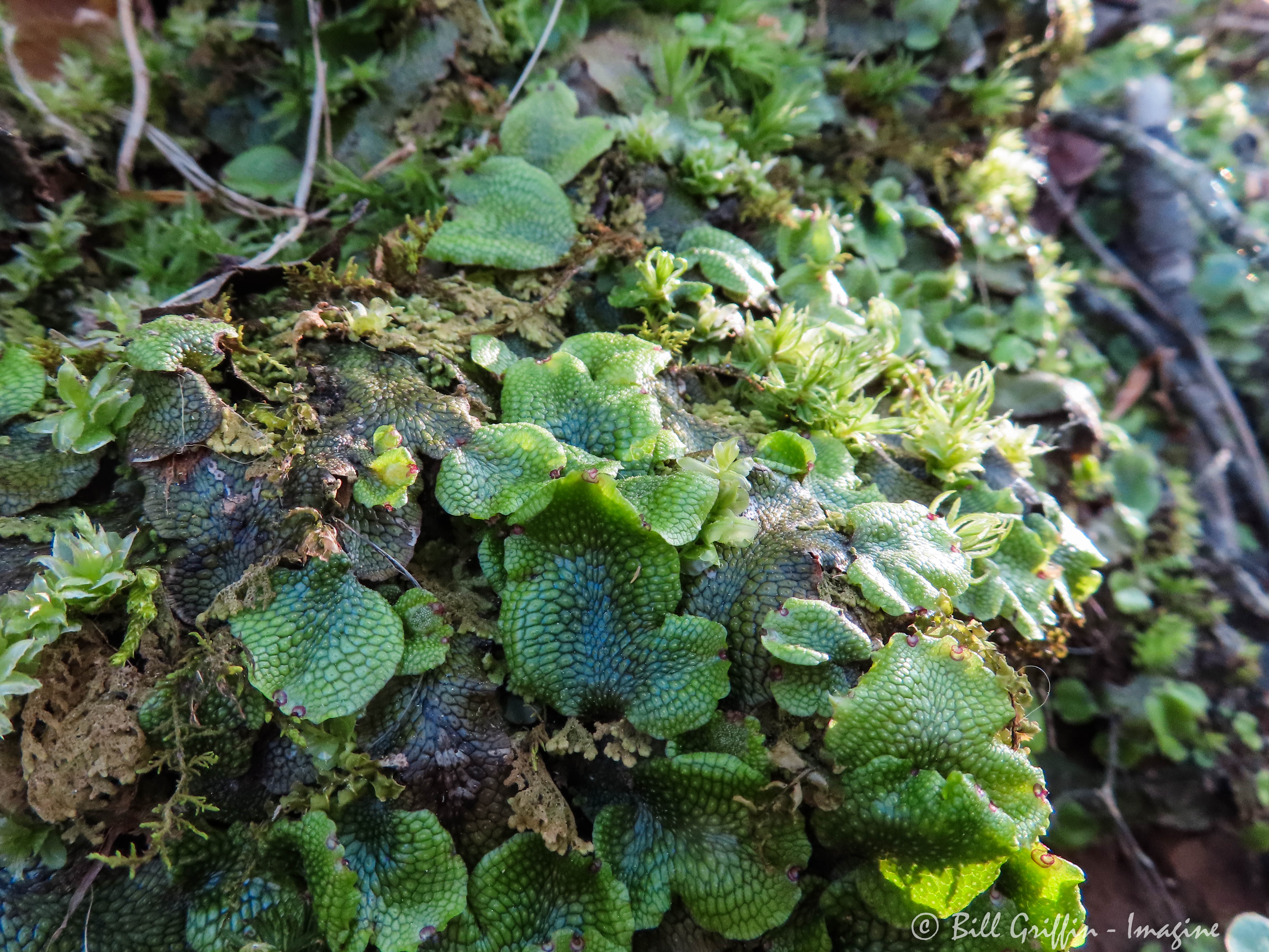
Snakewort (Liverwort), Conocephalum salebrosum

 . 
❦ ❦ ❦
 . 
The Beekeeper’s Daughter
 . 
A garden of mouthings. Purple, scarlet-speckled, black
The great corollas dilate, peeling back their silks.
Their musk encroaches, circle after circle,
A well of scents almost too dense to breathe in.
Hieratical in your frock coat, maestro of the bees,
You move among the many-breasted hives,
 . 
My heart under your foot, sister of a stone.
 . 
Trumpet-throats open to the beaks of birds.
The Golden Rain Tree drips its powders down.
In these little boudoirs streaked with orange and red
The anthers nod their heads, potent as kings
To father dynasties. The air is rich.
Here is a queenship no mother can contest—
 . 
A fruit that’s death to taste: dark flesh, dark parings.
 . 
In burrows narrow as a finger, solitary bees
Keep house among the grasses. Kneeling down
I set my eye to a hole-mouth and meet an eye
Round, green, disconsolate as a tear.
Father, bridegroom, in this Easter egg
Under the coronal of sugar roses
 . 
The queen bee marries the winter of your year.
 . 
Sylvia Plath
from The Kenyon Review, Autumn 1960 • Vol. XXII No. 4
 . 
I sat down this morning to read some Sylvia Plath poetry. I read The Bell Jar for the first time a few years ago, while at my Dad’s deathbed. You would think it would have been a poor choice for that time in my life, but truly I loved the book, so beautifully written. So my Earth Day selection from Plath is The Beekeeper’s Daughter. Bees are the ultimate example of community working together for good. This piece is very sensual and dark, in a way too. For me it is a reminder that light and darkness, life and death are an irrevocable part of the human experience. While we may be in a time of darkness and existential dread about the future of our earth, it is imperative now more than ever, that we seek community to sustain us.
 . 
Thank you, Bill, for these lovely poems you send each week. It brightens my week immensely when I am able to take the time to read them. – Kitsey Burns
 . 

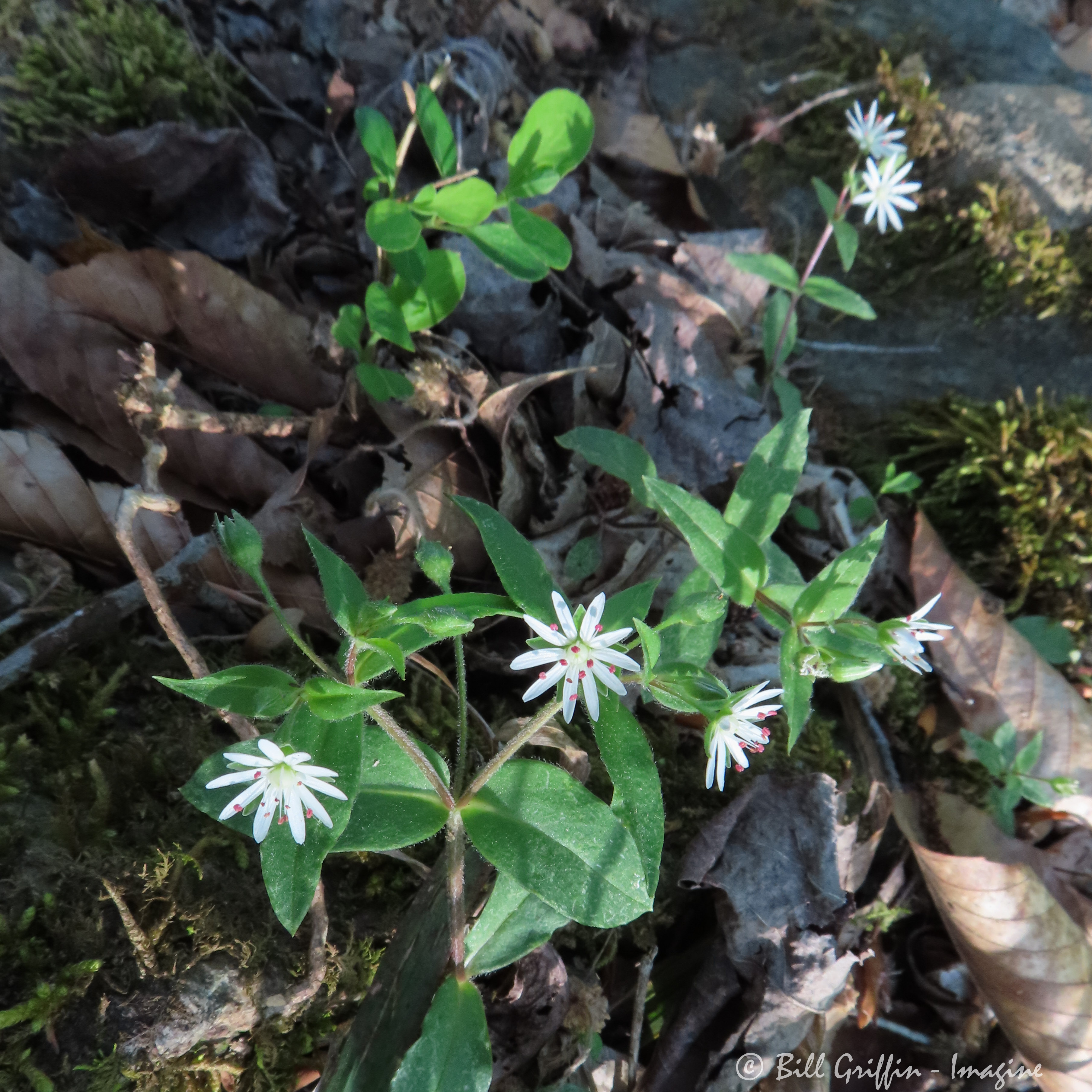
Star Chickweed, Stellaria pubera

 . 
❦ ❦ ❦
 . 
The Day of the Funeral
 . 
Are you ready? they say, preparing to go. The search
how to say, how to feel, becomes a groping for jackets,
a finding of shoes. I look for a place to tie up my hair
and there is the cabinet, forever there.
Its mirrored backing can barely be seen
behind gold-speckled teacups, presents child-made,
crystal marching away to the past. Kneeling on carpet
I join in this scene and serious features
echo and float amongst
gilt generations of gently washed china.
An accordion of hands is fixing my hair.
Has anyone ever been ready?
 . 
Katherine Spadaro
from Visions International, Vol. 109
 . 
I often think of how much we have buried or pushed nature aside but she is there waiting and will sooner or later reclaim it all from us, our brief, brief dominion.
 . 
For earth day I thought of the subtext of this little poem from the past (mine). –  Bradley Strahan
 . 
 . 
Ghosts
 . 
In a lost corner of childhood
where marshland sleeps
beneath concrete,
the tide of evening
still climbs the forest wall.
 . 
Across the pond,
now drained and lawned,
the path looks westward
through the red receding flood of day.
 . 
There June is always a memory of redwings
singing with a chorus of frogs,
and in dank basements ghost cattails grow
through the temporary habitations of man.
 . 
Bradley Strahan
 . 

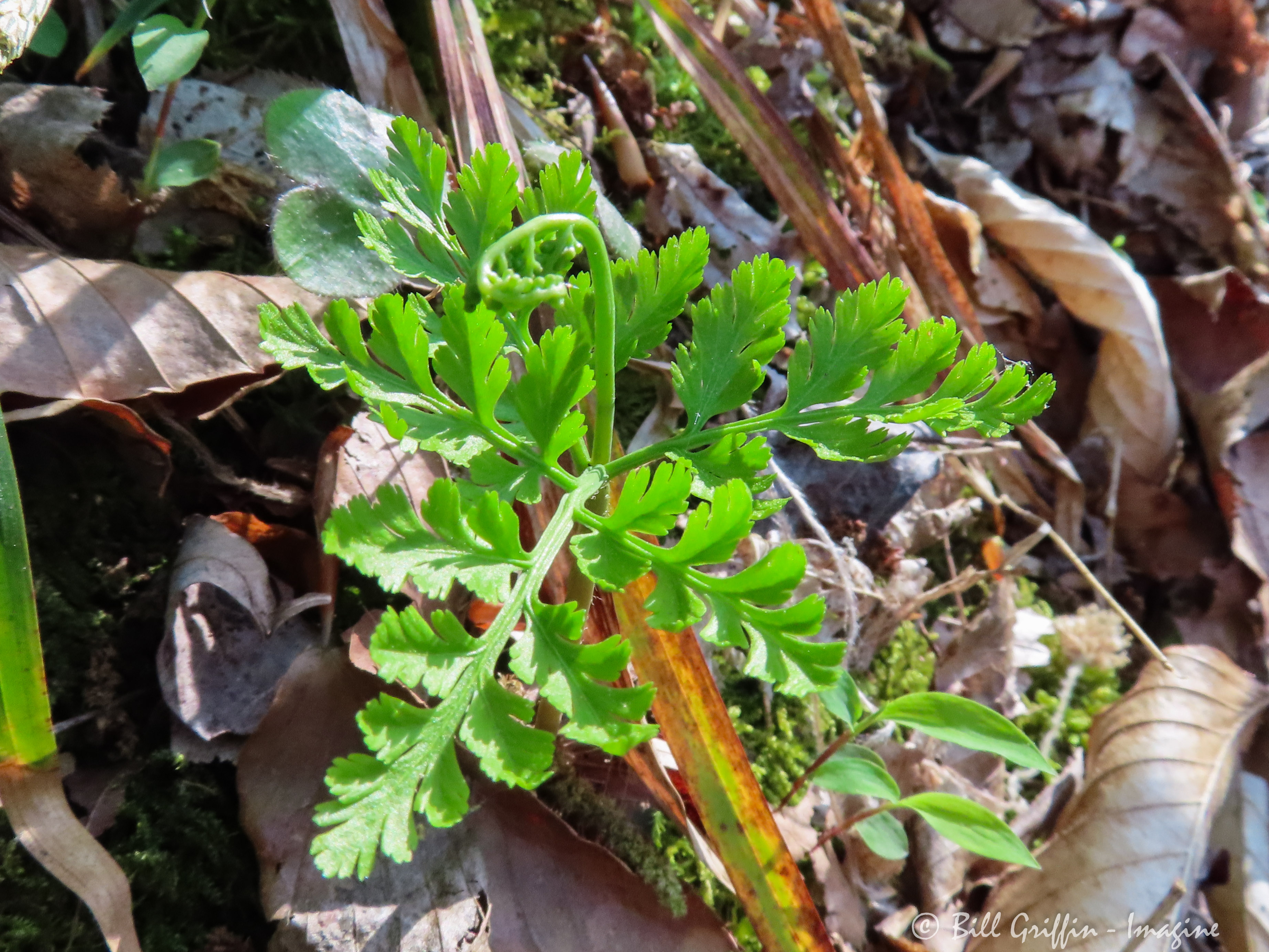
Rattlesnake Fern, Botrypus virginianus

 . 
❦ ❦ ❦
 . 
The Cormorant
    for Eunice
 . 
Up through the buttercup meadow the children lead
their father. Behind them, gloom
of spruce and fir, thicket through which they pried
into the golden ruckus of the field, toward home:
 . 
this rented house where I wait for their return
and believe the scene eternal. They have been out
studying the economy of the sea. The trudged to earn
sand-dollars, crab claws, whelk shells, the huge debt
 . 
repaid in smithereens along the shore:
ocean, old blowhard, wheezing in the give
and take, gulls grieving the shattered store.
It is your death I can’t believe,
 . 
last night, inland, away from us, beyond
these drawling compensations for the moon.
If there’s an exchange for you, some kind of bond,
it’s past negotiation. You died alone.
 . 
Across my desk wash memories of ways
I’ve tried to hold you: that poem of years ago
starring you in your mater dolorosa phase;
or my Sunday picnic sketch in which the show
 . 
is stolen by your poised, patrician foot
above whose nakedness the party floats.
No one can hold you now. The point is moot.
I see you standing, marshalling your boats
 . 
of gravy, chutney, cranberry, at your vast
harboring Thanksgiving table, fork held aloft
while you survey the victualling of your coast.
We children surged around you, and you laughed.
 . 
Downstairs the screen door slams, and slams me back
into the present, which you do not share.
Our children tumble in, they shake the pack
of sea-treasures out on table, floor, and chair.
 . 
But now we tune our clamor to your quiet.
The deacon spruces keep the darkest note
though hawkweed tease us with it saffron riot.
There are some wrecks from which no loose planks float,
 . 
nothing the sea gives back. I walked alone
on the beach this morning, watching a cormorant
skid, thudding, into water. It dove down
into that shuddering darkness where we can’t
 . 
breathe. Impossibly long. Nothing to see.
Nothing but troughs and swells
over and over hollowing out the sea.
And, beyond the cove, the channel bells.
 . 
Rosanna Warren
from Poems for a Small Planet: Contemporary American Nature Poetry, Middlebury College Press, University Press of New England; A Breadloaf Anthology © 1993.
 . 
In the Afterword to Small Planet, Robert Pack writes, “When the primary models for beauty and creativeness no longer are grounded in nature, we will already have evolved into another kind of species. . . . Without the sense of beauty that derives from an awareness of others, from the realization that we are merely creatures in an evolving world that we share with other creatures, a prior world on which our fabricated cultural world depends, the capacity for taking delight in our surroundings will wither away. Even before the planet becomes inhospitable to the human species, we will have died in spirit.” 
 . 
One thing we inevitably share with every other creature is our mortality. Turning our backs and refusing to see death, or chasing promises to extend our lives at all costs, are simply among the many ways that we also choose to ignore and overlook life. Lichen stone and bee, ghost cattail and cormorant, I will sit down at your wake and invite you to mine. Until that day, let us live together. – Bill Griffin
 . 

Sensitive Fern, Onoclea sensibilis

 . 
❦ ❦ ❦
 . 
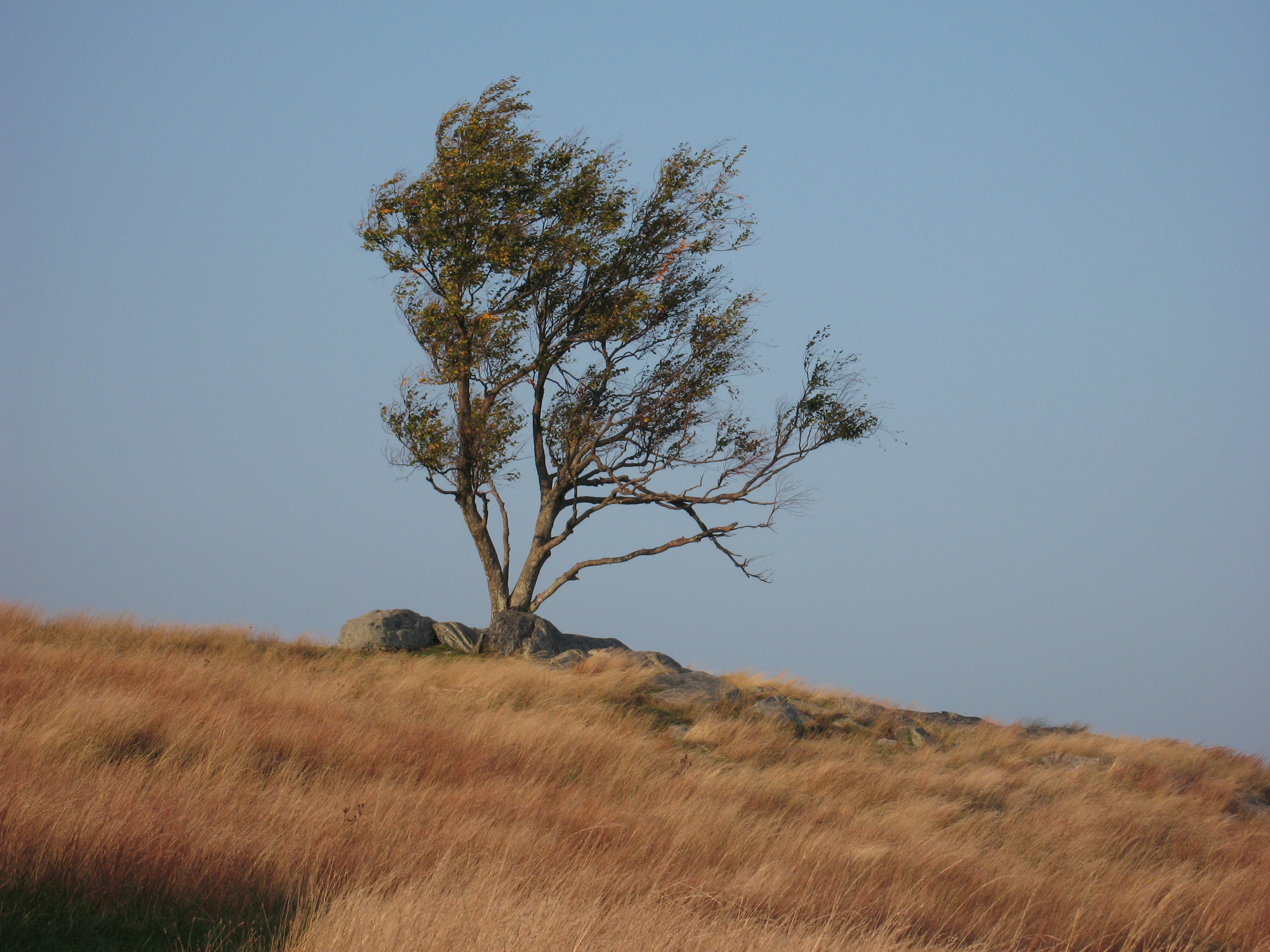
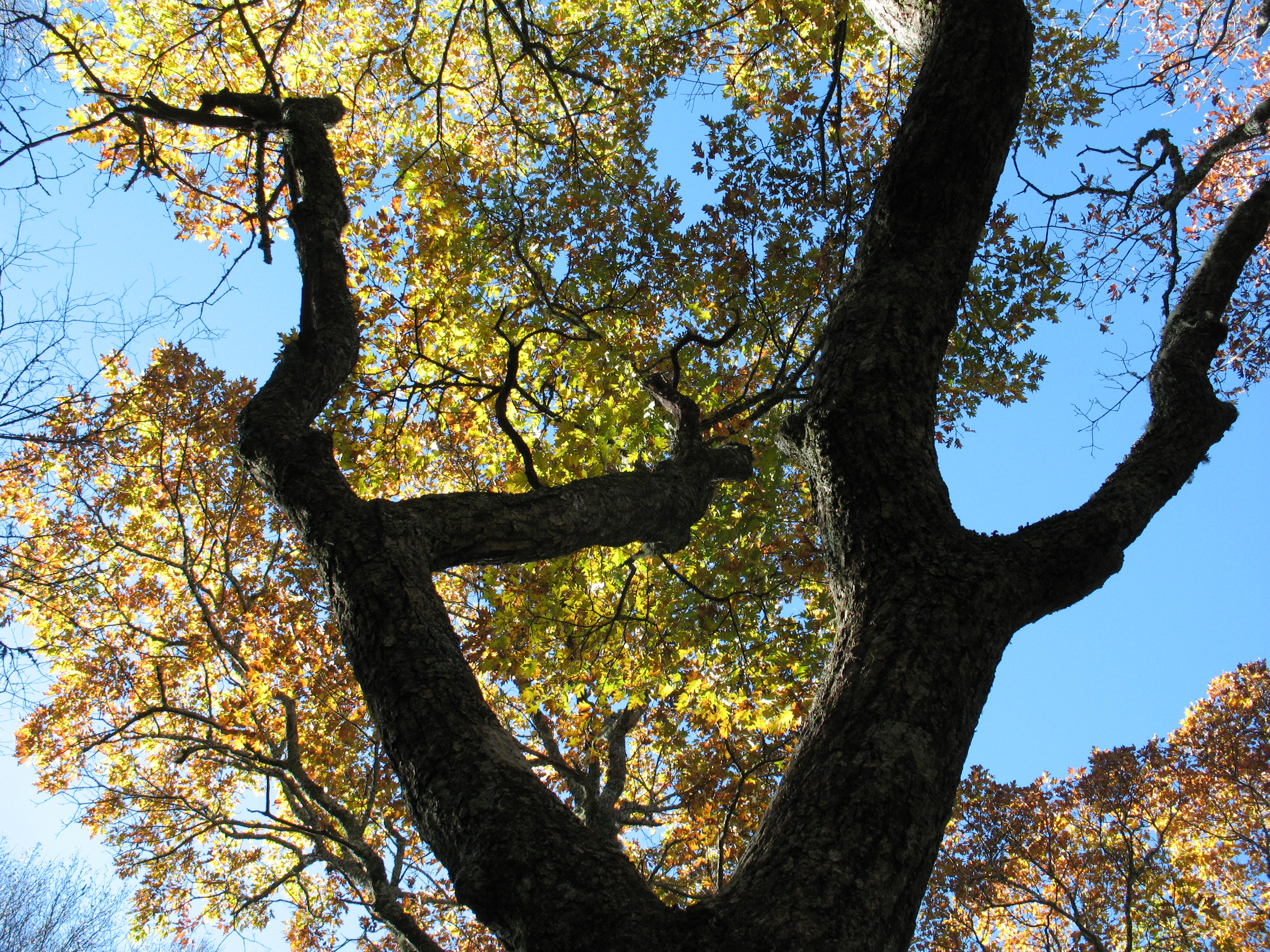
Doughton Park Tree 2016-05-08a
 . 
 . 

Read Full Post »

 . 
[poems by Veiga Simões, Barbara Conrad, Mary Oliver, Camille Dungy – 
selected and shared by Christina Baumis, David Radavich,
Scott Owens, Bill Griffin] 
 . 
Ao Viandante
(To the Person Who Passes Through This Place)
 . 
You that pass and raise your arm to me
before you hurt me, look at me well.
I am the heat of your home in the cold winter nights.
I am the friendly shade that you find
when walking under the August sun
And my fruits are appetizing freshness
That satisfy your thirst on the way.
I am the friendly beam of your house, the board of your table
the bed in which you rest and the wood of your boat.
I am handle of your hoe, the door of your dwelling
the wood of your cradle and of your own coffin.
I am the bread of goodness and the flower of beauty.
You that pass, look at me well and do no harm.
 . 
Veiga Simões
a tree with a poem on sign beneath it, located in Lisbon, Portugal.
 . 
This poem brings into stark view how we use and harm trees in a final plea from the tree; “You pass, look at me well and do no harm.” The poem certainly made me ponder the consideration of a grove of trees and what they give of themselves for us and our community over generations from their community. As a nature lover who enjoys walks under and among trees, trees had my gratitude already, yet this poem enhanced it even more.  The poem is written almost a caveat, testimonial, or witness statement from the specific tree in Lisbon. The article in which this appeared had a nice side note about the relationship between tree canopies and crime rates, too. – Christina Baumis
 . 
 . 
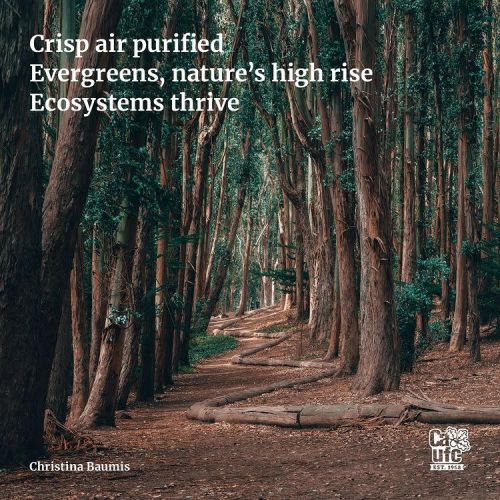
Evergreen trees are like nature’s high rises; their community intermingles to sustain ecosystems as well as us.  Posted on the California Urban Forests Councils’ Facebook Page (published on January 21, 2024) from their Haiku contest 2024.
 . 
❦❦❦
 . 
The last word in ignorance is the man who says of an animal or plant: ‘What good is it?’ If the land mechanism as a whole is good, then every part is good, whether we understand it or not. … To keep every cog and wheel is the first precaution of intelligent tinkering.  – Aldo Leopold
 . 
❦❦❦
 . 
Blue in Winter, Blame the Moon
 . 
+++ after a New York Times article on biological rhythms,
+++ peppered with phrases from the dining section
 . 
Blue in winter, blame the moon, say the scientists
for anyone living dark in the northern latitudes.
 . 
Overeating, sleeping in fits, activity cycles
shifted—even for mutant hamsters and fruit flies.
 . 
We trudge through cabbage season, tongue tingling
at the thought of gumbo and Sazerac, more laissez-faire
 . 
than the fusty French.  Earth spins and the moon
thumps inside our cells.  Trillions of clocks, ticking, ticking.
 . 
The universe feels it.  Some cataclysm must have caused
our nights to topple like this, seasons spliced
 . 
like a butchered hog.  We’re a mélange of earth crust
and asteroid dust—yes, that asteroid,
 . 
ejected into space, continuing as moon, tilting
primordial earth.  We are orbs of something
 . 
we can’t quite claim.  A recipe for stardust.
Chickpeas coming home to roost.
 . 
Barbara Conrad
from There Is a Field, Future Cycle; ©  2018
 . 
I have long been a fan of Barbara Conrad’s poetry, admiring her commitment to social justice causes.  This poem is remarkable for its yoking of the cosmic and the everyday, with climate change radiating in the nexus between galactic forces and routine human activities like eating and sleeping.  Plus lots of colorful imagery you can feel and taste.  The final line is a trenchant joke but also brings the interplanetary down to earth, namely to our dinner tables.  Delicious!  – David Radavich
 . 
 . 
In the New Year
 . 
Ice is on the move—
broken off and floating freely
toward South Georgia Island
with a force to wipe out
indigenous life
and redirect our planet.
 . 
Those of us far away
see mostly waters rising,
rising, claiming
sand and beach houses
and boats of the wealthy
along lapping shores.
 . 
Carving of life
by the power of tides.
 . 
So we arrive at
another year: uprisings,
more ire in politics,
love reduced to islands
under siege,
 . 
we move inward
to protect ourselves—
bold nesting terns
or astronauts
in deepest space.
 . 
David Radavich
from Snapdragon
 . 
❦❦❦
 . 
All ethics so far evolved rest upon a single premise: that the individual is a member of a community of interdependent parts. . . . The land ethic simply enlarges the boundaries of the community to include soils, waters, plants, and animals, or collectively: the land.  – Aldo Leopold
 . 
 . 
❦❦❦
 . 
Wild Geese
You do not have to be good.
You do not have to walk on your knees
for a hundred miles through the desert repenting.
You only have to let the soft animal of your body
love what it loves.
Tell me about despair, yours, and I will tell you mine.
Meanwhile the world goes on.
Meanwhile the sun and the clear pebbles of the rain
are moving across the landscapes,
over the prairies and the deep trees,
the mountains and the rivers.
Meanwhile the wild geese, high in the clean blue air,
are heading home again.
Whoever you are, no matter how lonely,
the world offers itself to your imagination,
calls to you like the wild geese, harsh and exciting –
over and over announcing your place
in the family of things.
 . 
Mary Oliver
from Dream Work, Atlantic Monthly Press; ©  1986.
 . 
One of my favorite poems ever by one of my favorite poets ever. Wild Geese simply reminds me of my place in the intricate web of existence, in the universal community. – Scott Owens
 . 
 . 
Wild and Precious
In Memoriam, Mary Oliver, 1/17/19
 . 
Seen at a distance this time of year
when trees are silhouettes
against a white sky
every shadow, I think,
must be a bird I’d like to identify,
waxwings, falcon, the largest of them
surely a beautiful hawk waiting
to chase a careless squirrel
across the yard and twice
around the trunk of the pecan tree,
rising on perfectly banked wings
so close it could almost reach out
and grasp the tuft of tail fur
dancing behind.
 . 
Often it turns out to be mistletoe,
nest, mere leftover leaves,
but even these speak
of life that was,
that will soon enough return,
and that thankfully always is.
 . 
Mary Oliver, the woman I’ve introduced
to more than 40 years of new students
as one of our greatest living poets,
died today,
but in view of trees, and birds,
and winter skies, and everything
that can be expressed in leaves,
it is impossible to think of her
as ever going away.
 . 
Scott Owens
from Prepositional, Redhawk Publications; © 2022
 . 
❦❦❦
 . 
A philosopher has called this imponderable essence the numenon of material things. It stands in contradistinction to phenomenon, which is ponderable and predictable, even to the tossing and turning of the remotest star. The grouse is the numenon of the north woods, the blue jay of the hickory groves, the whisky-jack of the muskegs, the piñonero of the juniper foothills. – Aldo Leopold
 . 
 . 
❦❦❦
 . 
Trophic Cascade
 . 
After the reintroduction of gray wolves
to Yellowstone and, as anticipated, their culling
of deer, trees grew beyond the deer stunt
of the mid century. In their up reach
songbirds nested, who scattered
seed for underbrush, and in that cover
warrened snowshoe hare. Weasel and water shrew
returned, also vole, and came soon hawk
and falcon, bald eagle, kestrel, and with them
hawk shadow, falcon shadow. Eagle shade
and kestrel shade haunted newly-berried
runnels where mule deer no longer rummaged, cautious
as they were, now, of being surprised by wolves. Berries
brought bear, while undergrowth and willows, growing
now right down to the river, brought beavers,
who dam. Muskrats came to the dams, and tadpoles.
Came, too, the night song of the fathers
of tadpoles. With water striders, the dark
gray American dipper bobbed in fresh pools
of the river, and fish stayed, and the bear, who
fished, also culled deer fawns and to their kill scraps
came vulture and coyote, long gone in the region
until now, and their scat scattered seed, and more
trees, brush, and berries grew up along the river
that had run straight and so flooded but thus dammed,
compelled to meander, is less prone to overrun. Don’t
you tell me this is not the same as my story. All this
life born from one hungry animal, this whole,
new landscape, the course of the river changed,
I know this. I reintroduced myself to myself, this time
a mother. After which, nothing was ever the same.
 . 
Camille T. Dungy
from Trophic Cascade, Wesleyan University Press. August 16, 2021 at Poems.com
 . 
Yesterday walking beside Elkin Creek, Linda and I remarked that Wood Anemone and Star Chickweed like to grow together. Each white bloom points to its friend and neighbor. Why? Just the right balance of sun and shade for them both? Enough nourishment in the leaf mould but not too much? Are their tiny hands clasped beneath the surface in a group hug of mycorrhizal fungus?
 . 
I remind myself that the connections and community are so much vaster than I can even imagine. And I recall this final quotation by Aldo Leopold:
 . 
. . . Modern natural history deals only incidentally with the identity of plants and animals, and only incidentally with their habits and behaviors. It deals principally with their relations to each other, their relations to the soil and water in which they grow, and their relations to the human beings who sing about “my Country” but see little or nothing of its inner workings.  – Aldo Leopold
 . 
[all quotations are from A Sand County Almanac, Oxford University Press. © 1989]
 . 
❦❦❦
 . 
 . 
Doughton Park Tree 2016-05-08b

Read Full Post »

Older Posts »