Feeds:
Posts
Comments

Posts Tagged ‘Bill Griffin’

 . 
[including Carbon Canyon by David Duchovny]
 . 
We cannot know how good for us
the bad times were. 
. . . . . . . . . . . . . . . . . . . .High Five in the Sky
 . 
Bill and I decide to take a walk together this autumn afternoon. The year is 2020. Does visceral memory plunge you into context? When did he and I last see each other, if only above the nasal hem of an N-95? But today we will be together outdoors, the light breeze adequate to disperse particulates as we pick our way along the steep trail down to Dutchman Creek below our homes. Near neighbors, nearly always separate in our daily meanderings. Today reconnecting. Today again confessing to each other that we are connected somewhere deep in our guts, spleen & pancreas, since that first day in 1979 when Bill introduced himself to me as my Senior Resident and I stepped onto the wards at Durham County General as an Intern.
 . 
That first night we stumbled on the brink of fucking up completely. One patient we had stabilized and put to bed crashed at 3 AM while we were looking elsewhere. We were able to bring her back and at 0600 coffee before rounds with the Attending we listed to each other all the things we’d just learned. Still learning now, forty-one years later, Bill on the bench I’ve planted on my hill and me on a rock six feet distant. We confess completely fucking up again, this time our friendship when we split ten years after that very first connection. Time is not calligraphy, an artful line advancing with curlicues that mark each pleasant memory. Time is a patchwork of craters where the bombs went off. Time may soften a few scars, allow fireweed and fleabane to bloom amidst the desecration, but be careful you don’t stumble at the lip of former chaos.
 . 
Or do stumble. Look up for once from always looking down. Pull up your sleeve and share the bruises. I’m talking to you, one Bill to another Bill. I am grateful to have you as my friend.
 . 
 . 
❦ ❦ ❦
 . 
Carbon Canyon
 . 
We lived in Carbon Canyon the, before the fire,
unpack that given irony – were there no
carbon copies, we so unique and blessed?
 . 
There was a time when I walked
with my three-year-old daughter
(I think three . . .).
Anyway, I know we were walking the deep decline
of Carbon Canyon
on one of those short, mommyless jaunts . . .
And we came upon
the recently car-crushed carcass
of a gray field mouse, part three-dimensional
as in life,
part flattened as in a drawing,
the weight of the car
having made its lower half unreal, a cartoon.
The drive long gone,
unaware of their handiwork, guiltless.
 . 
A tiny trickle of blood from its slightly opened
mouth, a last profound unheard utterance,
so perfectly dramatic and telling
as if to seem placed by a movie crew
hiding in the bushes perhaps.
 . 
And my daughter (two, three, four?)
about to spy it on the ground, and I, a daddy,
with knowledge spilling out of my pockets,
life lessons, sense a teaching moment for the disquisition
on mortality that very parent believes
every three-year-old needs –
(see, it all ends, best laid plans and all that,
life’s unfair; carpe diem, little one;
Latin for . . . heaven; there but for the grace of god –)
in these moments, I realize I am nothing but a recording
of my own parents’ voices – their greatest hits,
my soul their phonograph . . .
 . 
Fade in: a father slows his daughter, allowing
the chance to happen upon a dead mouse,
it/death knowledge. Consequence. Mortality.
But it is only now, as we kneel,
that I notice the vibrant cha-cha line of ants
dancing in and out of the ruined creature
in all their anarchic discipline,
carrying to and fro unseeable bits of meat
and nutrient mouse ooze.
 . 
And my breath catches
because suddenly this lesson is for Daddy,
and it is Daddy who cannot face too much death,
the death after death, my death
in this mouse’s mouth, my daughter’s death.
I’ve not quite stomach enough
to face the pieces of us all carried off into oblivion,
eaten till we are unrecognizable, digested,
shit. Roadkill.
 . 
Dizzying, I say, “Oh, let’s go sweetheart . . .”
 . 
But it’s too late – my daughter,
two or three or four, has seen
leans down farther, her blue eyes
in inch or two from the ground, and says,
“Daddy, look the ants, there’s so many of them.”
“Yes, I see. Maybe we should let the mouse sleep, let her
sleep.”
 . 
I take her hand to lead her, though I don’t know where.
I know I am blind and unprepared,
a child leading a child,
and the little one stops and smiles,
and points back to the carnage –
 . 
“No, the ants, Daddy, the ants – look how much they love
her.”
 . 
David Duchovny
from About Time, Akashic Books, Brooklyn NY; © 2025
 . 
❦ ❦ ❦
 . 
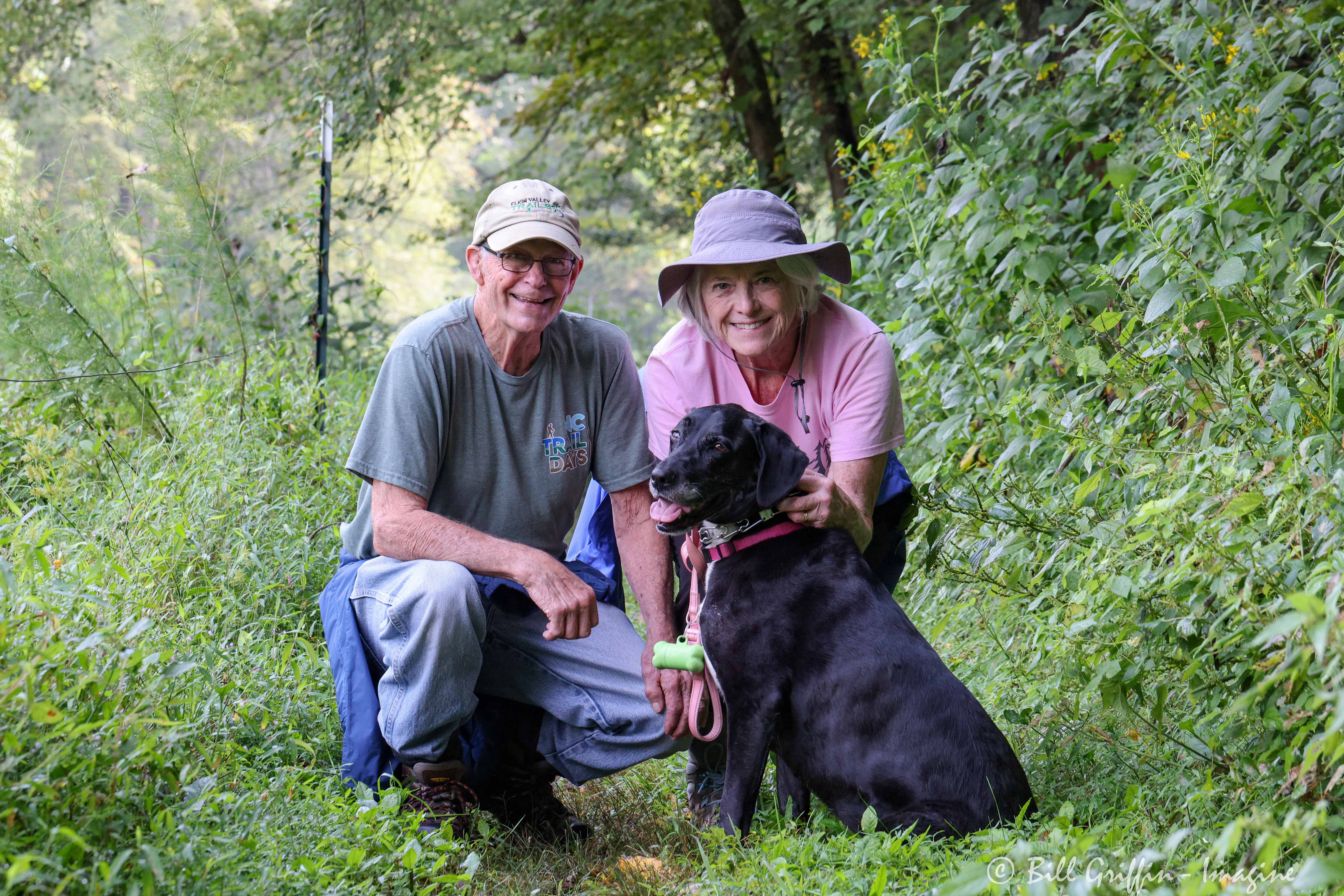
This morning, 6 Sept. 2025, I pick Bill up at his door for another walk. Before we get in the car he hands me a gift, a book, a book of poetry. Poetry, admit it, has been the gravity that brought Bill and me back to earth after we had orbited so far apart. Years of smoldering enmity smoke out when a friend made us sit down together in the sam room to read poetry, to write it, to share it with each other. Something as tenuous as spider silk can still contain the angry wasp – we did indeed think we were still intent on stinging each other until we discovered we weren’t. One line leads to another. Today Bill reaches out to give me David Duchovny’s book after he himself has read it, most pages heiroglyphed with his own lightly pencilled checkmarks and squiggled connectors. Which I will pay more attention to than the words themselves.
 . 
Time, I tell myself, is a crap teacher. I’m always ever looking backwards at the time I’ve mangled and wasted, misunderstood and misspent. If time is so instructive, why can’t I look forward and craft a hunk of time into the shape I hope it shall become? Now time has brought Bill himself across a health threshold from which there is, this time, no returning. We talk about it as we reach our trailhead; we live within its reality as we walk the trail. We reach our limit, turn around, walk back towards the car, and time keeps on arrowing in its singleminded direction. Here we stand in the mess and glory of autumn blooming. Some flowers, dying and dry, want their seeds to hitch a sticky ride on our pants; some pods pop as we brush by; some buds are just this day erupting. Time is not a thread. Time is a thousand threads, a billion-billion threads and all tangled and intertwined like this patch of hog peanut within the thicket of goldenrod. You can’t pick it apart but here and there you can find the flowers. Wherever our threads have crossed and re-crossed, Bill, I will keep learning to be grateful.
 . 
❦ ❦ ❦
 . 
David Duchovny is an actor, director, singer-songwriter, podcaster. About Time, his first full length poetry collection, follows four published novels and is available HERE.
 . 
❦ ❦ ❦
 . 
 . 
 . 
Read Full Post »

 . 
[for my mother]
 . 
Liminal
crepuscular
 . 
You take my hand and lead
me from the porch, leavings
of sticky watermelon rind,
half-eaten hotdogs, out into
the yard where the older kids
whoop in the descent
of darkness almost too deep
to see through; at its edge
grownups in folding chairs,
the orange winks of their cigarettes
like lightning bugs.
 . 
Too dark. You feel me hanging back
but here around the corner
real fireflies guide us, cool green,
silent. You catch one
in your hands, Like this . . .
when I was a girl, laughing
in the twilight; you pinch off
its tiny ember and smear
the glowing on your eyelids
so that when you close your eyes
its faint gaze assures
that you still see me.
 . 
And the truly wondrous thing,
besides this moment together while
the luminescence fades
and I am able too to laugh,
is that once you were a girl.
 . 
❦❦❦
 . 
All stories are true. The story’s facts may get a bit smudged & skewed, a bit shuffled & stretched, a bit jiggled & juxtaposed & conflated, but the story’s truth is undiminished. Good stories know their truth. The best stories know your truth. You discover it in their pages. Perhaps it was always in you, smudged & skewed – now you are following its trail into the open.
 . 
A poem has its own particular way of telling its story. Planed down until you can see the grain. That burl is a metaphor for the winter storm when something cracked. The curly maple echoes laughter you can still hear tinkling faint from the past. Storms and laughing are metaphors for what you’re facing this morning when you roll out of bed. The poem rolls you out of bed. It won’t feed you lying down.
 . 
And in a poem the story lives on its own fine edge. It balances the limn between nothing and everything. Wait here, breathing slowly, at the transition between dusk and night. Or between darkness and dawn. The poem’s story may seem at ease but in the silence beside the swift river you can hear the rush, the flow, the movement. The poem taps the shoulder of awareness – look ahead, look back, live right now in all those moments that coalesce to make a life. Your story is unfolding, and don’t you know it’s true?
 . 
 . 
❦❦❦
 . 
Liminal
riparian
 . 
Let’s tube the Brandywine: you
are brilliant, my kids so fractious,
lucky to keep them for an hour
in the same room with Grandmommy
much less engaged.
All the lazy afternoon
watched over by staid sycamores
of summer, the splashing,
the dunking, and through smooth
passages you get them talking
about yesterday’s museum, Howard Pyle
and the Wyeths, art, its stories,
how if we can only imagine
something strongly enough
we may make it so.
 . 
Imagine: all things flow,
the benevolent stream, its clarity
every possibility of color
and everything it collects,
benediction of damp
on our bodies, water and salt,
half-adrift in the dailyness
of life and where
might this meandering take us?
 . 
At the takeout toweling off
you touch my shoulder, point:
a tree swallow’s looping masterwork
has knit together river, forest, sky,
metallic blue . . . brilliant.
 . 
❦❦❦
 . 
A story about Mom: when I was five we lived in a little house on Marion Road in Memphis. Mom had made a special cake for my birthday surprise, German chocolate with thick gooey coconut and pecan frosting. She hid it in the little closet pantry until after supper, but when she brought it out for five candles, she wept. It was covered with ants. Don’t you think my brother and I were able to pick off the little crawlies and eat it anyway? And every year at birthday time we piped up, “Mom, make us another Ant Cake!” It was years before she could laugh.
 . 
Another one: Mom and Dad moved away from the South before I was born, but her friends in Michigan or Ohio or Delaware could still detect the remnants of her North Carolina accent. I believe they always thought her a bit prim. When I was fifty I happened to visit Mom in Wilmington DE around Halloween. She said, “Let’s go trick-or-treating!” I figured we’d just walk down the block and say Hi to the neighbors, but she came out of the bedroom wearing a cape and hunchback, an old wig pulled all the way down over her face, and stark staring eyes painted on her cheeks. A wooly booger. None of the neighbors knew who the hell she was and they flinched visibly when she cackled.
 . 
Last story?: Mom was the czarina of crosswords, and she could finish the entire Jumble in the morning paper while I was still juggling the first word. The last few months of her life, at ninety-six, she would sit on the couch after breakfast and I would bring in the paper, sit down beside her, and hand her a pen. Sometimes, I admit, I had to offer her hints (assuming I myself could figure out the words). But at times she would put pen to paper, hesitate just a moment, and fill in the blocks with faint, spidery letters. Just right, Mom. Just right.
 . 
 . 
❦❦❦
 . 
Liminal
nonagenarian
 . 
Every Sunday after church I knock
at your kitchen door then forge on through
to the living room before you can struggle
from your favorite chair, milky tea
half-finished, The Times crossword
and a few spaces you’ve saved me,
78 down, wings, four letters, and today
I’ve brought my grand-daughter,
 . 
your great-. We’ve taken to calling her
Sister like your brother and all
the cousins called you,
and while she cuddles your old doll
almost ninety itself and explains
to it the universe of her three years
you settle your pad across your lap,
charcoal on your fingers, capture
the purity of her which is the closest
we will ever come to defining love,
the three of us a grand alignment
 . 
of planets in some untrammeled
system, and although the scratch scratch
on paper binds me to this moment
I see you luminescent, intangible,
the halo of fine white hair that limns
your face, your wings, alae,
strong enough to lift us all.
 . 
Bill Griffin
first appeared in Grey Sparrow Journal  –  Issue 32, Summer 2018
 . 
❦❦❦
 . 
 . 
2020-06-11a Doughton Park Tree

Read Full Post »

 + 
[with 3 poems by Sarah Small]
 + 
Dad, Peeling Apples
 + 
++++++ The color of wheat
bread speckled
like the skin of a Golden Delicious,
freckles on top of freckles
and tiny nicks
from his knife, dots of blood
turned to brown scabs.
My father’s hands
 + 
have never changed. Every night
a different apple
skinned naked,
split and seeded without him
ever looking down, loving the fit
 + 
of apple
in the left hand, brown-handled
knife in the right.
He licks the tip of his finger
where the juice runs clear
and skewers a slice
 + 
for me, which I take
regardless
of whether I want
an apple or whether
the flesh has begun to brown
around the edges.
 + 
When he is done,
knife set down and fingers wiped
clean against the legs
of his beige corduroys, I will take
the leathered back
of his hand to my cheek
and hold it there, begging
 + 
his weathered roots to spread
their soil-caked fingers
long and strong
as deep as the generations will go.
 + 
Sarah Cummins Small
from Stitches, Finishing Line Press, Georgetown, Kentucky. © 2025
 + 
❦ ❦ ❦
 + 
Last week I was out on the Mountains-to-Sea Trail with Bob and Steve digging ditches. “Erosion mitigation features” – yeah, ditches. Along one stretch we kept turning up huge earthworms, dozens of them, fat and long as little snakes. As we rescued each one and chucked him/her off the trail, Bob turned to me, local naturalist, and asked, “Say Bill, can you tell which is male and which is female?” Smirk on, Bob. If I recall correctly from Mrs. Schilling’s high school biology, every worm is both. One end is boy and the other end is girl, hermaphrodites. When they want to make little wormlets, they line up parallel head to tail and exchange genetic material. Slimy but exciting!
 + 
Thank you Hermes, Aphrodite, and Mrs. Schilling, whose motto was, “There’s no place in the world for weak women!” Everybody, now, hands on! as we dissected our earthworm. And each 9-week term Mrs. Schilling also sent us out collecting: leaves, insects, fungi. In mid-winter Ohio it was bare bud identification time, each labeled per Linnaeus. I’ve never forgotten Acer rubrum and Quercus alba. My lab partner Dave tried to foist off the bare tip of his defunct Christmas tree as one of his collected buds. Just before he turned his project in, I replaced its label (Pinus pinus?) with Gluteus maxiumus. It was exactly five minutes before Mrs. Schilling’s menacing contralto penetrated to our back row table: “Mr. Mason, come forward!”
 + 
Mrs. Schilling was one of my three most memorable teachers (Mr. Geigel, English, and Herr Watt, German, the other two). I am still in love with Latin binomials and squishy things thanks to her. Mrs. Schilling would certainly never shrink from describing in the most squirm-inducing detail the reproductive habits of earthworms. And at age 15 who is not obsessed with sex in all its varieties, manifestations, and practices? I can’t in all honesty confess that the mystery has even now been fully dispelled, although I think I may have finally figured out the convoluted sex life of ferns. (Listen up, y’all, that’s pronounced Thallus.)
 + 
When I was 12, Dad never sat me down for THE TALK. He just handed me a slim pamphlet, mysteriously titled Where You Came From, then sent me off to read it somewhere my little brother couldn’t peep. “When you’re finished, let me know if you have any questions.” I returned it to him later with the 1965 equivalent of “All good,” but for at least the next two years I still confused female anatomy with British monarchy (Elizabeth Regina). And now I’m supposed to be the one to sit Dad down at 98 and explain to him the facts of why he can’t be asking his physical therapist out on a date? I think I’d rather just stick with the earthworms.
 + 
 + 
❦ ❦ ❦
 + 
War
 + 
++++++ Our mother is beautiful
Without makeup, with the round balls
Of her cheekbones like crabapples
Or plums, and her crooked front
Tooth. But with a little
Pencil to shade in the sharp arch
Of eyebrows and bright red lipstick, she becomes
A black-and-white
Photograph hung in a young man’s barracks
Where in the early evening before dark
And after a green supper, one soldier lies
Sideways on his cot facing her,
Tracing the soft outline of her cheek
With one knuckle, three fingers from his lips
To hers and back. We will never be
So carefully memorized.
 + 
Sarah Cummins Small
from Stitches, Finishing Line Press, Georgetown, Kentucky. © 2025
 + 
❦ ❦ ❦
 + 
We will never be / so carefully memorized – Sarah Small begins her collection Stitches with a portrait of her parents in the 1940’s, deeply imagined, drawn deep from her heart. Poem by poem she pieces a quilt of memory and legacy, reverence and longing. This is one poetry collection that left me wanting more when I had turned the final page. Its beautiful pattern gradually emerges, on each page so carefully felt and conveyed. The simplest things conceal the greatest mysteries. Within the simplest the greatest is revealed.
 + 
The poet’s eye and ear, her imagery and music, each delicate detail and meticulous observation, all the lives shared, every secret revealed: the colors and textures arrange themselves until we recognize not only the poet’s family but our own place among the tribe of humankind. These are indeed the stitches that gather us into a single human family.
 + 
 + 
Stitches is Sarah Cummins Small’s debut collection and is available HERE.
The book’s cover art and design are by Summer Small.
 + 
 + 
❦ ❦ ❦
 + 
Unstitched
 + 
I am held together
by tiny stitches
on small scraps of feed sack,
snatches of wool, snips of gingham.
A patchwork of pastels—
a slipshod collage of cotton.
I’ve been silk, satin, taffeta;
I’ve been flowers, polka-dots, and plaid.
 + 
Thin white thread
++++ ++++ zig-zags
++++ across
++++ ++++ the decades
++++ hemming me in, keeping me
from ripping.
 + 
I’ve been zipped.
++++ Buttoned.
++++ ++++ Unsnapped.
I’ve been bumblebunched, twisted,
and straightened. Held pins in my mouth,
pricked fingers, and calloused
my thimble-less thumbs.
 + 
I am done.
Unravel me now:
Rip out the seams
one by one, untwist strings
and untangle knots. Fold me gently.
What I haven’t finished—
take now.
Begin again.
 + 
Sarah Cummins Small
from Stitches, Finishing Line Press, Georgetown, Kentucky. © 2025
 + 
❦ ❦ ❦
 + 
Just a reminder that I m leading a naturalist hike the morning of Friday, September 12, 2025 on the Mountains-to-Sea Trail near Elkin and you are invited. During the month of September we celebrate the birthday of the MST! It’s an easy walk, 2 hours or so, lots of stops to check out flora and fauna. Sign up at:
 + 
 + 
And if you can’t come on the Friday, we will probably repeat the hike on Saturday, September 27. Sign up with Elkin Valley Trails Association at Meetup.com to receive notices.
 + 
 + 
❦ ❦ ❦
 + 
2014-06-30a Doughton Park Tree

Read Full Post »

« Newer Posts - Older Posts »