Feeds:
Posts
Comments

Posts Tagged ‘Bill Griffin’

Southern Sentence Poem Revisited

Last week when I reminisced about my Granddaddy, Pee Wee Griffin, Seaboard Airline Engineer for some fifty years, among the many comments I received was Kathryn Stripling Byer’s: The song of a train passing has haunted many a Southern poet’s work.  Haunted, that is indeed what we are.

Yesterday I caught a snippet on public radio by a Civil War historian at Duke.  He describes Governor Graham dragging his heels about secession; as much as a third of North Carolinians opposed war.  The Duke Prof then tells about pulling into a barbecue restaurant in Kinston recently.  During the War, General Pickett encamped at Kinston on his return from a disastrous attempt to recapture New Bern from the Union.  In Kinston Pickett hanged twenty-two North Carolinians he considered deserters, though most of them had never sworn the oath to the Confederate Army.  Pickett was later accused of war crimes and fled to Canada – the historical point being that allegiances, honor, and motivations are a lot more complicated than South vs. North.  When the Professer parks at the restaurant and looks down the row of cars and pickups with Stars and Bars on their bumpers, he just shakes his head and says, “You don’t even know who you are.”

.     .     .     .     .

IMG_0132

Who are we, anyway?  That’s why there’s poetry – that we may discover who we are.  I’m pondering again the form an essentially Southern poem might take. Remember in August I suggested such a poem must include Place, Past, and Culture.  Our identity is complex, but a poem’s complexity lies in its brevity.  What sense most perfectly evokes a memory?  The sense of smell – impossible to describe, complex and heavy with nuance, a simple odor may transport you to a time and place you thought you’d departed forever.  I want a poem to do the same, to be vastly more than the sum of its words, to cause the reader to gasp and sigh at the same time.

Therefore, the SOUTHERN SENTENCE POEM MUST BE SEVEN LINES.

Why seven?  When I as a doddering old man kiss my great-grandchild, I will have held or been held by seven generations of my family.  There are seven Southern waters: spring from rock fissure, clear trout stream, green piedmont river, dam & lake, blackwater meandering, sound, shore.  Southerners more than many are subject to the seven deadly sins and seven heavenly virtues.  Don’t forget the seven bridges road in Montgomery, Alabama.  But most of all because I think seven lines is just the right length.

.     .     .     .     .

IMG_2789

So here’s another attempt:

When the train whistle blows
through the Yadkin Valley
we lay down our plastic toys,
lean across the porch rail
until the last beckoning
has trailed away, and I become
my grandson, wondering.

.     .     .     .     .

IMG_8451

Place – Yadkin Valley; Past – becoming my Grandson; Culture – porch rail and, of course, that lonesome, haunting train whistle.

Leave me your Southern Sentence Poems here or on our new Facebook Page.

.     .     .     .     .

IMG_3509

.

Read Full Post »

Each of us needs a friend who challenges us a little.  Someone who expects more from us than we expect from ourselves.  Who wiggles something interesting in our peripheral vision, something we may not have thought about in years, and just knows we will turn and reach for it.

I have a friend like that who wiggled poetry where I just couldn’t quite ignore it.  About twenty years ago Anne Gulley called: “Bill, the Friends of the Library is sponsoring a poetry series, and I think you should come.”  “The last poem I read was Walt Whitman in college.  Well, I think I did try to write Linda a poem for our twentieth anniversary.”  “There, you see.”

When I took German in high school our teacher, Herr Watt, spent as much time narrating all the Wagnerian operas for us as he did on pronunciation and declension.  He insisted, “This is important!  It’s part of your allgemeine Bildung*.”  Maybe it was curiosity, maybe I recognized the need to beef up my allgemeine Bildung, maybe it was a sheepish feeling of being undereducated, but I went to the series: six Sunday evenings reading contemporary poets I’d never heard of like A.R.Ammons and Sharon Olds.  Holy Zeitgeist, this was writing as fresh as today’s Washington Post and a couple of orders of magnitude more compelling.  My brain fizzed.  Thanks, Anne!  And the very best part was the instructor.

Joseph Bathanti drove down from the mountains for each of those Sunday sessions. So calm, so coaxing, another friend who just naturally expects more from you than you even expect from yourself, he held out a handful of seeds to the squirrels of our curiosity with confidence that we’d come.  When we read Ammons’s Hymn I shuddered to discover language that melds lyricism and physics, imagination and biology, the particular with the cosmic.  I had to discover more of this stuff.  I’m still discovering.  Thanks, Joseph!

IMG_4244

.     .     .     .     .

Last month Leighanne at the Foothills Arts Council called to see if I’d like read some poems at an event she was planning.  Music by “Not Your Usual . . . ,” wine by Grassy Creek, eight readers, she titled the evening BEAT!  If there are going to be beatniks, you can’t neglect Allen Ginsburg, so I decided to read America, but I also wanted to introduce folks who don’t know his work to our newest NC Poet Laureate – Joseph Bathanti.  I re-read Joseph’s newest collection, Restoring Sacred Art, and finally chose to read Your Leaving.

What grabs me about this poem (besides the razor sharp dead center descriptions) is the complexity of the characters, artfully revealed in just a few lines.  There’s the father laughing drunk the night before his daughter’s wedding, then next day standing stoic in his “mourning suit.”  Marie, giggling in a muumuu with her bridesmaids, is transformed, “perfect in all the ways a bride desires to be.”  Mother, one moment stern and organizing, the next moment lost “on the edge of her bed, still in her house dress.”  And of course there’s the little brother, angry at the cousins and the loss of his bed, but struggling with a greater loss as he begins his “apprenticeship as an only child.”  Ambivalence, conflict, longing, revelation – reading these lines is to walk into a new household and become part of the family.

.     .     .     .     .

Your Leaving
for Marie

The night before you married,
Pap’s godsons from Detroit
got him drunk and I had to help
wrangle him upstairs, so mad

I threatened to punch them.
Married men, cement finishers
with mortar grey hands who spoke
broken English with Michigan accents,

they wore Bermuda shorts, undershirts,
black socks and tennis loafers.
My outrage made them laugh.
A father marrying off his only daughter,

his best girl, after all, is entitled
on the eve of the wedding
to drink as much as he wants.
Pap laughed too,

but he felt sorry for me.  Like them,
he figured I was still innocent.
We laid him in my bed.
Mother wouldn’t sleep with him,

“stupid drunk
the night before his daughter’s wedding.”
She blinked the porch light off and on
to signal you in from kissing

your fiancé in his red MG,
the first Protestant
to marry into the family.
No wonder Pap got drunk;

it was you last night home.
Your bridesmaids slept over,
cosmetic kits and high, spun hair,
spit-curls scotch-taped to their cheeks,

rustling aqua gowns lounging
from the mantel on cloth hangars.
the six of you stayed up all night in muumuus,
laughing and eating popcorn.

Downtown, the groom and his ushers cheered
the stripers at the Edison Hotel.
I had nowhere to sleep,
so I crawled into your empty bed, and began

my apprenticeship as an only child.
The next day, Pap got up
and donned his mourning suit.
The girls descended the porch steps

in single file, heads bowed
over nosegays as the photographer
stilled each for posterity.
And you, only twenty, behind them,

without hesitation, disguised
in wedding dress and veil, perfect
in all the ways a bride desires to be,
the repeated click of the camera

documenting those first irrevocable seconds
of your leaving once and for all,
while upstairs Mother san on the edge
of her bed, still in a house dress.

© 2010 by Joseph Bathanti, Star Cloud Press, Scottsdale AZ

.     .     .     .     .

A couple of years after that Friends of the Library series Anne called again.  “We’ve arranged a Saturday morning poetry writing workshop at the Arts Council.  I really want you to meet Frank Levering.  And Bill is going to be there.”  A whole new story – estrangement, reconciliation, inspiration, new friendships.  Anne, you can’t quit challenging me!

While I was trying not to step in the bear scat on Albert Mountain two weeks ago, the Foothills Arts Council held opening night for Anne’s show Mythology–eyes, which will be up through most of November.  Her oils, from almost pocket-size to wall filling, are for me a little like that Ammons poem.  Rooted in closely observed and rendered beasts, landscapes, they branch and soar into surreal planes that challenge me to see, to think, to discover.  Thanks, Anne!  My allgemeine Bildung continues to accrue.

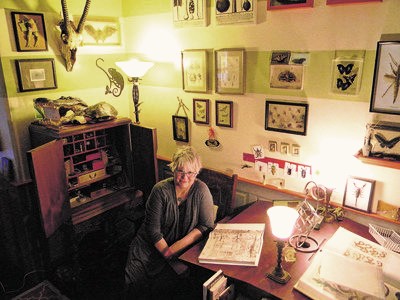
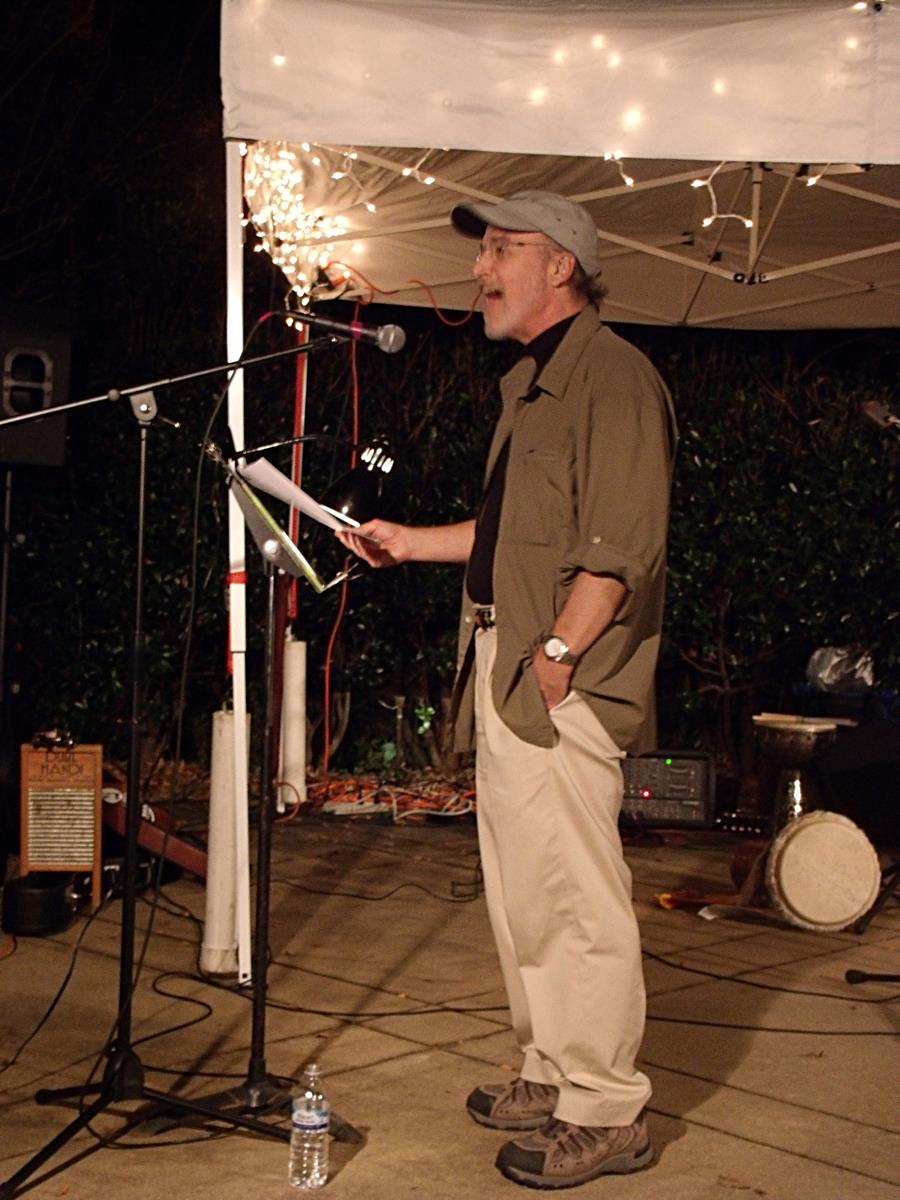
Here’s a photo of Anne cloistered in her Cabinet of Curiosity, and me reading Your Leaving at the FAC.

5W7E_Obscura_2

.     .     .     .     .

334773_504673889552553_984935058_o

.     .     .     .     .

*   Allgemeine Bildung = general culture, or education – Google the phrase for 17 megahits.

.     .     .     .     .

IMG_1827

Read Full Post »

Keep close to Nature’s heart, yourself;
and break clear away 
once in a while,
and climb a mountain
or spend a week in the woods.
Wash your spirit clean.
John Muir

IMG_3937

.     .     .     .    .

Why have they come?  Why have they driven hundreds of miles of highway and another twenty of Forest Service gravel to this Deep Gap?  Why have they tracked down my friend Mike Barnett and persuaded him to share with them everything they will need to know to spend a few nights on the trail? Why forsake comfort for mist, rain, steep switchbacks, cold nights, hard ground?  Why have they come here?

Now they huddle at the trail head – Judy, Nora, Cathy, Gloria, Joan, Nancy – median age 65 (just a wild guess, Ladies!).  They pull on fleece and rain gear because we’re already above 3,000 feet and it’s mid-October.  Mist condenses on the leaves and drips like rain.  The plan is to hike the AT for three days with everything we need to survive on our backs: food, stove, water & filter, tent, mummy bags, and lots of layers for nights just above freezing.  We’ll reward ourselves the third night with a short side hike to Albert Mountain and hope to catch the sunset and sunrise from the 5,280 foot summit and fire tower.

That sunrise seems a long way off as we hunker down for the first night half-way up Standing Indian Mountain.  It’s pitch dark , a “hunter moon,” first new moon after equinox, but what does absent moon matter when we are engulfed in cloud with thunder echoing ridge to ridge as lightning strikes the summit?  Kids, I just want to let you know that your grandmothers are some tough-ass mountain women – they wake up the next morning joking that the howl of wind and rain had caused them to miss George Clooney’s surprise midnight visit.  And the only complaint I hear is when Joan comes back from digging a cat hole just as the mist lifts to reveal a nice rainproof privy not twenty yards from our camp site.

IMG_4128

Our second night we stop at Beech Gap, a saddle between peaks with a good spring and level tent sites.  The stars burn cold as diamond just above our shoulders; we are wearing every layer of clothing we’ve carried.  I ask, “Why?  Why did you go to so much trouble to put this trek together?”

Judy was the instigator.  She told Nora she wanted to hike at least one stretch of the Appalachian Trail before she died.  Nora replied, “Gee, I know someone who’s been taking kids on high adventure hikes in the mountains for twenty years, and his sister-in-law Carol is my good friend.”  Nora called Carol, Carol called Mike, and Mike said, “OK.”  (I still haven’t asked him why he said yes!)  Wheels began to turn.  It began to look like Judy’s promise to herself that she’d have something big to to tell her grandchildren would be fulfilled.

Nora invited others, and Mike’s wife Nancy makes six.  One had hiked with her family as a child and wanted to recapture that feeling.  One walked miles every day and wondered if she could handle the challenge of doing it uphill with a pack.  Another had become concerned about her stamina and embarked on a course to improve her fitness; now she wanted to kick it up a notch. One had never experienced mountain wilderness.  All of the women had come with a frank openness to experiencing something new.  Something challenging.

IMG_3985

There are plenty of obvious physical challenges to spending a night on a mountain.  Just deciding what you’re willing to carry vs. what you’re willing to live without can become a metaphysical exercise.  Then there’s the trail itself.  Where will I find water?  Will the spring be dry?  How many uphill miles before my buns turn to steel?  How much huffing and puffing before I have a heart attack?

Physical challenges are obvious, but they are illusory.  I may be thirsty now, but I will drink later.  When the trail is steep, I walk more slowly.  I stop and rest.  Tired and sore?  Leaves are falling that I may scrape together for a bower.  Strange noises in the night?  My companions are close by.

I’m guessing there are still more reasons we’ve come to these mountains that none of us have yet spoken.  I’m certain there are reasons we couldn’t even have named until after we took this walk together.  There are reasons we’ll discover only with days and weeks of contemplation to come.  A taste of wildness – remote, unforgiving, pristine, elemental.  An assurance of self – I made it, I persevered.  Connection, unvarnished and unabashed – each one of us making our small offering to the survival, and the joy, of the group.  And a much larger connection – wind, trees, slopes, stars . . .  we are part of this living realm and can’t exist without it.

Why have we come here?  That’s exactly what we’re still discovering.

IMG_3921_crop

.     .     .     .     .

Final question: Why did Mike ask me if I’d like to come and lend a hand as general schlepper, filter pumper, water boiler, story teller?  Because he knew as soon as the word “mountains” left his lips I would be saying, “YES!”

.     .     .     .     .

Forever Mountain
Fred Chappell

for J.T.Chappell, 1912-1978

Now a lofty smoke has cleansed my vision.

I see my father has gone to climb
Lightly the Pisgah slope, taking the time
He’s got a world of, making spry headway
In the fresh green mornings, stretching out
Noontimes in the groves of beech and maple.
He has cut a walking stick of second-growth hickory
And through the amber afternoon he measures
Its shadow and his own shadow on a sunny rock.
Not marking the hour, but observing
The quality of light come over him.
He is alone, except what voices out of time
Swarm to his head like bees to the bee-tree crown,
The voices of former life as indistinct as heat.

By the clear trout pool he builds his fire at twilight,
And in the night a granary of stars
Rises in the water and spreads from edge to edge.
He sleeps, to dream the tossing dream
Of the horses of pine trees, their shoulders
Twisting like silk ribbon in the breeze.

He rises glad and early and goes his way,
Taking by plateaus the mountain that possesses him.

My vision blurs blue with distance,
I see no more.
Forever Mountain has become a cloud
That light turns gold, that wind dislimns.

This is continually a prayer.

.     .     .     .     .

from The Fred Chappell Reader, St. Martin’s Press, (c) 1987 by Fred Chappell

IMG_4192_crop

.     .     .     .     .

A brief postscript: Mike has told me several times of his instructions to Nancy that his ashes are to be strewn from the top of Standing Indian Mountain.  By noon on our second day the mist had lifted, and we ate lunch at that summit with glorious views of the autumn-hued ridges extending to an infinite horizon.  Mike, I hope it’s years in our future, but I can’t think of a better spot to lend the flora a little potash and calcium for all eternity.

.      .     .     .     .

Our true home lies outside, deep in the wilderness of forest and mountain, river and desert and sea, the source of our being and the destiny of our great meandering blundering dreaming journey through time. Like Odysseus in his wanderings, we are homeward bound whether we know it or not.
Edward Abbey

IMG_4021

.     .     .     .     .

IMG_1948

Read Full Post »

« Newer Posts - Older Posts »