Feeds:
Posts
Comments

Poem in the Key of E

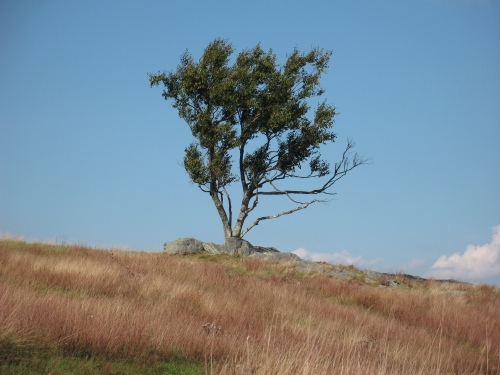
Some trees keep their color and shape
even beyond the time that we have ceased
to dream. They tease us into faith.

This one I approach from a distance.
Its leaves, like tiny flags of grace,
beckon to me. It is November, and the rain

has pelted us, sweeping masses
of yellow to the sodden earth.
But these leaves stay, and the tree,

bright orange against the now blue
sky, stands against the growing dark.
Some days I am afraid to come,

fearing that a mean and fickle God
will flip the table, leaving me nothing
but a tangle of dark and dirty branches.

The neighbors think I’m weird.
“For Christ sake,” the plumber says.
“It’s just a fucking tree.” Maybe.

I thought that once myself. But now
if I close my eyes hard in the night,
the color comes and the room

slides away. I float upward in this
orange, this strange treeness.
My body is inside, looking out.


Anthony S. Abbott, from The Angel Dialogues, Lorimer Press, 2014

.     .     .     .     .     .     .

Poetry, on some level, is about saving things. . . . Things die; poetry retrieves them.

Tony Abbott graced my life during the few years I knew and worked with him. He was president of the NC Poetry Society while I served on the Board, he was mentor in the Gilbert-Chappell program for students, and he was an inspiring colleague and friend. I sat in awe: Davidson professor, poet and novelist, literary leader. But Tony didn’t want our awe. He was a seeker for meaning in this tangled, sometimes messy human journey and he simply invited fellow travelers.

Perhaps empathy and humility spring from the same root. If one has suffered deeply, one cares for and feels deeply the suffering of others; if one has experienced the frailties and missteps to which none of us are immune, one sets aside pride and judgement and stoops to lift the burden of one’s fellows. If one member suffers, all suffer together with it; if one member is honored, all rejoice together with it.

Tony, with his vast gifts and achievements, embodied empathy and humility. My life is richer for having shared it with him. Now his voice we carry within ourselves.

.     .     .     .     .     .     .

Going Home:
a poem in memory of those North Carolina writers who have gone before us

– Weymouth Center, July, 2009

Late afternoon. I lie in the long grass and wait
for words. The still white clouds mock me. Then,
unexpectedly, the sound of music. I sit up. From
an open window upstairs, the clear sounds
of Dvorak. I know these notes like I
know the timbers of my own soul. Yes.

The English horn sings the theme, and sings it
yet again, with the bass clarinet. And then
the strings enter, like a prayer. Take me home,
Lord, take me home. Now the clarinets,
and the horns like faith answer. Then the strings
whisper softly, yes, and again, yes.

I see Graham Jackson, tears running down his black
cheeks, Graham Jackson, in full dress uniform, playing
“Goin’ Home” for his beloved Franklin Roosevelt, and then
the farmers, young and old, black and white, all
of them poor, who loved the only man they had
ever known as President of the United States, hundreds
standing on the hills of Georgia and the Carolinas
watching the train go by with the body of their lost
leader, watching the train take him home. “Goin’ home”
say the English horns again, and then the clarinet returns.

Here I am, listening, images surfacing – the trim brick walks
of my beloved town, the green hills to the west, rising
and falling like the strings, the waves on the outer
banks crashing like the cymbals, then sliding back
like the clarinets. I see the faces of my friends, I hear
the voices of the poets who have gone before, their words
rising again. Dark skinned and light, old and young, male
and female, children of the valleys and the mountains,
children of the coast and the Piedmont. I am here, they say,
I have made the path for you, and I am still here, my words
as true as the rock face of Cold Mountain.

The music soars and for a moment there is light. The whole
orchestra together in hope. then the English horn alone,
mournful, and the strings so soft, almost a whisper.
The strings carry our love over the hills to the sea,
the horns offer it to the sky, and the strings set it aloft.
It is done. They have gone home, and who and what
they are we carry within ourselves. The evening comes.
I rise from the grass and walk toward the open window.


Anthony S. Abbott, from If Words Could Save Us, Lorimer Press, 2011

.     .     .     .     .     .     .

Poetry, on some level, is about saving things. Even a poem so simple as “Growing Up” in A Small Thing is about saving the wonder of the child in an adult world that conspires to destroy it. Maxine Kumin uses the term ‘Retrieval System’ in one of her great poems. Poetry is a retrieval system. Things die; poetry retrieves them.
from Anthony S. Abbott – In His Own Words

Tony Abbott’s publications at Lorimer Press

Biography and induction into the North Carolina Literary Hall of Fame

The scriptural quotation above is I Corinthians 12:26, New Revised Standard Version

Sam Ragan Poetry Festival of the North Carolina Poetry Society — March 22, 2015

.     .     .     .     .     .     .


IMG_1783

[with two poems by Malaika King Albrecht]

The lesson you need is the one you weren’t looking for.

The lesson you keep is the one you didn’t want.

Our final exercise is to sit. Not in the open air pavilion where we’ve weathered hours of presentations and discussion. And not by any means moving along the trails we’ve hiked for hours encountering a new species every minute. Now at the close of our weekend naturalist course on plants of the Smokies we are instructed to stop, settle, sit. We are to find a green thing we don’t know or one we’ve have ignored and sit for half an hour. Pay attention. Become intimate.

I choose to sketch a bryophyte not much bigger than my thumb. Perhaps I’ll never know its true name – starmoss? sphagnum? – but we could become friends. I won’t even give it a name. Be satisfied sometimes simply to explore, to know first with all my senses, that is what I’m learning. Where does it like to lie and spread? Whom does it choose for neighbors? How does it make its living? Naming can come later.

Moss with Doghobble leaf

Look at us all, scattered like toadstools across this mountain glade quietly noticing. For now the birds and insects get to make all the noise. Eventually our quiet must end and we gather one last time for closing and summarizing and making sense. Now Tonya has a surprise. A worm snake, while she sat, has burrowed, well, wormed into her open sandals and curled around her toe. She untangles it and cradles it for us all to see while it tries to bite her with its mere slit of a mouth, better suited for eating slugs. If we were quiet, if we paid attention, if we sat long enough would we be reclaimed by moss and crawling things and become a haven for all that is small and necessary?

We eat our lunch along the trail, we travel back to Tremont, we pack our cars. At the parking lot I congratulate Tonya upon completing her final course and receiving her Naturalist Certification. I tell her, I’m still only half way through.

Tonya turns to me. She sets down her pack. She is solid, present, her eyes deep and full as a hardwood cove. Help the new ones, she pleads. Share what you know.

And during the five hour drive back to my foothills what image recurs? Not family characteristics that differentiate Brassicaceae, Lamiaceae, Asteraceae; not frond morphology and sorus distribution. No, the image I can’t escape is of the two first-timers in our course turning a leaf over and over in their hands, turning the leaves of a guidebook, excited, figuring things out. And of me a pace or two removed, watching them, adding nothing.

Sometimes I think I have the perfect temperament and skill set to be a moss-covered log slowly digested by fungal mycelia. Ah, the long and placid observations I would make. But that’s not the lesson I need or the lesson I will keep. Instead, this: don’t imagine you know so much. But know that what you do know has value when you share it. Know that its only value is in the sharing. You have joined the circle of seekers. Now open the circle wide.

Rudbeckia lacianata; Cutleaf Coneflower; Asteraceae

Rudbeckia lacianata

.     .     .     .     .     .     .

A week ago I shared here two poems by Malaika King Albrecht from her most recent book. I’m not finished with her. Something about this collection of poetry has become very necessary for me as I continue to pile and compile the lessons from my most recent course in the Southern Appalachian Naturalist Certification Program at Great Smoky Mountains Institute at Tremont. The quantity of information itself is just shy of infinite. I’m working through a book titled, Botany in a Day, which would more realistically be In a Couple of Years. Just the new vocabulary reminds me of starting Med school (that was 1974 – what am I doing here?!) or maybe of being smacked with a breaker at Fort Macon beach.

But being overwhelmed with information is the trees, it is not the forest. That is why I need poetry. I will study the taxonomy but poetry will teach me the connections. I will feel like I can never know enough but poetry will teach me to live with and love the mystery. I will work on what to know but poetry will teach me how to know.

Malaika’s collection is just the solace and challenge and promise needed. Her poems can be grounded in the senses but spiral into the imagined and unimagined. I would say her poems make connections but even more they open me to make connections. It can be the difference between burying myself in the Field Guides and opening myself to the field.

Thanks again, Malaika!

.     .     .     .     .     .     .

Following the Wind

Everything leaves a mark:
dull grass in the morning where the raccoon
ambled away full of cat food,
antler scratches along the willow oak,
and tracks and scat everywhere.

I know what stirs in this forest:
Deer nosing the horse path,
red fox slitting the tall switch grass,
rabbit bounding, freezing, and hopping again.

At the edge of Loftin Woods, I fall
for the wind, the way it parts the grass,
makes branches speak
and vultures glide their shallow V’s.

If sky holds our dreams,
then earth, our memories,
and wind, only the now
of this moment calling,
calling from everywhere.

Elephantopus carolinianus; Elephant Foot; Asteraceae

.     .     .     .     .     .     .

Praise Song for What Is

Praise the frozen rain, the icicles daggering
the trees, the gray snow sludge. Praise
the shiver, the wet wind cutting through clothes,
the frozen water troughs. Blessed be
the hard frost, the frozen pond,
the apple sapling snapped in half.

Praise autumn and spring, the hot then cold
then hot again. Praise the corn mazes,
the haystacks, the reaping what we’ve sown.
Blessed be the fig tree, the honeycomb, the hive.
Praise the kudzu, the poison ivy,
the forsythia shouting yellow at a fence.

Praise the mosquito, the itch,
the scratch. Praise the heat waves,
the asphalt, the stopped
highway traffic. Blessed be
the dusty, the wilted, the dry
husks of corn in summer drought.

Praise the possum lumbering
into the chicken coop,
the fox slinging the wood’s edge.
The owl, the hawk, blessed be
their swift descent to prey.
Praise the failures, the losses. Blessed be
the broken path that brought me here.

.     .     .     .     .     .     .

From The Stumble Fields, Malaika King Albrecht. Main Street Rag Publishing Company, Charlotte, North Carolina. © 2020.

Botany in a Day, The Patterns Method of Plan Identification; Thomas J. Elpel; HOPS Press, LLC; © 2018; An Herbal Field Guide to Plant Families of North America

Wildflowers of Tennessee the Ohio Valley and the Southern Appalachians; Dennis Horn and Tavia Hathcart; Partners Publishing © 2018; The Official Field Guide of the Tennessee Native Plant Society


.     .     .     .     .     .     .

[with two poems by Malaika King Albrecht]

Charismatic Megafauna is what people hope to see when they visit Great Smoky Mountains National Park. If traffic barely creeps approaching Cades Cove there must be a black bear feeding near a pullout; if traffic stops altogether Mama has cubs. And if cars are pulled over for a mile along the prairie verge leading to Oconaluftee Visitor Center it means elk are grazing the pasture.

From the center lane I saw the big bull with six-foot rack and a harem of twenty and I slowed but I didn’t stop: the gate into Tremont would only be open from 4:00 to 5:00. It takes at least an hour up and over New Found Gap down to Sugarlands and on west into the Park. Fifteen of us will be arriving for a naturalist course on this final weekend in August, hoping to get personal with that other charismatic Kingdom – Plantae.

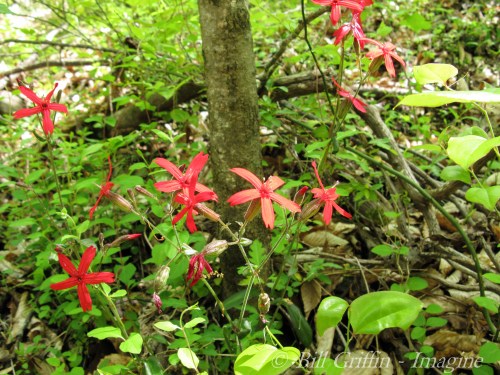
Lobelia cardinalis; Cardinal Flower; Campanulaceae

Trees, ferns, and flowers certainly draw many to the Smokies, if only for the deep summer shade and restorative air. Some people are even known to kneel. As winter unscrews her frozen vice we hurry to see ephemerals – trailing arbutus, hepatica, bloodroot. Then arrives the princess of spring’s reign, Trillium, including uncommon Catesby’s and Vasey’s. As we wind through the seasons we lust for phacelia, fringed orchids, lady’s slippers. But what about now at the tail end of summer?

Summer, the season of yellow: asters, wild sunflowers, goldenrod (19 species in the Park), but driving west on I-40 didn’t every weedy median present us with all these and more Asteraceae? Solid gold at 70 mph. Time to slow down. The hour for Latin and Linnaeus is after vespers with our books and guides. In this moment the growl of Harleys on Little River Road can’t penetrate the glade. The rumble of the river into its Sinks reaches us only as subsonic reassurance through our soles. All light has slipped bent drifted through tuliptree and hemlock to recline with us among shaggy green. We are crouched among the ferns.

Botrychium dissectum; Common Grape Fern; Ophioglossaceae

So many different kinds of ferns. Notice blade and stipe, dimensions and symmetries. We “frondle” them to read the hieroglyphics of their spores. We smell them. We struggle to know their names.

But here’s another fern-like frond, toothed and divided but with a tell-tale: a spike of yellow flowers like sequins in the wildwood. Lean closer. Five-petaled, many threads of stamens, Rose family. Agrimonia, harvestlice, swamp agrimony, but let us name it rose-among-the-ferns. Let us name ourselves sit-and-notice. Call us one-more-among-all-small-things. Look closely. Kneel. The least among the most is what we have come here to discover.

Agrimonia parviflora; Harvestlice Agrimony; Rosaceae

.     .     .     .     .     .     .

Before, during, and after my summer visit to Great Smoky Mountains Institute at Tremont I have been reading Malaika King Albrecht’s newest book of poetry, The Stumble Fields. If a work of art could be a facial expression her book would be a quiet, welcoming smile – the kind that lets you know she is about to share a great confidence. Her poems are revealing in the way sitting patiently in a quiet glade will gradually begin to reveal its true life.

And the spirit that often winds among her lines is, to me, that same spirit that leads us to desire to live truly in this world. Not to skip along its edges but to draw fully and be drawn deeply into it, discovering our selves as we discover the truths of our co-travelers. It is the naturalist urge – to find our connections at every stratum and station.

I am thankful to be connected to Malaika through her words.

.     .     .     .     .     .     .

Lactuca floridana; Florida Blue Lettuce; Asteraceae

Loftin Woods

I’ve wanted to be a single story,
so I could tell you a happy ending
but every breath’s different.
In these woods I’m lost enough
to notice but not lost enough to care.
I find my body when the barred owl
startles the air. I find
my body where white trillium
catches light. I find my body
in the music of cantering horses
singing to sky. Today I could fall
right through this fabric of grass.

.     .     .     .     .     .     .

Prunella vulgaris; Heall All; Lamiaceae

Silver Tangle of Brambles at Midnight

Late night you remember God’s first language
is silence. The space between heart beats,

the pause before someone says, Yes,
a brief moment before ebb becomes flow.

So you say, Fine. Don’t talk to me
like God’s a stubborn ghost.

You say, I’ll hear messages
whether you speak or not.

Every closed-door signals detour,
and each broken heart demands

sitting quietly for a time.

.     .     .     .     .     .     .

From The Stumble Fields, Malaika King Albrecht. Main Street Rag Publishing Company, Charlotte, North Carolina. © 2020.

Vernonia flaccidifolia; Tennessee Iron Weed; Asteraceae

.     .     .     .     .     .     .

IMG_0880