Feeds:
Posts
Comments

Archive for the ‘poetry’ Category

  . 
[5 poems by winners of NC Poetry Society student contests]
  . 
Fear
  . 
There I stood upon the water
Looking out to foreign lands
Separated by the oceans
I take a breath and clench my hands
I take a step and close my eyes
And jump across to the other side
I land in all the sandy rubble
And I looked back and saw a puddle!
  . 
Juliet Geracitano
5th grade, Audrey W. Garrett Elementary School, Mebane, NC
Third Place, Travis Tuck Jordan Award of NC Poetry Society
  . 
  . 
❦ ❦ ❦
  . 
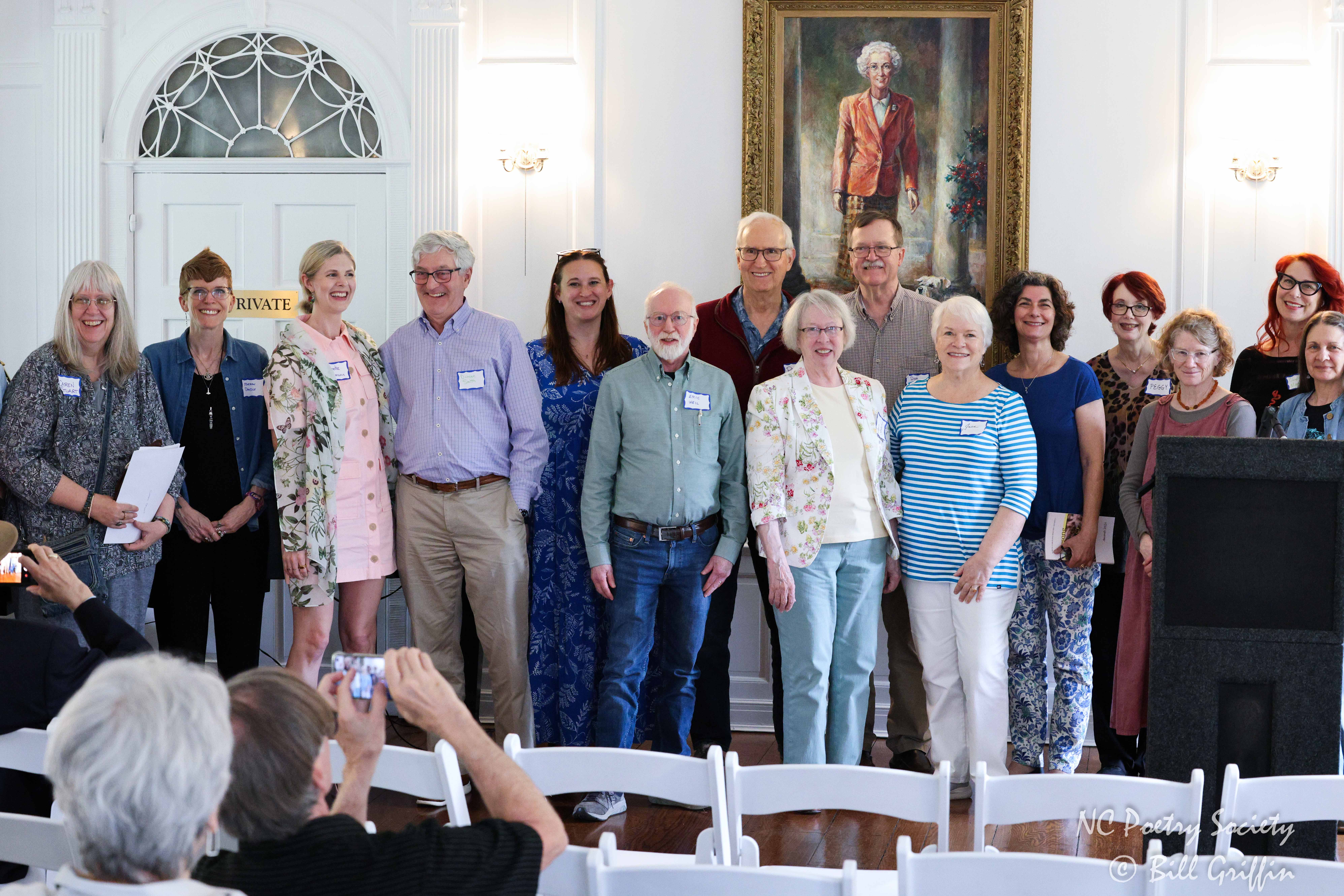
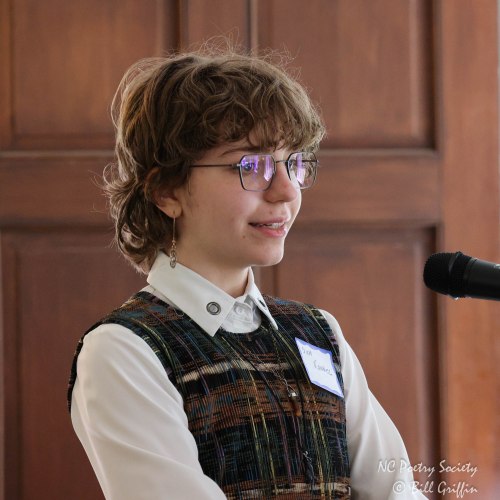
It is impossible to convey the enthusiasm and joy that radiates from these students as they step up to the microphone to read their poems. Some of them have to climb a rostrum to be visible behind the lectern. Some of them have arrived cloaked in adulthood. All of them lean in, open to the page which holds their lines, and when they have finished, look up at us with a glorious victorious smile. And they see us smiling right back as we applaud.
  . 
Each year the North Carolina Poetry Society sponsors five different contests open to students stratified by grade level, from 3rd grade through college undergraduates. Winning poems are published in the annual anthology Pinesong, and each May the Society holds Sam Ragan Awards Day at Weymouth Center for the Arts & Humanities to give these winning poems voice. The poems reprinted here are a small sampling of those read by their winning authors on May 10, 2025. Contact this site (comments@griffinpoetry.com) if you would like to purchase Pinesong, which also includes the winners of the eleven adult contests
  . 
❦ ❦ ❦
  . 
The Reservoir
  . 
The sky has emptied itself, curving in cloudy
porcelain over the few dwellers, here,
trembling
and the small pieces of bare water
settle beneath.
  . 
Beside the bridge to Highway 73
(we’ve driven by it every week this November)
a heron bends double
  . 
with the draggled trees, ribs of logs soft with rot,
over everything the film of silk like
skin, exposed.
  . 
The reeds
and the heron’s feathers
and what’s left of the water
flutter with the dark wind.
  . 
The sky cannot protect them from this –
a huddling in the newly foreign crevices beneath
the upturned bowl.
  . 
Sometimes I think that the world pours out
all that it has – all of itself – on us
and still it is not enough.
  . 
Lillian Skolrood
9th grade, Sparrow Academy, Cornelius, NC
Third Place, Joan Scott Environment Award of NC Poetry Society
  . 
  . 
❦ ❦ ❦
  . 
Pat Riviere-Seel served as this year’s judge of the Sherry Pruitt Award for students in grades 10 through 12. Besides her own numerous publications and writing awards, Pat has been a forceful and relentless supporter of the literary arts for decades. She offered this challenge to these students and to all of us:
  . 
I’m wearing several hats today, but the most important one is the one as your cheerleader. As I read the more than one hundred poems in the high school student contest, I realized just how fortunate we are in this state, in this country, to have a new generation of poets who use their poems to tell their truth, to shine a light on what is often a dark and disturbing time. Some of the poems were overtly political; others were intensely personal. All contained important truths and are necessary.
  . 
At this time in our country when the arts are under attack, when books are being banned, and our nation’s history and culture are being perverted by a political agenda of hate, please know this: Your words matter. Your poems matter. You are not alone. For every poem that you write, know there are at least a dozen more people who will find themselves in your words-their joys, their sorrows, their fears, their hopes and dreams. You-each one of you-are the only one who can write your poems. If you do not write them, no one will. And that would be a big loss.
  . 
The politicians and the performers will not save us. They may have political power at the moment, but words-your words-also have power. And that power-unlike political power-is lasting.
  . 
Poetry cleanses.  Poetry gives us back our soul, both individually and collectively. Keep writing. Be fearless. Do not ever let anyone censor or silence you.
– Pat Riviere-Seel
  . 
❦ ❦ ❦
  . 
Fly Me to the Moon
  . 
There’s war in Ukraine, chaos in Gaza,
while I sit at the piano, looking at the keys.
  . 
It’s just practice, nothing to worry about, but
my eyes start to burn. I think of leaving, not
  . 
coming back. I look at the pages and look
at the teacher, ready to move on. I try
  . 
to sight read but can’t shape my hands
fast enough, left in the notes and chords.
  . 
The tempo is too fast, the piece once sung
by Sinatra. No tears come as I find the notes.
  . 
In another sky, I know there are missiles,
to destroy concert halls and opera houses.
  . 
After, I walk through a desert into the dark
abyss, shot by starlight, to a melancholy song.
  . 
Vicky Teng
10th grade, Marvin Ridge High School, Waxhaw, NC
Third Place, Sherry Pruitt Award of the NC Poetry Society
  . 
  . 
❦ ❦ ❦
  . 
I Would Bleed
  . 
I want to be a wild thing
And soar high on feathered wings
I want to scar the dirt with heavy claws
And watch a vulture feed
  . 
I want to be untamable
And bite the hand that feeds
I want to escape this poison air
And I want to scream
  . 
I want to be the loudest beast
And roar louder than a waterfall sings
I want to stomp and dance without rhythm
And I want to breathe
  . 
I will be a guardian
And keep the tall grass green
I want to see the stars again
And for that I would bleed
  . 
Sam Kawalec
10th grade, R. J. Reynolds High School, Winston-Salem, NC
Honorable Mention, Sherry Pruitt Award of the NC Poetry Society
  . 
  . 
❦ ❦ ❦
  . 
Pelmeni / Russian Dumpling
  . 
It is New Year’s Eve, and I am making pelmeni and thinking only of you.
Russian dumplings, I used to watch my mother fold them; delicately and properly.
She never let me do it.
I fold the flour into the dough, and it swirls in a cloud, landing on my shirt.
I am nineteen, but with this powdered coating, I am seven, and ten, and twelve again.
  . 
How do I love you?
I never learned it. It was not something I could watch my mother do.
I did not watch her and know how to touch. How to hold your hand, to grab you and say
I love I love you I love you; can you feel it?
  . 
I blunder through, an attempt to be gentle, but I am butchering it.
The meat is falling out of the dough, red against white. Flesh-like.
Is this what my heart looks like to you? Exposed, Unnatural?
My mother said if I don’t pinch the corners hard enough the entire pelmen will explode.
Let me patch it back up. Let me hide it away.
  . 
I place the finished ones onto a plate. They sit with a resoluteness that seems final.
‘Yes, here is my place on this plate.’
Oh, little dumpling, if you only knew the boiling pot that waits to greet you!
You will hiss as you enter and sink silently to the very bottom.
  . 
I plop the dumpling in, and a droplet of boiling water flies out and lands on my arm.
I jerk it away, instinctual.
How do the pelmeni do it? Hiss, and die, and resurface?
How much bravery in one small pocket?
  . 
I do not know how to ask for you.
I sit, pelmen-like, waiting for you to read my thoughts.
Waiting for you to understand the extent of my want.
How deep is it buried? At the very bottom of the pot?
  . 
Masha Dixon
Sophomore, University of North Carolina, Chapel Hill, NC
Second Place, Undergraduate Award of the NC Poetry Society
  . 
  . 
❦ ❦ ❦
 . 
  . 
The Student Contests of the North Carolina Poetry Society open for submissions each year on November 1, with a deadline of January 31. Check HERE for guidelines and details.
Travis Tuck Jordan Award for students in Grades 3 – 5.
Endowed by Dorothy and Oscar Pederson
Joan Scott Memorial Award for poems about the environment, students in Grades 5 – 9.
Endowed by contributions in memory of Joan Scott and by the Board of the NC Poetry Society.
Mary Chilton Award for students in Grades 6 – 9.
Sponsored by Tori Reynolds
Sherry Pruitt Award for students in Grades 10 – 12
Endowed by Gail Peck
Undergraduate Award for students attending a North Carolina college or university or whose parents or guardians live in the state of North Carolina .
Endowed by the Judith C. Beale Bequest
  . 
  . 
❦ ❦ ❦
  . 
  . 

Read Full Post »

 . 
[with poems from Tar River Poetry by Michael Gaspeny,
Grey Brown, and Sydney Lea]
 . 
Burying the Runt
 . 
Rain so long
the dusty pink bucket
outside the basement brims
and a puny squirrel floats
++++ ++++ ++++ ++++ face down.
 . 
I dig a hole in the azalea bed
near the stair well. The ground splits
++++ into a glove
++++ ++++ with root threads for fingers.
++++ ++++ ++++ I trickle
++++ ++++ ++++ the bucket into its palm.
++++ ++++ The runt’s round stare catches the sun.
 . 
I cover the fuzzy ribs. Close the glove. Smooth
++++ the hole. ++++ Bless the soul
++++ ++++ in case
++++ there’s somewhere else.
 . 
Michael Gaspeny
from Tar River Poetry, Volume 64 Number 2, Spring 2025
 . 
❦ ❦ ❦
 . 
Perhaps bedtime reading infiltrates one’s dreams. I selected this particular book imagining it might hold the secret, and then hold that secret out to me in revelation: Where is God? Was I wrong to expect to find God in a book, when pretty much everything else I’ve ever wanted to find was in books? Or if the thing itself is not in a book at least the book is able to make the thing comprehensible, graspable, whole. Oh my, how that word creeps in, whole. I had read this author’s contemplations about becoming one’s complete and perfect self, wholly connected and part of the universe which is God, and now here I am halfway through her book, whose theme is “relational holism.”
 . 
But where am I really? These woods are dark and close. I can’t quite see what is screeching high up amidst the branches, but it sounds like quantum entanglement and Jungian archetypes. Assuming I do wake in the morning, I will recall snatches of dreams about trying to put things together that refuse to fit. Long halls and which of these closed doors is the one I’m meant to open? Being surrounded by people I could swear I should know but who don’t know me.
 . 
The title of this microessay is Manipulative Intelligence, subtitle The Paradox of a Trillion Synapses. Consider me a wholly average representative of my genus and species. I can read without glasses as long as the light is bright, but I can’t see remotely as well at distance as a hawk or as an owl at midnight. I can smell bread baking but the remainder of the world’s vast olfactory tapestry of edibles which is plain as the nose on a bear’s face is inscrutable to me. I can hear a C minor chord sung by a competent quartet but the deer can hear me coming a concert hall away. And I can’t imagine that those huge cetaceans with their massive cerebral cortices are thinking whalethoughts any less profound than my humanthoughts. What does that leave, then, to account for the relentless invasive proliferation of persons, for 9 billion homo sapiens infesting the earth?
 . 
Manipulative intelligence is the inborn gift of fiddling with things. Manual fiddling progresses to building machines capable of even bigger and faster fiddling. If there is one trait that makes humans unique, it is that we have fiddled with, changed, and are continuing to alter our surroundings. Not just for protection or dwelling, bowerbirds and beeswax, but we have manipulated our entire biosphere. The venture capitalists say, “Way to go!” while the rest of us who live on Planet Earth, including the hawks and owls and bears and deer and whales and bowerbirds and bees, say “What the fuck!” But here’s the paradox: besides imagining that our big heads are a fiddling gift, we also contend that our trillion+ synapses have made us the only creatures capable of encountering the Giver. And something about the way our limbic systems interconnect with our frontal lobes has also convinced us that we are God’s favorite.
 . 
Back to my book and my dreams. A hundred more pages of Ilia Delio to go. I promise I’ll make it to the finish line. To God. I will lie back and let Carl Jung sort out my dreams. Meanwhile this morning has presented a rare couple of hours with absolutely no prescribed fiddlings. Sitting on the porch while the house wren lets everyone in earshot know he has a nest and a mate here, while the beech and maple deepen the shade across the deck slats minute by minute, while I hold my notebook on my lap but don’t get another line written beyond Trillion Synapses, I’m thinking. Empty thoughts with no script or outline and no polysyllabic labels. Non-fiddling thoughts. I think Ilia is right. God is not out there. God is in here.
 . 
 . 
The Not-Yet God: Carl Jung, Teilhard de Chardin, and the Relational Whole by Ilia Delio, O.S.F. Orbis Books, Maryknoll NY. © 2023
 . 
 . 
❦ ❦ ❦
 . 
Family Plot
 . 
Once on a cruise,
my mother spent the week
not letting my father find her.
 . 
Behind a book,
hunkered in a deck chair,
she would see him coming
 . 
and dash starboard
then dash again if need be.
She thought him ridiculous
 . 
disco dancing at 70,
his shorts and tube socks.
Why couldn’t he just read?
 . 
His second wife
insisted on his cremation
and I imagined my father
 . 
dancing into flames.
Now my mother
rolls alone under
 . 
the grass and plastic flowers
of a double plot, bought
too soon.
 . 
She draws the soil
up under her chin
but still does not miss him.
 . 
She wonders what will happen
to the space beside her.
She would not mind
 . 
if someone else moved in,
perhaps someone sensible,
someone who reads.
 . 
Grey Brown
from Tar River Poetry, Volume 64 Number 2, Spring 2025
 . 
❦ ❦ ❦
 . 
I treasure my memories of Tar River Poetry founding editor Peter Makuck. I met him first and formally through rejection letters, as kind as any, and later an occasional acceptance, O Frabjous Day! Later yet we met in person a few times at statewide poetry meetings. Bit by bit we discovered many more things in common – Ohio and Kent State, Bogue Banks, birding – and also shared more poetry with each other. I featured a poem by Peter during my tenure as Poet in Residence at the NC Zoo. Several times a year he would send me a poem he’d discovered that he thought I’d appreciate. And of course I was reading everything Peter published.
 . 
Peter Makuck was a truly generous and warm person. And creative, and insightful, and true. I am thankful to Advisory Editor Luke Whisnant for furthering the work Peter began at Tar River Poetry, and I am very grateful to the newest Editors, Charmaine Cadeau and Helena Feder, for Volume 64 Number 2. And here’s a shout out to everyone else whose name appears inside the front cover:
Advisory Board: Chris Abani, Alice Allan, Stephanie Bolster, Jane Hirshfield, Brandon Krieg, Dorianne Laux, Amit Majmudar, Matthew Buckley Smith
Interns: Onyx Bradley, Rebecca Donaldson, Paige Osché (hey Onyx, I’m the one who took that photo of you presenting at the NC Museum of Art in 2023 and sent to John Hoppenthaler)
 . 
Peter Makuck, Distinguished Professor Emeritus at East Carolina University, died in 2023 at the age of 83.
 . 
 . 
❦ ❦ ❦
 . 
Jeremiad
 . 
I should say it aloud, Don’t listen to me, one more old man
++ rebuking the younger
as old people will, a man half ashamed to be partway
++ launched into unspoken rant
just now by the sound – of all things on earth – of a nearby
++ pileated woodpecker
in awakening hardwoods behind the house, a sound that
++ occasions my own yen to squawk
at some innocent I see only in mind, Take out those Air Pods
++ or whatever they’re called
and hear this beat, pure percussion, granted, no music
++ beyond its simple tock
but somehow entailing a tune because, as Keats, though
++ himself no more than a stripling,
so rightly noted, Heard melodies are sweet but those unheard /
++ Are sweeter,
and true enough, that red-crowned bird offers up its song
++ without singing,
song of those hardwoods soon to burst into their million
++ shades of green,
of the ducklike calls from the pondside wood frogs, of
++ actual ducks, and so on and on.
Listen! I shout in silence, that tock contriving for us the
++ springtime dream
we’ll wake from, sadly, and into which so many have never
++ fallen, really,
and can’t, what with shells and mortars raking the world and
++ lethal airplanes aloft –
not like the two fabulous peregrine falcons racing this morning
++ majestically
across our lawn: no, not like bombers and drones that mob
++ the sky like bees –
no, not like bees that wills warm here soon, as the
++ woodpecker’s unheard strains declare
while I rebuke some unknown someone, and the soundless,
++ song may in fact scold me,
a man, judgmental, self-centered, who dares, in the midst of
++ all this abundance, to suffer
his thirst for more and looks around for even more, on the
++ verge of tears,
thrusting up his springtime lust as some old-fashioned
++ cartoon beggar
might hold up his cup – which may mean the man has
++ simply been wrong in this censure here
of the one or ones he’s conjured and cursed, and might have
++ done better with fingers in ears.
 . 
Sydney Lea
from Tar River Poetry, Volume 64 Number 2, Spring 2025
 . 
❦ ❦ ❦
 . 
IMG_0768, tree
 . 

Read Full Post »

 . .
[with 4 poems by Emilie Lygren]
 . .
Ritual
 . .
In each new place I look at the leaves.
 . .
Some are gray and withered, others gold or green.
 . .
The round spots of fungi, insect holes, split lines along veins all say:
 . .
I have been here long enough for here to change me.
 . .
May I stay half as long.
 . .
 . .
You Find Hope When
 . .
You find hope when you remember that
your best friend was elected Prom Queen.
 . .
We were shocked.
She was not popular or plastic or a cheerleader,
like prom queens in the movies always were.
 . .
She was kind to everyone.
 . .
When things feel bleak, remember the people out there
who thought that mattered.
 . .
Emilie Lygren
from What We Were Born For, Blue Light Press / 1st World Publishing, Fairfield IA; © 2021
 . .
❦ ❦ ❦
 . .
Something here beside the river is dragging. Something is slowing me down, clenching me inside, holding my skull between two fists. What is this cud of anger I’m chewing, chewing? I tug it loose when it snags on last summer’s dry aster or catches on a shard of quartz. I refuse to let go because it’s mine and I deserve to have it.
 . .
As I walk its banks, the river notices that I have stopped noticing it but the river doesn’t comment. The river refuses to tell me whether I’m good enough or why I’m not. I can’t convince it to admit that it’s really all those others hurting me and not me hurting them. The river has plenty to carry without taking on another load of trash. Stuff, big and little, just wants to tag along with the river. Silt enjoys the life of swirls and eddies, leaves love to dance. Stones tune up and provide the music. The river invites their company and moves along.
 . .
Is time passing here? The movement of water, always movement, and yet there is always always more water. Time must have passed, because I find I have misplaced whatever it was that was dragging me, I mean, whatever I was dragging. The music hasn’t stopped and there is singing. Suddenly I notice that what I really want is to join the river. And I find I have.
 . .
 . .
❦ ❦ ❦
 . .
River, competence
 . .
Rocks once ripped
from mountainsides,
broken branches of trees,
leaf or tuft of grass.
 . .
Swept up by
constant working currents,
blue undersides of streams,
mud unstuck from banks,
wed to clear movement.
 . .
Ripple pool and wave
reduce rough edges into roundness,
sand sticks into gleaming bare swords,
hold stones until their shapes converge.
 . .
Stay here long enough
and the parts of you, too,
that have been broken
will be made smooth
 . .
Emilie Lygren
from What We Were Born For, Blue Light Press / 1st World Publishing, Fairfield IA; © 2021
 . .
❦ ❦ ❦
 . .
Emilie Lygren’s poems are not all quiet. Some rage against tyrants. Some spit and hiss at what the ocean spits up, the trash we have crammed down its throat. Some push back hard against cruelty and prejudice, anything that willfully splits and cleaves.
 . .
But all of Emilie Lygren’s poems quiet me. When I am disgusted by things people do and say and think; when it hurts me that the people I love are hurting and are hurting me; when I despair that we human beings will never learn kindness; when I can’t see any hope for our future as a species or for all the species we destroy –
 . .
When all this noise and rage and torment shake me like a maple leaf, then Emilie Lygren’s poems return with their voice of understanding. We all feel these things. We all need something better. Listen, just listen. The earth is still here for you. Join it, the earth and all it embraces. Find its place in you and rediscover your place on the earth. Every day, if only for a moment – quiet.
 . .
 . .
Emilie Lygren is a poet and outdoor educator in California. What We Were Born For is the winner of the 2021 Blue Light Book Award from Blue Light Press / 1st World Publishing and can be purchased at Bookshop.org.
 . .
Read an additional poem by Emilie Lygren, Erosion, HERE:
 . .
 . .
All of today’s photos are by Jonathan Saul Griffin, © 2022
 . .
 . .
❦ ❦ ❦
 . .
Meditation
 . .
Sitting near the window.
I watched a fly stammering
against the glass,
trying to break free
and transcend the
transparent boundary
it could not comprehend.
 . .
As I cupped my hands around the fly
then let it out the open door,
I wished that we could trade places –
 . .
that someone would gently remove me
from the invisible walls
I have pressed myself up against,
offer an opening I am too small to see.
 . .
After sitting longer,
I start to think that maybe I am all parts of the story –
 . .
the trembling fly,
the gently cupped hands,
the clear glass window,
the necessary air outside.
 . .
Emilie Lygren
from What We Were Born For, Blue Light Press / 1st World Publishing, Fairfield IA; © 2021
 . .
❦ ❦ ❦
 . .
 . .

Read Full Post »

« Newer Posts - Older Posts »