Feeds:
Posts
Comments

Archive for the ‘poetry’ Category

 . 
[with 3 poems by Stephen Dunn]
 . 
Returning from an Artist’s Studio
 . 
Late at night in my one life
I see fireflies scintillating a field
and a fullish moon up there working
on its reputation, which I thought
was secure. And though I’m not one
to stop my car for beauty
I stop, get out, begin to understand
how the first stories winked
of another world. It’s as if
I’m witness to some quiet carnival
of the gods, or the unrisen dead
speaking in code.
 . 
Insects are eating each other. Stunned
beyond fear, mice are being given
their first and last flights,
talons holding them dear.
The fox has found a warren.
Everything I can’t see
is at least as real as what I can.
If I stand here long enough
I’ll hear a bark and a squeal.
 . 
The artist had an eye for exaggerated sunsets
splashed with rain, odd collisions
of roots, animals, seeds.
I didn’t like a thing I saw,
so much effort to be strange.
The moon is hanging from a leafy branch.
The fireflies are libidinous
and will not be denied.
 . 
Stephen Dunn
from Different Hours, W.W.Norton & Company, New York, NY. © 2000
 . 
❦ ❦ ❦
 . 
Its birthday is three days from now: Monday, December 25. It will be two years old. Call it, perhaps, a mote which from where we stand is invisible. Or better, call it an eye, one that sees into almost everything. Best of all, in this season of visionaries who seek truth and meaning as they follow stars, call this a new-born star. There it glints, locked in thrall of its own near infinitely larger star, to which it turns its back and pays no attention at all.
 . 
The James Webb Space Telescope launched from Kourou, French Guiana, on December 25, 2021. Within a few weeks it maneuvered into its orbit around the Sun, 1.5 million km from Earth, and unfolded its mirror of bright hexagons, gold-plated beryllium, the ommatidia of its compound eye. It sees the light of galaxies emitted 13.1 billion years in the past (13.1 billion light-years distant). It is already shattering theories about the earliest times of our universe’s creation. Primordial black holes, early giant stars, galaxy clusters – is this inconceivable vastness really the Universe of which our own little planet is the center?
 . 
We choose December 25 to celebrate the birthday of a human being who represents God’s tangible presence here on earth. Immanuel, God-with-us. Jesus, in halo orbit around the Lagrange point of God’s gravitational unity – in the phraseology of Process Theology, “perfectly synchronized to God at all moments of life”; “fully and in every way responsive to God’s call.” This is how I yearn to experience my God – fully present in the wild aster seeds I gathered and sowed yesterday, and equally present throughout a universe spanning some 10*30 cubic light years. If the JWST reveals more wonders and marvels than I could ever dream, do I deny the nature of reality or shall I enlarge my notion of God?
 . 
Here’s my mission this Christmas season. First, to shift myself off center. As much as I’m able, to remember that the Universe does not really revolve around me; to open myself to the persuasive power of love pushing me to its Lagrange point. Second, to unfold my compound eye. To look out as far as it takes, and as deep within, to discover God in constant process of moving and becoming. And at the same time to discover what it is that I am called to become.
 . 
 , 
❦ ❦ ❦
 . 
Before the Sky Darkens
 . 
Sunsets, incipient storms, the tableaus
of melancholy – maybe these are
the Saturday night-events
to take your best girl to. At least then
there might be moments of vanishing beauty
before the sky darkens,
and the expectation of happiness
would hardly exist
and therefore might be possible.
 . 
More and more you learn to live
with the unacceptable.
You sense the ever-hidden God
retreating even farther,
terrified or embarrassed.
You might as well be a clown,
big silly clothes, no evidence of desire.
 . 
That’s how you feel, say, on a Tuesday.
Then out of the daily wreckage
comes an invitation
with your name on it. Or more likely,
that best girl of yours offers you,
once again, a small local kindness.
 . 
You open your windows to good air
blowing in from who knows where,
which you gulp and deeply inhale
as if you have a death sentence. You have.
All your life, it seems, you’ve been appealing it.
Night sweats and useless strategem. Reprieves.
 . 
Stephen Dunn
from Different Hours, W.W.Norton & Company, New York, NY. © 2000
 . 
❦ ❦ ❦
 . 
So many bookcases. In this house are many mansions. A few days ago, on one of the less accessible shelves, I noticed a book I hadn’t opened in years. I couldn’t recall the specifics of the poems it contains but just looking at its cover recalled emotions from when I last read it: warmth, questioning, surprise, discovery, assurance that this process of living is valid, valuable, and even in its fearfulness to be cherished. Then I opened Stephen Dunn’s Different Hours and found this:
 . 
 . 
Twenty-three Christmases ago. I wonder how my parents selected this particular book for me? It had just been published but I don’t imagine it greeting folks boisterously as they entered the door at Barnes & Noble. Did Mom and Dad realize the book would win the 2001 Pulitzer Prize for Poetry? As well as I can recall, the only other book of poetry they every bought me was Maya Angelou. And then there’s the inscription, from “Dad and Mom,” although this is certainly my mother’s handwriting, still elegant and strong at the beginning of the century.
 . 
All these questions. In spite of them, I see that it was the perfect book for me then and that this is the perfect week to rediscover it. Stephen Dunn explores love, its foolishness and its bedrock. He explores death, of those people and things we love and our own racing toward us. And within the “different hours” of doubt and questioning, of emptiness and aimlessness, he hints at hope and wonder within this elusive reality we occupy.
 . 
After Christmas, as new books heap themselves on my desk, I’ll return this one to its safe berth. Whenever I next happen to chance upon it, I know it will again be the perfect time.
 . 
❦ ❦ ❦
 . 
The Metaphysicians of South Jersey
 . 
Because in large cities the famous truths
already had been plumbed and debated,
the metaphysicians of South Jersey lowered
their gaze, just tried to be themselves.
They’d gather at coffee shops in Vineland
and deserted shacks deep in the Pine Barrens.
Nothing they came up with mattered
so they were free to be eclectic, and as odd
as getting to the heart of things demanded.
They walked undisguised on the boardwalk.
At the Hamilton Mall they blended
with the bargain-hunters and the feckless.
Almost everything amazed them,
the last hour of a county fair,
blueberry fields covered with mist.
They sought the approximate weight of sadness,
its measure and coloration. But they liked
a good ball game too, well pitched, lots of zeroes
on the scoreboard. At night when they lay down,
exhausted and enthralled, their spouses knew
it was too soon to ask any hard questions.
Come breakfast, as always, the metaphysicians
would begin to list the many small things
they’d observed and thought, unable to stop talking
about this place and what a world it was.
 . 
Stephen Dunn
from Different Hours, W.W.Norton & Company, New York, NY. © 2000
 . 
❦ ❦ ❦
 . 
The James Webb Space Telescope is located near (in a “halo orbit” that keeps it in the vicinity of) the Sun-Earth L2 Lagrange Point. A Lagrange Point is an area of gravitational equilibrium in relationship to two massive bodies: Sun-Earth, Earth-Moon, etc. Positioning JWST in this way requires less energy to maintain and allows a longer functional lifespan.
 . 
More about the James Webb Space Telescope, and some literally awesome photographs, HERE
 . 
More about Process Theology, which states that each instant of Being is ever in the process of Becoming, HERE
 . 
Stephen Dunn (1939-2021) as described by The Poetry Foundation: Dunn’s poetry reflects the social, cultural, psychological, and philosophical territory of the American middle class; his intelligent, lyrical poems narrate the regular episodes of an everyman speaker’s growth, both as an individual and as part of a married—and later divorced—couple. His poetry is concerned with the anxieties, fears, joys, and problems of how to coexist in the world with all those who are part of our daily lives.
 . 
 . 
❦ ❦ ❦
 . 
 . 

Read Full Post »

 . 
[with 4 poems by Kim Hayes]
 . 
Winter Wind and Chimes
 . 
All this winter, the wind has moaned,
its deep modal harmonies
rolling up the valley’s throat
like a procession of monks, chanting.
And at the darkened door,
they strike the chimes –
cowled visitors
shifting restlessly, foot to foot,
on the icy steps.
 . 
All this winter, like metronomes,
two ghostly porch chairs
have, in unison, rocked a rhythm
for strange sulfurous chords;
invented, frenzied arpeggios;
or just one strident not repeated,
brassy as a storefront bell –
wind and chimes tangled in
an endless ensemble.
 . 
All this winter, she has listened,
even going out once to tie a string
around one pitchless chime,
hoping to set it better in tune.
But the wind worried loose the knot
and snatched it off.
Come spring, she thought,
I will take down these chimes.
 . 
All this winter, the wind has composed
for chimes and chairs and a woman
who will, on second thought,
let the wind have its way,
leave the chimes alone
to be played by softer breezes
on a warm summer day.
 . 
Kim Hayes
from As If She Spoke in Tongues, Grateful Steps Foundation, Asheville, NC; © 2023
 . 
❦ ❦ ❦
 . 
Technical challenge, that’s one of the reasons I love choral singing. Will I even be able to learn this tenor part with its oddball intervals and syncopation? Can I project a clear open tone all the way up to that G sharp, maybe the A? Can I keep balance & rhythm and avoid falling off the stage when the time signature flips from 6/8 to 2/2? Can I listen so perfectly to this alto standing next to me that our voices may create something beyond the sum of us two?
 . 
This last challenge transcends technical. In an ensemble, the emphasis is not on the individual but the communal voice. Perhaps blend and modulation are learned skills, but the birth of art is in the give and take, the sharing, the group coming together as a single organism. What a fine metaphor for poetry. Writer and reader are not performer and audience. The poet can learn craft, devise image and simile, tinker with language and rhythm, but all the poem’s music is flat until the reader breathes it in and the lines begin to sing in her heart.
 . 
This is the spark both music and poetry yearn to ignite: beyond technical and communal, the beauty and truth which burn into us and set us afire. Several times in this season of many rehearsals and concerts I have felt a moment’s elevation to that mysterious plateau. In a blink, the magic of notes, harmonies, lyrical language swell my heart until I can’t read the score for my tears. I couldn’t say the epiphany arises from the instruments, from the lines of verse, from the voices surrounding me – it takes life from all of these together. The music communicates its message directly to the heart.
 . 
The choir releases its music into the air. The poet surrenders her lines to the universe. A new language is revealed. A new voice speaks from which some ear, some mind may discover some new life never before imagined. Our spirit breathes in these vaporous things and is exalted.
 . 
 . 
❦ ❦ ❦
 . 
The Grandmothers
 . 
Thanksgiving morning,
before the sun, I wait
in the dark kitchen
for the gentle ghosts
of my grandmothers.
 . 
I welcome them
as I heat the oven,
feel them gathering,
like the warm aromas
of brown sugar and
cinnamon, to watch me
as I baste and bake.
 . 
In the drifting dust of sifted flour,
their hands guide mine:
a pinch more of this or
a little salt in the broth or
give that a stir before it sticks.
 . 
A I set the table, they lean in,
sighing, fingers smoothing,
lingering over each fine stitch
in the embroidered
tablecloth, handed down,
daughter to daughter;
they smile as I take out
the old rose-patterned
wedding china.
 . 
And so, they keep me company,
chat, chuckle and chide
all morning long as they
share my kitchen,
the grandmothers who,
by being who there were,
make me who I am.
 . 
Kim Hayes
from As If She Spoke in Tongues, Grateful Steps Foundation, Asheville, NC; © 2023
 . 
❦ ❦ ❦
 . 
. . . as long as she kept [her words] to herself, they were one language. Her language. It was only when she gave them up, like babies for adoption, that they slipped from her grasp and became subject to interpretation. . . . No translation was the same. No understanding was universal. The language of her words unfolded into many languages, many understandings, as if she spoke in tongues.
 . 
From the Author’s Note in As If She Spoke in Tongues by Kim Hayes, this is a mysterious and provoking expression of the potential and power of words. Innocent-sounding words spoken with heat might spark a conflagration. Words fumbling for meaning may yet reach their mark and forge strong bonds. Even we writers with the opportunity to pause and ponder, we who strive to select from all options the perfect words, can never know how they will be received. From this mystery rises poetry’s power to connect.
 . 
The poems in Kim’s collection connect in all these mysterious ways. Her poems span generations and geographies. The speaker may be obvious and defined or intentionally obscure, thereby becoming universal. We humans are not, thank all stars, telepathic. Therefore from the writer’s images and memories we must create our own imagery and resurrect our own memories. And doesn’t this surprising connection we discover within ourselves also fire a feeling of connection to the writer?
 . 
We cast our words into the breeze like feathered seeds and cannot know what will bloom. As in this line from Adrienne Rich, But poems are like dreams: in them you put what you don’t know you know. And these lines from Poems for Sale by Kim Hayes: a poem like a trick of the eye, / peripheral flicker – / what might or might not be, / glimpsed and gone; // I have for you today . . .
 . 
[Order As If She Spoke in Tongues   HERE  ]
 . 
 . 
❦ ❦ ❦
 . 
Rocks and Hard Places
 . 
Barefoot, I walk
on a dream road
paved with all your
rocks and hard places,
misery and discontent.
“I only had to bury him once,” you said.
“It’s the god-damned memories that won’t
stay in the ground.”
 . 
Sharp-honed memories like flint shards,
chiseled by every hard place
you ever knew ( and there were plenty),
stabbing themselves upward to the surface,
resurrected and designed to cut deep.
 . 
My feet are bleeding now.
 . 
But tonight, I still plan to dance
with your unearthed undead,
twirling on yet another hard place,
by bloody footprints leaving
gritty, blushing rosettes,
 . 
while you wait somewhere in the dark,
another rock in your hand.
 . 
Kim Hayes
from As If She Spoke in Tongues, Grateful Steps Foundation, Asheville, NC; © 2023
 . 
 . 
❦ ❦ ❦
 . 
My Heart of Stone
 . 
Running a thumb over
the worn and rounded edges
of this cold, found rock,
I try to think
of strength.
 . 
This worry stone,
gemstone,
whetstone,
pocked and veined
with sparks
of fool’s gold, cools
 . 
as I hold it,
no heart to part
with it today, although
I have often thought of
giving it away, until
 . 
feeling the pull of it,
charged, magnetic,
I always come home,
press my heart of stone
into the warm palm of
your open hand.
 . 
Kim Hayes
from As If She Spoke in Tongues, Grateful Steps Foundation, Asheville, NC; © 2023
 . 
 . 
❦ ❦ ❦
 . 
IMG_1948
 . 

Read Full Post »

 . 
[with 3 poems by Bob Wickless]
 . 
Not Wind, Not Water
+++++ In Memory of Rod Jellema
 . 
I would study, if I could, not wind
Nor water, but the silence after wind,
The scattering after second motion
 . 
On a darkened shore. Tests, if given,
Would consist of laying pages
End to end, the opening of endless
 . 
Information, movements on the beach
At dawn. Neither light nor darkness overall,
But the space of intersection . . .
 . 
The X between the film and camera
Where easy motion crosses over
One to the world. There I’d sit,
 . 
X’ed out, oblivious, yet hugely intelligent.
Schools of fish would soon dismiss me,
Flotsam would pass, failures survive,
 . 
But I, jetsam, drunk beyond knowledge,
Would float aimless, issuing assignments,
Collecting homework from the stars.
 . 
Bob Wickless
from The Secret Care the World Takes, The Orchard Street Press, Gates Mills, OH, © 2023
 . 
❦ ❦ ❦
 . 
Not much to see here this time of year? But that’s exactly why we’ve come. While Linda and Margaret chase Bert down the wide camellia-lined promenades of the university garden, Josh and I take an inconspicuous side path. Not many folks meandering these narrow trails today. Winter-brown, bloomed-out, leaf-strewn: welcome to Native Plants.
 . 
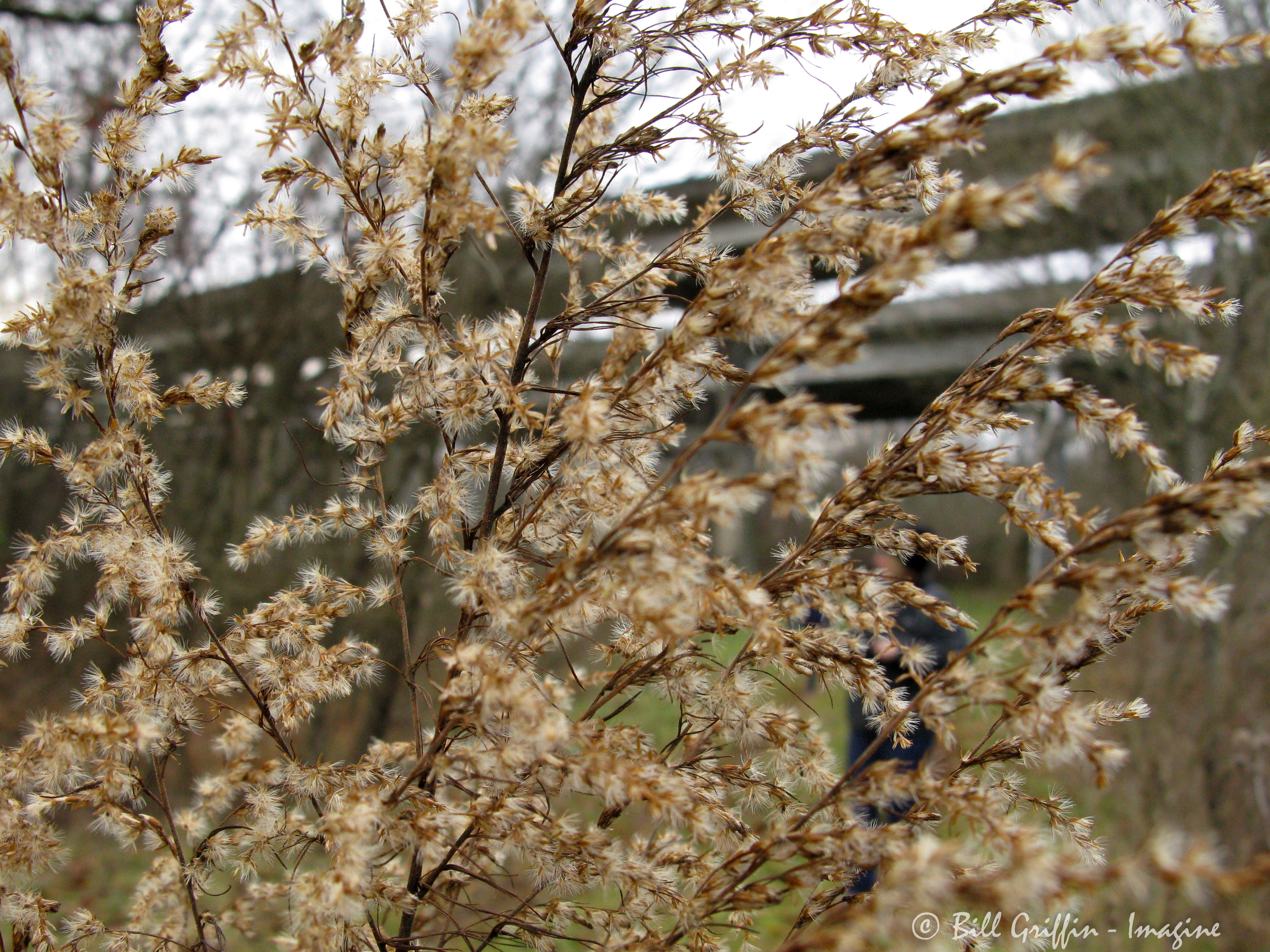
Meadow, borders, understory, they draw us right in. Just a month ago these pale bristles, fuzzballs, and tufts  were brightly hued racemes, cymes, and corymbs. So inviting. Now begging for dispersal. I let my hand cup a stem and run up over the feathery head. I examine my palm – dozens of tiny seedlets, each with its stiff barbule. My, my — Josh just happens to have a sheaf of miniature brown envelopes in his shirt pocket. He hands me one and I dribble my catch into it. How many different species of goldenrod and aster? And we still have an entire little prairie to traverse.
 . 
A month after last April’s tornado crossed our neighborhood, after the cherry picker and chainsaws had gone home, after the ‘dozer had pushed two-ton trunks and root balls to the edge of our property past the Duke Energy cut, I imagined that the bare clay and churned up leaf mold would wait for winter, barren, when I could sow the half-acre with something new. But this summer the exposed earth received something it had patiently waited decades for. Sunlight. This fall the slope is a jostling upright congregation of pilewort and poke, and knee deep in damnable invasive stilt grass.
 . 
Best get to it. It’s a lot of square meters, but I have a fire rake and a 5-pound hazelhoe I use for trail workdays. And on the screened porch I have a bag of bags, cold stratifying, waiting for January and a smooth, raked bed: native silver plume grass, big bluestem, Indian grass my friend Joe gathered from his meadow on the Mitchell River; wingstem, crownbeard, ironweed I’ve been pulling during hikes along the MST; store-bought half-kilos of Southeast Wildflowers; and a little miniature brown envelope, stuffed full, and hand-labeled “Duke Mix.”
 . 
 . 
❦ ❦ ❦
 . 
Two Poems From School
1. Drawing Horses
 . 
There was one slow girl from grade two
And three, unable to multiplicate, ill-
At-ease, and long to devise, who tried
But tired of her dull and daily work,
Turned the smudge of your yellow page off
And began to draw horses.
 . 
Riderless, stream of those great manes back,
her horses rode out of no course but gladly off
The end of every page to the end of every class.
 . 
And when that girl died in a white hospital
Kicked by no horse but the one deep inside
Galloping over her frail, fourth grade hide,
I though I would try drawing horses. But I,
I was no good.
 . 
So girl, who never learned much from school
But taught me a daily grace in the movement
Of horses, these are for you.
 . 
Bob Wickless
from The Secret Care the World Takes, The Orchard Street Press, Gates Mills, OH, © 2023
 . 
❦ ❦ ❦
 . 
When Bob Wickless signed my copy of The Secret Care the World Takes, he noted that while we have never met in person we share three things in common: poetry; North Carolina; the editorial generosity of Jack Kristofco at The Orchard Street Press. And a fourth thing – a year ago I featured Bob’s poem Prayer in Spring in another post extolling the wonders of native “weeds.”
 . 
Bob is from Maryland and has “held many jobs” in his lifetime, but he wisely retired to Reidsville NC to reside in “the writingest state.” Secret Care takes seriously the creative task of reminding us of what we all share in common. Bob leads his characters by the hand, introduces them to us, places our hand in theirs and waits quietly while we gaze into each other’s eyes. That tender connection may be wistful, it may be sad, but there is also humor in these poems. Laughter. Joy.
 . 
In the end may we become convinced that the World does care for us. Perhaps we may feel the tug to care also for the World and what it contains, what it nurtures, what it brings forth. Through the magic of poetry, this care is no longer secret.
 . 
 . 
Check out The Orchard Street Press, its annual contest and anthology, Quiet Diamonds, and order Bob Wickless’s book HERE
 . 
 . 
❦ ❦ ❦
 . 
Solstice: The Children’s Ward
 . 
The secret care the world takes
Has pressed closed all the petals
Of tiny summer flowers
As if darkness might infuse
Those dying colors
With some thing they did not mean,
Some statement thy did not possess,
Some dream they could never intend.
 . 
It is in the same way rain,
Or even the thought of rain
Oncoming, turns up a maple’s leaves
Like fragile buckets –
Or a whole forest of maples,
A hundred, thousand, children’s hands
Raised in anticipation
Of the sky’s sweet promise.
 . 
And it is evident, too, the easy way
You breathe, so effortlessly in sleep,
How your small, secret bodies know,
Always, exactly what is required
Of this world and the next
To simply sleep
A sleep simple enough
To trust all your flowers to love.
 . 
Bob Wickless
from The Secret Care the World Takes, The Orchard Street Press, Gates Mills, OH, © 2023
 . 
 , 
❦ ❦ ❦
 . 
 . 

Read Full Post »

« Newer Posts - Older Posts »