Feeds:
Posts
Comments

Archive for the ‘Photography’ Category


[poems by Joyce Compton Brown and Billy]

Happy Birthday to Me!

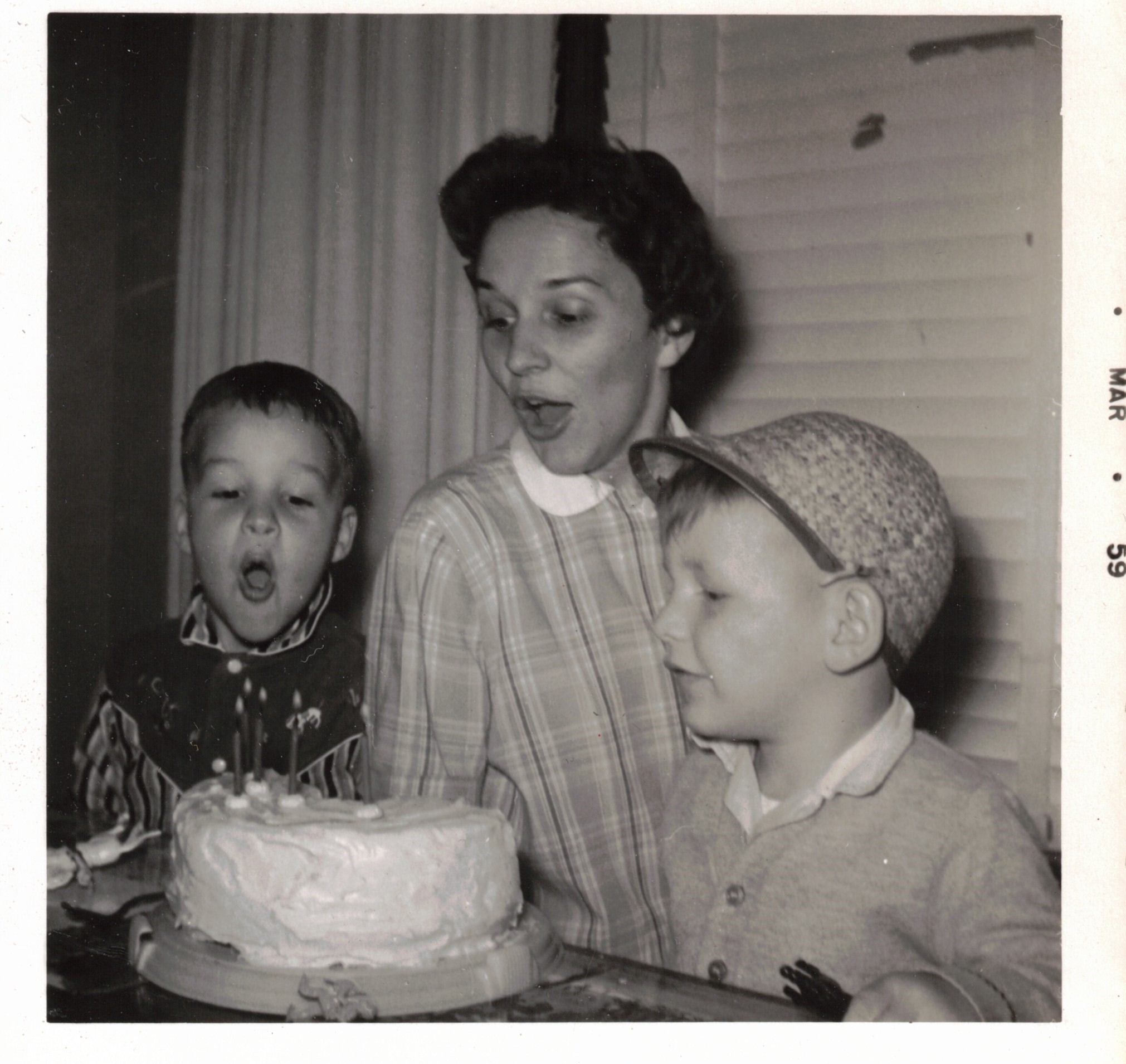
Yep, February 11, this is my day. Sixty-nine years ago my Mom was probably feeling the Niagara rumble from her birthing bed on the umpteenth floor of St. Mary’s. On the American side of the Falls, if you were wondering. Name already picked out – Eugene Wilson the Third – but already in use by Dad and Granddaddy so nickname picked out as well – Billy.

In a few years Mom and Dad moved back down south – Memphis, this time – then over the next ten years to Delaware, Michigan, finally Ohio, but never back to their home state of North Carolina. “Here’s to the land of the Long-Leaf Pine, a summer land where the sun doth shine.” Linda and I moved to NC a week after our wedding – to Durham, Duke Med – and held a place for them here. Just in case.

It’s a good thing. Ten years ago Mom and Dad at last resettled near us, Winston-Salem, where Mom grew up and went to Reynold’s High. They’re right across the street from historic Old Salem. I visited yesterday (secretly hoping there might be cake and candles – Birthday Party #1-of-many). Today I’m expecting Margaret and Bert (4) from Raleigh. Maybe tomorrow Saul (13) and Amelia (6) from across just around the corner. Maybe more cake?

So what do I actually want for my birthday? In Russia I’d have a pie with my name in the crust; in China a longevity noodle that fills the entire bowl (with scallions & bok choy); Hungarians would pull my earlobes (69 times); Jamaicans would dust me with flour.

All those sound awesome, but no, don’t bring presents. I have a walk in the woods with Linda planned. I have Grandkids to wear me out and make me laugh. We have the Blue Ridge with its arms spread to hold us here, not saying much, not needing to. Trees and mountains, family, homeplace – happy birthday to me!

.     .     .     .     .     .     .
.     .     .     .     .     .     .

Looking Across

the fog shuffles
++++ within
++++ ++ the folded mountain

whispers
++++ old stories
++++ ++ of before we were

Joyce Compton Brown
++++ from Standing on the Outcrop, Redhawk Publications, © 2021

.     .     .     .     .     .     .

I’ve heard Joyce Compton Brown read her poetry at many a gathering and my admiration still grows and grows. There is a treasure of different voices in this collection from Redhawk, Standing on the Outcrop, but they all have in common their deeply felt truth, authentic as hunger and earth. These are rural voices, Southern voices, mountain voices, mostly from the first half of the twentieth century; they are telling urgent stories in danger of being lost if Joyce does not hear them and reveal them to us. Places, history, personal struggle, hard-won triumph — these are Joyce Brown’s specialties and she here treats them well.


.     .     .     .     .     .     .

Mattie, 1955

Before our families came
++++ there wasn’t much.
They say there were some old forts,
++++ and arrowheads
the men turned up
++++ in the plowing.
We mad collections,
++++ sent them to school
++++ ++++ for the kids to show.

They say these pastures
++++ were good hunting grounds,
And I don’t wonder,
++++ look at this land, these two mountains –
Linville, with its craggy top, Honeycutt
++++ folding on up toward the highlands,
this river, the clearest water.
++++ Any living thing would be drawn
++++ ++++ to this valley.

they say the Catawba and Cherokee fought
++++ over it till we came.
Then they fought us.
++++ It was perfect for these farms.
You can still see,
++++ those big old white houses
from before the land got too divided
++++ and people had to find work.

They say it had a name,
++++ Conasaga, an Indian word
for beautiful valley.
++++ That may just be talk.
But we use the name
++++ for our cookbook, and the kids use it
for their school yearbooks.
++++ They like the way it sounds.

Joyce Compton Brown
++++ from Standing on the Outcrop, Redhawk Publications, © 2021


.     .     .     .     .     .     .
Stroke

Afterwards he was free
to speak a new language,
come back to tell them all.

They strained to understand
to interpret his assertions
to feel his newfound power.

He told them how
he’d hated factory saws
the whine of lathe and blade

Told them how
the smoldering glow
held by tight-closed lips

kept him from
trying to tell
what they didn’t

want to hear.
How he’d loved
his fingers shuffling

guitar strings
that flatpick style
speaking its own sad voice

milking the cow
in his own sweet barn
before everybody else was up

They couldn’t see
the fiery tongue
above his head.

They couldn’t feel
the pyretic fury
in his mind.

But now he was
at center, felt the
glow from lips of fire,

felt the heat
in seething brain,
felt the gift

of flaming tongue,
watched them all
leaning inward.

Joyce Compton Brown
++++ from Standing on the Outcrop, Redhawk Publications, © 2021


.     .     .     .     .     .     .


.     .     .     .     .     .     .

I’ll close my Birth Day post with a poem I wrote almost 20 years ago. Oldest son, first grandson, I was always the good boy. Never got into trouble (or at least never got caught). High school class pres. Early admissions, graduations with honors. Married my high school honey and we’re still best buds.

(Although when we were college Juniors and told my parents we wanted to get married, my Mom said, “Oh thank goodness, I’m so glad you didn’t decide to run off and live in a commune!” I guess maybe my hair was a little on the long side that year.)

Being the eternal good boy might become a burden – especially when one knows full well that one is not nearly as good as everyone makes out. (But anyway I prefer, Linda too, the silence of a forest to the company of people – no dang commune for this good boy.)

.     .     .     .     .     .     .

Good Boy Turns 50
++++ “I ain’t no physicist, but I knows what matters.” – Popeye

How did he earn this golden sobriquet
first christened by Nana for the merest trait
of being born the first grandchild, the grinning gay
toddler who could do no wrong? And wait,
how did he keep it all through the sixties when
pick up your toys and set the table gave way
to a ponytail and poems by Ho Chi Minh
(though there was no doubt he’d still bring home the A)?
Forever the glass-half-full sort of guy,
in marriage, too, he hefts vows more abundant
than Old Fred’s prescription, “Don’t leave and don’t die” –
the grace of wanting to want what she may want.
++++ So let’s give him what he needs in the next fifty
++++ if he ever discovers what that might be.

Bill Griffin
++++ first appeared in Pinesong, annual anthology of the NC Poetry Society;
++++ ++++ first place in the “formal poetry” category, 2004
++++ collected in Crossing the River, Main Street Rag Publishing, © 2017


.     .     .     .     .     .     .

.     .     .     .     .     .     .

Read Full Post »

[poems by Kathleen Wakefield]

A slew of 35 degree days and 20 degree nights make the rare and lovely snow hard as a skillet and slick as spilt grease (olive oil in my case). Our favorite trails want to maim us. I tried walking down the ridge back of our house and made it about twenty yards before I realized just one slip and I’d be sliding on my butt all the way into Dutchman Creek. When I turned back uphill I couldn’t take a step. My trekking poles wouldn’t pierce the crust.

Yesterday I ventured back to Grassy Creek and the MST for the first time in two weeks. Shaded areas were crunchy and slippy but sunkissed slopes had cleared. As I hiked I was specifically looking for leaves poking through the snow to photograph: cranefly orchid, wild ginger, pipsissewa. And then I came upon eight little alien life forms such as I’d never seen.

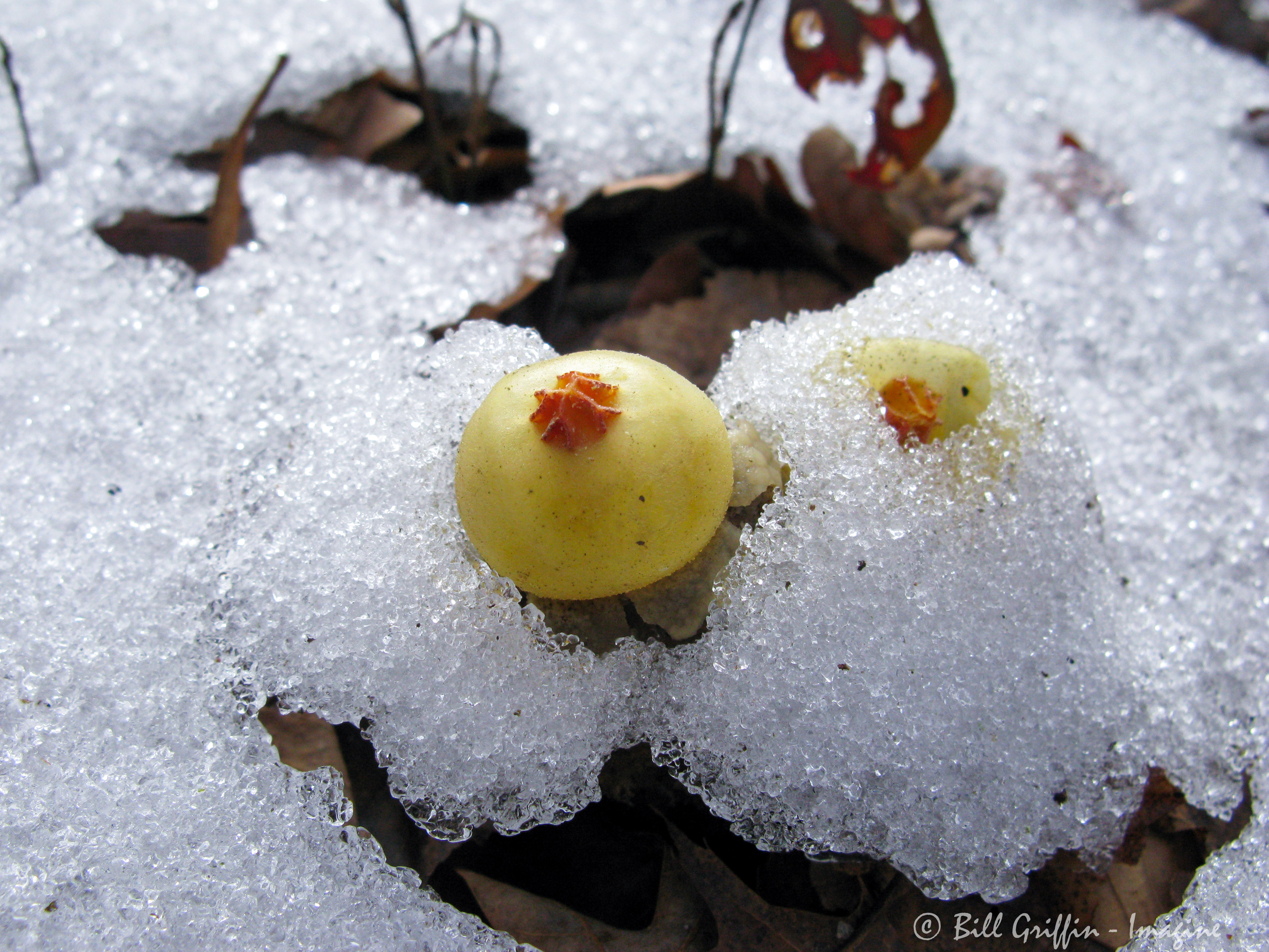
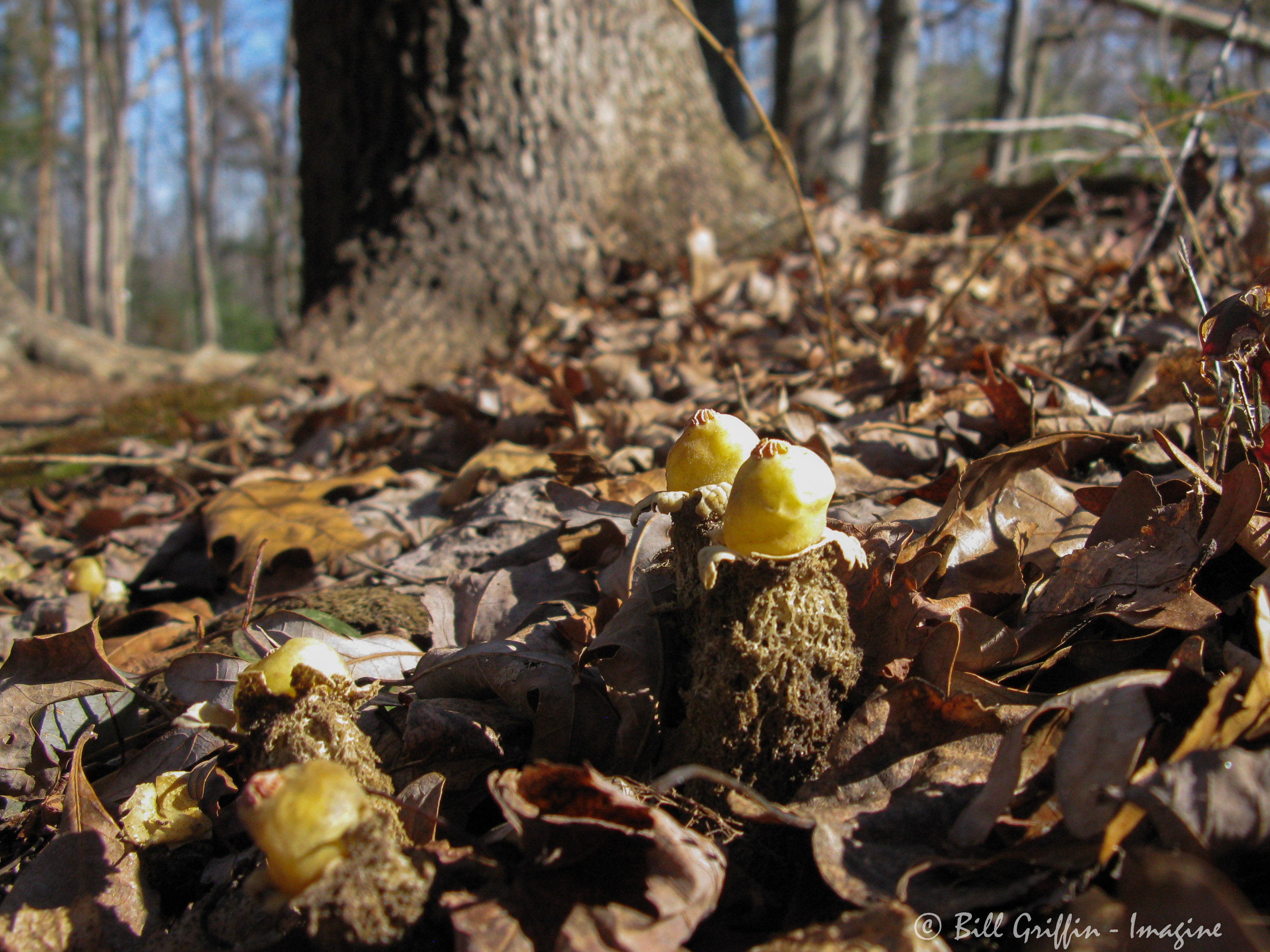
Imagine a thumb-sized lemon cupcake with a beak of orange icing in the center. The cupcake papers peel back to make a grungy collar. Each little cakelet is elevated on a 3 inch tangled stalk like chewed up rutabaga or moldy hemp. One of the cupcakes is broken and oozing white custard. And they are all peering through the snowy crust as if they intend to take over this dormant and unsuspecting planet.

I figured weird looking = fungus. After much searching I learned their identities – Calostoma lutrescens. Yellow-stalked puffball (not actually in the same clade as true puffballs), “pretty mouth,” or “hot lips.” Listed as common in the Southern Appalachians. Shoot, thought I’d found something new and rare. On the other hand there was only this one little cluster of eight fruits in four miles of trail; their little cupcakes will no doubt dry, shrivel, and disappear within a few days; I’d certainly never seen anything like them before.

Common does not preclude rare. Old they are, but new to me.

.     .     .     .     .     .     .

Why We Do Not Cut the Meadow Down

It establishes itself like the sea.
We ride its swells.
Two kinds of dragonfly, cobalt and crimson,
a pair of catbirds, orioles skim the tops of the grasses,
insect glints, multitudes unnamed.

Once it was an orchard, a woods,
before that a real sea that left us a lake.
Today the dry meadow is all fire and pulse –
hot sputter of crickets, bees cruising the nightshade,
the wings of a small white butterfly dipping at this and that,
yes and yes above the brasses where light assembles.

The meadow admits stray saplings, cottonwood and ash.
Opens to rain like a body full of desire.
The fringed flags of the grasses take note of
the least wind: when you think it’s still
a cloud of pollen swells and lifts.

The meadow does not mistake the seed –
scutcheoned, tasseled or winged – for anything else
Whatever comes into the meadow, earthworm, black beetle, ant,
feels the long fall of sunlight on its back
before it descends.

Kathleen Wakefield
+++ from Grip, Give and Sway, Silver Birch Press, © 2016

.     .     .     .     .     .     .

Reverent. Grateful. Seeking. The poems in Kathleen Wakefield’s Grip, Give and Sway require attention from the reader but they hold nothing back. Their beauty bewitches but also unsettles, like dawn when the dark forest holds its breath and anticipates light. Gradually the shapes of trees arise. I found myself reading each poem twice, then again, to take in everything it wanted to impart.

Each of the book’s four sections has its own subtle voice: imagistic and deeply rooted, lyrical and lingering on the tongue, lightly touching the moment to make it universal. In the final section the invisible stenographer observes and records the millennia and their follies but sometimes forsakes her reserve and becomes a participant. This is a book that inspires both deep feeling and deep thought, that invites contemplation about what is within us and what is without us.

.     .     .     .     .     .     .

The Invisible Stenographer Tries Not to Look in the Mirror

What would she see –
++++ ++++ ++++ transparency
of oxygen, or eyes smudged with kohl?

Head-binding wimple.
++++ ++++ ++++ Sky blue burkha.
Iron brank tearing into the tongue
which said too much.

A cat mask, candle-lit, trimmed
with gold sequins and feathers
++++ ++++ the color of a bishop’s robe.

Hematite lips, lips drawn in rose madder;
cheeks ash streaked; tattooed;
++++ white powdered, porcelain smooth

++++ A single pearl drop earring
dangling above a creamy ruff
++++ ++ of belgian lace
stained from centuries of use.

Is everything she sees
who she is?
++++ Why not a coiled forest of dreadlocks,
or the shapeliness of a head
shaved to the cool shine of the moon?

Or worry crossing a woman’s brow
++++ like cloud shadow troubling a wheatfield,
as if she were remembering a stove
on at thome, the child left
too long alone.

Kathleen Wakefield
+++ from Grip, Give and Sway, Silver Birch Press, © 2016

.     .     .     .     .     .     .

Rumors

All night the bee that’s clung
++++ to the sunflower, dark as
++++ ++++ coffee, waits for the sun

to warm its stilled apparatus,
++++ one leg ticking like the hand of a tiny clock
++++ ++++ that can’t get started.

See how the morning glories,
++++ like closed umbrellas glazed
++++ ++++ with rain, open in the cool air

to cobalt cups of heaven
++++ or the idea of heaven, gone
++++ ++++ by noon. The wood thrush

I’ve never seen repeats
++++ last night’s song, trill and lick
++++ ++++ spilling from the flute of its throat

as if it knows a rigorous joy,
++++ as if the world’s consolable.
++++ ++++ Blue sky, clear and widened

like a mind that’s looked into itself and beyond,
++++ is this what we fear, or long for?
++++ ++++ Caught

in the undertow of the linden’s shade,
++++ rumors of something sweet and light
++++ ++++ and never forgotten.

Kathleen Wakefield
+++ from Grip, Give and Sway, Silver Birch Press, © 2016

.     .     .     .     .     .     .

.     .     .     .     .     .     .
I learned about Kathleen Wakefield and her poetry through her friend Patricia Hooper, also featured in these pages. She has worked as a poet-in-the-schools and taught creative writing at the Eastman School of Music and University of Rochester.

Give, Grip and Sway and Silver Birch Press.

More about the Calostoma genus, which includes the irresistibly named and undeniably repugnant “tomato-in-aspic” fungus.


.     .     .     .     .     .     .

IMG_0768


Read Full Post »

[with poems by Augusta Wray]

1932, Charlotte, North Carolina – the Great Depression has all but silenced the constant rumble of railcars from Atlanta to D.C. through this hub of the South. Most of the cotton mills are shuttered but Ben Gossett, president of Chadwick-Hoskins, has an idea. He asks President Herbert Hoover for help. Mill workers will weave cloth from 50,000 bales of cotton sitting in idled factories and sew it into clothing for the needy. Slowly the Queen City will again stir to life.

That same year, 1932, The Charlotte Symphony Orchestra was founded. More songs were recorded in Charlotte than in Nashville (and just 4 years later Bill Monroe would make his first recording in a closed Charlotte warehouse). Seeking a different kind of music, six poets gathered that spring in the home of Edna Wilcox Talley to begin a venture dedicated to expanding the appreciation of poetry in their state. The North Carolina Poetry Society would begin to admit members whose skills “measured up.” Over the next few years they would hold monthly workshops and an annual banquet, with a prominent writer as speaker, begin publication of a regional literary journal, and slowly expand their reach from Charlotte to the entirety of the state and beyond.

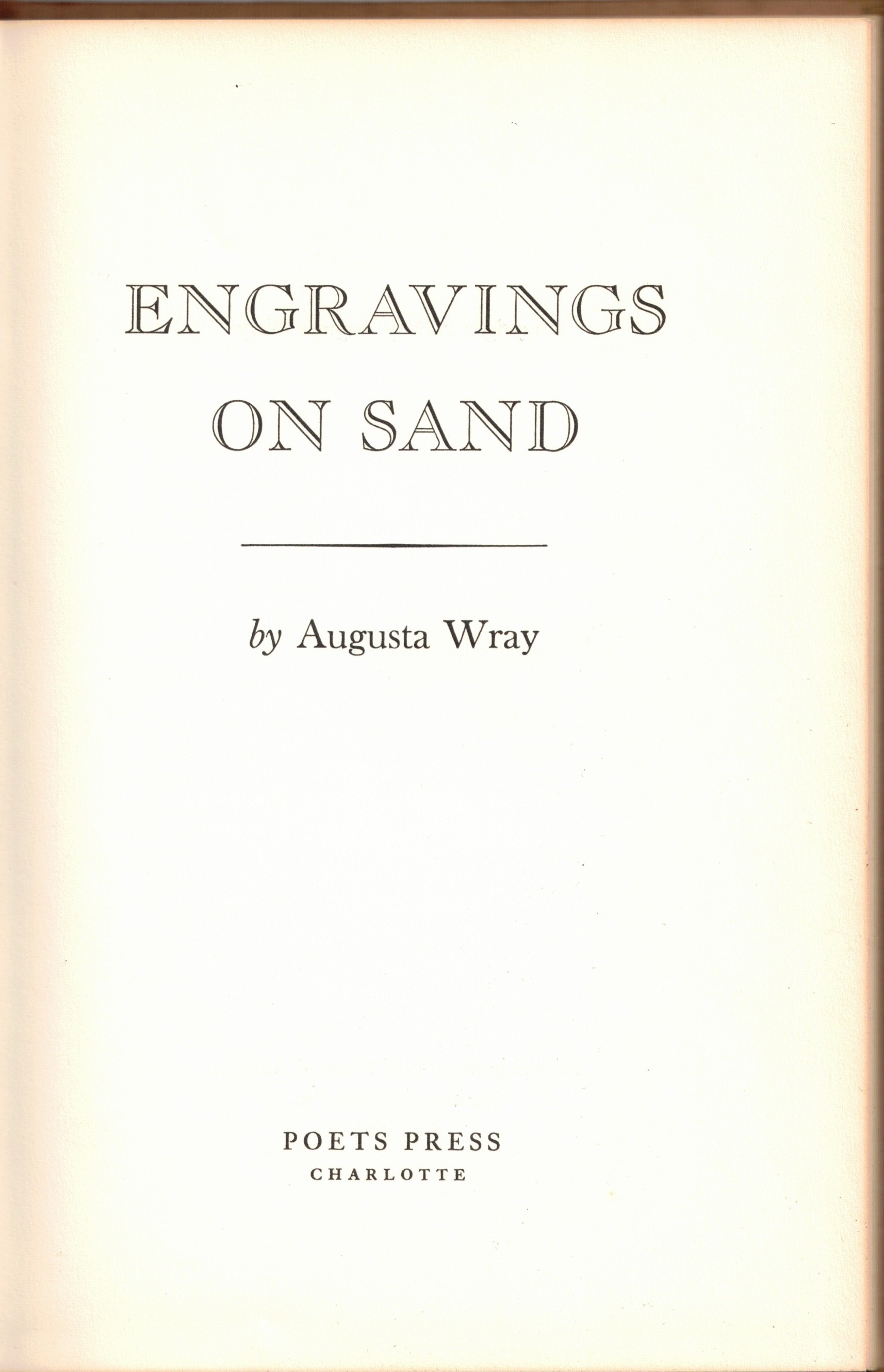
One of these Charter Members was August Wray. She had lived in Charlotte since her marriage in 1902. She attended every meeting of the NCPS through the 1950’s. Her poems would appear in The North Carolina Poetry Review, Journal of American Poetry, and many other publications, especially the poetry column of The Charlotte Observer, edited by Andrew Hewitt. She won many poetry honors and prizes in the 1930’s and 1940’s. And in 1959 she would publish a full length collection, Engravings on Sand, edited by Dorothy Edwards Summerrow.

.     .    .     .     .     .     .

Trees at Night

Ink spots upon a midnight sky – fantastic,
+++ sinister and dark –
At night, trees take on fearsome shapes
+++ with no detail of leaf or bark
To add to grace of swaying limb where
+++ branches curve and intertwine,
No carven foliage of jade – all monotone
+++ in black design,

Carbon pictures, weird and ghostly, of night
+++ Dragons crouched to spring,
Warily silent and foreboding, menacing,
+++ like a wounded thing –
Smoky masses, deeply shadowed, with outlines blurred
+++ that mystify –
Trees clutch the heart in night’s dark silence
+++ silhouetted against the sky.

Augusta Wray
+++ from Engravings on Sand, Poets Press, Charlotte NC, © 1959

.     .    .     .     .     .     .


Last week I received Engravings on Sand in the mail. Bibliophile Carmela Dodd discovered it at a flea market and upon reading its inscription by Augusta Wray to “Mrs. Charles Evans,” Carmela felt that the book deserved a home with the North Carolina Poetry Society. Thank you, Carmela! What an amazing artifact and memorial during the Society’s 90th anniversary year.

Dorothy Edwards Summerrow, who edited the collection, writes this to begin her foreward: When, at Augusta Wray’s request, I was given the pleasure of compiling and editing “Engravings on Sand,” there was turned over to me a large suitcase literally bulging with poetry manuscript. Dorothy describes excitement but also dismay at selecting the best work of one of North Carolina’s finest poets . . . because I must of necessity select for public inspection, only a small fraction of the prodigious output of her private heart.

In 1959 Augusta Wray was 83 years old. She had been widowed four years earlier. She and her husband had no children nor other close family; she told Dorothy, “My poems are my children.” Dorothy describes the treasure before her: When I opened the suitcase entrusted to me, the sparkle of the poems made the dark, rainy afternoon brilliant with the fire of many gems.

.     .    .     .     .     .     .

Release

In the dark and tranquil stillness of the night
When quietude has simulated peace,
When joy is born without the aid of light
And sorrows softly fade away and cease,
When weary eyes are drifting into sleep
That carries them afar from day’s dull care,
When dreams appear invitingly to seep
Through all perplexities and leave them bare –
Then does the spirit take command and things
Become unreal and float away like foam;
The soul is loosed and on unweary wings
takes leave of what was once its mortal home.
++ The soul and body separate, go free,
++ When sleep, or death, gives them their liberty.

Augusta Wray
+++ from Engravings on Sand

.     .    .     .     .     .     .

Nocturne in Silver

Silver shadows in somber silence
Wrap folds around the tranquil night,
Silver rain from a silver moon
Pours its radiance through silver light.

Sleeping leaves from moon-drenched branches
Drip silver pendants edged with pearl,
Flowers with their petals closing
Gleam with silver as the furl.

Cobwebs, silver-strewn with dewdrops,
Chiming tone when brushed by moth wings,
Are silken harps, tht quivering, make
Plaintive music from silver strings.

Augusta Wray
+++ from Engravings on Sand

.     .    .     .     .     .     .

The seasons . . . love . . . death . . . these are the themes of most of Augusta Wray’s collected poems. She is steeped in Carolina culture and climes. In this final poem I’ve chosen, though, I hear an understated voice of longing and regret. Perhaps she refers here to her childlessness, but perhaps she is opening herself, and her readers, to discovering beauty in the reality that is her life – who cares what it may have seemed to some to lack?

Flowering Plum

In loveliness she stands,
Blonde beauty rare,
With white and fragile hands
Folded in prayer.

Of bridal purity,
A perfumed veil
Hides with security
A body frail.

The season waits for her,
She blooms each year
When winds softly murmur:
“Spring is now here.”

Feathered choristers sing
Blithely and loud,
Sheltered beneath the wing
Of petaled cloud..

Lonely she stand apart,
No fruit she bears.
Such beauty serves the heart.
Barren? . . . Who cares?

Augusta Wray
+++ from Engravings on Sand

.     .    .     .     .     .     .

Dorothy Edwards Summerrow was a renowned Carolina poet herself, winner in 1957 of the Roanoke-Chowan Award for Poetry. She also noted in the foreward: In Silver Echoes, the poetry anthology published in the spring of 1959 by the North Carolina Federation and edited and compiled by this editor, more of [Augusta Wray’s] poetry is included that that of any other writer in the state.

.     .    .     .     .     .     .

History of the North Carolina Poetry Society

Charlotte / Mecklenburg historical timeline

Roanoke-Chowan Award for Poetry

2015-06-15Doughton Park Tree

Read Full Post »

« Newer Posts - Older Posts »