Archive for the ‘music’ Category
Ear Worm #1A
Posted in family, music, tagged Bill Griffin, Dorianne Laux, Duet, Jacar Press, Joseph Millar, NC Poets, poetry, Southern writing on August 16, 2024| 11 Comments »
.
[with poems from Duet by Dorianne Laux and Joseph Millar]
.
Listening to Paul Simon
.
Such a brave generation.
We marched onto the streets
in our T-shirts and jeans, holding
the hand of the stranger next to us
with a trust I can’t summon now,
our voices raised in song.
Our rooms were lit by candlelight,
wax dripping on the table, then
onto the floor, leaving dusty
starbursts we’d pop off
with the edge of a butter knife
when it was time to move.
But before we packed and drove
into the middle of our lives
we watched the leaves outside
the window shift in the wind
and listened to Paul Simon,
his tindery voice, then fell back
into our solitude, leveled our eyes
on the American horizon
that promised us everything
and knew it was never true:
smoke and cinders, insubstantial
as fingerprints on glass.
It isn’t easy to give up hope,
to escape a dream. We shed
our clothes and cut our hair,
our former beauty piled at our feet.
And still the music lived inside us,
whole worlds unmaking us in the dark,
so that sleeping and waking we heard
the train’s distant whistle, steel
trestles shivering across the land
that was still our in our bones and hearts,
its lone headlamp searching the weedy
stockyards, the damp, gray rags of fog.
.
Dorianne Laux and Joseph Millar
from Duet, Jacar Press, Durham, NC; © 2016
.
❦ ❦ ❦
.
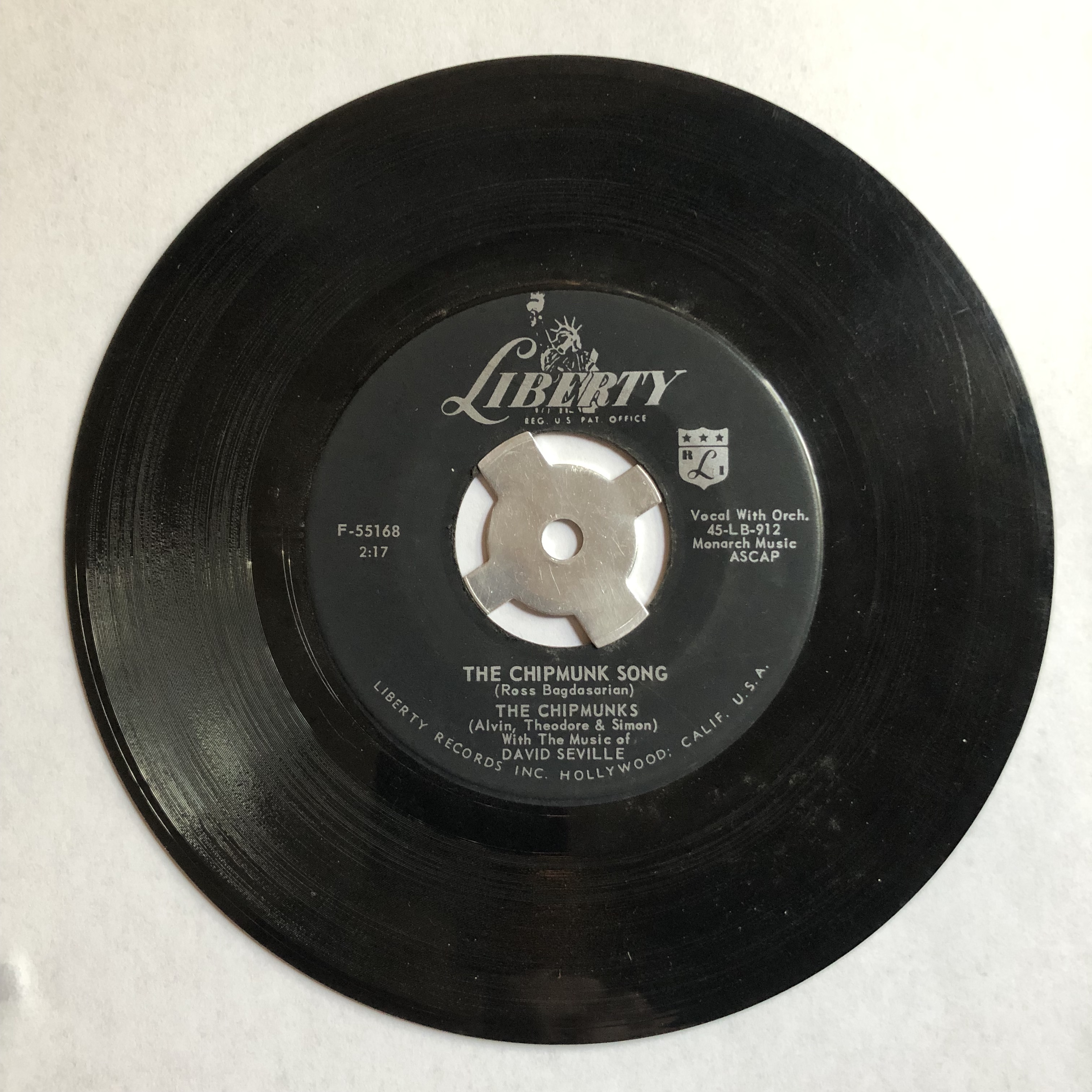
Here I am again, six years old this time, sitting cross-legged on the floor beside the pinnacle of 1959 technology. I wind it up, carefully lay the 6-inch plastic disc on the little turntable (it’s bright yellow plastic, I will never forget that), and position the needle at the outer groove. The wind-up box is white and red and has a picture of Mickey Mouse grinning; it looks like Mickey’s arm is what holds the stylus. The needle itself juts from a hollow flat cylinder, sort of like a tuna can with perforations; the little holes are what transmit the sound. No electronics, no electricity involved.
.
I push a lever and the disk begins to rotate. The needle finds its groove (at least a decade before finding one’s groove will mean anything to me) and in between all the scratches from a hundred earlier renditions – music! The little record finishes, I lift the needle from where it’s begun making little whump whump sounds with each revolution, I place the needle back at groove one, and it starts all over again.
.
And even so my mother remained sane to her dying day.
.
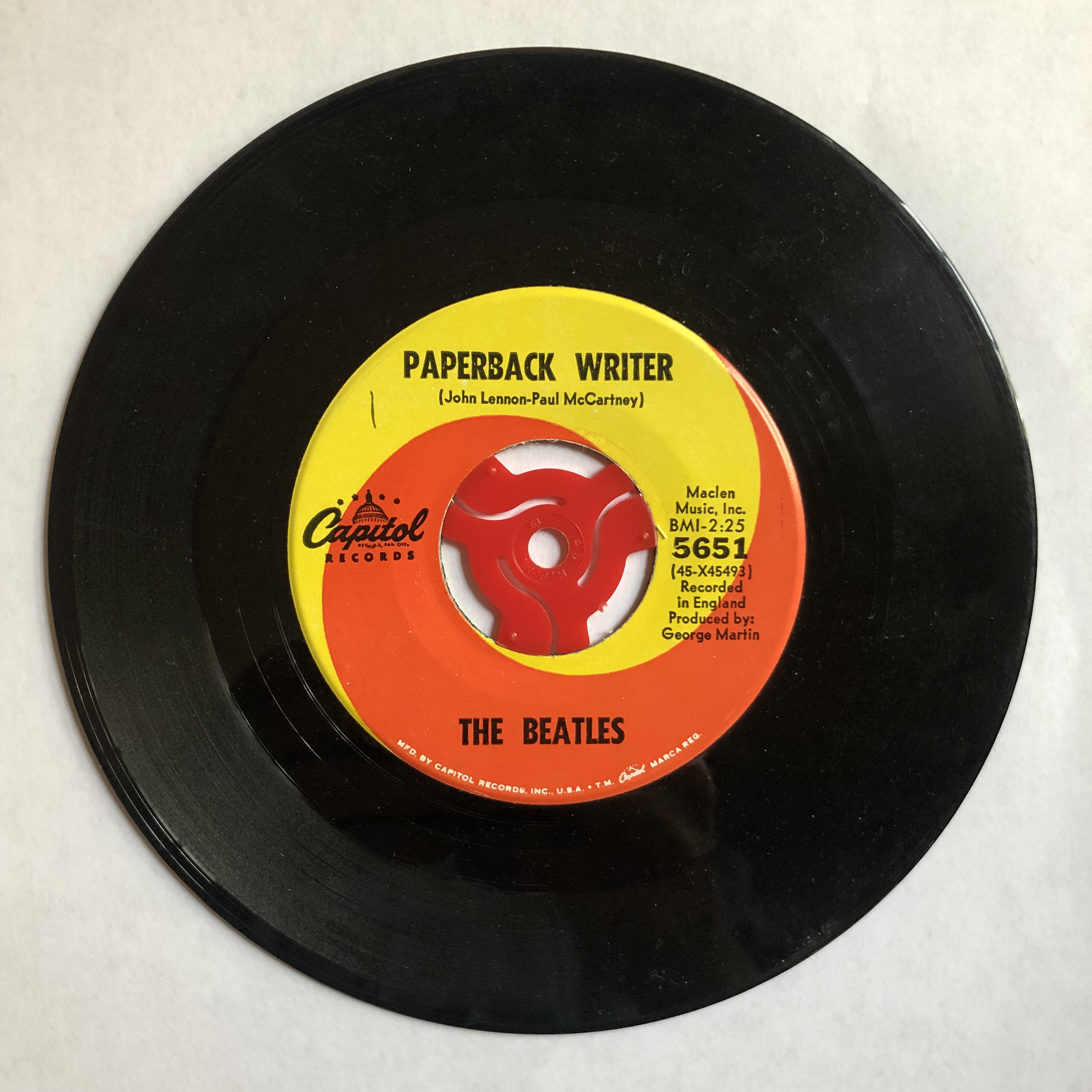
As the years passed, Mom and Dad began to let me listen to their records on the Hi-Fi (mono, not stereo; Uncle Carlyle soldered it himself). It never seemed to drive them crazy to hear Peter and the Wolf or The Music Man a dozen times a day, or even Bobby Darin singing Mack the Knife. Hard core. Finally the big day – I was 11, I had saved my birthday money, I had laid awake at night tallying which of their songs were included: I bought my first LP, Introducing . . . The Beatles.
.
Introducing . . . is an anomaly in Beatles discography. It was released by Vee-Jay Records because Capitol/EMI had farted around about agreeing to a first USA Beatles album and Vee-Jay scooped them. Apparently it was only on the market for a year or so before the suits prevailed and forced them to cease and desist. Anyhow, I listened to that vinyl disc about a thousand times before I bought Beatles ‘65. In fact, I might just go slap it on the old turntable right now. Scratches and all. Please, please me!
.

.
❦
.
And that little yellow record? Easter Parade. Sixty-five years later I still find no evidence that there has ever been such a parade, but now the melody has wormed it’s way in again: “In your Easter bonnet, with all the frills upon it . . .” And even so, my mother somehow remained sane.
.
.
❦ ❦ ❦
Mick Jagger (World Tour, 2008)
.
He stands on stage
after spot-lit stage, yowling
with his rubber mouth. If you
turn off the sound he’s
a ruminating bovine,
a baby’s face tasting his first
sour orange or spitting
spooned oatmeal out.
Rugose cheeks and beef
jerky jowls, shrubby hair
waxed, roughed up, arms
slung dome-ward, twisted
branches of a tough tree, knees
stomping high as his sunken chest.
Oddities aside, he’s a hybrid
of stamina and slouch,
tummy pooch, pouches under
his famous invasive rolling eyes.
He flutters like the pages
of a dirty book, doing
the sombrero dance, rocking
the microphone’s
round black foot, one hand
gripping the skinny metal rod,
the other pumping its victory fist
like he’s flushing a chain toilet.
Old as the moon and sleek
as a puma circling the herd.
The vein in this forehead
pops. His hands drop into fists.
he bows like a beggar then rises
like a monarch. Sir Mick,
our bony ruler. Jagger, slumping
off stage shining with sweat.
O please don’t die. Not now,
not ever, not yet.
.
Dorianne Laux and Joseph Millar
from Duet, Jacar Press, Durham, NC; © 2016
.
.
❦ ❦ ❦
.
Uno Voce – when Sandy Beam rehearsed an a capella selection, he required us to blend our tone with each person singing near us until it was as if we all sang with one voice. Vibrato is anathema; sibilance is sin! Of course, Sandy would have been happiest if we had all been boy sopranos, but at least we could strive for that brilliant transparent evocation of light he desired.
.
Light and truth evoked by a single voice – not at all unlike these poems in Duet. They are each about music – Bo Diddley, Lightnin’ Hopkins, Paul Simon, James Taylor, Ladysmith Black Mambazo, Cher. They build a portrait in layers of color, tone, and years, filled with the music that infuses our past and vibrates in our bones to create our present. And they are written by the duet of Dorianne Laux and Joseph Millar, but the tones and melodies blend until we readers hear a single voice.
.
Not an ear worm in the bunch.
.
❦
.
Duet is one in the continuation of the Greatest Hits Series, originally conceived by editor Jennifer Bosveld at Pudding House Press in 2000 and acquired by Sammy Greenspan of Kattywampus Press in 2010. Jacar Press was asked to take over the series under the careful eye of series editor David Rigsbee in 2017. More about the book, the Series, and Jacar Press HERE
.
.
❦ ❦ ❦
.
.
.
❦ ❦ ❦
.
.
.
The Way Home
Posted in family, music, Photography, poetry, tagged An American Sunrise, Bill Griffin, family, imagery, Joy Harjo, nature, nature photography, poetry on May 3, 2024| 10 Comments »
.
[with 3 poems by Joy Harjo]
.
And the blessing began a graceful moving through the grasses of time, from the beginning, to the circling around place of time, always moving, always
++++++++ from Bless This Land, Joy Harjo
.
❦
.
The Story Wheel
.
I leave you to your ceremony of grieving
Which is also of celebration
Given when an honored humble one
Leaves behind a trail of happiness
In the dark of human tribulation.
None of us is above the other
In this story of forever.
Though we follow that red road home,
one behind another.
There is a light breaking through the storm
And it is buffalo hunting weather.
There you can see your mother.
She is bus as she was ever –
She holds up a new jingle dress, for her youngest beloved daughter.
And fo her special son, a set of finely beaded gear.
All for that welcome home dance,
The most favorite of all –
when everyone finds their way back together
to dance, eat and celebrate.
And tell story after story
of how they fought and played
in the story wheel
and how no one
was every really lost at all.
.
Joy Harjo
from An American Sunrise, W. W. Norton, New York NY, © 2019
.
❦ ❦ ❦
.
Last night I sat silent on stage waiting as a few early arrivals took their seats in the audience. We singers had a few more selections to rehearse before filing out to prepare our official entrance, and for now we waited. Shouldn’t I have been anxious in anticipation of the harmonies we would soon raise together? Shouldn’t I have been thrilled as the strings took their places and began to tune their instruments? Shouldn’t joy live here?
.
No, something dark nagged me. My heart was stone. I felt suspicious of these watchers, listeners. I was afraid of their grand and thriving church. I distrusted what they would think of me if they in turn suspected I didn’t think or believe precisely as they did. I told myself I was already rejected, on the outside. I didn’t belong here.
.
Joy Harjo writes, The old Mvskoke laws outlawed the Christian religion / Because it divided the people. / . . . But Mvskoke ways are to make relatives. Where is the religion that makes relatives? People, plants, creatures, everything together as family? A religion that turns all people to face each other within the circle rather than turning them out? Linda and I had been thrashing with recent revelations that people were leaving our son’s church because one of the ministers has come out as gay. These people leaving – we thought we knew them, we considered them neighbors. We don’t understand the rejection, the turning apart. How can we understand?
.
When our chorus returns to our places before a full house, I don’t recognize many faces. But I do know a few, some from years in the past, and I remember I love them. Now lift our voices together and sing of a Creator who is always with us. We sing longing and loss, humor and fullness, songs like rivers that course and meander a long journey, that carry all the weight of time and earth. I sing. And at the end of the singing we have become one family.
.
The heart of stone has only hardened itself. Everything that lives wants to soften that heart. Everything that lives wants to open each heart to beauty and truth.
.
.
❦ ❦ ❦
.
from Exile of Memory
. . .
In the complex here there is a singing tree.
It sings of the history of the trees here.
It sings of Monahwee who stood with his warrior friends
On the overlook staring into the new town erected
By illegal residents.
It sings of the Civil War camp, the bloodied
The self-righteous, and the forsaken.
It sings of atomic power and the rise
Of banks whose spires mark
The worship places.
The final verse is always the trees.
They will remain.
. . .
When it is time to leave this place of return,
What will I say that I found here?
.
From out of the mist, a form wrestled to come forth –
It was many legged, of many arms, and sent forth thoughts of many colors.
There were deer standing near us under the parted, misted sky
As we watched, the smelled for water
Green light entered their bodies
From all leaved things they ate –
. . .
The Mvskoke laws outlawed the Christian religion
Because it divided the people.
We who are relatives of Panther, Racoon, Deer, and the other animals and winds were soon divided.
But Mvskoke ways are to make relatives.
We made a relative of Jesus, gave him a Mvskoke name
. . .
We could not see our ancestors as we climbed up
To the edge of destruction
But from the dark we felt their soft presences at the edge of our mind
And we hear their singing.
.
There is no word in this trade language, no words with enough power to hold all this we have become –
.
Joy Harjo
from An American Sunrise, W. W. Norton, New York NY, © 2019
.
❦ ❦ ❦
.
.
❦ ❦ ❦
.
An American Sunrise opens with a map of a trail of tears, that of the Muscogee Creek Nation’s forced displacement to Oklahoma from their native homelands near Talladega, Georgia in the 1830’s. One of many trails of tears. In Joy Harjo’s preface she includes this plea and blessing: May we all find the way home.
.
Toward the close of the book, Joy Harjo describes how her Great-Grandfather Monahwee could bend time. The entire book is an experience of time and place bending, fluid, circular, all connected. We hear the voices of ancestors and offspring. We hear the voices of creatures on earth and of Earth herself. We are torn by hatred and injustice – we bleed. We smell the smoke of cook fires at dawn and feel the sun on our face – we are fed. We are challenged and re-challenged to connect ourselves to the thread of life that weaves through all people and all creation and leaves nothing out. As the poet says, Nobody goes anywhere / though we are always leaving and returning. And her experiences are, as for all of us . . . the giving away to history which in no means meant giving up. For a warrior it is not possible to give up.
.
For any of us to find home, we must all find home. We must all witness cruelty and kindness in this land. From the book’s final poem, Bless This Land: Bless us, these lands, said the rememberer. These land aren’t our / lands. These lands aren’t your lands. We are this land. May the poems and the songs bring all things into our memory and show us the way.
.
❦
.
An American Sunrise, Joy Harjo; W. W. Norton & Company, New York NY © 2019. Joy Harjo served as Poet Laureate of the United States for three terms, 2019 through 2021.
.
❦ ❦ ❦
.
Beyond
.
Beyond sunrise, there is a song we follow
Beyond clouds traveling with rain humped
On their backs, lightning in their fists
Beyond the blue horizon where our ancestors
Appear bearing gifts, wrapped in blankets woven
With sun and strands of scarlet time
.
Beyond the footpaths we walk every day
From sunrise to kitchen, to work, to garden, to play
To sunset, to dark, and back
.
Beyond where the baby sleeps, her breath
A light mist of happiness making
A fine rainbow of becoming knowledgeable around us.
.
Beyond the children learning alphabets
And numbers, bent over their sticks and dolls
As they play war and family, grow human paths
.
Beyond the grandmothers and grand fathers
Their mothers and fathers, and in the marrow of their bones
To when that song was furs sung we traveled on
.
Beyond sunset, can you hear it?
The shaking of shells, the drumming of feet, the singers
Singing, all of us, all at once?
.
In the song of beyond, how deep we are –
.
Joy Harjo
from An American Sunrise, W. W. Norton, New York NY, © 2019
.
.
❦ ❦ ❦
.
.
Speaking in Tongues
Posted in Imagery, music, Photography, poetry, tagged As If She Spoke in Tongues, Bill Griffin, Kim Hayes, nature photography, NC Poets, poetry, Southern writing on December 15, 2023| 11 Comments »
.
[with 4 poems by Kim Hayes]
.
Winter Wind and Chimes
.
All this winter, the wind has moaned,
its deep modal harmonies
rolling up the valley’s throat
like a procession of monks, chanting.
And at the darkened door,
they strike the chimes –
cowled visitors
shifting restlessly, foot to foot,
on the icy steps.
.
All this winter, like metronomes,
two ghostly porch chairs
have, in unison, rocked a rhythm
for strange sulfurous chords;
invented, frenzied arpeggios;
or just one strident not repeated,
brassy as a storefront bell –
wind and chimes tangled in
an endless ensemble.
.
All this winter, she has listened,
even going out once to tie a string
around one pitchless chime,
hoping to set it better in tune.
But the wind worried loose the knot
and snatched it off.
Come spring, she thought,
I will take down these chimes.
.
All this winter, the wind has composed
for chimes and chairs and a woman
who will, on second thought,
let the wind have its way,
leave the chimes alone
to be played by softer breezes
on a warm summer day.
.
Kim Hayes
from As If She Spoke in Tongues, Grateful Steps Foundation, Asheville, NC; © 2023
.
❦ ❦ ❦
.
Technical challenge, that’s one of the reasons I love choral singing. Will I even be able to learn this tenor part with its oddball intervals and syncopation? Can I project a clear open tone all the way up to that G sharp, maybe the A? Can I keep balance & rhythm and avoid falling off the stage when the time signature flips from 6/8 to 2/2? Can I listen so perfectly to this alto standing next to me that our voices may create something beyond the sum of us two?
.
This last challenge transcends technical. In an ensemble, the emphasis is not on the individual but the communal voice. Perhaps blend and modulation are learned skills, but the birth of art is in the give and take, the sharing, the group coming together as a single organism. What a fine metaphor for poetry. Writer and reader are not performer and audience. The poet can learn craft, devise image and simile, tinker with language and rhythm, but all the poem’s music is flat until the reader breathes it in and the lines begin to sing in her heart.
.
This is the spark both music and poetry yearn to ignite: beyond technical and communal, the beauty and truth which burn into us and set us afire. Several times in this season of many rehearsals and concerts I have felt a moment’s elevation to that mysterious plateau. In a blink, the magic of notes, harmonies, lyrical language swell my heart until I can’t read the score for my tears. I couldn’t say the epiphany arises from the instruments, from the lines of verse, from the voices surrounding me – it takes life from all of these together. The music communicates its message directly to the heart.
.
The choir releases its music into the air. The poet surrenders her lines to the universe. A new language is revealed. A new voice speaks from which some ear, some mind may discover some new life never before imagined. Our spirit breathes in these vaporous things and is exalted.
.
.
❦ ❦ ❦
.
The Grandmothers
.
Thanksgiving morning,
before the sun, I wait
in the dark kitchen
for the gentle ghosts
of my grandmothers.
.
I welcome them
as I heat the oven,
feel them gathering,
like the warm aromas
of brown sugar and
cinnamon, to watch me
as I baste and bake.
.
In the drifting dust of sifted flour,
their hands guide mine:
a pinch more of this or
a little salt in the broth or
give that a stir before it sticks.
.
A I set the table, they lean in,
sighing, fingers smoothing,
lingering over each fine stitch
in the embroidered
tablecloth, handed down,
daughter to daughter;
they smile as I take out
the old rose-patterned
wedding china.
.
And so, they keep me company,
chat, chuckle and chide
all morning long as they
share my kitchen,
the grandmothers who,
by being who there were,
make me who I am.
.
Kim Hayes
from As If She Spoke in Tongues, Grateful Steps Foundation, Asheville, NC; © 2023
.
❦ ❦ ❦
.
. . . as long as she kept [her words] to herself, they were one language. Her language. It was only when she gave them up, like babies for adoption, that they slipped from her grasp and became subject to interpretation. . . . No translation was the same. No understanding was universal. The language of her words unfolded into many languages, many understandings, as if she spoke in tongues.
.
From the Author’s Note in As If She Spoke in Tongues by Kim Hayes, this is a mysterious and provoking expression of the potential and power of words. Innocent-sounding words spoken with heat might spark a conflagration. Words fumbling for meaning may yet reach their mark and forge strong bonds. Even we writers with the opportunity to pause and ponder, we who strive to select from all options the perfect words, can never know how they will be received. From this mystery rises poetry’s power to connect.
.
The poems in Kim’s collection connect in all these mysterious ways. Her poems span generations and geographies. The speaker may be obvious and defined or intentionally obscure, thereby becoming universal. We humans are not, thank all stars, telepathic. Therefore from the writer’s images and memories we must create our own imagery and resurrect our own memories. And doesn’t this surprising connection we discover within ourselves also fire a feeling of connection to the writer?
.
We cast our words into the breeze like feathered seeds and cannot know what will bloom. As in this line from Adrienne Rich, But poems are like dreams: in them you put what you don’t know you know. And these lines from Poems for Sale by Kim Hayes: a poem like a trick of the eye, / peripheral flicker – / what might or might not be, / glimpsed and gone; // I have for you today . . .
.
[Order As If She Spoke in Tongues HERE ]
.
.
❦ ❦ ❦
.
Rocks and Hard Places
.
Barefoot, I walk
on a dream road
paved with all your
rocks and hard places,
misery and discontent.
“I only had to bury him once,” you said.
“It’s the god-damned memories that won’t
stay in the ground.”
.
Sharp-honed memories like flint shards,
chiseled by every hard place
you ever knew ( and there were plenty),
stabbing themselves upward to the surface,
resurrected and designed to cut deep.
.
My feet are bleeding now.
.
But tonight, I still plan to dance
with your unearthed undead,
twirling on yet another hard place,
by bloody footprints leaving
gritty, blushing rosettes,
.
while you wait somewhere in the dark,
another rock in your hand.
.
Kim Hayes
from As If She Spoke in Tongues, Grateful Steps Foundation, Asheville, NC; © 2023
.
.
❦ ❦ ❦
.
My Heart of Stone
.
Running a thumb over
the worn and rounded edges
of this cold, found rock,
I try to think
of strength.
.
This worry stone,
gemstone,
whetstone,
pocked and veined
with sparks
of fool’s gold, cools
.
as I hold it,
no heart to part
with it today, although
I have often thought of
giving it away, until
.
feeling the pull of it,
charged, magnetic,
I always come home,
press my heart of stone
into the warm palm of
your open hand.
.
Kim Hayes
from As If She Spoke in Tongues, Grateful Steps Foundation, Asheville, NC; © 2023
.
.
❦ ❦ ❦
.
.


Lovely, uplifting for this cat lover.